The main category of Forex News.
You can use the search box below to find what you need.
[wd_asp id=1]
The main category of Forex News.
You can use the search box below to find what you need.
[wd_asp id=1]
The EURJPY pair resumed the bullish attempts, taking advantage of its repeated stability above the extra support at 169.10, reaching the previously suggested target at 171.60, to face the resistance of the main bullish channel, which forces it to form a sideways fluctuation by its rebound to 171.30.
Due to the strength of the current resistance we expect entering instability station by the contradiction of the resistance stability against the main indicators attempts to provide the positive momentum, while resuming the bullish attack requires forming new bullish wave to settle above 172.00 level, to open the way towards recording extra gains that might begin at 172.80 reaching 173.90.
The expected trading range for today is between 170.45 and 171.90
Trend forecast: Fluctuated within the bullish track
July 8, 2025 – Written by Tim Boyer
STORY LINK Pound to Dollar Forecast: Trend Bullish, but “Near-term Pullback Possible”
GBP/USD short-term technicals remain bullish/neutral according to foreign exchange forecasters at Scotiabank.
“The multi-month trend remains bullish, but we are looking to the possibility of a near-term pullback from recent multi-year highs.”
US trade developments are likely to dominate in the short term with US Administration announcements on tariffs ahead of the July 9th deadline.
ING commented; “FX markets are preparing for a noisy week on trade.”
Meanwhile, the Pound is still vulnerable on fiscal grounds. The Pound to Dollar (GBP/USD) exchange rate dipped to lows at 1.3575 before settling close to 1.3600.
UoB commented; “Overall, only a breach of the ‘strong resistance’ at 1.3750 (no change in level) would indicate that the likelihood of GBP breaking clearly below 1.3560 has faded.”
Scotiabank, however, maintains a positive underlying stance on the Pound; “We remain bullish GBP and see no reason to make changes to our longer-term forecast targeting 1.40 by year-end 2025.”
US trade developments are likely to dominate in the short term.
On Monday, President Trump is set to start releasing letters informing countries of their tariff rates while last-minute negotiations will continue.
There have, however, also ben indications that tariffs would not come into effect until August 1st which would leave time for further negotiations.
Convera senior corporate FX dealer James Kniveton commented; “Market volatility appears inevitable when the pause officially ends and new tariff levels are announced.”
Nevertheless, he added; “the impact may prove more muted this time. Unlike previous announcements where tariff levels exceeded expectations, current proposals are largely anticipated. Moreover, markets appear to be pricing in continued deadline extensions.”
According to ING; “Threats of a resumption of 50% tariff levels could briefly hit the benign risk environment, although with a market already positioned underweight the dollar, the dollar might not have too far to fall.”
MUFG noted the risk of complacency given Administration unpredictability; “The ‘Trump Always Chickens Out’ (TACO) theory is certainly part of why investors show limited concerns. Hence, there is a risk of surprise for the markets if over the coming days the tariffs prove more aggressive than expected.”

It added; “More aggressive action will likely see some milder degree of repeat of what happened in April after ‘Liberation Day’ while a more benign scenario should push US Treasury yields lower, fuel stronger speculation of Fed rate cuts that would result in moderate dollar selling.”
Overall confidence in the Pound remains fragile amid fiscal and monetary policy reservations.
Expectations of tax increases in the Autumn budget have intensified further with some reports that tax increases of £20bn would be needed in the Autumn budget to meet current fiscal rules.
UBS economist Dean Turner commented; “We learned last week that any attempt to curb spending is going to prove almost impossible for this government, even with such a large majority. This inevitably means taxes are going up. The sooner the government is honest with the public and gets the deed done, the better.”
Turner downplayed the risk of selling in the UK bond market; “For investors in the gilt market, the volatility is likely here to stay for the time being. But this does not mean gilts do not look attractive, especially relative to cash, as interest rates will be much lower by the time the government’s second anniversary comes around.”
Scotiabank still has confidence in the Pound; “We see Wednesday’s political turbulence as a short-lived event with no lasting impact, given PM Starmer’s expression of continued support for Chancellor Reeves as both the PM and Chancellor seek to reinforce their commitment to fiscal responsibility in the UK.”
International Money Transfer? Ask our resident FX expert a money transfer question or try John’s new, free, no-obligation personal service! ,where he helps every step of the way,
ensuring you get the best exchange rates on your currency requirements.
TAGS: Pound Dollar Forecasts
Copper price attempted to surpass stochastic negativity by its stability yesterday above $4.9000 level, which forms 68.00%Fibonacci correction level, to reinforce its stability within the bullish channel’s levels, extending its support to $4.8400.
Note that the continuation of the main indicator’s contradiction might push the price to provide weak sideways trading, but the bearish correctional suggestion will remain valid, depending on the stability of the barrier at $5.1000, to expect testing the bullish channel’s support, then monitor its behavior to detect the expected trend on the upcoming trading.
The expected trading range for today is between $4.8650 and $5.0000
Trend forecast: Fluctuated within the bullish track
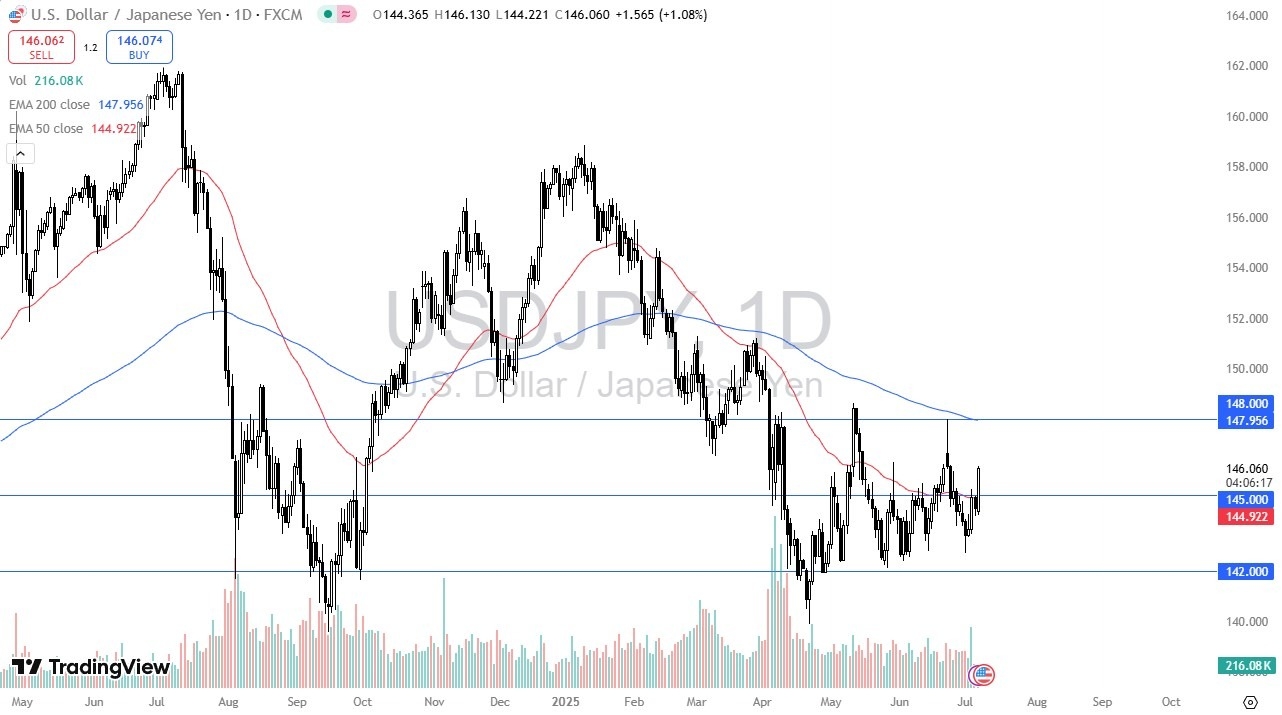
But ultimately, when you look at the price action, none of this should be a surprise because quite frankly, we have seen a lot of back and forth trading between 142 yen and 148 yen.

Ultimately, I think you have a situation where traders will continue to look at this as somewhat range bound and perhaps try to build a floor in the market as this is an area that previously had been very important also. With all of this, I think you have to look at this through the prism of just more of the same. It’s really not until we break above the 148 yen level that I think things change drastically. In that environment, then I believe that the US dollar goes looking to the 150 yen level, followed by 158 long-term.
Remember, you get paid to hang on to this pair via interest rate swap at the end of every day. And I think a lot of traders will be attracted to that in an environment that is uncertain to say the least. Rates have spiked in the U.S. as bonds have sold off. So that swap is only going to end up getting bigger at this point. The Bank of Japan, on the other hand, has its own issues with the bond market in Japan that nobody seems to be willing to bid on occasionally, which is disastrous for a currency. All things being equal, this is a market that is range bound, but I still favor the upside.
Want to trade our USD/JPY forex analysis and predictions? Here’s a list of forex brokers in Japan to check out.
Christopher Lewis has been trading Forex and has over 20 years experience in financial markets. Chris has been a regular contributor to Daily Forex since the early days of the site. He writes about Forex for several online publications, including FX Empire, Investing.com, and his own site, aptly named The Trader Guy. Chris favours technical analysis methods to identify his trades and likes to trade equity indices and commodities as well as Forex. He favours a longer-term trading style, and his trades often last for days or weeks.
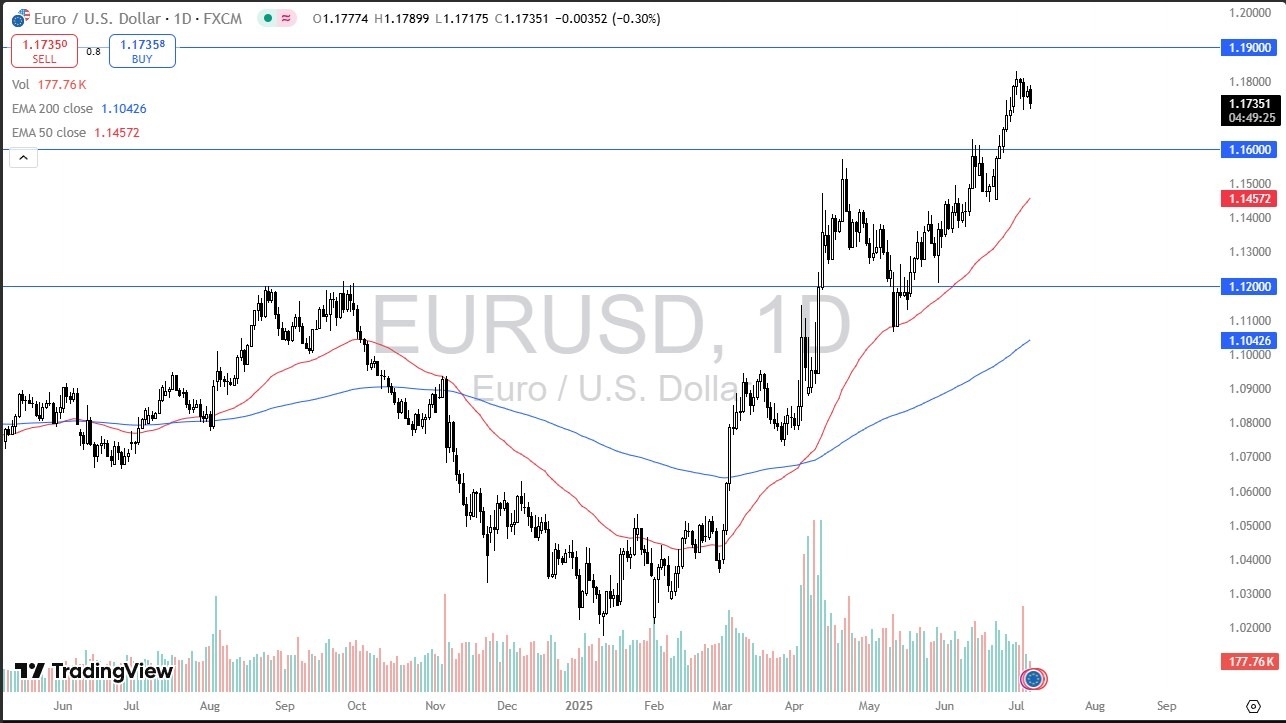
Nonetheless, this is a market that’s been bullish for a while. And I do think you have a situation where you have to look at this through the prism of just simply taking a bit of a breather.
Quite frankly, the market had been rather overdone. So, it doesn’t surprise me at all that we would see this market then perhaps try to fall in order to really see a collecting a profit, if you will, the 1.16 level is an area that I anticipate should offer pretty significant support based on not only psychology, but also the idea of market memory.
If we break down below there, then we start to target the 50 day EMA near the 1.1450 level. And that is an area that I think a lot of technical traders will be watching. If we get below there, then look out below, we really could start to change the trend. All things being equal though, I think we’ve got a situation where the euro continues to attract inflows. And if that ends up being the case, then I’m willing to buy the dip, especially near the 1.16 level, where I would be very interested in seeing a bounce that I can take advantage of if in fact we get it.
Ready to trade our daily Forex analysis? We’ve made a list of the best forex demo accounts worth trading with.
Christopher Lewis has been trading Forex and has over 20 years experience in financial markets. Chris has been a regular contributor to Daily Forex since the early days of the site. He writes about Forex for several online publications, including FX Empire, Investing.com, and his own site, aptly named The Trader Guy. Chris favours technical analysis methods to identify his trades and likes to trade equity indices and commodities as well as Forex. He favours a longer-term trading style, and his trades often last for days or weeks.
Although the relationship to the 200-Day MA carries more weight than the trendline, it is not yet clear whether today’s low will be established as a swing low. The low for the day was very close to the next lower trendline. It looks like that line may continue to take precedence over the rising line that recently crossed above the 200-Day MA and was shown as resistance today. This might mean there could be two or a few days of consolidation around the confluence of the next lower uptrend line, the 61.8% Fibonacci retracement at $3.51, and the 200-Day MA.
The relationship of the price of natural gas to the 200-Day MA is going to be key for finding clues in price behavior. If the 200-Day line fails to hold as a dynamic trend support area, then that would indicate that sellers dominate and therefore additional downside in prices could follow. The first sign of relative weaking would be on a daily closing price below the 200-Day MA, and that could happen today. At the time of this writing, trading has been occurring around the line could end Monday’s session either above or below the line.
Since October 2024 there have been only two instances where there was a daily closing price below the 200-Day MA. There were five days in April and then one day in May. In other words, natural gas remains in a support zone that could expand a little on the downside yet retain underlying buying pressure. A decisive daily close above the 200-Day line would show interest from buyers increasing. That would be for the short-term only, however, and further signs of strength would be needed to support a sustainable bullish reversal.
For a look at all of today’s economic events, check out our economic calendar.
Since it looks like the bull wedge breakout may have completed the first daily pullback today, silver could be ready to move higher as the bull trend progresses. A decisive rally above today’s high of $37.23 provides the next sign of strength. That would put silver in prime position to trigger a continuation of the bull trend on a new trend high above $37.32.
A new high target zone is marked by a confluence range from $38.46 to $38.61. Note that the price zone is in the area around a top rising long-term channel line, and near the midline (dashed) of a shorter rising trend channel. Depending on when and if the price zone is eventually reached, the two lines can also provide clues to price action.
Last week was the highest weekly closing price for silver since September 2011. The advance earlier on Monday triggered a weekly breakout above last week’s high of $37.08. That established the potential for a continuation of strength indicated by that rise. It is important to consider that a bullish reversal on the weekly chart was triggered last week as well.
Subsequently, strength was confirmed by a weekly closing price above the prior week’s high and a close in a relatively bullish position, near the high for the week. This is bullish behavior on the larger time frame. Therefore, the breakout of a bull wedge within the parameters of an advancing trend channel, and bouncing off support of the 20-Day MA, are all signs that buyers are taking more interest in silver.
For a look at all of today’s economic events, check out our economic calendar.
July 7, 2025 – Written by David Woodsmith
STORY LINK GBP/USD Forecast: Pound Sterling Falls vs Dollar as Tariff Jitters Hit Markets
The Pound US Dollar exchange rate (GBP/USD) weakened on Monday as Donald Trump’s looming tariff deadline soured market sentiment.
At the time of writing, GBP/USD was trading at $1.3595, down around 0.3% on the day.
The US Dollar (USD) made gains on Monday, buoyed by a wave of risk aversion that swept through global markets in anticipation of Donald Trump’s looming tariff deadline.
The US President had previously pushed back the implementation of his so-called ‘reciprocal’ tariffs to allow room for negotiations, but the grace period ends on Wednesday. With many nations still without agreements in place, investors grew increasingly jittery.
Adding to the tension, Trump warned that countries choosing to align with the BRICS bloc of emerging economies could face even steeper trade penalties.
Posting on Truth Social, Trump declared:
‘Any Country aligning themselves with the Anti-American policies of BRICS, will be charged an ADDITIONAL 10% Tariff. There will be no exceptions to this policy. Thank you for your attention to this matter!’
The renewed threat of tariffs dampened risk appetite across markets, driving investors towards the relative safety of the US Dollar and lending it fresh momentum to start the week.
The Pound (GBP) came under pressure on Monday, as the prevailing risk-off sentiment weighed on the increasingly risk-sensitive currency. Still, Sterling managed to hold up better than some counterparts, partly shielded by the UK’s existing trade agreement with the US, which helped soften concerns over looming American tariffs.
Even so, domestic issues continued to cloud the outlook for the Pound. With no major UK data releases to drive momentum, investors remained focused on political developments at home. Last week, the UK government was forced into an embarrassing climbdown on planned welfare cuts, after signs of a brewing rebellion among Labour backbenchers.
This U-turn not only cast doubt on the administration’s authority to push through tough fiscal measures but also fuelled speculation that tax rises could be on the cards in the autumn to plug the gap, unsettling markets already wary of the UK’s fragile public finances. As a result, the Pound lacked support on Monday.
Looking ahead, a sparse data calendar for both the Pound and the Dollar in the coming days means broader market sentiment is set to take the driver’s seat for the GBP/USD pair.
Much of the focus will be on developments surrounding Trump’s tariff agenda. If nerves persist over the prospect of sweeping ‘reciprocal’ tariffs – or the threat of extra levies on BRICS-aligned nations – investors could continue to favour the safe-haven US Dollar, pushing Sterling lower.
On the other hand, any signs of progress on trade talks, unexpected compromises or a decision to delay implementation could lift global risk appetite, offering the Pound some relief against the ‘Greenback’.
Either way, with markets on edge over trade policy, the stage looks set for heightened volatility, leaving GBP/USD vulnerable to sharp swings.
International Money Transfer? Ask our resident FX expert a money transfer question or try John’s new, free, no-obligation personal service! ,where he helps every step of the way,
ensuring you get the best exchange rates on your currency requirements.
TAGS: Pound Dollar Forecasts
Gold price is trading close to the $3,300 mark early Monday in a bearish start to a new week, having gained roughly 2% last week.
Gold price has resumed its retreat from the weekly high of $3,366 on account of the reviving safe-haven demand for the US Dollar (USD) amid US President Donald Trump’s latest tariff concerns-led risk aversion.
Markets remain unnerved as Trump’s July 9 trade deal deadline approaches and his tariff letters are going to be sent to 12 countries this Monday for those who haven’t struck a trade deal with the United States (US).
Trump said last Thursday that the rates in the letters would go into effect August 1 and warned some could be as high as 70%.
The US President in April announced a 10% base tariff rate on most countries and higher “reciprocal” rates ranging up to 50%, with an original deadline of this Wednesday.
His latest warning of charging 10% additional tariffs on nations aligned with BRICS is sending jitters across the markets, leaving investors on the edge and scurrying to the safe-haven currency, the Greenback.
Meanwhile, the non-yielding Gold price is also reeling from the pain of a strong US employment report, which squashed hopes for aggressive Federal Reserve (Fed) easing.
Data on Thursday showed that the headline Nonfarm Payrolls rose by 147,000 in June, against expectations of a 110,000 increase and the previous revision of 144,000. The Unemployment Rate unexpectedly dropped to 4.1% last month versus 4.3% expected and May’s 4.2%.
Looking ahead, Gold price will likely remain at the mercy of the tariff headlines and their impact on the USD price action.
Meanwhile, traders remain expectant of the Minutes of the Fed’s June meeting on Wednesday for more clarity on the timing of the next interest rate cut.
Having faced rejection above the 21-day Simple Moving Average (SMA) once again at $3,350, Gold price has breached the 50-day SMA support at $3,321.
The 14-day Relative Strength Index (RSI) is pointing lower below the midline, currently near 47, suggesting that more downside is opening up for the bright metal.
Sellers need a daily candlestick close below the 50-day SMA to flex their muscles toward the 38.2% Fibonacci Retracement (Fibo) level of the April record rally at $3,297.
A sustained move below the latter will target the monthly low of $3,248.
On the flip side, recapturing the 21-day SMA is critical to reviving the recovery from five-week lows.
Further up, the 23.6% Fibo level of the same advance at $3,377 could act as a tough nut to crack once again.
The next topside hurdle is seen at the $3,400 threshold.
Tariffs are customs duties levied on certain merchandise imports or a category of products. Tariffs are designed to help local producers and manufacturers be more competitive in the market by providing a price advantage over similar goods that can be imported. Tariffs are widely used as tools of protectionism, along with trade barriers and import quotas.
Although tariffs and taxes both generate government revenue to fund public goods and services, they have several distinctions. Tariffs are prepaid at the port of entry, while taxes are paid at the time of purchase. Taxes are imposed on individual taxpayers and businesses, while tariffs are paid by importers.
There are two schools of thought among economists regarding the usage of tariffs. While some argue that tariffs are necessary to protect domestic industries and address trade imbalances, others see them as a harmful tool that could potentially drive prices higher over the long term and lead to a damaging trade war by encouraging tit-for-tat tariffs.
During the run-up to the presidential election in November 2024, Donald Trump made it clear that he intends to use tariffs to support the US economy and American producers. In 2024, Mexico, China and Canada accounted for 42% of total US imports. In this period, Mexico stood out as the top exporter with $466.6 billion, according to the US Census Bureau. Hence, Trump wants to focus on these three nations when imposing tariffs. He also plans to use the revenue generated through tariffs to lower personal income taxes.
The euro has pulled back just a bit during the trading session here on Monday, as it looks like we may have just gotten a little bit ahead of ourselves. And I think ultimately, we could see a pullback to the 1.16 level, an area that previously had been significant resistance. So, I think it does make a certain amount of sense that, really, at that point in time, I think any type of bounce opens up the possibility of getting long again. If we break down below there, then it’s likely that we will go much lower.
The US dollar has risen against the Japanese yen as well, as we are well above the 145 yen level, and it looks much like a market that does want to go higher over the longer term, perhaps reaching the 148 yen level. That being said, we are very much in the middle of consolidation right now, and therefore, I’m not really aggressive with it at this point. I think short-term pullbacks do offer a little bit of hope here for those who would want to take advantage of value. I think 142 yen is your floor, 148 yen is your ceiling.