The main category of Forex News.
You can use the search box below to find what you need.
[wd_asp id=1]
The main category of Forex News.
You can use the search box below to find what you need.
[wd_asp id=1]
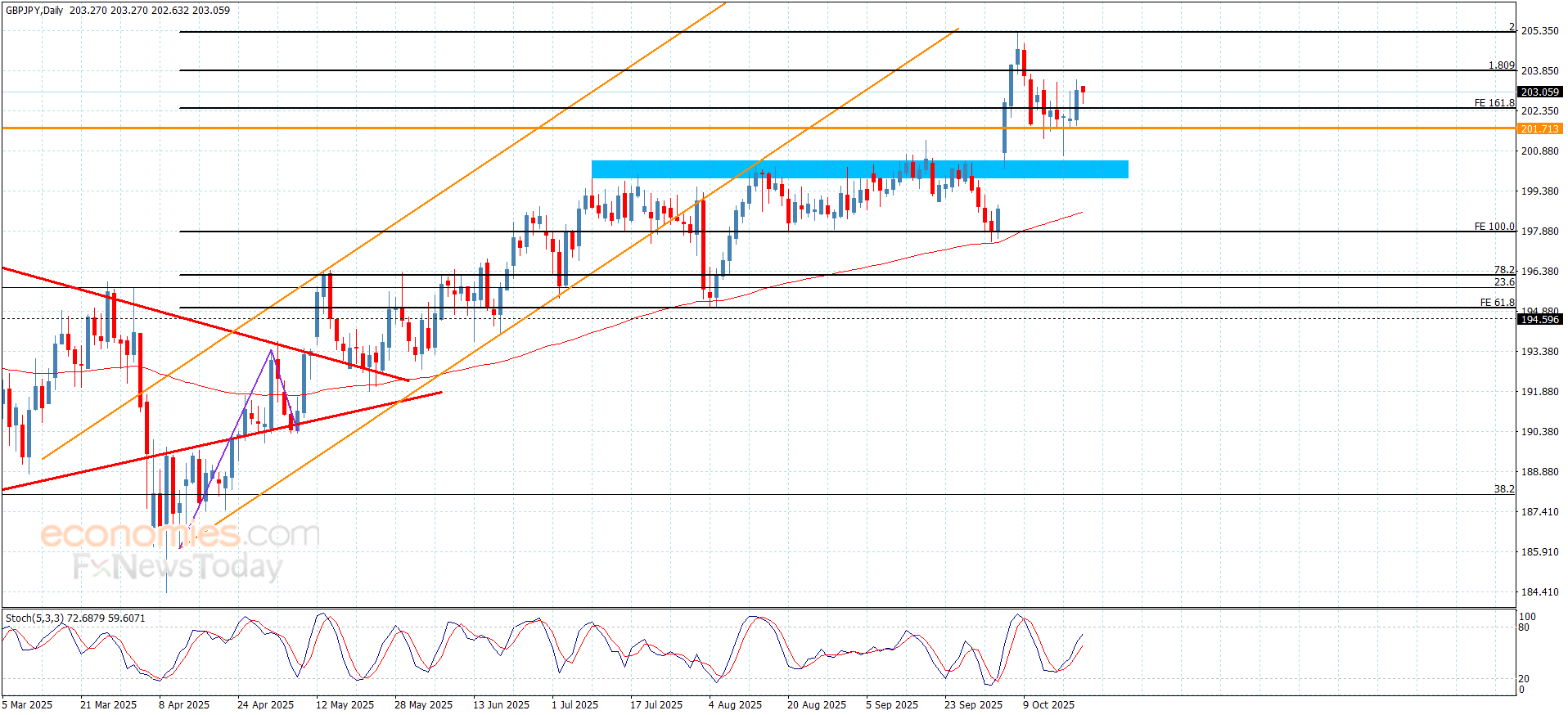
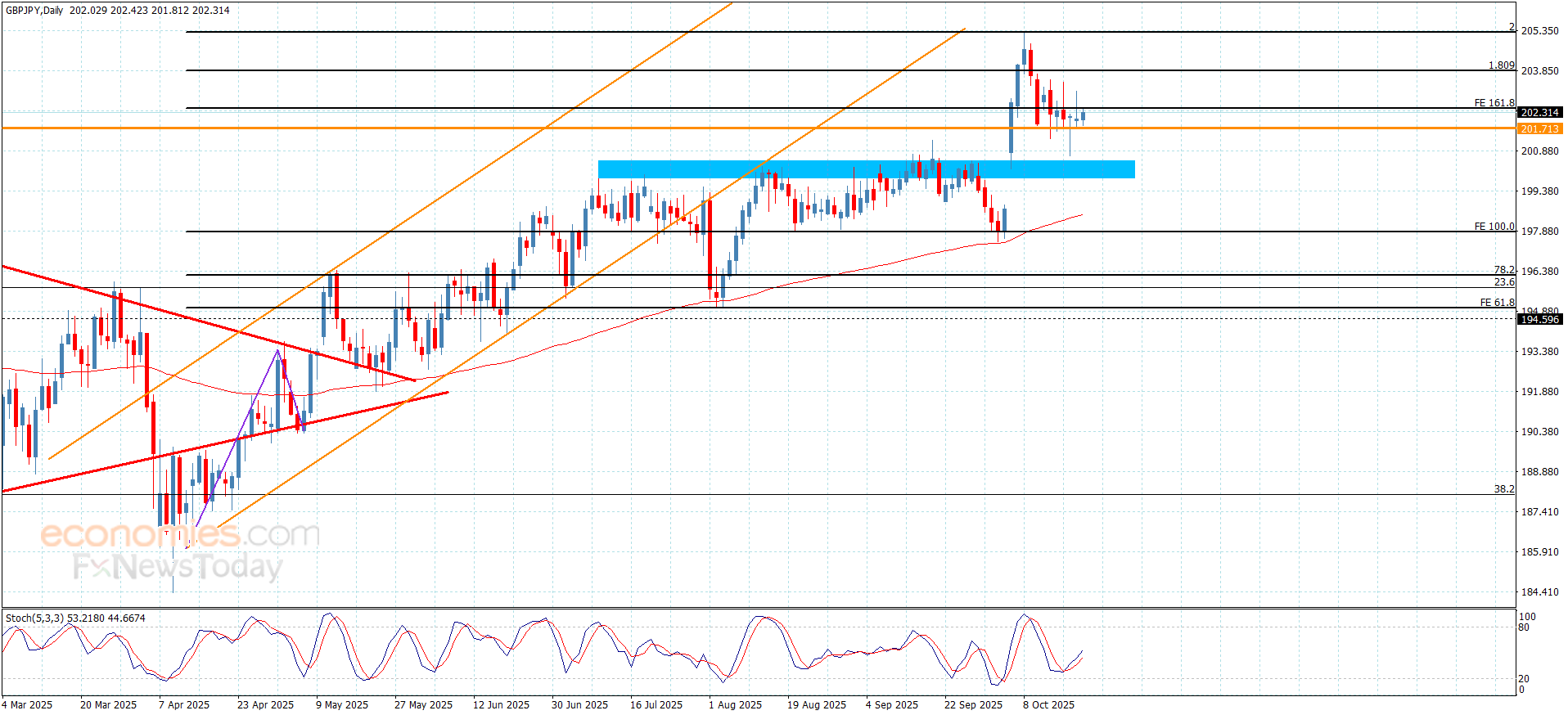
The GBPJPY pair confirmed the stability of the bullish scenario by forming a new bullish rally yesterday, achieving the initial target by hitting 203.50 level, to settle above $161.8 Fibonacci extension level at 202.50.
The continuation of providing positive momentum by the main indicators will increase the strength of the bullish track, to expect attacking the barrier at 203.95, and surpassing it will open the way for reaching new stations that might begin from 204.60 and 205.25, while changing the trend and begin the bearish corrective track requires forming sharp decline to settle below the extra support at 201.70.
The expected trading range for today is between 202.60 and 203.95
Trend forecast: Bullish
This marks the third test of the 200-day average this month, with prior attempts sparking a double top and bearish correction. Today’s high also stalled at the top parallel line of a small rising trend channel, extended 25% (dashed blue line). Resistance at this confluence isn’t surprising — momentum surged from the recent $2.89 swing low, but the lower high relative to October’s earlier peaks hints at potential fatigue. A brief pullback or consolidation would be healthy if buyers aim to hold the reins.
The 20-day moving average at $3.22 stands as key dynamic support if tested, but yesterday’s bullish conviction suggests buyers could avoid this level if they maintain control. Weakness would first show on a drop below today’s $3.36 low, challenging the rally’s staying power. The lower high at $3.50, paired with the significant resistance zone, leans bearish short-term unless momentum shifts.
A decisive rally and close above $3.50 would affirm the advance, but clearing the prior $3.55 swing low adds confidence. For a true bullish reversal, prices must surpass the $3.59 swing high, igniting a third upswing in the rising channel and signaling robust demand.
The $3.47-$3.50 zone is make-or-break—clear it for bullish confirmation, or falter for a pullback to $3.22. Watch today’s close: above $3.43 keeps buyers in play, but sub-$3.36 flags weakness. The channel and 200-day line hold the keys — sustained strength needs $3.59, or consolidation may cool this hot run.
For a look at all of today’s economic events, check out our economic calendar.
Front month copper traded at $4.94 and held up well in the rout in precious metals prices. Many copper miners (often because of associated gold production) were beaten up anyway.
Today, TD Cowen was out with a report highlighting a tightening market and they boosted their 2026 price to $5.25 from $4.40 previously. They also took up their long-term price to $4.50 from $4.25/lb.
The swing has been that trouble at several major mines has taken about 5% of global supply offline. The recent run-up in copper prices came after the mudslide at Grasberg.
On September 8th, Grasberg operations in Indonesia were subject to a
massive mudflow into the mine, causing a shutdown of operations and Freeport
declaring force majeure on its contracts. A subsequent announcement from Freeport
later in the month revealed preliminary impacts suggesting a production impact of
roughly 200kt and 270kt Cu in Q4/25 and 2026, respectively, from the world’s
second-largest copper mine (~3.4% total mined supply in 2024). Further disruptions
this year include the seismic event at Kamoa-Kakula (~200kt), ramp-up difficulties at
QB (~100kt), and El Teniente’s mine collapse (~48kt), which when combined represent
~2% of global supply.
Prices have been consolidating in the $4.90 to $5.20 range, which is near the top end of all-time highs.
Copper
Looking ahead, TD Cowen sees a 222kt deficit in 2026, which they warn could be conservative.
Longer term, lower production from mines entering mature stages of their mine life
along with the lack of greenfield investments imply that a larger copper price is
inevitable to incentivize development and support growing demand
So far this year, copper demand has been stronger than anticipated, with Wood Mackenzie now seeing 3.7% growth. The swing factor is often Chinese growth and that’s held up better than feared. In the years ahead, power generation/transmission, AI datacenters and greening the economy could be massive tailwinds.
Note that the US appears to be scrambling for copper supplies.
In terms of miners, TD’s top
picks include Lundin with buy ratings on Capstone, Ivanhoe and Teck along with top developer pick
Arizona Sonoran, where they are particularly bullish.
The value of gold dropped more than 5% on Tuesday, pacing what would be the largest single-day decline for the metal in more than a decade, leading a broader metal sell-off as investors appear to step back from a record-breaking buying frenzy.
Silver and platinum have joined gold with record-breaking rallies in recent months as investors seek out safer assets.
getty
Gold futures dropped 5.2% by Tuesday afternoon to around $4,130, paring back earlier losses after falling as much as 6.3%, marking the largest intraday drop for the metal since a 6.3% plunge in June 2013.
Futures for silver and platinum, which have risen 60% and 66% this year, respectively, outpacing gold (54%), have fallen 6.7% and 7.2%, respectively.
A sell-off for the metals is not unexpected as they have each surged this year, with investors now pulling back after earlier relying on them as safer assets, according to Standard Chartered analyst Suki Cooper, who said the market is experiencing a “technical correction” as the “universe of investors has expanded rapidly.”
Bart Melek, TD Securities’ global head of commodity strategy, told Bloomberg that precious metal dealers are “taking profits after a very robust rally,” noting recent rallies were historically unsustainable.
Gold prices also tend to fall as the U.S. dollar strengthens, making bullion expensive for investors overseas—the dollar index has risen 0.4% on Tuesday.
Bank of America analysts raised their price forecast for gold earlier this month, becoming the first major bank to give gold a $5,000 per ounce price target for 2026. HSBC, noting it remains bullish on the metal, gave a more conservative outlook last week after raising its average 2025 price target for gold to $3,950 from $3,125. Economists were previously bearish on gold’s value: JPMorgan in February set a $2,950 price target for the end of the year, while Citigroup and Goldman Sachs set $3,000 targets for year’s end and by the middle of 2026, respectively.
Bank of America similarly raised its price target for silver, lifting its outlook for the metal to $65 an ounce (it was trading at just under $48 on Tuesday afternoon). Analysts warned of possible risks for silver, however, indicating prices may become volatile as liquidity grows and demand falls, despite the metal remaining favored among investors. Goldman Sachs wrote last week it’s likely silver prices will continue to rise during a government shutdown and expectations of an interest rate cut from the Federal Reserve, which has signaled officials were divided over whether to lower rates two more times this year.
Metals have surged so far this year during periods of “elevated” economic and policy uncertainty, headlined by President Donald Trump’s widespread tariffs and growing inflation, according to Goldman Sachs analyst Lina Thompson. Hedge fund billionaire Ray Dalio has previously called on new investors to jump on gold and other precious metals while other assets, like equites, perform poorly during these periods, claiming metal is “the one asset that does very well.” Silver has climbed because inventory in the metal’s global trading hub, London, has disappeared this year, according to Greenland Investment Management’s Anant Jania, who told Bloomberg there is “no liquidity available currently.” Silver and gold are often tied together and are favored as safe-haven assets, but Goldman Sachs analysts said they expect “more volatility and downside risk” for silver than for gold, which is backed by demand from central banks. Platinum, while also viewed as a safer investment, has risen in value because of strong demand from jewelers and automakers, analysts said.
Silver (XAG/USD) is finally correcting lower. Market expectations that the US and China will de-escalate trade tensions are boosting the US Dollar’s recovery and hurting precious metals. Silver has extended its reversal from last week’s highs at the $55.00 area, to session lows near $49.00 so far.
US President Trump soothed markets on Monday, announcing that he was planning to meet his Chinese counterpart Xi Jinping next week, and that he expected to reach a “fair deal” which would lead to a good trade relationship between the two countries. These comments tackled fears of a trade war and have sent the US Dollar rallying across the board.
Silver has broken below the base of the ascending channel from mid-September lows and extended losses below the neckline of a bearish Head & Shoulders, a common figure in trend shifts, at the $50.71 area.
The pair is attempting to return above the $50.00 psychological level at the time of writing, and is likely to retest the mentioned H&S neckline, which might act as a resistance now, at the 50.80 area. Further up, the target would be the reverse trendline, near 52.10.
To the downside, intra-day lows are at $49.20 ahead of the October 9 low, at $48.45. The H&S pattern’s measured target is coincident with the 61.8% Fibonacci retracement of the September-October rally, at $46.15.
Silver is a precious metal highly traded among investors. It has been historically used as a store of value and a medium of exchange. Although less popular than Gold, traders may turn to Silver to diversify their investment portfolio, for its intrinsic value or as a potential hedge during high-inflation periods. Investors can buy physical Silver, in coins or in bars, or trade it through vehicles such as Exchange Traded Funds, which track its price on international markets.
Silver prices can move due to a wide range of factors. Geopolitical instability or fears of a deep recession can make Silver price escalate due to its safe-haven status, although to a lesser extent than Gold’s. As a yieldless asset, Silver tends to rise with lower interest rates. Its moves also depend on how the US Dollar (USD) behaves as the asset is priced in dollars (XAG/USD). A strong Dollar tends to keep the price of Silver at bay, whereas a weaker Dollar is likely to propel prices up. Other factors such as investment demand, mining supply – Silver is much more abundant than Gold – and recycling rates can also affect prices.
Silver is widely used in industry, particularly in sectors such as electronics or solar energy, as it has one of the highest electric conductivity of all metals – more than Copper and Gold. A surge in demand can increase prices, while a decline tends to lower them. Dynamics in the US, Chinese and Indian economies can also contribute to price swings: for the US and particularly China, their big industrial sectors use Silver in various processes; in India, consumers’ demand for the precious metal for jewellery also plays a key role in setting prices.
Silver prices tend to follow Gold’s moves. When Gold prices rise, Silver typically follows suit, as their status as safe-haven assets is similar. The Gold/Silver ratio, which shows the number of ounces of Silver needed to equal the value of one ounce of Gold, may help to determine the relative valuation between both metals. Some investors may consider a high ratio as an indicator that Silver is undervalued, or Gold is overvalued. On the contrary, a low ratio might suggest that Gold is undervalued relative to Silver.
Spot Gold plunged on Tuesday amid a better market mood and resurgent US Dollar (USD) demand. The XAU/USD pair fell towards $4,080 before bouncing to the current $4,110 level, holding on to substantial losses in the American afternoon.
The market sentiment improved after the United States (US) President Donald Trump made some optimistic comments about a potential trade deal with China, ahead of an economic conference in South Korea next week, when he will likely meet his Chinese counterpart, Xi Jinping. Global equities reflect the latest optimism, with most global indexes trading in the green.
On a negative note, the US government shutdown continues. The US Senate voted again on Monday on potential funding bills, rejecting both the Democratic and the Republican proposals, though market participants seem unconcerned.
The notorious absence of US macroeconomic data will be broken on Friday, when the Bureau of Labor Statistics will release September Consumer Price Index (CPI) data. The reading is critical ahead of the Federal Reserve (Fed) monetary policy meeting next week.
The daily chart for the XAU/USD pair shows that the sharp decline could be seen as a corrective move. Technical indicators head south almost vertically, but remain within positive levels and erased extreme overbought conditions. At the same time, the pair keeps developing far above all bullish moving averages, with the 20 Simple Moving Average (SMA) currently at $4,001.20.
The near-term technical picture suggests XAU/USD may not be done correcting lower. The pair is currently developing far below its 20 SMA, which turned lower. The 100 and 200 SMAs maintain their bullish slopes below the current level, with the shorter one currently at $4,043. Finally, technical indicators approach oversold readings without signs of giving up and retaining their strong downward momentum.
Support levels: 4,105.10 4,081.70 4,065.90
Resistance levels: 4,134.45 4,148.30 4,162.60

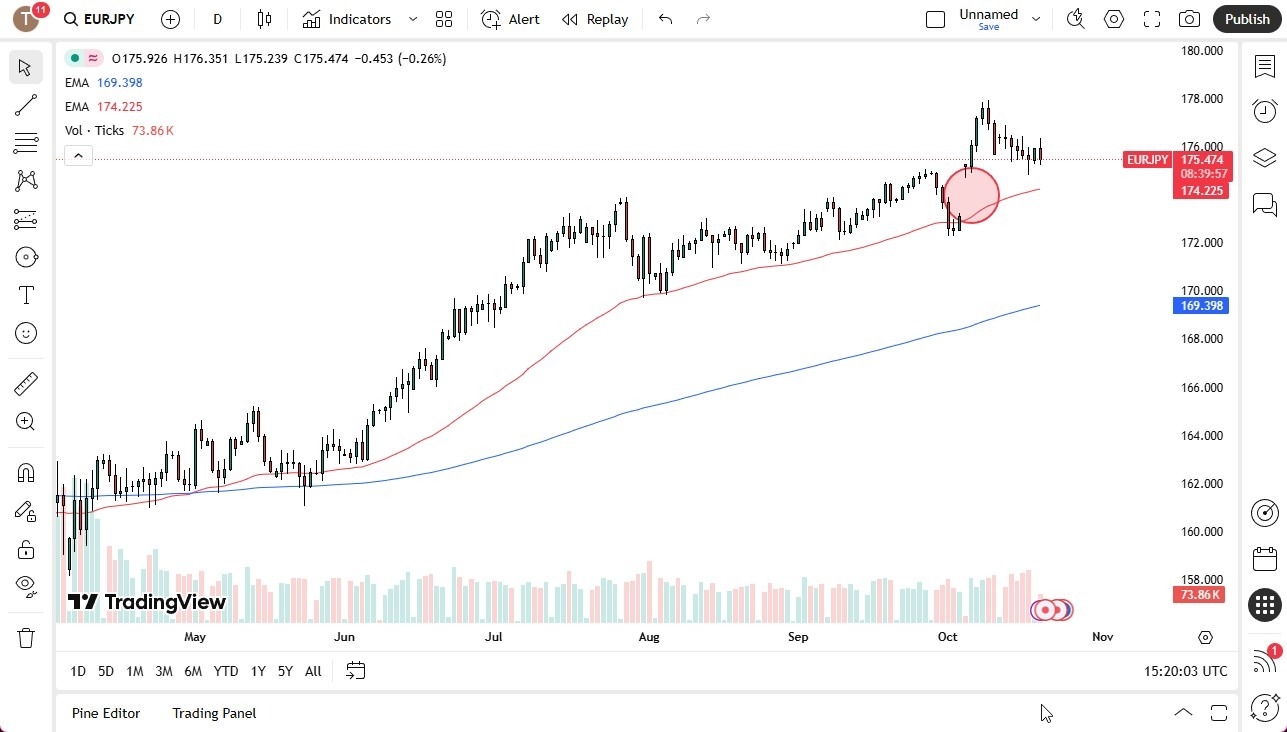
We have been in an uptrend for some time, and I do believe that it will continue eventually, and that each pullback does tend to offer a bit of support and, more importantly, value. Ultimately, the Bank of Japan is in a situation where it probably cannot do much, at least not enough to turn the markets around. While we could fall in order to fill the gap, meaning that we could drop all the way back down to the ¥173.25 level, I still think there are plenty of buyers between here and there to at least cushion the fall, and then eventually turn things around. Ultimately, this means that I have no real interest in shorting this market, despite the fact that it does seem like it is struggling a bit in this general vicinity.
With all of that being said, this is a market that I think eventually has to deal with the 170 Ian level, which is an area that has acted like significant resistance. If we can break above that level, it would obviously be very bullish, and it could send this market much higher. In that environment, I see the ¥180 level as being very likely, perhaps even higher than that. Remember, this doesn’t have much to do with the euro and everything to do with the Japanese yen. This pair will move in the same direction and overall attitude as many other JPY-denominated markets.
Begin trading our daily forecasts and analysis. Here is a list of Forex brokers in Japan to work with.
Christopher Lewis has been trading Forex and has over 20 years experience in financial markets. Chris has been a regular contributor to Daily Forex since the early days of the site. He writes about Forex for several online publications, including FX Empire, Investing.com, and his own site, aptly named The Trader Guy. Chris favours technical analysis methods to identify his trades and likes to trade equity indices and commodities as well as Forex. He favours a longer-term trading style, and his trades often last for days or weeks.
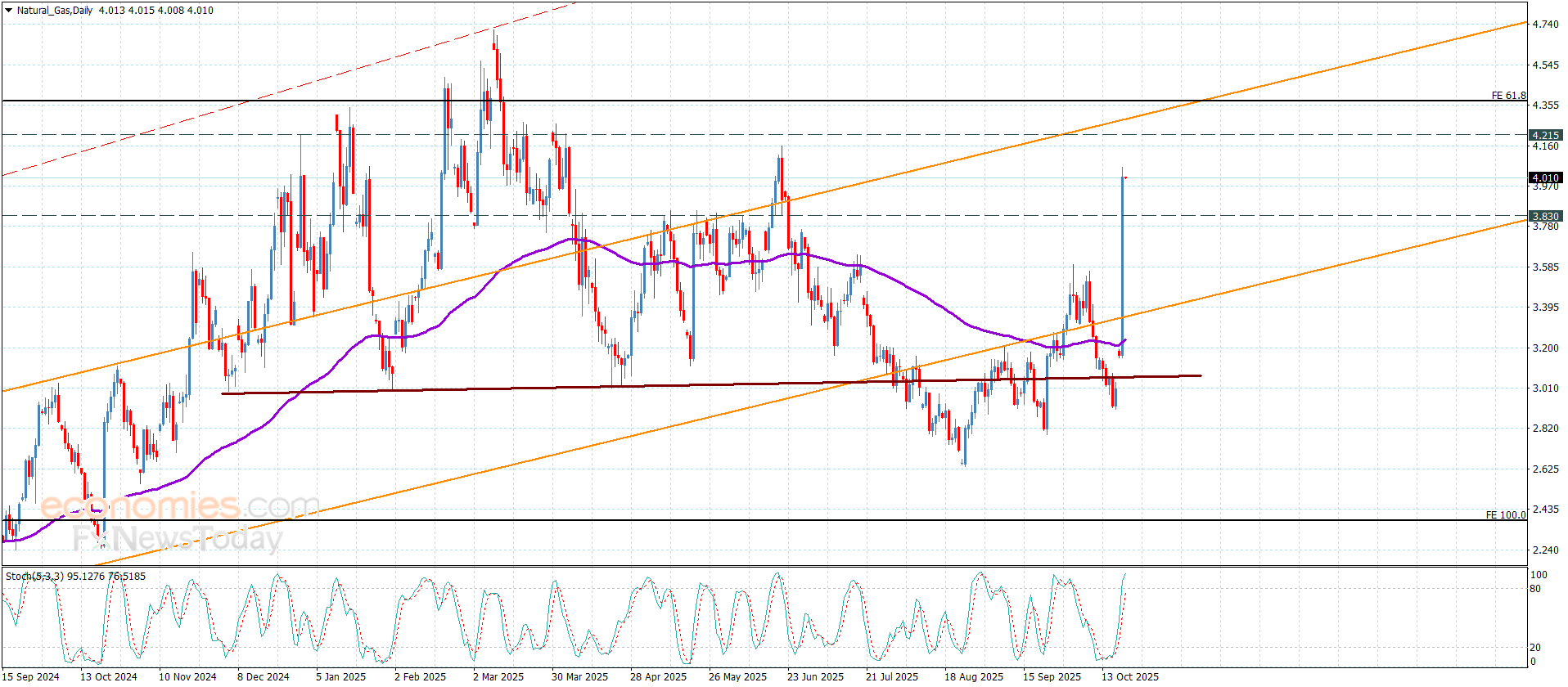
Natural gas price affected by the economic data, forming strong bullish rally yesterday, surpassing the resistance at $3.350 then recording big gains by reaching $4.060, to settle above $3.830 level, which forms a new support against the bullish trading.
Providing positive momentum by the main indicators will increase the strength of the bullish track, to expect resuming the bullish attack, to target $4.150 level reaching the next resistance near $4.280.
The expected trading range for today is between $3.900 and $4.150
Trend forecast: Bullish
The British pound is starting to roll over slightly from the 50-day EMA as well. Although bearish, I wouldn’t worry too much about it because we’re basically in the middle of the overall consolidation. So, therefore, we’re essentially at fair value. I do favor the US dollar over the pound. Although the British pound is a little bit of an outlier considering how it performs against the US dollar, even as we were falling during 2024, it was falling less rapidly against the greenback than many other currencies. Conversely, on the way back up, the British pound was one of the best performers. So it’s got a history of fighting the dollar a little bit more. So although it does look weaker than strong, I’m not overly concerned. I think we will stay in this range for the time being.
And finally, when it comes to triangulation between the euro, the pound, and the dollar, it makes sense that the euro and the pound look pretty much the same. That’s because they’re pretty neutral towards each other. The euro is currently sitting right out of the 50-day EMA against the British pound, right in the middle of a larger consolidation area.
I think this is essentially trying to tell us something important, and that’s where the dollar goes, which will dictate where everything moves in the first two pairs in this analysis. This is about the dollar and not really about the pound and the euro. There is no strength in the euro versus the pound or vice versa. Over the longer term, the euro has risen quite nicely, but going back to the last three months or so, we’ve been pretty sideways between 0.86 and 0.8750. I don’t see that changing anytime soon.
For a look at all of today’s economic events, check out our economic calendar.
Platinum price reached $1557.00 level in its last corrective decline, then rallies again to settle above the extra support level at $1605.00, but this will not confirm its readiness to activate the bullish track again, due to its fluctuation below the resistance at $1695.00.
The continuation of providing negative momentum by stochastic will increase the efficiency of the bearish corrective track, to expect reaching $1575.00 and facing extra pressure might force it to target $1525.00 level, which forms an extra support against the current trading.
The expected trading range for today is between $1575.00 and $1670.00
Trend forecast: Bearish