The main category of Forex News.
You can use the search box below to find what you need.
[wd_asp id=1]
The main category of Forex News.
You can use the search box below to find what you need.
[wd_asp id=1]
The GBPJPY pair is under strong bearish pressure, which forces it to resume the bearish correctional attack, facing the support of the bullish channel’s support at 195.35, to settle above it to stop the negative bleeding in the current period, to rally towards 195.95.
Note that surpassing 196.45 level is important to confirm its readiness to renew the bullish attempts, to expect attacking the extra barrier at 197.45, while the continuation of the negative pressure and breaking the current support will force it to suffer new losses, to wait for reaching 194.20, then attempts to press on the EMA50 that is located near 193.55.
The expected trading range for today is between 195.55 and 197.45
Trend forecast: Bullish
July 3, 2025 – Written by David Woodsmith
STORY LINK GBP/USD Forecast: Pound Under Pressure vs Dollar ahead of US Jobs Data
The Pound to US Dollar exchange rate (GBP/USD) edged lower on Wednesday, slipping toward $1.3640 as markets awaited key US labour market data.
While the Pound Sterling lacked direction amid a quiet UK economic calendar, the US Dollar (USD) clawed back earlier losses following stronger-than-expected JOLTs job openings.
Optimism over US employment trends helped stabilise the Greenback, which had initially come under pressure from fiscal concerns surrounding President Trump’s proposed $3.3 trillion spending bill.
With attention turning to upcoming releases including non-farm payrolls, unemployment figures, and the UK services PMI, both GBP and USD face potential volatility as fresh data shape the near-term currency outlook.
The US Dollar (USD) regained ground during Wednesday’s European session, recovering much of its earlier losses following market anxiety over President Donald Trump’s proposed spending bill on Tuesday.
The ‘big beautiful bill’, projected to add $3.3 trillion to the US national debt, had initially dragged the Dollar lower on Tuesday, as concerns grew over long-term fiscal stability.
However, the release of stronger-than-expected JOLTs job openings data later in the day helped restore confidence in the US economy, allowing the ‘Greenback’ to rally into mid-week trade.
That said, with the latest ADP employment report still to come, the US Dollar remained vulnerable.
A surprise downside in the upcoming jobs data could undermine USD strength and shift momentum as the session unfolds.
The Pound (GBP) drifted sideways on Wednesday, with a lack of fresh UK economic data leaving markets with little to respond to.
Following some early-week losses, partly linked to growing political uncertainty around the Labour Party, Sterling stabilised as trading progressed.
However, without any new domestic releases, the Pound remained largely directionless.
With market sentiment providing limited support, GBP exchange rates hovered in a tight range, unable to generate any momentum.
Looking ahead to Thursday’s European session, movement in the GBP/USD exchange rate is likely to hinge on the release of key US labour market data.

Markets will be closely watching June’s non-farm payrolls and unemployment rate, both of which are expected to print below expectations.
Forecasts point to a slowdown in job creation and a slight uptick in unemployment, which could reignite concerns over the resilience of the US economy.
If the data underwhelms, the US Dollar may come under renewed pressure.
Meanwhile, in the UK, attention will turn to the finalised services PMI for June.
The index is expected to rise slightly from 50.9 to 51.3, signalling a modest but continued expansion in the UK’s largest economic sector.
If confirmed, the reading could offer some support to the Pound by reinforcing signs of steady growth.
International Money Transfer? Ask our resident FX expert a money transfer question or try John’s new, free, no-obligation personal service! ,where he helps every step of the way,
ensuring you get the best exchange rates on your currency requirements.
TAGS: Pound Dollar Forecasts
Platinum price activated the bullish rally by surpassing the extra barrier at $1366.00 reaching $1433.00, then bounces below2.618%Fibonacci extended level at $1420.00 forming bearish correctional waves.
The stability of the price within the bullish channel’s levels, accompanied by the continuation of forming strong extra support at $1330.00 level reinforces the dominance of the bullish track, to wait for breaching $1420.00 level, opening the way for reaching new bullish stations that might extend to $1458.00 reaching $1507 in the upcoming period trading.
The expected trading range for today is between $1375.00 and $1458.00
Trend forecast: Bullish
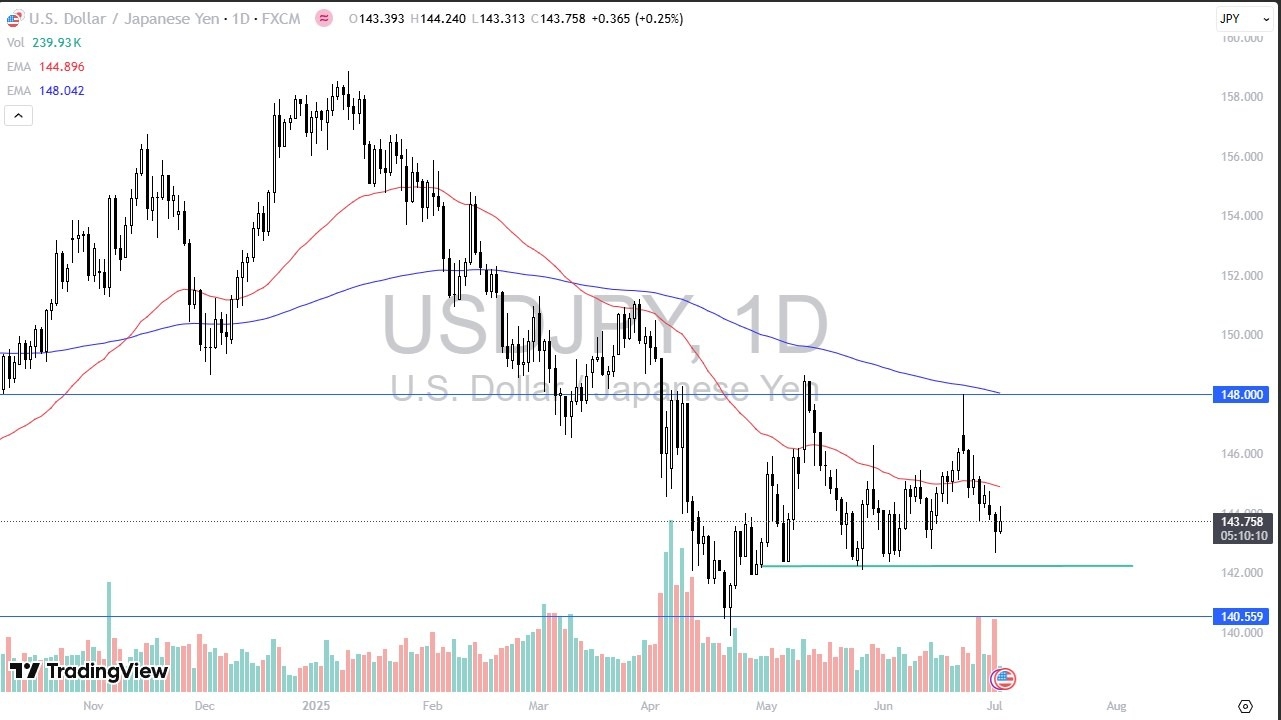
The 142 yen level continues to be significant support level here on short-term dips, I think as long as we stay above there, then it’s possible that we could see value hunting here because of the interest rate differential.

This has been a situation that while the US dollar has been weak, the Japanese have a significant problem with the bond market. So, it’s probably only a matter of time before the Bank of Japan has to enter and start quantitative easing. So therefore, I still like the idea of buying the US dollar against the Japanese yen, but I also recognize that perhaps it is going to be a situation where things are going to be rocky. They’re going to be noisy.
Hopefully, if you get long on a pullback, you are patient enough to take advantage of the interest rate differential during the swap and waiting on it to go higher. Ultimately, if we break down below the 142 yen level, then we could drop to the 140 yen level. All things being equal, this is a market that I think eventually will find a reason to go to 148 yen, although it could take some time from now to get there.
Want to trade our USD/JPY forex analysis and predictions? Here’s a list of forex brokers in Japan to check out.
Christopher Lewis has been trading Forex and has over 20 years experience in financial markets. Chris has been a regular contributor to Daily Forex since the early days of the site. He writes about Forex for several online publications, including FX Empire, Investing.com, and his own site, aptly named The Trader Guy. Chris favours technical analysis methods to identify his trades and likes to trade equity indices and commodities as well as Forex. He favours a longer-term trading style, and his trades often last for days or weeks.
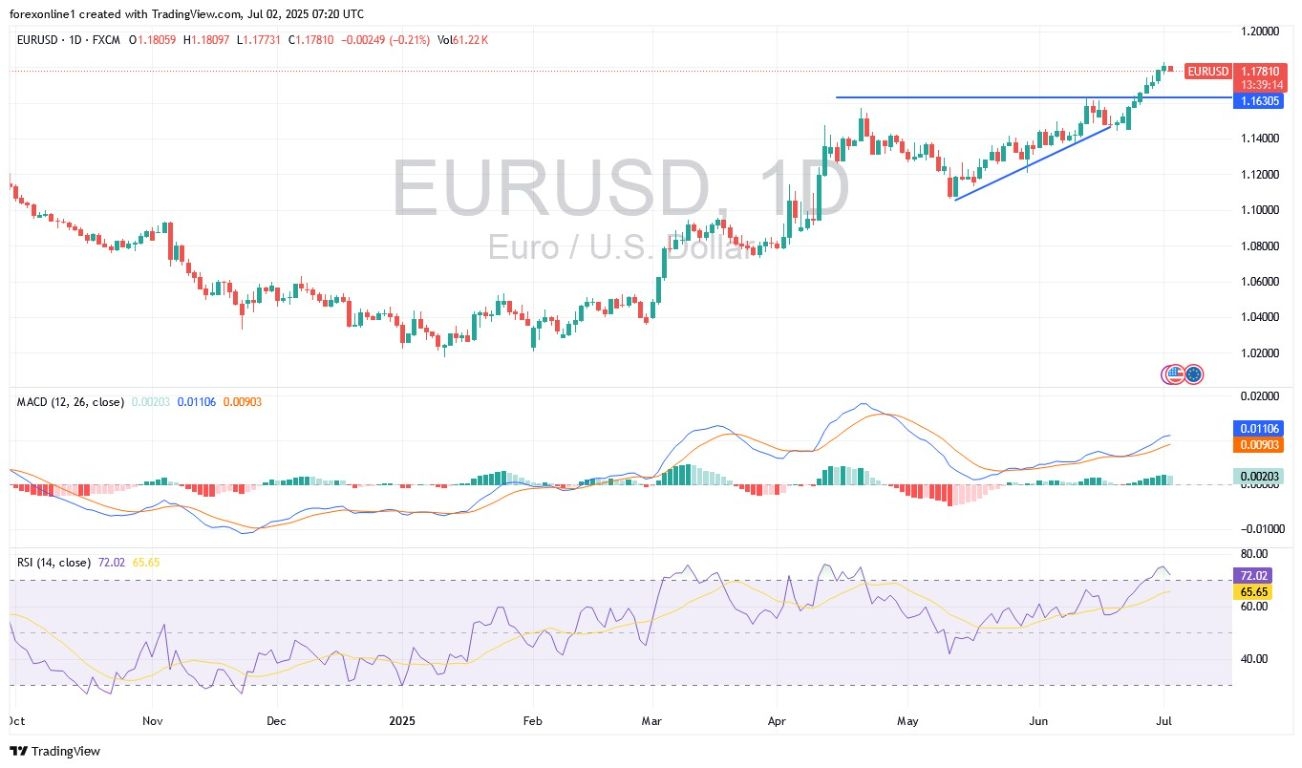
As anticipated, the EUR/USD pair has continued its strong upward momentum, with gains extending to the 1.1830 resistance level, the highest for this prominent currency pair in the forex market since August 2021. The Euro’s gains intensified as investors assessed comments from European Central Bank (ECB) policymakers following the Eurozone’s inflation rate reaching the ECB’s 2% target.
Speaking at the ECB Forum on Central Banking, ECB President Christine Lagarde welcomed the June inflation data, which came in as expected, but cautioned about “two-sided risks” stemming from increasing economic fragmentation and escalating geopolitical tensions. At the same time, other ECB officials indicated that interest rates are likely to remain stable at this month’s meeting, after eight consecutive deposit rate cuts since June 2024. This caution is amid ongoing concerns about global trade tensions, instability in the Middle East, and the Euro’s recent strength.
The single European currency also found support from a weaker US dollar, as markets continue to anticipate Federal Reserve interest rate cuts despite uncertainty surrounding the impact of tariffs imposed by US President Trump.
We advise monitoring EUR/USD selling levels rather than considering buying in hopes of further gains.
According to forex market experts, the EUR/USD trend remains positive; the medium-term trend is still upward and optimistic, as we’ve observed a multi-month sequence of higher lows and higher highs since March. The 1.1800 resistance will remain a key target for bulls, but keep in mind that technical indicators are heading towards overbought territory, led by the 14-day RSI (Relative Strength Index) and the MACD (Moving Average Convergence Divergence) indicator. Overall, we foresee continued US dollar risks and further EUR/USD gains; however, the current combination of negative risks for the US dollar makes the first half of July one of the best opportunities for a potential breakthrough of the 1.2000 psychological resistance.
These forecasts come as we approach mid-2025, a year characterized by a significant depreciation of the US dollar. In fact, it’s the worst start to a year for the US dollar since 1973, when it became a fully free-floating currency. It’s often said that US President Donald Trump’s policies are the main driver for the US dollar, but not enough is said about China, one of the most important factors facilitating these declines.
In this regard, trading experts added that the pace of China’s currency adjustment will influence the pace of the US dollar’s decline, which in turn will affect the pace of other global currencies. “Emerging European currency markets, as expected, are leading this field, as is the Euro, and I feel there is a significant impact on the price right now.”
As is well known, China manages the Yuan (CNY) through a daily fixing mechanism. When it allows the Yuan to appreciate (i.e., lowers the USD/CNY rate), it typically reflects its intention to absorb more global capital and reduce trade imbalances. China has pursued a stable Yuan policy that benefits its exporters by artificially keeping the exchange rate low.
However, in response to Trump’s efforts to rebalance US trade, there is an implicit understanding by Chinese authorities that their currency needs to be allowed to depreciate. This has global consequences, as a stronger CNY usually means widespread weakness for the US dollar. Traders also interpret lower USD/CNY rates as a signal to broadly sell the US dollar.
Trading experts forecast that for the EUR/USD to surpass the 1.2000 psychological resistance, the USD/CNY exchange rate would need to approach 7.0000. As of July 1, the USD/CNY exchange rate was 7.16, and the EUR/USD exchange rate was currently at 1.18000.
According to performance on the daily chart and across reliable trading platforms, the EUR/USD gains have pushed technical indicators towards strong overbought levels. This is clearly visible in the direction of the 14-day RSI (Relative Strength Index), which has breached the 70 lines, confirming overbought conditions. Also, the MACD (Moving Average Convergence Divergence) lines. Consequently, if the EUR/USD receives new strong momentum, the currency pair could be subject to profit-taking selling.
Furthermore, we expect the euro dollar price to remain stable around its gains until the markets react to the announcement of US jobs numbers at the end of the week, which in turn affects market expectations for future Federal Reserve policy. Today, the euro dollar price may react to the announcement of the eurozone unemployment rate at 12:00 PM. Cairo time. Then expected statements from the Governor of the European Central Bank, Lagarde.
Ready to trade our daily Forex analysis? We’ve made a list of the best forex demo accounts worth trading with.
July 2, 2025 – Written by Tim Boyer
STORY LINK Pound to Dollar Forecast: “GBP Must Break and Hold 1.3800 Soon”
Pound Serling (GBP) was unable to make any headway against the US Dollar (USD) in early Europe on Wednesday and slid further to hit 1-week lows below 1.3600 early in US trading before settling around 1.3620.
The Pound to Dollar exchange rate (GBP/USD) was hurt on domestic grounds while the dollar was resilient despite a shock US jobs report.
UoB commented; “There are early signs that upward momentum is beginning to slow. From here, GBP must break and hold above 1.3800 soon, or the probability of further GBP strength will diminish rapidly.”
In the near term, it expects GBP/USD will trade between 1.3700-1.3780.
Scotiabank took a similar view with evidence that the bullish trend is close to exhaustion and added; “We continue to highlight the importance of medium-term support at the 50 day MA (1.3462) and anticipate a near -term range bound between 1.3650 support and 1.3750/1.3780 resistance.”
MUFG has a year-end forecast of 1.3950 amid renewed dollar losses.
The Pound was undermined initially by fiscal concerns following yesterday’s House of Commons vote on welfare reform.
The government survived, but only through a series of U-turns which dramatically watered down the content.
In this context, there will be little in the way of medium-term savings, reinforcing underlying fiscal concerns with increased speculation over Autumn tax rises.
Later in the session, monetary policy was the key element with notably dovish comments from Bank of England (BoE) external MPC member Taylor.
He commented; “Previously, I had seen a UK soft landing in the cards, with some remaining upside risks to inflation from the bump in 2025.”
He added; “Now I see that soft landing as being at risk, and greater probability of a downside scenario in 2026 pushing us off track as demand weakness and trade disruptions build.”
Taylor called for three further rate cuts in 2025. Markets had expected dovish comments given his vote for a cut at the June MPC meeting, but the tone was more downbeat than expected.
Scotiabank noted the shift in BoE market pricing; “Rates markets are pricing in about 56bpts of easing by year end, down adding about 15bpts over the last month or so.”
Traders are also pricing in at least a 90% chance of a rate cut at the August meeting.
The dollar survived despite much weaker-than-expected jobs data.
ADP reported that private payrolls declined 33,000 for June compared with consensus forecasts of an increase close to 100,000 and the May increase was revised lower to 29,000 from the 37,000 reported previously. This was the first negative figure since January 2021.
The data reinforced concerns over the labour market, although the latest Challenger survey reported that the pace of layoffs had eased in June.
Markets were also having to digest US fiscal developments and look ahead to major announcements on trade policy next week.
The Senate passed the budget Bill with Vice President Vance having to cast the tie-breaker vote. The legislation will now go back to the House for further debate.
The Congressional Budget Office has estimated that debt will be increased by $3.3trn over the next 10 years.
Win Thin, global head of markets strategy at Brown Brothers Harriman & Co commented; “I think the knee-jerk reaction was to buy the dollar on lower fiscal policy uncertainty.”
He added; “To me, pushing through a massive tax cut will eventually widen the budget deficit, which is ultimately dollar-negative.”
BNP Paribas FX portfolio manager Peter Vassallo pointed to underlying unpredictability surrounding policy making; “This switch towards a more uncertain policy regime created an environment where we as market participants see the U.S. as more hostile to international capital flows, international trading.”
International Money Transfer? Ask our resident FX expert a money transfer question or try John’s new, free, no-obligation personal service! ,where he helps every step of the way,
ensuring you get the best exchange rates on your currency requirements.
TAGS: Pound Dollar Forecasts
The silver price printed solid gains on Wednesday, up 1.40%, yet it remains consolidating within the $36.00-$36.60 range for the second consecutive day. A positive market mood and broad US Dollar strength capped the grey metal’s advance.
From a technical standpoint, XAG/USD remains upward biased, even though it has failed to print a new higher high since June 18, when Silver hit a yearly peak of $37.31. At the same time, the latest cycle low reached on June 23 at $35.82, remains respected. This, along with bulls gathering momentum as portrayed by the Relative Strength Index (RSI), suggests further upside is expected.
With that said, the first resistance level for XAG/USD is $37.00. If surpassed, the next stop would be the yearly peak of $37.31, ahead of testing the February 29, 2012, peak at $37.49. A breach of the latter will expose $38.00
On the other hand, Silver could take a negative turn if the spot price drops below $36.00, paving the way for a test of $35.82. Once hurdled, the next stop would be $35.00, before challenging the 50-day Simple Moving Average (SMA) at $34.24.
Silver is a precious metal highly traded among investors. It has been historically used as a store of value and a medium of exchange. Although less popular than Gold, traders may turn to Silver to diversify their investment portfolio, for its intrinsic value or as a potential hedge during high-inflation periods. Investors can buy physical Silver, in coins or in bars, or trade it through vehicles such as Exchange Traded Funds, which track its price on international markets.
Silver prices can move due to a wide range of factors. Geopolitical instability or fears of a deep recession can make Silver price escalate due to its safe-haven status, although to a lesser extent than Gold’s. As a yieldless asset, Silver tends to rise with lower interest rates. Its moves also depend on how the US Dollar (USD) behaves as the asset is priced in dollars (XAG/USD). A strong Dollar tends to keep the price of Silver at bay, whereas a weaker Dollar is likely to propel prices up. Other factors such as investment demand, mining supply – Silver is much more abundant than Gold – and recycling rates can also affect prices.
Silver is widely used in industry, particularly in sectors such as electronics or solar energy, as it has one of the highest electric conductivity of all metals – more than Copper and Gold. A surge in demand can increase prices, while a decline tends to lower them. Dynamics in the US, Chinese and Indian economies can also contribute to price swings: for the US and particularly China, their big industrial sectors use Silver in various processes; in India, consumers’ demand for the precious metal for jewellery also plays a key role in setting prices.
Silver prices tend to follow Gold’s moves. When Gold prices rise, Silver typically follows suit, as their status as safe-haven assets is similar. The Gold/Silver ratio, which shows the number of ounces of Silver needed to equal the value of one ounce of Gold, may help to determine the relative valuation between both metals. Some investors may consider a high ratio as an indicator that Silver is undervalued, or Gold is overvalued. On the contrary, a low ratio might suggest that Gold is undervalued relative to Silver.
The NZDCAD activated the bullish attempts in its last trading, taking advantage of its lean above the bullish channel’s support at 0.8240 level, achieving some of the gains by reaching extra significant resistance near 0.8325.
Note that the main indicators unionism by providing the positive momentum, specifically stochastic reach to the overbought levels, will reinforce the chances for breaching the current resistance, to ease the mission of achieving extra gains that might extend to 0.8370 reaching the next target at 0.8405.
The expected trading range for today is between 0.8295 and 0.8370
Trend forecast: Bullish
Important DisclaimersThe content provided on the website includes general news and publications, our personal analysis and opinions, and contents provided by third parties, which are intended for educational and research purposes only. It does not constitute, and should not be read as, any recommendation or advice to take any action whatsoever, including to make any investment or buy any product. When making any financial decision, you should perform your own due diligence checks, apply your own discretion and consult your competent advisors. The content of the website is not personally directed to you, and we does not take into account your financial situation or needs.The information contained in this website is not necessarily provided in real-time nor is it necessarily accurate. Prices provided herein may be provided by market makers and not by exchanges.Any trading or other financial decision you make shall be at your full responsibility, and you must not rely on any information provided through the website. FX Empire does not provide any warranty regarding any of the information contained in the website, and shall bear no responsibility for any trading losses you might incur as a result of using any information contained in the website.The website may include advertisements and other promotional contents, and FX Empire may receive compensation from third parties in connection with the content. FX Empire does not endorse any third party or recommends using any third party’s services, and does not assume responsibility for your use of any such third party’s website or services.FX Empire and its employees, officers, subsidiaries and associates, are not liable nor shall they be held liable for any loss or damage resulting from your use of the website or reliance on the information provided on this website.Risk DisclaimersThis website includes information about cryptocurrencies, contracts for difference (CFDs) and other financial instruments, and about brokers, exchanges and other entities trading in such instruments. Both cryptocurrencies and CFDs are complex instruments and come with a high risk of losing money. You should carefully consider whether you understand how these instruments work and whether you can afford to take the high risk of losing your money.FX Empire encourages you to perform your own research before making any investment decision, and to avoid investing in any financial instrument which you do not fully understand how it works and what are the risks involved.
July 2, 2025 – Written by James Fuller
STORY LINK Pound-to-Euro Forecast: GBPEUR Tipped to FALL to 1.1360
The British Pound Sterling (GBP) attempted to rally on Tuesday, but rebounds met selling interest and the Pound to Euro exchange rate (GBP/EUR) retreated to 10-week lows close to 1.1630.
ING commented; “EUR/GBP remains underpinned by a bullish bias, with the welfare reform reversal doing little to alter that outlook. Incoming UK data over the coming weeks will determine whether any push above 0.8600 (GBP/EUR below 1.1630) proves sustainable.”
The multiple U-turns on welfare reform have raised fresh concerns that further UK tax increases will be needed.
UK gilt yields were, however, broadly stable with the 10-year yield close to 4.50% which limited the scope for more substantial near-term Pound selling.
MUFG expects GBP/EUR to trade around 1.1630 at the end of 2025.
HSBC is more bearish on the Pound and forecasts losses to 1.1360 by the end of this year.
The government managed to win a House of Commons vote on welfare payments. The Administration, however, was heading for defeat and had to make further last-minute concessions to cut the number of rebels.
A key element is that the planned savings have been watered down dramatically.
Helen Miller, the new head of the Institute for Fiscal Studies thinktank commented; “There will be a reduction in the health element of Universal Credit, that will be some savings for the Government, but there is an increase in the sort of regular rate of Universal Credit. That is a giveaway.”
She added; “The Government has moved from a position of saving some money to saving nothing, at least by the end of this Parliament.”
Looking at the implications she noted that tax changes are; “increasingly likely at the budget”.
The position of Prime Minister Starmer and Chancellor Reeves have both been weakened further.
ING commented; “Aside from the potential implications for the stability of PM Starmer’s party leadership, the probability of autumn tax hikes has probably increased further.”
Monetary policy will also be a key underlying element for the Pound.
According to the latest Incomes Data Research survey, median UK pay awards increased to 3.4% in the three months to May, from 3.2% previously with some impact from the April minimum wage hike.
Private-sector pay deals increased to 3.5%, with close to 20% of employers giving raises above 6% from 12% in April.
The Bank of England is expecting that overall wage pressures will continue to subside, but the equation for interest rate cuts will change sharply if pressures continue.
MUFG expects further weakness in the labour market and added; “Relative to last month we see increased risks that the MPC could go back-to-back with cuts in August and September if labour market data remains weak. That points to downside risks for GBP relative to our forecasts.”
CIBC added; “We see the risks to BoE pricing as tilted towards more rather than less easing, as the MPC appears to be putting increased focus on the output gap.”
HSBC added; “If UK data stay soft, the BoE will have to deliver more cuts.”
The Euro will be vulnerable if currency strength triggers ECB warnings over renewed downward pressure on inflation. In comments on Monday Vice-President de Guindos stated that the bank would be comfortable with EUR/USD at 1.20, but gains above this level could be more complicated.
CIBC commented; “While some ECB members may soon become nervous regarding the pace of EUR appreciation, we would still view the currency as being on the cheap side of relative fair value.”
International Money Transfer? Ask our resident FX expert a money transfer question or try John’s new, free, no-obligation personal service! ,where he helps every step of the way,
ensuring you get the best exchange rates on your currency requirements.
TAGS: Pound Euro Forecasts