The main category of Forex News.
You can use the search box below to find what you need.
[wd_asp id=1]
The main category of Forex News.
You can use the search box below to find what you need.
[wd_asp id=1]
GBP/USD stays on the back foot and trades near 1.3550 in the European session on Tuesday after posting small gains on Monday. The pair could extend its decline if the support level at 1.3530 fails.
The table below shows the percentage change of British Pound (GBP) against listed major currencies this week. British Pound was the weakest against the New Zealand Dollar.
| USD | EUR | GBP | JPY | CAD | AUD | NZD | CHF | |
|---|---|---|---|---|---|---|---|---|
| USD | -0.17% | 0.15% | 0.20% | -0.17% | -0.67% | -0.75% | 0.09% | |
| EUR | 0.17% | 0.18% | 0.35% | -0.01% | -0.40% | -0.59% | 0.27% | |
| GBP | -0.15% | -0.18% | 0.20% | -0.19% | -0.58% | -0.77% | 0.09% | |
| JPY | -0.20% | -0.35% | -0.20% | -0.37% | -1.18% | -1.28% | -0.50% | |
| CAD | 0.17% | 0.00% | 0.19% | 0.37% | -0.43% | -0.58% | 0.28% | |
| AUD | 0.67% | 0.40% | 0.58% | 1.18% | 0.43% | -0.19% | 0.68% | |
| NZD | 0.75% | 0.59% | 0.77% | 1.28% | 0.58% | 0.19% | 0.86% | |
| CHF | -0.09% | -0.27% | -0.09% | 0.50% | -0.28% | -0.68% | -0.86% |
The heat map shows percentage changes of major currencies against each other. The base currency is picked from the left column, while the quote currency is picked from the top row. For example, if you pick the British Pound from the left column and move along the horizontal line to the US Dollar, the percentage change displayed in the box will represent GBP (base)/USD (quote).
The improving risk mood made it difficult for the US Dollar (USD) to stay resilient against its peers on Monday and helped GBP/USD push higher. The Wall Street Journal reported that Iran was looking to end hostilities with Israel and resume talks about its nuclear program. Major equity indexes ended the day decisively higher, reflecting a risk-positive market atmosphere.
Early Tuesday, investors turn cautious and allow the USD to hold its ground as the Israel-Iran conflicts enters its fifth day. Citing Iran’s IRNA news agency, Reuters reported that Iran has recently launched a “more powerful” new wave of missiles toward Israel. Additionally, a senior commander for the Iranian army noted that a new wave of hundred of drones will soon hit Israel.
In the second half of the day, the US economic calendar will offer Retail Sales and Industrial Production data for May. A significant negative surprise in the Retail Sales data could hurt the USD with the immediate reaction. Nonetheless, unless Wall Street stages a bullish opening, the USD could continue to benefit from safe-haven flows.
Early Wednesday, the UK’s Office for National Statistics will publish the Consumer Price Index (CPI) data for May. Later in the day, the Federal Reserve (Fed) will announce monetary policy decisions and publish the revised Summary of Economic Projections. On Thursday, the Bank of England is expected to leave the bank rate unchanged at 4.25%.
The Relative Strength Index (RSI) indicator on the 4-hour chart stays slightly below 50 and GBP/USD trades below the 20-period and the 50-period Simple Moving Averages (SMA), hinting at a bearish tilt on the short-term outlook.
On the downside, the 100-period SMA forms the first support level at 1.3530 ahead of 1.3500 (round level, static level) and 1.3430 (200-period SMA). Looking north, resistance levels could be spotted at 1.3570 (20-period SMA), 1.3600 (static level, support level) and 1.3630 (mid-point of the ascending channel).
The Pound Sterling (GBP) is the oldest currency in the world (886 AD) and the official currency of the United Kingdom. It is the fourth most traded unit for foreign exchange (FX) in the world, accounting for 12% of all transactions, averaging $630 billion a day, according to 2022 data.
Its key trading pairs are GBP/USD, also known as ‘Cable’, which accounts for 11% of FX, GBP/JPY, or the ‘Dragon’ as it is known by traders (3%), and EUR/GBP (2%). The Pound Sterling is issued by the Bank of England (BoE).
The single most important factor influencing the value of the Pound Sterling is monetary policy decided by the Bank of England. The BoE bases its decisions on whether it has achieved its primary goal of “price stability” – a steady inflation rate of around 2%. Its primary tool for achieving this is the adjustment of interest rates.
When inflation is too high, the BoE will try to rein it in by raising interest rates, making it more expensive for people and businesses to access credit. This is generally positive for GBP, as higher interest rates make the UK a more attractive place for global investors to park their money.
When inflation falls too low it is a sign economic growth is slowing. In this scenario, the BoE will consider lowering interest rates to cheapen credit so businesses will borrow more to invest in growth-generating projects.
Data releases gauge the health of the economy and can impact the value of the Pound Sterling. Indicators such as GDP, Manufacturing and Services PMIs, and employment can all influence the direction of the GBP.
A strong economy is good for Sterling. Not only does it attract more foreign investment but it may encourage the BoE to put up interest rates, which will directly strengthen GBP. Otherwise, if economic data is weak, the Pound Sterling is likely to fall.
Another significant data release for the Pound Sterling is the Trade Balance. This indicator measures the difference between what a country earns from its exports and what it spends on imports over a given period.
If a country produces highly sought-after exports, its currency will benefit purely from the extra demand created from foreign buyers seeking to purchase these goods. Therefore, a positive net Trade Balance strengthens a currency and vice versa for a negative balance.
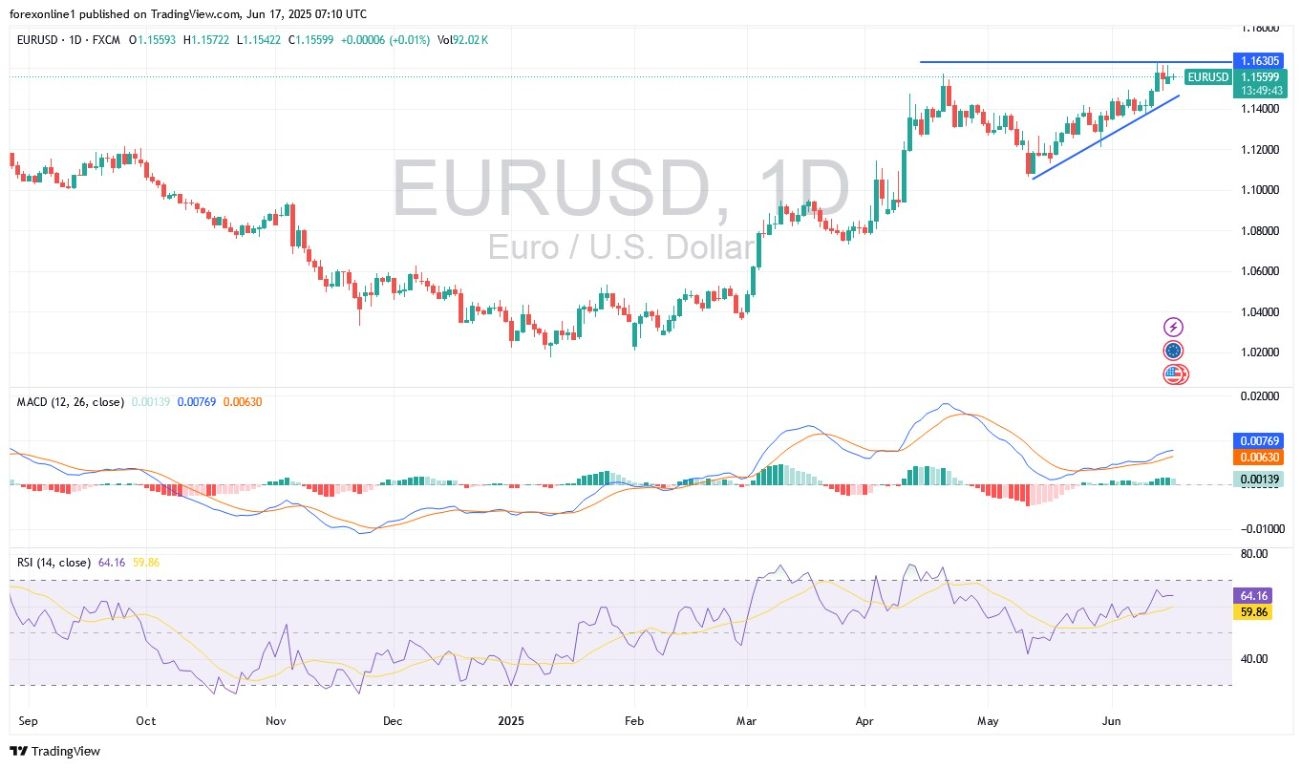
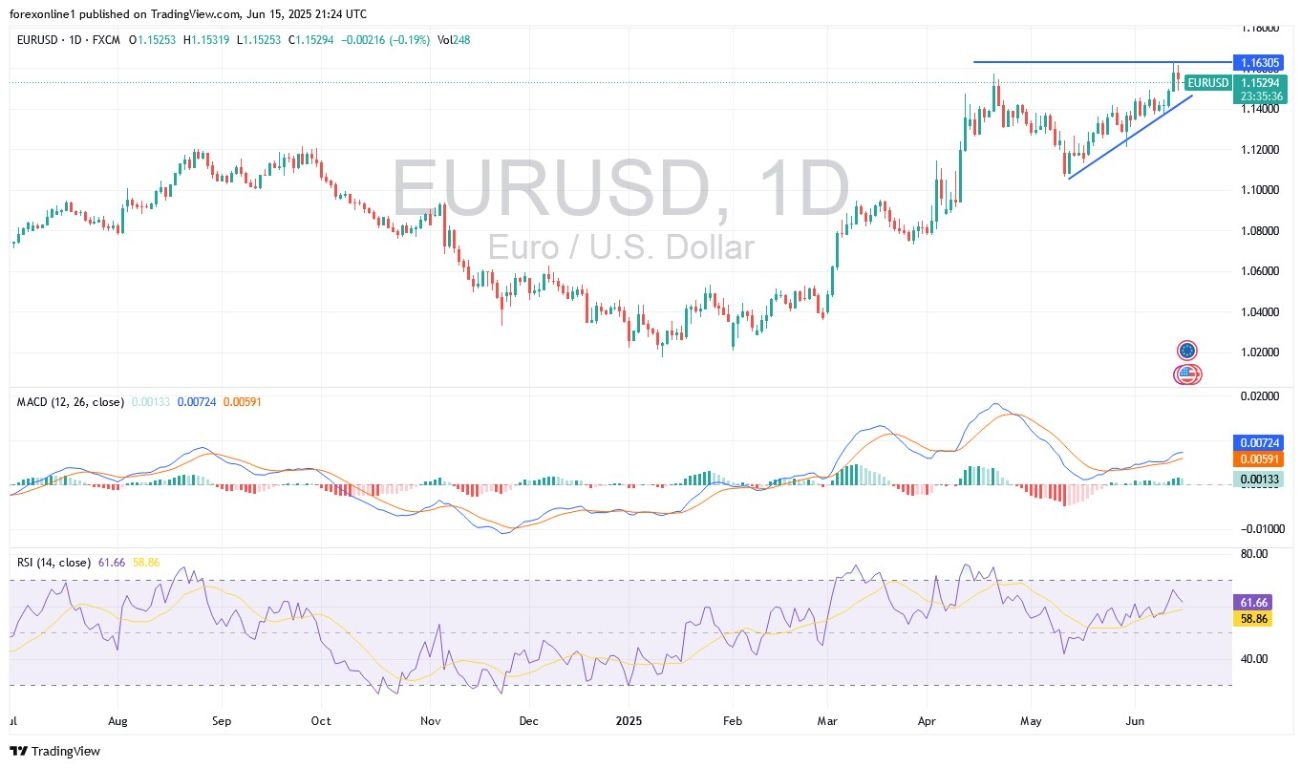
Based on recent trades, the EUR/USD pair continues to trade within a well-defined ascending channel, which has guided price action over the past few weeks. The EUR/USD pair is currently testing a resistance level near the upper boundary at 1.1540. The currency pair has demonstrated resilience by maintaining its upward trajectory along the lower trendline support of the channel.
Overall, technical analysis reveals that the EUR/USD pair recently approached the top of the channel after bouncing off support levels, indicating sustained upward momentum. However, approaching the resistance level might lead to some profit-taking or consolidation before the next directional movement begins. Fibonacci retracement levels provide key reference points for potential pullback scenarios. Should the EUR/USD pair retrace from its current levels, initial support might appear around the 38.2% retracement level at 1.1532, followed by the more significant 50% level at 1.1502.
A deeper correction could extend towards the 61.8% Fibonacci level at 1.1473, which closely coincides with dynamic support levels.

The EUR/USD trend remains upward, but it may face some volatility from the announcement of US inflation figures and the US Federal Reserve’s policy announcements this week, in addition to the extent of investor risk aversion.
At the same time, the moving average formation supports positive expectations, with shorter-term averages positioned above longer-term averages, confirming that the stronger path remains upward. These dynamic levels are trending higher and may provide support for any short-term weakness, reinforcing the lower boundary of the ascending channel. From a momentum perspective, the Stochastic indicator appears to be approaching the overbought region, suggesting that upward pressure might reach exhaustion levels. This situation indicates the possibility of sellers emerging soon, which could lead to a pullback within the channel’s framework.
The RSI (Relative Strength Index) readings show the oscillator fluctuating between neutral and slightly bullish, allowing for further upside before reaching overbought territory. However, any decline from current levels suggests the potential for a corrective phase to begin. Overall, the technical outlook for EUR/USD remains positive within the ascending channel structure, though some consolidation or a slight pullback would not be surprising given its proximity to resistance and momentum indicators.
Today’s EUR/USD trading will be influenced by important economic data, led by the ZEW German Economic Sentiment Index reading, with expectations for a recovery to 34.8 from the previous reading of 25.2. This release is due at 12:00 PM Egypt time. Later the same day, the EUR/USD will react to the announcement of US retail sales figures, due at 3:30 PM Egypt time. These figures confirm consumer confidence and, consequently, spending.
During yesterday’s trading session, European stocks closed significantly higher across stock trading platforms, ending five consecutive sessions of losses. Recently, the easing of concerns that hostilities between Israel and Iran would impede the global economy contributed to higher global stock prices. Recent reports indicated that Tehran is prepared to resume nuclear talks with the United States, signalling its readiness to de-escalate exchanges with Israel, which bolstered hopes that the conflict would not negatively impact global economic activity and energy prices. Financial markets are also preparing for key monetary policy decisions this week, led by the Bank of England, the Swiss National Bank, the Swedish Central Bank, and the Norwegian Central Bank, in addition to the US Federal Reserve and the Bank of Japan outside of Europe.
According to trading activity, bank stocks led the gains as bond yields fell, with shares of Santander, BNP Paribas, Intesa Sanpaolo, and UniCredit rising between 2.5% and 3%. Technology stocks also saw increases, with Adyen and Nokia shares jumping between 2% and 3%. Finally, Kering’s stock rose by 12% on expectations that Luca de Meo, CEO of Renault, would join the luxury goods giant.
Ready to trade our daily Forex analysis? We’ve made a list of the best forex trading platforms for beginners worth trading with.
Despite Platinum price attempts to provide some positive trading, but its repeated stability below the barrier at $1275.00 level assists to motivate providing new bearish trading, attempting to decline below $1225.00, then targeting $1184.00 level, which represents the initial extra target for the near trading.
By the above image, we notice stochastic reach below 50 level, to increase the chances for gathering the required negative momentum to reach the mentioned negative stations.
The expected trading range for today is between $1185.00 and $1260.00
Trend forecast: Bearish
Despite Platinum price attempts to provide some positive trading, but its repeated stability below the barrier at $1275.00 level assists to motivate providing new bearish trading, attempting to decline below $1225.00, then targeting $1184.00 level, which represents the initial extra target for the near trading.
By the above image, we notice stochastic reach below 50 level, to increase the chances for gathering the required negative momentum to reach the mentioned negative stations.
The expected trading range for today is between $1185.00 and $1260.00
Trend forecast: Bearish
The Federal Open Market Committee (FOMC) begins its two-day policy meeting today, with a decision expected Wednesday. While no immediate policy changes are anticipated, traders are keenly focused on Chair Jerome Powell’s forward guidance, especially in light of tariff-related inflation risks.
Increased tensions in the Middle East, particularly following strikes near the Strait of Hormuz and concerns over energy infrastructure, have revived safe-haven flows into gold and silver. Though the situation remains fluid, the proximity of these developments to vital shipping lanes has stoked investor caution.
On Monday, three oil tankers reportedly caught fire in the Gulf of Oman. While investigations are ongoing, the incident drew parallels to the 2019 tanker attacks and triggered risk aversion across Asian equity markets. Gold, long considered a geopolitical hedge, responded accordingly.
Silver (XAG/USD), meanwhile, mirrored gold’s strength, rising toward $36.50. The metal briefly touched $36.4955 before stabilizing.
Gold holds above $3,373 trendline support as bulls eye $3,404. Silver consolidates near $36.64, with breakout potential toward $36.88 if $36.12 support holds. Momentum remains neutral.
Important DisclaimersThe content provided on the website includes general news and publications, our personal analysis and opinions, and contents provided by third parties, which are intended for educational and research purposes only. It does not constitute, and should not be read as, any recommendation or advice to take any action whatsoever, including to make any investment or buy any product. When making any financial decision, you should perform your own due diligence checks, apply your own discretion and consult your competent advisors. The content of the website is not personally directed to you, and we does not take into account your financial situation or needs.The information contained in this website is not necessarily provided in real-time nor is it necessarily accurate. Prices provided herein may be provided by market makers and not by exchanges.Any trading or other financial decision you make shall be at your full responsibility, and you must not rely on any information provided through the website. FX Empire does not provide any warranty regarding any of the information contained in the website, and shall bear no responsibility for any trading losses you might incur as a result of using any information contained in the website.The website may include advertisements and other promotional contents, and FX Empire may receive compensation from third parties in connection with the content. FX Empire does not endorse any third party or recommends using any third party’s services, and does not assume responsibility for your use of any such third party’s website or services.FX Empire and its employees, officers, subsidiaries and associates, are not liable nor shall they be held liable for any loss or damage resulting from your use of the website or reliance on the information provided on this website.Risk DisclaimersThis website includes information about cryptocurrencies, contracts for difference (CFDs) and other financial instruments, and about brokers, exchanges and other entities trading in such instruments. Both cryptocurrencies and CFDs are complex instruments and come with a high risk of losing money. You should carefully consider whether you understand how these instruments work and whether you can afford to take the high risk of losing your money.FX Empire encourages you to perform your own research before making any investment decision, and to avoid investing in any financial instrument which you do not fully understand how it works and what are the risks involved.
Despite Platinum price attempts to provide some positive trading, but its repeated stability below the barrier at $1275.00 level assists to motivate providing new bearish trading, attempting to decline below $1225.00, then targeting $1184.00 level, which represents the initial extra target for the near trading.
By the above image, we notice stochastic reach below 50 level, to increase the chances for gathering the required negative momentum to reach the mentioned negative stations.
The expected trading range for today is between $1185.00 and $1260.00
Trend forecast: Bearish
The USD/JPY outlook remains slightly supported as the pair snapped a two-day winning streak after the Bank of Japan left the policy rate unchanged at 0.50%. Earlier this week, the pair saw a rise amid safe-haven flows triggered by the Middle East crisis.
-If you are interested in forex day trading then have a read of our guide to getting started-
However, the yen bulls may struggle to find a meaningful trend as the Bank of Japan could postpone the rate hikes to the first quarter of 2026 due to tariff uncertainty. In the G7 meeting, the US and Japan could not reach an agreement on the tariffs. Japan’s Finance Minister Kato also stated that they have no plan to meet US Treasury Secretary Bessent. This is another factor that could cap yen’s gains. The US plans to impose 25% tariffs on Japanese vehicles and 24% tariffs on other imports.
According to the UOB analysts, the USD/JPY price may remain within a familiar range of 143.50 to 145.50 with the least probability of breaking the level.
On the other hand, the US dollar remains significantly weak amid last week’s dismal inflation figures. Moreover, the tariff uncertainty continues to linger, giving no room to recover. The currency is gradually losing its safe-haven status as well. Given the recent geopolitics, gold, and yen tend to perform way better than the dollar.
On the geopolitical front, the Iran-Israel conflict enters the fifth day with both sides aggressively attack. President Trump warned Iranians through Truth Social post to evacuate Tehran. A White House official clarified that the purpose of the post was to show urgency to bring Iran to the table for talks.
Investors are cautious as we head towards the FOMC meeting due tomorrow. The Federal Reserve is widely expected to keep rates on hold. However, the monetary policy statement is important to watch as market participants are keen about the policy path and number of cuts in 2025.
The core retail sales are expected to grow, while the retail sales may show a contraction.
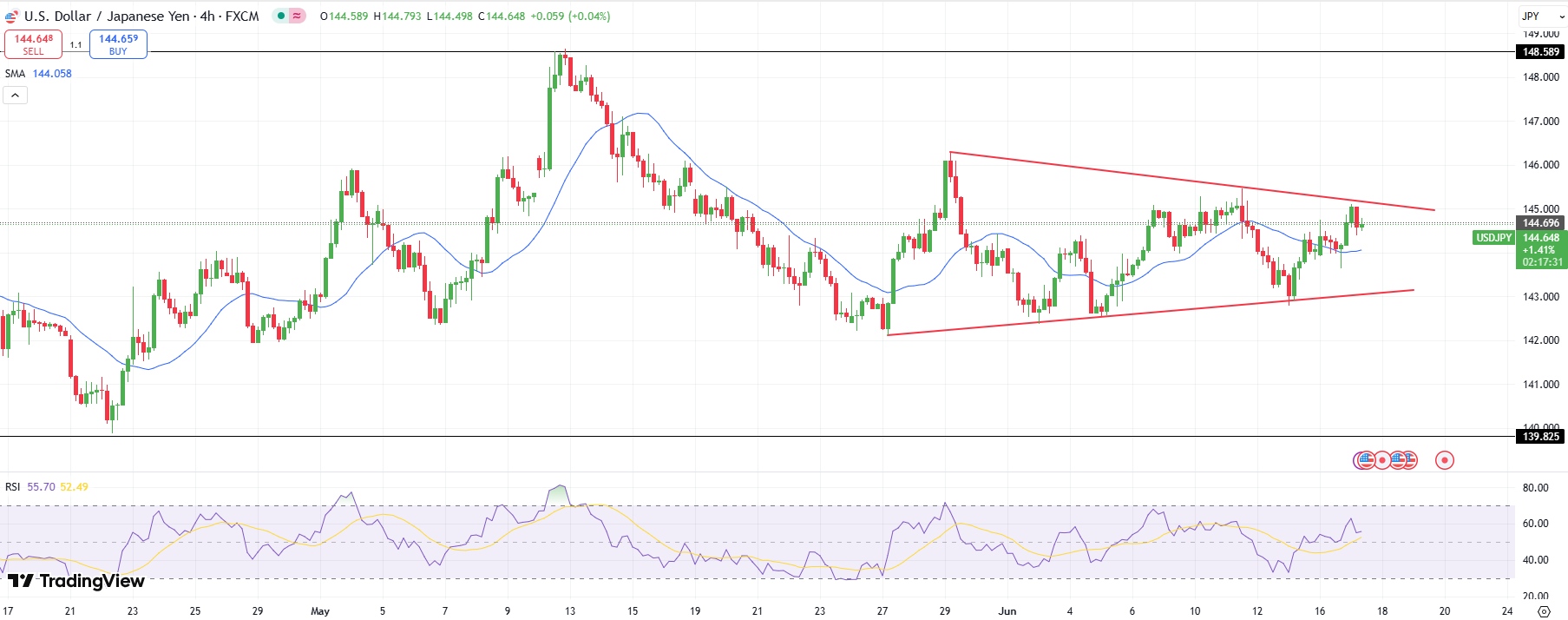
The 4-hour chart shows a bullish pinbar and a rising trendline, lending enough support to the pair. Moreover, the price stays well above the 20-period SMA, which is another bullish sign. The RSI is at 56.0, heading north. These factors reveal that the buyers are mildly dominating. The immediate resistance comes at 145.00 ahead of 145.50.
-Are you looking for the best AI Trading Brokers? Check our detailed guide-
On the flip side, the close below the 20-period SMA could ignite the selling pressure leading towards a support at 144.00 ahead of 143.50.
Looking to trade forex now? Invest at eToro!
67% of retail investor accounts lose money when trading CFDs with this provider. You should consider whether you can afford to take the high risk of losing your money.
Today’s advance shows the likely completion of a bottom with a slightly higher swing low established at $3.45. Support was confirmed around the price level by the confluence of the 50-Day MA, the 20-Day MA, a 50% retracement level, and a significant anchored volume weighted average price (AVWAP) support level calculated from the swing low in April. Recently, the 20-Day MA began to rise again and moved away from the 50-Day MA. That dynamic between the two moving averages is a sign of improving underlying demand.
There were essentially three attempts following the April swing low to reclaim the $3.84 price level. Resistance was seen at $3.84, which established a swing high. Two subsequent rallies stopped short at $3.83 and $3.82, respectively. Monday’s advance shows another likely attempt will be made. Notice that the 50-Day MA (orange) was last reclaimed on June 2. Therefore, the recent pullback was a successful test of prior dynamic resistance as support. Since it was followed by a bullish reversal, the bearish correction should be complete, with a new attempt to rise above $3.84 likely to be seen next.
A rally above today’s high of $3.76 will provide the next sign of strength but an advance above the most recent lower swing high of $3.82 will give a more reliable indication. If the $3.84 level is broken a continuation of the rising ABCD pattern will be triggered and increase the chance of eventually reaching the initial target from the pattern at $4.08. That price level can be considered as potential resistance along with the 61.85% Fibonacci retracement level at $4.12.
For a look at all of today’s economic events, check out our economic calendar.
Ahead of significant economic events this week and the escalation of global tensions over the past weekend, we anticipate strong and exciting volatility in forex markets this week. According to licensed trading platforms, the EUR/USD pair jumped to the 1.1632 resistance level, its highest in three and a half years, before experiencing a swift sell-off last Friday. This moved the pair towards the 1.1488 support level before it closed the week settling around 1.1550. This bullish movement in the EUR/USD pair may react to geopolitical tensions in the Middle East in the new trading week, following the Israeli attack on Iranian nuclear facilities, raising fears of a broader regional conflict.
Also, financial markets will closely monitor any progress in trade negotiations between the United States and its major partners. Meanwhile, attention turns to the G7 summit in Canada, where leaders of the world’s largest economies will meet to discuss major global challenges. It’s also a busy week for monetary policy decisions from global central banks. The US Federal Reserve, the People’s Bank of China, the Bank of Japan, and the Bank of England are all expected to keep interest rates unchanged.
The Euro’s gains may be vulnerable to collapse if investor risk aversion increases amid successive global tensions.
Technically, the overall outlook for the EUR/USD price remains bullish so far. Its recent gains and the breach of the 1.1600 resistance have pushed some technical indicators, led by the 14-day RSI (Relative Strength Index) and MACD (Moving Average Convergence Divergence) lines, to the brink of overbought readings. I anticipate that the EUR/USD will be a target for selling from above the 1.1600 resistance, especially if forex investors turn to buying the US Dollar as a safe haven amid global trade and geopolitical tensions. The nearest targets for the bulls are currently 1.1660, 1.1720, and 1.1800, respectively. These levels are sufficient to push all technical indicator readings into overbought territory.
Renewed selling of the Euro against the US Dollar is the more likely forecast given events in the Middle East and concerns about the military conflicts expanding to other countries. This threatens crude oil sources, leading to a setback for the future of global economic recovery, which would significantly harm the Euro. Based on the daily timeframe chart, the 1.1370 support level will remain a technical threat to the EUR/USD’s upward movement, as it could increase selling pressure towards the psychological support of 1.1200. At the start of this trading week, the EUR/USD is not anticipating any significant economic releases from either the Eurozone or the United States.
According to forex market experts, Israel’s strikes on Iran are stimulating a US Dollar rebound, causing the Euro to retreat against the US Dollar from its 43-month high. However, the EUR/USD pair saw a sharp decline to below 1.1520 on Friday, following the Israeli strike on Iranian nuclear facilities, amid escalating geopolitical tensions, a sharp rise in oil prices, and a decline in stock markets. According to trading experts at ING Bank, “We believe the starting point was already quite extended for this EUR/USD pair, and a return to the 1.14-1.15 range seems perfectly appropriate.”
Danske Bank noted that “the attack adds significant uncertainty to diplomacy, as US officials deny direct involvement and warn that it could hinder, or unexpectedly force, Iran into discussions.”
Overall, the Israeli strikes have added to the underlying trade and economic uncertainty. There is inevitably concern about any escalation as markets remain closed and safe-haven assets are increasingly sought. According to currency trading experts, “The geopolitical turmoil could temporarily distort the US dollar’s downward trend and weigh on risk indicators.” They also point out that “the main difference from previous confrontations between Israel and Iran is the targeting of nuclear facilities, and while crude oil production does not appear to have been affected so far, markets must add a higher risk premium given Iran’s pivotal role in global oil supplies.”
Ready to trade our Forex daily forecast? We’ve shortlisted the best forex broker list for you to check out.