The main category of Forex News.
You can use the search box below to find what you need.
[wd_asp id=1]
The main category of Forex News.
You can use the search box below to find what you need.
[wd_asp id=1]
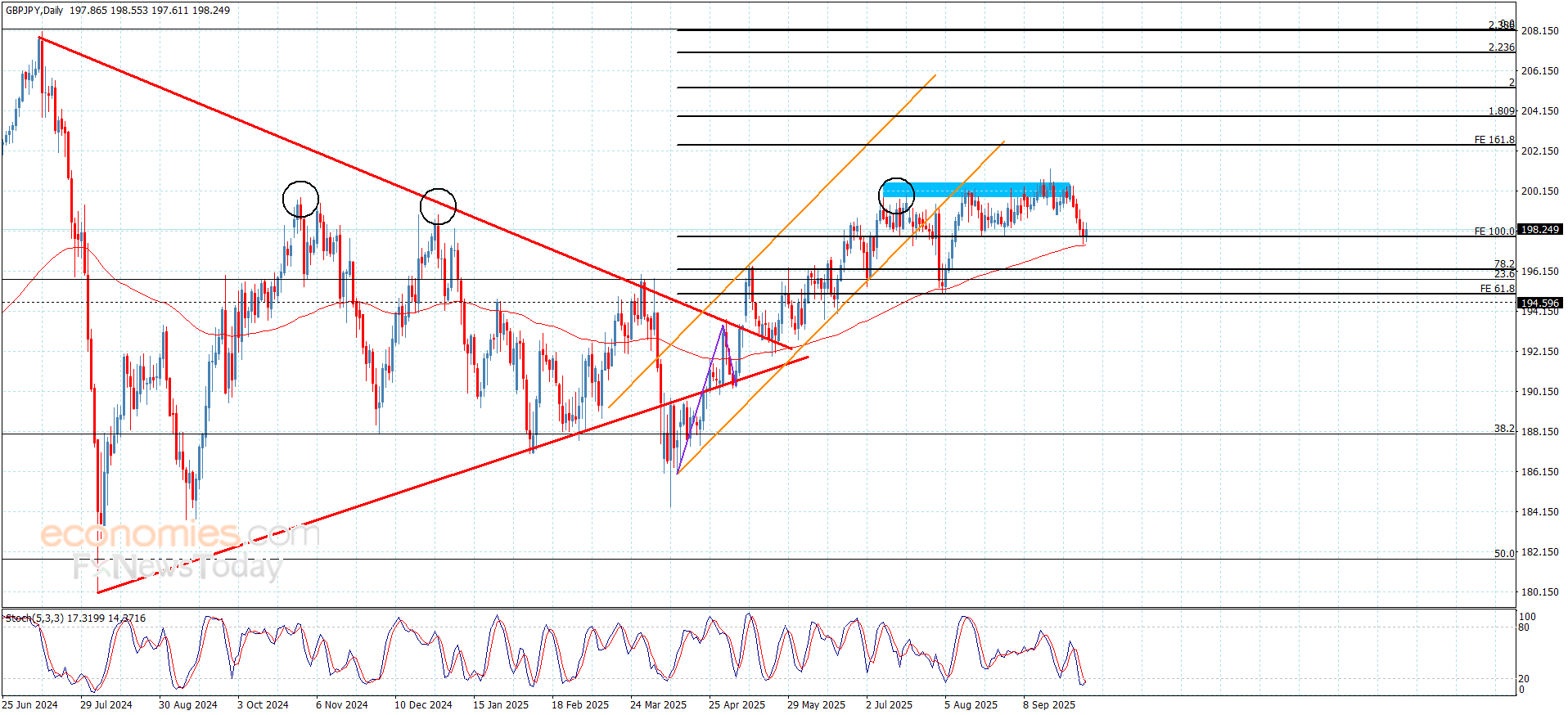
The GBPJPY pair remains affected by the negative pressure that comes from stochastic reach to the oversold level, to notice its attempt to reach below the support at 197.80, facing the moving average 55 then bouncing again to settle above the support as appears in the above image.
The stability above the current support will increase the chances of renewing the bullish attempts, to expect targeting some positive stations by its rally towards 198.80 and 199.80, while moving to the negative track requires forming strong bearish waves, to surpass the moving average 55, then target 196.30 level.
The expected trading range for today is between 197.55 and 198.80
Trend forecast: Bullish
The (Brent) price rose in its last trading on the intraday levels, amid the dominance of main bearish wave on the short-term basis, with the continuation of the negative pressure that comes from its trading below EMA50, intensifying the negative pressure around the price, attempting to recover some of its previous losses, and offloading some of its clear oversold levels on the relative strength indicators, especially with the emergence of the positive signals.
Get high-accuracy trading signals delivered directly to your Telegram. Subscribe to specialized packages tailored for the world’s top markets:
Full VIP signals performance report for September 22–26, 2025:
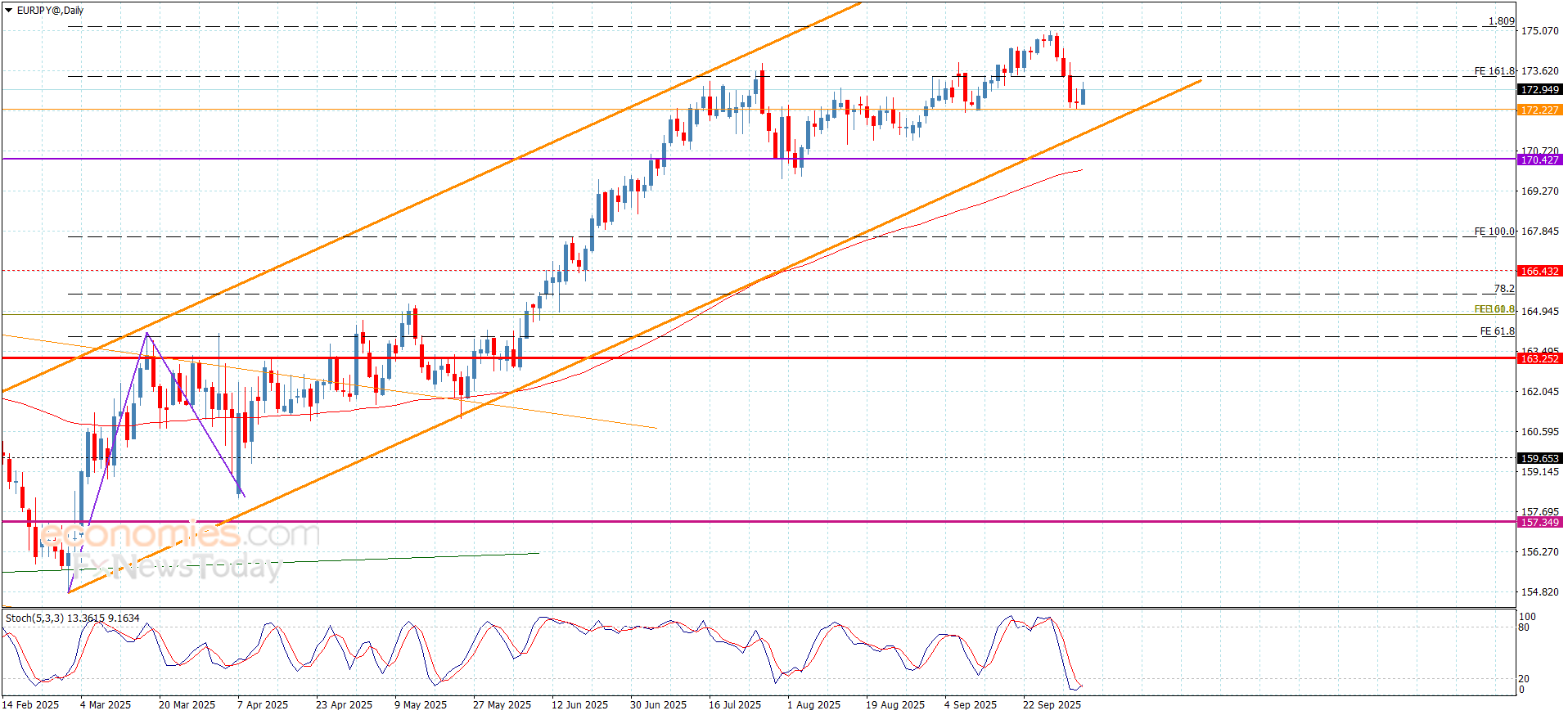
The EURJPY pair kept its positive stability above the extra support level at 172.20, which allowed it to achieve some gains, to notice its rally towards 173.20, approaching from the initial barrier at 173.40 level.
By the above image, we notice stochastic attempt to exit the oversold level, opening the way for more of the positive stations by its rally to 174.40, while suffering new negative pressure and reaching below 172.20 might push it to attack the support of the main bullish channel at 171.45 before any attempt to hit the positive targets.
The expected trading range for today is between 172.20 and 173.70
Trend forecast: Bullish
Silver hits fresh daily highs above $47.50 after bouncing from lows right below $46.00.
Precious metals are rallying on Friday, as the US Dollar weakens across the board.
XAG/USD’s bulls targeting the 4-year highs at $48.03
Silver (XAG/USD) has resumed its bullish trend on Friday to retrace most of Thursday’s losses, supported by a softer US Dollar. XAG/USD has reached session highs above $47.50 after bouncing at $46.00 on Thursday, and is drawing closer to the long-term highs, in the area of $48.00.
Precious metals are rallying, as investors shrug off the hawkish comments from Fed’s Logan, putting further rate cuts into question. The downbeat employment figures seen earlier this week and the US Government shutdown have boosted investors’ expectations that the US central bank will cut rates in October, and, highly likely, also in December
The pair’s corrective pullback found support right below $46.00 on Thursday and is trading higher, at least for now. The 4-hour RSI has returned below the overbought area and, although the daily chart keeps showing signs that the rally is overextended, right now there is room for further appreciation.
Immediate resistance is at the mentioned $48.00 area, which capped bulls on Wednesday and Thursday. Beyond here, the top pf the near-term bullish channel is around $48.65. The 161.8% extension of the September 17-23 bullish run, at $49.15, further down, the next targets are at $45.30 (September 25 high) and $44.50 (September 23 high).
To the downside, immediate support area is at the area between the bottom of the mentioned channel, now at $46.15 and the September 30 and October 2 lows, around $45.95 from current levels might find support at the $45.96 intraday lows ahead of the previous long-term highs, at $45.30 (September 25 high) and $44.45 (September 23 high).
Silver is a precious metal highly traded among investors. It has been historically used as a store of value and a medium of exchange. Although less popular than Gold, traders may turn to Silver to diversify their investment portfolio, for its intrinsic value or as a potential hedge during high-inflation periods. Investors can buy physical Silver, in coins or in bars, or trade it through vehicles such as Exchange Traded Funds, which track its price on international markets.
Silver prices can move due to a wide range of factors. Geopolitical instability or fears of a deep recession can make Silver price escalate due to its safe-haven status, although to a lesser extent than Gold’s. As a yieldless asset, Silver tends to rise with lower interest rates. Its moves also depend on how the US Dollar (USD) behaves as the asset is priced in dollars (XAG/USD). A strong Dollar tends to keep the price of Silver at bay, whereas a weaker Dollar is likely to propel prices up. Other factors such as investment demand, mining supply – Silver is much more abundant than Gold – and recycling rates can also affect prices.
Silver is widely used in industry, particularly in sectors such as electronics or solar energy, as it has one of the highest electric conductivity of all metals – more than Copper and Gold. A surge in demand can increase prices, while a decline tends to lower them. Dynamics in the US, Chinese and Indian economies can also contribute to price swings: for the US and particularly China, their big industrial sectors use Silver in various processes; in India, consumers’ demand for the precious metal for jewellery also plays a key role in setting prices.
Silver prices tend to follow Gold’s moves. When Gold prices rise, Silver typically follows suit, as their status as safe-haven assets is similar. The Gold/Silver ratio, which shows the number of ounces of Silver needed to equal the value of one ounce of Gold, may help to determine the relative valuation between both metals. Some investors may consider a high ratio as an indicator that Silver is undervalued, or Gold is overvalued. On the contrary, a low ratio might suggest that Gold is undervalued relative to Silver.
After losing about 0.3% and snapping a four-day winning streak on Thursday, GBP/USD holds steady at around 1.3450 in the European session on Friday. The pair’s technical outlook points to a loss of bullish momentum as market focus shifts to the Institute for Supply Management’s (ISM) Services Purchasing Managers’ Index (PMI) data for September.
The table below shows the percentage change of British Pound (GBP) against listed major currencies this week. British Pound was the strongest against the Canadian Dollar.
| USD | EUR | GBP | JPY | CAD | AUD | NZD | CHF | |
|---|---|---|---|---|---|---|---|---|
| USD | -0.27% | -0.40% | -1.41% | 0.22% | -0.84% | -0.76% | -0.06% | |
| EUR | 0.27% | -0.14% | -1.28% | 0.49% | -0.56% | -0.50% | 0.19% | |
| GBP | 0.40% | 0.14% | -1.07% | 0.63% | -0.49% | -0.36% | 0.33% | |
| JPY | 1.41% | 1.28% | 1.07% | 1.70% | 0.63% | 0.53% | 1.41% | |
| CAD | -0.22% | -0.49% | -0.63% | -1.70% | -1.01% | -0.98% | -0.31% | |
| AUD | 0.84% | 0.56% | 0.49% | -0.63% | 1.01% | 0.06% | 0.76% | |
| NZD | 0.76% | 0.50% | 0.36% | -0.53% | 0.98% | -0.06% | 0.84% | |
| CHF | 0.06% | -0.19% | -0.33% | -1.41% | 0.31% | -0.76% | -0.84% |
The heat map shows percentage changes of major currencies against each other. The base currency is picked from the left column, while the quote currency is picked from the top row. For example, if you pick the British Pound from the left column and move along the horizontal line to the US Dollar, the percentage change displayed in the box will represent GBP (base)/USD (quote).
In the second day of the US federal government shutdown on Thursday, the Senate did not vote on the funding legislation in observance of the Yom Kippur holiday.
Nevertheless, United States (US) President Donald Trump’s administration announced late Wednesday that they froze $26 billion for Democratic-leaning states. Additionally, Trump noted that he will meet with the head of the Office of Management and Budget, Russ Vought, to discuss which federal programs could be cut.
In case lawmakers make progress on finding an agreement to restore funding to the government following these developments, the US Dollar (USD) could gather strength heading into the weekend and cause GBP/USD to stretch lower.
Because of the shutdown, the US Bureau of Labor Statistics will not publish the Nonfarm Payrolls data for September later in the day. Instead, investors will scrutinize the ISM Services PMI report and its Employment Index component.
The ISM Services PMI is expected to stay in the expansion territory, slightly above 50, in September. If the headline PMI drops below 50, the immediate reaction could hurt the USD. In case the headline PMI remains above 50 and the Employment Index, which was 46.5 in August, rises above 50, the USD could outperform its rivals and weigh on GBP/USD.
The Relative Strength Index (RSI) indicator on the 4-hour chart stays near 50, pointing to a lack of directional momentum.
The 100-day Simple Moving Average (SMA) and the 20-day SMA form a strong resistance level at 1.3500. The 100-period and the 200-period SMAs on the 4-hour chart reinforce this hurdle as well. In case GBP/USD clears 1.3500, technical buyers could show interest. In this scenario, 1.3550 (Fibonacci 23.6% retracement of the latest uptrend) could be seen as the next resistance level before 1.3600 (static level, round level).
On the downside, support levels 1.3410-1.3400 (Fibonacci 50% retracement, round level) and 1.3360 (Fibonacci 61.8% retracement).
The Pound Sterling (GBP) is the oldest currency in the world (886 AD) and the official currency of the United Kingdom. It is the fourth most traded unit for foreign exchange (FX) in the world, accounting for 12% of all transactions, averaging $630 billion a day, according to 2022 data.
Its key trading pairs are GBP/USD, also known as ‘Cable’, which accounts for 11% of FX, GBP/JPY, or the ‘Dragon’ as it is known by traders (3%), and EUR/GBP (2%). The Pound Sterling is issued by the Bank of England (BoE).
The single most important factor influencing the value of the Pound Sterling is monetary policy decided by the Bank of England. The BoE bases its decisions on whether it has achieved its primary goal of “price stability” – a steady inflation rate of around 2%. Its primary tool for achieving this is the adjustment of interest rates.
When inflation is too high, the BoE will try to rein it in by raising interest rates, making it more expensive for people and businesses to access credit. This is generally positive for GBP, as higher interest rates make the UK a more attractive place for global investors to park their money.
When inflation falls too low it is a sign economic growth is slowing. In this scenario, the BoE will consider lowering interest rates to cheapen credit so businesses will borrow more to invest in growth-generating projects.
Data releases gauge the health of the economy and can impact the value of the Pound Sterling. Indicators such as GDP, Manufacturing and Services PMIs, and employment can all influence the direction of the GBP.
A strong economy is good for Sterling. Not only does it attract more foreign investment but it may encourage the BoE to put up interest rates, which will directly strengthen GBP. Otherwise, if economic data is weak, the Pound Sterling is likely to fall.
Another significant data release for the Pound Sterling is the Trade Balance. This indicator measures the difference between what a country earns from its exports and what it spends on imports over a given period.
If a country produces highly sought-after exports, its currency will benefit purely from the extra demand created from foreign buyers seeking to purchase these goods. Therefore, a positive net Trade Balance strengthens a currency and vice versa for a negative balance.
Gold continues to dominate global markets, with XAU/USD trading near $3,844 after briefly dipping toward $3,820 before recovering. The metal is on pace for a seventh straight weekly gain, rising 47% year-to-date and gaining 14% just since late August, making it one of the strongest asset classes in 2025. Futures in India also reflect the surge: MCX December contracts fell slightly to ₹1,16,945 per 10 grams, while the February 2026 contract cooled from a record ₹1,19,674 per 10 grams to ₹1,18,213, highlighting mild profit-taking at these peaks.
The rally is being fueled by the U.S. government shutdown, which entered its second day and created a data blackout from the Bureau of Labor Statistics. Nonfarm Payrolls data may not be released on schedule, amplifying uncertainty. Meanwhile, the Federal Reserve’s pivot is firmly in play, with markets pricing a 99% chance of a 25 bps rate cut at the October 29 FOMC meeting, bringing the fed funds rate into the 3.75%–4% range. Dallas Fed President Lorie Logan warned that inflation remains elevated, but traders see political paralysis and slowing labor momentum as catalysts for easing. This environment has pushed investors aggressively into safe havens, boosting gold alongside falling Treasury yields, with the 10-year yield slipping to 4.08%.
Spot bullion rates in New Delhi were quoted at ₹1,17,000 per 10 grams, while Mumbai rates reached ₹1,17,190 per 10 grams. Silver also tracked higher, with New Delhi at ₹1,42,910/kg and Mumbai at ₹1,43,050/kg. On the MCX, gold futures traded at ₹1,16,290 per 10 grams, underscoring the intensity of futures-driven flows as traders hedge against policy and fiscal risk. This synchronized move across India’s largest bullion centers reinforces that the rally is broad-based and not speculative in isolation.
A critical underpinning of the rally is the massive inflow into Western ETFs, with holdings up 109 tonnes in September alone, compared with Goldman Sachs’ model estimate of just 17 tonnes. This shows private investors are rotating away from bonds into bullion at an accelerated pace. Central bank buying remains strong, with emerging market institutions continuing to diversify away from the U.S. dollar. According to Goldman, speculation has contributed only about 1 percentage point of the 14% rally since August 26, meaning the surge is being driven by structural flows, not hot money.
Analysts note that after such an aggressive run, technical indicators show gold in “overbought” territory. Thursday saw MCX December futures dip ₹643 (-0.55%) as traders booked profits, snapping a five-day winning streak. Still, market watchers suggest pullbacks will be shallow. Support for XAU/USD sits near $3,793, with a stronger floor at the 20-day moving average around $3,713. Upside levels to monitor include $3,850, $3,895, and $3,900, with a sustained break above $3,900 potentially triggering a new wave of inflows.
Goldman Sachs reiterated gold as its “highest-conviction long commodity recommendation,” lifting expectations above its mid-2026 target of $4,000/oz. The bank argues that even minor portfolio shifts from fixed income into gold could unleash another leg higher given the relative size of bond markets. Structurally higher central bank accumulation, coupled with ETF inflows, is building the case for bullion exceeding $4,000 much sooner than initially projected.
From a technical perspective, XAU/USD is consolidating above the EMA50 and riding a supportive bullish trendline, reinforcing upside bias. RSI readings are stretched but remain above the midline, suggesting momentum is intact despite near-term exhaustion signals. A daily close above $3,850 would open the door to retesting $3,895 and $3,900, while a failure to hold $3,832 could invite corrective moves toward $3,793. Sentiment is overwhelmingly bullish, yet the emergence of profit-taking shows traders are cautious at record valuations.
Factoring in the 47% YTD gain, the structural ETF inflows, central bank buying, Fed easing bets, and political turmoil from the U.S. shutdown, gold remains a BUY at current levels. Near-term pullbacks toward $3,793–$3,800 should be seen as entry opportunities, with medium-term upside targets stretching toward $4,000–$4,200 per ounce. Given the macro backdrop, XAU/USD continues to justify its role as the strongest hedge in 2025, even as volatility around these record levels persists.
EUR/USD holds its ground and trades in positive territory, slightly below 1.1750, in the European session on Friday. With the postponement of the release of the September employment data because of the US federal government shutdown, investors will scrutinize the Institute for Supply Management’s (ISM) Services Purchasing Managers’ Index (PMI) data for September.
The table below shows the percentage change of Euro (EUR) against listed major currencies this week. Euro was the strongest against the Canadian Dollar.
| USD | EUR | GBP | JPY | CAD | AUD | NZD | CHF | |
|---|---|---|---|---|---|---|---|---|
| USD | -0.26% | -0.39% | -1.37% | 0.23% | -0.79% | -0.66% | -0.09% | |
| EUR | 0.26% | -0.14% | -1.26% | 0.48% | -0.52% | -0.41% | 0.15% | |
| GBP | 0.39% | 0.14% | -1.05% | 0.62% | -0.45% | -0.27% | 0.29% | |
| JPY | 1.37% | 1.26% | 1.05% | 1.64% | 0.63% | 0.59% | 1.33% | |
| CAD | -0.23% | -0.48% | -0.62% | -1.64% | -0.97% | -0.89% | -0.33% | |
| AUD | 0.79% | 0.52% | 0.45% | -0.63% | 0.97% | 0.12% | 0.69% | |
| NZD | 0.66% | 0.41% | 0.27% | -0.59% | 0.89% | -0.12% | 0.71% | |
| CHF | 0.09% | -0.15% | -0.29% | -1.33% | 0.33% | -0.69% | -0.71% |
The heat map shows percentage changes of major currencies against each other. The base currency is picked from the left column, while the quote currency is picked from the top row. For example, if you pick the Euro from the left column and move along the horizontal line to the US Dollar, the percentage change displayed in the box will represent EUR (base)/USD (quote).
United States (US) President Donald Trump said on Wednesday that he will meet with Russ Vought, the head of the Office of Management and Budget, to see which federal programs could be cut. Additionally, the Trump administration announced that they froze $26 billion for Democratic-leaning states.
Markets could turn optimistic about the shutdown coming to an end soon, in case Democrats look to find a middle ground on the spending bill amid the threat of losing funds for their programs.
Nevertheless, the September employment report, which featured the Nonfarm Payrolls, Unemployment Rate and wage inflation figures, will not be released later in the day.
The ISM Services PMI is forecast to edge lower to 51.7 in September from 52 in August. In the absence of the NFP data, market participants could react to the Employment Index component of the survey, especially if the headline PMI arrives near the market expectation. If the Employment Index recovers above 50 and shows an increase in the service sector payrolls, the USD could gather strength heading into the weekend and cause EUR/USD to turn south. On the flip side, EUR/USD could gather bullish momentum in the American session if this data comes in below the August print of 46.5.
The Relative Strength Index (RSI) indicator on the 4-hour chart moves sideways near 50 and EUR/USD fluctuates between the 20-day and the 50-day Simple Moving Average (SMA), reflecting a neutral stance in the near term.
On the upside, 1.1750-1.1770 aligns as a strong resistance area, where the Fibonacci 23.6% retracement of the latest uptrend meets the 100-period SMA and the 20-day SMA. If EUR/USD manages to clear that hurdle, 1.1820 (static level) could be seen as the next resistance level before 1.1900 (static level, round level).
On the downside, the first support area is located 1.1710-1.1690 (200-period SMA, Fibonacci 38.2% retracement, 50-day SMA) ahead of 1.1640 (Fibonacci 50% retracement).
The Euro is the currency for the 19 European Union countries that belong to the Eurozone. It is the second most heavily traded currency in the world behind the US Dollar. In 2022, it accounted for 31% of all foreign exchange transactions, with an average daily turnover of over $2.2 trillion a day.
EUR/USD is the most heavily traded currency pair in the world, accounting for an estimated 30% off all transactions, followed by EUR/JPY (4%), EUR/GBP (3%) and EUR/AUD (2%).
The European Central Bank (ECB) in Frankfurt, Germany, is the reserve bank for the Eurozone. The ECB sets interest rates and manages monetary policy.
The ECB’s primary mandate is to maintain price stability, which means either controlling inflation or stimulating growth. Its primary tool is the raising or lowering of interest rates. Relatively high interest rates – or the expectation of higher rates – will usually benefit the Euro and vice versa.
The ECB Governing Council makes monetary policy decisions at meetings held eight times a year. Decisions are made by heads of the Eurozone national banks and six permanent members, including the President of the ECB, Christine Lagarde.
Eurozone inflation data, measured by the Harmonized Index of Consumer Prices (HICP), is an important econometric for the Euro. If inflation rises more than expected, especially if above the ECB’s 2% target, it obliges the ECB to raise interest rates to bring it back under control.
Relatively high interest rates compared to its counterparts will usually benefit the Euro, as it makes the region more attractive as a place for global investors to park their money.
Data releases gauge the health of the economy and can impact on the Euro. Indicators such as GDP, Manufacturing and Services PMIs, employment, and consumer sentiment surveys can all influence the direction of the single currency.
A strong economy is good for the Euro. Not only does it attract more foreign investment but it may encourage the ECB to put up interest rates, which will directly strengthen the Euro. Otherwise, if economic data is weak, the Euro is likely to fall.
Economic data for the four largest economies in the euro area (Germany, France, Italy and Spain) are especially significant, as they account for 75% of the Eurozone’s economy.
Another significant data release for the Euro is the Trade Balance. This indicator measures the difference between what a country earns from its exports and what it spends on imports over a given period.
If a country produces highly sought after exports then its currency will gain in value purely from the extra demand created from foreign buyers seeking to purchase these goods. Therefore, a positive net Trade Balance strengthens a currency and vice versa for a negative balance.
– Written by
Ben Hughes
STORY LINK Pound to Dollar Forecast: Bond-Market Jitters Keep GBP Under Pressure
The Pound to Dollar exchange rate (GBP/USD) continues to stall at resistance near 1.3520, with UoB analysts expecting range trading between 1.3360 and 1.3525. Scotiabank is more upbeat, highlighting Sterling’s recovery above its 50-day MA as scope for a sustained push higher, though bond-market jitters remain a core risk.
The Pound to Dollar rate again challenged resistance above 1.3500 on Thursday but failed to hold the gains and retreated to near 1.3450 with another bout of anxiety over UK bonds. Key resistance remains in place around 1.3520/5.
According to UoB; “Yesterday, GBP rose briefly and slightly above 1.3525 (high was 1.3527), before retreating quickly. There has been no clear increase in upward momentum, and we continue to expect GBP to trade between 1.3360 and 1.3525 for now.”
Scotiabank is more confident over the outlook; “We are reassured by the GBP’s push back above its 50 day MA (1.3463) and see scope for a sustained push back above 1.35.”
Longer-term MUFG is not forecasting a GBP/USD move above 1.40 despite dollar vulnerability.
Domestically, the bond market remains a key focus with the latest auction on Thursday.
Get better rates and lower fees on your next international money transfer.
Compare TorFX with top UK banks in seconds and see how much you could save.
Scotiabank commented; “The UK bond market is once again in focus, as the latest 10Y gilt auction generated the lowest oversubscription rate since December 2023. The UK’s fiscal outlook remains a core risk for the GBP into the November 26 budget release.
The 10-year yield increased to 4.75% from below 4.70% before a retreat to 4.72%.
Markets remain wary over the risk of bonds and the Pound weakening in tandem.
The latest US Challenger data recorded a decline in layoffs to just over 54,000 for September from close to 73,000 the previous year.
For the first nine months of the year, layoffs are still 55% higher than the previous year with the highest figure since 2020.
The layoffs data overall offered some encouragement, but Scotiabank focussed on yesterday’s ADP jobs data.
According to the bank; “ADP is down for two consecutive months and negative in three of the past four. That is hard to ignore as a clear sign of more pronounced labour market weakness.”

The US Supreme Court ruled on Wednesday that Fed Governor Cook is allowed to remain in post for now. The court will hear arguments in January over President Trump’s attempt to fire her.
IG market analyst Tony Sycamore commented; “Market concern about the Fed’s independence now moves to the backburner for the next few months.”
MUFG still pointed to longer-term risks; “Without an open Fed Governor seat, President Trump will now likely need to use Stephen Miran’s seat to potentially bring in his candidate to be the next Fed Chair unless he picks an existing Fed Governor to be the next Fed Chair.”
The bank added; “The likelihood of further Fed rate cuts and ongoing threats to the Fed’s independence from the Trump administration are important reasons why we continue to expect further US dollar weakness in the year ahead.”
International Money Transfer? Ask our resident FX expert a money transfer question or try John’s new, free, no-obligation personal service! ,where he helps every step of the way,
ensuring you get the best exchange rates on your currency requirements.
TAGS: Pound Dollar Forecasts
The price of natural gas has dropped to 2021 levels and gas sellers told ERR they don’t expect it to rise significantly for household consumers this fall and winter.
The global market price of natural gas has now dropped so far that it’s returned to the levels seen in the summer of 2021 — that is, back to where it was before Russia launched its full-scale invasion of Ukraine.
As of Thursday, the price of natural gas on the Dutch TTF gas exchange was €31 per megawatt-hour. For comparison, the price briefly spiked to nearly €60 in February of this year, but has been trending downward since. Over the past three months, it has hovered between €30 and €35 per megawatt-hour.
“The gas market is currently stable. New supply chains are in place and the price of gas has fallen back to summer 2021 levels. Current forecasts suggest it will remain around this level through the upcoming heating season,” Kristofer Vähi, head of portfolio management and optimization at Elenger, told ERR.
Vähi said the price for residential customers — €0.54 per cubic meter since June — will remain the same in November. What happens after that will depend on global market prices, especially those on the TTF exchange, which is used to source gas for the Estonian region.
Kalvi Nõu, head of energy trading at Alexela, also told ERR he doesn’t believe gas prices for household consumers will rise this winter.
“Compared to last winter, prices will likely be 20 to 30 percent lower and they probably won’t go up from where they are today,” said Nõu.
Last December, gas prices on the TTF exchange fluctuated between €40 and €50, rose above €50 in January and peaked at €58 per megawatt-hour in February.
Still, a price rebound this fall cannot be ruled out, Vähi noted, because the current balance is still fragile and there are many variables at play.
“The global market is increasingly supplied with U.S. LNG, but large-scale growth in supply will take a few more years. In Europe, storage levels are somewhat below the historical average, which means that cold weather or unexpected events could cause price volatility,” he said.
Nõu, however, pointed out that due to the increased LNG production capacity compared to last year, the risk of a gas shortage in the European Union has become minimal, and that’s reflected in the prices.
“In theory, factors that could drive up gas prices include cold weather and forecasts, geopolitical developments or problems with LNG export capacity,” he added.
According to Nõu, gas storage in the EU currently stands at 82.5 percent of maximum capacity and will likely increase somewhat further before the active heating season begins.
There are no supply issues in Estonia’s region either, Vähi said.
“There are no problems with supply security in the Baltic region and overall the situation is stable. In addition to ongoing LNG deliveries, the region’s gas needs are buffered by Latvia’s very large underground storage facility,” he said.
—
EUR/JPY gains ground after a neutral day, trading around 173.10 during the Asian hours on Friday. The technical analysis of the daily chart indicates a revival of bullish bias as the currency cross rebounded toward the ascending channel pattern.
However, the 14-day Relative Strength Index (RSI) remains below the 50 mark, suggesting that bearish bias is still in play. Additionally, the short-term price momentum is weaker as the EUR/JPY cross is positioned below the nine-day Exponential Moving Average (EMA).
On the downside, the primary support appears at the 50-day EMA at 172.49. A break below this level would weaken the medium-term price momentum and put downward pressure on the EUR/JPY cross to navigate the region around the three-month low of 169.72, which was recorded on July 31.
A successful return into the ascending channel would revive the bullish bias and lead the EUR/JPY cross to test its initial barrier at the nine-day EMA of 173.48. Further advances would improve the short-term price momentum and support the currency cross to explore the area around the ascending channel’s upper boundary at 175.40, aligned with the all-time high of 175.43, reached in July 2024.
The table below shows the percentage change of Euro (EUR) against listed major currencies today. Euro was the strongest against the Japanese Yen.
| USD | EUR | GBP | JPY | CAD | AUD | NZD | CHF | |
|---|---|---|---|---|---|---|---|---|
| USD | -0.08% | -0.09% | 0.28% | -0.01% | -0.05% | -0.05% | -0.04% | |
| EUR | 0.08% | 0.05% | 0.35% | 0.08% | 0.04% | 0.03% | 0.04% | |
| GBP | 0.09% | -0.05% | 0.34% | 0.01% | -0.01% | -0.02% | -0.01% | |
| JPY | -0.28% | -0.35% | -0.34% | -0.29% | -0.34% | -0.34% | -0.34% | |
| CAD | 0.01% | -0.08% | -0.01% | 0.29% | -0.02% | -0.04% | -0.02% | |
| AUD | 0.05% | -0.04% | 0.01% | 0.34% | 0.02% | -0.01% | -0.03% | |
| NZD | 0.05% | -0.03% | 0.02% | 0.34% | 0.04% | 0.01% | 0.01% | |
| CHF | 0.04% | -0.04% | 0.00% | 0.34% | 0.02% | 0.03% | -0.01% |
The heat map shows percentage changes of major currencies against each other. The base currency is picked from the left column, while the quote currency is picked from the top row. For example, if you pick the Euro from the left column and move along the horizontal line to the US Dollar, the percentage change displayed in the box will represent EUR (base)/USD (quote).