The main category of Forex News.
You can use the search box below to find what you need.
[wd_asp id=1]
The main category of Forex News.
You can use the search box below to find what you need.
[wd_asp id=1]
The latest developments come as Israel reportedly targeted Iran’s nuclear sites and senior military commanders, prompting retaliatory drone attacks from Iran. According to Israel’s military, over 100 drones were launched by Iran in response. The rising instability has rattled global markets, increased investor anxiety, and sent gold prices to their highest level in nearly two months, signaling a classic flight to safety.
The benchmark Brent crude price surged over 10% shortly after Israel confirmed the attack, climbing to levels not seen since January. As European markets opened, prices cooled slightly but still held a 5% gain compared to Thursday, trading around $72.80 per barrel. U.S. West Texas Intermediate (WTI) also rose, trading at $73.20.
Although prices remain well below the $100-plus highs seen during Russia’s 2022 invasion of Ukraine, traders are now pricing in potential threats to vital supply routes and oil facilities across the region. The Middle East is home to a significant share of global oil production, and any conflict that puts that at risk sends shockwaves through the market.
Yes, energy analysts are warning that this conflict, if it escalates, could disrupt oil flows—especially if Iran targets infrastructure or shipping routes like the Strait of Hormuz. This narrow waterway is one of the most critical chokepoints for global energy supplies, with nearly one-fifth of the world’s oil passing through it daily. According to Saul Kavonic, head of energy research at MST Financial, “What we see now is a very initial risk-on reaction. But over the next day or two, the market will need to factor in where this could escalate to.” Capital Economics analysts say if Iranian production or export facilities are hit, Brent crude could rise to $80–$100 per barrel, depending on the scale of the disruption. However, they also suggest that higher prices could trigger increased output from other oil-producing nations, which might limit the long-term impact.
The rising oil prices triggered widespread uncertainty across financial markets. Stock markets across Asia and Europe declined, with Japan’s Nikkei closing down 0.9% and the UK’s FTSE 100 index falling 0.4% by mid-morning.
At the same time, “safe-haven assets” like gold and the Swiss franc gained sharply. The gold price jumped 1.2% to hit $3,423.30 an ounce, marking its highest level in nearly two months.
These moves reflect growing investor concern that this latest round of violence could spiral into a wider regional conflict, with unpredictable effects on global inflation and energy supply.
It’s still unclear whether this spike in crude prices will immediately impact prices at the pump. According to Rod Dennis from the UK’s RAC motoring group, it’s “too soon” to say.
He added that “there are two key factors at play: whether higher wholesale fuel prices are sustained over the coming days and, crucially, the sort of margin retailers decide to take.”
If the conflict continues or worsens, consumers could feel the pinch in the form of higher petrol and diesel prices, especially if disruptions reach the Strait of Hormuz. Rising fuel costs also feed into higher transportation and food prices, which could affect inflation worldwide.
Analysts are warning that the current situation could either calm quickly—or spiral into a broader war. Vandana Hari of Vanda Insights told the BBC, “It’s an explosive situation, albeit one that could be defused quickly, as we saw in April and October last year.”
However, she also warned, “It could also spiral out into a bigger war that disrupts Mideast oil supply.”
If Iran’s oil infrastructure or shipping routes come under serious threat, the global energy market could face a major crisis. With multiple countries relying heavily on oil shipped from the Gulf, any major conflict could send shockwaves far beyond the region.
Oil traders and analysts will now be closely watching political and military developments. Key questions include whether Iran escalates its response, if other regional powers become involved, and how the U.S. and allies react. At the same time, OPEC and major producers may be forced to consider output changes to stabilize markets.
As the situation unfolds, the global economy faces rising uncertainty—not just over oil, but over inflation, market stability, and energy security.
Q1: Why did global oil prices surge after Israel’s strike on Iran?
Oil prices jumped due to fears that the Israel-Iran conflict could disrupt key Middle East oil supplies.
Q2: Could the Strait of Hormuz be affected by this conflict?
Yes, if tensions rise, Iran might block or disrupt oil flow through the crucial Strait of Hormuz.
The GBP/USD weekly forecast remains strongly bullish as the pair hits its third consecutive week in gains. The price marked a 39-month top at 1.3635 before pulling back ahead of the weekend.
-If you are interested in forex day trading then have a read of our guide to getting started-
The bullish momentum gained traction after a period of consolidation earlier in the week. The weaker dollar and improved risk sentiment helped the buyers. However, the key catalyst was progress in the US-China trade negotiation, concluded in London with an agreement to ease restrictions on exports, including rare earth metals. Though the announcement had no details, it boosted risk appetite and weighed on the safe-haven Greenback.
The US inflation data surprised the market to the downside, with a 0.1% rise on a monthly basis, which dragged annual inflation to 2.4%, missing the estimate of 2.5%. The core inflation also remained downbeat, increasing odds for a dovish Fed. This was further fueled by softer US PPI data and rising weekly jobless claims that deepened the USD losses and provided additional strength to the pound.
However, the rally proved to be short-lived. Geopolitical tensions ignited later in the week due to Israel’s attack on Iran, killing Iranian military officials and scientists. Iran responded in retaliation, which escalated the fear of broader conflict.
The safe-haven demand for the US dollar soared on the news that triggered a significant pullback of more than a hundred pips in the GBP/USD pair. The downward pressure was further intensified by the UoM Consumer Sentiment Index that rose to 60.5, well above the expected 53.5.
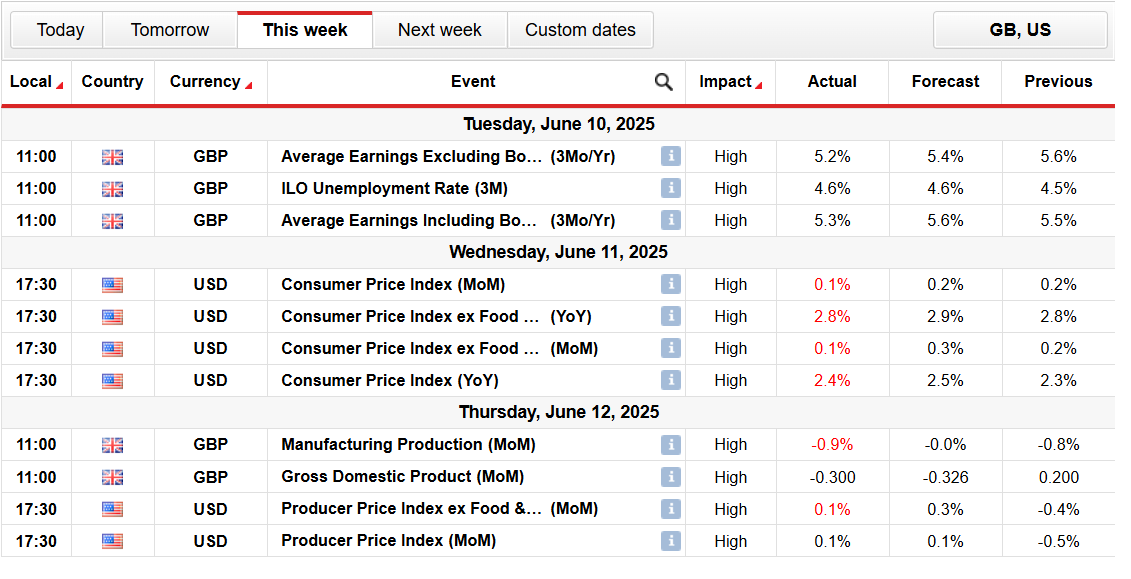
Looking ahead, next week, the market participants will focus on the upcoming central bank meetings. Both the US Federal Reserve and the Bank of England are set to announce their key policy decisions midweek. Consensus suggests no change from either the Fed, which is expected to hold rates at 4.25%-4.50%, or the BoE, which is also expected to hold rates at 4.25%.
Moreover, the US and UK retail sales data, along with UK CPI and US jobless claims, will be important to watch. Meanwhile, geopolitics and the Fed’s further commentary will also shape the outlook.
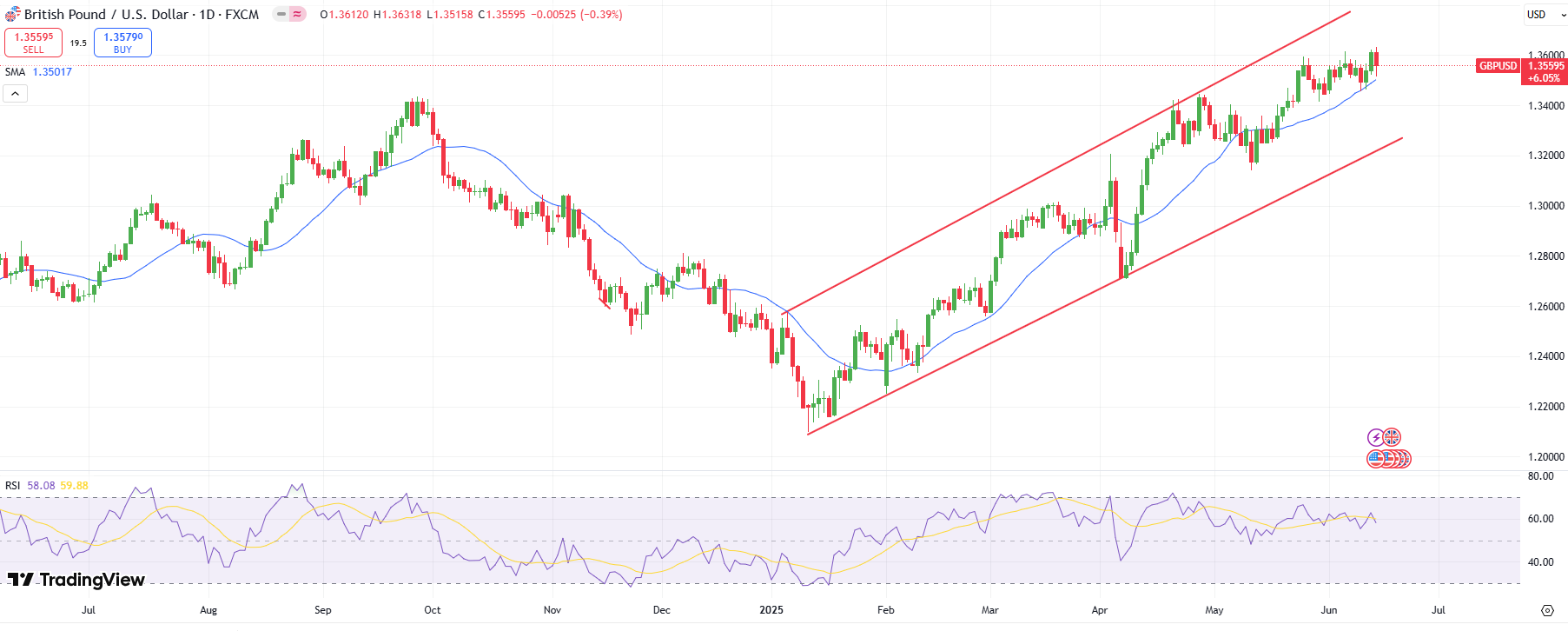
The daily chart of the GBP/USD suggests a consolidation within a broad uptrend. The Friday pullback remained strongly supported by the 20-day SMA. Meanwhile, a strong support zone also emerges in the 1.3420-60 area. The daily RSI is at 58.00 with a tilt to the downside, which suggests further consolidation.
-Are you looking for the best AI Trading Brokers? Check our detailed guide-
On the upside, the resistance lies at 1.3600, which is a round number ahead of 1.3635, which is a fresh 39-month top. Breaking the level may gather enough traction to test 1.3700.
Looking to trade forex now? Invest at eToro!
67% of retail investor accounts lose money when trading CFDs with this provider. You should consider whether you can afford to take the high risk of losing your money.
Weekly support from last week was at $3.50 and it was broken on Wednesday. However, it was not confirmed with a daily close below that price level. Therefore, a weekly closing price above that level could be the sign of a false breakdown. Currently, today’s closing price will be above that price level and at a four-day closing high, another sign of strength.
Nonetheless, key support is at a minor higher swing low of $3.44, while this week’s low was at $3.45. If the slightly lower $3.44 level fails, the 61.8% Fibonacci retracement at $3.38 is the next lower target where support may be seen. Then, a little lower is the 200-Day MA, now at $3.32.
A decisive breakout above today’s high of $3.62 could be the next sign of strength that has the potential to lead to higher prices. But the four-day high of $3.66 would need to be exceeded before there are clearer signs of a bottom. A recovery of the $3.66 level would establish a slightly higher swing low from this week. Solid potential resistance lies above and up to the $3.84 swing high from May. If natural gas can get above the May swing high, it has a chance to complete a rising ABCD pattern at $4.08. That price level is joined by the 61.8% Fibonacci retracement level at $4.12.
Given the two recent bounces off the area around the 200-Day MA since April, the uptrend begun from the April swing low is expected to continue. That could change if there is a decisive decline below the 200-Day line.
For a look at all of today’s economic events, check out our economic calendar.
June 13, 2025 – Written by Frank Davies
STORY LINK Euro to Dollar Forecast: EUR Tumbles After Israel Strike on Iran
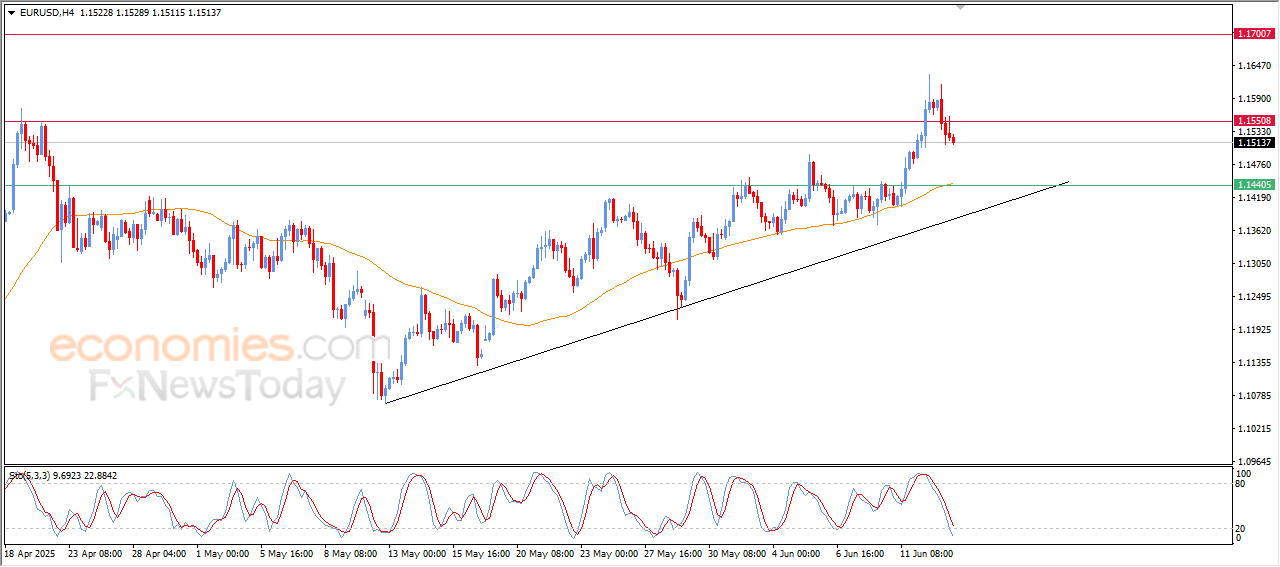
The Euro to Dollar exchange rate (EUR/USD) surged to 43-month highs just above 1.1630 on Thursday as the dollar came under renewed pressure.
There was, however, a sharp retreat to lows below 1.1520 on Friday following Israel’s strike on Iran’s nuclear facilities with a surge in geo-political tensions and a spike in oil prices while equity markets retreated.
According to ING; “we think the starting point was already quite rich for the pair, and a return to the 1.14-1.15 seems entirely appropriate.”
Danske Bank noted; “The attack adds significant uncertainty to diplomacy, with US officials denying direct involvement while cautioning that it could either hinder or, unexpectedly, pressure Iran towards discussions.”
The Israeli strikes have added to underlying trade and economic uncertainty. There will inevitably be unease over any escalation while markets are closed with demand for safe-haven assets.
OCBC currency strategist Christopher Wong commented; “Geopolitical noise may temporarily distort the dollar downtrend and temporarily weigh on risk proxies especially heading into the weekend.”
According to ING; “The key difference from previous Israel-Iran standoffs is that nuclear facilities have now been targeted, and while oil production does not seem to be affected just yet, markets have to add in a bigger risk premium given the crucial role of Iran in global oil supply.”
Nordea commented; “Geopolitical worries added to the list of potential headwinds for risk appetite, with Israel attacking Iran’s nuclear facilities and Iran retaliating. Oil prices shot up as a result, though from rather low levels.”
It added; “It is worth remembering that geopolitical tensions like these seldom remain the main market driver for a longer time, though as noted, this time they are by far not the only factor causing worries.”
According to ING; “The risks now point more definitively towards a prolonged period of tension, in contrast to recent episodes. And we think this could continue to take some pressure off the dollar.”
There are still doubts whether the dollar can secure sustained support given fundamental concerns and risk of capital outflows.
The Euro has also gained net support from increased speculation that the ECB will decide against further interest rate cuts.
MUFG commented; “The developments could provide a timely test of the US dollar’s traditional safe haven appeal after it hit fresh year to date lows yesterday prior to Israel’s military strikes.”
In this context, the dollar was subjected to further selling pressure on Thursday with further evidence of a softer labour market reinforcing expectations that the Federal Reserve would move close to interest rate cuts.
Continuing jobless claims rose to their highest level since November 2021.
MUFG commented; “we still expect the Fed to be reluctant to cut rates at upcoming policy meetings in June or July until they have more clarity over US trade policy and impact on inflation and labour market.”
It added; “At the same time, the release yesterday of the latest weekly initial and continuing claims have added to concerns that the US labour market is continuing to soften in response to trade disruption and heightened policy uncertainty.”
ING, however, also considers that the dollar is over-sold; “We had felt the USD negative reaction to the soft CPI print was exaggerated, and new geopolitical tensions give the Fed another argument to stay cautious, arguing for that CPI move to be scaled back.”
International Money Transfer? Ask our resident FX expert a money transfer question or try John’s new, free, no-obligation personal service! ,where he helps every step of the way,
ensuring you get the best exchange rates on your currency requirements.
TAGS: Euro Dollar Forecasts
The investment bank said current prices already reflect a 7% chance of a worst-case geopolitical scenario, one in which Iranian oil supplies are severely disrupted and the price reaction becomes “exponential rather than linear.”
As of early Friday, Brent futures surged nearly 9% to $75.36 per barrel, while WTI rose $6.16 to $74.20, following the news of Israeli strikes on Iran’s uranium enrichment facilities and military leadership. Iranian media reported explosions at the Natanz nuclear site and confirmed the death of Hossein Salami, commander of the Revolutionary Guards.
Also Read | Rs 1 lakh gold, $78 oil, 1,300 point Sensex crash: Israel’s Friday the 13th bombshellHere are the six key takeaways from J.P. Morgan’s latest oil market outlook, now playing out against an increasingly combustible geopolitical backdrop:
1. A 7% chance of a nightmare scenario already priced in
According to the J.P. Morgan, oil prices reflect a “7% probability of a worst-case scenario,” in which the impact on supply goes beyond reduced Iranian exports. In such a case, the bank said, price surge would not be gradual but “exponential,” driven by panic reactions and wider regional contagion.
2. Oil could jump to $120, pushing U.S. inflation to 5%
“An attack on Iran could spike oil prices to $120, driving U.S. CPI to 5%,” the investment bank warned.Such a move would reverse recent progress on inflation and complicate monetary policy for the Federal Reserve, which has been preparing for a potential rate-cut cycle later this year.
3. Base case oil forecast held at $60–$65
Despite the heightened tensions, J.P. Morgan said it was “downplaying geopolitical concerns” and maintaining its base case for Brent crude in the “low-to-mid $60s oil for the rest of 2025, and $60 in 2026.”
The investment bank expects oil to average $60 per barrel in 2026. This forecast assumes that regional powers will act to prevent a full-scale conflict.
4. Strait of Hormuz closure seen as unlikely
The bank downplayed fears of Iran closing the Strait of Hormuz, a key global shipping chokepoint, stating: “The closure of Hormuz is a low-risk event as Iran would be damaging its own position, both economically and politically, by irritating its main customer.”
Roughly a fifth of global oil passes through this strait, and any disruption there would have dramatic effects on energy markets.
5. Gulf nations have a stake in stability
J.P. Morgan argued that major Middle Eastern producers have strong incentives to keep hostilities from spiraling.
“Main players in the Middle East have strong incentives to keep the conflict contained given the economic transformation currently planned and implemented in the Gulf region requires a sustained absence of conflict,” the bank said, citing the sweeping economic diversification plans underway in the Gulf, which depend on prolonged regional calm.
This includes massive infrastructure and diversification efforts in Saudi Arabia and the UAE.
6. Oil surged, markets sank as tensions boiled over
Oil prices spiked while global markets sold off on Friday after Israel’s offensive on Iranian military and nuclear sites. Brent crude gained $6 to hit $75.36 a barrel, while WTI futures rose $6.16 to $74.20. Gold, another haven asset, climbed 1.5% to $3,434 per ounce.
Meanwhile, Israel said it was preparing for retaliatory missile and drone attacks, declaring a state of emergency nationwide. Iran has vowed a response after losing top military officials, including Salami, and seeing key installations in Tehran and Natanz come under fire.
U.S. Secretary of State Marco Rubio said that Washington had no role in the Israeli operation, calling it a “unilateral action.”
The sudden escalation comes amid stalled nuclear talks between Washington and Tehran and ahead of a critical vote by the International Atomic Energy Agency on June 12 in Vienna, which could trigger a snapback of United Nations sanctions on Iran.
With oil supply risks now sharply elevated and diplomatic off-ramps narrowing, J.P. Morgan’s warning looks increasingly prescient.
Also read | Oil jumps more than 12% as Israel strikes Iran, rattling investors
(Disclaimer: Recommendations, suggestions, views and opinions given by the experts are their own. These do not represent the views of The Economic Times)
GBP/USD declines sharply and trades below 1.3550 in the European session on Friday after posting its highest daily close since February 2022 on Thursday. The risk-averse market environment could make it difficult for the pair to regain its traction heading into the weekend.
The table below shows the percentage change of British Pound (GBP) against listed major currencies today. British Pound was the weakest against the US Dollar.
| USD | EUR | GBP | JPY | CAD | AUD | NZD | CHF | |
|---|---|---|---|---|---|---|---|---|
| USD | 0.57% | 0.43% | 0.42% | 0.14% | 0.81% | 1.06% | 0.41% | |
| EUR | -0.57% | -0.10% | -0.10% | -0.37% | 0.33% | 0.46% | -0.16% | |
| GBP | -0.43% | 0.10% | -0.06% | -0.35% | 0.34% | 0.55% | -0.04% | |
| JPY | -0.42% | 0.10% | 0.06% | -0.27% | 0.39% | 0.62% | -0.01% | |
| CAD | -0.14% | 0.37% | 0.35% | 0.27% | 0.65% | 0.94% | 0.31% | |
| AUD | -0.81% | -0.33% | -0.34% | -0.39% | -0.65% | 0.23% | -0.38% | |
| NZD | -1.06% | -0.46% | -0.55% | -0.62% | -0.94% | -0.23% | -0.60% | |
| CHF | -0.41% | 0.16% | 0.04% | 0.00% | -0.31% | 0.38% | 0.60% |
The heat map shows percentage changes of major currencies against each other. The base currency is picked from the left column, while the quote currency is picked from the top row. For example, if you pick the British Pound from the left column and move along the horizontal line to the US Dollar, the percentage change displayed in the box will represent GBP (base)/USD (quote).
The broad-based selling pressure surrounding the US Dollar (USD) allowed GBP/USD to gather bullish momentum on Thursday. After suffering large losses against its major rivals on weaker-than-expected Consumer Price Index (CPI) figures on Wednesday, the USD continued to weaken on Thursday as the data published by the Department of Labor showed that there were 248,000 Initial Jobless Claims in the week ending June 7, compared to the market forecast of 240,000.
Early Friday, safe-haven flows started to dominate the action in financial markets after Israel’s Prime Minister Benjamin Netanyahu announced that they have launched “Operation Rising Lion,” targeting Iran’s nuclear infrastructure, ballistic missile factories and its military capabilities. In response, Iran’s Armed Forces General staff said that Israel and the US will “pay a very heavy price.”
The USD seems to be benefiting from the flight to safety, causing GBP/USD to push lower. The US economic calendar will feature the University of Michigan’s preliminary Consumer Sentiment Index for June. Investors are likely to pay little to no attention to this data and remain focused on the developments surrounding the Israel-Iran conflict. Unless there is a de-escalation, market participants could stay away from risk-sensitive assets.
The Relative Strength Index (RSI) indicator on the 4-hour chart stays slightly below 50 and GBP/USD trades near the 20-period and the 50-period Simple Moving Averages (SMA), reflecting the loss of bullish momentum.
On the downside, the 100-period SMA forms the immediate support level at 1.3520 before 1.3460 (static level) and 1.3420 (200-period SMA). Looking north, resistance levels could be spotted at 1.3600 (mid-point of the ascending channel), 1.3630 (static level) and 1.3700 (static level, round level).
The Pound Sterling (GBP) is the oldest currency in the world (886 AD) and the official currency of the United Kingdom. It is the fourth most traded unit for foreign exchange (FX) in the world, accounting for 12% of all transactions, averaging $630 billion a day, according to 2022 data.
Its key trading pairs are GBP/USD, also known as ‘Cable’, which accounts for 11% of FX, GBP/JPY, or the ‘Dragon’ as it is known by traders (3%), and EUR/GBP (2%). The Pound Sterling is issued by the Bank of England (BoE).
The single most important factor influencing the value of the Pound Sterling is monetary policy decided by the Bank of England. The BoE bases its decisions on whether it has achieved its primary goal of “price stability” – a steady inflation rate of around 2%. Its primary tool for achieving this is the adjustment of interest rates.
When inflation is too high, the BoE will try to rein it in by raising interest rates, making it more expensive for people and businesses to access credit. This is generally positive for GBP, as higher interest rates make the UK a more attractive place for global investors to park their money.
When inflation falls too low it is a sign economic growth is slowing. In this scenario, the BoE will consider lowering interest rates to cheapen credit so businesses will borrow more to invest in growth-generating projects.
Data releases gauge the health of the economy and can impact the value of the Pound Sterling. Indicators such as GDP, Manufacturing and Services PMIs, and employment can all influence the direction of the GBP.
A strong economy is good for Sterling. Not only does it attract more foreign investment but it may encourage the BoE to put up interest rates, which will directly strengthen GBP. Otherwise, if economic data is weak, the Pound Sterling is likely to fall.
Another significant data release for the Pound Sterling is the Trade Balance. This indicator measures the difference between what a country earns from its exports and what it spends on imports over a given period.
If a country produces highly sought-after exports, its currency will benefit purely from the extra demand created from foreign buyers seeking to purchase these goods. Therefore, a positive net Trade Balance strengthens a currency and vice versa for a negative balance.
Gold (XAU/USD) appreciates for the third consecutive day on Friday, and is on track for a weekly rally beyond 3%. Israel’s attack on Iran has crushed an already fragile market sentiment on Friday, triggering a rush for safety that has boosted Gold and all the traditional safe assets.
Israel attacked Iran with unprecedented strength earlier on Friday, pounding nuclear sites and killing high-ranking Revolutionary Guard Officials. Iran retaliated with a drone attack and leaving the nuclear negotiations with the US. Fears of a full-blown war in the region have fuelled an intense risk-off mood.
Technical indicators are pointing higher again. RSI studies in the 4-hour chart are high but still below overbought territory. The fundamental background is supportive, despite generalised USD strength, and bearish attempts remain limited so far.
The precious metal is trading at the top of a wedge pattern with trendline resistance at $3,425 is holding bears ahead of the May 6 high, at $3,440. Bulls need to clear these levels before shifting their focus to the $3,495 all-time high hit in late April.
On the downside, bears are being held above the $3,400 previous resistance (Jun 5 high). A pullback below here would bring the June 12 low and the bottom of the wedge pattern, both around $3,345, into focus.
Gold has played a key role in human’s history as it has been widely used as a store of value and medium of exchange. Currently, apart from its shine and usage for jewelry, the precious metal is widely seen as a safe-haven asset, meaning that it is considered a good investment during turbulent times. Gold is also widely seen as a hedge against inflation and against depreciating currencies as it doesn’t rely on any specific issuer or government.
Central banks are the biggest Gold holders. In their aim to support their currencies in turbulent times, central banks tend to diversify their reserves and buy Gold to improve the perceived strength of the economy and the currency. High Gold reserves can be a source of trust for a country’s solvency. Central banks added 1,136 tonnes of Gold worth around $70 billion to their reserves in 2022, according to data from the World Gold Council. This is the highest yearly purchase since records began. Central banks from emerging economies such as China, India and Turkey are quickly increasing their Gold reserves.
Gold has an inverse correlation with the US Dollar and US Treasuries, which are both major reserve and safe-haven assets. When the Dollar depreciates, Gold tends to rise, enabling investors and central banks to diversify their assets in turbulent times. Gold is also inversely correlated with risk assets. A rally in the stock market tends to weaken Gold price, while sell-offs in riskier markets tend to favor the precious metal.
The price can move due to a wide range of factors. Geopolitical instability or fears of a deep recession can quickly make Gold price escalate due to its safe-haven status. As a yield-less asset, Gold tends to rise with lower interest rates, while higher cost of money usually weighs down on the yellow metal. Still, most moves depend on how the US Dollar (USD) behaves as the asset is priced in dollars (XAU/USD). A strong Dollar tends to keep the price of Gold controlled, whereas a weaker Dollar is likely to push Gold prices up.
Copper price neediness to the momentum in the last trading led to delay the bullish attempts, to notice its fluctuations below the barrier near $4.8100, and providing an intraday negative rebound at $4.7100.
Note that the price success to settle above 50% Fibonacci correction level at $4.6600 will assist to reinforce the chances for activating the bullish track until breaching the mentioned barrier, while breaking this support will increase the negative pressure on the current trading, which force it to suffer extra losses by reaching $4.6000 and $4.5300.
The expected trading range for today is between $4.6600 and $4.8100
Trend forecast: Fluctuated within the bullish track
Copper price neediness to the momentum in the last trading led to delay the bullish attempts, to notice its fluctuations below the barrier near $4.8100, and providing an intraday negative rebound at $4.7100.
Note that the price success to settle above 50% Fibonacci correction level at $4.6600 will assist to reinforce the chances for activating the bullish track until breaching the mentioned barrier, while breaking this support will increase the negative pressure on the current trading, which force it to suffer extra losses by reaching $4.6000 and $4.5300.
The expected trading range for today is between $4.6600 and $4.8100
Trend forecast: Fluctuated within the bullish track
Copper price neediness to the momentum in the last trading led to delay the bullish attempts, to notice its fluctuations below the barrier near $4.8100, and providing an intraday negative rebound at $4.7100.
Note that the price success to settle above 50% Fibonacci correction level at $4.6600 will assist to reinforce the chances for activating the bullish track until breaching the mentioned barrier, while breaking this support will increase the negative pressure on the current trading, which force it to suffer extra losses by reaching $4.6000 and $4.5300.
The expected trading range for today is between $4.6600 and $4.8100
Trend forecast: Fluctuated within the bullish track