The main category of Forex News.
You can use the search box below to find what you need.
[wd_asp id=1]
The main category of Forex News.
You can use the search box below to find what you need.
[wd_asp id=1]
Copper price delayed the bullish rally due to the negative pressure that comes by a stochastic approach from 50 level, suffering some extra losses by hitting $4.6000 level, attempting to settle above the moving average 55.
The contradiction between the main indicators might force the price to provide sideways trading, but the repeated stability below 6.8%Fibonacci correction level at $4.8100 represents a main factor that confirms the bearish correctional bias dominance, to keep waiting for resuming the decline and targeting $4.5000 level in the near period.
The expected trading range for today is between $4.5000 and $4.7000
Trend forecast: Bearish
Do you need help in trading decisions? Do you want to learn how to start trading?
Join Economies.com VIP Club and benefit from over 15 years of market analysis expertise and get:
Special Offer: Subscribe to the Economies.com VIP channel and get also a free subscription to a trusted trading signals channel provided by Best Trading Signal.
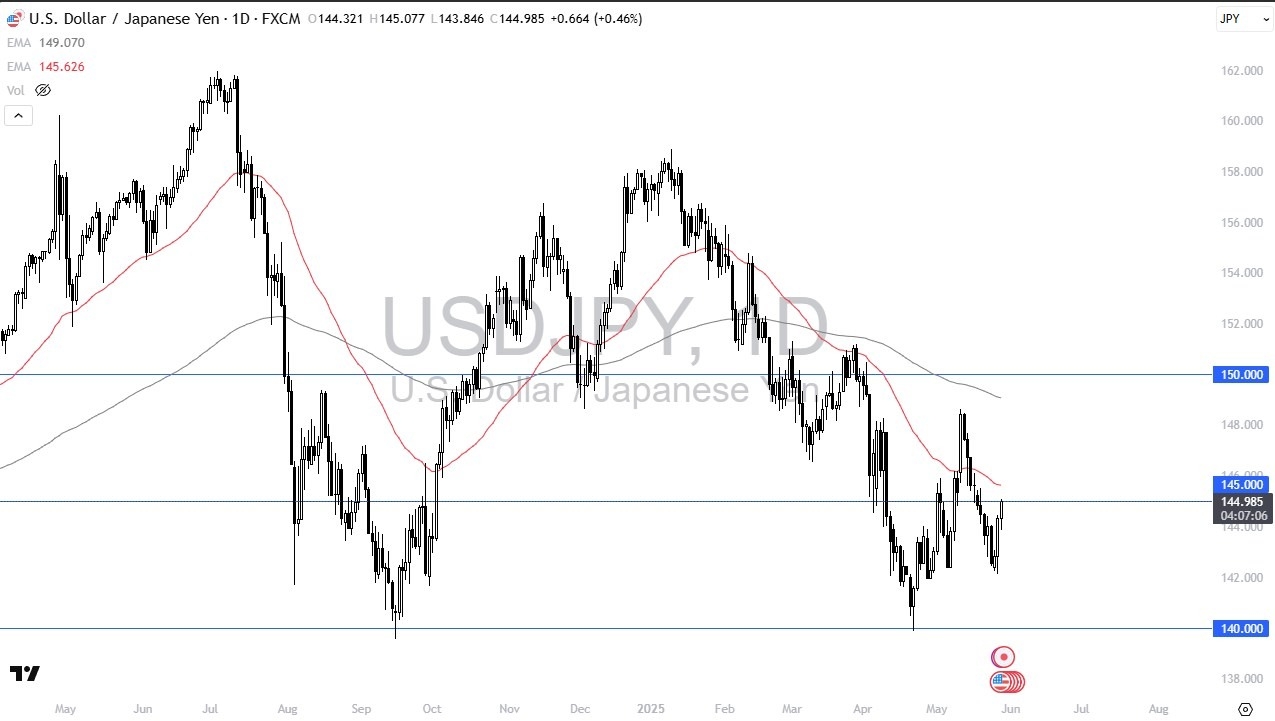
Ultimately, this is a market that I believe remains sketchy and noisy, but I do favor the upside overall. If we break above the 50-day EMA, then it’s likely that we will go looking at the 148 yen level, an area that previously had been significant resistance and where we are hanging around and watching the 200-day EMA appear.

Obviously, the 200-day EMA will continue to attract attention in and of itself. And with that, I look at this market as one that is trying to get there. Whether or not we can get there quickly is a completely different story, but I do recognize that we are at least in the process of trying to form some type of double bottom, if you will. And as we have exploded to the upside from the 142 yen level in the last couple of days, I am starting to look at the 142 yen level as your floor in the market, at least at the moment.
If we were to break down below there, then you have to look at 140 yen, which has been important multiple times in the past. So, it’s not a huge surprise to see a significant amount of bullish pressure at these very low levels. The question now is, will the interest rate differential continue to favor the green back over the Japanese yen, at least as far as market action is concerned, because the interest rate differential is very large between these two currencies.
Want to trade our USD/JPY forex analysis and predictions? Here’s a list of forex brokers in Japan to check out.
Christopher Lewis has been trading Forex and has over 20 years experience in financial markets. Chris has been a regular contributor to Daily Forex since the early days of the site. He writes about Forex for several online publications, including FX Empire, Investing.com, and his own site, aptly named The Trader Guy. Chris favours technical analysis methods to identify his trades and likes to trade equity indices and commodities as well as Forex. He favours a longer-term trading style, and his trades often last for days or weeks.
Copper price delayed the bullish rally due to the negative pressure that comes by a stochastic approach from 50 level, suffering some extra losses by hitting $4.6000 level, attempting to settle above the moving average 55.
The contradiction between the main indicators might force the price to provide sideways trading, but the repeated stability below 6.8%Fibonacci correction level at $4.8100 represents a main factor that confirms the bearish correctional bias dominance, to keep waiting for resuming the decline and targeting $4.5000 level in the near period.
The expected trading range for today is between $4.5000 and $4.7000
Trend forecast: Bearish
Do you need help in trading decisions? Do you want to learn how to start trading?
Join Economies.com VIP Club and benefit from over 15 years of market analysis expertise and get:
Special Offer: Subscribe to the Economies.com VIP channel and get also a free subscription to a trusted trading signals channel provided by Best Trading Signal.
The EUR/USD forecast turned bearish after falling below the key 1.1300 level, marking fresh weekly lows. at 1.1210. The downtick move stemmed from a rise in the US dollar after a US federal trade court paused the imposition of broader tariffs on imports, stating it misuse of authority under IEEPA. The decision has reduced the fears of trade war.
–Are you interested in learning more about Canadian forex brokers? Check our detailed guide-
The US Dollar Index (DXY) surged above 100.40 due to improved risk sentiment and expected sharp rise in US bond yields. The recent court decision may provide a boost to US growth outlook and weigh on the Euro’s bullish trend.
According to ING analyst, Chris Turner, the EUR/USD is reasonably lower on US tariff news as the US growth outlook has slightly improved along with risk premium attached with the dollar. He also stated that the recent downturn move could lead to 1.1050, maintaining a broad range of 1.10 to 1.15.
Meanwhile, Trump’s delay on imposing tariffs on EU until July 09, offered some respite to the markets. However, uncertainty still persists. The ECB officials will announce policy decision next week. The consensus remains for another rate cut, some officials have turned hawkish, resisting further easing.
The recent Eurozone data added more traction to the sellers with France’s inflation slowing unexpectedly. On the other hand, the ECB policymaker and head of Slovak Central Bank, Peter kazimir was found guilty of corruption. This development has clouded the image of ECB and raised a political noise across the Europe.
On the other hand, the recent uptick move in the dollar could be temporary as the President Trump can seek alternatives to restore the tariffs which can eventually weigh on the dollar.
Today’s major economic data is US Q1 GDP which can provide further impetus to the market. The US dollar has erased some gains in anticipation of the data.
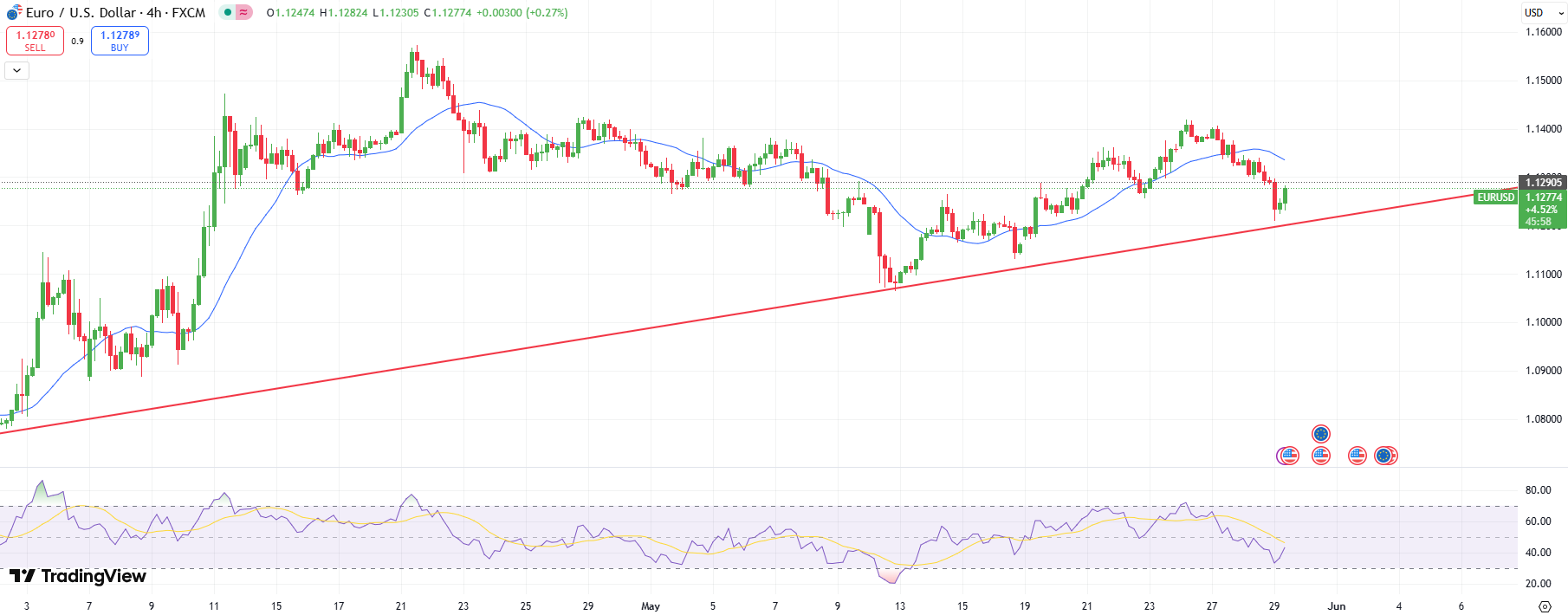
The EUR/USD 4-hour chart shows the price remains well supported by the rising trendline. Today’s bearish move met solid support and recovered around 60 pips so far. However, the price is below 20-period SMA. Meanwhile, the RSI shows a sharp reversal from the oversold zone.
–Are you interested in learning more about high leveraged brokers? Check our detailed guide-
Any upside will meet strong resistance around 1.1300 ahead of 1.1340 and then 1.1400. On the flip side, the pair may test today’s lows at 1.1210 ahead of 1.1150 and then 1.1050.
Looking to trade forex now? Invest at eToro!
68% of retail investor accounts lose money when trading CFDs with this provider. You should consider whether you can afford to take the high risk of losing your money.
The GBP/JPY cross prolonged its weekly uptrend for the fourth straight day on Thursday and climbed to the 196.30 area during the Asian session, back closer to a multi-month peak touched earlier this May. Spot prices, however, retreat around 50 pips from the daily swing high and currently trade around the 195.85-195.80 region, up 0.40% for the day.
The US tariffs-block news led to a sharp bounce in risk trade and weighs heavily on the safe-haven Japanese Yen (JPY), which, in turn, assists the GBP/JPY cross to attract some follow-through buying. However, expectations that the Bank of Japan (BoJ) will continue raising interest rates help limit JPY losses. Furthermore, a broadly stronger US Dollar (USD) weighs on the British Pound (GBP) and contributes to capping the currency pair.
From a technical perspective, the GBP/JPY cross recently showed some resilience below the very important 200-day Simple Moving Average (SMA). The subsequent move-up and positive oscillators on the daily chart suggest that the path of least resistance for spot prices remains to the upside. However, bulls might wait for a sustained strength beyond the monthly swing high, around the 196.40 area, before placing fresh bets.
The GBP/JPY cross might then aim to reclaim the 197.00 round figure for the first time since January. The momentum could extend further towards the 197.40-197.50 intermediate hurdle en route to the 198.00 mark and the 198.25 region, or the year-to-date high. Some follow-through buying will be seen as a fresh trigger for bullish traders and pave the way for an extension of the recent uptrend witnessed over the past two months or so.
On the flip side, any further pullback could find some support and attract some dip-buyers near the 195.50-195.40 horizontal zone, which, in turn, should help limit the downside for the GBP/JPY cross near the 195.00 psychological mark. Some follow-through selling below the Asian session low, around the 194.85 region, might trigger some long-unwinding and drag spot prices to the 194.40-194.35 intermediate support en route to the 194.00 mark.
The table below shows the percentage change of Japanese Yen (JPY) against listed major currencies today. Japanese Yen was the strongest against the Swiss Franc.
| USD | EUR | GBP | JPY | CAD | AUD | NZD | CHF | |
|---|---|---|---|---|---|---|---|---|
| USD | 0.45% | 0.28% | 0.69% | 0.11% | 0.05% | 0.45% | 0.74% | |
| EUR | -0.45% | -0.16% | 0.25% | -0.34% | -0.33% | -0.00% | 0.28% | |
| GBP | -0.28% | 0.16% | 0.41% | -0.17% | -0.16% | 0.15% | 0.36% | |
| JPY | -0.69% | -0.25% | -0.41% | -0.61% | -0.67% | -0.30% | -0.07% | |
| CAD | -0.11% | 0.34% | 0.17% | 0.61% | -0.11% | 0.35% | 0.52% | |
| AUD | -0.05% | 0.33% | 0.16% | 0.67% | 0.11% | 0.34% | 0.51% | |
| NZD | -0.45% | 0.00% | -0.15% | 0.30% | -0.35% | -0.34% | 0.18% | |
| CHF | -0.74% | -0.28% | -0.36% | 0.07% | -0.52% | -0.51% | -0.18% |
The heat map shows percentage changes of major currencies against each other. The base currency is picked from the left column, while the quote currency is picked from the top row. For example, if you pick the Japanese Yen from the left column and move along the horizontal line to the US Dollar, the percentage change displayed in the box will represent JPY (base)/USD (quote).
Gold price is extending its four-day bearish streak early Thursday, flirting with the lowest level in a week near $3,250.
The buying interest around the US Dollar (USD) remains unabated so far this week, with the latest leg up powered by the cautious Minutes of the US Federal Reserve’s (Fed) May policy meeting and a US federal court’s ruling that blocked President Donald Trump’s “Liberation Day” tariffs.
The court deemed such tariffs illegal, citing that Trump didn’t have the authority to impose across-the-board duties on imports from nations that sell more to the United States (US) than they buy, per Reuters.
Meanwhile, the Fed Minutes read, “participants agreed that uncertainty about the economic outlook had increased further, making it appropriate to take a cautious approach until the net economic effects of the array of changes to government policies become clearer.”
Furthermore, the upbeat market mood on the back of encouraging earnings report from the American artificial intelligence (AI) pioneer Nvidia, showing a strong revenue forecast.
The earnings showed a $44.06bn of revenue for last quarter, beating industry estimates of $43.2bn, earnings per share also beat estimates at $0.96, vs. $0.93.
The market optimism helped the US Dollar bolster its recovery, offsetting any impact of the ongoing US-China trade tension.
According to the latest report, by the New York Times (NYT) the Trump administration is moving to restrict the sale of critical US technologies, including those related to jet engines, semiconductors, and certain chemicals, to China.
Attention now turns to the mid-tier US economic data releases and speeches from a slew of Fed policymakers for some respite to Gold buyers.
A bout of profit-taking in the Greenback could be on the cards ahead of Friday’s US core Personal Consumption Expenditure (PCE) Price Index, the Fed’s preferred inflation measure.
The data could pour cold water on the Fed’s recent hawkish stance and likely trigger a fresh pullback in the USD, allowing Gold price to stage a comeback.
In the meantime, US weekly Jobless Claims and the revision to Gross Domestic Product (GDP) data could provide some trading incentives to the USD and Gold traders.
Trade headlines and geopolitical updates will also continue to play a critical role in the Gold price performance.
The tide seems to have turned in favor of sellers in the near term as the 14-day Relative Strength Index (RSI) tests waters below the midline, currently near 49.50.
Also, Gold buyers failed to defend a powerful demand area near $3,295, which was the confluence of the 21-day Simple Moving Average (SMA) and the 38.2% Fibo of the April record rally, to keep the upside potential intact.
The next test for them is the 50% Fibo support near $3,230, where the 50-day SMA closes in, making that zone a tough nut to crack.
A daily candlestick closing below that level could put the focus back on the 61.8% Fibo support at $3,168, from where Gold price rebounded to two-week highs of $3,366 last week.
Alternatively, if Gold price bounces off the abovementioned critical support area near $3,230, buyers could recapture the 21-day SMA, now at $3,287.
The next immediate resistance is aligned near $3,300 where the 38.2% Fibo level and the round level coincide.
Further up, a sustained break above the $3,350 psychological level is needed to resume the uptrend.
Gold has played a key role in human’s history as it has been widely used as a store of value and medium of exchange. Currently, apart from its shine and usage for jewelry, the precious metal is widely seen as a safe-haven asset, meaning that it is considered a good investment during turbulent times. Gold is also widely seen as a hedge against inflation and against depreciating currencies as it doesn’t rely on any specific issuer or government.
Central banks are the biggest Gold holders. In their aim to support their currencies in turbulent times, central banks tend to diversify their reserves and buy Gold to improve the perceived strength of the economy and the currency. High Gold reserves can be a source of trust for a country’s solvency. Central banks added 1,136 tonnes of Gold worth around $70 billion to their reserves in 2022, according to data from the World Gold Council. This is the highest yearly purchase since records began. Central banks from emerging economies such as China, India and Turkey are quickly increasing their Gold reserves.
Gold has an inverse correlation with the US Dollar and US Treasuries, which are both major reserve and safe-haven assets. When the Dollar depreciates, Gold tends to rise, enabling investors and central banks to diversify their assets in turbulent times. Gold is also inversely correlated with risk assets. A rally in the stock market tends to weaken Gold price, while sell-offs in riskier markets tend to favor the precious metal.
The price can move due to a wide range of factors. Geopolitical instability or fears of a deep recession can quickly make Gold price escalate due to its safe-haven status. As a yield-less asset, Gold tends to rise with lower interest rates, while higher cost of money usually weighs down on the yellow metal. Still, most moves depend on how the US Dollar (USD) behaves as the asset is priced in dollars (XAU/USD). A strong Dollar tends to keep the price of Gold controlled, whereas a weaker Dollar is likely to push Gold prices up.
Currently trading at around ~1.34650, GBP/USD trades 0.32% lower in today’s session. Easing from multi-year highs made last week, cable continues to benefit from robust economic data and underlying dollar weakness.
With Donald Trump renewing threats of US-EU tariffs over the weekend, continued uncertainty surrounding the US economy and future trade relations continues to weigh negatively on the dollar.
First threatening a 50% tariff on EU imports to be imposed June 1st, only to renege days later, frustrations in ongoing negotiations between the US and the European Union regarding trade further general ‘risk-off’ sentiment, and a general cautiousness on world equity markets.
The obvious comparison is that, unlike the United Kingdom, the United States has been unable to strike a deal with the European Union, with Trump taking a seemingly less diplomatic approach to negotiations.
While a list of trade negotiation deadlines loom, dollar upside is likely to be limited until the picture on global trade becomes clearer and, most importantly, more certain.
With last Friday representing cable’s best performance in over three weeks, gaining 0.89%, an unexpected rise in reported retail sales data helped boost cable pricing to three-year highs.
Beating expectations by some margin, Friday’s data showed retail sales data rising for the fourth consecutive month, suggesting increasing consumer confidence and somewhat vindicating the current Bank of England strategy on monetary policy.
The result has been a remarkable rise in sterling value versus the dollar.
With the US observing Memorial Day on Monday, lower-than-usual trading volumes did not deter GBP/USD from making further gains, ending the day 0.18% higher.
In a vacuum, this would suggest that the recent rise in GBP/USD pricing is not dependent on active US market participation, indicating that capital flows outside the US are at least somewhat influencing price action.
With this trading week noticeably sparse for UK-facing economic events, GBP/USD traders will closely monitor Bank of England commentary, which may suggest their likely next move.
While recent rises in retail sales would otherwise encourage the Bank of England to become more dovish, inflation in the United Kingdom remains uncomfortably high at 3.5% year-over-year in April.
Writing ahead of BoE Governor Bailey’s speech tomorrow, most predict rates will remain unchanged in the upcoming June decision.
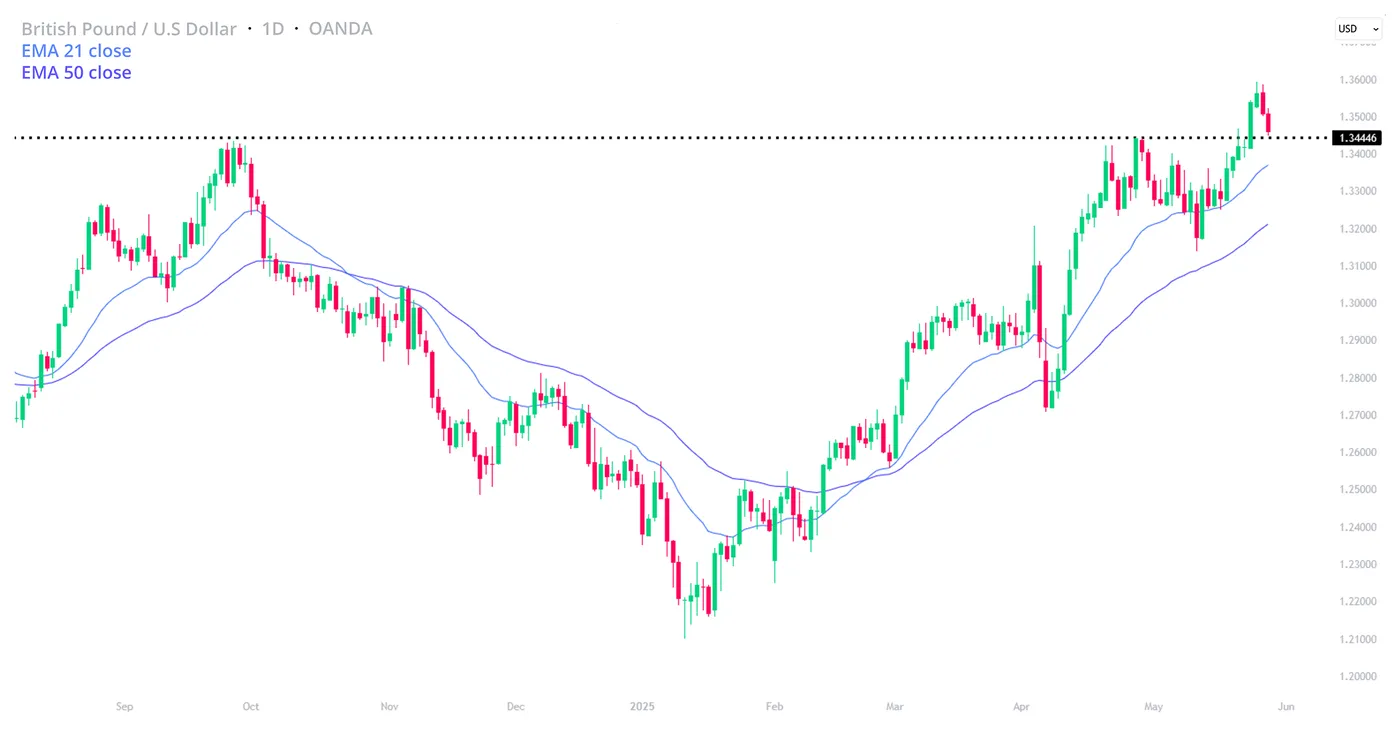
A chart showing the recent price action of GBPUSD. OANDA,TradingView, 28/05/2024
May 28, 2025 – Written by David Woodsmith
STORY LINK Euro to US Dollar Forecast: EUR/USD Finds Support Near 1.1300
The Euro to Dollar exchange rate (EUR/USD) was unable to make headway on Tuesday and dipped to test the 1.1300 level before a recovery to 1.1335 on Wednesday.
US data was a net positive and Wall Street posted strong gains, but longer-term doubts remain a key element.
According to ING; “If US data and Trump continue to deliver positive surprises this week, a decisive break lower is possible.”
The bank is, however, sceptical that this scenario will play out; “For now, we see 1.130 as a likely anchor, with upside risks for EUR/USD still dominant in the weeks ahead.”
Scotiabank noted; “Near-term support is expected around 1.1280 and near-term resistance is expected around 1.1420.”
Multiple dollar elements have continued to reverberate within global markets.
The US consumer confidence data recorded a strong rebound for May with a jump to 98.0 from 85.7 the previous month and well above expectations of 87.1.
According to the survey, de-escalation on US trade tariffs was a key element boosting confidence, but the frequent policy shifts are masking a lack of overall progress.
HSBC noted; “the reality is that not much is changing. Trade talks are ongoing but not yielding public breakthroughs. US monetary policy is on hold.”
There are also still concerns that underlying confidence has been damaged.
Scotiabank commented; “Although President Trump has stepped back again from the precipice of aggressive tariff action, the rather capricious appearance of policymaking may undermine global investors’ confidence in US markets at a time when the erosion of free trade, concerns over fiscal policy and the administration’s relations with the Fed are already proving challenging for investor sentiment.”
According to Danske Bank; “The Trump administration’s late-week reversal on EU tariff threats reinforces our view that broad-based US tariffs are structurally negative for the USD.”
It added While large fiscal deficits supported growth and the USD in the post-Covid period, today’s deficits – set against a more fragile global backdrop – are fuelling concerns about long-term sustainability and increased reliance on foreign capital.
MUFG takes a similar view; “We remain in the camp of “damage done” and hence continue to expect weaker economic activity ahead given the likely curtailment of business and household decision-making.”

The longer-term dollar and Euro outlook also remains a key element.
Danske added; “Markets continue to reassess the “US exceptionalism” narrative that previously underpinned USD strength.”
According to Pepperstone head of research Chris Weston; “In a way, all roads have led to a weaker USD. Higher perceived U.S. deficits have raised concerns about increased future Treasury issuance, pushing up term premium and seeing people migrate away from the USD.”
This week, ECB President Lagarde has made the case for a stronger global role for the Euro.
According to Lagarde; “The ongoing changes create the opening for a ‘global euro moment.”
She added; “The euro will not gain influence by default – it will have to earn it.”
ING commented; “If European policymakers continue to push the idea, we could see strategic long positions in the euro build even faster. Lagarde’s enthusiasm is understandable; a stronger, more global euro supports bond market stability and keeps rates lower, while nominal appreciation helps cap inflation.”
It did, however, add; “exporters are already voicing concerns about the strong euro, and national governments, especially those with stronger finances, may be less keen, as they already enjoy low borrowing costs.”
International Money Transfer? Ask our resident FX expert a money transfer question or try John’s new, free, no-obligation personal service! ,where he helps every step of the way,
ensuring you get the best exchange rates on your currency requirements.
TAGS: Euro Dollar Forecasts
The GBP/JPY pair corrects to near 194.50 during European trading hours on Wednesday after refreshing an almost two-week high around 195.60 the previous day. The pair faces selling pressure as the Pound Sterling (GBP) underperforms after a strong run-up in the past few trading days.
The table below shows the percentage change of British Pound (GBP) against listed major currencies today. British Pound was the weakest against the Japanese Yen.
| USD | EUR | GBP | JPY | CAD | AUD | NZD | CHF | |
|---|---|---|---|---|---|---|---|---|
| USD | 0.09% | 0.02% | -0.14% | 0.07% | -0.02% | -0.37% | 0.00% | |
| EUR | -0.09% | -0.02% | -0.16% | -0.01% | -0.09% | -0.42% | -0.06% | |
| GBP | -0.02% | 0.02% | -0.14% | 0.06% | -0.05% | -0.07% | -0.00% | |
| JPY | 0.14% | 0.16% | 0.14% | 0.20% | 0.11% | -0.21% | 0.22% | |
| CAD | -0.07% | 0.01% | -0.06% | -0.20% | -0.08% | -0.40% | -0.06% | |
| AUD | 0.02% | 0.09% | 0.05% | -0.11% | 0.08% | -0.00% | 0.05% | |
| NZD | 0.37% | 0.42% | 0.07% | 0.21% | 0.40% | 0.00% | 0.05% | |
| CHF | -0.01% | 0.06% | 0.00% | -0.22% | 0.06% | -0.05% | -0.05% |
The heat map shows percentage changes of major currencies against each other. The base currency is picked from the left column, while the quote currency is picked from the top row. For example, if you pick the British Pound from the left column and move along the horizontal line to the US Dollar, the percentage change displayed in the box will represent GBP (base)/USD (quote).
However, the outlook of the Pound Sterling remains firm as traders pare bets supporting the Bank of England (BoE) to reduce interest rates again in the June policy meeting. A hotter-than-projected United Kingdom (UK) Consumer Price Index (CPI) and robust growth in Retail Sales data for April have forced traders to reassess BoE dovish bets.
The data released last week showed that the UK headline CPI accelerated at a faster pace to 3.5% year-over-year, and retail sales expanded strongly by 1.2% month-over-month.
Meanwhile, the Japanese Yen (JPY) performs strongly due to a sharp spike in Japan bond yields in expectations of significant changes in the bond program for the current fiscal year. A report from Reuters on Tuesday showed that Japan’s Ministry of Finance will consider tweaking the composition of its bond program, which could involve cuts to its issuance of super-long bonds.
GBP/JPY strengthens after a breakout of the horizontal resistance plotted from the May 19 high of 194.00 on an hourly timeframe. The 50-hour Exponential Moving Average (EMA) is expected to be a key support for the pair around 194.35.
The 14-period Relative Strength Index (RSI) falls into the 40.00-60.00 range after turning overbought above 80.00. A fresh bullish momentum would come into action when the RSI returns above 60.00.
The pair could extend its upside towards the January 7 high of 198.26 and the psychological level of 200.00 after breaking above the four-month high of 196.40.
On the flip side, a downside move by the pair below the May 6 low of 190.33 will expose it to the March 11 low of 188.80, followed by the February 7 low of 187.00.
The Japanese Yen (JPY) is one of the world’s most traded currencies. Its value is broadly determined by the performance of the Japanese economy, but more specifically by the Bank of Japan’s policy, the differential between Japanese and US bond yields, or risk sentiment among traders, among other factors.
One of the Bank of Japan’s mandates is currency control, so its moves are key for the Yen. The BoJ has directly intervened in currency markets sometimes, generally to lower the value of the Yen, although it refrains from doing it often due to political concerns of its main trading partners. The BoJ ultra-loose monetary policy between 2013 and 2024 caused the Yen to depreciate against its main currency peers due to an increasing policy divergence between the Bank of Japan and other main central banks. More recently, the gradually unwinding of this ultra-loose policy has given some support to the Yen.
Over the last decade, the BoJ’s stance of sticking to ultra-loose monetary policy has led to a widening policy divergence with other central banks, particularly with the US Federal Reserve. This supported a widening of the differential between the 10-year US and Japanese bonds, which favored the US Dollar against the Japanese Yen. The BoJ decision in 2024 to gradually abandon the ultra-loose policy, coupled with interest-rate cuts in other major central banks, is narrowing this differential.
The Japanese Yen is often seen as a safe-haven investment. This means that in times of market stress, investors are more likely to put their money in the Japanese currency due to its supposed reliability and stability. Turbulent times are likely to strengthen the Yen’s value against other currencies seen as more risky to invest in.
Gold prices are threatening key technical layers of support on Wednesday, with Bullion searching for a fresh catalyst to drive prices out of the confines of the bull flag pattern.
After erasing 1.25% on Tuesday, the momentum of the downtrend has temporarily paused. At the time of writing, Gold prices are trading above the $3,300 psychological level with the 20-day Simple Moving Average (SMA) providing additional support at $3,289.
The current zone of price action remains technically significant, as it aligns with the upper bound of the bull flag and the 23.60% Fibonacci Retracement level of the January-April move at $3,290.
With the descending trendline from the bull flag providing an additional barrier of resistance for bulls near $3,320, bears have struggled to gain momentum below the Fibonacci support.
With the Relative Strength Index (RSI) flattening around 52, the next big move for the yellow metal hinges on whether bulls or bears can break free from their relative zones of restriction.
A breakdown below $3,200 could open the door toward the 38.2% retracement level at $3,161, followed by deeper support near the 50% and 61.8% Fibonacci levels at $3,057 and $2,952, respectively.
On the upside, a decisive breakout above the descending wedge, particularly a close above $3,350-$3,360, would likely attract bullish momentum. Such a breakout would target a retest of April’s all-time high just below $3,500.
Gold has played a key role in human’s history as it has been widely used as a store of value and medium of exchange. Currently, apart from its shine and usage for jewelry, the precious metal is widely seen as a safe-haven asset, meaning that it is considered a good investment during turbulent times. Gold is also widely seen as a hedge against inflation and against depreciating currencies as it doesn’t rely on any specific issuer or government.
Central banks are the biggest Gold holders. In their aim to support their currencies in turbulent times, central banks tend to diversify their reserves and buy Gold to improve the perceived strength of the economy and the currency. High Gold reserves can be a source of trust for a country’s solvency. Central banks added 1,136 tonnes of Gold worth around $70 billion to their reserves in 2022, according to data from the World Gold Council. This is the highest yearly purchase since records began. Central banks from emerging economies such as China, India and Turkey are quickly increasing their Gold reserves.
Gold has an inverse correlation with the US Dollar and US Treasuries, which are both major reserve and safe-haven assets. When the Dollar depreciates, Gold tends to rise, enabling investors and central banks to diversify their assets in turbulent times. Gold is also inversely correlated with risk assets. A rally in the stock market tends to weaken Gold price, while sell-offs in riskier markets tend to favor the precious metal.
The price can move due to a wide range of factors. Geopolitical instability or fears of a deep recession can quickly make Gold price escalate due to its safe-haven status. As a yield-less asset, Gold tends to rise with lower interest rates, while higher cost of money usually weighs down on the yellow metal. Still, most moves depend on how the US Dollar (USD) behaves as the asset is priced in dollars (XAU/USD). A strong Dollar tends to keep the price of Gold controlled, whereas a weaker Dollar is likely to push Gold prices up.