The main category of Forex News.
You can use the search box below to find what you need.
[wd_asp id=1]
The main category of Forex News.
You can use the search box below to find what you need.
[wd_asp id=1]
The USD/JPY forecast shows further dollar weakness after a downgrade to the US government’s credit rating. At the same time, market participants were worried about progress on trade negotiations between the US and its trading partners.
–Are you interested in learning more about buying NFT tokens? Check our detailed guide-
The dollar fell on Friday after data revealed weak consumer sentiment. According to the report, consumer sentiment came in at 50.8 compared to expectations of 53.1. The unexpected drop revealed that consumers were still not confident in the economy.
Moreover, the greenback started the week down against most of its peers, including the yen. This happened after Moody’s downgraded the US government’s credit rating, citing its growing debt size. This was another reason for traders to dump the dollar and buy the yen.
Furthermore, demand for the safe-haven yen increased after reports that Trump was threatening tariffs on countries that are not negotiating in good faith. The US has announced trade deals with the UK and China, which boosted sentiment. However, talks with India, Japan, and South Korea seem to have stalled. As a result, Trump’s tariff threats caused some uncertainty in the market.
Meanwhile, BoJ policymakers are ready to keep hiking interest rates as long as the economy pushes past Trump’s tariff impacts.
Market participants do not expect any key economic releases from the US and Japan.
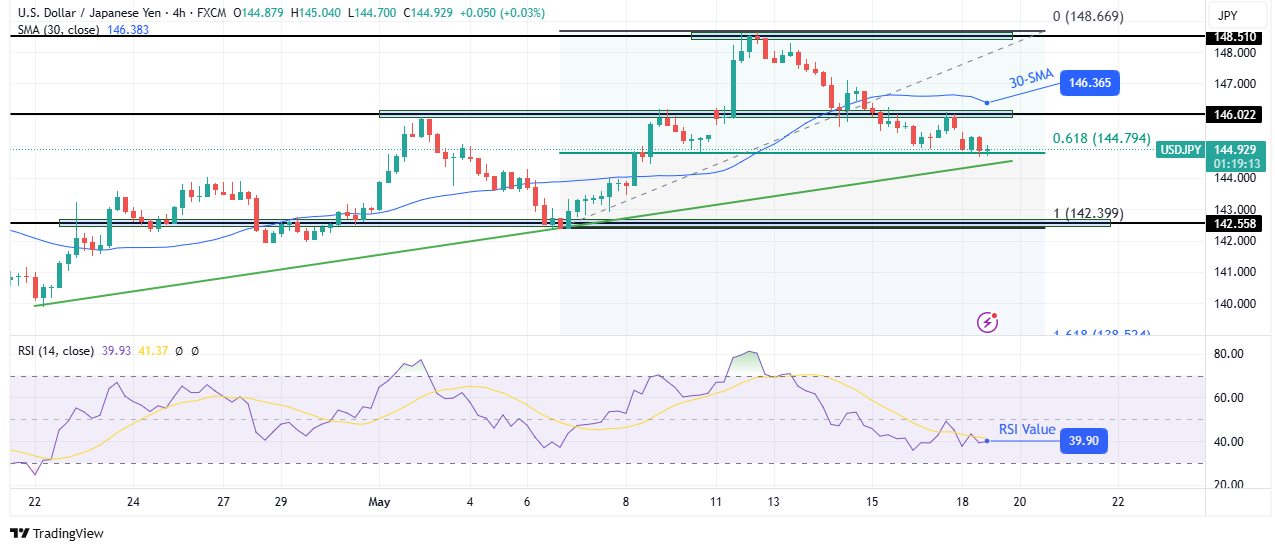
On the technical side, the USD/JPY price has pulled back and is approaching its support trendline. The price trades below the 30-SMA, with the RSI under 50, indicating a bearish bias. At the same time, the price has reached the 0.618 Fib retracement level that might act as a support.
–Are you interested in learning more about forex robots? Check our detailed guide-
Therefore, USD/JPY might soon bounce higher. The price has maintained a shallow uptrend that chops through the SMA but respects the trendline. Consequently, the uptrend will continue if bulls return near the trendline support. Such an outcome would allow the price to break above the 146.02 resistance level and the 30-SMA. Bulls would likely break above the 148.51 resistance level to make a new high.
On the other hand, a break below the trendline would signal a shift in sentiment. It would allow bears to retest the 142.55 support level.
Looking to trade forex now? Invest at eToro!
68% of retail investor accounts lose money when trading CFDs with this provider. You should consider whether you can afford to take the high risk of losing your money.
Gold price is showing some fresh signs of life early Monday, following a weekly decline. The further upside in Gold price depends on the upcoming Fedspeak and talks over potential US trade deals amid rising concerns over US fiscal debt.
Markets have resorted to selling US assets as they respond to the credit blow, marking the start of a new week. Moody’s downgraded the US sovereign credit rating on Friday by one notch from its pristine “Aaa” rating to “Aa1”.
The rating downgrade is based on concerns about the nation’s growing $36 trillion debt pile and higher interest payments amid US President Donald Trump’s erratic economic and trade policies.
The US Dollar (USD) wilted alongside the Treasury bonds and US equity futures, reviving the safe-haven appeal of Gold price. However, rising US Treasury bond yields on economic concerns limit the upside attempts in the yellow metal, leaving the bullion confined in a range above $3,200.
Further, US Treasury Secretary Scott Bessent’s tariff threat on Sunday also keeps markets on the edge, allowing Gold price some sigh of relief. Bessent said, “Trump has put them (trading partners) on notice that if you do not negotiate in good faith, you will ratchet back up to your April 2 level.”
These factors have unnerved markets, and hence, they pay little heed to the news that the House panel approved President Trump’s tax cut bill early Monday, paving the way for possible passage in the House of Representatives later this week.
In the day ahead, Gold price could likely remain supported as the USD could face headwinds from growing economic and fiscal concerns. Data released last week showed that the US Producer Price Index (PPI) in April fell unexpectedly, while Retail Sales growth slowed, and Consumer Price Index (CPI) rose less than expected.
However, any optimistic headlines on the expected US trade agreements with South Korea, India and Japan could refuel the Gold price downside. Cautious remarks from Federal Reserve (Fed) policymakers will likely hinder the rebound in the bright metal.
Technically, Gold price remains exposed to further downside risks as the 14-day Relative Strength Index (RSI) sits beneath the midline, near 48.50.
The bright metal remains capped between the 21-day Simple Moving Average (SMA) at $3,299 and the 50-day SMA at $3,169.
So long as the price stays above the throwback support of the 50-day SMA, a brief recovery toward the 21-day SMA remains in the offing.
Acceptance above that level will add legs to the upswing, exposing the falling trendline resistance at $3,407.
On the downside, if sellers manage to crack the 50-day SMA on a sustained basis, a fresh sell-off could be fuelled toward the $3,100 mark.
The April 10 low of $3,072 would then come to the rescue of buyers.
Tariffs are customs duties levied on certain merchandise imports or a category of products. Tariffs are designed to help local producers and manufacturers be more competitive in the market by providing a price advantage over similar goods that can be imported. Tariffs are widely used as tools of protectionism, along with trade barriers and import quotas.
Although tariffs and taxes both generate government revenue to fund public goods and services, they have several distinctions. Tariffs are prepaid at the port of entry, while taxes are paid at the time of purchase. Taxes are imposed on individual taxpayers and businesses, while tariffs are paid by importers.
There are two schools of thought among economists regarding the usage of tariffs. While some argue that tariffs are necessary to protect domestic industries and address trade imbalances, others see them as a harmful tool that could potentially drive prices higher over the long term and lead to a damaging trade war by encouraging tit-for-tat tariffs.
During the run-up to the presidential election in November 2024, Donald Trump made it clear that he intends to use tariffs to support the US economy and American producers. In 2024, Mexico, China and Canada accounted for 42% of total US imports. In this period, Mexico stood out as the top exporter with $466.6 billion, according to the US Census Bureau. Hence, Trump wants to focus on these three nations when imposing tariffs. He also plans to use the revenue generated through tariffs to lower personal income taxes.
EUR/USD gains traction and trades in positive territory above 1.1200 to begin the new week. The pair could face a strong resistance level at 1.1270.
The table below shows the percentage change of Euro (EUR) against listed major currencies today. Euro was the strongest against the US Dollar.
| USD | EUR | GBP | JPY | CAD | AUD | NZD | CHF | |
|---|---|---|---|---|---|---|---|---|
| USD | -0.66% | -0.58% | -0.36% | -0.16% | -0.32% | -0.26% | -0.38% | |
| EUR | 0.66% | -0.17% | 0.15% | 0.33% | 0.23% | 0.23% | 0.06% | |
| GBP | 0.58% | 0.17% | -0.02% | 0.50% | 0.40% | 0.40% | 0.23% | |
| JPY | 0.36% | -0.15% | 0.02% | 0.22% | 0.20% | 0.30% | 0.04% | |
| CAD | 0.16% | -0.33% | -0.50% | -0.22% | -0.15% | -0.10% | -0.27% | |
| AUD | 0.32% | -0.23% | -0.40% | -0.20% | 0.15% | -0.00% | -0.16% | |
| NZD | 0.26% | -0.23% | -0.40% | -0.30% | 0.10% | 0.00% | -0.17% | |
| CHF | 0.38% | -0.06% | -0.23% | -0.04% | 0.27% | 0.16% | 0.17% |
The heat map shows percentage changes of major currencies against each other. The base currency is picked from the left column, while the quote currency is picked from the top row. For example, if you pick the Euro from the left column and move along the horizontal line to the US Dollar, the percentage change displayed in the box will represent EUR (base)/USD (quote).
The selling pressure surrounding the US Dollar (USD) following Moody’s downgrade of the United States’ credit rating helps EUR/USD push higher in the European morning on Monday. The USD Index, which tracks the USD’s performance against a basket of six major currencies, was last seen losing 0.6% on the day below 100.50, pointing to a broad-based USD weakness.
Moody’s announced late Friday that it downgraded the US’ credit rating to ‘AA1’ from ‘AAA’, citing concerns about the growing $36 trillion debt pile. “Successive US administrations and Congress have failed to agree on measures to reverse the trend of large annual fiscal deficits and growing interest costs,” Moody’s explained, per Reuters.
In the second half of the day, several Federal Reserve (Fed) policymakers will be delivering speeches.
Late last week, Atlanta Fed President Raphael Bostic said that he expects just one rate cuts this year amid uncertainty. In case Fed officials adopt a similar tone, the USD could stage a rebound and limit EUR/USD’s upside. According to the CME FedWatch Tool, markets are currently pricing in about a 70% probability of the Fed cutting the policy rate at least twice this year.
The Relative Strength Index (RSI) indicator on the 4-hour chart rises toward 60, reflecting a buildup of bullish momentum.
On the upside, 1.1270 (Fibonacci 38.2% retracement of the latest uptrend, 100-period Simple Moving Average (SMA), 200-period SMA) aligns as a key resistance level before 1.1300 (static level) and 1.1380 (Fibonacci 23.6% retracement).
Looking south, the first support level could be spotted at 1.1200 (static level, round level) ahead of 1.1170 (Fibonacci 50% retracement) and 1.1080 (Fibonacci 61.8% retracement).
The Euro is the currency for the 19 European Union countries that belong to the Eurozone. It is the second most heavily traded currency in the world behind the US Dollar. In 2022, it accounted for 31% of all foreign exchange transactions, with an average daily turnover of over $2.2 trillion a day.
EUR/USD is the most heavily traded currency pair in the world, accounting for an estimated 30% off all transactions, followed by EUR/JPY (4%), EUR/GBP (3%) and EUR/AUD (2%).
The European Central Bank (ECB) in Frankfurt, Germany, is the reserve bank for the Eurozone. The ECB sets interest rates and manages monetary policy.
The ECB’s primary mandate is to maintain price stability, which means either controlling inflation or stimulating growth. Its primary tool is the raising or lowering of interest rates. Relatively high interest rates – or the expectation of higher rates – will usually benefit the Euro and vice versa.
The ECB Governing Council makes monetary policy decisions at meetings held eight times a year. Decisions are made by heads of the Eurozone national banks and six permanent members, including the President of the ECB, Christine Lagarde.
Eurozone inflation data, measured by the Harmonized Index of Consumer Prices (HICP), is an important econometric for the Euro. If inflation rises more than expected, especially if above the ECB’s 2% target, it obliges the ECB to raise interest rates to bring it back under control.
Relatively high interest rates compared to its counterparts will usually benefit the Euro, as it makes the region more attractive as a place for global investors to park their money.
Data releases gauge the health of the economy and can impact on the Euro. Indicators such as GDP, Manufacturing and Services PMIs, employment, and consumer sentiment surveys can all influence the direction of the single currency.
A strong economy is good for the Euro. Not only does it attract more foreign investment but it may encourage the ECB to put up interest rates, which will directly strengthen the Euro. Otherwise, if economic data is weak, the Euro is likely to fall.
Economic data for the four largest economies in the euro area (Germany, France, Italy and Spain) are especially significant, as they account for 75% of the Eurozone’s economy.
Another significant data release for the Euro is the Trade Balance. This indicator measures the difference between what a country earns from its exports and what it spends on imports over a given period.
If a country produces highly sought after exports then its currency will gain in value purely from the extra demand created from foreign buyers seeking to purchase these goods. Therefore, a positive net Trade Balance strengthens a currency and vice versa for a negative balance.
The GBPJPY pair remains affected by the negative pressures, which forces it to fluctuate below the extra support at 193.15 level, which forces it to delay the bullish rally on the current trading, while the stability of the moving average 55 above the support at 191.50, stochastic approach from 20 level, these factors make us wait for gathering the positive momentum, then begin targeting some of the positive stations, by its rally to 194.50 and 195.30.
While the decline below 191.50 and providing a negative close will confirm its move to the bearish track, to expect suffering big losses by reaching 190.40.
The expected trading range for today is between 192.20 and 194.10
Trend forecast: Bullish
Do you need help in trading decisions? Do you want to learn how to start trading?
Join Economies.com VIP Club and benefit from over 15 years of market analysis expertise and get:
Special Offer: Subscribe to the Economies.com VIP channel and get also a free subscription to a trusted trading signals channel provided by Best Trading Signal.
The GBPJPY pair remains affected by the negative pressures, which forces it to fluctuate below the extra support at 193.15 level, which forces it to delay the bullish rally on the current trading, while the stability of the moving average 55 above the support at 191.50, stochastic approach from 20 level, these factors make us wait for gathering the positive momentum, then begin targeting some of the positive stations, by its rally to 194.50 and 195.30.
While the decline below 191.50 and providing a negative close will confirm its move to the bearish track, to expect suffering big losses by reaching 190.40.
The expected trading range for today is between 192.20 and 194.10
Trend forecast: Bullish
Do you need help in trading decisions? Do you want to learn how to start trading?
Join Economies.com VIP Club and benefit from over 15 years of market analysis expertise and get:
Special Offer: Subscribe to the Economies.com VIP channel and get also a free subscription to a trusted trading signals channel provided by Best Trading Signal.
Copper price began forming a negative move, activating with the negativity of the main indicators, to settle near the extra support at $4.5000, facing negative pressures will increase the chances for breaking the current support, to open the way towards targeting extra negative stations, which might begin at $4.4500 reaching $4.3100.
The failure to break the current support might push the price to form mixed trading, and there is a new chance for targeting 50%Fibonacci correction level near $4.6600.
The expected trading range for today is between $4.4500 and $4.5600
Trend forecast: Bearish
Do you need help in trading decisions? Do you want to learn how to start trading?
Join Economies.com VIP Club and benefit from over 15 years of market analysis expertise and get:
Special Offer: Subscribe to the Economies.com VIP channel and get also a free subscription to a trusted trading signals channel provided by Best Trading Signal.
The GBPJPY pair remains affected by the negative pressures, which forces it to fluctuate below the extra support at 193.15 level, which forces it to delay the bullish rally on the current trading, while the stability of the moving average 55 above the support at 191.50, stochastic approach from 20 level, these factors make us wait for gathering the positive momentum, then begin targeting some of the positive stations, by its rally to 194.50 and 195.30.
While the decline below 191.50 and providing a negative close will confirm its move to the bearish track, to expect suffering big losses by reaching 190.40.
The expected trading range for today is between 192.20 and 194.10
Trend forecast: Bullish
Do you need help in trading decisions? Do you want to learn how to start trading?
Join Economies.com VIP Club and benefit from over 15 years of market analysis expertise and get:
Special Offer: Subscribe to the Economies.com VIP channel and get also a free subscription to a trusted trading signals channel provided by Best Trading Signal.
Institutional interest in bullion remains subdued as traders reassess the likelihood of near-term Fed action. Retail sales and PPI data showed enough resilience to keep growth concerns at bay, while sticky inflation expectations may force policymakers to stay cautious. Without a decisive dovish pivot or renewed geopolitical stress, gold is likely to remain under pressure.
Unless upcoming Fed commentary pushes back clearly against rising real rates or reaffirms a near-term policy shift, capital rotation toward risk assets and away from gold will likely persist. With safe-haven demand cooling and inflation uncertainty elevated, gold faces continued headwinds in the short term.
Technically, XAU/USD is still in an uptrend, but momentum has shifted to the downside.
A sustained move under the pivot at $3166.46 is likely to extend the selling pressure this week towards the next major pivot at $3018.52.
Traders are expected to continue to buy the dips into support, but unlike previous similar moves, they are being met by traders selling the rallies.
The major support is the swing bottom at $2956.56. If this price fails then look out to the downside with the 52-week moving average at $2707.24 the next like target.
More Information in our Economic Calendar.
May 18, 2025 – Written by Frank Davies
STORY LINK Euro to Dollar Forecast for Next Week: EUR to Extend 1.12 Consolidation
Nordea forecasts that the Euro to Dollar exchange rate (EUR/USD) will strengthen to 1.20 by the end of 2026 and would not be surprised if this level was reached much earlier than this.
ING is far from bullish on the dollar, but expects EURUSD will be held to 1.13 at the end of this year.
The EUR/USD recovered strongly from initial lows near 1.1050 during the week, but there was a fresh retreat to 1.1150 as the dollar found fresh energy.
The dollar bounced strongly following the US-China deal to lower tariffs by 115% points for the next 90 days.
Fears over dollar selling abated and defensive Euro demand also faded.
There are still important underlying concerns surrounding the dollar outlook and whether there has been long-term damage to the outlook.
According to Deutsche Bank; “The fact that China retaliated strongly to US tariffs and made no publicly known concessions to effect the reduction, highlights that we are in very different times.”
It added; “A backtracking on tariffs does not mean the importance of underlying issues has changed, merely that the approach or timing of dealing with them may have. The fundamental overproduction-overconsumption imbalance between China and the US remains large, striking and unsustainable.”
The bank considers that this has important implications; “The significance of this conclusion cannot be over-estimated. We have been arguing over the last few months that the market is reducing its willingness to fund US twin deficits,” Saravelos writes. “We worry this is brewing a major problem for the dollar and potentially the US bond market too.”
Nordea maintains a bearish dollar stance; “We think the USD will weaken even more. It is facing a trifecta of headwinds: domestic economic slowdown, political uncertainty undermining global trust and upside growth potential in Europe beyond the short term uncertainties.”
It added; “Trump’s public challenges to the Fed’s independence could undermine trust and confidence that the Fed will do its job. If investors begin to doubt the Fed’s commitment or ability to control inflation, they are likely to demand a higher risk premium to hold US assets – adding further pressure on the dollar.”
According to Berenberg; “The extremely uncertain macroeconomic environment is causing companies to postpone recruitment and investment plans. This could drive the economy into stagnation.”
The bank, however, sees little scope for rate cuts; “we believe that the interest rate cuts currently being priced in are somewhat exaggerated.”
At this stage it has a longer-term target of 1.13 for EUR/USD.

It did, however, add; “should the Fed fail to with-stand the attacks from Trump and his supporters, this would further call into question the safe-haven status of the US dollar. In combination with the risk of high US government debt and potential refinancing problems, the US dollar could continue to fall significantly in value in this scenario and reach price levels above 1.20.”
According to SocGen, there has been long-term damage to confidence; “In this instance, we know the U.S. Administration wants a weaker dollar in order to make U.S. manufacturing more competitive. We also know, and will not be able to forget, that foreign ownership of U.S. assets is excessive.
It added; “The world’s investors have too many under-hedged U.S. dollar assets in their portfolios for safety, especially given an Administration that would like to see the dollar weaker.”
International Money Transfer? Ask our resident FX expert a money transfer question or try John’s new, free, no-obligation personal service! ,where he helps every step of the way,
ensuring you get the best exchange rates on your currency requirements.
No news for Copper price until this moment by its repeated sideways fluctuation near $4.6200 level, attempting to settle below the initial barrier at $4.6600, reinforcing the chances for activating the suggested negative scenario, reminding you that the initial targets are located near $4.4500 and $4.3100 level.
Note that regaining the bullish bias requires forming strong bullish waves, to surpass the resistance at $4.9100, and holding above it to open the way towards achieving big gains that might begin at $5.0300.
The expected trading range for today is between $4.4500 and $4.6800
Trend forecast: Bearish
Do you need help in trading decisions? Do you want to learn how to start trading?
Join Economies.com VIP Club and benefit from over 15 years of market analysis expertise and get:
Special Offer: Subscribe to the Economies.com VIP channel and get also a free subscription to a trusted trading signals channel provided by Best Trading Signal.