The main category of Forex News.
You can use the search box below to find what you need.
[wd_asp id=1]
The main category of Forex News.
You can use the search box below to find what you need.
[wd_asp id=1]
Gold price is looking to extend the previous day’s over 2% sell-off early Thursday. The yellow metal remains vulnerable near monthly lows, trading below $3,200, as it awaits the high-impact US Producer Price Index (PPI) and Retail Sales data ahead of Federal Reserve (Fed) Chair Jerome Powell’s speech.
A negative shift in risk sentiment in Asian trades on Thursday seems to be exerting renewed downward pressure on the US Dollar (USD), helping Gold price pause its decline at the moment.
Traders are turning cautious and refraining from placing directional bets on the Greenback and Gold price before the release of the US PPI inflation and Retail Sales data, which could significantly impact the markets’ expectations of future interest rate cuts by the Fed.
Retail volumes could see a big boost from frontloading to get ahead of US tariffs impact, while the US PPI inflation is set to decline to 2.5% over the year in April. Markets are pricing in about 53 basis points (bps) of Fed rate cut this year, with a probability of a 25 bps rate reduction in September standing at about 50%, according to the CME Group’s Fed Watch Tool.
The increased odds of fewer Fed rate cuts continue to act as a headwind to the non-yielding Gold price, even though the US Consumer Price Index (CPI) cooled slightly in April. Annually, US CPI rose 2.3% in the same period, compared to a forecast of 2.4%.
Gold price also bears the brunt of receding US recession fears, courtesy of the trade truce between the world’s two largest economies – the US and China. Furthermore, optimism over US-South Korea trade talks and expectations of a US-Iran nuclear deal keep the traditional safe-haven Gold price under pressure.
However, it remains to be seen if the Gold price continues its descent, as risk sentiment could deteriorate further if the upcoming Ukraine-Russia peace talks turn sour. Weaker-than-expected US PPI and Retail Sales data could rekindle dovish Fed expectations and provide the much-needed support to Gold price.
Additionally, Gold price could draw support from rising tensions over the US deficit after Treasury reported a $1.049 trillion budget deficit for the first seven months of fiscal 2025, which started October 1, up 23%, or $194 billion, from a year earlier.
Technically, Gold price remains exposed to further downside risks so long as the price stays below the 21-day Simple Moving Average (SMA) at $3,308.
Currently, the yellow metal is challenging the key 50-day Simple Moving Average (SMA) at $3,155.
The 14-day Relative Strength Index (RSI) is currently holding below the midline, near 44, indicating more downside potential.
However, if buyers manage to defend the 50-day SMA at $3,155, a rebound toward the 21-day SMA at $3,308 cannot be ruled out.
Further up, the falling trendline resistance at $3,419 will come into play.
A sustained break below the 50-day SMA support could trigger a fresh downtrend toward the 100-day SMA at $2,972
Ahead of that, the $3,100 round level and the April 10 low of $3,072 would be tested.
Jerome H. Powell took office as a member of the Board of Governors of the Federal Reserve System on May 25, 2012, to fill an unexpired term. On November 2, 2017, President Donald Trump nominated Powell to serve as the next Chairman of the Federal Reserve. Powell assumed office as Chair on February 5, 2018.
Next release:
Thu May 15, 2025 12:40
Frequency:
Irregular
Consensus:
–
Previous:
–
Source:
Federal Reserve
The Gold price (XAU/USD) trades with mild gains near $3,180 during the early Asian session on Thursday. However, the potential upside for the yellow metal might be capped in the near term due to better risk appetite and progress in trade talks.
The precious metal remains on the defensive as tension eases in the global trade war, pushing investors away from safe-haven demand. The US and China agreed to reduce tariffs on each other after two days of negotiations in Geneva, Switzerland. The US lowered tariffs on Chinese imports to 30% from 145%, while China cut tariffs on US imports to 10% from 125%.
“Overall it’s an improved risk sentiment that for now has reduced gold’s appeal,” said Ole Hansen, head of commodities strategy at Saxo Bank A/S.
A top adviser to Iran’s supreme leader, Ali Shamkhani, said late Wednesday that Iran is ready to sign a nuclear deal with certain conditions with US President Donald Trump in exchange for lifting economic sanctions. These positive developments contribute to the Gold’s downside.
However, trade uncertainties and escalating geopolitical risks could help limit the Gold’s losses. Traders will keep an eye on the release of the US Retail Sales and Producer Price Index (PPI) for April later on Thursday. Also, the Federal Reserve (Fed) Chair Jerome Powell is set to speak.
Gold has played a key role in human’s history as it has been widely used as a store of value and medium of exchange. Currently, apart from its shine and usage for jewelry, the precious metal is widely seen as a safe-haven asset, meaning that it is considered a good investment during turbulent times. Gold is also widely seen as a hedge against inflation and against depreciating currencies as it doesn’t rely on any specific issuer or government.
Central banks are the biggest Gold holders. In their aim to support their currencies in turbulent times, central banks tend to diversify their reserves and buy Gold to improve the perceived strength of the economy and the currency. High Gold reserves can be a source of trust for a country’s solvency. Central banks added 1,136 tonnes of Gold worth around $70 billion to their reserves in 2022, according to data from the World Gold Council. This is the highest yearly purchase since records began. Central banks from emerging economies such as China, India and Turkey are quickly increasing their Gold reserves.
Gold has an inverse correlation with the US Dollar and US Treasuries, which are both major reserve and safe-haven assets. When the Dollar depreciates, Gold tends to rise, enabling investors and central banks to diversify their assets in turbulent times. Gold is also inversely correlated with risk assets. A rally in the stock market tends to weaken Gold price, while sell-offs in riskier markets tend to favor the precious metal.
The price can move due to a wide range of factors. Geopolitical instability or fears of a deep recession can quickly make Gold price escalate due to its safe-haven status. As a yield-less asset, Gold tends to rise with lower interest rates, while higher cost of money usually weighs down on the yellow metal. Still, most moves depend on how the US Dollar (USD) behaves as the asset is priced in dollars (XAU/USD). A strong Dollar tends to keep the price of Gold controlled, whereas a weaker Dollar is likely to push Gold prices up.
That being said, the market will do what the market will do, and technical analysis is only good for so much. After all, if it all worked 100% of the time, then people would all be wealthy trading in the Forex markets. That being said though, it does suggest that there is a lot of selling pressure above, so I think the upside at this point in time is probably somewhat limited.

Furthermore, there are a lot of reasons to ask whether or not the risk appetite out there would continue to go higher. After all, even though we’ve had some movement between the Americans and the Chinese, the reality is that we are still in a “wait and see” mode.
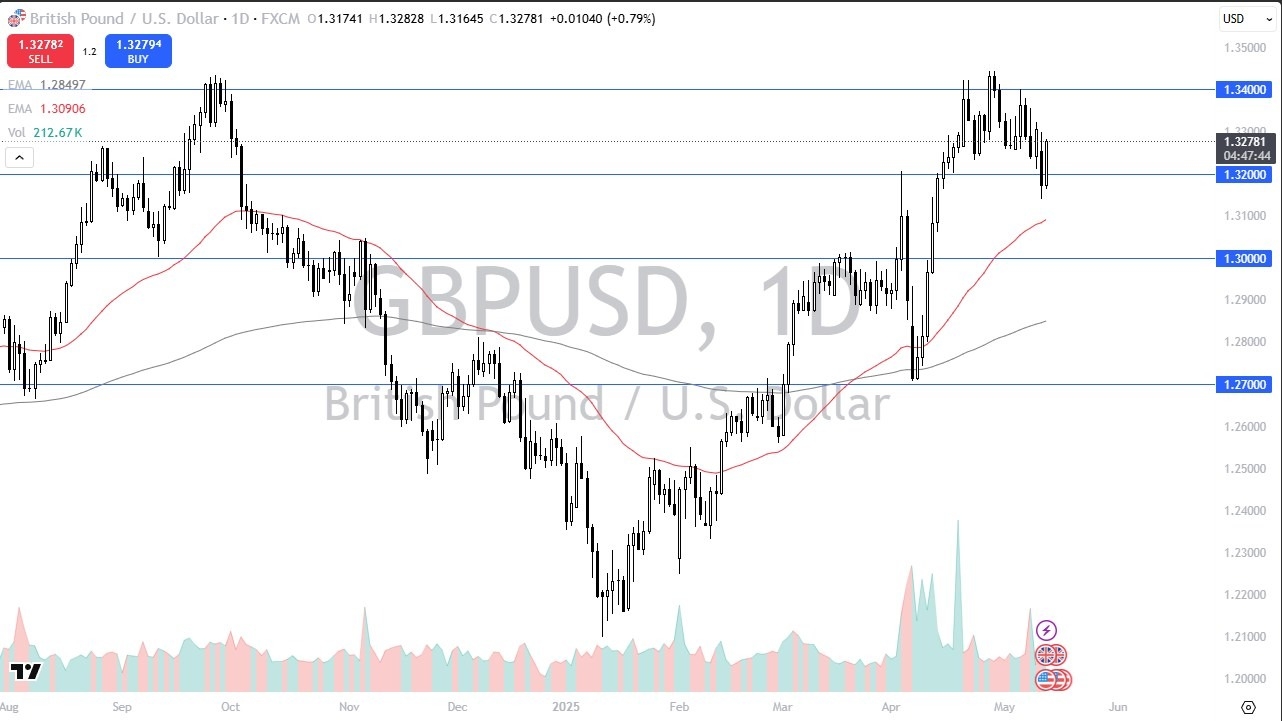
We have those 3 shooting stars on the weekly chart, but I also see a lot of resistance near the 1.34 level. This is an area that’s been important multiple times in the past, and therefore think you need to pay close attention to after all, longer-term charts can guide the way, as larger positions are certainly placed around these areas, but we also have to keep in mind that you must be flexible enough to take the other trade if you do in fact that signal.
For example, the market were to break above the 1.35 level, then it’s obvious that the sellers have been run over, and that the market should probably go higher. On a break lower from here, the 50 Day EMA sits right around the 1.31 level, and is rising. That could be a little bit of dynamic support, but ultimately, I think we can even drop all the way down to the 1.30 level.
Ready to trade the Forex GBP/USD analysis and predictions? Here are the best forex trading platforms UK to choose from.
Christopher Lewis has been trading Forex and has over 20 years experience in financial markets. Chris has been a regular contributor to Daily Forex since the early days of the site. He writes about Forex for several online publications, including FX Empire, Investing.com, and his own site, aptly named The Trader Guy. Chris favours technical analysis methods to identify his trades and likes to trade equity indices and commodities as well as Forex. He favours a longer-term trading style, and his trades often last for days or weeks.
Silver price fell 2% on Wednesday amid elevated US Treasury bond yields as investors seemed confident that the US Federal Reserve would not reduce interest rates. At the time of writing, the XAG/USD trades at $32.20, unchanged as the Asian session begins.
Silver price is set to consolidate within the $32.00 – $33.00 range, capped on the upside by the 50-day Simple Moving Average (SMA) at $32.73 and on the downside by the 100-day SMA at $31.91.
From a momentum standpoint, sellers are in charge, as the Relative Strength Index (RSI) portrays. However, price action dictates that bears must clear the $32.00 mark, followed by the 100-day SMA to aim for lower prices. In that outcome, XAG/USD’s next support would be the 200-day SMA at $31.30. A breach of the latter will expose the $31.00 figure, followed by the latest cycle low seen at $28.33, the April 7 low.
Conversely, if XAG/USD clears the 50-day SMA, the grey metal would be poised to test $33.00. Once surpassed, the next stop would be the April 24 swing high at $33.68 ahead of the $34.00 figure.
Silver is a precious metal highly traded among investors. It has been historically used as a store of value and a medium of exchange. Although less popular than Gold, traders may turn to Silver to diversify their investment portfolio, for its intrinsic value or as a potential hedge during high-inflation periods. Investors can buy physical Silver, in coins or in bars, or trade it through vehicles such as Exchange Traded Funds, which track its price on international markets.
Silver prices can move due to a wide range of factors. Geopolitical instability or fears of a deep recession can make Silver price escalate due to its safe-haven status, although to a lesser extent than Gold’s. As a yieldless asset, Silver tends to rise with lower interest rates. Its moves also depend on how the US Dollar (USD) behaves as the asset is priced in dollars (XAG/USD). A strong Dollar tends to keep the price of Silver at bay, whereas a weaker Dollar is likely to propel prices up. Other factors such as investment demand, mining supply – Silver is much more abundant than Gold – and recycling rates can also affect prices.
Silver is widely used in industry, particularly in sectors such as electronics or solar energy, as it has one of the highest electric conductivity of all metals – more than Copper and Gold. A surge in demand can increase prices, while a decline tends to lower them. Dynamics in the US, Chinese and Indian economies can also contribute to price swings: for the US and particularly China, their big industrial sectors use Silver in various processes; in India, consumers’ demand for the precious metal for jewellery also plays a key role in setting prices.
Silver prices tend to follow Gold’s moves. When Gold prices rise, Silver typically follows suit, as their status as safe-haven assets is similar. The Gold/Silver ratio, which shows the number of ounces of Silver needed to equal the value of one ounce of Gold, may help to determine the relative valuation between both metals. Some investors may consider a high ratio as an indicator that Silver is undervalued, or Gold is overvalued. On the contrary, a low ratio might suggest that Gold is undervalued relative to Silver.
Gold prices are down on Wednesday with the bright metal trading at its lowest since mid-April. The XAU/USD pair accelerated its slide during American trading hours, piercing the $3,200 mark, as investors keep moving away from safe-haven assets. Despite risk appetite receding on Wednesday, investors are less concerned about global growth and a potential United States (US) recession, given the de-escalation of trade tensions between the US and China.
Meanwhile, speculative interest kept digesting US inflation data. The slight uptick in the Consumer Price Index (CPI) in April reminded investors of the “hawkish” Federal Reserve’s stance. As a result, Wall Street trades mixed, with the Nasdaq Composite and the S&P 500 posting modest intraday advances and the Dow Jones Industrial Average (DJIA) down for a second consecutive day.
Data-wise, the macroeconomic calendar remained scarce, but Thursday will bring Australian monthly employment figures, an update on the United Kingdom (UK) Gross Domestic Product, and the US April Producer Price Index (PPI).
From a technical point of view, the daily chart for the XAU/USD pair shows it fell further below a now flat 20 Simple Moving Average (SMA), while technical indicators resumed their slides within negative levels, in line with another leg lower. The 100 and 200 SMAS keep advancing, yet are too far below the current level to be relevant.
In the near term, and according to the 4-hour chart, XAU/USD is bearish. The pair trades below all its moving averages, with the 20 SMA about to cross below the 200 SMA. The latter stands at $3,232, providing relevant resistance in the case of a recovery. Finally, technical indicators lack directional strength but hold within negative levels, reflecting the absence of buying interest.
Support levels: 3,173.80 3,158.40 3,142.65
Resistance levels: 3,198.20 3,215.80 3,232.10
Important DisclaimersThe content provided on the website includes general news and publications, our personal analysis and opinions, and contents provided by third parties, which are intended for educational and research purposes only. It does not constitute, and should not be read as, any recommendation or advice to take any action whatsoever, including to make any investment or buy any product. When making any financial decision, you should perform your own due diligence checks, apply your own discretion and consult your competent advisors. The content of the website is not personally directed to you, and we does not take into account your financial situation or needs.The information contained in this website is not necessarily provided in real-time nor is it necessarily accurate. Prices provided herein may be provided by market makers and not by exchanges.Any trading or other financial decision you make shall be at your full responsibility, and you must not rely on any information provided through the website. FX Empire does not provide any warranty regarding any of the information contained in the website, and shall bear no responsibility for any trading losses you might incur as a result of using any information contained in the website.The website may include advertisements and other promotional contents, and FX Empire may receive compensation from third parties in connection with the content. FX Empire does not endorse any third party or recommends using any third party’s services, and does not assume responsibility for your use of any such third party’s website or services.FX Empire and its employees, officers, subsidiaries and associates, are not liable nor shall they be held liable for any loss or damage resulting from your use of the website or reliance on the information provided on this website.Risk DisclaimersThis website includes information about cryptocurrencies, contracts for difference (CFDs) and other financial instruments, and about brokers, exchanges and other entities trading in such instruments. Both cryptocurrencies and CFDs are complex instruments and come with a high risk of losing money. You should carefully consider whether you understand how these instruments work and whether you can afford to take the high risk of losing your money.FX Empire encourages you to perform your own research before making any investment decision, and to avoid investing in any financial instrument which you do not fully understand how it works and what are the risks involved.
Silver price (XAG/USD) is down over 1% to near $32.15 during North American trading hours on Wednesday. The white metal faces a sharp selling pressure as demand for safe-haven assets has fizzled out, with the United States (US) and China aiming to avert a more than a month-long trade war.
On Monday, Washington and Beijing agreed to lower import duties by 115% for 90 days, which reduced tariffs on them to 10% and 30%, respectively, after a two-day meeting in Switzerland. US Treasury Secretary Scott Bessent stated on Tuesday that Washington doesn’t intend to decouple with China but wants to bring medicine, semiconductor, and other strategic industries home.
The white metal outperformed when the world’s two largest powerhouses entered a trade war after Beijing announced counter-tariffs against reciprocal tariffs imposed by US President Donald Trump in April.
Additionally, easing inflationary pressures have also diminished the demand for Silver. The US Consumer Price Index (CPI) data showed on Tuesday that the headline inflation fell to 2.3%, the lowest level seen in over four years.
Going forward, the next trigger for the Silver price will be the Federal Reserve (Fed) Chair Jerome Powell’s speech on Thursday. Investors would like to know whether Powell has turned dovish on the interest rate outlook after soft inflation data and a temporary US-China trade truce.
Silver price trades in a Symmetrical Triangle formation on a four-hour timeframe. The chart pattern reflects indecisiveness among market participants. The near-term trend of the white metal is bearish as it trades below the 20-period Exponential Moving Average (EMA), which is around $32.70.
The 14-period Relative Strength Index (RSI) oscillates inside the 40.00-60.00 range, indicating a sharp volatility contraction.
Looking up, the March 28 high of $34.60 will act as key resistance for the metal. On the downside, the April 11 low of $30.90 will be the key support zone.
Silver is a precious metal highly traded among investors. It has been historically used as a store of value and a medium of exchange. Although less popular than Gold, traders may turn to Silver to diversify their investment portfolio, for its intrinsic value or as a potential hedge during high-inflation periods. Investors can buy physical Silver, in coins or in bars, or trade it through vehicles such as Exchange Traded Funds, which track its price on international markets.
Silver prices can move due to a wide range of factors. Geopolitical instability or fears of a deep recession can make Silver price escalate due to its safe-haven status, although to a lesser extent than Gold’s. As a yieldless asset, Silver tends to rise with lower interest rates. Its moves also depend on how the US Dollar (USD) behaves as the asset is priced in dollars (XAG/USD). A strong Dollar tends to keep the price of Silver at bay, whereas a weaker Dollar is likely to propel prices up. Other factors such as investment demand, mining supply – Silver is much more abundant than Gold – and recycling rates can also affect prices.
Silver is widely used in industry, particularly in sectors such as electronics or solar energy, as it has one of the highest electric conductivity of all metals – more than Copper and Gold. A surge in demand can increase prices, while a decline tends to lower them. Dynamics in the US, Chinese and Indian economies can also contribute to price swings: for the US and particularly China, their big industrial sectors use Silver in various processes; in India, consumers’ demand for the precious metal for jewellery also plays a key role in setting prices.
Silver prices tend to follow Gold’s moves. When Gold prices rise, Silver typically follows suit, as their status as safe-haven assets is similar. The Gold/Silver ratio, which shows the number of ounces of Silver needed to equal the value of one ounce of Gold, may help to determine the relative valuation between both metals. Some investors may consider a high ratio as an indicator that Silver is undervalued, or Gold is overvalued. On the contrary, a low ratio might suggest that Gold is undervalued relative to Silver.
a
The GBP/JPY pair corrects to near 194.45 during European trading hours on Wednesday from its four-month high of 196.40 posted earlier in the day. The cross retraces sharply as the Japanese Yen (JPY) strengthens across the board after comments from Bank of Japan (BoJ) Deputy Governor Shinichi Uchida indicated that hopes of further interest rate hikes are still alive despite global economic uncertainty in the wake of tariffs announced by United States (US) President Donald Trump.
The table below shows the percentage change of Japanese Yen (JPY) against listed major currencies today. Japanese Yen was the strongest against the Australian Dollar.
| USD | EUR | GBP | JPY | CAD | AUD | NZD | CHF | |
|---|---|---|---|---|---|---|---|---|
| USD | -0.32% | -0.21% | -0.98% | -0.00% | 0.04% | -0.12% | -0.41% | |
| EUR | 0.32% | 0.12% | -0.66% | 0.32% | 0.36% | 0.18% | -0.09% | |
| GBP | 0.21% | -0.12% | -0.80% | 0.20% | 0.24% | 0.06% | -0.21% | |
| JPY | 0.98% | 0.66% | 0.80% | 0.98% | 1.02% | 0.84% | 0.56% | |
| CAD | 0.00% | -0.32% | -0.20% | -0.98% | 0.04% | -0.12% | -0.40% | |
| AUD | -0.04% | -0.36% | -0.24% | -1.02% | -0.04% | -0.16% | -0.45% | |
| NZD | 0.12% | -0.18% | -0.06% | -0.84% | 0.12% | 0.16% | -0.28% | |
| CHF | 0.41% | 0.09% | 0.21% | -0.56% | 0.40% | 0.45% | 0.28% |
The heat map shows percentage changes of major currencies against each other. The base currency is picked from the left column, while the quote currency is picked from the top row. For example, if you pick the Japanese Yen from the left column and move along the horizontal line to the US Dollar, the percentage change displayed in the box will represent JPY (base)/USD (quote).
Japan’s underlying inflation and medium- to long-term inflation expectations are likely to temporarily stagnate. But even during that period, wages are expected to continue rising as Japan’s job market is very tight, Uchida said on Tuesday, Reuters reported.
Meanwhile, the Pound Sterling (GBP) trades calmly ahead of the flash United Kingdom (UK) Q1 Gross Domestic Product (GDP) data, which will be released on Thursday. The UK economy is estimated to have expanded at a robust pace of 0.6%, compared to 0.1% growth seen in the last quarter of 2024.
On the monetary policy front, the Bank of England (BoE) is expected to reduce interest rates further as the UK labor market has cooled down. The Office for National Statistics (ONS) reported that the ILO Unemployment Rate accelerated to 4.5%, as expected, from 4.4% in the three months ending February. In the same period, the economy added 112K fresh workers, significantly lower than the prior release of 206K.
GBP/JPY struggles to extend its upside above the horizontal resistance plotted from the March 27 high of 196.00. However, the outlook of the cross is still bullish as the 20-day Exponential Moving Average (EMA) slopes higher, which trades around 192.32.
The 14-day Relative Strength Index (RSI) retraces to near 60.00 from 67.00. A fresh bullish momentum would emerge if the RSI holds above the 60.00 level.
The pair could extend its upside to near the January 7 high of 198.26 and the psychological level of 200.00 after breaking above the four-month high of 196.40.
On the flip side, a downside move by the pair below the May 6 low of 190.33 will expose it to the March 11 low of 188.80, followed by the February 7 low of 187.00.
The Gross Domestic Product (GDP), released by the Office for National Statistics on a monthly and quarterly basis, is a measure of the total value of all goods and services produced in the UK during a given period. The GDP is considered as the main measure of UK economic activity. The QoQ reading compares economic activity in the reference quarter to the previous quarter. Generally, a rise in this indicator is bullish for the Pound Sterling (GBP), while a low reading is seen as bearish.
Gold prices remain under pressure as investors reassess the interest rate outlook and digest mixed signals from recent US economic data. At the time of writing, XAU/USD is down 2.23% on the day, trading below $3,200, extending a week-to-date decline of 4.26%.
The pullback reflects uncertainty surrounding the Federal Reserve’s (Fed) policy stance, as softer inflation data clash with firm labor market conditions. This macro backdrop has kept Gold range-bound just below its all-time high, with traders looking for fresh direction.
On the daily chart, Gold has formed a bullish pennant, a continuation pattern that typically signals a potential resumption of the prevailing uptrend. The April surge forms the flagpole, while current price action is consolidating within converging trendlines, indicating tightening market conditions and indecision among market participants.
However, the integrity of the pattern is now under pressure. Price has slipped below the 20-day Simple Moving Average (SMA), currently at $3,316.20, reflecting short-term weakness. Additionally, the Relative Strength Index (RSI) has declined to 47.13, pointing to neutral-to-bearish momentum. These developments suggest that the bullish setup may be faltering.
The immediate focus is on the horizontal support at $3,200, which marks the lower boundary of the pennant. With prices currently below this level, a confirmed break would invalidate the pattern and likely trigger a deeper correction. Conversely, a move above $3,300, particularly if it clears the descending trendline resistance, would reaffirm the bullish bias and potentially open the path to new highs.
Gold (XAU/USD) daily chart
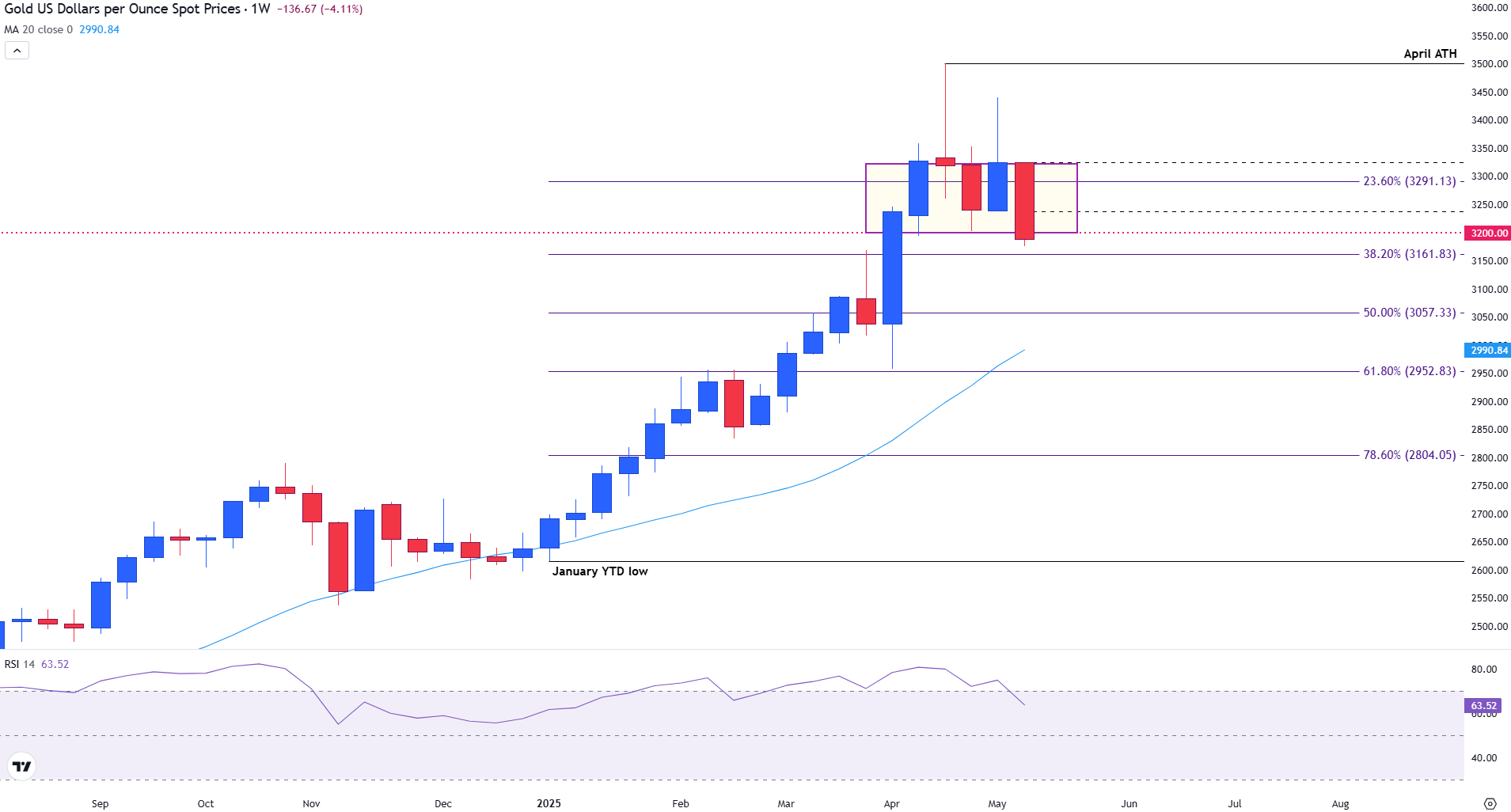
From a broader perspective, the weekly chart shows that Gold remains in a consolidation phase following its ascent to a record high of $3,500 in April. This advance was underpinned by safe-haven demand and market expectations of future interest rate cuts. However, the rally was quickly met with profit-taking, evidenced by a long upper shadow on the weekly candle — a signal of rejection and growing resistance.
Since that peak, Gold has traded within a narrow horizontal band between $3,200 and $3,300, representing a pause in the uptrend rather than a full reversal. The long-term bullish structure remains intact, supported by an ascending trendline originating from the January low. Importantly, price is still holding above the 23.6% Fibonacci retracement level at $3,291, drawn from the January low to the April high.
Gold (XAU/USD) weekly chart
While the broader trend favors the bulls, the near-term outlook hinges on how price behaves within the pivotal $3,200–$3,300 range.
A decisive breakout above $3,300, especially if accompanied by rising momentum and a break of descending trendline resistance, would confirm the continuation of the broader uptrend. In this scenario, Gold could retest the $3,450–$3,500 area.
A confirmed breakdown below $3,200 would invalidate the pennant structure and expose Gold to deeper retracements, with support levels at $3,161 (38.2% Fibonacci) and $3,057 (50.0%) offering potential downside targets.
Until a breakout occurs, Gold is likely to remain range-bound, with short-term direction dictated by incoming macroeconomic data and Fed policy signals.
Gold has played a key role in human’s history as it has been widely used as a store of value and medium of exchange. Currently, apart from its shine and usage for jewelry, the precious metal is widely seen as a safe-haven asset, meaning that it is considered a good investment during turbulent times. Gold is also widely seen as a hedge against inflation and against depreciating currencies as it doesn’t rely on any specific issuer or government.
Central banks are the biggest Gold holders. In their aim to support their currencies in turbulent times, central banks tend to diversify their reserves and buy Gold to improve the perceived strength of the economy and the currency. High Gold reserves can be a source of trust for a country’s solvency. Central banks added 1,136 tonnes of Gold worth around $70 billion to their reserves in 2022, according to data from the World Gold Council. This is the highest yearly purchase since records began. Central banks from emerging economies such as China, India and Turkey are quickly increasing their Gold reserves.
Gold has an inverse correlation with the US Dollar and US Treasuries, which are both major reserve and safe-haven assets. When the Dollar depreciates, Gold tends to rise, enabling investors and central banks to diversify their assets in turbulent times. Gold is also inversely correlated with risk assets. A rally in the stock market tends to weaken Gold price, while sell-offs in riskier markets tend to favor the precious metal.
The price can move due to a wide range of factors. Geopolitical instability or fears of a deep recession can quickly make Gold price escalate due to its safe-haven status. As a yield-less asset, Gold tends to rise with lower interest rates, while higher cost of money usually weighs down on the yellow metal. Still, most moves depend on how the US Dollar (USD) behaves as the asset is priced in dollars (XAU/USD). A strong Dollar tends to keep the price of Gold controlled, whereas a weaker Dollar is likely to push Gold prices up.
GBP/USD benefited from the broad-based US Dollar (USD) weakness on Tuesday and gained nearly 1% on the day. The pair preserves its bullish momentum and trades at a fresh weekly high near 1.3350 in the European session on Wednesday.
April inflation data from the US weighed on the USD on Tuesday, opening the door for a leg higher in GBP/USD during the American trading hours. The US Bureau of Labor Statistics reported that annual inflation, as measured by the change in the Consumer Price Index (CPI), edged lower to 2.3% in April from 2.4% in March. Read more…
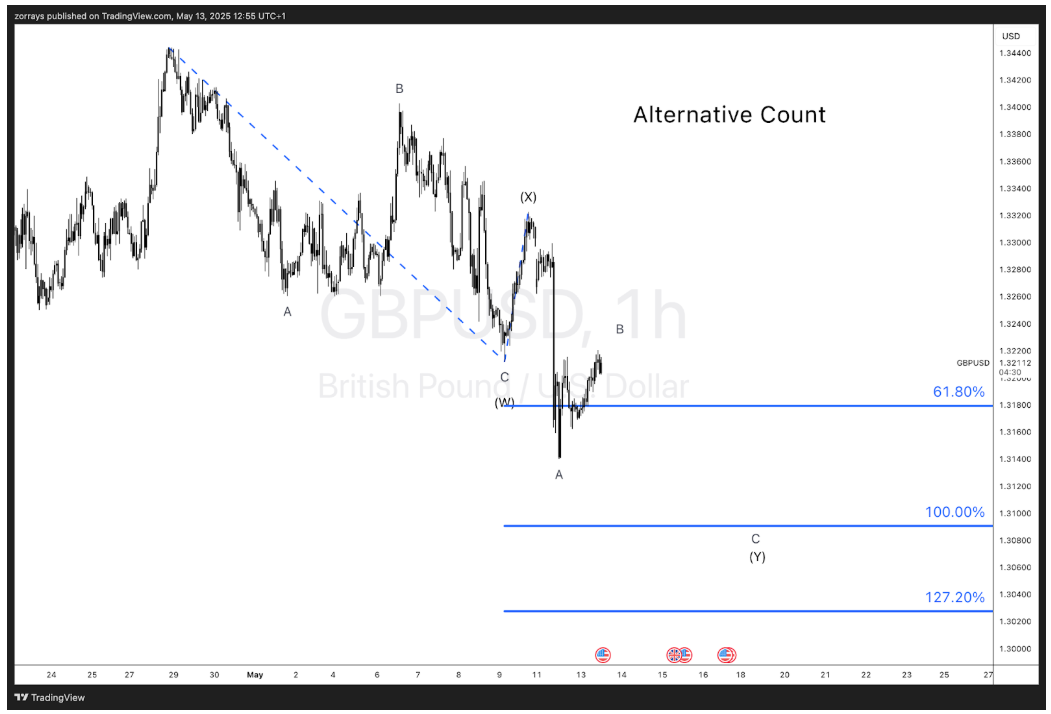
The GBP/USD 1-hour chart presents a compelling Elliott Wave structure, suggesting the potential completion of a corrective Wave (C) at the recent low near the 1.3140 region. According to the primary count, this could mark a significant inflection point, indicating that the pair may have bottomed out and is beginning a new impulsive rally.
This bullish shift coincides with macroeconomic commentary from Huw Pill, the Chief Economist at the Bank of England, who on Tuesday expressed concerns about inflationary pressures in the UK. Speaking at a London School of Economics conference, Pill emphasized. Read more…