The main category of Forex News.
You can use the search box below to find what you need.
[wd_asp id=1]
The main category of Forex News.
You can use the search box below to find what you need.
[wd_asp id=1]
The (USDJPY) price declined in its recent intraday trading, affected by the stability of the current resistance level at 148.13, gathering the gains of its last rises, attempting to gain positive momentum that might assist it to keep the solid bullish correctional wave, besides its attempt to offload some of its clear overbought conditions on the (RSI), especially with the emergence of negative overlapping signal from it.
The domination of the bullish correctional trend supports the price, accompanied by its upcoming intraday trading, especially when breaching the resistance at 148.13, to target the next resistance at 150.00.
Do you need help in trading decisions? Do you want to learn how to start trading?
Join Economies.com VIP Club and benefit from over 15 years of market analysis expertise and get:
Special Offer: Subscribe to the Economies.com VIP channel and get also a free subscription to a trusted trading signals channel provided by Best Trading Signal.
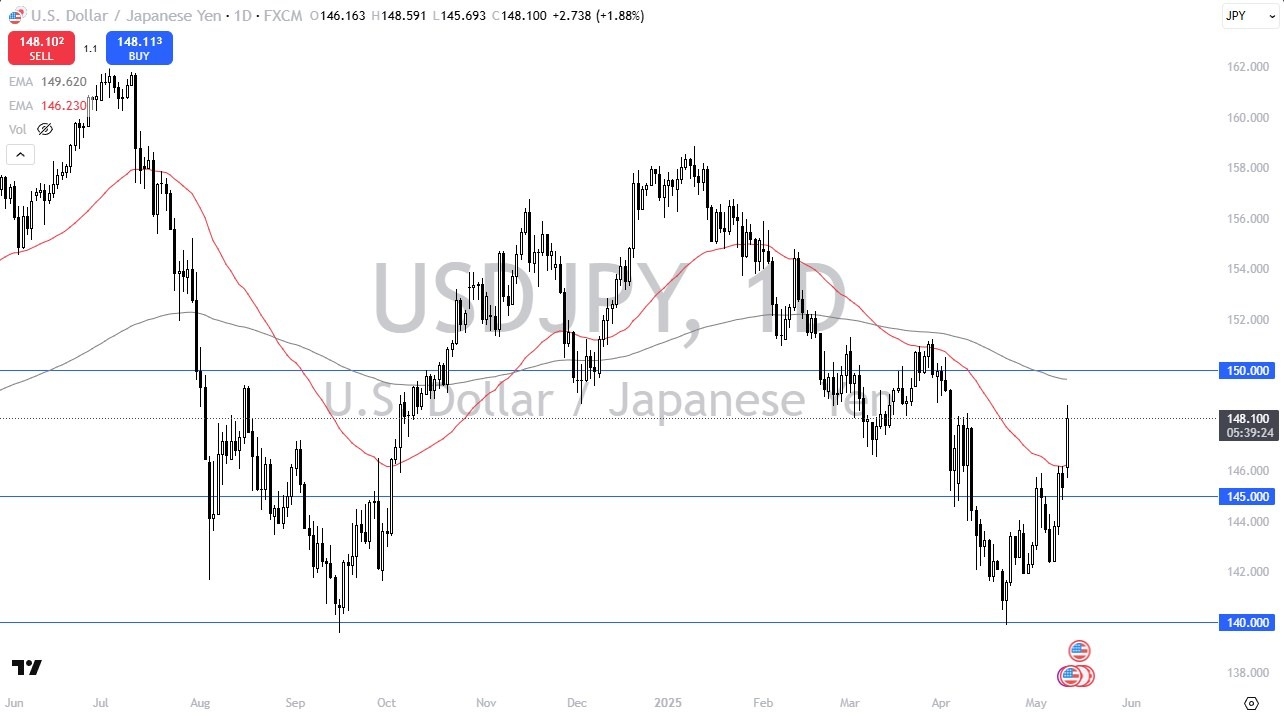
Furthermore, it’s worth noting that the United States is definitely seeing inflows during the trading session on Monday, not only in the currency markets, but also the stock market.

So, with that being said, I think we’ve got a situation where short-term pullbacks offer buying opportunities like I’ve been saying for some time. I think the 140 yen level is going to end up being a massive floor in the market but do keep in the mind that if we get a lot of concern in the market again, we could see the Japanese yen strengthen.
Short-term pullbacks offer those buying opportunities I’ve been talking about, especially near the 50 day EMA. The 200 day EMA sits just below the 150 yen level, which has a lot of psychology attached to it.
So, if we can break above there, that’s a very bullish sign. But right now, I think we’ve got a situation where we’ve definitely started to see some short covering. We definitely are starting to see a certain amount of momentum. All things being equal, this is a market that I think will continue to find value hundreds, especially considering, like I said, you get paid at the end of every day.
Want to trade our USD/JPY forex analysis and predictions? Here’s a list of forex brokers in Japan to check out.
Christopher Lewis has been trading Forex and has over 20 years experience in financial markets. Chris has been a regular contributor to Daily Forex since the early days of the site. He writes about Forex for several online publications, including FX Empire, Investing.com, and his own site, aptly named The Trader Guy. Chris favours technical analysis methods to identify his trades and likes to trade equity indices and commodities as well as Forex. He favours a longer-term trading style, and his trades often last for days or weeks.
Crude oil futures tumbled over the past week, falling more than 6% as concerns over weakening global demand and a resurgent supply outlook weighed on sentiment. West Texas Intermediate (WTI) briefly hit a low of $56.39 before recovering to $59.24 by Thursday’s close. While dip-buying provided short-term support, the underlying market tone remains distinctly bearish as fundamental pressures intensify.
China Demand Slowdown Fuels Bearish Sentiment
Fresh economic data from China delivered a major blow to oil bulls. The country’s official manufacturing PMI slumped to 49.0 in April, signaling contraction and raising alarm over the health of the world’s largest crude importer. Of particular concern was the new export orders index, which plunged to its weakest level since 2012 outside of pandemic anomalies. Analysts responded by slashing full-year growth forecasts to just 3.5%, casting doubt on sustainable Chinese demand.
Though China’s March crude imports surged, analysts argue this was driven more by pre-sanctions stockpiling than any uptick in consumption. With Beijing’s fiscal stimulus measures struggling to gain traction, traders are increasingly skeptical of China’s ability to sustain meaningful crude demand growth in the near term.
Trade War Escalation Undermines Global Oil Demand Expectations
U.S.-China trade tensions are exacerbating the fragile demand picture. A fresh round of tariffs and retaliatory measures has heightened fears of a global…
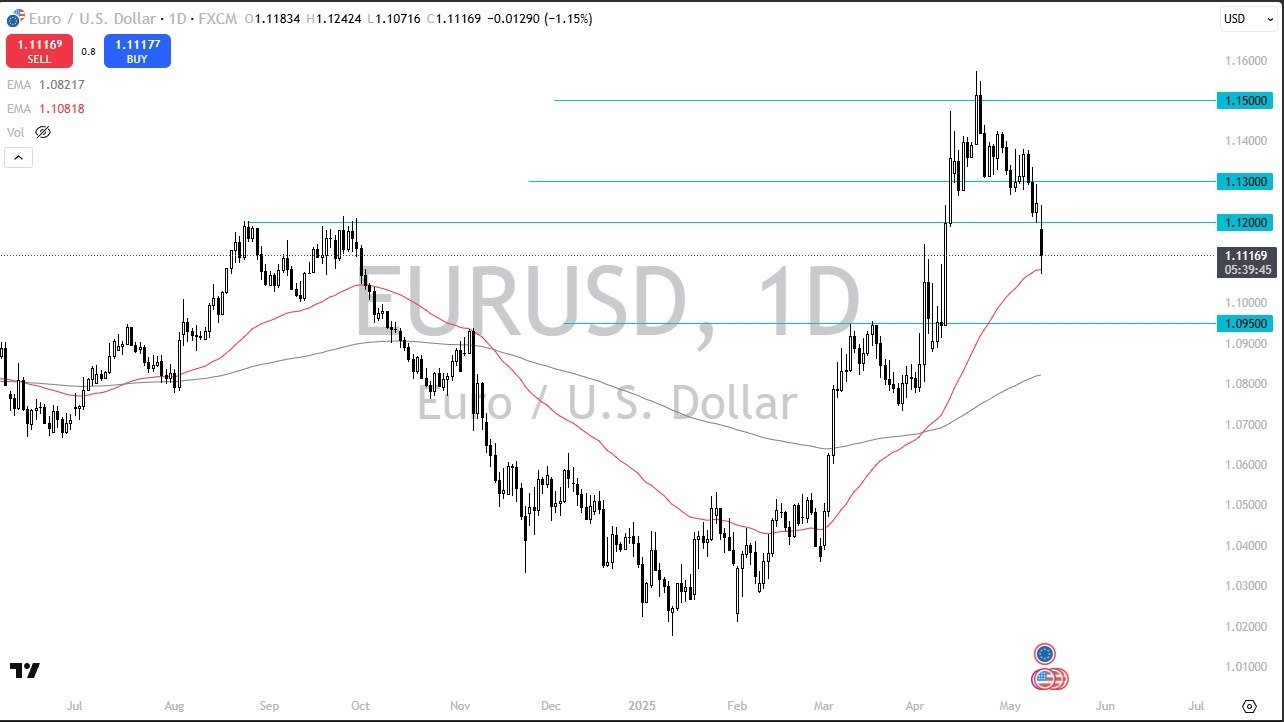
Anything below there opens up the possibility of a move to the 1.0750 level. On the other hand, if we turn around and rally from here, the 1.12 level is an area of potential resistance as we have seen over the last several months, a couple of different times. Ultimately, the euro has gotten a little bit of a barrier to deal with due to the fact that the China and US trade tariff talks actually went fairly well over the weekend. And this could isolate Europe if they are not careful.
After all, a lot of this comes down to the idea of the United States starving itself of capital coming in and goods coming in, which of course will not be the case regardless. But at this point in time, Europe is starting to show signs of cracks in several places. It’s more risk on in Europe in the indices than it is the currency.
The Euro, you know, it probably settles back into the range that we had been in for several years now between 1.05 and 1.09 or so. We’ll just have to wait and see. But at this point, I’m still relatively bearish. I do recognize there may be a bounce or two, but I think going down to the 1.0950 level at the very least makes the most sense. I would not be looking to buy this market, at least not right now.
Ready to trade our daily Forex analysis? We’ve made a list of the best forex trading platforms for beginners worth trading with.
Christopher Lewis has been trading Forex and has over 20 years experience in financial markets. Chris has been a regular contributor to Daily Forex since the early days of the site. He writes about Forex for several online publications, including FX Empire, Investing.com, and his own site, aptly named The Trader Guy. Chris favours technical analysis methods to identify his trades and likes to trade equity indices and commodities as well as Forex. He favours a longer-term trading style, and his trades often last for days or weeks.
The GBPJPY pair continued forming bullish trading, to face 23.6%Fibonacci correction level at 159.80, forming the previously suggested main target, to notice forming mixed trading due to stochastic reach to the overbought level, which makes us prefer the domination of the sideways bias temporarily until breaching the current barrier, which allows it to target new positive stations that might begin at 196.60.
While the failure to breach the barrier might assist the price to activate the bearish correctional track, which forces the price to suffer several losses by reaching 193.85 followed by 193.30 level, to close the last price gap.
The expected trading range for today is between 194.40 and 196.60
Trend forecast: Bullish
Do you need help in trading decisions? Do you want to learn how to start trading?
Join Economies.com VIP Club and benefit from over 15 years of market analysis expertise and get:
Special Offer: Subscribe to the Economies.com VIP channel and get also a free subscription to a trusted trading signals channel provided by Best Trading Signal.
The GBPJPY pair continued forming bullish trading, to face 23.6%Fibonacci correction level at 159.80, forming the previously suggested main target, to notice forming mixed trading due to stochastic reach to the overbought level, which makes us prefer the domination of the sideways bias temporarily until breaching the current barrier, which allows it to target new positive stations that might begin at 196.60.
While the failure to breach the barrier might assist the price to activate the bearish correctional track, which forces the price to suffer several losses by reaching 193.85 followed by 193.30 level, to close the last price gap.
The expected trading range for today is between 194.40 and 196.60
Trend forecast: Bullish
Do you need help in trading decisions? Do you want to learn how to start trading?
Join Economies.com VIP Club and benefit from over 15 years of market analysis expertise and get:
Special Offer: Subscribe to the Economies.com VIP channel and get also a free subscription to a trusted trading signals channel provided by Best Trading Signal.
The (USDJPY) price declined in its recent intraday trading, affected by the stability of the current resistance level at 148.13, gathering the gains of its last rises, attempting to gain positive momentum that might assist it to keep the solid bullish correctional wave, besides its attempt to offload some of its clear overbought conditions on the (RSI), especially with the emergence of negative overlapping signal from it.
The domination of the bullish correctional trend supports the price, accompanied by its upcoming intraday trading, especially when breaching the resistance at 148.13, to target the next resistance at 150.00.
Do you need help in trading decisions? Do you want to learn how to start trading?
Join Economies.com VIP Club and benefit from over 15 years of market analysis expertise and get:
Special Offer: Subscribe to the Economies.com VIP channel and get also a free subscription to a trusted trading signals channel provided by Best Trading Signal.
The GBPJPY pair continued forming bullish trading, to face 23.6%Fibonacci correction level at 159.80, forming the previously suggested main target, to notice forming mixed trading due to stochastic reach to the overbought level, which makes us prefer the domination of the sideways bias temporarily until breaching the current barrier, which allows it to target new positive stations that might begin at 196.60.
While the failure to breach the barrier might assist the price to activate the bearish correctional track, which forces the price to suffer several losses by reaching 193.85 followed by 193.30 level, to close the last price gap.
The expected trading range for today is between 194.40 and 196.60
Trend forecast: Bullish
Do you need help in trading decisions? Do you want to learn how to start trading?
Join Economies.com VIP Club and benefit from over 15 years of market analysis expertise and get:
Special Offer: Subscribe to the Economies.com VIP channel and get also a free subscription to a trusted trading signals channel provided by Best Trading Signal.
Gold price has managed to defend the $3,200 mark again, consolidating Monday’s 3% slump early Tuesday. Gold sellers take a breather as traders await the high-impact US Consumer Price Index (CPI) data, which is expected to drive the next trading impetus.
The gold price is showing some fresh signs of life in Asian trading this Tuesday as the US Dollar (USD) pulls back after a strong performance following news of a highly anticipated US-China trade truce.
Following the weekend’s trade talks in Geneva, both sides agreed that the US would reduce levies on Chinese imports from 145% to 30% during a 90-day negotiation period, and China would lower duties from 125% to 10%.
Risk flows intensified amid optimism about the China trade deal, easing US recession fears and reducing bets for aggressive Federal Reserve (Fed) interest rate cuts this year, which in turn powered the USD’s ongoing recovery at the expense of the traditional safe-haven Gold price.
Additionally, a ceasefire between India and Pakistan, along with optimism ahead of Thursday’s Russia-Ukraine peace talks, contributed to the downside in the Gold price.
In Tuesday’s trading so far, USD sellers appear to have regained control, as investors remain wary of the prospects for a permanent thaw in the US-China trade war. Fanning these concerns, US Trade Representative Jamieson Greer said late Monday that China has agreed to remove countermeasures. However, if things don’t work out, China tariffs can be reinstated.
Furthermore, traders resort to profit-taking on their USD longs heading into the US CPI showdown, thereby capping the downside of the Gold price.
The next directional move in the bright metal hinges on the outcome of the US inflation data release. Markets are expecting the headline annual US CPI to rise 2.4% in April, at the same pace as in March. The core CPI inflation is set to remain at 2.8% over the year in the same period.
An upside surprise to the CPI figures would double down on the renewed hawkish sentiment surrounding the Fed, bolstering the USD rally while fuelling a fresh decline in the non-interest-bearing Gold price. On the other hand, an unexpected slowdown in the US CPI growth could revive expectations of more than two Fed rate cuts, lending support to the bullion.
However, any headlines from the Trump administration regarding potential trade deals with the US’ major trading partners could outweigh the market reaction to the US CPI data, driving the Gold price action.
Speeches from Fed policymakers will also be closely scrutinized.
Gold price cracked the 21-day Simple Moving Average (SMA), then at $3,313 on a daily closing basis on Monday, opening the door for further downside.
The 14-day Relative Strength Index (RSI) also turned bearish after closing below the midline for the first time since early April.
At the time of this press, the leading indicator is flirting with the midline, near 49, as buyers vie for control.
Thus, it remains to be seen if a hotter-than-expected US CPI data fuel a fresh leg down in Gold price toward the 50-day SMA at $3,145.
The next healthy support levels are seen at the $3,100 round level and the April 10 low of $3,072.
In case the US CPI data surprises to the downside, Gold price could recapture the 21-day SMA support-turned-resistance, now at $3,311. Acceptance above that level will call for a test of the falling trendline resistance at $3,430, where the intermittent resistance aligns.
A sustained move above that level will open the door toward the record high of $3,500.
The Gold price (XAU/USD) edges lower to around $3,235 during the early Asian session on Tuesday. The precious metal remains on the defensive due to a stronger US Dollar (USD), higher US yields, and optimism on the US-China trade deal. Later on Tuesday, traders will take more cues from the US April Consumer Price Index (CPI) report.
Improved risk sentiment following the announcement of a temporary deal between the United States (US) and China to reduce tariffs has weighed on the safe-haven asset, like the Gold price. The US will cut extra tariffs it imposed on Chinese imports in April this year to 30% from 145%, and Chinese duties on US imports will be reduced to 10% from 125%. The fresh measures are effective for 90 days.
“The de-escalation of tensions between China and the US is reducing the demand for safe haven assets like gold,” said Giovanni Staunovo, analyst at Swiss bank and London bullion clearer UBS.
Gold traders brace for the US CPI inflation data on Tuesday, which might offer some hints about the US Federal Reserve’s (Fed) policy path. The headline CPI is expected to show an increase of 2.4% YoY in April, while the core CPI is projected to show a rise of 2.8% YoY in the same report period.
Swap markets have priced in the Fed’s first 25 basis points (bps) rate cut for the September meeting, and they expect two additional rate reductions towards the end of the year. Last week, they indicated three cuts this year, with a change likely as soon as July.
India’s Prime Minister Narendra Modi said on Monday that operations against Pakistan have only been kept in abeyance, and the future will depend on their behaviour. Meanwhile, Ukrainian President Volodymyr Zelensky noted he is prepared to meet Russian President Vladimir Putin this week, shortly after Trump urged him to “immediately” accept the Russian leader’s offer to hold peace talks in Turkey. Any signs of escalating geopolitical tensions could boost the safe-haven flows, benefiting the yellow metal.
Gold price trades on a negative note on the day. According to the daily timeframe, the constructive outlook of the precious metal remains intact, characterized by the price holding above the key 100-day Exponential Moving Average. However, further consolidation ot temporary sell-off cannot be ruled out as the 14-day Relative Strength Index (RSI) is located below the midline.
On the bright side, the first upside barrier to watch is $3,347, the high of May 9. Any follow-through buying above this level could pave the way to $3,432, the upper boundary of the Bollinger Band. Further north, the next hurdle is seen at the all-time high of $3,500.
In the bearish case, the $3,200 psychological level acts as an initial support level for XAU/USD. The additional downside filter emerges at $3,142, the high of April 2.
In the world of financial jargon the two widely used terms “risk-on” and “risk off” refer to the level of risk that investors are willing to stomach during the period referenced. In a “risk-on” market, investors are optimistic about the future and more willing to buy risky assets. In a “risk-off” market investors start to ‘play it safe’ because they are worried about the future, and therefore buy less risky assets that are more certain of bringing a return, even if it is relatively modest.
Typically, during periods of “risk-on”, stock markets will rise, most commodities – except Gold – will also gain in value, since they benefit from a positive growth outlook. The currencies of nations that are heavy commodity exporters strengthen because of increased demand, and Cryptocurrencies rise. In a “risk-off” market, Bonds go up – especially major government Bonds – Gold shines, and safe-haven currencies such as the Japanese Yen, Swiss Franc and US Dollar all benefit.
The Australian Dollar (AUD), the Canadian Dollar (CAD), the New Zealand Dollar (NZD) and minor FX like the Ruble (RUB) and the South African Rand (ZAR), all tend to rise in markets that are “risk-on”. This is because the economies of these currencies are heavily reliant on commodity exports for growth, and commodities tend to rise in price during risk-on periods. This is because investors foresee greater demand for raw materials in the future due to heightened economic activity.
The major currencies that tend to rise during periods of “risk-off” are the US Dollar (USD), the Japanese Yen (JPY) and the Swiss Franc (CHF). The US Dollar, because it is the world’s reserve currency, and because in times of crisis investors buy US government debt, which is seen as safe because the largest economy in the world is unlikely to default. The Yen, from increased demand for Japanese government bonds, because a high proportion are held by domestic investors who are unlikely to dump them – even in a crisis. The Swiss Franc, because strict Swiss banking laws offer investors enhanced capital protection.