The main category of Forex News.
You can use the search box below to find what you need.
[wd_asp id=1]
The main category of Forex News.
You can use the search box below to find what you need.
[wd_asp id=1]
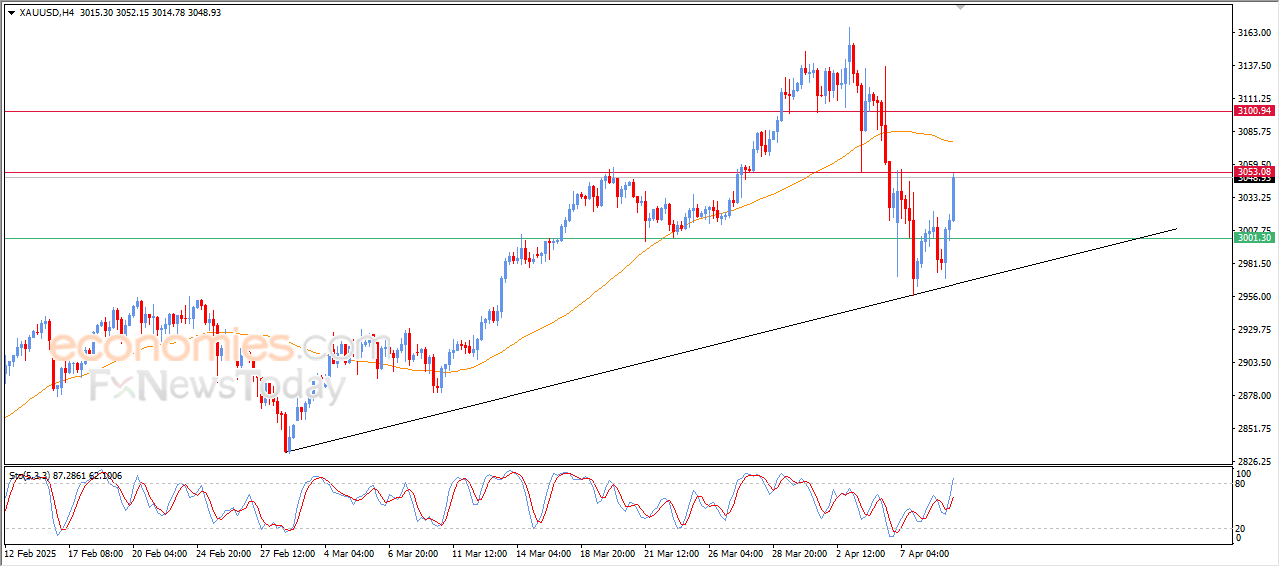
Silver (XAG/USD) mirrored the weakness in gold, trading at $33.44 after touching an intraday low of $33.37. The broader risk-on tone, fueled by upbeat U.S. economic figures and reduced trade friction, contributed to the decline.
Both metals remain under pressure as investors tilt toward equities and higher-yielding assets.
U.S. macro data released Thursday showed notable strength. Weekly jobless claims came in at 222,000, reflecting a still-resilient labor market. March durable goods orders surged 9.2%—driven by a third consecutive 27% rise in transportation equipment—beating the 2% forecast handily.
This bolstered the U.S. dollar, further weighing on gold. However, dovish commentary from Fed officials provided a partial buffer.
Cleveland Fed President Beth Hammack said rate cuts could begin as early as June, while Governor Waller acknowledged a need to ease policy if tariffs begin harming employment. Markets now price in up to three rate cuts by year-end.
Despite the pullback, geopolitical uncertainty continues to underpin gold. A missile strike in Kyiv—reportedly one of the deadliest since the start of the conflict—killed at least 12 people, keeping a geopolitical risk premium embedded in gold prices.
Natural gas price suffered new negative pressures by stochastic approach from 20 level, which forces it to reach below the extra support at $3.610, forming new bearish wave to settle near $3.500 as appears in the above image.
In spite of the main stability within the bullish channel’s levels, but the continuation of the negative pressures and forming extra barrier at $3.770, so these factors supports the bearish bias dominance in the current period, to expect suffering new losses by reaching $3.380 reaching the moving average 55 near $3.230.
The expected trading range for today is between $3.380 and $3.700
Trend forecast: Bearish
Do you need help in trading decisions? Do you want to learn how to start trading?
Join Economies.com VIP Club and benefit from over 15 years of market analysis expertise and get:
Special Offer: Subscribe to the Economies.com VIP channel and get also a free subscription to a trusted trading signals channel provided by Best Trading Signal.
The USD/JPY weekly forecast is bullish as improving risk appetite weighs on the safe-haven yen, pushing the pair higher.
The USD/JPY pair had a bullish week as the dollar rebounded and the yen lost its safe-haven appeal. The greenback recovered as calm returned to most US markets. Trump halted his earlier attacks on the Fed, restoring faith in the central bank’s independence.
If you are interested in automated forex trading, check our detailed guide-
At the same time, trade tensions between China and the US eased. The US said it was ready to lower tariffs on China to 50% and start negotiations. Meanwhile, China was prepared to exempt some US goods from tariffs. As a result, recession concerns eased, boosting the dollar. At the same time, risk appetite improved, hurting the safe-haven yen.
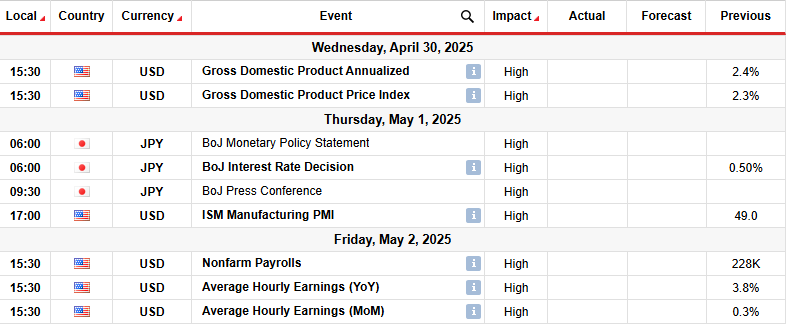
Next week, the US will release crucial figures on economic growth, business activity, and employment. Moreover, market participants will focus on the Bank of Japan policy meeting.
Traders will focus on the US monthly employment report for signs of deterioration in the US economy. Experts believe Trump’s tariffs have hurt the US economy. Meanwhile, Fed policymakers are waiting for evidence of this. Therefore, a downbeat report will increase Fed rate cut expectations, pushing USD/JPY lower.
Meanwhile, economists expect the Bank of Japan to keep interest rates unchanged on Thursday.
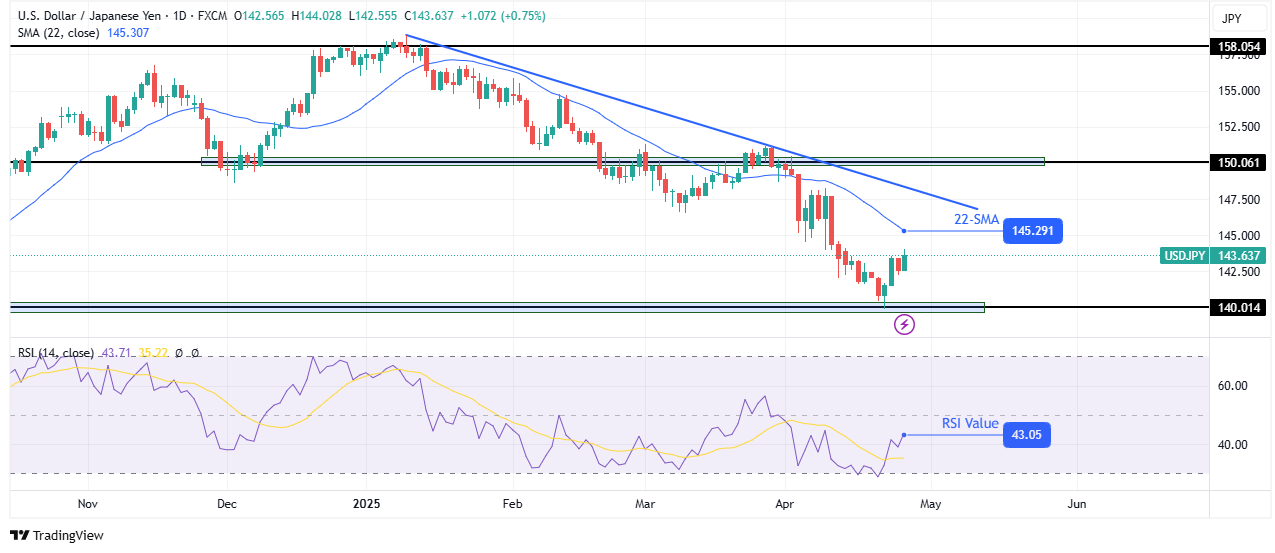
On the technical side, the USD/JPY price has rebounded after reaching the 140.01 support level. However, it still trades below the 22-SMA, indicating that bears remain in the lead. At the same time, the RSI is under 50, suggesting solid bearish momentum.
If you are interested in guaranteed stop-loss forex brokers, check our detailed guide-
Bears have maintained the downward trajectory since they took charge near the 158.05 key level. The price has mostly traded below the 22-SMA and the RSI below 50. Moreover, USD/JPY has consistently made lower highs and lows. If this trend continues, the price will respect the SMA as resistance and bounce lower.
Even if it punctures the SMA, it will not go beyond the bearish trendline. A break below the 140.01 support will strengthen the bearish bias and continue the downtrend. Meanwhile, the trend can only change if the price breaks above the SMA and the resistance trendline.
Looking to trade forex now? Invest at eToro!
67% of retail investor accounts lose money when trading CFDs with this provider. You should consider whether you can afford to take the high risk of losing your money.
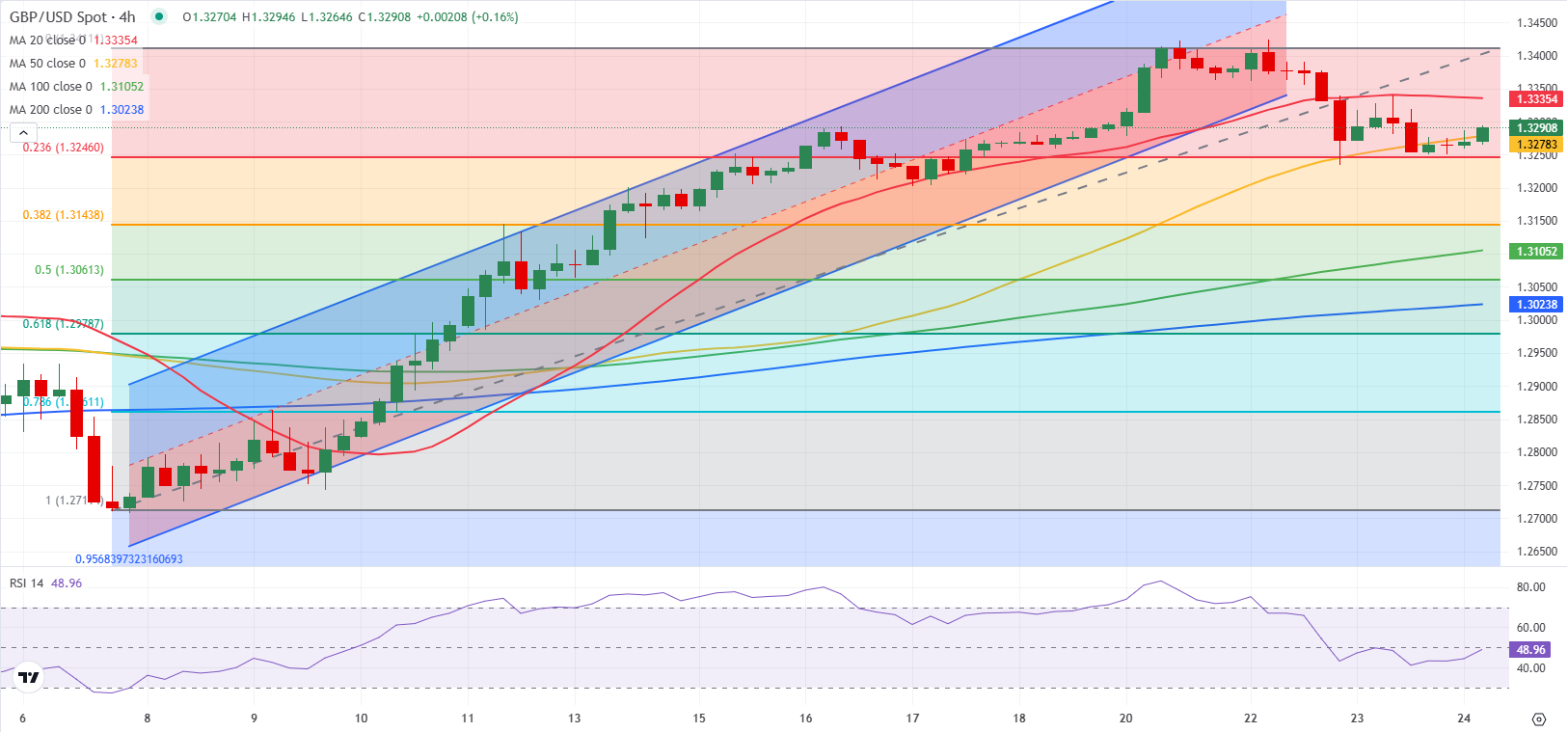
GBP/USD stays on the back foot following Thursday’s rebound and trades slightly below 1.3300 in the European session on Friday. The renewed US Dollar (USD) strength makes it difficult for the pair to hold its ground as investors remain focused on latest developments surrounding the US-China trade relations.
US President Donald Trump said late Thursday that a meeting between Chinese and US officials took place earlier in the day. During the Asian trading hours, Bloomberg reported that China was considering suspending its 125% tariff on some US imports, including medical equipment and ethane, and officials were having discussions about waiving tariffs on plane leases. Read more…
GBP/USD extended its decline into a second consecutive day on Wednesday and registered its lowest daily close in a week near 1.3250. The pair holds its ground early Thursday and recovers toward 1.3300.
The disappointing Purchasing Managers Index (PMI) data from the UK, which showed a contraction in the private sector’s business activity in April, caused Pound Sterling to weaken against its rivals during the European trading hours on Wednesday. Later in the day, the US Dollar (USD) benefited from heightened optimism about easing tensions between China and the US, causing the pair to stretch lower. Read more…
Official White House Photo by Daniel Torok
“The dollar bear market is finally here,” say Tim Baker and George Saravelos, foreign exchange market strategists at Deutsche Bank.
The call marks a major shift in Deutsche Bank’s thinking about currencies as its analysts respond to meaningful shifts in global fundamentals under the second Trump presidency. They think the shifting tectonic plates pave the way to a stronger Euro and British Pound against the Dollar in the coming years, confirming the multi-year lows are in the rearview window.
These new forecasts can be viewed here.
“What has changed since the start of the year? The list of superlatives is long – the largest shift in US trade policy in a century; the biggest pivot in German fiscal policy since re-unification; the most significant reassessment of US geopolitical leadership since World War II, to name a few,” say the authors.
“Our view on all these factors is that the pre-conditions are now in place for the beginning of a major dollar downtrend,” they add.
Euro to Reign Supreme
Deutsche Bank expects EUR/USD to appreciate towards purchasing power parity over the remainder of the decade.
Purchasing power parity is a simple but fundamentally critical economic model that says the exchange rate must ultimately adjust to balance the cost discrepancies between the same good or service in two different economies. If the same good is more expensive in the U.S. than in the Eurozone, the theory says the U.S. consumer will substitute towards that European good. The process boosts the value of the Euro.
Flows have turned to favour Eurozone assets in 2025, with investors buying European stocks, which trade at lower values relative to those in America. The same can be said for bonds and other assets. Particularly given expectations that the Eurozone is to see a revival as Germany increases spending.
Pound-Euro Lower
For the Pound-to-Euro cross, what will matter is whether EUR/USD or GBP/USD appreciates the fastest.
Deutsche Bank’s targets show that EUR/USD will win the race, which means GBP/EUR must go lower. In fact, the forecasts show the exchange rate will favour the bottom of its multi-year range.
“This speaks to the ability of the euro to benefit more than the pound from repatriation flows,” say the authors.
What are the exchange rate forecasts for this year and next? Given the major upheavals we are seeing, we have begun tracking point forecasts at the major investment banks on behalf of our partners, Horizon Currency. We have added Deutsche Bank’s new targets to this document, which can be requested here.
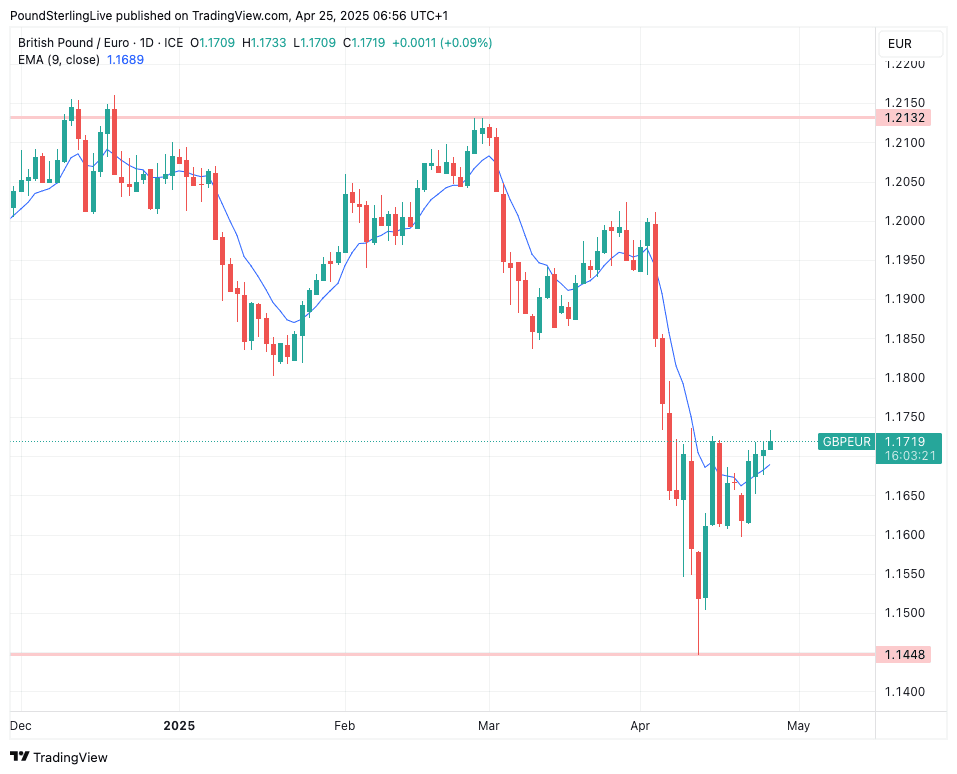
Above: GBP/EUR might be pointed lower multi-year.

Deutsche Bank says relative growth dynamics between the Eurozone and the U.S. are shifting in favour of the Euro, powered by Germany’s decision to increase spending in infrastructure and defence.
However, the analysts think the Euro could also be set to benefit from ‘safe haven’ flows driven by increased bond issuance in the Eurozone as well as increased demand from euros as a reserve currency at global central banks.
Pantheon Makes Near-term Forecast Adjustments
The decline in the Dollar marks the end of U.S. exceptionalism, which saw all U.S. assets rally on the basis that the economy was outperforming its global peers.
Donald Trump’s seemingly ad hoc and disruptive approach to government has upended exceptionalism, not least because of the massive import tariffs that will raise inflation and lower growth.
Stagflation is rarely a good outcome for currencies and U.S. exceptionalism gives way to “sell America” in 2025.
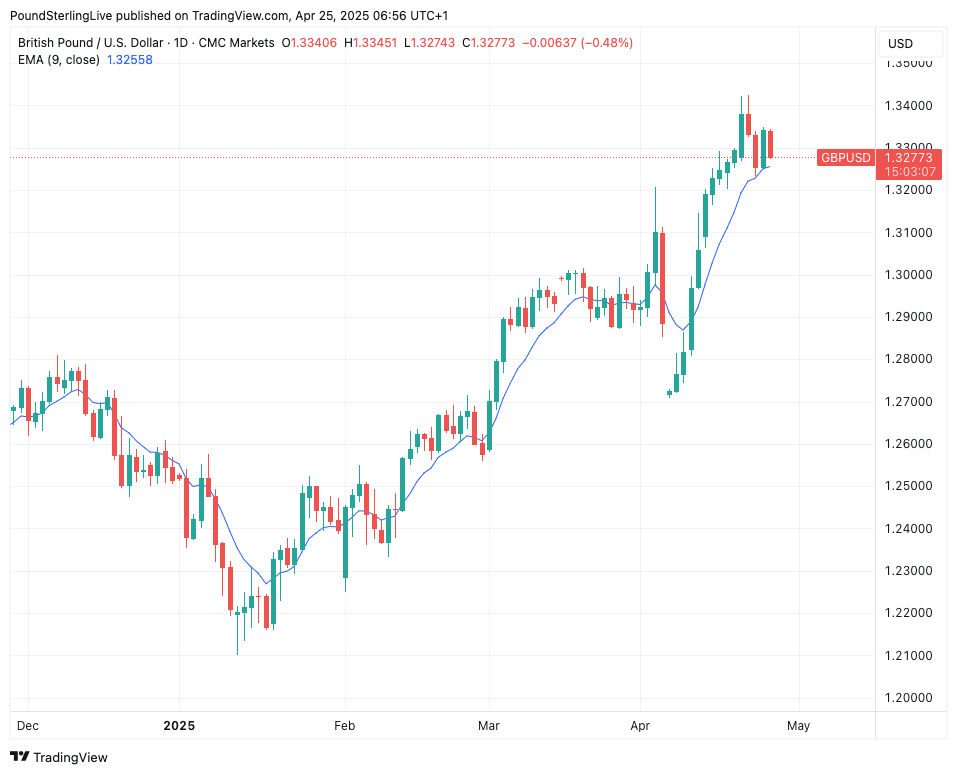
Above: GBP/USD multi-year lows might just be in.
Fears about the Fed’s future independence are just the latest market worry, exacerbating the ‘sell America’ trade: the British pound struck its highest level in seven months against the Dollar on Monday, amidst renewed fears for the independence of the U.S. Federal Reserve after President Donald Trump launched a fresh attack on Chair Jerome Powell.
“The US dollar index declined to its weakest level since 2022 after President Donald Trump’s criticism of Federal Reserve Chair Jerome Powell contributed to fears over the independence of the central bank,” says Mark Haefele, Global Wealth Management Chief Investment Officer at UBS AG.
Elsewhere, strategists at Pantheon Macroeconomics say they are trimming their Pound Sterling forecasts vs. the Euro but raising them against the Dollar.
“Our call for one extra 25bp cut to Bank Rate this year would ordinarily mean that we trim our GBP forecasts,” says Elliott Jordan-Doak at Pantheon Macroeconomics. “But we think risk premia have overtaken rate differentials as the driving force in the currency markets.”
Pantheon raises its year-end Pound-to-Dollar forecast to 1.30 from 1.27, and cuts its Pound-Euro forecast to 1.18 from 1.20.
April 25, 2025 – Written by Tim Boyer
STORY LINK Pound to Dollar FX Forecast: GBPUSD “Trend Remains Bullish”
The Pound to Dollar rate found support below 1.3300 on Friday and traded around 1.3320.
UK equities were able to make further gains, potentially advancing for the 10th successive session which would be the strongest run for over five years.
Scotiabank commented on GBP/USD; “the trend remains bullish, given the sequence of higher lows and higher highs. The RSI is softening but still in bullish territory. Near-term price action appears to have settled within a range roughly bound between support in the low 1.32s and resistance above 1.3400.”
According to Credit Agricole; “GBP is starting to look expensive vs the USD. An important question for FX investors is whether the upcoming UK data releases and global developments could trigger a reversal of recent market trends in the near term.”
US data releases will also be under close scrutiny in the near term given that markets want to see whether tariffs and uncertainty have triggered an impact in the real economy.
Scotiabank commented; “Hard data reports have held up relatively well—perhaps reflecting a burst of activity before tariffs really bite—but optimism on the US economic outlook has been replaced with growing recession concerns.”
Friday’s release reported that there was a small recovery in the April University of Michigan (UoM) consumer confidence index to 52.2 from the flash reading of 50.8, but still below the March reading of 57.0. The revision was due to gains in current conditions while expectations made only a marginal recovery.
UoM surveys of Consumers Director Joanne Hsu commented; “Consumer sentiment fell for the fourth straight month, plunging 8% from March. While the April decline in current conditions was modest, the expectations index plummeted with drop-offs in personal finances as well as business conditions. Expectations have fallen a precipitous 32% since January, the steepest three-month percentage decline seen since the 1990 recession.”
ING commented; “As to the dollar more broadly, it could find a little support as trade tensions calm a little. The next big chapter here will be whether all this volatility has hit real world decisions – especially in the US jobs market. There is plenty of US jobs data released next week and any deterioration here could trigger another round of dollar losses.”
Danske Bank maintains a negative dollar stance; “Longer term, structural challenges like US political shifts, the trade war, and capital rotation away from US assets suggest significant USD downside.”
UK retail sales volumes increased 0.4% for March after a revised 0.7% gain the previous month and compared with consensus forecasts of a 0.3% decline.
According to Scotiabank; “The release is unlikely to influence policymakers ahead of the May 8 BoE rate decision, given the well communicated bias to further accommodation. Markets are pricing in 27bpts of easing for the meeting.”

International Money Transfer? Ask our resident FX expert a money transfer question or try John’s new, free, no-obligation personal service! ,where he helps every step of the way,
ensuring you get the best exchange rates on your currency requirements.
TAGS: Pound Dollar Forecasts
Despite finding support yesterday at the AVWAP, downward pressure remains. Prior support from the January swing low at $2.99 was tested today as resistance, as the high for the day was at $2.98. Moreover, at the time of this writing, natural gas is trading below Thursday’s closing price of $2.94 and it may end the day in a similar position. Each is a bearish sign.
Nevertheless, the bearish correction has seen the price of natural gas fall by $2.04 or 41.7% from the recent trend high of $4.90. The decline shows symmetry on a percentage basis with the earlier bearish correction that started following the June 2024 swing high at $3.16. Natural gas declined following that high and eventually established a higher swing low in August.
That low provided the second point to draw a rising trendline across support, which was used to generate the top line of a bullish trend channel. Note that the 2024 decline was the largest since the 2024 bottom, until now. Once there is symmetry in price between swings, there is the potential for support to be seen and possibly the completion of the correction.
Furthermore, since the lower line of the trend channel has not been tested as support, while the top line shows resistance a few times recently, there is a chance that the lower line will be tested before the bearish correction is complete. But that is not much lower than current prices. The 78.6% Fibonacci retracement level is at $2.79 and the 127.2% projection for a falling ABCD pattern points to $2.77. Alternatively, the current low continues to hold and a one-day bullish reversal triggers on a move above today’s high. If the 200-Day MA, now at $3.08, is subsequently reclaimed, a bottom may be established.
For a look at all of today’s economic events, check out our economic calendar.
April 25, 2025 – Written by David Woodsmith
STORY LINK Pound Sterling to Euro Forecast: Dollar Slide Could Enable Strong GBP Gains
The Pound to Euro exchange rate hit a 2-week peak just above the key level of 1.1730 on Friday before settling around 1.1725 with a firm underlying tone.
Equity markets again helped underpin the Pound Sterling on the day. The FTSE 100 has already risen for the last nine trading sessions as trade war tensions have cooled, the longest run since December 2019.
According to ING; “EUR/GBP breaking under 0.8520/25 could lead to a much deeper correction.” (Strong GBP/EUR gains if it can sustain a move above 1.1730.)
Credit Agricole added; “we note that our estimates of short-term fair value that are based on FX drivers like relative rate spreads and risk aversion suggest that the GBP is looking quite undervalued vs the EUR.”
It added; “An important question for FX investors is whether the upcoming UK data releases and global developments next week and the outcome of the BoE policy meeting on 8 May could trigger a reversal of recent market trends.”
Scotiabank, however, sees GBP/EUR at 1.1630 at the end of the second quarter.
MUFG expects a focus on inflation; “Given the labour market and the recent strength of the economy, along with a minimum wage increase, inflation risks remain much higher in the UK.”
If the Bank of England remains cautious over rate cuts and risk appetite is less hostile, the Pound could benefit.
UK data was mixed on Friday with stronger than expected retail sales data offset by a further dip in consumer confidence
Retail sales volumes increased 0.4% for March compared with consensus forecasts of a 0.3% decline, although the February increase was revised to 0.7% from the original reading of 1.0%.
Favourable weather boosted demand for clothing and outdoor sales which was offset partly by a decline in supermarket sales.
First-quarter sales increased 1.6% from the fourth quarter of 2024, the strongest increase since July 2021.
According to SocGen chief FX strategist Kit Juckes; “Sterling has got a little bit of comfort from this. I wouldn’t overstate it, but it had a decent run and was threatening to fall back and got a little bit of help from the data, temporarily at least.”
There were still doubts whether spending would be sustained.
The GfK consumer confidence index declined to -23 for April from -19 previously, slightly worse than expectations of -21 and the lowest reading since November 2023 with all components declining on the month.
Neil Bellamy, Consumer Insights Director at GfK, an NIQ Company, commented; “Consumers have not only been grappling with multiple April cost increases in the form of utilities, council tax, stamp duty, and road tax, but they are also hearing dire warnings of renewed high inflation on the back of the Trump Tariffs.”
He added; “Are we now on the verge of another round of rapidly increasing prices? If so, consumer confidence is likely to collapse and the broad gains seen since the disastrous September 2022 minibudget, when confidence hit a record low of -49, could quickly be eroded.”
International Money Transfer? Ask our resident FX expert a money transfer question or try John’s new, free, no-obligation personal service! ,where he helps every step of the way,
ensuring you get the best exchange rates on your currency requirements.
Silver price (XAG/USD) plunges more than 1.5% to near $33.00 during North American trading hours on Friday. The white metal falls sharply from its three-week high of $33.70 posted earlier in the day. The asset weakens as investors have become increasingly confident that the United States (US) and China will make a deal sooner.
Hopes of a truce on a trade war between the world’s two largest powerhouses have increased as China has stated that it is considering suspending additional tariffs on imports of medical equipment and some industrial chemicals from the US, Bloomberg reported.
Investors see the scenario as favorable for the global economic outlook. Theoretically, improving global economic prospects diminish the demand of safe-haven assets, such as Silver.
Meanwhile, the US Dollar (USD) has bounced back after a sharp corrective move on Thursday. The US Dollar Index (DXY), which tracks the Greenback’s value against six major currencies, recovers to near 99.75.
However, contradictory statements from US President Donald Trump and China over whether both nations have come on the table or not for negotiating trade deals are expected to keep investors on the sidelines. Trump has been stating that discussion between Washington and Beijing on trade are going well, however, China has denied these remarks, saying that there has not been any “economic and trade negotiations between China and the US”.
Silver price falls sharply after posting a fresh three-week high around $33.70. However, the near-term outlook of the white metal remains bullish as it holds the 20-day Exponential Moving Average (EMA), which trades around $32.60.
The 14-day Relative Strength Index (RSI) struggles to break above 60.00. A fresh bullish momentum would emerge if the RSI will break above that level.
Looking up, the March 28 high of $34.60 will act as key resistance for the metal. On the downside, the April 11 low of $30.90 will be the key support zone.
Silver is a precious metal highly traded among investors. It has been historically used as a store of value and a medium of exchange. Although less popular than Gold, traders may turn to Silver to diversify their investment portfolio, for its intrinsic value or as a potential hedge during high-inflation periods. Investors can buy physical Silver, in coins or in bars, or trade it through vehicles such as Exchange Traded Funds, which track its price on international markets.
Silver prices can move due to a wide range of factors. Geopolitical instability or fears of a deep recession can make Silver price escalate due to its safe-haven status, although to a lesser extent than Gold’s. As a yieldless asset, Silver tends to rise with lower interest rates. Its moves also depend on how the US Dollar (USD) behaves as the asset is priced in dollars (XAG/USD). A strong Dollar tends to keep the price of Silver at bay, whereas a weaker Dollar is likely to propel prices up. Other factors such as investment demand, mining supply – Silver is much more abundant than Gold – and recycling rates can also affect prices.
Silver is widely used in industry, particularly in sectors such as electronics or solar energy, as it has one of the highest electric conductivity of all metals – more than Copper and Gold. A surge in demand can increase prices, while a decline tends to lower them. Dynamics in the US, Chinese and Indian economies can also contribute to price swings: for the US and particularly China, their big industrial sectors use Silver in various processes; in India, consumers’ demand for the precious metal for jewellery also plays a key role in setting prices.
Silver prices tend to follow Gold’s moves. When Gold prices rise, Silver typically follows suit, as their status as safe-haven assets is similar. The Gold/Silver ratio, which shows the number of ounces of Silver needed to equal the value of one ounce of Gold, may help to determine the relative valuation between both metals. Some investors may consider a high ratio as an indicator that Silver is undervalued, or Gold is overvalued. On the contrary, a low ratio might suggest that Gold is undervalued relative to Silver.
April 25, 2025 – Written by Tim Boyer
STORY LINK Pound to Dollar FX Forecast: GBPUSD “Trend Remains Bullish”
The Pound to Dollar rate found support below 1.3300 on Friday and traded around 1.3320.
UK equities were able to make further gains, potentially advancing for the 10th successive session which would be the strongest run for over five years.
Scotiabank commented on GBP/USD; “the trend remains bullish, given the sequence of higher lows and higher highs. The RSI is softening but still in bullish territory. Near-term price action appears to have settled within a range roughly bound between support in the low 1.32s and resistance above 1.3400.”
According to Credit Agricole; “GBP is starting to look expensive vs the USD. An important question for FX investors is whether the upcoming UK data releases and global developments could trigger a reversal of recent market trends in the near term.”
US data releases will also be under close scrutiny in the near term given that markets want to see whether tariffs and uncertainty have triggered an impact in the real economy.
Scotiabank commented; “Hard data reports have held up relatively well—perhaps reflecting a burst of activity before tariffs really bite—but optimism on the US economic outlook has been replaced with growing recession concerns.”
Friday’s release reported that there was a small recovery in the April University of Michigan (UoM) consumer confidence index to 52.2 from the flash reading of 50.8, but still below the March reading of 57.0. The revision was due to gains in current conditions while expectations made only a marginal recovery.
UoM surveys of Consumers Director Joanne Hsu commented; “Consumer sentiment fell for the fourth straight month, plunging 8% from March. While the April decline in current conditions was modest, the expectations index plummeted with drop-offs in personal finances as well as business conditions. Expectations have fallen a precipitous 32% since January, the steepest three-month percentage decline seen since the 1990 recession.”
ING commented; “As to the dollar more broadly, it could find a little support as trade tensions calm a little. The next big chapter here will be whether all this volatility has hit real world decisions – especially in the US jobs market. There is plenty of US jobs data released next week and any deterioration here could trigger another round of dollar losses.”
Danske Bank maintains a negative dollar stance; “Longer term, structural challenges like US political shifts, the trade war, and capital rotation away from US assets suggest significant USD downside.”
UK retail sales volumes increased 0.4% for March after a revised 0.7% gain the previous month and compared with consensus forecasts of a 0.3% decline.
According to Scotiabank; “The release is unlikely to influence policymakers ahead of the May 8 BoE rate decision, given the well communicated bias to further accommodation. Markets are pricing in 27bpts of easing for the meeting.”
International Money Transfer? Ask our resident FX expert a money transfer question or try John’s new, free, no-obligation personal service! ,where he helps every step of the way,
ensuring you get the best exchange rates on your currency requirements.
TAGS: Pound Dollar Forecasts