The main category of Forex News.
You can use the search box below to find what you need.
[wd_asp id=1]
The main category of Forex News.
You can use the search box below to find what you need.
[wd_asp id=1]
April 24, 2025 – Written by David Woodsmith
STORY LINK Euro to Dollar Forecast: Crucial EURUSD Support Near 1.13
After finding support above 1.1300, the Euro to Dollar exchange rate (EUR/USD) posted strong gains to just below 1.14 on Thursday before settling just above 1.1350 as the dollar’s recovery from 3-year lows ran out of steam and better than expected data helped protect the Euro.
Scotiabank commented on the short-term outlook; “EURUSD remains in an uptrend, with a clear sequence of higher lows and higher highs. Recent support has been observed in the 1.1280 area and near-term resistance appears limited ahead of 1.15.”
According to ING; “The 1.130 area is key: in the past couple of weeks, attempted EUR/USD corrections faced heavy buying interest around that level. A decisive break below 1.130 can open the door for a bigger leg lower.”
Goldman Sachs chief economist Jan Hatzius noted the perils of forecasting; “I often dodge questions about the dollar. A large body of academic literature and my own experience as an economic forecaster have taught me that predicting exchange rates is even harder than predicting growth, inflation and interest rates.”
He does, however, have strong views; “But with all due humility, I believe that the recent dollar depreciation of 5% on a broad trade-weighted basis has considerably further to go.”
Hatzius pointed to two historical periods with similar dollar valuations to the present day – the mid-1980s and early 2000s – and these set the stage for a 25-30% depreciation.
Markets are continuing to monitor trade related headlines very closely, but there have been no major developments surrounding tariff talks on Thursday.
MUFG commented; “While further steps to water down/reverse tariffs would be positive developments, we are not convinced that recent developments are sufficient yet to support a more sustained rebound for the US dollar at the current juncture.”
Scotiabank added; “Grounds for optimism on trade should remain in check, I think which will serve to keep the USD on the defensive.”
There was further relatively dovish rhetoric from Fed Governor Waller who stated that he expects tariff-related price increases would be a on-off event and that we would be willing to look through price increases.
Waller also stated that the focus on data brings the risk of being too late on policy action.
The German IFO business confidence index edged higher to 86.9 for April from 86.7 previously and significantly above consensus forecasts of 85.1.
There was a net improvement in the current conditions index with only a small retreat in the expectations component.
According to the IFO; “Uncertainty among the companies has increased. The German economy is preparing for turbulence.”

ING commented; “All in all, today’s Ifo index comes as a positive surprise.”
The bank, however, put this into perspective; “Still, we caution against too premature optimism. There are currently more unknowns than knowns for the German economy, and we continue to expect another year of stagnation – which would mark the first time ever for Germany to go through three consecutive years without growth.”
ECB rhetoric remains relatively dovish with the potential for further rate cuts while there were also reports from within the central bank that is considering changing strategy to enable more nimble moves.
International Money Transfer? Ask our resident FX expert a money transfer question or try John’s new, free, no-obligation personal service! ,where he helps every step of the way,
ensuring you get the best exchange rates on your currency requirements.
TAGS: Euro Dollar Forecasts
Silver price (XAG/USD) retraces to near $33.30 during North American trading hours on Thursday from an almost three-week high of $33.70 posted earlier in the day. The white metal corrects as investors become hopeful of significant de-escalation in trade war between the United States (US) and China.
Investors’ confidence on normalizing trade relations between the world’s two largest powerhouses increased after US President Donald Trump assured of making a deal with Beijing. Discussions with Beijing are going well, and I think that we will reach a deal,” Trump said on Tuesday.
Additionally, US Treasury Secretary Scott Bessent has signaled that both nations can reduce additional tariffs imposed recently. “I don’t think either side believes that the current tariff levels are sustainable, so I would not be surprised if they went down in a mutual way,” Bessent said on Wednesday.
A report from the Wall Street Journal (WSJ) showed on Wednesday that the White House can lower additional import duties roughly between 50%-65%.
Meanwhile, China has given ultimatum to the US to “completely cancel all unilateral tariff measures” if it wants trade talks, according to a spokesperson from Chinese commerce ministry, Financial Times (FT) reported.
Positive comments from Washington for resolving trade disputes between the US and China have diminished fears of a global economic turmoil. Theoretically, the scenario weighs on the safe-haven demand of the Silver price. However, improving relations between them increase the demand of Silver as industrial metal.
Silver has application in various industries, such as Electric Vehicles (EV), electronic alliances, power and cables, mining etc.
Silver price tests the breakout region of the consolidation around $33.10 formed on the daily timeframe. The 20-day Exponential Moving Average (EMA) near $32.55 continues to provide support to the Silver price.
The 14-day Relative Strength Index (RSI) reaches near 60.00. A fresh bullish momentum would emerge if the RSI breaks above 60.00.
Looking up, the March 28 high of $34.60 will act as key resistance for the metal. On the downside, the April 11 low of $30.90 will be the key support zone.
Silver is a precious metal highly traded among investors. It has been historically used as a store of value and a medium of exchange. Although less popular than Gold, traders may turn to Silver to diversify their investment portfolio, for its intrinsic value or as a potential hedge during high-inflation periods. Investors can buy physical Silver, in coins or in bars, or trade it through vehicles such as Exchange Traded Funds, which track its price on international markets.
Silver prices can move due to a wide range of factors. Geopolitical instability or fears of a deep recession can make Silver price escalate due to its safe-haven status, although to a lesser extent than Gold’s. As a yieldless asset, Silver tends to rise with lower interest rates. Its moves also depend on how the US Dollar (USD) behaves as the asset is priced in dollars (XAG/USD). A strong Dollar tends to keep the price of Silver at bay, whereas a weaker Dollar is likely to propel prices up. Other factors such as investment demand, mining supply – Silver is much more abundant than Gold – and recycling rates can also affect prices.
Silver is widely used in industry, particularly in sectors such as electronics or solar energy, as it has one of the highest electric conductivity of all metals – more than Copper and Gold. A surge in demand can increase prices, while a decline tends to lower them. Dynamics in the US, Chinese and Indian economies can also contribute to price swings: for the US and particularly China, their big industrial sectors use Silver in various processes; in India, consumers’ demand for the precious metal for jewellery also plays a key role in setting prices.
Silver prices tend to follow Gold’s moves. When Gold prices rise, Silver typically follows suit, as their status as safe-haven assets is similar. The Gold/Silver ratio, which shows the number of ounces of Silver needed to equal the value of one ounce of Gold, may help to determine the relative valuation between both metals. Some investors may consider a high ratio as an indicator that Silver is undervalued, or Gold is overvalued. On the contrary, a low ratio might suggest that Gold is undervalued relative to Silver.
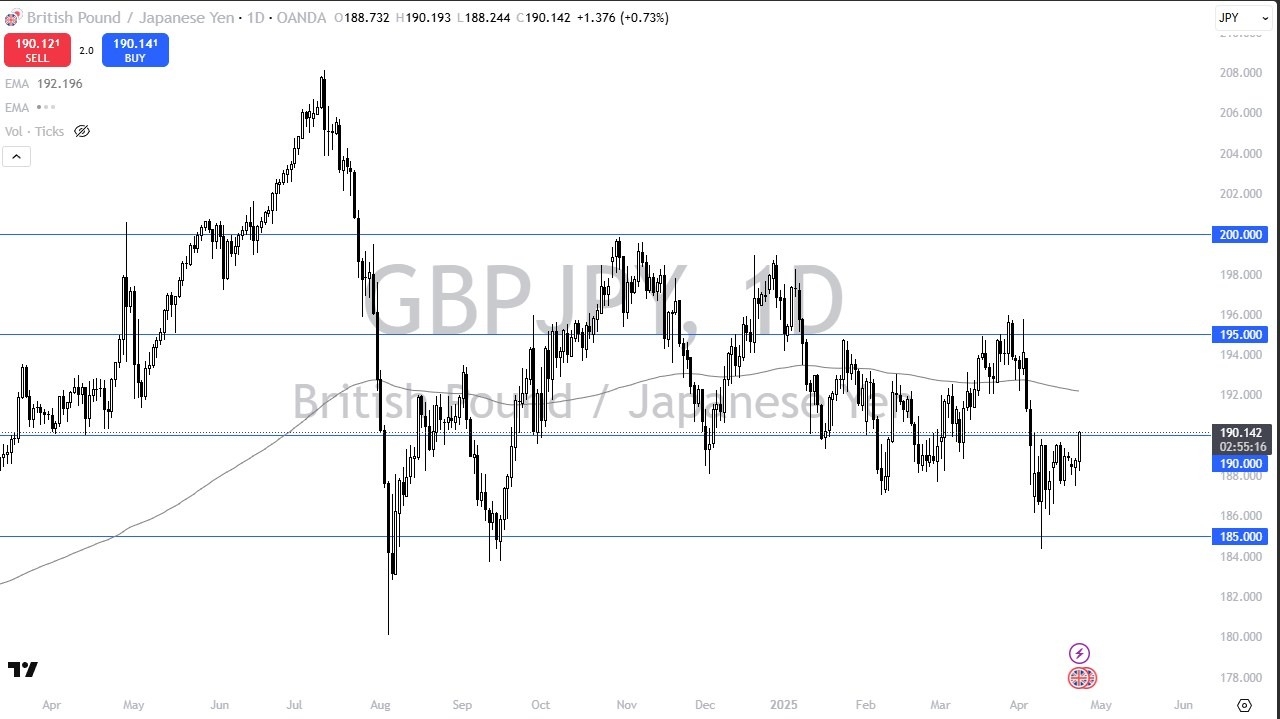
Obviously, breaking above the ¥190 level is a very bullish sign, and therefore it does open up the possibility that the British Pound continues to go much higher. The 50 Day EMA is sitting right around the ¥191 level, so that might be our first barrier. If we can clear that area, then the 200 Day EMA, just above the ¥192 level, is your next potential target.
After that, the British pound could go looking to the ¥195 level. This of course would be a major coup for the British pound bulls, and an area that should see a lot of resistance. If we can break above there, then it changes the entire outlook for this pair.

That being said, rallying to the ¥195 level would not be as crazy as it sounds, because it would just be a return to the previous consolidation area that we had been in. After all, this was the ceiling previously for several months, so return to testing that makes quite a bit of sense.
If we were to break down from here, the ¥188 level is very important, and breaking below there could open up a move all the way down to the ¥185 level. While that doesn’t seem as likely, it is something that you need to keep in the back of your mind for potential targeting.
Begin trading our daily forecasts and analysis. Here is a list of Forex brokers in Japan to work with.
Markets are increasingly pricing in a June rate cut, with the CME FedWatch Tool showing odds above 60% for at least one reduction this summer. The Federal Reserve’s Beige Book, released Wednesday, pointed to slowing labor market momentum and tepid consumer spending.
“Growth is modest and uneven,” the report noted, signaling that conditions could soon warrant a policy response.
Non-yielding assets like gold benefit from a lower interest rate environment. With traders anticipating as many as three cuts in 2025, gold’s resilience reflects a hedge against weakening macroeconomic data and declining yields.
The U.S. Dollar Index slipped from recent highs as Treasury Secretary Scott Bessent dismissed reports of unilateral tariff reductions, underscoring continued uncertainty around the U.S.-China trade dialogue. A weaker dollar typically boosts demand for dollar-denominated assets, lending support to bullion.
A preliminary reading of S&P Global’s April PMI showed mixed results: manufacturing ticked higher, while services slowed, adding to investor caution. Looking ahead, Jobless Claims and Durable Goods Orders will provide the next major data points.
While gold remains range-bound, its ability to hold above $3,300 amid improving sentiment suggests persistent underlying demand driven by macro and policy uncertainty.
According to Forex trading, the British pound declined against most other major currencies following the release of the latest UK services PMI data. The preliminary Purchasing Managers’ Index (PMI) for April revealed a marked decline in the UK’s vital services sector, falling below the 50-point threshold for the first time in 18 months, the dividing line between growth and contraction.
Amid ongoing global disruptions stemming from US President Donald Trump’s tariffs, this month’s services sector data reflected broader economic challenges, leading to decreased demand for the British pound in mid-week trading.
The British pound will remain the best performer amid market pressure on the dollar due to Trump’s trade wars, with Britain relatively insulated from the tension.
According to recent trading and across stock trading platforms, the UK’s FTSE 100 index closed higher by approximately 0.9% at 8,403 points, tracking gains in major stock markets amid trader optimism that trade tensions between the US and China would soon ease. At the same time, concerns about the independence of US monetary policy subsided. Meanwhile, traders monitored the April Manufacturing and Services PMI data, along with major corporate earnings results. The latest data showed UK business activity returning to contraction in April, at its fastest rate in over two years.
According to stock prices, Croda International shares rose by 8.2%, leading the index, after the chemical group reported strong first-quarter sales. On the other hand, Fresnillo shares were among the biggest losers, falling by 5.2%, as the precious metals mining company reported a decrease in silver and gold production in the first quarter despite reaffirming its full-year production outlook.
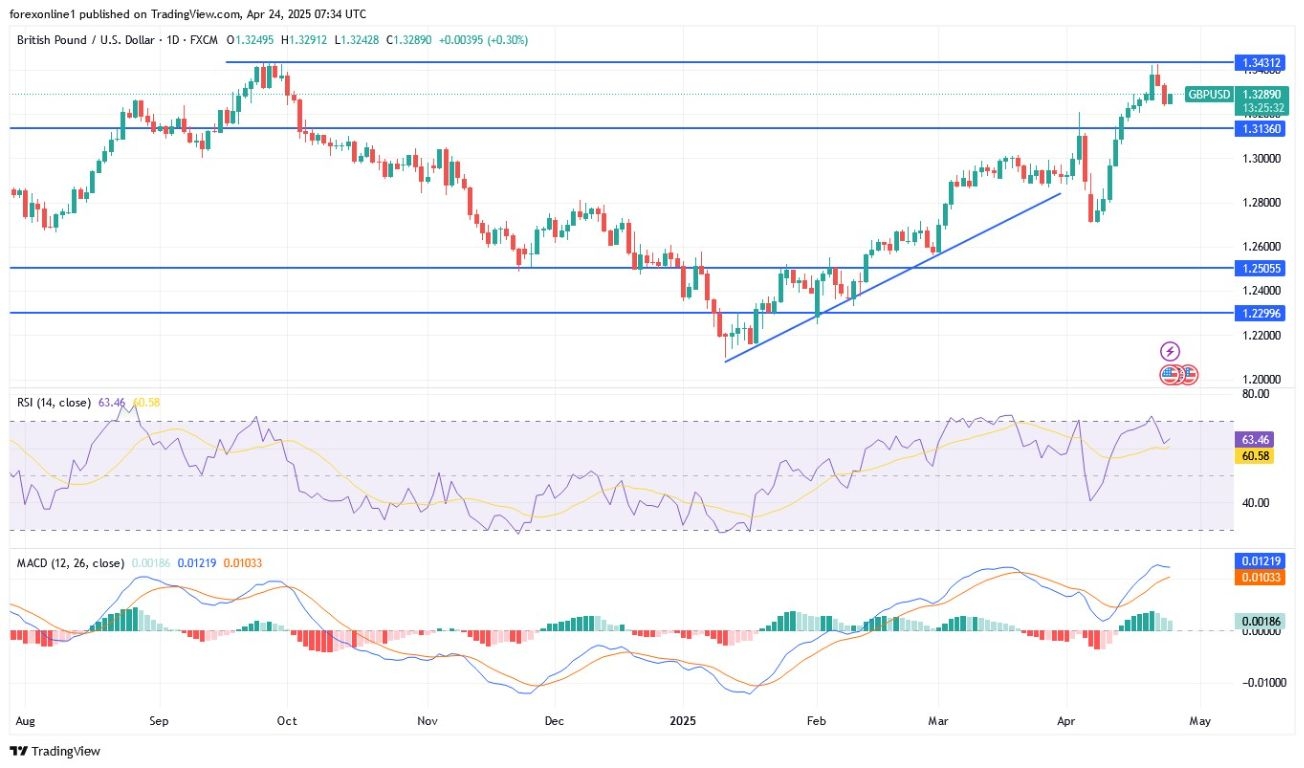
According to recent trading, the GBP/USD pair has recently retreated from its highs near 1.3490, suggesting a potential corrective move within the broader bullish trend. The pair is currently testing key Fibonacci retracement levels that could provide significant support areas for buyers. After reaching overbought conditions, the price has declined towards the 38.2% Fibonacci retracement level at 1.3153, which could offer initial support. Should selling pressure persist, the 50% retracement level at 1.3068 and the 61.8% level at 1.2983 could form the next key support areas. The 61.8% Fibonacci level is particularly important as it coincides with a previous resistance area that could now act as support.
From a broader trend perspective, the GBP/USD pair maintains its bullish structure on the daily timeframe, as evidenced by the series of higher lows and higher highs since March. The 100-day Simple Moving Average (SMA) remains above the 200-day SMA, confirming that the dominant trend is upward.
At the same time, both moving averages are trending upwards, reinforcing the bullish bias. The pair is also trading above an ascending trendline that has supported price action since early March. However, momentum indicators suggest some caution. The Stochastic oscillator is trending downwards from the overbought zone, indicating the potential for continued downward pressure in the near term. Similarly, the Relative Strength Index (RSI) has declined from elevated levels and has room to fall before reaching oversold conditions.
Looking ahead, if the current pullback finds support at any of the aforementioned Fibonacci levels, the GBP/USD pair could resume its bullish trend towards its recent highs and potentially target the 1.3600 area. Conversely, a break below the 61.8% Fibonacci level and the ascending trendline could signal a deeper correction towards the 100% Fibonacci retracement level at 1.2707.
Ready to trade our GBP/USD daily forecast? We’ve shortlisted the best regulated forex brokers UK in the industry for you.
The EURJPY pair provided several slow sideways range trading, due to its neediness to the negative momentum, but its main stability below the bearish channel’s resistance at 163.00 makes us keep the negative suggestion in the near and medium period trading.
Stochastic exit from the overbought level will increase the chances for gaining negative momentum, to reinforce the chances of targeting negative stations, which might begin at 161.30 and 160.30, while moving to the bullish track requires forming a strong bullish attack, to provide several positive closes above 163.25 level, then begin recording several gains by its rally to 164.20.
The expected trading range for today is between 160.35 and 162.65
Trend forecast: Bearish
Do you need help in trading decisions? Do you want to learn how to start trading?
Join Economies.com VIP Club and benefit from over 15 years of market analysis expertise and get:
Special Offer: Subscribe to the Economies.com VIP channel and get also a free subscription to a trusted trading signals channel provided by Best Trading Signal.
According to forex market trading, the US dollar has rebounded from its lowest levels in three years amid easing concerns about the independence of the Federal Reserve and growing hopes for a de-escalation of the trade war. Recently, Trump stated that he has no intention of dismissing Federal Reserve Chairman Jerome Powell, allaying concerns about political interference in US monetary policy. Also, he indicated a softer stance toward China, saying he plans to be “very gentle” in any trade negotiations.
Meanwhile, US Treasury Secretary Scott Bessent acknowledged that the tariff standoff with China is unsustainable and stressed the need for both sides to de-escalate soon.
Despite the recent recovery, the US dollar remains down about 9% since the beginning of 2025 and has lost much of its safe-haven appeal in recent weeks amid ongoing trade tensions, recession risks, and political pressure on the US Federal Reserve, which has prompted many investors to move away from US assets.
” dir=”auto” id=”content-1686574122635″>
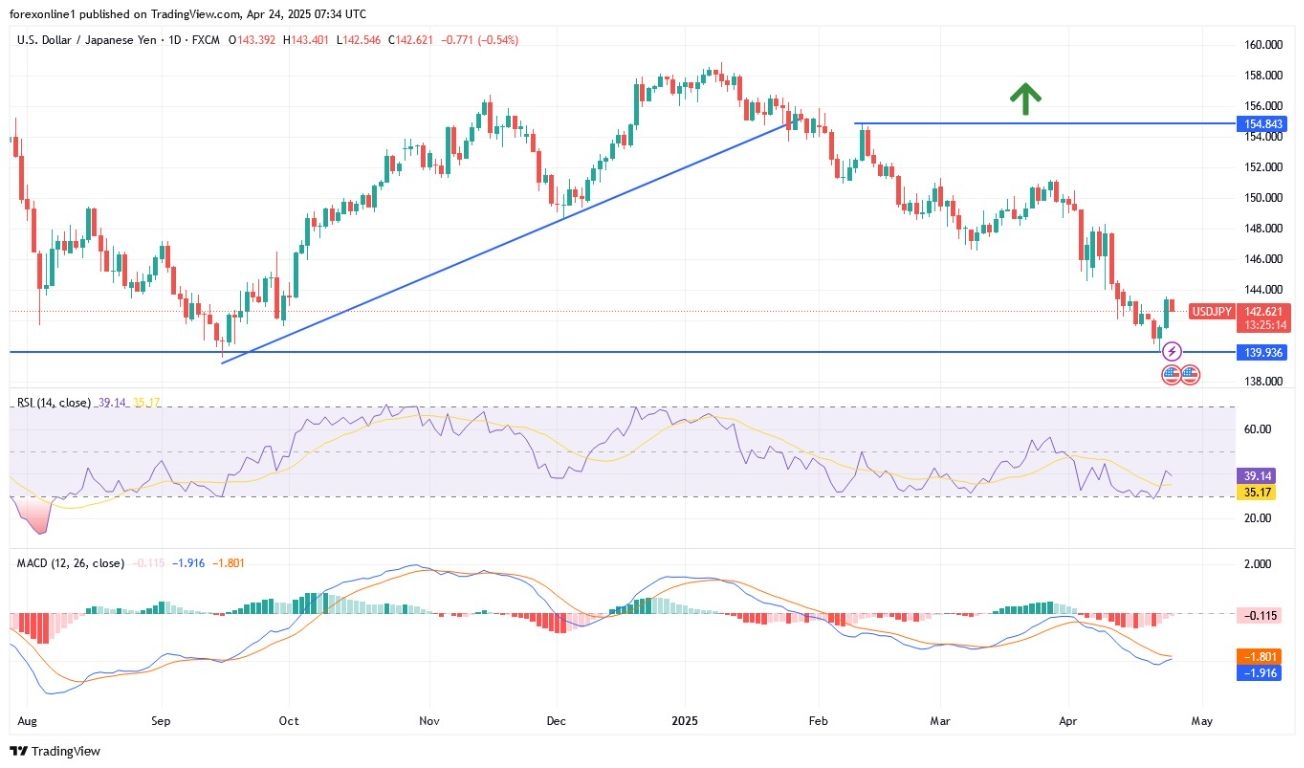
The USD/JPY trend remains bearish, and market tensions will ultimately support the Japanese yen.
During yesterday’s trading and across stock trading platforms, US stock market indices closed higher, with the S&P 500 index rising by 1.7%, the Nasdaq index by 2.5%, and the Dow Jones Industrial Average by 419 points, as the easing of trade tensions between the United States and China, and Trump’s confirmation that he would not dismiss Federal Reserve Chairman Jerome Powell, boosted sentiment.
However, the three US stock indices retreated from their highs, as investors questioned whether a trade resolution was imminent. US Treasury Secretary Bessent indicated that Trump had not proposed a unilateral reduction in tariffs and that talks with China had not yet begun, dampening early optimism. Clearly, this statement followed the President’s remarks suggesting that tariffs might not remain at the current 145% level.
Meanwhile, Trump’s change of tone toward Powell helped ease concerns about the US central bank’s independence. Tesla shares rose 5.4% after CEO Elon Musk announced he would significantly reduce his involvement with the government to focus on leading his companies. Boeing shares also rose 6.1%, supported by improved aircraft deliveries.
According to the performance on the daily chart, the overall trend for the USD/JPY currency pair remains bearish despite its recent gains. A break of the overall bearish trend on this timeframe will not occur without the bulls successfully pushing towards the resistance levels of 145.00 and 147.80, respectively. Conversely, on the same timeframe, the support levels of 141.70 and 140.00 will remain a real threat to the upward movement and important areas for strong bear control. After its recent gains, the 14-day RSI indicator is moving away from the oversold barrier, while the MACD indicator remains stable near the oversold peak so far.
The USD/JPY pair will be affected by the extent of investors’ risk appetite, as well as the release of the US weekly jobless claims and durable goods orders figures.
Want to trade our USD/JPY forex analysis and predictions? Here’s a list of forex brokers in Japan to check out.
The NZDCAD price forms bearish correctional waves but its main stability within the bullish channel’s levels, besides the continuation of forming extra support at 0.8220 level, these factors support the continuation of the positivity in the upcoming trading.
Gathering the required momentum is important to assist activating the bullish attack, which targets 0.8295 level reaching the near period of the resistance at 0.8365, while the trading below the extra support will confirm delaying the bullish attack and forming several bearish correctional waves, to attempt to test the moving average 55 near 0.8180.
The expected trading range for today is between 0.8220 and 0.8295
Trend forecast: Bullish
Do you need help in trading decisions? Do you want to learn how to start trading?
Join Economies.com VIP Club and benefit from over 15 years of market analysis expertise and get:
Special Offer: Subscribe to the Economies.com VIP channel and get also a free subscription to a trusted trading signals channel provided by Best Trading Signal.
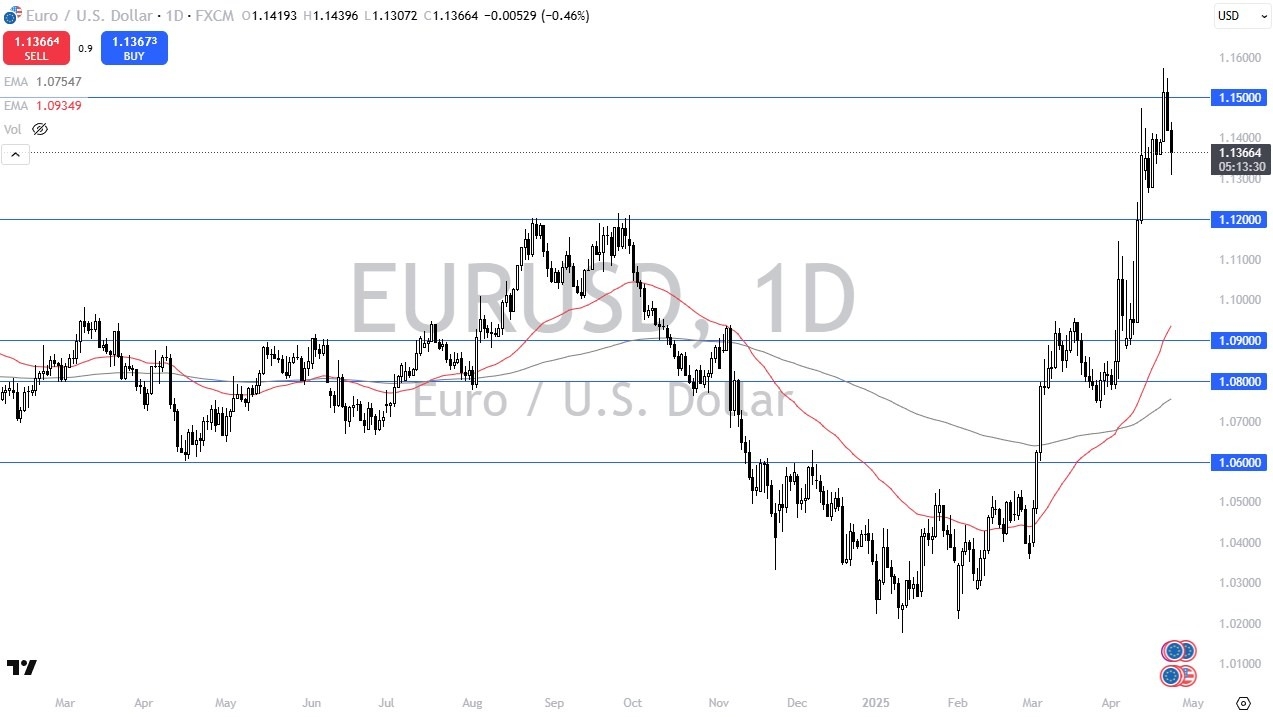
The 1.12 level underneath is a significant amount of support just waiting to happen as it had been major resistance, all things being equal. That’s an area where we will have to make a major inflection point. We will have to make a lot of decisions in that area.
Ultimately, I think we’ve got a situation where we are in the middle of a potential range between the 1.12 and 1.15 level. And therefore, it wouldn’t surprise me to see the market just level out here. After all, the market was parabolic for quite some time, and now it has to have a little bit of digestion. Markets cannot go in one direction forever, no matter how hyped people get.
Furthermore, the interest rate differential is actually starting to spread out quite far, and sooner or later, people are going to want to collect that interest, especially in an environment where the economic and market situation around the world is so jittery. Why risk or test your luck in a market that is all over the place when you can get a whopping return on just parking cash into treasuries.
We are starting to see US treasuries catch a bid and that helps the US dollar as there had been so many pulled out of the country, dollars are starting, I suspect, to flow back into America. Does that mean the trend changes here? No, not necessarily, but it does mean that we got way ahead of ourselves.
Ready to trade our daily Forex analysis? We’ve made a list of the best forex demo accounts worth trading with.
The EURUSD settled bearishly in its recent intraday trading, affected by the technical formation negativity, which was formed previously on the short- term basis, represented by the rising wedge pattern, which causes correctional pressures on the price.
The continuation of the trading below EMA50, besides the emergence of weakness signals from the (RSI), after offloading some of the exaggerated oversold conditions, increase the continuation of the negative scenario.
Do you need help in trading decisions? Do you want to learn how to start trading?
Join Economies.com VIP Club and benefit from over 15 years of market analysis expertise and get:
Special Offer: Subscribe to the Economies.com VIP channel and get also a free subscription to a trusted trading signals channel provided by Best Trading Signal.