The main category of Forex News.
You can use the search box below to find what you need.
[wd_asp id=1]
The main category of Forex News.
You can use the search box below to find what you need.
[wd_asp id=1]
EUR/USD gained more than 3.5% in the previous week and touched its highest level in over three years above 1.1470 on Friday. Following a technical correction heading into the weekend, the pair started the week slightly lower but didn’t have a difficult time regaining its traction. At the time of press, EUR/USD was trading in positive territory at around 1.1400.
The table below shows the percentage change of Euro (EUR) against listed major currencies last 7 days. Euro was the strongest against the US Dollar.
| USD | EUR | GBP | JPY | CAD | AUD | NZD | CHF | |
|---|---|---|---|---|---|---|---|---|
| USD | -3.87% | -2.28% | -1.76% | -3.00% | -4.73% | -5.24% | -4.55% | |
| EUR | 3.87% | 1.94% | 2.82% | 1.54% | -0.96% | -0.80% | -0.09% | |
| GBP | 2.28% | -1.94% | -0.41% | -0.39% | -2.85% | -2.70% | -2.00% | |
| JPY | 1.76% | -2.82% | 0.41% | -1.22% | -2.08% | -2.33% | -2.50% | |
| CAD | 3.00% | -1.54% | 0.39% | 1.22% | -2.13% | -2.31% | -1.87% | |
| AUD | 4.73% | 0.96% | 2.85% | 2.08% | 2.13% | 0.16% | 0.87% | |
| NZD | 5.24% | 0.80% | 2.70% | 2.33% | 2.31% | -0.16% | 0.72% | |
| CHF | 4.55% | 0.09% | 2.00% | 2.50% | 1.87% | -0.87% | -0.72% |
The heat map shows percentage changes of major currencies against each other. The base currency is picked from the left column, while the quote currency is picked from the top row. For example, if you pick the Euro from the left column and move along the horizontal line to the US Dollar, the percentage change displayed in the box will represent EUR (base)/USD (quote).
Although easing tensions surrounding the US-China trade conflict seems to be helping the market mood improve at the beginning of the week, the US Dollar (USD) finds it difficult to attract buyers.
US President Donald Trump’s administration granted some technology imports, including smartphones, computers, laptops and disc drives, exemptions from the steep 125% additional tariffs imposed on China. These products will reportedly still be subject to the 20% existing tariffs, which were imposed initially because of the fentanyl crisis in the US.
Over the weekend, US Commerce Secretary Howard Lutnick said that technology imports, alongside semiconductors, will face separate new levies within the next two months.
Reflecting the positive shift in risk sentiment, US stock index futures rise between 0.9% and 1.8% in the European morning.
The economic calendar will not feature any high-tier data releases on Monday. Later in the American session, several Federal Reserve (Fed) policymakers will be delivering speeches. The CME FedWatch Tool shows that markets are currently pricing in about a 20% probability of a 25 basis points Fed rate cut at the May policy meeting. In case Fed officials reiterate the need to remain patient regarding policy-easing, the USD could stay resilient against its peers and limit EUR/USD’s upside.
The Relative Strength Index (RSI) indicator on the 4-hour chart holds above 70, suggesting that EUR/USD remains technically overbought.
In case EUR/USD stabilizes above 1.1400 (psychological level, static level), 1.1470 (static level) could be seen as next resistance before 1.1500 (round level). Looking south, first support could be spotted at 1.1340 (static level) ahead of 1.1300 (static level, round level) and 1.1250 (static level).
The Euro is the currency for the 19 European Union countries that belong to the Eurozone. It is the second most heavily traded currency in the world behind the US Dollar. In 2022, it accounted for 31% of all foreign exchange transactions, with an average daily turnover of over $2.2 trillion a day.
EUR/USD is the most heavily traded currency pair in the world, accounting for an estimated 30% off all transactions, followed by EUR/JPY (4%), EUR/GBP (3%) and EUR/AUD (2%).
The European Central Bank (ECB) in Frankfurt, Germany, is the reserve bank for the Eurozone. The ECB sets interest rates and manages monetary policy.
The ECB’s primary mandate is to maintain price stability, which means either controlling inflation or stimulating growth. Its primary tool is the raising or lowering of interest rates. Relatively high interest rates – or the expectation of higher rates – will usually benefit the Euro and vice versa.
The ECB Governing Council makes monetary policy decisions at meetings held eight times a year. Decisions are made by heads of the Eurozone national banks and six permanent members, including the President of the ECB, Christine Lagarde.
Eurozone inflation data, measured by the Harmonized Index of Consumer Prices (HICP), is an important econometric for the Euro. If inflation rises more than expected, especially if above the ECB’s 2% target, it obliges the ECB to raise interest rates to bring it back under control.
Relatively high interest rates compared to its counterparts will usually benefit the Euro, as it makes the region more attractive as a place for global investors to park their money.
Data releases gauge the health of the economy and can impact on the Euro. Indicators such as GDP, Manufacturing and Services PMIs, employment, and consumer sentiment surveys can all influence the direction of the single currency.
A strong economy is good for the Euro. Not only does it attract more foreign investment but it may encourage the ECB to put up interest rates, which will directly strengthen the Euro. Otherwise, if economic data is weak, the Euro is likely to fall.
Economic data for the four largest economies in the euro area (Germany, France, Italy and Spain) are especially significant, as they account for 75% of the Eurozone’s economy.
Another significant data release for the Euro is the Trade Balance. This indicator measures the difference between what a country earns from its exports and what it spends on imports over a given period.
If a country produces highly sought after exports then its currency will gain in value purely from the extra demand created from foreign buyers seeking to purchase these goods. Therefore, a positive net Trade Balance strengthens a currency and vice versa for a negative balance.

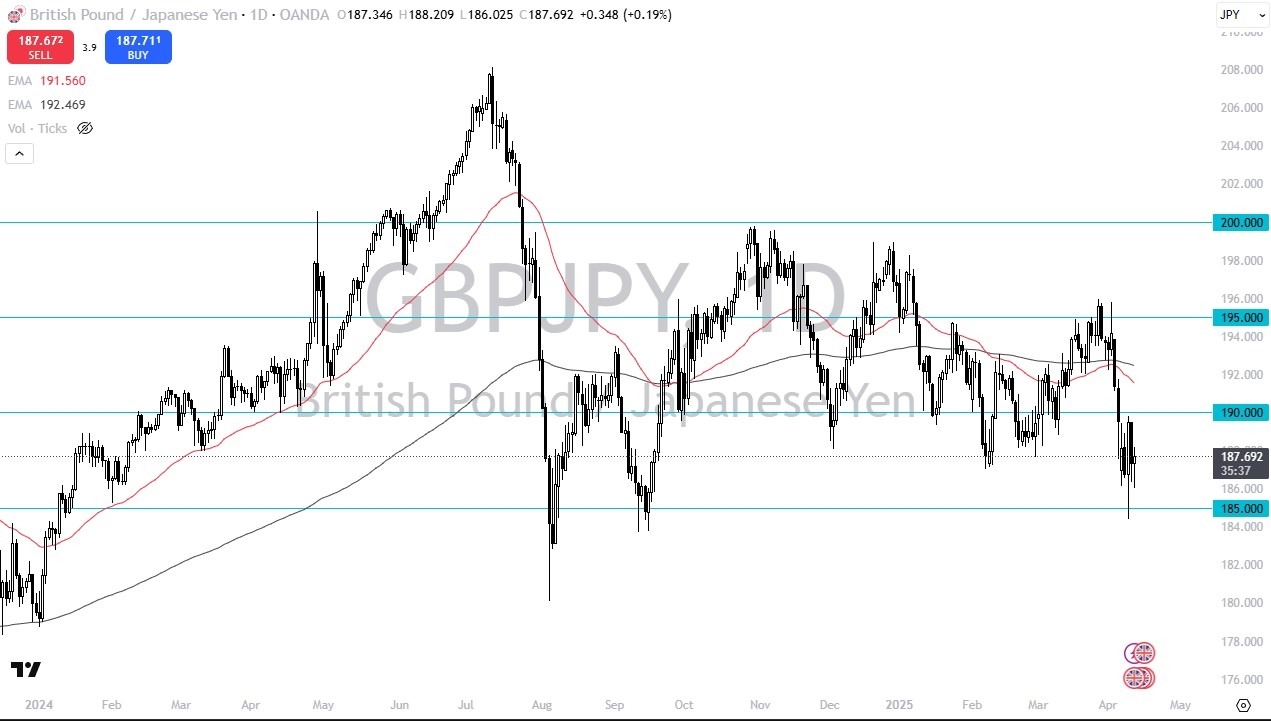
This is a market that I think given enough time we will have to sort out what was to do next, but in the meantime, I think we should probably look at this as being in the middle of a consolidation pattern, with the ¥185 level on the bottom in the ¥190 level on the top. As we are basically hanging around the ¥187.50 level, we are essentially in the middle of this range, and therefore you can make an argument that we are basically at “fair value.”
If we were to break above the ¥190 level, then I think we have a real shot at this pair going much higher, perhaps to the ¥195 level, and also I think you could see the Japanese yen get hammered against most currencies, not just this one. On the other hand, if this pair were to break down below the ¥185 level, then there’s a real shot that the Japanese yen strengthens against almost everything else as well. At this point, it seems like it’s all about the Japanese yen and the safety trade, which of course the Japanese yen is considered to be a “safety currency.” Until things settle down, it’s probably somewhat sluggish to the upside.
Begin trading our daily forecasts and analysis. Here is a list of Forex brokers in Japan to work with.
Gold price is sustaining its retreat from all-time highs of $3,245 reached on Friday, reverting toward $3,200 early Monday.
Having posted an outstanding 6.5% weekly gain, Gold price kicks off a new week on the back foot, pausing its three-day record-setting rally. The latest downtick in Gold price could be attributed to the positive shift in risk sentiment following a tumultuous week.
US President Donald Trump’s tariff concession on the Chinese electronics supply chain, hopes of more stimulus coming from China and Beijing’s stance of ignoring further US responses have offered markets some relief, diminishing the safe-haven appeal of the Gold price.
Trump clarified late Sunday that there will be no tariff exemption on semiconductors and the electronics supply chain but these products will be subject to the existing 20% tariffs on fentanyl and not the 145% levies.
This comes after China said on Friday that it will ignore further US responses after raising tariffs on US good to 125%, in retaliation to Trump’s 145% tariffs.
Meanwhile, Chinese policymakers vow to step up stimulus to cushion the world’s second-largest economy from the impact of the escalating trade war with the United States (US).
Gold price also bears the brunt of some progress on the US-Iran geopolitical talks. According to Reuters, US envoy Steve Witkoff and Iranian Foreign Minister Abbas Araghchi spoke for around 45 minutes on Saturday, with the Trump administration reportedly satisfied with the first round of talks. The second round of negotiations are expected to continue later this week.
That said, any dip in Gold price is likely to be bought in as traders remain wary about tariff talks and ahead of Wednesday’s Chinese first-quarter growth figures. Markets also remain unnerved as the US earnings season begins later this week.
In the meantime, Gold traders will look forward to China’s March trade data. However, the data is unlikely to show the full impact of the US-Sino trade war. Later in the day, several Federal Reserve (Fed) policymakers are scheduled to speak. Their take on Trump’s tariffs and hints on the Fed’s next interest rate move could provide some trading incentives in Gold price.
The daily chart shows that the 14-day Relative Strength Index (RSI) has eased from the overbought region to currently trade near 69, suggesting that the corrective pullback will likely be shallow.
The first area of contention for sellers is at the $3,200 threshold, below which Friday’s low of $3,176 will be challenged.
Additional declines could test the $3,100 round level, followed by the 21-day Simple Moving Average (SMA) resistance-turned-support at $3,074.
Conversely, the record high of $3,245 is the immediate topside barrier for Gold buyers. Scaling that level will open the door toward the $3,300 mark.
Gold price is back in the red early Monday, snapping a three-day record rally to lifetime highs of $3,245 set on Friday.
Safe-haven flows appear to have eased in Asian trading on Monday as traders rejoice in Wall Street’s turnaround on Friday alongside some positive updates on the US-China tariff war, alleviating the bullish pressure on the Gold price for now.
On Friday, China responded to the US tariff hike to 145% by raising tariffs on American goods to 125%. However, Beijing said it would ignore further US responses.
Over the weekend, US President Donald Trump considered imposing 20% tariffs on Chinese semiconductors and the electronics supply chain against the previously announced 145% levies.
These tariff updates seem to be perceived positively by markets, as they provide some consolation and allow a modest recovery in the US Dollar against its major currency rivals from 35-month lows.
The US Dollar uptick and risk appetite keep the corrective downside intact in Gold price as traders await China’s Trade Balance report and speeches from several US Federal Reserve (Fed) policymakers for further trading impetus.
Markets could use the excuse of not-so-steep tariffs on Chinese electronics and chips to take profits off the table following the recent Gold price upsurge.
Tariffs are customs duties levied on certain merchandise imports or a category of products. Tariffs are designed to help local producers and manufacturers be more competitive in the market by providing a price advantage over similar goods that can be imported. Tariffs are widely used as tools of protectionism, along with trade barriers and import quotas.
Although tariffs and taxes both generate government revenue to fund public goods and services, they have several distinctions. Tariffs are prepaid at the port of entry, while taxes are paid at the time of purchase. Taxes are imposed on individual taxpayers and businesses, while tariffs are paid by importers.
There are two schools of thought among economists regarding the usage of tariffs. While some argue that tariffs are necessary to protect domestic industries and address trade imbalances, others see them as a harmful tool that could potentially drive prices higher over the long term and lead to a damaging trade war by encouraging tit-for-tat tariffs.
During the run-up to the presidential election in November 2024, Donald Trump made it clear that he intends to use tariffs to support the US economy and American producers. In 2024, Mexico, China and Canada accounted for 42% of total US imports. In this period, Mexico stood out as the top exporter with $466.6 billion, according to the US Census Bureau. Hence, Trump wants to focus on these three nations when imposing tariffs. He also plans to use the revenue generated through tariffs to lower personal income taxes.
Important DisclaimersThe content provided on the website includes general news and publications, our personal analysis and opinions, and contents provided by third parties, which are intended for educational and research purposes only. It does not constitute, and should not be read as, any recommendation or advice to take any action whatsoever, including to make any investment or buy any product. When making any financial decision, you should perform your own due diligence checks, apply your own discretion and consult your competent advisors. The content of the website is not personally directed to you, and we does not take into account your financial situation or needs.The information contained in this website is not necessarily provided in real-time nor is it necessarily accurate. Prices provided herein may be provided by market makers and not by exchanges.Any trading or other financial decision you make shall be at your full responsibility, and you must not rely on any information provided through the website. FX Empire does not provide any warranty regarding any of the information contained in the website, and shall bear no responsibility for any trading losses you might incur as a result of using any information contained in the website.The website may include advertisements and other promotional contents, and FX Empire may receive compensation from third parties in connection with the content. FX Empire does not endorse any third party or recommends using any third party’s services, and does not assume responsibility for your use of any such third party’s website or services.FX Empire and its employees, officers, subsidiaries and associates, are not liable nor shall they be held liable for any loss or damage resulting from your use of the website or reliance on the information provided on this website.Risk DisclaimersThis website includes information about cryptocurrencies, contracts for difference (CFDs) and other financial instruments, and about brokers, exchanges and other entities trading in such instruments. Both cryptocurrencies and CFDs are complex instruments and come with a high risk of losing money. You should carefully consider whether you understand how these instruments work and whether you can afford to take the high risk of losing your money.FX Empire encourages you to perform your own research before making any investment decision, and to avoid investing in any financial instrument which you do not fully understand how it works and what are the risks involved.
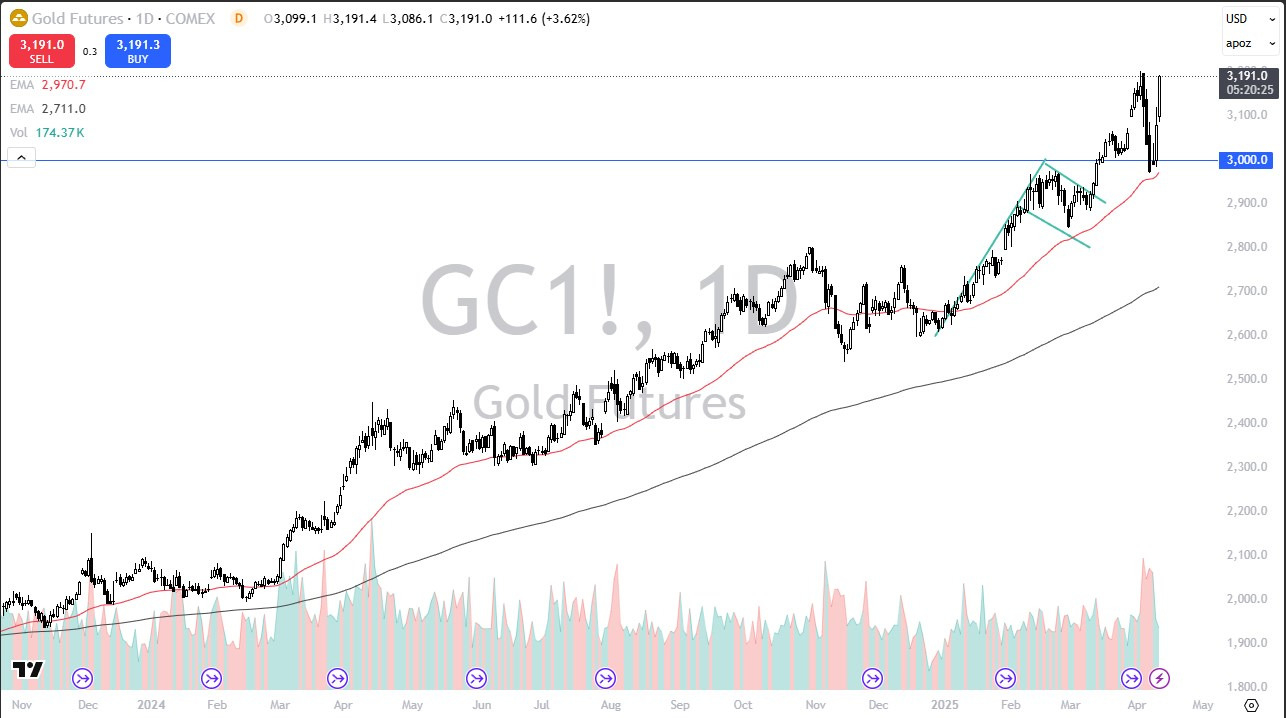
Most of what you’ve seen recently has been forced liquidation by hedge funds who were trying to cover losses in other markets. Remember, they have a leveraged book. So if they find themselves in serious trouble, for example, with the NASDAQ 100 or maybe something along the lines of levered Tesla or Nvidia positions, and sooner or later, they are forced to pay more margin and typically, what they’ll do is they will sell a market that’s done very well to collect some of those profits and send them to their prime dealer. The $3,000 level has offered support. The 50-day EMA as well, just below, has offered support and at this point in time, it looks like we are ready to go screaming higher again.
I don’t expect this type of momentum to continue, but I do think that the uptrend is most certainly going to be looking at the bullish flag underneath, we had a measured move of $3,300 and there’s nothing on the chart that suggests that we can’t get there. In fact, I do think we will probably go higher than that. Gold is screaming higher for a multitude of reasons, not just the fact that there’s a lot of financial stress out there, the simple fact that there’s a lot of geopolitical problems, and of course it looks like the global economy may slow down in various places. So, all this leads for a continuation of the trend that we’ve seen for the better part of a year and a half now.
Ready to trade today’s Gold forecast? Here are the best Gold brokers to choose from.
April 13, 2025 – Written by Frank Davies
STORY LINK Pound to Dollar Forecast: Banks Radically Hike 12-month Predictions to 1.30-1.39
The Pound-to-Dollar exchange rate (GBP/USD) posted sharp losses to near 1.2700 early in the week before a surge to highs near 1.3150 as the dollar slumped amid very high volatility.
According to ING; “The question of a potential dollar confidence crisis has now been definitively answered – we are experiencing one in full force.”
Goldman Sachs has radically changed its view and is now forecasting dollar losses. The 12-month GBP/USD forecast has been revised to 1.39 from 1.24 previously.
Investment banks have generally downgraded dollar forecasts which has increased GBP/USD projections even though banks are far from convinced over the UK outlook.
According to Scotiabank, on a near-term view, gains above 1.32 would lead to gains to 1.34.
Nordea now expects GBP/USD will trade at 1.30 at the end of 2025 compared with the 1.23 forecast previously.
According to Nordea; “We have made a complete reversal in our dollar outlook and now expect the dollar to weaken rather than strengthen.”
UK GDP data was stronger than expected, but global developments dominated.
Although a slide in risk appetite undermined the Pound on the crosses, dollar losses triggered the GBP/USD rebound.
RBC pointed to huge elements of uncertainty; “The question for FX though is how the US shock will compare to the rest of the world? How much if anything will be in place a month from now, or six months from now?”
It added; “All we can say at the moment is that whether or not tariffs are implemented, the uncertainty is going to have a negative growth impact, not just on the US.”
RBC also commented; “Trump’s desire to break with the post-WW2 world order has investors questioning whether USD can retain its status as the world’s primary reserve currency.”
It added; “Summing it up leaves us with a bias for USD to drift lower over the next 12-18 months but mindful that sudden policy changes could shift that view materially in either direction.”
RBC expects GBP/USD to be capped around 1.30 over the next 12 months.

Goldman Sachs explained its change of stance; “First, the combination of an unnecessary trade war and other uncertainty-raising policies is severely eroding consumer and business confidence. Second, negative trends in US governance and institutions are eroding the appeal of US assets for foreign investors. Third, rudimentary calculations and a constant back-and-forth makes it difficult for investors to price outcomes other than high uncertainty.”
President Trump’s imposition of reciprocal tariffs had triggered an element of defensive dollar buying, but buyers were quickly overwhelmed by sellers.
Support collapsed amid fear over the US economy as the US-China trade war intensified.
After warning against retaliation, Trump increased tariffs on imports from China to 145% while China refused to back down and increased tariffs on US imports to 125%.
If these tariffs are sustained for any significant period, there will be major dislocation to trade and economic damage.
Other reciprocal tariffs were delayed by 90 days as the Administration was forced to blink amid market chaos, but uncertainty remained intense.
Unusually, US equities, bonds and the dollar all weakened at the same time which suggested a notable loss of confidence in US assets.
UBS commented; “As a result of this tariff chaos, Treasury markets saw fluctuations during the week, which reminded some investors of the “Truss-moment” from the gilt market in 2022.
UBS added; “In our view, much damage has been done, which is not easily reversible.
It forecasts GBP/USD gains to 1.34 by March 2026.
Danske Bank now forecasts GBP/USD gains to 1.41 on a 12-month view from 1.31 previously.
Scotiabank’s Chief FX Strategist Shaun Osborne also referenced UK parallels; “Financial markets can have a disciplining effect, as former UK PM Truss discovered in 2022 when the pound, Gilts and UK equities were falling in unison. That has been happening in the US this week and it is a clear signal that markets anticipate negative consequences from the US’ pursuit of aggressive tariffs on its trade partners and are dumping US assets as a result.”
He added; “The 90-day reprieve won’t help. It just prolongs the uncertainty and increases the risk of a negative economic outcome. A tariff off-ramp must be found quickly or the USD will continue to fall.”
According to ANZ group chief economist Richard Yetsenga; “Regardless of how the next 90 days evolve, the U.S.’s international reputation has been eroded.”
Comments from Nomura strategist Naka Matsuzawa were unusually forthright; “I’m deeply concerned about a lack of confidence among investors in the U.S. now. It’s a no confidence vote from not just the equity market but also Treasury market participants in the Trump administration and its policies.”
Latest US inflation data was weaker than expected and markets expect three Fed rate cuts this year despite fears that tariffs will put upward pressure on inflation.
US Congress pushed ahead with tax cuts in the budget resolution with the budget expected to increase long-term deficits.
ING added; “We also cannot exclude that the budget resolution passed by the House yesterday, which poses significant funding questions for tax cut extensions, is adding another layer of risk premium to risk assets and Treasuries.”
Long-time dollar bull HSBC is wavering; “We have pushed back against such concerns over the years given resilient US growth supporting high yields and solid foreign demand for US assets. Yet, we cannot easily brush aside the USD’s structural weaknesses, especially given the current climate.”
International Money Transfer? Ask our resident FX expert a money transfer question or try John’s new, free, no-obligation personal service! ,where he helps every step of the way,
ensuring you get the best exchange rates on your currency requirements.
Despite macro headwinds, LNG exports held strong. Net flows to US export terminals reached 16.3 Bcf/d on Friday, up 9.1% week-over-week. This remains a key area of support for prices. Traders are also watching US storage levels, which BloombergNEF projects will be 10% below the five-year average by summer—keeping bullish positioning alive even as near-term drivers remain mixed.
EIA data showed a +57 Bcf injection for the week ended April 4, broadly in line with expectations but well above the five-year average of +17 Bcf for this period. Storage remains 2.1% below the five-year norm and 19.8% under last year, signaling tight underlying supply. Still, the size of the injection gave the market little reason to rally.
Dry gas production held at 106.2 Bcf/d, up 4.7% y/y, while demand reached 76.7 Bcf/d, up 11.4% y/y. Electricity output rose 4.05% y/y, suggesting firm baseline power burn, but not yet summer-driven demand.
Weather outlooks are neutral to slightly bearish. The Commodity Weather Group sees above-normal temps in the West and seasonal conditions elsewhere from April 16–20—limiting late-season heating demand. Baker Hughes reported an increase of one rig, bringing the gas rig count to 97, still historically low but off recent lows.
With trade tension clouding demand outlooks and weather offering no near-term support, nat-gas looks vulnerable to further downside. LNG flows and tight storage remain bullish anchors, but unless a weather or export catalyst emerges, price action may continue to drift lower in the near term.
More Information in our Economic Calendar.
The price of gold (GOLD) has moved higher strongly in its recent intraday trading, supported by positive signals from relative strength indicators (RSI), reaching our first target to test the current resistance level of $3,053. This comes amid the dominance of the main upward trend, with trading occurring near the trend line.
To get our more detailed analysis and 100% accurate signals provided by Best Trading Signal, subscribe to Economies.com VIP Club through the link below!
Just two weeks ago, copper prices were climbing fast due to the US stockpiling ahead of new tariffs. Traders warned that new US tariffs on copper could squeeze global supply. But things turned around quickly. But now, the copper rally has reversed into a full-blown crash.
This is a direct outcome of President Donald Trump’s trade war, aka “Trump Tariffs,” that is shaking the global market. Investors now fear that the new tariffs will slow down demand for copper worldwide.
Bloomberg reported, on Friday, April 4, copper prices dropped sharply, along with stock markets. The fall continued till Monday. In the London Metal Exchange, copper prices sank as much as 7.7% before bouncing back slightly to $8,735 a ton.

Earlier, we saw how traders rushed to send copper to the US before tariffs hit, driving premiums as high as $500 a ton. Big players like Mercuria and Trafigura even predicted prices could reach $12,000 a ton. But things changed rapidly when Trump shortened the tariff timeline, giving buyers very few days in hand.
Because of this, copper is piling up outside the US. Global buyers have more to choose from, but many aren’t interested. With demand dropping due to tariffs, the extra supply doesn’t help.
Chile, the world’s biggest copper producer, is preparing to lower its copper price estimate for 2025. It’s a telltale sign of growing global economic concerns.
According to the Wall Street Journal, Chile’s copper agency, Cochilco, held its 2025 price forecast at $4.25 per pound in February. This came after it raised the estimate from $3.85 back in May 2024.
It also kept the 2026 forecast at $4.25. Cochilco expects copper prices to stay above $4.00 per pound for the next ten years.
The final figure will be announced by the end of April. However, Juan Ignacio Guzman, head of Chilean mineral consulting firm GEM, said,
“If the trade war triggers a recession, prices could tumble to as low as $3 a pound — or about $6,600 a ton.”

Chile, which produced 24% of the world’s copper last year, is now feeling the pressure.
In a separate report from the Shanghai Metals Market, we discovered that,
Earlier this year, in January and February, Chile’s copper production dropped compared to the previous month. Exports to China also declined during that period.
The Bloomberg report highlighted that the worst might not be over. Max Layton, global head of commodities research at Citigroup Inc., warned that the global trade shake-up could lead to a historic market correction. Citi now expects copper prices outside the US to average $8,500 this quarter — but they also say the risk of further drops is high.
BNP Paribas SA strategist David Wilson, who had warned prices could collapse, now sees the downtrend continuing in the short term. Goldman Sachs still believes in copper’s long-term value but admits that slower global growth could delay the expected supply shortage.
Meanwhile, JPMorgan now expects the US to fall into a recession this year. UBS estimates that every 1% drop in US GDP could cut output in export-driven Asian economies like Taiwan and South Korea by up to 2%.
Copper stocks have taken a beating amid falling prices, global slowdown fears, and rising trade tensions. The sharp selloff followed news from China’s Xinhua News Agency that Beijing will impose a 34% tariff on all US imports starting April 10.
Here’s a quick look at how major mining companies are reacting:
KNOW MORE: Copper Prices Slump Below $9,000: What Does It Mean for Global Growth?
What started as a bullish rush has turned into a brutal crash. With tariffs rising and demand shrinking, copper is now a symbol of deeper market fears. Global supply chains are out of sync, and the world’s top miners are feeling the heat. If trade tensions escalate, this copper price crash may face a difficult recovery.