The main category of Forex News.
You can use the search box below to find what you need.
[wd_asp id=1]
The main category of Forex News.
You can use the search box below to find what you need.
[wd_asp id=1]
The EURUSD pair declined in its last intraday trading, to clear most of its early gains, and settling below 1.0945, this is amidst the continued dominance of a corrective downward wave and its trading along a trend line on the intraday levels, after the price attempted to offload some of its clear oversold condition on the (RSI).
To get our more detailed analysis and 100% accurate signals provided by Best Trading Signal, subscribe to Economies.com VIP Club through the link below!
April 8, 2025 – Written by Tim Boyer
STORY LINK Pound Sterling Forecast: GBP Recovers vs EUR USD, Next US-China Moves Crucial
Trade considerations have continued to dominate on Tuesday with a further net recovery in risk appetite.
Markets overall are slightly more confident that there will be bilateral negotiations to ease the impact of US “reciprocal” tariffs, but there is still a very high degree of uncertainty.
The next move is likely to be determined by the US-China trade war. Risk appetite will surge further if China or Trump blink, but there are likely to be fresh losses in equities if neither side back off.
After sliding to 1-month lows near 1.2700, the Pound to Dollar (GBP/USD) exchange rate has recovered to 1.2785.
The Pound to Euro (GBP/EUR) exchange rate has recovered from 8-month lows below 1.1650 to trade around 1.1670.
Reservations surrounding the UK economic outlook have also increased, limiting Pound recovery potential.
Markets have also now fully priced in a rate cut at the May Bank of England meeting and there have been some calls for a 50 basis-point cut.
According to Scotiabank; “The loss of rate support adds to near-term downside risk for GBP.”
The 30-year UK bond yields edged higher again on Tuesday amid speculation that the government would eventually relax fiscal rules.
Monex noted that this was; “a notable concern for markets.”
According to Monex; “Our long-term view remains that UK fundamentals are better than markets currently price, now helped by tariff differentials, while the government will ultimately choose not to scrap their fiscal rules with the memory of Liz Truss still fresh in the mind.”
It did, however, add; “For now, though, with sentiment still in the driving seat, sterling looks set to continue trading under pressure.”
There is still an important element of uncertainty surrounding Chinese tariffs ahead of the April 9th scheduled introduction of additional tariffs.
China has not backed away from imposing its own tariffs while Trump has threatened even more aggressive tariffs if China refuses to bend.

In comments on Tuesday, Trump stated that China was desperate for a deal and that they would relent.
According to Scotiabank; “Messaging from the administration on tariff policy remains confusing.”
It added; “Markets may lack enough clarity on tariff policy end goals to form a solid base for now.”
US economic conditions will be a key element in the short term.
The NFIB small business confidence index dipped to a 4-month low of 97.4 for April from 100.7 previously and below consensus forecasts of 98.9.
Significantly, this has pushed the index below the long-term average.
The net percent of owners expecting better business conditions posted a third consecutive monthly decline and the largest monthly dip since December 2020.
According to the NFIB; “This year will be one ruled by uncertainty. Global and domestic actions are generating insecurities in abundance, both political and economic. President Trump’s administration is rearranging the deck chairs at a record pace. Is there an “iceberg” looming ahead or will we sail through to a restructured economy safely?”
The survey was conducted before the tariff increases came into effect and markets will be looking at data compiled after the tariff introduction for insight into the potential impact.
International Money Transfer? Ask our resident FX expert a money transfer question or try John’s new, free, no-obligation personal service! ,where he helps every step of the way,
ensuring you get the best exchange rates on your currency requirements.
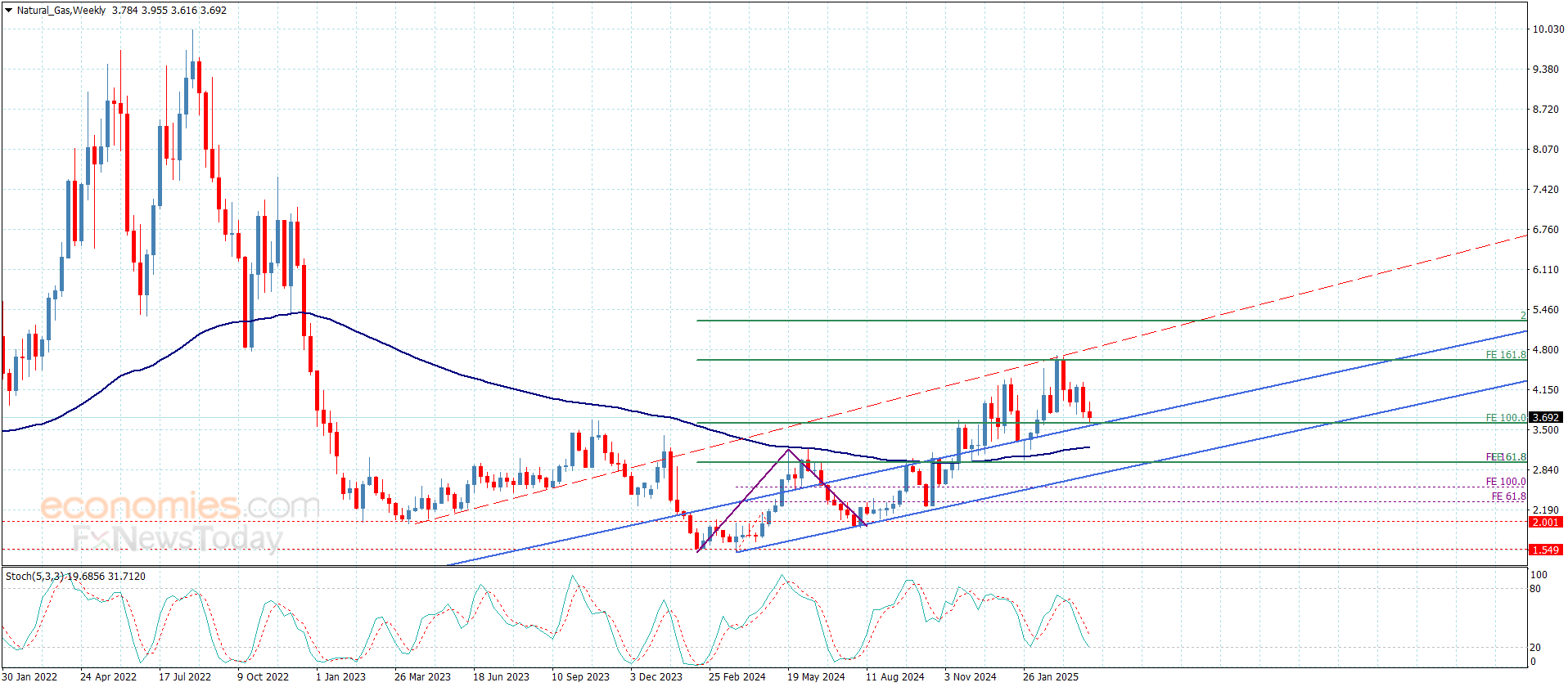
Natural gas price remains affected by stochastic negativity, to be forced to delay the bullish rally and providing mixed trading, noticing testing the extra support at 3.610$ yesterday and holding above it.
We expect providing more of the sideways trading until gathering the positive momentum, to ease the mission of renewing the bullish rally and begin targeting the positive stations near 3.950$ and 4.180$, while facing new negative pressure and breaking 3.600$ level will cancel the bullish scenario for the near trading, which force the price to suffer new losses by its decline towards 3.560$ and 3.380$.
The expected trading range for today is between 3.600$ and 3.950$
Trend forecast: Bullish
The (USDCAD) has declined in its recent intraday trading after failing to break the key resistance level at 1.4275, which coincided with testing the resistance of the EMA50. This increased the selling pressure on the price. The decline came as negative signals emerged from the Relative Strength Index (RSI) after it reached excessively overbought levels earlier, supporting the idea of a temporary pullback to gain new momentum.
Despite the current decline, the pair is still moving within an upward corrective wave, enhancing the chances of resuming the upward movement if a key technical condition is achieved, which is breaking the 1.4275 resistance level.
To get our more detailed analysis and 100% accurate signals provided by Best Trading Signal, subscribe to Economies.com VIP Club through the link below!
Apple’s stock price (AAPL) tumbled in latest intraday trading, amid the dominance of the downward correctional trend, while the price is hurt by a negative technical pattern that formed in the short term, the Head and Shoulders pattern, with negative signals streaming from the Stochastic after forming a negative divergence, which bolstered the downward trend.
Therefore we expect more losses for the price, targeting the first support at $178.35 as a price target for the forming Head and Shoulders pattern.
Today’s price forecast: Bearish
After rising to 1.1050 on Monday, EUR/USD lost its traction and closed the day slightly above 1.0900. The pair holds its ground early Tuesday and clings to modest daily gains at around 1.0950.
The table below shows the percentage change of Euro (EUR) against listed major currencies today. Euro was the strongest against the US Dollar.
| USD | EUR | GBP | JPY | CAD | AUD | NZD | CHF | |
|---|---|---|---|---|---|---|---|---|
| USD | -0.26% | -0.18% | -0.28% | -0.51% | -1.30% | -1.15% | -0.14% | |
| EUR | 0.26% | 0.04% | -0.06% | -0.26% | -1.03% | -0.85% | 0.11% | |
| GBP | 0.18% | -0.04% | -0.09% | -0.27% | -1.07% | -0.88% | 0.15% | |
| JPY | 0.28% | 0.06% | 0.09% | -0.22% | -1.00% | -0.89% | 0.20% | |
| CAD | 0.51% | 0.26% | 0.27% | 0.22% | -0.80% | -0.62% | 0.44% | |
| AUD | 1.30% | 1.03% | 1.07% | 1.00% | 0.80% | 0.19% | 1.24% | |
| NZD | 1.15% | 0.85% | 0.88% | 0.89% | 0.62% | -0.19% | 1.05% | |
| CHF | 0.14% | -0.11% | -0.15% | -0.20% | -0.44% | -1.24% | -1.05% |
The heat map shows percentage changes of major currencies against each other. The base currency is picked from the left column, while the quote currency is picked from the top row. For example, if you pick the Euro from the left column and move along the horizontal line to the US Dollar, the percentage change displayed in the box will represent EUR (base)/USD (quote).
In an interview with Fox News on Monday, Kevin Hassett, Director of the US National Economic Council (NEC), said US President Donald Trump will listen to trading partners if they offer “really great deals.” Later in the day, several news outlets, including Reuters, reported that Hassett told CNBC that Trump is considering a 90-day pause in tariffs for all countries except China. The immediate reaction to this headline boosted the risk mood and helped EUR/USD push higher.
As the White House came out with a statement shortly after, calling the CNBC reporting “fake news,” the risk rally quickly lost its steam and made it difficult for EUR/USD to keep its footing.
Meanwhile, European Union trade commissioner Maros Sefcovic said on Monday that they have offered zero-for-zero tariffs to the US for cars and all industrial goods. “The EU remains open to and strongly prefers talks but we will not wait endlessly,” he noted.
The economic calendar will not offer any high-impact data releases that could influence EUR/USD’s action on Tuesday. Hence, market participants will continue to scrutinize the fresh developments on the global trade conflict.
While it’s difficult to know what will be the next tariff-related headline, the action in Wall Street could provide a directional clue for EUR/USD. A bullish action in US stocks after the opening bell could support the pair and vice versa.
The Relative Strength Index (RSI) indicator on the 4-hour chart stays near 50, reflecting a lack of bullish momentum.
If EUR/USD fails to stabilize above 1.0950 (static level), 1.0900 (static level, round level) could be seen as the next support before 1.0870 (100-period Simple Moving Average (SMA), 20-day SMA). On the upside, resistances could be seen at 1.1000 (static level, round level), 1.1050 (static level) and 1.1100 (static level).
The Euro is the currency for the 19 European Union countries that belong to the Eurozone. It is the second most heavily traded currency in the world behind the US Dollar. In 2022, it accounted for 31% of all foreign exchange transactions, with an average daily turnover of over $2.2 trillion a day.
EUR/USD is the most heavily traded currency pair in the world, accounting for an estimated 30% off all transactions, followed by EUR/JPY (4%), EUR/GBP (3%) and EUR/AUD (2%).
The European Central Bank (ECB) in Frankfurt, Germany, is the reserve bank for the Eurozone. The ECB sets interest rates and manages monetary policy.
The ECB’s primary mandate is to maintain price stability, which means either controlling inflation or stimulating growth. Its primary tool is the raising or lowering of interest rates. Relatively high interest rates – or the expectation of higher rates – will usually benefit the Euro and vice versa.
The ECB Governing Council makes monetary policy decisions at meetings held eight times a year. Decisions are made by heads of the Eurozone national banks and six permanent members, including the President of the ECB, Christine Lagarde.
Eurozone inflation data, measured by the Harmonized Index of Consumer Prices (HICP), is an important econometric for the Euro. If inflation rises more than expected, especially if above the ECB’s 2% target, it obliges the ECB to raise interest rates to bring it back under control.
Relatively high interest rates compared to its counterparts will usually benefit the Euro, as it makes the region more attractive as a place for global investors to park their money.
Data releases gauge the health of the economy and can impact on the Euro. Indicators such as GDP, Manufacturing and Services PMIs, employment, and consumer sentiment surveys can all influence the direction of the single currency.
A strong economy is good for the Euro. Not only does it attract more foreign investment but it may encourage the ECB to put up interest rates, which will directly strengthen the Euro. Otherwise, if economic data is weak, the Euro is likely to fall.
Economic data for the four largest economies in the euro area (Germany, France, Italy and Spain) are especially significant, as they account for 75% of the Eurozone’s economy.
Another significant data release for the Euro is the Trade Balance. This indicator measures the difference between what a country earns from its exports and what it spends on imports over a given period.
If a country produces highly sought after exports then its currency will gain in value purely from the extra demand created from foreign buyers seeking to purchase these goods. Therefore, a positive net Trade Balance strengthens a currency and vice versa for a negative balance.
(This story was corrected on April 8 at 09:12 GMT to mention in the first bullet point that EUR/USD stays below 1.1000, not 1.0000.)
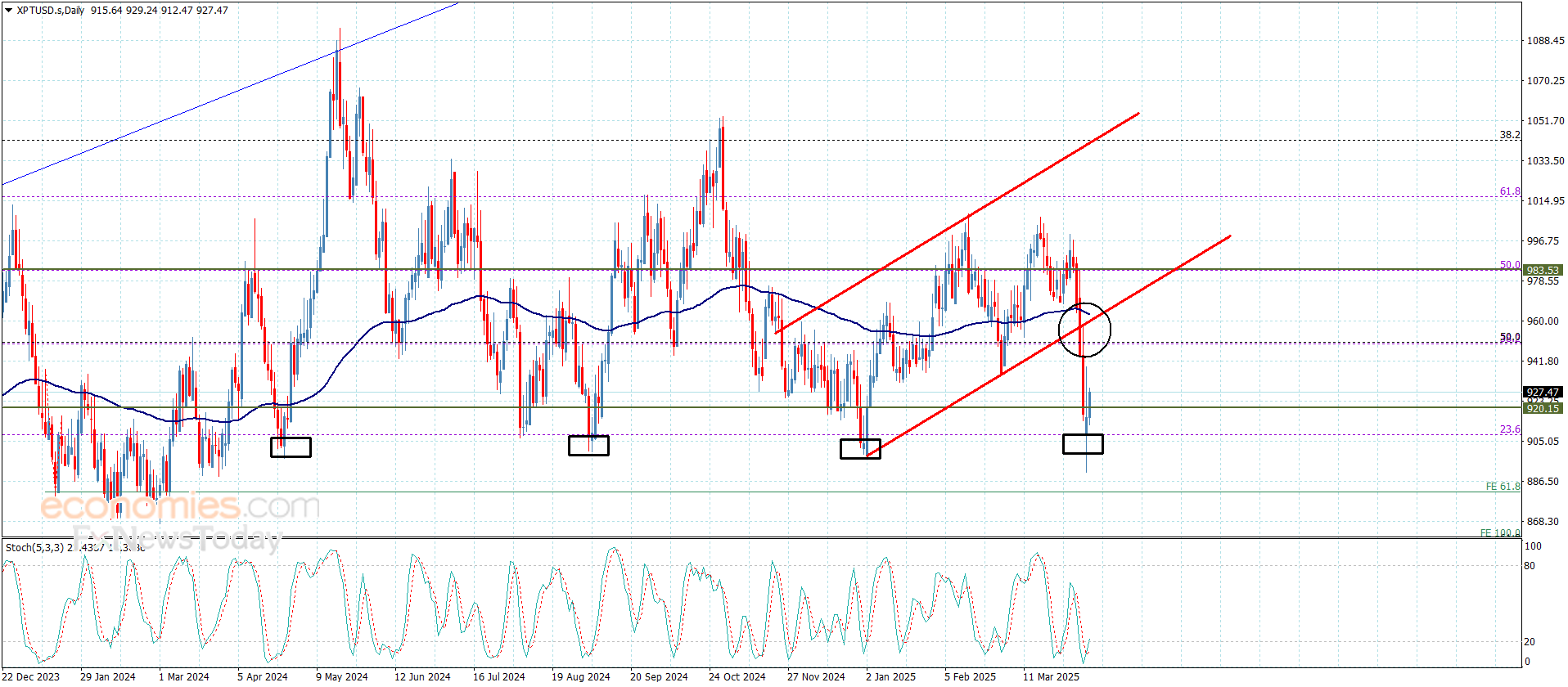
Platinum price confirmed its interaction with the support base at 895.00$, getting advantage from stochastic attempt to provide positive momentum, forming a new positive rally and settled near 930.00$.
The repeated stability above the mentioned support will increase the chances for compensating the losses, to expect the price rally towards 940.00$ reaching the resistance at 960.00$, while activating the bearish track requires a negative close below the current support, then begin targeting several negative stations, the initial target for the negative trading is located at 880.00$.
The expected trading range for today is between 910.00$ and 945.00$
Trend forecast: Bullish
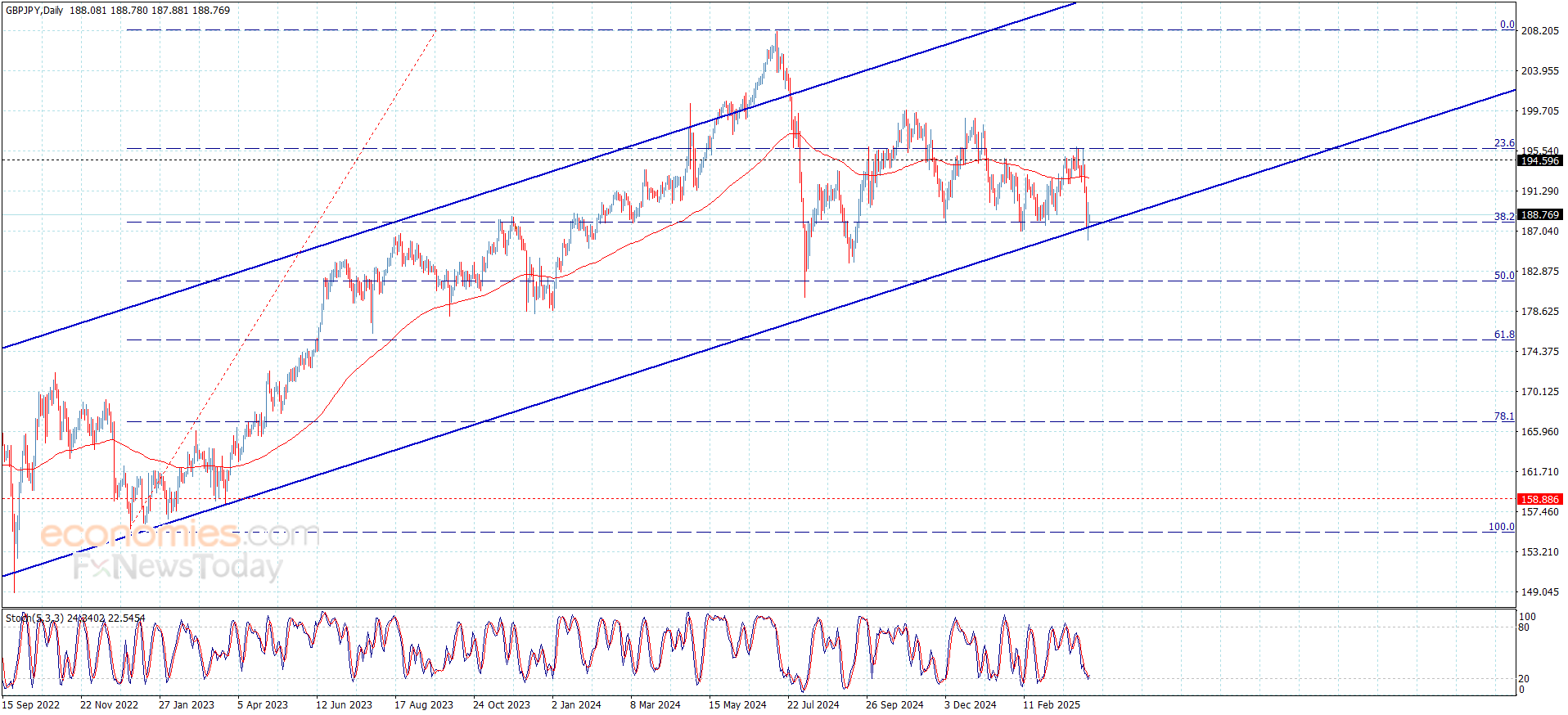
The GBPJPY pair succeeded to face the negative pressures by its rally above the critical support at 187.50, increasing the chances for its stability within the bullish channel’s levels and begin forming bullish waves, noticing its stability near 188.70.
Note that forming more of the bullish attempts is important to surpass the obstacle at 189.60 level, reinforcing the chances for recording extra gains that might extend towards 190.30 and 191.45, while the failure to breach the obstacle will force the price to provide mixed trading, we should confirm that monitoring the price is important in case declining to the critical support, to avoid any losses that might be caused by exiting the bullish track.
The expected trading range for today is between 187.90 and 190.30
Trend forecast: Bullish
The Silver price (XAG/USD) posts modest gains around $30.15 during the Asian trading hours on Tuesday. The upside for the white metal might be limited due to investors liquidating positions to secure profits, possibly covering losses or margin calls on falling asset valuations, fueled by concerns about a global trade war. Nonetheless, the weaker Greenback might help limit the USD-denominated commodity price’s losses.
According to the daily chart, the bearish sentiment of the Silver remains in play as the price remains capped below the key 100-day Exponential Moving Average (EMA). Furthermore, the downward momentum is supported by the 14-day Relative Strength Index (RSI), which stands below the midline near 32.70, supporting the sellers in the near term.
The first downside target for the XAG/USD emerges at the $30.00 psychological level. Further south, the next contention level is seen at $28.80, the low of December 20, 2024. The additional downside filter to watch is $28.31, the low of April 7.
On the bright side, the immediate resistance level is located at $30.85, the high of January 21. Any follow-through buying above this level could pave the way to $31.77, the 100-day EMA. A decisive break above the mentioned level could see a rally to $33.20, the high of February 20.
Silver is a precious metal highly traded among investors. It has been historically used as a store of value and a medium of exchange. Although less popular than Gold, traders may turn to Silver to diversify their investment portfolio, for its intrinsic value or as a potential hedge during high-inflation periods. Investors can buy physical Silver, in coins or in bars, or trade it through vehicles such as Exchange Traded Funds, which track its price on international markets.
Silver prices can move due to a wide range of factors. Geopolitical instability or fears of a deep recession can make Silver price escalate due to its safe-haven status, although to a lesser extent than Gold’s. As a yieldless asset, Silver tends to rise with lower interest rates. Its moves also depend on how the US Dollar (USD) behaves as the asset is priced in dollars (XAG/USD). A strong Dollar tends to keep the price of Silver at bay, whereas a weaker Dollar is likely to propel prices up. Other factors such as investment demand, mining supply – Silver is much more abundant than Gold – and recycling rates can also affect prices.
Silver is widely used in industry, particularly in sectors such as electronics or solar energy, as it has one of the highest electric conductivity of all metals – more than Copper and Gold. A surge in demand can increase prices, while a decline tends to lower them. Dynamics in the US, Chinese and Indian economies can also contribute to price swings: for the US and particularly China, their big industrial sectors use Silver in various processes; in India, consumers’ demand for the precious metal for jewellery also plays a key role in setting prices.
Silver prices tend to follow Gold’s moves. When Gold prices rise, Silver typically follows suit, as their status as safe-haven assets is similar. The Gold/Silver ratio, which shows the number of ounces of Silver needed to equal the value of one ounce of Gold, may help to determine the relative valuation between both metals. Some investors may consider a high ratio as an indicator that Silver is undervalued, or Gold is overvalued. On the contrary, a low ratio might suggest that Gold is undervalued relative to Silver.
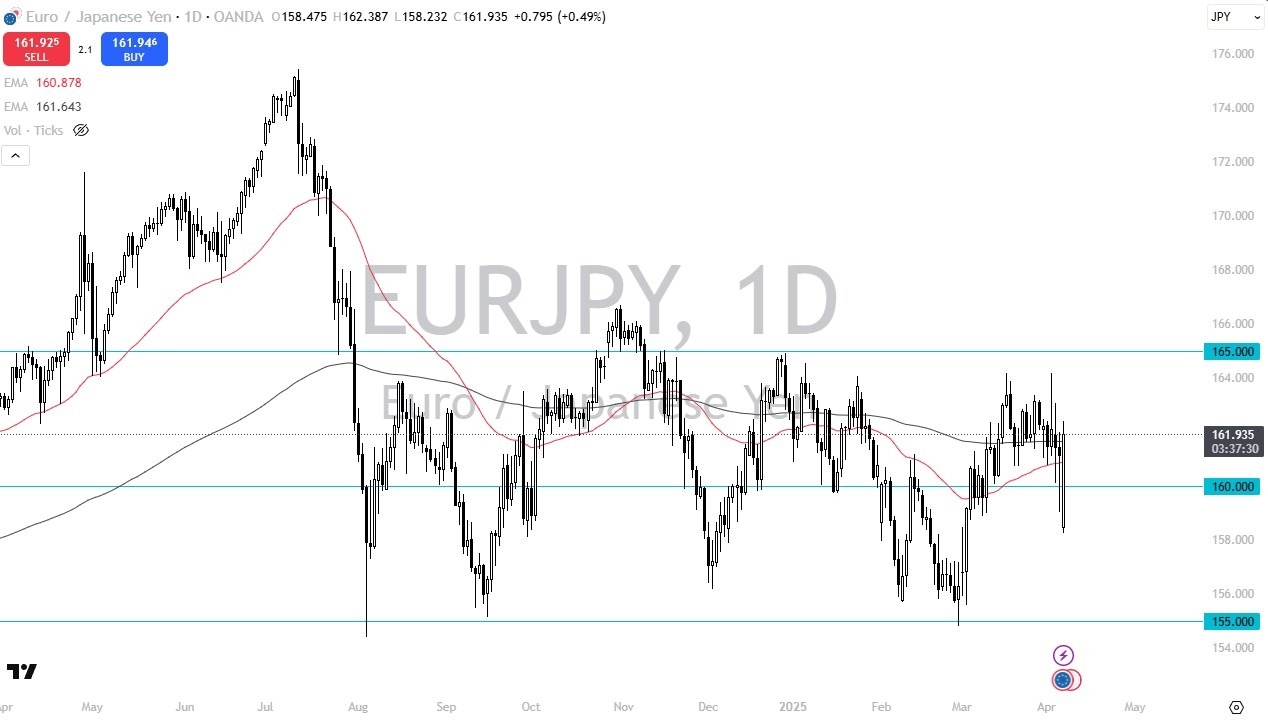
The technical analysis for this pair is actually fairly neutral, perhaps even starting to show signs of positivity, as the initial gapped lower look terrific, but the market was resilient enough to turn things around. That’s a good sign, and it does suggest that perhaps we are at least going to try to stay in the same range we have been in for a bit of normalcy. If that’s going to be the case, then I think we could go looking to the ¥165 level, but we need a little bit of positivity to make that happen easily.

On the other hand, if we do break down below the ¥160 level, then we will probably start to see the market reach down to the ¥158 level, the region that we had bounce from earlier in the session on Monday. Anything underneath there, then we probably see the euro drop down to the ¥155 level. This is an area that’s been important multiple times, so you need to be cognizant that this could happen, and you also need to recognize that it has been so well supported in the past that might end up being a nice buying opportunity based on value. Regardless, this is a market that I think continues to bounce around quite violently, just like the rest of the financial markets.
Begin trading our daily forecasts and analysis. Here is a list of Forex brokers in Japan to work with.