The main category of Forex News.
You can use the search box below to find what you need.
[wd_asp id=1]
The main category of Forex News.
You can use the search box below to find what you need.
[wd_asp id=1]
Natural gas prices fell and hit $3.810, thus approaching the support of $3.750, which is the key for deciding the overall trend in the near and medium term.
The price is now approaching the 55-day SMA support, which would reinforce its stability, while the Stochastic sends out positive signals, which boost the price further towards the resistance of $4.050, then $4.180.
Expected trading range today is between $3.750 and $4.050.
Today’s price forecast: Bullish as the support holds
Silver price (XAG/USD) holds onto gains near $33.80 in European trading hours on Wednesday. The white metal shows resilience as market participants are cautious over the United States (US) economic outlook under the leadership of President Donald Trump.
Fears of imposition of potential tariffs by Donald Trump on April 2 have dented the confidence of households in the economy. The US Conference Board reported on Tuesday that the Consumer Confidence, a leading indicator of individuals’ confidence in economic prospects, declined to 92.9, significantly lower than 100.1 seen in February. The scenario of heightened economic uncertainty often leads to an increase in the safe-haven demand of non-yielding assets, such as Silver.
However, Trump has teased that not all impending tariffs will come into effect on April 2 as he may give a “lot of countries” breaks on tariffs.
Meanwhile, the US Dollar Index (DXY), which tracks the Greenback’s value against six major currencies, trades sideways around the three-week high of 104.50. The US Dollar is expected to trade cautiously as investors expect Trump’s economic policies could result in an economic slowdown and a resurgence in inflationary pressures in the US economy.
This week, the major trigger for the US Dollar will be the US Personal Consumption Expenditure Price Index (PCE) data for February, which will be released on Friday. The inflation data will influence market expectations for the Federal Reserve’s (Fed) monetary policy outlook. The Silver price carries an inverse relationship with the degree of US interest rates.
Silver price strives to revisit the flat border of the Ascending Triangle chart pattern formation on the daily timeframe near the October 22 high of $34.87. The upward-sloping border of the above-mentioned chart pattern is placed from the August 8 low of $26.45. Technically, the Ascending Triangle pattern indicates indecisiveness among market participants.
The 20-day Exponential Moving Average (EMA) near $33.10 continues to provide support to the Silver price.
The 14-day Relative Strength Index (RSI) rebounds above 60.00, suggesting a resurgence in bullish momentum.
Looking down, the March 6 high of $32.77 will act as key support for the Silver price. While, the October 22 high of $34.87 will be the major barrier.
Silver is a precious metal highly traded among investors. It has been historically used as a store of value and a medium of exchange. Although less popular than Gold, traders may turn to Silver to diversify their investment portfolio, for its intrinsic value or as a potential hedge during high-inflation periods. Investors can buy physical Silver, in coins or in bars, or trade it through vehicles such as Exchange Traded Funds, which track its price on international markets.
Silver prices can move due to a wide range of factors. Geopolitical instability or fears of a deep recession can make Silver price escalate due to its safe-haven status, although to a lesser extent than Gold’s. As a yieldless asset, Silver tends to rise with lower interest rates. Its moves also depend on how the US Dollar (USD) behaves as the asset is priced in dollars (XAG/USD). A strong Dollar tends to keep the price of Silver at bay, whereas a weaker Dollar is likely to propel prices up. Other factors such as investment demand, mining supply – Silver is much more abundant than Gold – and recycling rates can also affect prices.
Silver is widely used in industry, particularly in sectors such as electronics or solar energy, as it has one of the highest electric conductivity of all metals – more than Copper and Gold. A surge in demand can increase prices, while a decline tends to lower them. Dynamics in the US, Chinese and Indian economies can also contribute to price swings: for the US and particularly China, their big industrial sectors use Silver in various processes; in India, consumers’ demand for the precious metal for jewellery also plays a key role in setting prices.
Silver prices tend to follow Gold’s moves. When Gold prices rise, Silver typically follows suit, as their status as safe-haven assets is similar. The Gold/Silver ratio, which shows the number of ounces of Silver needed to equal the value of one ounce of Gold, may help to determine the relative valuation between both metals. Some investors may consider a high ratio as an indicator that Silver is undervalued, or Gold is overvalued. On the contrary, a low ratio might suggest that Gold is undervalued relative to Silver.
May arabica coffee (KCK25) today is down -4.90 (-1.23%), and May ICE robusta coffee (RMK25) is down -80 (-1.43%).
Coffee prices today erased an early rally and turned lower after meteorologist Climatempo forecast widespread showers for Brazil’s coffee-growing regions later this week.
Commodity Bulletin: From crude oil to coffee, this FREE newsletter is for industry pros and rookies alike
Coffee prices today initially moved higher, with arabica posting a 2-1/2 week high on weather concerns in Brazil and Vietnam. Cooxupe, Brazil’s largest arabica coffee co-operative, said high temperatures and below-normal rainfall last month in Brazil would negatively affect coffee yields this year. Brazil is the world’s largest producer of arabica coffee. Also, the Dak Lak weather office said last Friday that Vietnam’s main coffee-producing region, Central Highlands, is expected to get more hot weather and less rainfall for the March 21-31 period. Vietnam is the world’s largest producer of robusta coffee.
Continued supply fears are supporting coffee prices. On March 13, Cecafe reported that Brazil’s February green coffee exports fell -12% y/y to 3 million bags. Also, on January 28, Conab, Brazil’s government crop forecasting agency, forecasted that Brazil’s 2025/26 coffee crop would fall -4.4% y/y to a 3-year low of 51.81 million bags. Conab also cut its 2024 Brazil coffee crop estimate by -1.1% to 54.2 million bags from a September estimate of 54.8 million bags.
The current coffee inventory situation is mixed. ICE-monitored robusta coffee inventories rose to a 7-week high Tuesday of 4,414 lots. Conversely, ICE-monitored arabica coffee inventories fell to a 1-month low last Friday of 777,708 bags.
On the negative side for coffee, Marex Solutions said on March 7 that they expect the global coffee surplus in the 2025/26 season to widen to 1.2 million bags from +200,000 bags in the 2024/25 season.
Recent higher-than-normal rainfall in Brazil eases dry conditions and is negative for prices. Somar Meteorologia reported Monday that Brazil’s biggest arabica coffee growing area of Minas Gerais received 31.2 mm of rain in the week ended March 22, or 102% of the historical average.
A bearish factor for robusta coffee was the March 6 report from Vietnam’s General Statistics Office that showed Vietnam’s Feb coffee exports rose +6.6% y/y to 169,000 MT.
The impact of dry El Nino weather last year may lead to longer-term coffee crop damage in South and Central America. Rainfall in Brazil has consistently been below average since last April, damaging coffee trees during the all-important flowering stage and reducing the prospects for Brazil’s 2025/26 arabica coffee crop. Brazil has been facing the driest weather since 1981, according to the natural disaster monitoring center Cemaden. Also, Colombia, the world’s second-largest arabica producer, is slowly recovering from the El Nino-spurred drought last year.
Robusta coffee prices are underpinned by reduced robusta production. Due to drought, Vietnam’s coffee production in the 2023/24 crop year dropped by -20% to 1.472 MMT, the smallest crop in four years. The USDA FAS on May 31 projected that Vietnam’s robusta coffee production in the new marketing year of 2024/25 will dip slightly to 27.9 million bags from 28 million bags in the 2023/24 season. In addition, Vietnam’s General Statistics Office reported on January 10 that 2024 Vietnam coffee exports fell -17.1% y/y to 1.35 MMT. Also, the Vietnam Coffee and Cocoa Association on March 12 cut its 2024/25 Vietnam coffee production estimate to 26.5 million bags from a December estimate of 28 million bags.
News of larger global coffee exports is bearish for prices. Conab reported on February 4 that Brazil’s 2024 coffee exports rose +28.8% y/y to a record 50.5 million bags. However, ICO reported on February 6 that Dec global coffee exports fell -12.4% y/y to 10.73 million bags, and Oct-Dec global coffee exports fell -0.8% y/y to 32.25 million bags.
The USDA’s biannual report on December 18 was mixed for coffee prices. The USDA’s Foreign Agriculture Service (FAS) projected that world coffee production in 2024/25 will increase +4.0% y/y to 174.855 million bags, with a +1.5% increase in arabica production to 97.845 million bags and a +7.5% increase in robusta production to 77.01 million bags. The USDA’s FAS forecasts that 2024/25 ending stocks will fall by -6.6% to a 25-year low of 20.867 million bags from 22.347 million bags in 2023/24. Separately, the USDA’s FAS on November 22 projected Brazil’s 2024/25 coffee production at 66.4 MMT, below its previous forecast of 69.9 MMT. The USDA’s FAS projects Brazil’s coffee inventories at 1.2 million bags at the end of the 2024/25 season in June, down -26% y/y.
For the 2025/26 marketing year, Volcafe on December 17 cut its 2025/26 Brazil arabica coffee production estimate to 34.4 million bags, down by about 11 million bags from a September estimate after a crop tour revealed the severity of an extended drought in Brazil. Volcafe projects a global 2025/26 arabica coffee deficit of -8.5 million bags, wider than the -5.5 million bag deficit for 2024/25 and the fifth consecutive year of deficits.
On the date of publication, Rich Asplund did not have (either directly or indirectly) positions in any of the securities mentioned in this article. All information and data in this article is solely for informational purposes. For more information please view the Barchart Disclosure Policyhere.
More news from Barchart
During yesterday’s trading on stock trading platforms, European stock indices rose. The STOXX 50 index increased by 0.7% to reach 5450 points, while the broader STOXX 600 index rose by 0.6%. This occurred as investors absorbed updates on US trade policy and improved confidence among German companies.
For his part, US President Trump indicated that not all tariffs scheduled for April 2 would apply, with some countries potentially exempt. However, he reiterated plans to impose new tariffs on cars, pharmaceuticals, and countries that purchase Venezuelan crude oil. Meanwhile, Germany’s Ifo business climate index rose to an eight-month high in March, supported by a historic debt agreement. In other news, Ukraine and Russia agreed to a ceasefire in the Black Sea following separate talks with US officials in Saudi Arabia.
On the corporate news front, shares of insurance company Baloise rose by 4% after announcing a 60.6% jump in 2024 profits. Conversely, shares of logistics giant Kuehne + Nagel fell by 4% after issuing a warning about weaker full-year operating profits. Retailer Kingfisher’s shares also declined by 14% after reporting a 7% drop in annual profits.

The EUR/USD‘s break below the 1.08 level will incentivize bears to push strongly downwards. Closely monitor the factors influencing the currency pair to identify the best trading opportunities.
In the US market, US stock prices struggled to find direction as investors assessed the potential impact of pending tariffs and economic uncertainty. Based on performance, the S&P 500 index held steady, while the Dow Jones lost 54 points, and the Nasdaq rose 0.1%. Monday’s rally, fuelled by hopes of easing tariffs, lost momentum after US President Trump indicated the possibility of some countries receiving exemptions from the reciprocal tariffs scheduled to take effect on April 2, while also hinting at new tariffs on pharmaceuticals and cars.
Regarding stock performance, Tesla shares fluctuated after rising by 12% at the start of the week, while Nvidia shares fell by 0.7%. KB Home shares dropped by 5% after lowering its sales forecast, and Unifirst shares declined by 12% after Cintas ended acquisition talks. Investors also absorbed a sharp decline in US consumer confidence, which fell to a four-year low, with future expectations dropping to a 12-year low. Meanwhile, traders increased their bets on a US Federal Reserve interest rate cut in 2025, but market analysts remained divided on stock predictions.
The EUR/USD performance on the daily chart continues to indicate a downward shift. Movement around and below the 1.0800 support level will technically incentivize bears to push the currency pair lower. On this timeframe, the next support levels are 1.0760, 1.0690, and 1.0600, respectively. At the latter level, technical indicators such as the Relative Strength Index (RSI) and the Moving Average Convergence Divergence (MACD) will move towards strong oversold levels. Conversely, on the same timeframe, the psychological resistance at 1.1000 remains crucial to confirm bulls’ control over the EUR/USD trend.
There are no significant European economic data releases that will impact the Euro. On the US Dollar front, the US Durable Goods Orders reading will be released. Additionally, the currency pair will be influenced by investor sentiment regarding US trade wars, which threaten the future of global economic recovery and negatively impact Euro sentiment.
Ready to trade our daily Forex analysis? We’ve made a list of the best forex demo accounts worth trading with.
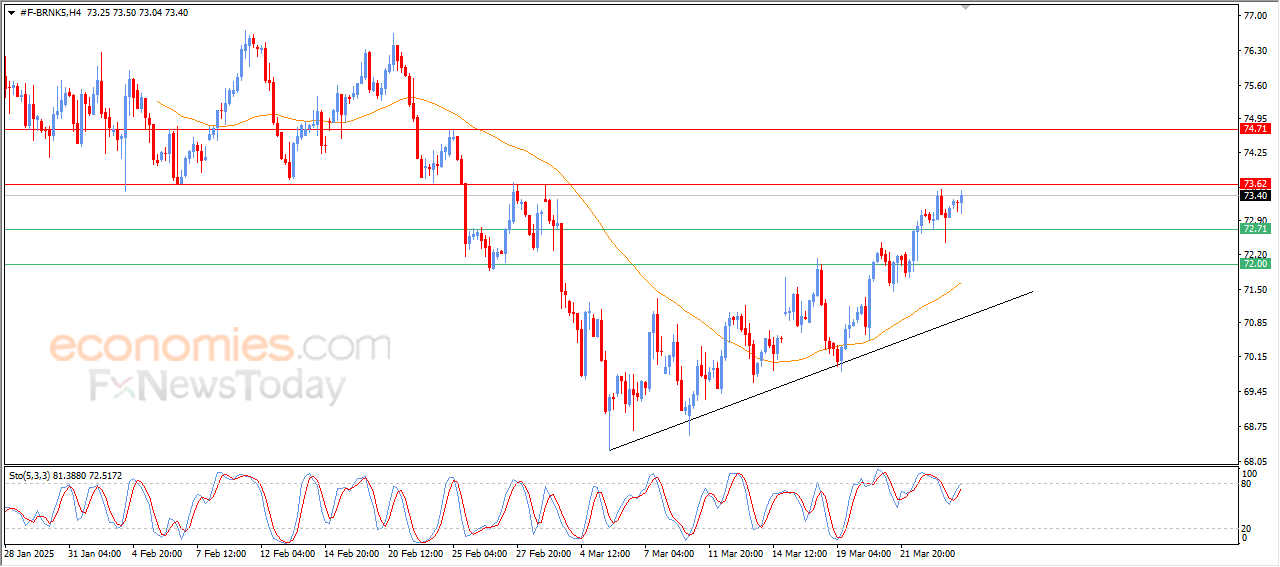
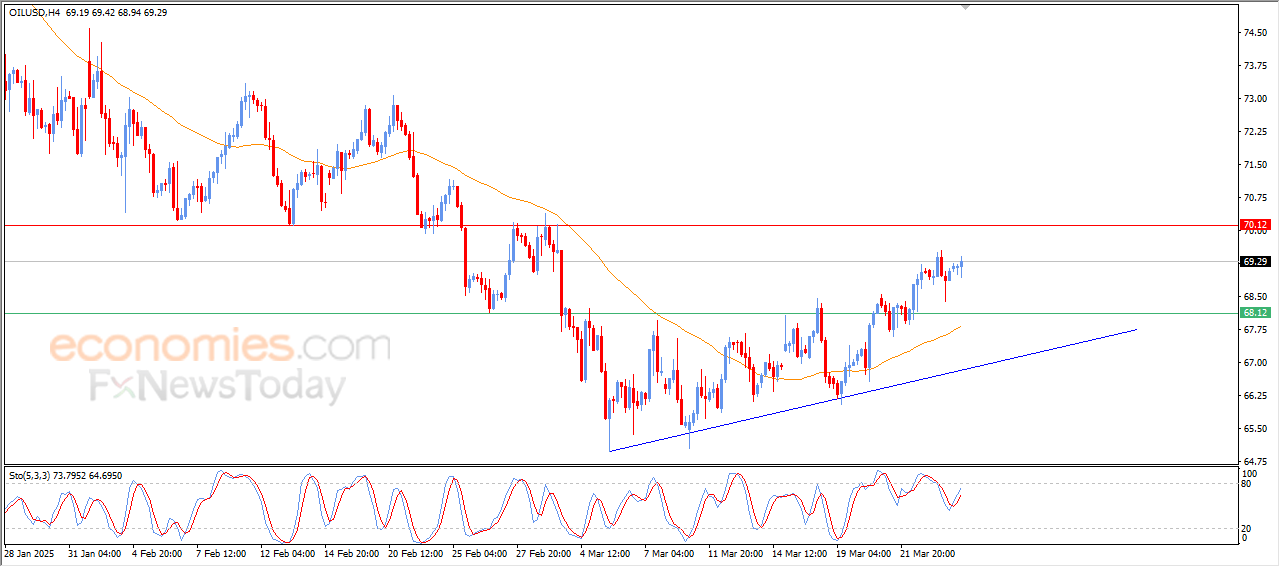
Brent crude oil price rose in latest intraday trading, while readying to attack the pivotal resistance of $73.60, after managing to vent off overbought saturation that was apparent in the Stochastic, with positive signals emerging from it once more, amid the dominance of the upward correctional trend in the short term as the price moves alongside the trend line.
To get our more detailed analysis and 100% accurate signals provided by Best Trading Signal, subscribe to Economies.com VIP Club through the link below!
March 26, 2025 – Written by Frank Davies
STORY LINK Pound to Dollar FX Outlook: GBP/USD Gains on Trump Tariff Uncertainty
The Pound-to-Dollar advanced on Tuesday following reports suggesting US President Donald Trump may take a more gradual approach to introducing new tariffs.
At the time of writing, the Pound US Dollar exchange rate (GBP/USD) was trading at around $1.2948, up approximately 0.2% from Tuesday’s opening levels.
The US Dollar (USD) faced headwinds on Tuesday as investors reacted to a report from the Financial Times suggesting the White House may take a two-step approach to implementing future tariffs.
According to the report, Trump’s administration is considering an initial round of emergency duties while conducting in-depth investigations into key trading partners. This strategy is expected to generate immediate revenue for potential tax cuts while establishing a more structured legal foundation for long-term tariffs.
The market viewed this approach as a potential softening of Trump’s aggressive tariff plans, leading to a dip in USD exchange rates.
Further weighing on the US Dollar was the latest US consumer confidence reading, which revealed a larger-than-expected decline. Given that weak consumer sentiment has been fuelling US recession fears, this drop renewed concerns over the country’s economic trajectory.
The Pound (GBP) remained rangebound on Tuesday as investors exercised caution ahead of Chancellor Rachel Reeves’s Spring Statement on Wednesday.
The statement will include updated economic forecasts from the Office for Budget Responsibility (OBR) and outline the government’s fiscal strategy. Reeves is expected to focus on reassuring financial markets by highlighting the government’s commitment to fiscal responsibility.
However, speculation over new spending cuts is generating uncertainty. If Reeves announces significant reductions in public spending that investors believe could hinder UK economic growth, it could place pressure on Sterling.
Looking ahead, movement in the Pound to US Dollar exchange rate on Wednesday is likely to be driven by the UK’s Spring Statement.
Before Reeves delivers her update, Sterling sentiment may also be influenced by the UK’s latest consumer price index.
Analysts forecast that inflation slowed slightly in February, which it could add to speculation that the Bank of England (BoE) may opt for another interest rate cut in May, potentially weighing on the Pound.
For USD investors, attention will turn to the latest US durable goods orders figures. Will a sharp decline in orders growth last month apply additional pressure to the US Dollar?
International Money Transfer? Ask our resident FX expert a money transfer question or try John’s new, free, no-obligation personal service! ,where he helps every step of the way,
ensuring you get the best exchange rates on your currency requirements.
TAGS: Pound Dollar Forecasts
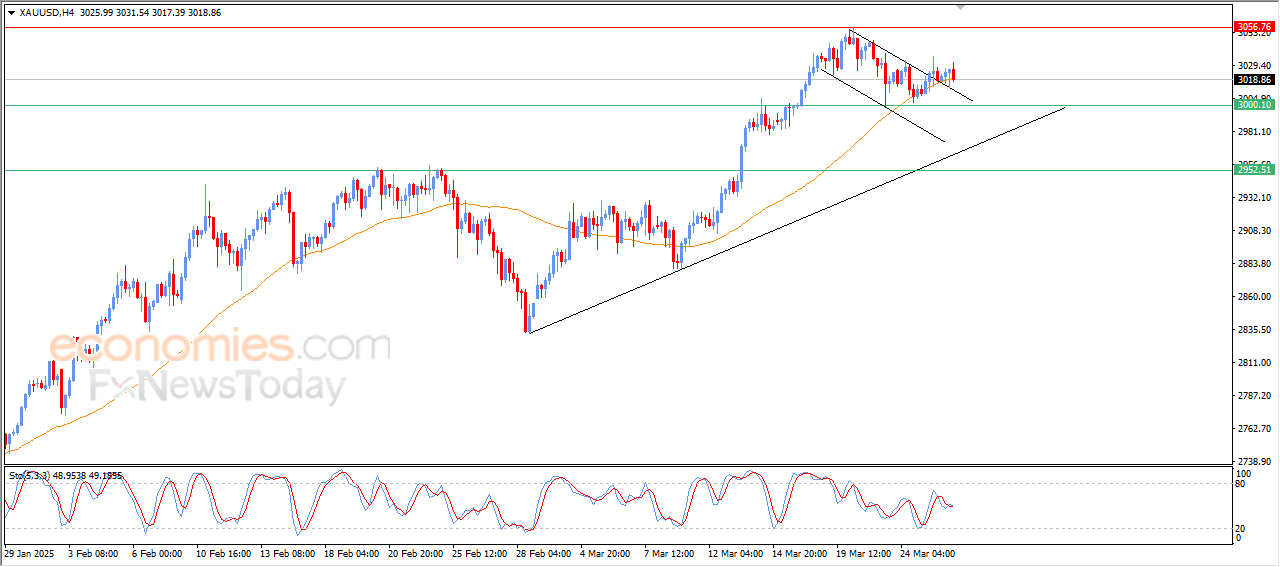
Gold price is consolidating the previous rebound above $3,000 early Wednesday, gathering pace before the next push higher. The focus is back on US tariffs and their impact on the global economies, enhancing the safe-haven appeal of Gold price.
US President Donald Trump is reportedly set to impose three escalating levels of tariffs, with Canada likely to be on the lower end of the April 2 tariffs, per the Toronto Star. Trump later clarified that “all we’re going to do is reciprocal,” adding that “not many exceptions on April 2 tariffs.”
At the same time, Bloomberg News reported that the US President “plans to implement copper import tariffs within weeks.”
These renewed tariff threats rekindled US economic concerns, keeping the US Dollar (USD) upside in check as investors sought refuge in the traditional safe-haven of Gold price.
Earlier this week, fears over a US economic slowdown were doused after the release of a stronger-than-expected S&P Global flash US Composite PMI Output Index. The gauge which tracks the manufacturing and services sectors, jumped to 53.5 this month from 51.6 in February.
That said, the further upside in Gold price appears intact as markets reposition, bracing for the April 2 reciprocal tariffs. However, if the US Durable Goods Orders data exceeds estimates by a wide margin, it could reinforce expectations for one interest rate cut by the US Federal Reserve (Fed) this year, fuelled by the upbeat PMI data on Monday.
The less dovish Fed narrative could cap the Gold price rebound while taking cues on policy from several Fed officials, who are due to speak later on Wednesday.
Also of note remains the geopolitical developments surrounding the Ukraine peace deal. The US on Tuesday reached deals with Ukraine and Russia to pause their attacks at sea and against energy targets, with Washington agreeing to push to lift some sanctions against Moscow. However, Ukrainian President Volodymyr Zelensky stated that he would seek US President Trump’s support in providing weapons and imposing sanctions on Russia if Moscow violated the agreements.
The technical setup on the daily chart favors buyers, with their sights set on the ascending triangle target, measured at $3,080.
The 14-day Relative Strength Index (RSI) is trending higher, currently at 66, which justifies the bullish momentum.
Gold price remains poised to take out the record high of $3,058 on the way to achieving the triangle target of $3,080.
Alternatively, the $3,000 round level will emerge as a powerful support. The next downside cap is aligned at the previous week’s low of $2,982.
Further south, the 21-day Simple Moving Average (SMA) and the triangle support confluence at $2,958 will be a tough nut to crack for sellers.
Tariffs are customs duties levied on certain merchandise imports or a category of products. Tariffs are designed to help local producers and manufacturers be more competitive in the market by providing a price advantage over similar goods that can be imported. Tariffs are widely used as tools of protectionism, along with trade barriers and import quotas.
Although tariffs and taxes both generate government revenue to fund public goods and services, they have several distinctions. Tariffs are prepaid at the port of entry, while taxes are paid at the time of purchase. Taxes are imposed on individual taxpayers and businesses, while tariffs are paid by importers.
There are two schools of thought among economists regarding the usage of tariffs. While some argue that tariffs are necessary to protect domestic industries and address trade imbalances, others see them as a harmful tool that could potentially drive prices higher over the long term and lead to a damaging trade war by encouraging tit-for-tat tariffs.
During the run-up to the presidential election in November 2024, Donald Trump made it clear that he intends to use tariffs to support the US economy and American producers. In 2024, Mexico, China and Canada accounted for 42% of total US imports. In this period, Mexico stood out as the top exporter with $466.6 billion, according to the US Census Bureau. Hence, Trump wants to focus on these three nations when imposing tariffs. He also plans to use the revenue generated through tariffs to lower personal income taxes.
March 26, 2025 – Written by Tim Boyer
STORY LINK Euro to Dollar Forecast: EUR Edges Higher vs USD after Contrasting Sentiment Surveys
EUR/USD is slightly higher and is consolidating the large gains triggered earlier in March by the German fiscal package.
Sentiment surveys in Germany and the US were released on Tuesday. While the Ifo Index in Germany climbed to the highest reading in nearly a year, US consumer sentiment readings fell to the lowest levels since 2021.
Tuesday’s session has been slower than Monday’s when stocks made a strong recovery rally in the US, driven higher by encouraging words from President Trump who changed his tone compared to the recession talk earlier in March. Fears over fresh tariffs on April 2nd have faded as first he said he would be “flexible,” then the tariffs wouldn’t include cars and chips, and on Monday, “I may give a lot of countries breaks on tariffs.”
The news flow has been neutral for the dollar, but EURUSD has managed to snap its 4-session losing streak with a small rally on Tuesday following the release of sentiment surveys on both sides of the Atlantic.
Tuesday’s release of the Ifo Index in Germany showed some improvements, and following on from Monday’s encouraging manufacturing PMI reading, it seems optimism is rising ahead of the fiscal stimulus package. However, that may be short-lived as the US tariff announcement is due on April 2nd and is very likely to target the EU. As ING note:
“The German economy is in the middle of two seismic activities: the just-agreed fiscal stimulus package and looming US tariffs. For the time being, the positives seem to outweigh the negatives as Germany’s most prominent leading indicator, the Ifo index, increased in March to 86.7, from 85.2 in February, its highest level since July last year.”
Both PMIs and the Ifo Index are “soft” data – surveys – and they usually lead hard data such as GDP growth. Whether this will be the case this year remains to be seen as the German economy has been stagnating around zero growth for several years now and just when the situation is finally starting to look better, tariffs may tip it into a recession, especially if auto imports are targeted. There are also some questions over how stimulative the fiscal package for infrastructure will be. Certainly, it will create jobs and have some effect, but this may not be significant or long lasting. As ING put it, “Modern infrastructure is essential for one of the world’s largest economies, but it doesn’t inherently drive innovation, sector transformation, or new growth opportunities.”
EURUSD is higher on Tuesday but there may be a further drift lower in the coming weeks as the sugar rush of the initial announcement of German fiscal stimulus fades.
Another sentiment survey is helping EURUSD and weighing on the US dollar as the Consumer Conference Board survey on consumer sentiment for March showed some concerning readings. The 92.9 print was below the 94.2 estimate and registered the fourth straight monthly decline. 92.9 is the lowest level since January 2021. Even worse, the consumer expectations index, which measures short-term outlooks on income, business, and labour market conditions, fell to its lowest level in 12 years, dipping just below July 2022 levels.
The overall picture shows more gloom for the all-important American consumer, following on from weak figures in February. Tariffs and high inflation expectations are clearly weighing on sentiment and spending, and the trade war is still in the very early stages. This doesn’t bode well for the rest of the year, although stocks were able to shrug off the bad news on Tuesday with marginal gains adding to Monday’s strong showing.
International Money Transfer? Ask our resident FX expert a money transfer question or try John’s new, free, no-obligation personal service! ,where he helps every step of the way,
ensuring you get the best exchange rates on your currency requirements.
TAGS: Euro Dollar Forecasts
Natural gas prices fell and hit $3.810, thus approaching the support of $3.750, which is the key for deciding the overall trend in the near and medium term.
The price is now approaching the 55-day SMA support, which would reinforce its stability, while the Stochastic sends out positive signals, which boost the price further towards the resistance of $4.050, then $4.180.
Expected trading range today is between $3.750 and $4.050.
Today’s price forecast: Bullish as the support holds
Natural gas prices fell and hit $3.810, thus approaching the support of $3.750, which is the key for deciding the overall trend in the near and medium term.
The price is now approaching the 55-day SMA support, which would reinforce its stability, while the Stochastic sends out positive signals, which boost the price further towards the resistance of $4.050, then $4.180.
Expected trading range today is between $3.750 and $4.050.
Today’s price forecast: Bullish as the support holds