The main category of Forex News.
You can use the search box below to find what you need.
[wd_asp id=1]
The main category of Forex News.
You can use the search box below to find what you need.
[wd_asp id=1]
US crude oil prices expanded the gains in latest intraday trading and confirmed the breach of the pivotal resistance of $68.00, amid the dominance of the upward correctional trend in the short term as the price trades alongside the trend line, with ongoing support due to trading above the 50-candle SMA.
To get our more detailed analysis and 100% accurate signals provided by Best Trading Signal, subscribe to Economies.com VIP Club through the link below!
The USD/CAD forecast shows caution as market participants await clarity on Trump’s next tariff moves. The Canadian dollar ended last week higher but remains vulnerable as traders prepare for a 25% tariff on Canadian goods starting in April. Meanwhile, experts believe the dollar might rebound with more tariffs, supporting Treasury yields.
–Are you interested in learning more about crypto brokers? Check our detailed guide-
The loonie fell on Friday after data revealed weaker-than-expected consumer spending in Canada. Retail sales dropped by 0.6% compared to estimates of a 0.4% decline. The poor report increased expectations of more Bank of Canada rate cuts. At the same time, uncertainty about looming Trump tariffs weighed on the Canadian dollar last week. Trump suspended a 25% tariff on Canada until April. With the start date looming, the outlook for Canada’s economy is dimming.
However, there was some relief for Canada’s currency as Wall Street rebounded amid hopes of a softer tariff stance. Trump said he might be open to some flexibility on tariffs.
On the other hand, experts believe the dollar will recover with more tariffs. Last week, the greenback rebounded after the Fed meeting, which revealed caution among policymakers. More tariffs will likely support Treasury yields, allowing the dollar to recover.
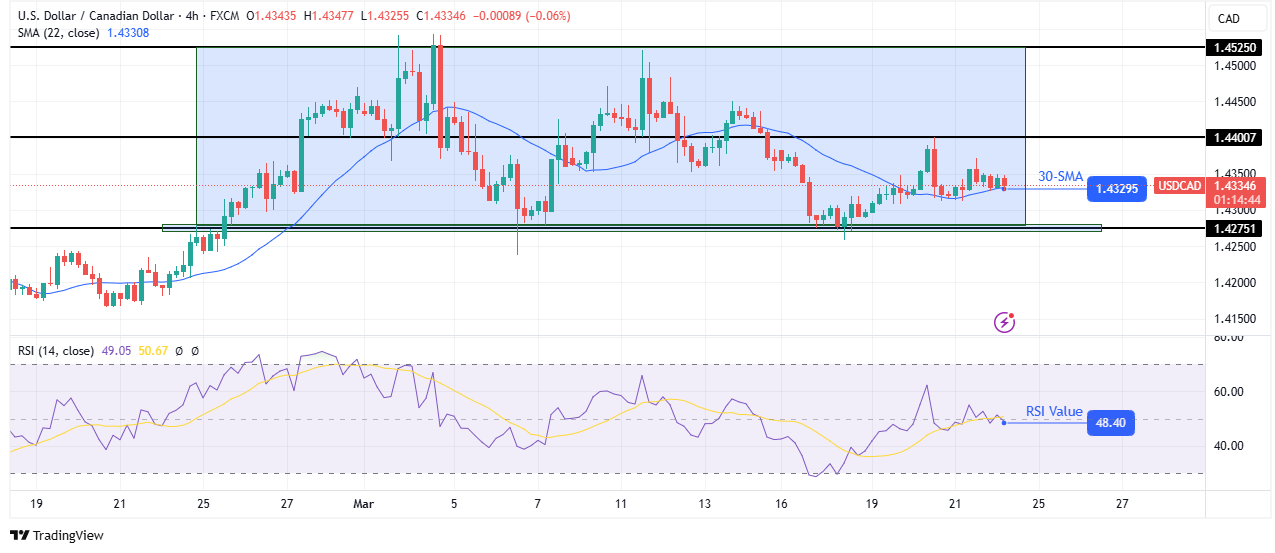
On the technical side, the USD/CAD price is facing the 30-SMA line after finding resistance at the 1.4400 resistance level. However, bulls are still in the lead because the price trades slightly above the SMA.
–Are you interested in learning more about managed forex accounts? Check our detailed guide-
On a larger scale, the price is trading in a range between the 1.4275 support and the 1.4525 resistance levels. Moreover, the range has a strong midpoint at the 1.4400 key level. USD/CAD recently retested the range support, which held firm. After this, the price broke above the SMA but paused at the range midpoint.
If the price breaks below the SMA, bears will make another attempt at the range support. A breakout will signal the start of a bearish trend. On the other hand, bulls might return to push the price off the 30-SMA and above the 1.4400 resistance. This would allow a retest of the range resistance.
Looking to trade forex now? Invest at eToro!
68% of retail investor accounts lose money when trading CFDs with this provider. You should consider whether you can afford to take the high risk of losing your money.
The gold price is trading on the back foot early Monday, looking to continue Friday’s correction from its all-time high of $3,058. Gold price bears the brunt of a risk-on market profile, diminishing its safe-haven appeal.
At the onset of a new week, the Gold price maintains its corrective downside as markets shift back to riskier assets amid renewed optimism over US President Donald Trump’s reciprocal tariffs, hopes for Chinese stimulus, and a potential Ukraine peace deal.
According to the latest report carried by the Wall Street Journal (WSJ), the White House is expected to narrow its list of tariffs due to take effect on April 2, likely omitting a set of industry-specific tariffs while applying reciprocal tariffs aimed at countries with significant trade ties to the United States (US).
Additionally, recent news that China is looking to boost consumption remains supportive of the risk flows, as markets remain hopeful of a likely end to the Russia-Ukraine conflict following Sunday’s meeting between US and Ukrainian officials in Saudi Arabia.
Ukrainian Defense Minister Rustem Umerov said that the talks on Sunday in Saudi Arabia were “productive and focused.”
Attention now turns to separate talks between Russian and US delegates on Monday regarding the Ukraine peace deal, as traders brace for the preliminary readings of global Purchasing Managers’ Index (PMI) gauges, which will likely shed light on the prospects of the global economy in the face of Trump’s tariff-induced recession fears.
Furthermore, markets will closely monitor any developments surrounding Trump’s plans to implement global reciprocal tariffs starting April 2, which drive risk sentiment and the Gold price action in the near term.
Technically, the Gold price maintains its ‘buy-the-dips’ status amid the confirmed breakout from the ascending triangle earlier this month.
However, with the 14-day Relative Strength Index (RSI) pointing south at the time of writing, a further retracement appears to be on the cards. That said, as long as the RSI holds above the midline, any pullbacks in the Gold price will be quickly bought back into.
On the extension of the latest leg down, Gold price could test Friday’s low of $3,000, below which the previous week’s low of $2,982 will be tested.
Further south, the 21-day Simple Moving Average (SMA) and the triangle support confluence at $2,950 will be a tough nut to crack for sellers.
Conversely, if buyers jump back into the game, Gold price could retest the record high of $3,058 if buyers regain poise. The door will then open up to test the triangle target measured at $3,080.
Gold has played a key role in human’s history as it has been widely used as a store of value and medium of exchange. Currently, apart from its shine and usage for jewelry, the precious metal is widely seen as a safe-haven asset, meaning that it is considered a good investment during turbulent times. Gold is also widely seen as a hedge against inflation and against depreciating currencies as it doesn’t rely on any specific issuer or government.
Central banks are the biggest Gold holders. In their aim to support their currencies in turbulent times, central banks tend to diversify their reserves and buy Gold to improve the perceived strength of the economy and the currency. High Gold reserves can be a source of trust for a country’s solvency. Central banks added 1,136 tonnes of Gold worth around $70 billion to their reserves in 2022, according to data from the World Gold Council. This is the highest yearly purchase since records began. Central banks from emerging economies such as China, India and Turkey are quickly increasing their Gold reserves.
Gold has an inverse correlation with the US Dollar and US Treasuries, which are both major reserve and safe-haven assets. When the Dollar depreciates, Gold tends to rise, enabling investors and central banks to diversify their assets in turbulent times. Gold is also inversely correlated with risk assets. A rally in the stock market tends to weaken Gold price, while sell-offs in riskier markets tend to favor the precious metal.
The price can move due to a wide range of factors. Geopolitical instability or fears of a deep recession can quickly make Gold price escalate due to its safe-haven status. As a yield-less asset, Gold tends to rise with lower interest rates, while higher cost of money usually weighs down on the yellow metal. Still, most moves depend on how the US Dollar (USD) behaves as the asset is priced in dollars (XAU/USD). A strong Dollar tends to keep the price of Gold controlled, whereas a weaker Dollar is likely to push Gold prices up.
Despite recent hawkish commentary from Federal Reserve Chair Jerome Powell, who pointed to a strong labor market and inflation nearing target, the dollar is struggling to maintain momentum. Powell’s remarks reinforced the Fed’s cautious tone but did little to lift the dollar amid conflicting policy signals.
President Trump’s tariff policy remains a source of uncertainty. Earlier this month, his administration proposed imposing significant fees on China-linked shipping, a move that has disrupted supply chains and pressured key U.S. sectors, including agriculture and energy.
Investors are now waiting to see if these trade stances soften following reports of renewed talks with Chinese officials.
Geopolitical developments have offered some support to risk sentiment, but not enough to drive sustained strength in the dollar. Over the weekend, U.S. and Ukrainian officials met in Riyadh, with the Biden administration pushing for a ceasefire in the Ukraine conflict.
Further discussions between U.S. and Russian representatives are expected later today. While these talks reduce short-term geopolitical risk, the dollar remains under pressure amid persistent concerns around trade policy and global economic growth.
Market participants are closely monitoring the upcoming U.S. PMI readings and a scheduled speech by Bank of England Governor Andrew Bailey at 6:00 PM GMT for further direction.
Silver price (XAG/USD) edges higher on Monday, trading around $33.10 per troy ounce during Asian hours after three consecutive sessions of losses. The rebound is driven by a weaker US Dollar as concerns over a potential US economic slowdown grow due to trade policies under President Donald Trump.
The US Dollar Index, which measures the USD against six major currencies, halts its three-day winning streak and trades lower near 104.10. Meanwhile, market participants await the preliminary reading of the US S&P Global Manufacturing PMI for March.
However, Silver may face headwinds as the Federal Reserve (Fed) maintains its outlook for two rate cuts later this year, following its decision to keep the federal funds rate at 4.25%–4.5% during its March meeting. The Fed’s stance, aligning with forecasts of slower GDP growth and higher unemployment, helps counterbalance inflation concerns, which may be exacerbated by aggressive tariffs imposed by President Trump.
Additionally, Silver prices could come under pressure from safe-haven flows amid improved risk sentiment as the White House revises its tariff strategy ahead of the April 2 implementation. According to the Wall Street Journal, the administration is expected to drop some industry-specific tariffs while imposing reciprocal tariffs on countries with strong trade ties to the US.
Additionally, geopolitical tensions ease following talks between Ukrainian and US officials in Riyadh on Sunday. Efforts to broker a ceasefire continue, with President Trump advocating for an end to the three-year war. Ukrainian Defense Minister Rustem Umerov discussed measures to safeguard energy and critical infrastructure, while US and Russian delegates are set for separate talks on Monday, according to Bloomberg.
Silver is a precious metal highly traded among investors. It has been historically used as a store of value and a medium of exchange. Although less popular than Gold, traders may turn to Silver to diversify their investment portfolio, for its intrinsic value or as a potential hedge during high-inflation periods. Investors can buy physical Silver, in coins or in bars, or trade it through vehicles such as Exchange Traded Funds, which track its price on international markets.
Silver prices can move due to a wide range of factors. Geopolitical instability or fears of a deep recession can make Silver price escalate due to its safe-haven status, although to a lesser extent than Gold’s. As a yieldless asset, Silver tends to rise with lower interest rates. Its moves also depend on how the US Dollar (USD) behaves as the asset is priced in dollars (XAG/USD). A strong Dollar tends to keep the price of Silver at bay, whereas a weaker Dollar is likely to propel prices up. Other factors such as investment demand, mining supply – Silver is much more abundant than Gold – and recycling rates can also affect prices.
Silver is widely used in industry, particularly in sectors such as electronics or solar energy, as it has one of the highest electric conductivity of all metals – more than Copper and Gold. A surge in demand can increase prices, while a decline tends to lower them. Dynamics in the US, Chinese and Indian economies can also contribute to price swings: for the US and particularly China, their big industrial sectors use Silver in various processes; in India, consumers’ demand for the precious metal for jewellery also plays a key role in setting prices.
Silver prices tend to follow Gold’s moves. When Gold prices rise, Silver typically follows suit, as their status as safe-haven assets is similar. The Gold/Silver ratio, which shows the number of ounces of Silver needed to equal the value of one ounce of Gold, may help to determine the relative valuation between both metals. Some investors may consider a high ratio as an indicator that Silver is undervalued, or Gold is overvalued. On the contrary, a low ratio might suggest that Gold is undervalued relative to Silver.
Bitcoin (BTCUSD) experienced fluctuating intraday trading in continuous attempts to find an upward base that provides the necessary positive momentum for recovery. In these attempts, it relied on a strong support wall, namely its 50-period simple moving average, which contributed to the formation of positive candles indicating an imminent recovery. This scenario is further reinforced by the emergence of positive signals from the Relative Strength Index after it reached extremely oversold levels, along with the price trading along an ascending corrective trendline.
Our outlook remains positive for a rise in Bitcoin’s price in the upcoming intraday sessions, provided that the support level at $82,000 holds, so as to target the main resistance level at $90,000.
To get our more detailed analysis and 100% accurate signals provided by Best Trading Signal, subscribe to Economies.com VIP Club through the link below!
The New Zealand Dollar versus the US Dollar (NZD/USD) fell in its recent intraday trading, breaking out of an ascending price channel that had previously bounded its short-term trading, thereby signaling the continuation of that bearish corrective wave, especially with the negative pressure from the 50-period simple moving average and the influx of negative signals from the Relative Strength Index, after the pair succeeded in offloading its oversold condition.
Accordingly, our forecast indicates further declines in the NZD/USD price in its upcoming intraday trading, as long as the resistance at 0.5765 holds, targeting the key support level at 0.5690.
To get our more detailed analysis and 100% accurate signals provided by Best Trading Signal, subscribe to Economies.com VIP Club through the link below!
Bitcoin (BTCUSD) experienced fluctuating intraday trading in continuous attempts to find an upward base that provides the necessary positive momentum for recovery. In these attempts, it relied on a strong support wall, namely its 50-period simple moving average, which contributed to the formation of positive candles indicating an imminent recovery. This scenario is further reinforced by the emergence of positive signals from the Relative Strength Index after it reached extremely oversold levels, along with the price trading along an ascending corrective trendline.
Our outlook remains positive for a rise in Bitcoin’s price in the upcoming intraday sessions, provided that the support level at $82,000 holds, so as to target the main resistance level at $90,000.
To get our more detailed analysis and 100% accurate signals provided by Best Trading Signal, subscribe to Economies.com VIP Club through the link below!
March 23, 2025 – Written by Tim Boyer
STORY LINK Pound to Dollar Weekly Forecast: Losses to 1.22 by End 2025?
Foreign exchange strategists at Scotiabank forecasts Pound to Dollar (GBP/USD) exchange rate losses to 1.22 at the end of 2025.
Danske Bank, however, now has a 12-month GBP/USD forecast of 1.31 from 1.23 previously.
GBP/USD hit 4-month highs just above 1.30 during the week, but failed to hold the gains and retreated to 1.2900 late in the week as the dollar recovered.
US economic and dollar developments are likely to dominate.
The Federal Reserve held interest rates at 4.50%, in line with consensus forecasts.
The Fed cut its growth forecasts while projecting slightly higher inflation which increased stagflation fears and complicated the Fed’s task.
Scotiabank commented; “With inflation expectations sharply rising, we expect the Federal Reserve will remain on hold through the first half of the year even though growth is slowing more rapidly than expected so far this year. The Fed has little ability to respond to lower growth in the short run given what we still consider to be a challenging inflation outlook.”
Yields will tend to underpin the dollar, especially if risk appetite deteriorates.
Scotiabank notes domestic and global risks to growth which will spark volatility; “The direction of US economic and geopolitical policy is the greatest threat to the global economy.”
According to Standard Chartered; “The inflation risks are likely to put a floor under US bond yields and lead to a recovery in the oversold USD in the near term.”
The bank expects trade policies will be important with medium-term risks; “Implementation of wide-ranging US tariffs in April could sustain a near-term USD rally, although any hit to US growth is likely to eventually drag the USD lower.”
HSBC also expects trade policies will be crucial; “The key for the USD now is likely to rest more on how US trade policy evolves, rather than monetary policy. Our central case is that the USD will recover some lost ground over the long run, as US tariffs rise, the Fed does not cut more than what is already priced, and the rest of the world begins to look less exceptional again.”
According to Danske; “US recession fears have resurged with a softening of business sentiment, weakness in consumer confidence and weak retail sales weighing on growth prospects. These risks are further exacerbated by elevated uncertainty regarding tariff policy from President Trump.”
Danske has cut its dollar forecasts which has raised its GBP/USD profile. It added; “The shift in risk asset allocation away from the US appears structural, supporting our decision to raise the profile.”
The Bank of England held interest rates at 4.50% and expressed a high degree of uncertainty over the outlook.
Rabobank commented; “Our baseline scenario has not changed since last summer: the Bank of England will likely cut rates quarterly, focusing on meetings with a Monetary Policy Report, aiming to end 2025 with a policy rate of 3.75%.”
Danske expects quarterly interest rate cuts to 3.75%, but added; “If the BoE opts for a more front-loaded cutting cycle, this would act as a headwind for GBP.”
Socgen sees structural dollar losses; “The US slowdown has resulted in a small fall in consensus growth forecasts, and those will ned to fall further to justify rate/FX pricing. It has a year-end forecast of 1.32 with 1.34 in the first quarter of 2026.”
International Money Transfer? Ask our resident FX expert a money transfer question or try John’s new, free, no-obligation personal service! ,where he helps every step of the way,
ensuring you get the best exchange rates on your currency requirements.
Rising supply and potentially weaker-than-expected demand are set to keep oil prices in check this year, with the price likely to average in the low $70s, analysts and investment banks say.
With the U.S. new administration, experts expect the average price to be lower compared to last year amid concerns about demand as economic uncertainty spiked with the start of the trade and tariff wars.
On the supply side, OPEC+ early this month confirmed it would begin adding barrels to the market as early as next month. Of course, OPEC+ left the door open to any changes to its supply in any direction, saying in the press release that it remains “adaptable to evolving conditions,” and “Accordingly, this gradual increase may be paused or reversed subject to market conditions.”
Wall Street Banks See Oil in the Low $70s
President Donald Trump’s trade policies threw market analysts a curveball, increasing the uncertainty about this year’s demand prospects if economies slow as a result of the tariffs.
Earlier this week, Goldman Sachs cut its year-end forecast for Brent Crude prices, citing expectations of slower U.S. economic growth and additional OPEC+ supply.
Related: American Oil Is Underhedged and Heavily Exposed
“While the $10 a barrel selloff since mid-January is larger than the change in our base case fundamentals, we reduce by $5 our December 2025 forecast for Brent to $71,” the investment bank’s research team said in a note, adding that “The medium-term risks to our forecast remain to the downside given potential further tariff escalation and potentially longer OPEC+ production increases.”
The tariff wars and high spare capacity at OPEC+ producers are skewing the oil price risk to the downside in the medium term, Goldman Sachs has also said.
HSBC analysts also see risks in oil skewed to the downside amid expectations of a surplus this year and next. Stronger supply growth compared to more sluggish demand growth would leave the oil market in a 200,000-bpd surplus this year, the bank said in a note. In the previous market view, HSBC expected a relatively balanced oil market in 2025.
Analysts at Barclays see Brent Crude prices at $74 per barrel this year, down by $9 from the previous forecast, as they slashed their global demand growth estimate in mounting economic uncertainties.
“We turn neutral on oil prices relative to the curve and consensus, as we revise down our 2025 demand outlook 510,000 barrels per day due to soft high-frequency indicators and elevated economic uncertainty,” Barclays analysts wrote in a note last week carried by Reuters.
The UK-based bank now sees this year’s demand growth at 900,000 bpd.
Barclays expects U.S. crude oil production to increase by the end of this year by just 200,000 bpd compared to the end of the fourth quarter of 2024.
Wood Mackenzie also expects oil prices to be lower this year compared to 2024.
Brent crude oil prices are projected to average $73 per barrel in 2025, down by $7 per barrel from 2024, due to expectations that supply would likely outstrip demand, Wood Mackenzie’s latest monthly oil market outlook showed. The $73 per barrel forecast for this year was revised down by $0.40 from the early February monthly report.
“We’re seeing a complex interplay of supply and demand factors. While global demand is expected to increase by 1.1 million barrels per day in 2025, non-OPEC production is forecasted to rise by 1.4 million barrels per day, potentially outpacing demand growth,” said Ann-Louise Hittle, Vice President of Oils Research at Wood Mackenzie.
Key Oil Market Drivers
OPEC+ supply and the U.S. trade policies (and their effect on economies) will be the two key driving factors for oil prices this year, WoodMac says, although there are also many geopolitical issues at play, including talks on a ceasefire in Ukraine and President Trump’s “maximum pressure” campaign on Iran.
WoodMac expects global economic growth at 2.8% for 2025, but this could be adjusted downward by around 0.5 percentage points depending on potential trade war scenarios.
Weaker economic growth could reduce oil demand growth by about 400,000 bpd from WoodMac’s current forecast of a 1.1 million bpd increase for 2025.
In case oil demand weakens, the annual average for Brent crude could be $3 to $5 per barrel lower than the $73 per barrel forecast, the energy consultancy says.
All these projections will depend on OPEC+ actions in terms of supply, U.S. trade and tariff policies, and global economic conditions, WoodMac noted.
For now, OPEC continues to see robust oil demand growth for both 2025 and 2026. The cartel left its demand outlook unchanged in its Monthly Oil Market Report (MOMR) last week. OPEC expects global oil demand to grow by 1.4 million bpd in each of 2025 and 2026.
The International Energy Agency’s monthly report, however, was bearish, as it has been typical of the IEA on oil demand for several years. The Paris-based agency expects growth to be just over 1 million bpd this year, with total global oil reaching 103.9 million bpd.
While this would be an acceleration from the estimated 830,000 bpd growth in 2024, the IEA predicts in its current balances that global oil supply may exceed demand by around 600,000 bpd this year.
By Tsvetana Paraskova for Oilprice.com
More Top Reads From Oilprice.com