The main category of Forex News.
You can use the search box below to find what you need.
[wd_asp id=1]
The main category of Forex News.
You can use the search box below to find what you need.
[wd_asp id=1]
Even as natural gas prices weakened recently, major indicators continue to produce positive signals, with the price managing to surpass the obstacle at $4.180, opening the door for more gains to come.
As the Stochastic approaches the 80 levels, the price will get further momentum and heads towards the target of $4.280 then $4.450.
Expected trading range today is between $4,150 and $4.280.
Today’s price forecast: Bullish
The GBP/JPY cross attracts sellers for the second successive day on Thursday and extends this week’s retracement slide from the vicinity of the 195.00 psychological mark, or over a two-month high. Spot prices weaken further below the 193.00 round figure during the Asian session and seem vulnerable to slide further amid a broadly stronger Japanese Yen (JPY).
Expectations that strong wage growth could boost consumer spending and contribute to rising inflation give the Bank of Japan (BoJ) headroom to keep hiking interest rates. Apart from this, the uncertainty over US President Donald Trump’s trade policies and geopolitical risks underpin the safe-haven JPY, which, in turn, is seen exerting pressure on the GBP/JPY cross. The British Pound (GBP), on the other hand, struggles to gain any traction as traders opt to wait for the Bank of England (BoE) decision.
From a technical perspective, spot price earlier this week struggled to find acceptance above the very important 200-day Simple Moving Average (SMA) and the subsequent fall could be seen as a key trigger for bearish traders. That said, oscillators on the daily chart are still holding in positive territory. Adding to this, the recent breakout through the 192.50 horizontal resistance warrants some caution before positioning for any further depreciating move heading into the key central bank event risk.
In the meantime, the aforementioned resistance breakpoint could protect the immediate downside, below which the GBP/JPY cross could accelerate the slide towards the 192.00 mark en route to the 191.35-191.30 support zone. Some follow-through selling has the potential to drag spot prices below the 191.00 round figure, towards the next relevant support near the 190.45-190.40 area en route to the 190.00 psychological mark and the 189.70-189.65 region.
On the flip side, any positive move might now confront resistance near the 194.00 round-figure mark ahead of the 200-day SMA, currently pegged around the 194.30 region. This is followed by the 194.90 region, or a multi-month peak touched earlier this week, which if cleared decisively should pave the way for additional gains. The GBP/JPY cross might then climb to the 196.00 mark en route to the 196.40 horizontal zone before aiming to reclaim the 197.00 round figure for the first time since January.
The Bank of England (BoE) announces its interest rate decision at the end of its eight scheduled meetings per year. If the BoE is hawkish about the inflationary outlook of the economy and raises interest rates it is usually bullish for the Pound Sterling (GBP). Likewise, if the BoE adopts a dovish view on the UK economy and keeps interest rates unchanged, or cuts them, it is seen as bearish for GBP.
Next release: Thu Mar 20, 2025 12:00
Frequency: Irregular
Consensus: 4.5%
Previous: 4.5%
Source: Bank of England
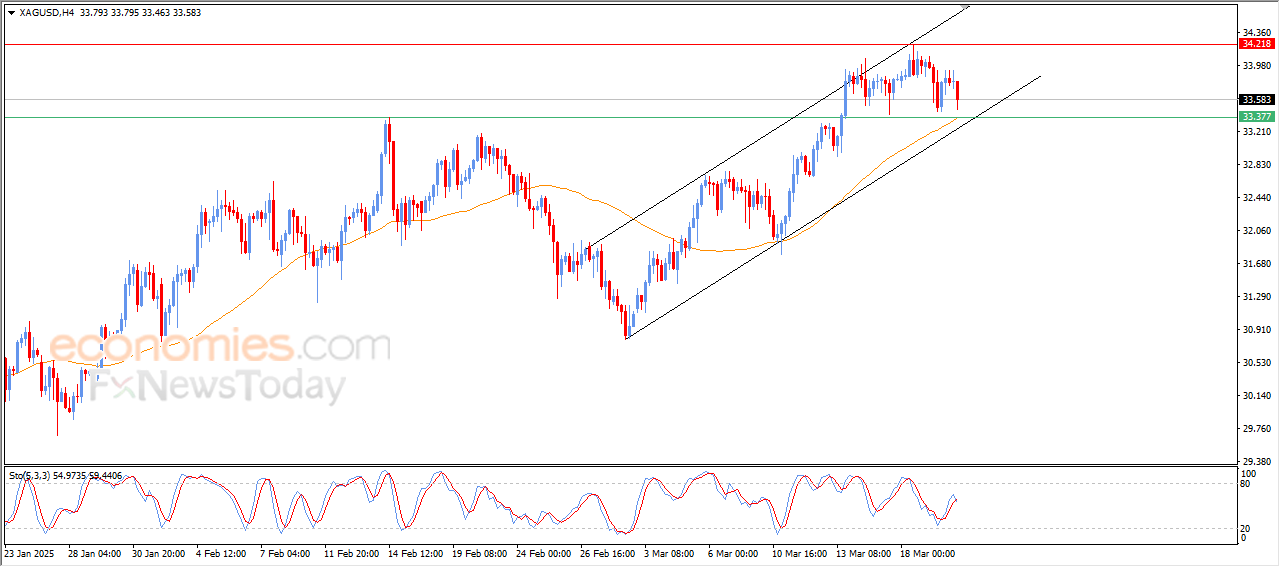
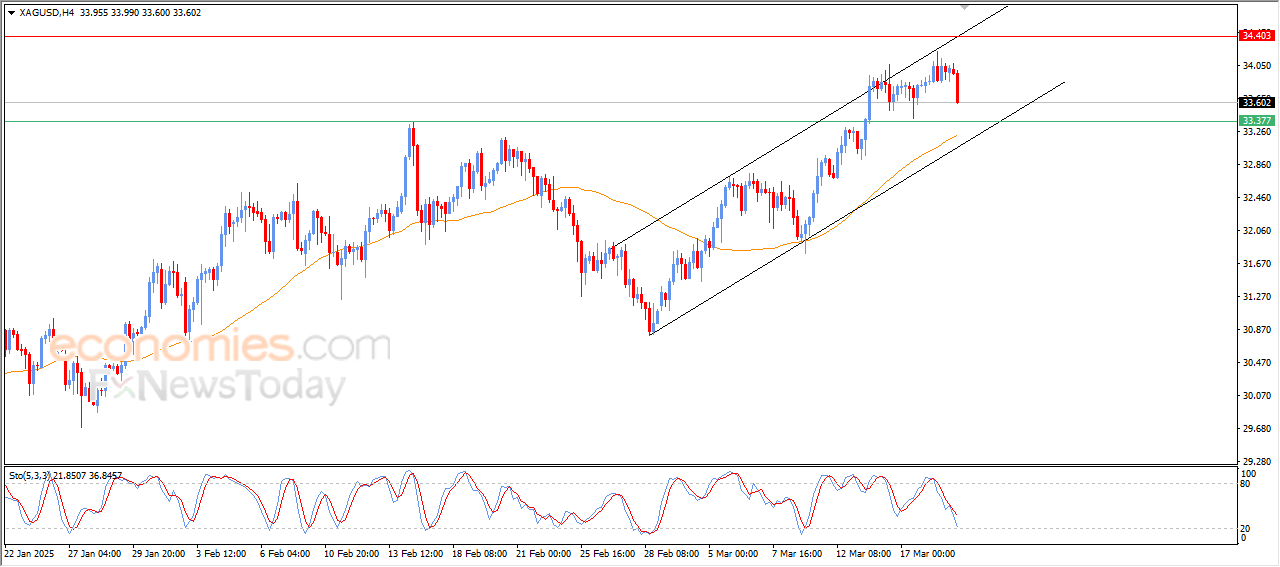
Silver price (XAG/USD) holds onto gains after a previous session of losses, trading around $33.80 per troy ounce during Asian hours on Thursday. However, the non-interest-bearing metal faces pressure following the Federal Reserve’s (Fed) interest rate decision.
As widely expected, the Fed maintained the federal funds rate at 4.25%–4.5% during its March meeting but reaffirmed its outlook for two rate cuts later this year. This stance aligns with forecasts of slower GDP growth and higher unemployment, counterbalancing concerns over rising inflation in the United States (US), potentially driven by aggressive tariffs imposed by President Donald Trump.
Silver, a non-yielding asset, may have found support as US Treasury yields declined, with the 2-year yield at 3.97% and the 10-year yield at 4.24%. Meanwhile, bonds gained traction following the Fed’s decision to slow the pace of quantitative tightening, citing concerns over reduced liquidity and potential risks tied to government debt limits.
Silver lease rates have surged due to shrinking stockpiles, particularly in London, as Silver flows toward the US to capitalize on higher prices. Banks and traders lease Silver to ensure short-term liquidity for trading or operational needs.
This shift has widened price gaps between major markets, with spot silver up 17% this year, outperforming other commodities. Additionally, physical Silver transfers from Canada and Mexico are strained by tariffs, further tightening supply. Growing fears of a “silver squeeze” could disrupt trade for months.
Silver is a precious metal highly traded among investors. It has been historically used as a store of value and a medium of exchange. Although less popular than Gold, traders may turn to Silver to diversify their investment portfolio, for its intrinsic value or as a potential hedge during high-inflation periods. Investors can buy physical Silver, in coins or in bars, or trade it through vehicles such as Exchange Traded Funds, which track its price on international markets.
Silver prices can move due to a wide range of factors. Geopolitical instability or fears of a deep recession can make Silver price escalate due to its safe-haven status, although to a lesser extent than Gold’s. As a yieldless asset, Silver tends to rise with lower interest rates. Its moves also depend on how the US Dollar (USD) behaves as the asset is priced in dollars (XAG/USD). A strong Dollar tends to keep the price of Silver at bay, whereas a weaker Dollar is likely to propel prices up. Other factors such as investment demand, mining supply – Silver is much more abundant than Gold – and recycling rates can also affect prices.
Silver is widely used in industry, particularly in sectors such as electronics or solar energy, as it has one of the highest electric conductivity of all metals – more than Copper and Gold. A surge in demand can increase prices, while a decline tends to lower them. Dynamics in the US, Chinese and Indian economies can also contribute to price swings: for the US and particularly China, their big industrial sectors use Silver in various processes; in India, consumers’ demand for the precious metal for jewellery also plays a key role in setting prices.
Silver prices tend to follow Gold’s moves. When Gold prices rise, Silver typically follows suit, as their status as safe-haven assets is similar. The Gold/Silver ratio, which shows the number of ounces of Silver needed to equal the value of one ounce of Gold, may help to determine the relative valuation between both metals. Some investors may consider a high ratio as an indicator that Silver is undervalued, or Gold is overvalued. On the contrary, a low ratio might suggest that Gold is undervalued relative to Silver.
The GBP/USDpair rose in intraday trading and pierced the resistance of $1.2985, buoyed by trading within a secondary price channel, and under the dominance of the main upward trend, with positive signals from the Stochastic after the pair vented off overbought saturation that was apparent previously, with ongoing positive support due to trading above the 50-candle SMA.
To get our more detailed analysis and 100% accurate signals provided by Best Trading Signal, subscribe to Economies.com VIP Club through the link below!
US crude oil prices rose in the intraday levels and managed to vent off oversold saturation that was apparent in the Stochastic, until it reached overbought levels compared to the price’s movements, thus sending out negative signals, with the dominance of the main downward trend as the price trades alongside a secondary short-term trend line, while the price is hurt by a recently forming negative Rising Wedge pattern.
To get our more detailed analysis and 100% accurate signals provided by Best Trading Signal, subscribe to Economies.com VIP Club through the link below!
The GBP/USDpair rose in intraday trading and pierced the resistance of $1.2985, buoyed by trading within a secondary price channel, and under the dominance of the main upward trend, with positive signals from the Stochastic after the pair vented off overbought saturation that was apparent previously, with ongoing positive support due to trading above the 50-candle SMA.
To get our more detailed analysis and 100% accurate signals provided by Best Trading Signal, subscribe to Economies.com VIP Club through the link below!
The GBP/JPY retreats after rallying for three straight trading days since last Friday. However, it struggled to clear the 195.00 figure and the 200-day Simple Moving Average (SMA), which exacerbated a drop in the cross pair beneath the 193.50 area. At the time of writing, the pair hovers near 193.28, virtually unchanged.
The GBP/JPY trades sideways for the second straight day, capped on the downside by the 100-day Simple Moving Average (SMA) at 193.23 and the Senkou Span B near 192.28. On the top side, the 200-day SMA at 194.18 would likely keep the pair trading range bound.
Additionally, despite being bullish, the Relative Strength Index (RSI) is flat. Hence, buyers and sellers lack the strength to break the trading range.
If GBP/JPY falls below 192.28, the next support would be the Tenkan-sen at 191.83, followed by the Kijun-sen at 191.24. Conversely, if GBP/JPY climbs past the 200-day SMA, the next resistance would be the March 18 peak at 194.89, ahead of 195.00.
The table below shows the percentage change of British Pound (GBP) against listed major currencies this week. British Pound was the strongest against the US Dollar.
| USD | EUR | GBP | JPY | CAD | AUD | NZD | CHF | |
|---|---|---|---|---|---|---|---|---|
| USD | -0.28% | -0.54% | -0.10% | -0.44% | -0.46% | -1.27% | -0.94% | |
| EUR | 0.28% | -0.38% | -0.21% | -0.15% | -0.31% | -1.00% | -0.68% | |
| GBP | 0.54% | 0.38% | 0.48% | 0.02% | 0.05% | -0.63% | -0.37% | |
| JPY | 0.10% | 0.21% | -0.48% | -0.34% | -0.56% | -1.12% | -0.96% | |
| CAD | 0.44% | 0.15% | -0.02% | 0.34% | -0.20% | -0.82% | -1.05% | |
| AUD | 0.46% | 0.31% | -0.05% | 0.56% | 0.20% | -0.67% | -0.35% | |
| NZD | 1.27% | 1.00% | 0.63% | 1.12% | 0.82% | 0.67% | 0.32% | |
| CHF | 0.94% | 0.68% | 0.37% | 0.96% | 1.05% | 0.35% | -0.32% |
The heat map shows percentage changes of major currencies against each other. The base currency is picked from the left column, while the quote currency is picked from the top row. For example, if you pick the British Pound from the left column and move along the horizontal line to the US Dollar, the percentage change displayed in the box will represent GBP (base)/USD (quote).
On Wednesday, Gold surged toward $3,050 during intraday trading as the Federal Reserve (Fed) made its latest interest rate decision, keeping rates unchanged at 4.5%. The Fed noted that growth projections for 2025 have been significantly hindered by the Trump administration’s erratic policy of announcing trade tariffs on social media only to later retract them. As a result, the Federal Open Market Committee (FOMC) revised its end-2025 Gross Domestic Product (GDP) forecast to 1.7%, a sharp decline from the 2.1% estimate shared in December.
Additionally, the median dot plot suggests the end-2025 interest rate will remain at 3.9%, showing little change since the last policy meeting. The FOMC plans to slow down its balance sheet runoff starting in April. Rate markets still indicate a greater than 50% chance of a quarter-point rate cut in June, with most rate traders pricing in 65% odds of a quarter-point or higher rate cut on June 18.
Fed’s Powell: Inflation remains somewhat elevated
Despite rising risks to the US economy via lagging growth metrics and growing concerns that the US’ haphazard tariff policy could kick off both fresh inflation and an economic recession at the same time, Fed Chair Jerome Powell noted on Wednesday that the current economic outlook still remains overall healthy, and the Fed is in no rush to shift away from its expectations of at least two more rate cuts later in the year.
This policy outlook matches the aggregate score of Fed policymaker speeches, scored by FXStreet’s internal Fed Sentiment Index, which shows Fed speakers have been vocal in pointing out the growing risks and concerns looming over the US economy, however the aggregate view remains pinned slightly to the dovish side, but close to neutral as the Fed awaits clearer data direction.
Monetary policy in the US is shaped by the Federal Reserve (Fed). The Fed has two mandates: to achieve price stability and foster full employment. Its primary tool to achieve these goals is by adjusting interest rates. When prices are rising too quickly and inflation is above the Fed’s 2% target, it raises interest rates, increasing borrowing costs throughout the economy. This results in a stronger US Dollar (USD) as it makes the US a more attractive place for international investors to park their money. When inflation falls below 2% or the Unemployment Rate is too high, the Fed may lower interest rates to encourage borrowing, which weighs on the Greenback.
The Federal Reserve (Fed) holds eight policy meetings a year, where the Federal Open Market Committee (FOMC) assesses economic conditions and makes monetary policy decisions. The FOMC is attended by twelve Fed officials – the seven members of the Board of Governors, the president of the Federal Reserve Bank of New York, and four of the remaining eleven regional Reserve Bank presidents, who serve one-year terms on a rotating basis.
In extreme situations, the Federal Reserve may resort to a policy named Quantitative Easing (QE). QE is the process by which the Fed substantially increases the flow of credit in a stuck financial system. It is a non-standard policy measure used during crises or when inflation is extremely low. It was the Fed’s weapon of choice during the Great Financial Crisis in 2008. It involves the Fed printing more Dollars and using them to buy high grade bonds from financial institutions. QE usually weakens the US Dollar.
Quantitative tightening (QT) is the reverse process of QE, whereby the Federal Reserve stops buying bonds from financial institutions and does not reinvest the principal from the bonds it holds maturing, to purchase new bonds. It is usually positive for the value of the US Dollar.
Nonetheless, the rising trendline may continue to mark resistance on the way up and therefore hampers the potential of a rally. It is also important to note that this week’s price action is contained within the price range from last week. Last week’s high of $4.90 established a new high for the uptrend, but it was followed by sellers taking control. Subsequently, the week ended with a bearish looking relatively wide range candlestick pattern. Since sellers dominated price action last week, downward pressure may continue.
Therefore, it looks like a rally may establish a lower swing low and the CD leg of a declining ABCD pattern. The first downswing from last week’s high generated the AB leg of the pattern. Also, note that there is a bearish divergence with the relative strength index (RSI). That also implies continued downward pressure. That may change if the trendline on the RSI window is broken to the upside.
Natural gas would first need to rise above last Wednesday’s high of $4.38 and stay above it for the above bearish thesis to begin to change. That would show continued strength and show a reclaim of the January prior trend high of $4.37. If further signs of strength followed, then natural gas would have a chance to challenge and possibly exceed the recent trend high.
On the downside, the 50-Day MA is critical support for the near-term angle of ascent. However, notice that the recent angle of the trend is higher than it has been. Since the $2.99 swing low from January was well below the 50-Day line, it could easily be broken again.
For a look at all of today’s economic events, check out our economic calendar.
Natural gas prices were flat since yesterday, holding their ground around the pivotal support of $3.750, while stabilizing above the support of the ascending secondary channel at $3.960.
The Stochastic attempted to provide some support by exiting oversold levels, with the price now likely attacking the barrier at $4.180, thus opening the door for more gains towards $4.280 and $4.450.
Expected trading range today is between $3.980 and $4.280.
Today’s price forecast: Bullish