The main category of Forex News.
You can use the search box below to find what you need.
[wd_asp id=1]
The main category of Forex News.
You can use the search box below to find what you need.
[wd_asp id=1]
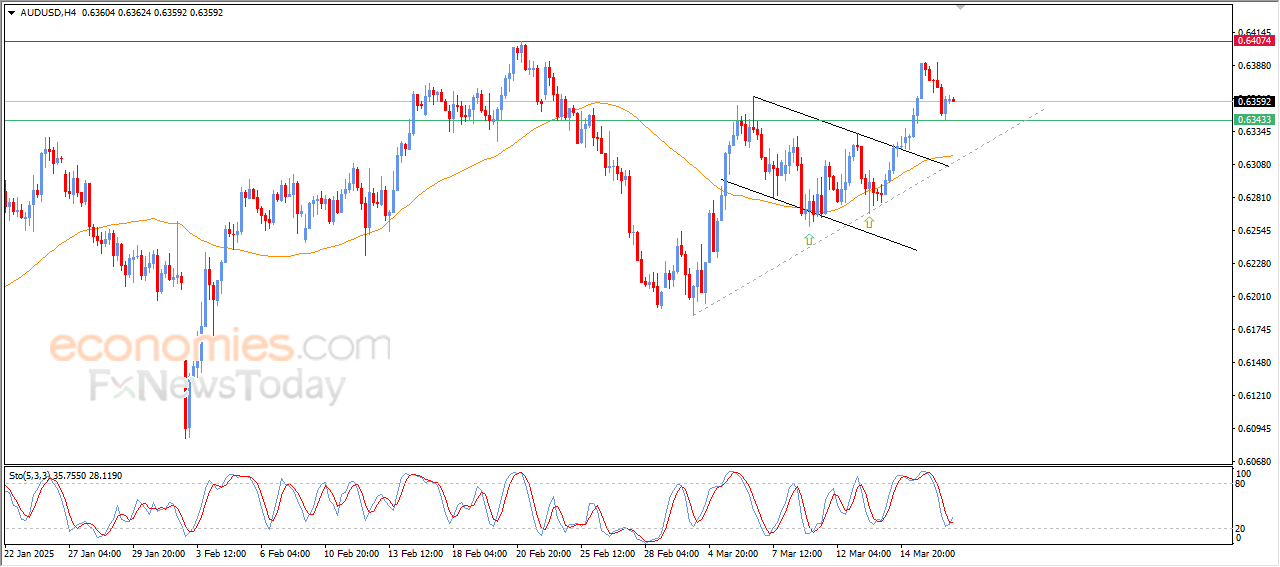
The EUR/USD pair managed to close higher for the third straight session, tackling the pivotal and stubborn resistance of $1.0945, with support due to trading above the 50-day SMA, and amid the dominance of the main upward trend, while the price trades within a secondary price channel in the intraday levels.
To get our more detailed analysis and 100% accurate signals provided by Best Trading Signal, subscribe to Economies.com VIP Club through the link below!
The USD/JPY price analysis indicates a slight decline in BoJ rate hike expectations after a cautious tone during the central bank’s policy meeting. The ongoing global trade wars have overshadowed recent upbeat data from Japan. Policymakers are now worried about the likely impact of Trump’s tariffs on the local economy.
-Are you interested in learning about the forex indicators? Click here for details-
The Bank of Japan kept interest rates unchanged as expected on Wednesday. Moreover, policymakers emphasized the need for time to assess the likely impacts of US trade policies. This means the central bank might be cautious in making any more moves. Nevertheless, Governor Ueda noted that wage growth and consumption were strong. Therefore, economic factors are lining up for more rate hikes.
The yen has pulled back sharply from recent peaks due to economic concerns. If Trump’s tariffs affect Japan’s economy, the BoJ will be forced to pause its rate hike campaign to preserve growth.
On the other hand, the dollar held steady as market participants geared up for the FOMC policy meeting. Economists expect the Fed to keep interest rates unchanged. Therefore, traders will focus on the messaging for clues on future moves. Recent downbeat US data has raised expectations for rate cuts. However, Trump’s tariff moves have raised inflation expectations. Therefore, the Fed has to balance growth and inflation.
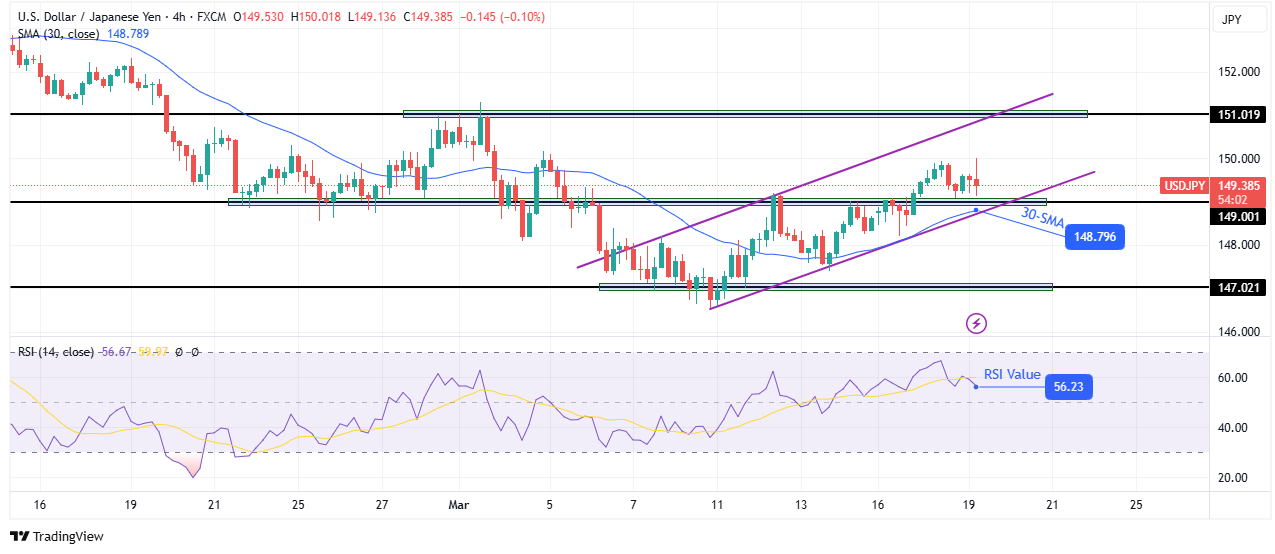
On the technical side, the USD/JPY price has paused its rally and pulled back slightly. However, it still sits above the 30-SMA with the RSI above 50, supporting a strong bullish bias. Moreover, the price still trades in a bullish channel.
-Are you interested in learning about the best AI trading forex brokers? Click here for details-
The pause might allow the price to retest the channel’s support and the 149.00 level before the rally continues. The next target for bulls is at the 151.01 resistance level. A break above this level will strengthen the bullish bias.
On the other hand, if bears overpower bulls, they might push the price below the 30-SMA and the channel support. Such an outcome would indicate a bearish shift in sentiment. It would allow USD/JPY to revisit the 147.02 support level.
Looking to trade forex now? Invest at eToro!
68% of retail investor accounts lose money when trading CFDs with this provider. You should consider whether you can afford to take the high risk of losing your money.
April WTI crude oil (CLJ25) today is up +0.06 (+0.09%), and April RBOB gasoline (RBJ25) is up +0.011 (+0.05%).
Crude oil and gasoline prices today climbed to 2-week highs and are slightly higher. Ramped up tensions in the Middle East are boosting crude prices after Israel launched a series of airstrikes across Gaza today. Also, the US is launching strikes against Houthi Rebels in Yemen for attacking shipping in the Red Sea. Today’s stronger-than-expected global economic news is also supportive for crude prices. Gains in crude were limited by a stronger dollar and hopes for a ceasefire in Ukraine, with President Trump set to speak with Russian President Putin later today as Mr. Trump pushes for an end to the three-year conflict.
Commodity Bulletin: From crude oil to coffee, this FREE newsletter is for industry pros and rookies alike
Crude prices are climbing from rising tensions in the Middle East, which could lead to disruption of supplies from the region. Israel launched a series of airstrikes across Gaza today, ending a nearly two-month ceasefire with Hamas and Israeli Prime Minister Netanyahu vowed to act “with increasing military strength” to free hostages and disarm Hamas. The US is also launching strikes on Yemen’s Houthi rebels, and Defense Secretary Hegseth said strikes would be “unrelenting” until the group stops attacking vessels in the Red Sea.
Today’s global economic news was supportive for energy demand and crude prices. US Feb housing starts rose +11.2% m/m to 1.501 million, stronger than expectations of 1.385 million. Also, US Feb manufacturing production rose +0.9% m/m, stronger than expectations of +0.3% m/m and the biggest increase in a year. In addition, the German Mar ZEW survey expectations of economic growth rose +25.6 to a 3-year high of 51.6, stronger than expectations of 48.3.
A bearish factor for crude was Sunday’s action by Goldman Sachs to cut its year-end WTI crude price forecast to $67 a barrel from $72 and lower its 2025 global oil demand forecast by 18% to 900,000 bpd, citing a slowing global economy from tariffs and the OPEC+ plan to increase production.
Also weighing on crude prices is concern that US tariffs and retaliatory tariffs will curb global growth and undercut energy demand.
Ramped-up Russian oil exports are negative for crude prices after data compiled by Bloomberg from analytics firm Vortexa showed Russian Feb oil products exports reached a 1-year high of 2.5 million bpd.
Crude prices were undercut when OPEC+ said on March 3 that it would restart some halted crude output in April, adding 138,000 bpd to global supplies. That is the first of a series of monthly hikes to reverse the 2-year-long production cut, which will gradually restore a total of 2.2 million bpd. OPEC+ had previously planned to restore production between January and late 2025, but now that production cut won’t be fully restored until September 2026. OPEC Feb crude production rose +320,000 bpd to a 14-month high of 27.35 million bpd.
In a supportive factor for crude oil prices, the US on January 10 imposed new sanctions on Russia’s oil industry that could curb global oil supplies. The measures targeted Gazprom Neft and Surgutneftgas, which exported about 970,000 bpd of Russian crude in the first 10 months of 2024, accounting for about 30% of its tanker flow, according to Bloomberg data. The US also targeted insurers and traders linked to hundreds of tanker cargoes. Weekly vessel-tracking data from Bloomberg showed Russian crude exports fell by -30,000 bpd to 3.45 million bpd in the week to March 16.
Crude oil demand in China has weakened and is a bearish factor for oil prices. According to Chinese customs data, China’s 2024 crude imports fell -1.9% y/y to 553 MMT. China is the world’s biggest crude importer.
A decline in crude oil held worldwide on tankers is bullish for oil prices. Vortexa reported Monday that crude oil stored on tankers that have been stationary for at least seven days fell by -20% w/w to 60.89 million bbl in the week ended March 14.
Last Wednesday’s EIA report showed that (1) US crude oil inventories as of March 7 were -5.1% below the seasonal 5-year average, (2) gasoline inventories were +1.3% above the seasonal 5-year average, and (3) distillate inventories were -4.8% below the 5-year seasonal average. US crude oil production in the week ending March 7 rose +0.5% w/w to 13.575 million bpd, modestly below the record high of 13.631 million bpd from the week of December 6.
Baker Hughes reported last Friday that active US oil rigs in the week ending March 14 rose +1 rig to 487 rigs, mildly above the 3-year low of 472 rigs posted on January 24. The number of US oil rigs has fallen over the past two years from the 4-1/2 year high of 627 rigs posted in December 2022.
On the date of publication, Rich Asplund did not have (either directly or indirectly) positions in any of the securities mentioned in this article. All information and data in this article is solely for informational purposes. For more information please view the Barchart Disclosure Policyhere.
After reaching a multi-month high above 1.0950 on Tuesday, EUR/USD corrects lower and trades below 1.0900 in the European morning on Wednesday. Investors await the Federal Reserve’s (Fed) monetary policy announcements.
The table below shows the percentage change of Euro (EUR) against listed major currencies today. Euro was the weakest against the US Dollar.
| USD | EUR | GBP | JPY | CAD | AUD | NZD | CHF | |
|---|---|---|---|---|---|---|---|---|
| USD | 0.58% | 0.33% | 0.07% | 0.15% | 0.46% | 0.42% | 0.03% | |
| EUR | -0.58% | -0.26% | -0.47% | -0.42% | -0.19% | -0.14% | -0.54% | |
| GBP | -0.33% | 0.26% | -0.19% | -0.16% | 0.08% | 0.12% | -0.29% | |
| JPY | -0.07% | 0.47% | 0.19% | 0.07% | 0.51% | 0.51% | 0.07% | |
| CAD | -0.15% | 0.42% | 0.16% | -0.07% | 0.30% | 0.30% | -0.14% | |
| AUD | -0.46% | 0.19% | -0.08% | -0.51% | -0.30% | 0.04% | -0.32% | |
| NZD | -0.42% | 0.14% | -0.12% | -0.51% | -0.30% | -0.04% | -0.41% | |
| CHF | -0.03% | 0.54% | 0.29% | -0.07% | 0.14% | 0.32% | 0.41% |
The heat map shows percentage changes of major currencies against each other. The base currency is picked from the left column, while the quote currency is picked from the top row. For example, if you pick the Euro from the left column and move along the horizontal line to the US Dollar, the percentage change displayed in the box will represent EUR (base)/USD (quote).
EUR/USD registered gains on Tuesday but lost its bullish momentum in the second half of the day as the US Dollar managed to limit its losses following the upbeat macroeconomic data releases.
Later in the day, the Fed is widely expected to leave its monetary policy settings unchanged. Investors will pay close attention to the changes in the Summary of Economic Projections (SEP), the so-called dot plot.
A downward revision to growth projections could hurt the US Dollar (USD) with the immediate reaction. On the flip side, the USD could rally if the dot plot reveals that policymakers now project only one rate cut this year, down from the two rate cuts reported in December’s publication.
In case Fed Chairman Jerome Powell adopts a cautious tone regarding the economic outlook in the post-meeting press conference, citing the potential negative impact of US President Donald Trump’s tariffs on the activity, the USD could have a difficult time outperforming its rivals. On the flip side, the USD could hold its ground, if Powell downplays growth concerns and puts more emphasis on the uncertainty surrounding the inflation outlook.
The Relative Strength Index (RSI) indicator on the 4-hour chart retreated below 50, reflecting a lack of buyer interest. On the downside, the lower limit of the ascending channel aligns as first support at 1.0840 ahead of 1.0800 (round level, static level) and 1.0730 (200-day Simple Moving Average).
Looking north, first resistance could be spotted at 1.0950 (static level), 1.1000-1.1020 (round level, mid-point of the ascending channel) and 1.1100 (round level, static level).
The Euro is the currency for the 19 European Union countries that belong to the Eurozone. It is the second most heavily traded currency in the world behind the US Dollar. In 2022, it accounted for 31% of all foreign exchange transactions, with an average daily turnover of over $2.2 trillion a day. EUR/USD is the most heavily traded currency pair in the world, accounting for an estimated 30% off all transactions, followed by EUR/JPY (4%), EUR/GBP (3%) and EUR/AUD (2%).
The European Central Bank (ECB) in Frankfurt, Germany, is the reserve bank for the Eurozone. The ECB sets interest rates and manages monetary policy. The ECB’s primary mandate is to maintain price stability, which means either controlling inflation or stimulating growth. Its primary tool is the raising or lowering of interest rates. Relatively high interest rates – or the expectation of higher rates – will usually benefit the Euro and vice versa. The ECB Governing Council makes monetary policy decisions at meetings held eight times a year. Decisions are made by heads of the Eurozone national banks and six permanent members, including the President of the ECB, Christine Lagarde.
Eurozone inflation data, measured by the Harmonized Index of Consumer Prices (HICP), is an important econometric for the Euro. If inflation rises more than expected, especially if above the ECB’s 2% target, it obliges the ECB to raise interest rates to bring it back under control. Relatively high interest rates compared to its counterparts will usually benefit the Euro, as it makes the region more attractive as a place for global investors to park their money.
Data releases gauge the health of the economy and can impact on the Euro. Indicators such as GDP, Manufacturing and Services PMIs, employment, and consumer sentiment surveys can all influence the direction of the single currency. A strong economy is good for the Euro. Not only does it attract more foreign investment but it may encourage the ECB to put up interest rates, which will directly strengthen the Euro. Otherwise, if economic data is weak, the Euro is likely to fall. Economic data for the four largest economies in the euro area (Germany, France, Italy and Spain) are especially significant, as they account for 75% of the Eurozone’s economy.
Another significant data release for the Euro is the Trade Balance. This indicator measures the difference between what a country earns from its exports and what it spends on imports over a given period. If a country produces highly sought after exports then its currency will gain in value purely from the extra demand created from foreign buyers seeking to purchase these goods. Therefore, a positive net Trade Balance strengthens a currency and vice versa for a negative balance.
Gold price is consolidating the recent upsurge to a record high of $3,038 in Wednesday’s Asian trading hours. Gold buyers take a breather as a sense of caution prevails, heading toward the all-important US Federal Reserve (fed) monetary policy announcements due later in the day.
The Fed is widely expected to extend the pause to its interest-rate-cutting cycle in March but the Statement of Economic Projections (SEP), the so-called Dot Plot chart, and Chairman Jerome Powell’s speech will hold the key to gauging the scope and timing of the central bank’s next policy moves.
Any hints of a further extension of the pause by the Fed this year, in the face of US President Donald Trump’s protectionism and its inflationary impact, could trigger a sharp correction in the non-interest-bearing Gold price. The US Dollar (USD) is likely to see a fresh recovery rally following a potential hawkish Fed decision.
Markets have priced in at least two more rate cuts this year due to growing economic concerns induced by Trump’s tariffs. Gold price could also feel the heat if the Fed policymakers pencil in fewer rate cuts this year compared to the December projections.
However, if Fed Chair Powell expresses concerns over a likely recession or if the Fed officials stick to their rate cut forecast for 2025, it could be perceived as a dovish hold. In such a scenario, the USD and the US Treasury bond yields could come under intense selling pressure, lifting Gold price to fresh record highs.
In the meantime, Gold could see a minor pullback as traders cash in on profits after the record rally while bracing for the Fed event-led volatility. Any downside in the safe-haven Gold price will likely remain capped due to persisting geopolitical and trade tensions.
Reuters reported on Wednesday that “Israeli airstrikes pounded Gaza and killed more than 400 people on Tuesday.” Meanwhile, Ukrainian President Volodymyr Zelensky remained sceptical on Russia’s proposal to halt strikes on energy infrastructure in a limited ceasefire arrangement agreed between US President Trump and his Russian counterpart Vladimir Putin over the phone on Tuesday.
These tensions, combined with tariff uncertainty and the outcome of the Bank of Japan (BoJ) policy decision, will likely drive the broad market sentiment, impacting the value of the US Dollar and the Gold price action.
The BoJ is expected to keep the short-term interest rate steady at 0.50%, with hawkish hints likely on the cards by the central bank due to rising inflationary pressures, stubborn wages and the trade war impact.
Technically, nothing changes for the Gold price in the near term as the bullish bias remains intact, with the ascending triangle breakout in play.
The 14-day Relative Strength Index (RSI) is flat-lined just above the overbought region, near 72, at the time of writing. The leading indicator suggests that a brief pullback could be in the offing before the next leg up resumes.
Therefore, if the Gold price extends the retreat, the initial demand area near the $2,980 level will be put to the test.
The next downside caps are at the previous triangle resistance-turned-support at $2,956 and the 21-day Simple Moving Average (SMA) at $2,935.
The triangle support at $2,915 will prove to be a tough nut to crack for sellers.
On the flip side, Gold price could retest the record high of $3,038 if buyers regain control. Further up, the $3,050 mark will be on their radars.
The Federal Reserve (Fed) deliberates on monetary policy and makes a decision on interest rates at eight pre-scheduled meetings per year. It has two mandates: to keep inflation at 2%, and to maintain full employment. Its main tool for achieving this is by setting interest rates – both at which it lends to banks and banks lend to each other. If it decides to hike rates, the US Dollar (USD) tends to strengthen as it attracts more foreign capital inflows. If it cuts rates, it tends to weaken the USD as capital drains out to countries offering higher returns. If rates are left unchanged, attention turns to the tone of the Federal Open Market Committee (FOMC) statement, and whether it is hawkish (expectant of higher future interest rates), or dovish (expectant of lower future rates).
Next release: Wed Mar 19, 2025 18:00
Frequency: Irregular
Consensus: 4.5%
Previous: 4.5%
Source: Federal Reserve
The EUR/USD pair managed to close higher for the third straight session, tackling the pivotal and stubborn resistance of $1.0945, with support due to trading above the 50-day SMA, and amid the dominance of the main upward trend, while the price trades within a secondary price channel in the intraday levels.
To get our more detailed analysis and 100% accurate signals provided by Best Trading Signal, subscribe to Economies.com VIP Club through the link below!
Silver price rally halts for the second straight day, with bulls remaining unable to decisively clear the $34.00 figure for the second consecutive day despite registering a yearly peak of $34.23. At the time of writing, the XAG/USD trades at $33.97, virtually unchanged, as Wednesday’s Asian session commences.
On Tuesday, Silver traded mostly sideways and printed a daily close below 50% of the candle’s size, indicating that neither buyers nor sellers are in charge. Although the overall trend suggests the uptrend might continue, bulls seem to take a breather as depicted by the Relative Strength Index (RSI) turning flatlines near overbought territory.
If XAG/USD rises past $34.20, the next key resistance would be the October 30, 2024, peak at $34.51, followed by the $35.00 mark. On the flip side, if Silver’s remains below $34.00, the first support would be the March 18 low of $33.75, followed by the March 17 through at $33.44.
Silver is a precious metal highly traded among investors. It has been historically used as a store of value and a medium of exchange. Although less popular than Gold, traders may turn to Silver to diversify their investment portfolio, for its intrinsic value or as a potential hedge during high-inflation periods. Investors can buy physical Silver, in coins or in bars, or trade it through vehicles such as Exchange Traded Funds, which track its price on international markets.
Silver prices can move due to a wide range of factors. Geopolitical instability or fears of a deep recession can make Silver price escalate due to its safe-haven status, although to a lesser extent than Gold’s. As a yieldless asset, Silver tends to rise with lower interest rates. Its moves also depend on how the US Dollar (USD) behaves as the asset is priced in dollars (XAG/USD). A strong Dollar tends to keep the price of Silver at bay, whereas a weaker Dollar is likely to propel prices up. Other factors such as investment demand, mining supply – Silver is much more abundant than Gold – and recycling rates can also affect prices.
Silver is widely used in industry, particularly in sectors such as electronics or solar energy, as it has one of the highest electric conductivity of all metals – more than Copper and Gold. A surge in demand can increase prices, while a decline tends to lower them. Dynamics in the US, Chinese and Indian economies can also contribute to price swings: for the US and particularly China, their big industrial sectors use Silver in various processes; in India, consumers’ demand for the precious metal for jewellery also plays a key role in setting prices.
Silver prices tend to follow Gold’s moves. When Gold prices rise, Silver typically follows suit, as their status as safe-haven assets is similar. The Gold/Silver ratio, which shows the number of ounces of Silver needed to equal the value of one ounce of Gold, may help to determine the relative valuation between both metals. Some investors may consider a high ratio as an indicator that Silver is undervalued, or Gold is overvalued. On the contrary, a low ratio might suggest that Gold is undervalued relative to Silver.
A rally earlier in Tuesday’s trading session saw crude oil trigger a potential breakout of a double bottom bullish reversal pattern. However, the subsequent bearish reaction negates that breakout and adds to the risk of a failed bull breakout. Therefore, the chance that crude oil may challenge recent lows before attempting to go higher again increases. Although a drop below today’s low would provide the next sign of weakening demand, crude oil would be falling into a support zone that has been retained for approximately 10 days, including today.
Certainly, it is possible that an upside breakout of the double bottom pattern will be attempted again, and it may have greater success next time. Given that the 20-Day MA continues to fall, the price that it represents will also decline. This makes it the next key potential resistance level to be challenged and possibly exceeded, if the bulls are to have a chance at a counter-trend rally. A daily close above the 20-Day MA would be needed for bullish signs that may continue to strengthen. Furthermore, a daily close above approximately $68.98 would then be needed to further confirm strength.
Note that the weekly chart (not shown) shows a potential bullish doji hammer candlestick pattern that formed last week. A bullish breakout signal triggered today and of course it has failed so far. But it is possible that following a deeper pullback into last week’s price range, a bullish reversal might follow that could lead to another breakout above last week’s high at $68.03 and the neckline of the double bottom pattern at $68.37.
For a look at all of today’s economic events, check out our economic calendar.
March 18, 2025 – Written by James Fuller
STORY LINK Pound Sterling Forecast vs Euro Ranges: Strong Support on Dips to 1.177
On Tuesday, the German parliament (Bundestag) approved the constitutional change to exempt defence and security spending from the debt brake. The huge German spending commitment is in stark contrast to UK pressure to tighten policy.
The Euro had priced in the approval, limiting scope for further buying, but did secure limited further support following the vote and the Pound to Euro (GBP/EUR) exchange rate settled around 1.1880.
Risk appetite took another dip lower which also limited wider Pound support.
Rabobank expects the Pound will be resilient close to current levels with strong GBP/EUR support on any dips to 1.1770.
ING also expects GBP/EUR support at 1.1765.
The Bundestag secured 512 votes in favour of the change, above the two-thirds majority of 489 needed.
As well as increased defence spending, there was also approval for a EUR500bn infrastructure fund.
The Bundesrat upper house will vote on Friday to approve the legislation formally.
According to Rabobank; “This should allow for greater spending on defence in addition to setting the stage for a EUR500 bln debt-financed infrastructure fund and allowing the German states to run modest budget deficits.”
The German ZEW investor confidence index strengthened sharply to 51.6 for March from 26.0 previously and above consensus forecasts of 48.0.
The current conditions index, however, improved only slightly to -87.6 from -88.5 in February and compared with expectations of -80.5, illustrating that there are still very important concerns over the outlook.
Attention will move towards UK fiscal policy with the budget statement on the 26th. The government announced welfare reform plans on Tuesday amid pressure to control spending.
According to the Resolution Foundation, Chancellor Reeves has a £4.4bn shortfall in meeting the fiscal rules compared with a £10bn surplus in October.
The OECD lowered its forecast for British growth this year to 1.4% from its December forecast of 1.7% ahead of the budget update, illustrating structural concerns.
According to Credit Agricole; “the UK Chancellor could be forced to unleash spending cuts in order to meet her own long-term budget rules. That contrasts quite starkly with the recent spending plans announced by the EU to in particular boost defence spending, which could then put the UK macro outlook at risk of falling behind most of Europe in the coming years.”
It added; “While more details and confirmation still awaits, the GBP may then only rely on its carry advantage and reduced geopolitical/tariff threats to eventually fare better than the EUR.”
Rabobank does consider that the Pound will need stronger growth to make any headway; “Hopes for a better growth outlook in the Eurozone have altered the dynamic for EUR/GBP. Our year end forecast of EUR/GBP0.83 assumes that UK growth can recover during the course of the year and most recent UK GDP indications have not been encouraging.”
International Money Transfer? Ask our resident FX expert a money transfer question or try John’s new, free, no-obligation personal service! ,where he helps every step of the way,
ensuring you get the best exchange rates on your currency requirements.
XAU/USD reached a fresh all-time high of $3,038.33 on Tuesday, trading nearby in the mid-American session. The bright metal benefited from mounting geopolitical jitters on different fronts.
On the one hand, Israeli Prime Minister Benjamin Netanyahu accused Hamas of breaking the peace agreement by refusing to release hostages and resuming attacks on Gaza, reviving the Middle East conflict despite the United States’ (US) efforts to maintain the cease-fire.
On the other hand, US President Donald Trump is set to call its Russian counterpart, Vladimir Putin, to reestablish the relationship between the two countries and discuss a possible end to the Russia-Ukraine war. Meanwhile, US President Trump engaged in airstrikes on Yemen as a response to the Houthis’ attack on US vessels in the Red Sea over the weekend.
Meanwhile, trade war concerns weigh on the US Dollar (USD). The Greenback hit fresh 2025 lows against European rivals, maintaining its broad weakness despite a dismal mood.
On Wednesday, the Federal Reserve (Fed) will announce its decision on monetary policy. As previously explained, the Fed is widely anticipated to keep the benchmark interest rate on hold at 4.25%-4.50% amid the uncertainty surrounding US President Trump’s trade war and its impact on the economic performance of the world’s largest economy. At the same time, the central bank will also release the Summary of Economic Projections (SEP) or dot plot, a document providing a fresh view of the overall state of the American economy alongside officials’ aims at interest rate moves. Finally, Chairman Jerome Powell will deliver a press conference.
The XAU/USD pair trades near its record high and technical readings in the daily chart suggest the bullish run will continue. Technical indicators head firmly north without signs of upward exhaustion despite the Relative Strength Index (RSI) indicator standing at overbought levels. At the same time, the bright metal develops well above all its moving averages, with the 20 Simple Moving Average (SMA) resuming its advance and currently standing at around $2,931.
The near-term picture also favors an upward extension. In the 4-hour chart, the 20 SMA accelerates north far above also bullish 100 and 200 SMAs. Still, the aforementioned 20 SMA stands at around $2,995, well below the current level. At the same time, the Momentum indicator diverges lower, easing within positive levels, while the Relative Strength Index (RSI) indicator consolidates at around 80. A corrective slide is possible, but buyers will likely take their chances on dips.
Support levels:3,010.40 2,996.90 2,978.40
Resistance levels: 3,040.00 3,055.00 3,070.00