The main category of Forex News.
You can use the search box below to find what you need.
[wd_asp id=1]
The main category of Forex News.
You can use the search box below to find what you need.
[wd_asp id=1]
The copper price has reinforced its bullish momentum by repeatedly fluctuating near the $4.9300 level, maintaining a positive stance within the boundaries of its ascending channel. Meanwhile, $4.8100 continues to serve as additional support in recent trading.
Currently, as the Stochastic indicator moves closer to the overbought zone, it could boost the price’s potential to gain the extra positive momentum needed to reach the channel’s resistance, which extends toward $5.000. This level represents a strong psychological barrier, so we recommend closely monitoring the price action once this target is approached.
Expected Trading Range for Today:
Between $4.8500 and $5.0000
Today’s Price Forecast: Bullish
To get our more detailed analysis and 100% accurate signals provided by Best Trading Signal, subscribe to Economies.com VIP Club through the link below!
After rising more than 0.4% on Monday, GBP/USD continued to edge higher and touched its strongest level since early November above 1.3000 on Tuesday before going into a consolidation phase. The pair’s short-term technical outlook shows that the bullish bias remains unchanged.
The table below shows the percentage change of British Pound (GBP) against listed major currencies this week. British Pound was the strongest against the Japanese Yen.
| USD | EUR | GBP | JPY | CAD | AUD | NZD | CHF | |
|---|---|---|---|---|---|---|---|---|
| USD | -0.52% | -0.40% | 0.60% | -0.62% | -0.66% | -1.27% | -0.56% | |
| EUR | 0.52% | 0.00% | 0.72% | -0.08% | -0.27% | -0.77% | -0.06% | |
| GBP | 0.40% | -0.00% | 1.03% | -0.31% | -0.29% | -0.78% | -0.14% | |
| JPY | -0.60% | -0.72% | -1.03% | -1.20% | -1.46% | -1.81% | -1.29% | |
| CAD | 0.62% | 0.08% | 0.31% | 1.20% | -0.25% | -0.66% | -0.50% | |
| AUD | 0.66% | 0.27% | 0.29% | 1.46% | 0.25% | -0.47% | 0.23% | |
| NZD | 1.27% | 0.77% | 0.78% | 1.81% | 0.66% | 0.47% | 0.70% | |
| CHF | 0.56% | 0.06% | 0.14% | 1.29% | 0.50% | -0.23% | -0.70% |
The heat map shows percentage changes of major currencies against each other. The base currency is picked from the left column, while the quote currency is picked from the top row. For example, if you pick the British Pound from the left column and move along the horizontal line to the US Dollar, the percentage change displayed in the box will represent GBP (base)/USD (quote).
The positive shift seen in risk mood following a bullish opening in Wall Street made it difficult for the US Dollar (USD) to find demand and helped GBP/USD post daily gains on Monday. In the meantime, the data published by the US Census Bureau showed that Retail Sales rose by 0.2% on a monthly basis in February, missing the market expectation for an increase of 0.7% by a wide margin.
February Industrial Production data will be featured in the US economic calendar later in the day, alongside Housing Starts and Building Permits figures.
Meanwhile, US stock index futures turned south and were last seen losing between 0.4% and 0.5% after starting the European session in positive territory. In case safe-haven flows start to dominate the action in financial markets in the second half of the day, GBP/USD could have a hard time extending its uptrend.
The Federal Reserve and the Bank of England will announce monetary policy decisions on Wednesday and Thursday, respectively. Investors could move to the sidelines ahead of these key events and limit GBP/USD’s volatility in the near term.
GBP/USD stays in the upper half of the ascending regression channel and the Relative Strength Index (RSI) indicator on the 4-hour chart holds above 60, reflecting a bullish bias. On the upside, 1.3000 (static level, round level) aligns as immediate resistance before 1.3040 (static level) and 1.3100 (upper limit of the ascending channel).
Looking south, supports could be spotted at 1.2940 (50-period Simple Moving Average (SMA)), 1.2900 (mid-point of the ascending channel) and 1.2870 (static level).
The Pound Sterling (GBP) is the oldest currency in the world (886 AD) and the official currency of the United Kingdom. It is the fourth most traded unit for foreign exchange (FX) in the world, accounting for 12% of all transactions, averaging $630 billion a day, according to 2022 data. Its key trading pairs are GBP/USD, also known as ‘Cable’, which accounts for 11% of FX, GBP/JPY, or the ‘Dragon’ as it is known by traders (3%), and EUR/GBP (2%). The Pound Sterling is issued by the Bank of England (BoE).
The single most important factor influencing the value of the Pound Sterling is monetary policy decided by the Bank of England. The BoE bases its decisions on whether it has achieved its primary goal of “price stability” – a steady inflation rate of around 2%. Its primary tool for achieving this is the adjustment of interest rates. When inflation is too high, the BoE will try to rein it in by raising interest rates, making it more expensive for people and businesses to access credit. This is generally positive for GBP, as higher interest rates make the UK a more attractive place for global investors to park their money. When inflation falls too low it is a sign economic growth is slowing. In this scenario, the BoE will consider lowering interest rates to cheapen credit so businesses will borrow more to invest in growth-generating projects.
Data releases gauge the health of the economy and can impact the value of the Pound Sterling. Indicators such as GDP, Manufacturing and Services PMIs, and employment can all influence the direction of the GBP. A strong economy is good for Sterling. Not only does it attract more foreign investment but it may encourage the BoE to put up interest rates, which will directly strengthen GBP. Otherwise, if economic data is weak, the Pound Sterling is likely to fall.
Another significant data release for the Pound Sterling is the Trade Balance. This indicator measures the difference between what a country earns from its exports and what it spends on imports over a given period. If a country produces highly sought-after exports, its currency will benefit purely from the extra demand created from foreign buyers seeking to purchase these goods. Therefore, a positive net Trade Balance strengthens a currency and vice versa for a negative balance.
The copper price has reinforced its bullish momentum by repeatedly fluctuating near the $4.9300 level, maintaining a positive stance within the boundaries of its ascending channel. Meanwhile, $4.8100 continues to serve as additional support in recent trading.
Currently, as the Stochastic indicator moves closer to the overbought zone, it could boost the price’s potential to gain the extra positive momentum needed to reach the channel’s resistance, which extends toward $5.000. This level represents a strong psychological barrier, so we recommend closely monitoring the price action once this target is approached.
Expected Trading Range for Today:
Between $4.8500 and $5.0000
Today’s Price Forecast: Bullish
To get our more detailed analysis and 100% accurate signals provided by Best Trading Signal, subscribe to Economies.com VIP Club through the link below!
The USDCAD pair has risen slightly in its recent intraday trading, thanks to the firm support level at 1.4280. This comes amid the dominance of an upward corrective trend and trading along a trendline with a relatively mild slope, as the pair attempts to recover some of its previous losses. At the same time, it is offloading some of its evident oversold condition indicated by the RSI, especially as a positive crossover begins to emerge.
However, despite these factors, the pair continues to face persistent bearish pressure because it is trading below its 50-day simple moving average, and it should be noted that it has come off a violent downward move. Based on this, our forecast for the pair is positive on the intraday levels only—provided that the support at 1.4280 holds—potentially targeting a retest of the resistance at 1.4350.
To get our more detailed analysis and 100% accurate signals provided by Best Trading Signal, subscribe to Economies.com VIP Club through the link below!
Silver price (XAG/USD) extends its upside to around $33.90, its highest level since October 30, 2024, during the Asian trading hours on Tuesday, bolstered by the weaker US Dollar (USD). The escalating geopolitical tensions in the Middle East, economic uncertainty and growing industrial demand provide some support to the white metal.
The mounting fears of a recession in the United States (US) and persistent uncertainty over trade relations weigh on investor sentiment, boosting safe-haven assets like Silver. Late Monday, US President Donald Trump said that he would be imposing both broad reciprocal tariffs and additional sector-specific tariffs on April 2. Trump has already imposed a 20% tariff rate in China and a 25% levy on steel and aluminum. He also announced a 25% tariff on Canadian and Mexican goods.
Additionally, the rising geopolitical risks in the Middle East contribute to the Silver price’s upside. Israeli Prime Minister Benjamin Netanyahu said on Tuesday that Israel resumes military operations against Hamas across the Gaza Strip, adding that the country will act against the militant group with increasing military force.
Supply deficits and growing industrial demand create a strong tailwind for the white metal. According to the global investment company WisdomTree, investors own a significant portion of it and expect higher prices to encourage sales. Silver’s industrial demand has reached all-time highs, owing to its use in photovoltaic applications, 5G technology, and automotive electronics.
The Federal Reserve (Fed) interest rate decision will be closely monitored on Wednesday. The US central bank is expected to hold its benchmark interest rate unchanged in a range of 4.25% to 4.50% at the March meeting. The primary focus will be on the Fed’s policy guidance. Any hawkish remarks from Fed officials could lift the Greenback and undermine the USD-denominated commodity price in the near term.
Silver is a precious metal highly traded among investors. It has been historically used as a store of value and a medium of exchange. Although less popular than Gold, traders may turn to Silver to diversify their investment portfolio, for its intrinsic value or as a potential hedge during high-inflation periods. Investors can buy physical Silver, in coins or in bars, or trade it through vehicles such as Exchange Traded Funds, which track its price on international markets.
Silver prices can move due to a wide range of factors. Geopolitical instability or fears of a deep recession can make Silver price escalate due to its safe-haven status, although to a lesser extent than Gold’s. As a yieldless asset, Silver tends to rise with lower interest rates. Its moves also depend on how the US Dollar (USD) behaves as the asset is priced in dollars (XAG/USD). A strong Dollar tends to keep the price of Silver at bay, whereas a weaker Dollar is likely to propel prices up. Other factors such as investment demand, mining supply – Silver is much more abundant than Gold – and recycling rates can also affect prices.
Silver is widely used in industry, particularly in sectors such as electronics or solar energy, as it has one of the highest electric conductivity of all metals – more than Copper and Gold. A surge in demand can increase prices, while a decline tends to lower them. Dynamics in the US, Chinese and Indian economies can also contribute to price swings: for the US and particularly China, their big industrial sectors use Silver in various processes; in India, consumers’ demand for the precious metal for jewellery also plays a key role in setting prices.
Silver prices tend to follow Gold’s moves. When Gold prices rise, Silver typically follows suit, as their status as safe-haven assets is similar. The Gold/Silver ratio, which shows the number of ounces of Silver needed to equal the value of one ounce of Gold, may help to determine the relative valuation between both metals. Some investors may consider a high ratio as an indicator that Silver is undervalued, or Gold is overvalued. On the contrary, a low ratio might suggest that Gold is undervalued relative to Silver.
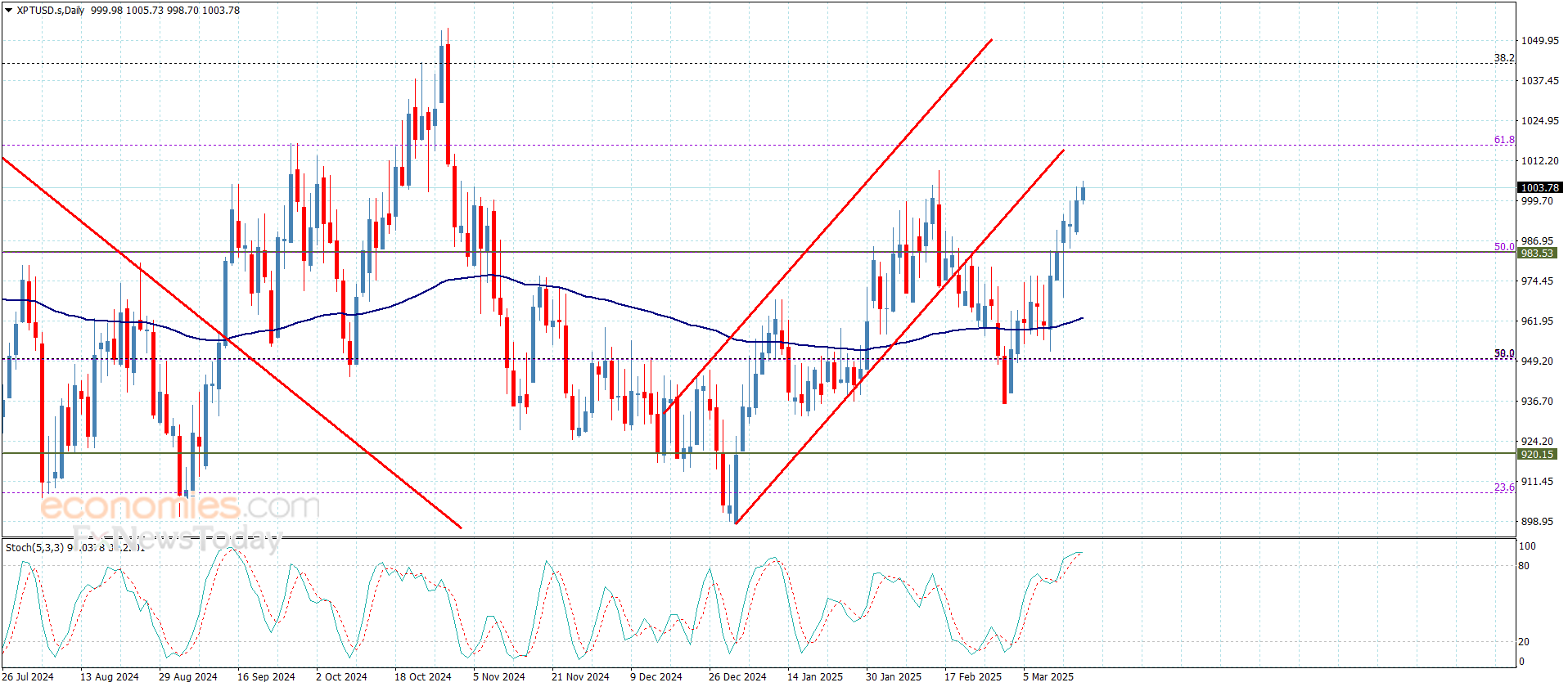
Gold (GOLD) has stabilized with an upward bias during recent intraday trading.
The price is attempting to break through the main and psychological resistance at $3,000.
This move is supported by trading within a short-term ascending price channel and continuous positive momentum from trading above its 50-period simple moving average, along with the formation of a complementary bullish chart pattern—the symmetrical triangle.
However, negative signals from the RSI have emerged as it reaches overbought territory, which is tempering the upward move by prompting profit-taking.
We expect gold’s price to rise in the upcoming sessions, particularly if it manages to break the $3,000 resistance level.
Once this resistance is breached, the next target will be the initial resistance at $3,020.
To get our more detailed analysis and 100% accurate signals provided by Best Trading Signal, subscribe to Economies.com VIP Club through the link below!
The price of crude oil has risen in recent intraday trading, confirming the break of a short-term downward sub-trendline.
This move is supported by its continuous trading above its 50-day simple moving average.
Additionally, it is trading along an upward corrective trendline, with the onset of a positive RSI crossover after the indicator reached significantly exaggerated oversold levels relative to the price movement.
Our forecast indicates further corrective upward movement for oil in the upcoming sessions, especially if it manages to break the resistance at $67.95.
Such a breakthrough would confirm the bullish double bottom pattern, with the price then targeting the resistance level at $70.00 as the next price target.
To get our more detailed analysis and 100% accurate signals provided by Best Trading Signal, subscribe to Economies.com VIP Club through the link below!
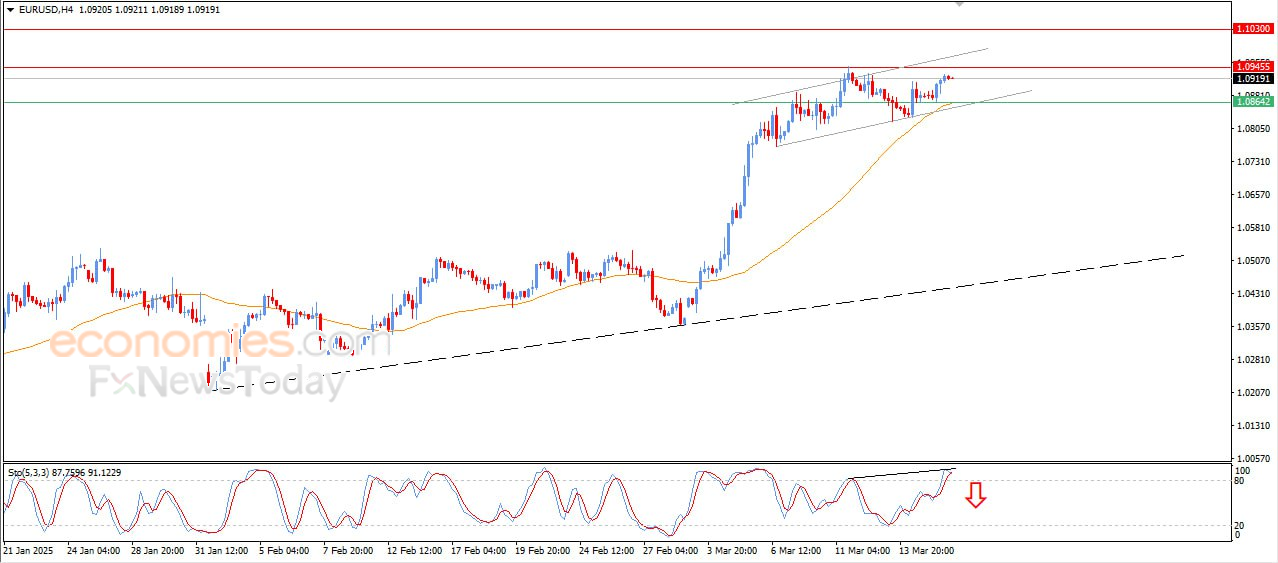
The British Pound against the Dollar (GBPUSD) retreated in its intraday trading due to the firm key resistance at 1.2985, as the pair rushed to lock in profits from its recent gains. It is also trying to shed some of its obvious bullish overbought condition indicated by the RSI—especially as a negative crossover begins to form—to consolidate positive momentum that might help it break through this resistance. This occurs amid the dominance of the primary uptrend and trading along both primary and secondary trendlines, in addition to continuous trading above its 50-day simple moving average, which provides further positive pressure.
Therefore, our forecast is for the pair to rise in the upcoming sessions, particularly if it manages to break the aforementioned resistance at 1.2985, and then immediately target the first resistance level at 1.3050. This bullish scenario remains valid as long as the support at 1.2900 holds.
To get our more detailed analysis and 100% accurate signals provided by Best Trading Signal, subscribe to Economies.com VIP Club through the link below!
Gold price is holding firm in Asian trades on Tuesday, building on its record-setting uptrend. Escalating Middle East geopolitical tensions are the primary driver behind the latest leg up in Gold price.
Reuters reported early Tuesday that a ceasefire between Israel and Hamas collapsed after Israeli military hit targets across Gaza, with Palestinian health ministry officials reporting at least 100 dead.
Israeli Prime Minister Benjamin Netanyahu’s office accused Hamas of “repeated refusal to release our hostages” and rejecting proposals from US President Donald Trump’s Mideast envoy Steve Witkoff.
In response, Hamas turned down the proposal of releasing 59 hostages still held in Gaza.
Further, some unconfirmed reports that an Iranian ship gathering intelligence was sunk by US forces as Gaza attacks took place added to the Middle East tensions. Over the weekend, US launched airstrikes on large-scale strikes on Yemen, targeting the Iran-backed militant group – Houthis. In response, Houthis attacked US vessels in the Red Sea.
Investors scurried to the traditional safe-haven Gold price on intensifying geopolitical risks as economic uncertainties linger on the Trump-induced global trade war.
White House reaffirmed on Tuesday that the reciprocal tariffs will go into effect on April 2. Meanwhile, US Retail Sales data for February rose less than expected, coming in at 0.2% on a monthly basis. The market forecast was for a 0.7% growth.
The data added to the US economic slowdown worries, helping Gold price stay afloat on Monday while the US Dollar (USD) continued to remain at the losing.
However, in Tuesday’s trading, the US Dollar finds fresh buyers on a flight to safety alongside Gold price. It remains to be seen if the Greenback can extend the rebound ahead of Wednesday’s US Federal Reserve (Fed) policy announcements.
That said, markets could resort to repositioning, cashing in on their Gold longs following the ongoing record-setting rally. For now, geopolitics will remain in the spotlight, driving the Gold price action in the sessions ahead.
Gold price looks to extend the upside break of an ascending triangle formation as confirmed last Thursday.
Having found acceptance above the $3,000 psychological barrier on Monday, Gold buyers now keep their sight on the $3,050 mark.
The 14-day Relative Strength Index (RSI) is grinding higher, prodding the overbought region near 69.50 at the press time. The leading indicator suggests that there is more room for the upside.
If a correction sets in, Gold price could challenge the initial demand area near the $2,980 level.
The next downside caps are at the previous triangle resistance-turned-support at $2,956 and the 21-day Simple Moving Average (SMA) at $2,929.
Gold has played a key role in human’s history as it has been widely used as a store of value and medium of exchange. Currently, apart from its shine and usage for jewelry, the precious metal is widely seen as a safe-haven asset, meaning that it is considered a good investment during turbulent times. Gold is also widely seen as a hedge against inflation and against depreciating currencies as it doesn’t rely on any specific issuer or government.
Central banks are the biggest Gold holders. In their aim to support their currencies in turbulent times, central banks tend to diversify their reserves and buy Gold to improve the perceived strength of the economy and the currency. High Gold reserves can be a source of trust for a country’s solvency. Central banks added 1,136 tonnes of Gold worth around $70 billion to their reserves in 2022, according to data from the World Gold Council. This is the highest yearly purchase since records began. Central banks from emerging economies such as China, India and Turkey are quickly increasing their Gold reserves.
Gold has an inverse correlation with the US Dollar and US Treasuries, which are both major reserve and safe-haven assets. When the Dollar depreciates, Gold tends to rise, enabling investors and central banks to diversify their assets in turbulent times. Gold is also inversely correlated with risk assets. A rally in the stock market tends to weaken Gold price, while sell-offs in riskier markets tend to favor the precious metal.
The price can move due to a wide range of factors. Geopolitical instability or fears of a deep recession can quickly make Gold price escalate due to its safe-haven status. As a yield-less asset, Gold tends to rise with lower interest rates, while higher cost of money usually weighs down on the yellow metal. Still, most moves depend on how the US Dollar (USD) behaves as the asset is priced in dollars (XAU/USD). A strong Dollar tends to keep the price of Gold controlled, whereas a weaker Dollar is likely to push Gold prices up.
Recently, US tariffs have rattled markets, in response to Trump’s threats. The United States imposed new global tariffs of 25% on steel and aluminium, without any exemptions, adding to the existing 20% tariffs on Chinese goods. This comes 22 days before the US begins its broader experiment in counter-trade policy, “reciprocal tariffs.”
As expected, retaliatory tariffs have begun to pile up, first from Canada, soon from Europe, and then from China. Numerous additional tariffs are likely to be imposed in April and the months to come. The Peterson Institute estimates that US households will spend approximately $1,000 more annually due to the latest tariffs, and this amount will increase significantly after the April 2 round begins.
US President Trump told reporters last week that there would be no exemptions from the April 2 round of tariffs once they are imposed, suggesting that negotiations are expected beforehand. US administration officials have indicated in various ways that some “disruption” or, according to Treasury Secretary Besant, “a period of recovery” lies ahead, with rising prices and market volatility. However, they say it will be worth it in the indefinite long term, as businesses relocate to the United States, employment increases, and manufacturing grows. They point out that their goal is to shift the economy from a government-led to a private-sector-led economy.
However, reading the US Consumer Price Index (CPI) report, which showed lower inflation pressures than expected in February, is somewhat irrelevant regarding tariffs, as they are a common phenomenon in March. The CPI result gave US stocks an initial boost, but it was quickly overshadowed by other factors.

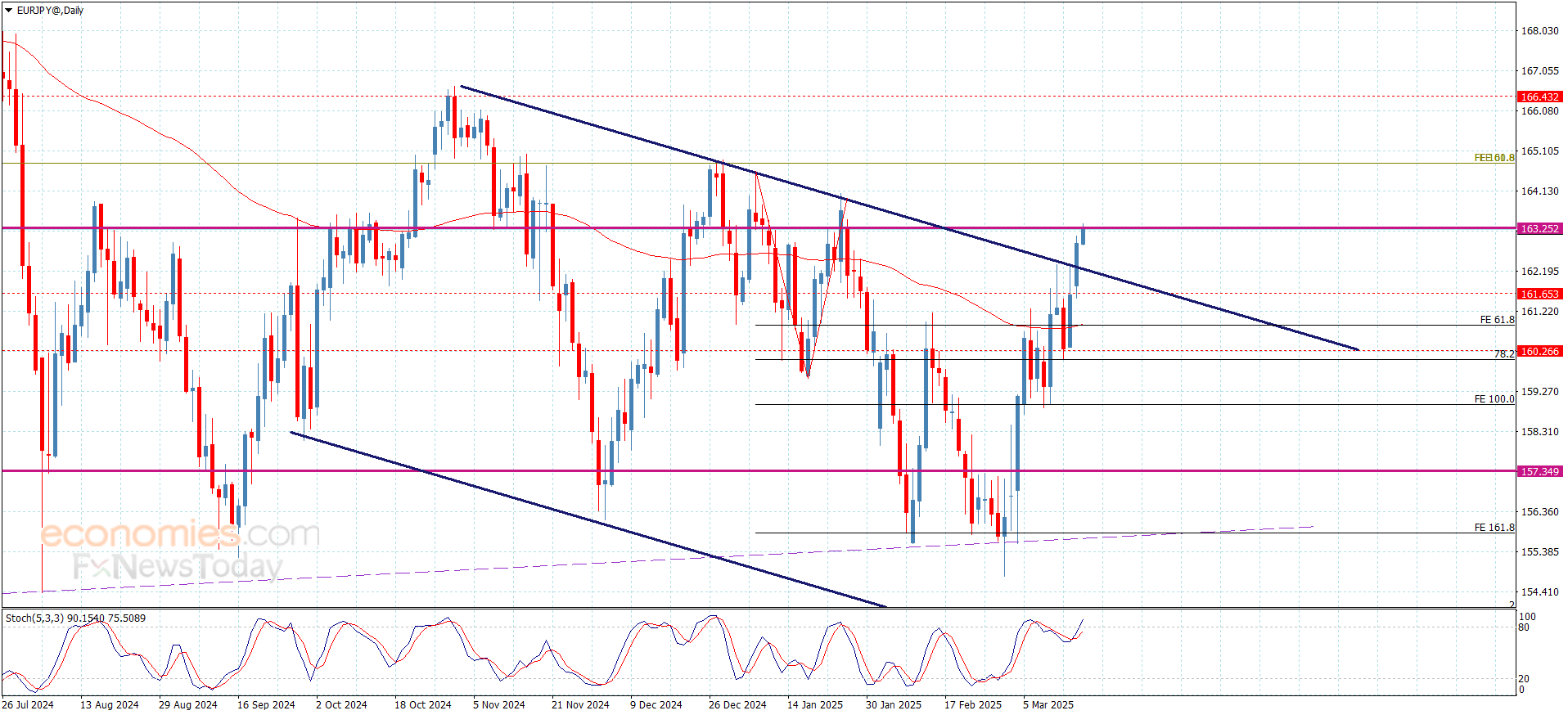
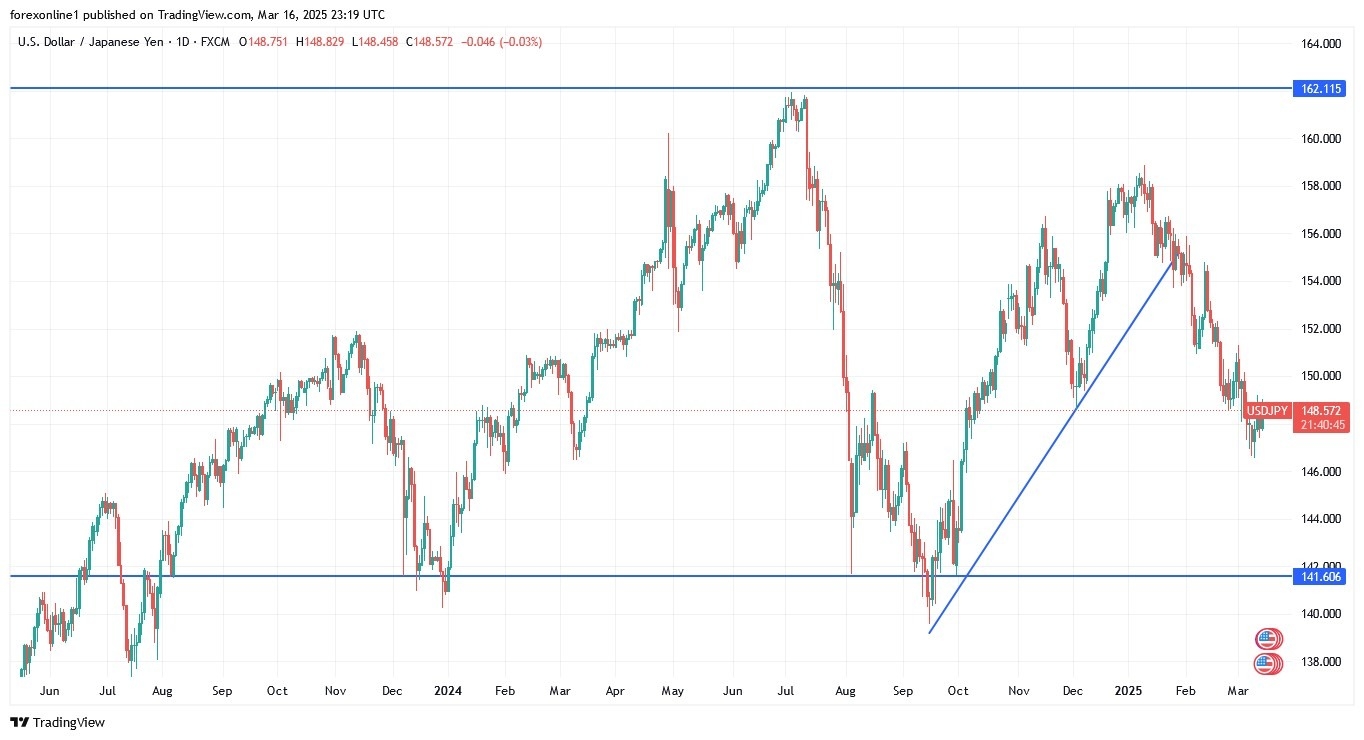
The dollar against the Japanese yen remains on a downward trajectory as long as it remains below 150.00. Beware of the events of this important week.
By the end of last week’s trading, US stock market indices concluded a difficult week with a notable rise, with the S&P 500 index jumping 2.1%, the Dow Jones by 674 points, and the Nasdaq 100 by 2.5%. In general, the easing of fears of a government shutdown and investor resilience in the face of weak US consumer confidence data contributed to the market rise. Recently, Senate Minority Leader Chuck Schumer indicated his support for a Republican-backed funding bill, reducing political uncertainty. However, the University of Michigan’s US consumer confidence index fell to 57.9 points, its lowest level since November 2022, reflecting concerns about inflation and tariffs.
Tech stocks led the recovery, with Nvidia shares rising 5.3%, while Tesla, Meta, Amazon, and Apple shares rose more than 1%. Palantir shares also jumped 8.3%, defying concerns about a potential cut in defence spending.
Despite Friday’s gains, the S&P 500 and Nasdaq fell more than 2% each for the week, while the Dow Jones Industrial Average fell 3.1%—its worst weekly performance since March 2023.
According to daily chart trading, the general trend for the USD/JPY currency pair remains downward. As we mentioned before, moving below 150.00 will continue to support the bears in moving towards stronger support levels, the closest of which are currently 147.70, 146.90, and 145.00, respectively, and will be sufficient to push technical indicators towards strong oversold levels. In contrast, and on the same time frame, a break of the current downward trend will occur if the bulls succeed in pushing the USD/JPY pair towards the resistance levels of 150.50 and 151.40, respectively.
Ultimately, the USD/JPY pair will continue to trade within narrow ranges around its current trajectory until markets and investors react to the US Federal Reserve’s announcement and determine whether investors are willing to take risks.
Want to trade our USD/JPY forex analysis and predictions? Here’s a list of forex brokers in Japan to check out.