The main category of Forex News.
You can use the search box below to find what you need.
[wd_asp id=1]
The main category of Forex News.
You can use the search box below to find what you need.
[wd_asp id=1]
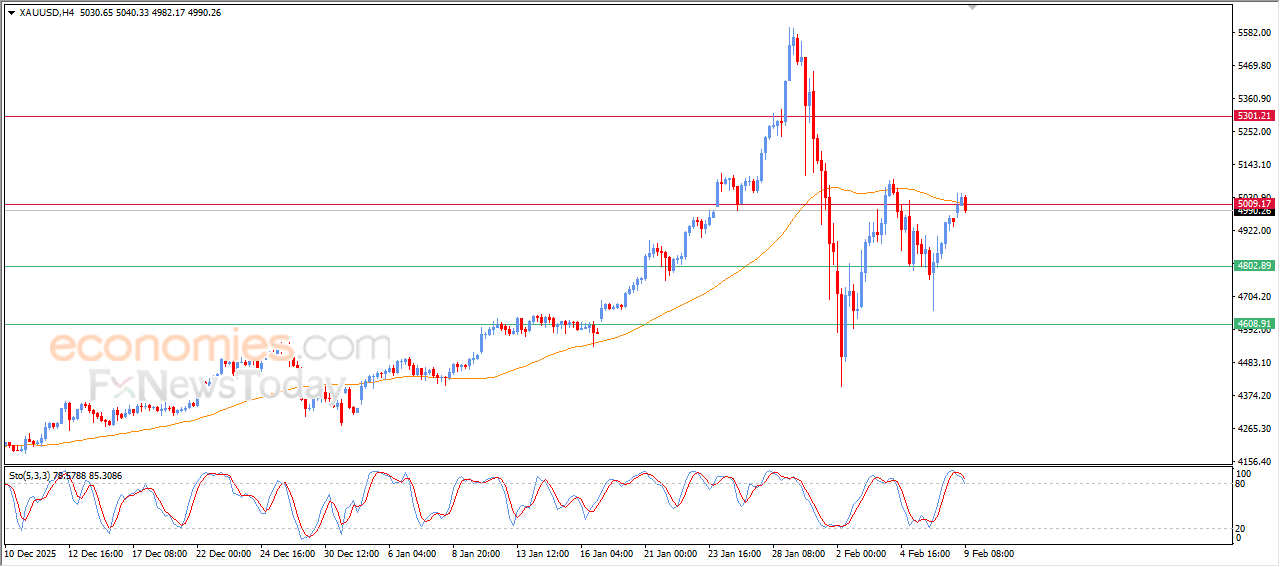
A sustained move over $5002.31 will indicate the presence of buyers, setting the stage for a potential breakout to the upside over the Fibonacci level at $5143.89. A breakdown under $5002.31 will mean that investors still feel the need to continue to build a stronger support base for the next rally.
The overall hesitation to overcome the retracement zone at $5002.31 to $5143.89 with conviction could be an indication that investors are looking for value rather than momentum.
The long-term bullish fundamentals remain in place. A recent report showed that China was still a buyer of gold in January for a 15th straight month, and the geopolitical picture remains clouded with uncertainty. Maybe not enough to trigger a breakout rally, but enough to provide underlying support.
Traders are saying that improved risk appetite for global equities could be capping gains today. If that’s the case, then we may have to focus on the S&P 500 Index later today for an intraday catalyst. They are also looking at this week’s U.S. economic reports for direction, starting with today’s retail sales and finishing with Wednesday’s Non-Farm Payrolls report and Friday’s consumer inflation data.
It all comes down to what will influence Fed policy the most. What could move the Fed rate cut needle from June to March or maybe even June to September.
Gold traders expect the NFP report to show the economy added 70,000 jobs in January. Steady or better numbers could sink gold prices because it will keep the odds of a June rate cut on the table and could even push them into September. A big miss, and gold will launch another rally.
– Written by
Frank Davies
STORY LINK Pound to Dollar Rate Forecast: GBP Pressured by UK Bond Rout, US Jobs Data
The Pound to Dollar exchange rate (GBP/USD) is navigating a fragile balance as rising UK bond yields, mounting political pressure on Prime Minister Starmer and crucial US labour market data converge to drive near-term direction.
With gilt yields hitting fresh 2026 highs and investors bracing for delayed US jobs figures, Sterling is holding above 1.35 but remains vulnerable to sharp volatility on both sides of the Atlantic.
If you’re planning a Dollar-Pound transfer or want to protect against renewed GBP swings, compare specialist money transfer providers now to secure competitive exchange rates before key data hits.
The Pound to Dollar (GBP/USD) exchange rate dipped below 1.3600 in early Europe on Monday before trading just above this level as a weaker dollar helped spare the Pound from further punishment with a rebound to around 1.3650. Crucial support is in the 1.3500 area.
According to Scotiabank; “the GBP looks to have found nearterm support around 1.35, at levels roughly corresponding to the prior local high from early January. The RSI is neutral, and additional support is expected around the 50 day MA at 1.3477 as well as the 200 day MA at 1.3430. We look to a near-term range bound between 1.3550 and 1.3650.”
CIBC has a year-end GBP/USD forecast of 1.39.
Get better rates and lower fees on your next international money transfer.
Compare TorFX with top UK banks in seconds and see how much you could save.
UK and US developments are both likely to have an important impact during the week with a focus on UK politics and US jobs data.
Political tensions have continued to rock the Pound with Prime Minister Starmer remaining under severe pressure over the Mandelson scandal.
Over the weekend, his chief of staff McSweeney resigned in an attempt to deflect pressure on Starmer, but his position remains perilous.
Markets remain concerned that if Starmer is forced to resign, Chancellor Reeves would also be likely to lose her job with markets fretting over the outlook for fiscal policy.
UK bonds lost ground on Monday with the 10-year yield increasing to a 2026 high of 4.58%. There will be further concerns over debt interest payments with the risk that bonds and the Pound will slide in tandem.
ING expects dollar vulnerability; “Barring a significant turn for the worse in risk appetite, it looks like we could see a down week for the dollar.”
It considers that solid risk appetite was curbing dollar demand.

The bank added; “US labour market data surprised on the downside last week, and markets are now bracing for the Federal Reserve to potentially re-apprise its view of the jobs market.”
The delayed US employment report is now due on Wednesday. Consensus forecasts are for an increase in non-farm payrolls of around 70,000 from 50,000 last month with the unemployment rate holding at 4.4%.
The latest retail sales data is due on Tuesday with the latest consumer prices data on Friday.
CNBC does see scope for a near-term dollar recovery; “For now, we are cognizant of near-term USD upside driven by very tactical catalysts. For one, the reshuffling of speculative positions in gold, silver, and bitcoin could still need more time to stabilize.”
The bank also sees the risk of a dip in risk appetite which would potentially support the US currency.
As far as UK data is concerned, the latest GDP data is due onThursday with consensus forecasts for a 0.1% increase for December from 0.3% previously.
Markets are also expecting GDP growth of 0.2% for the fourth quarter from 0.1% previously.
International Money Transfer? Ask our resident FX expert a money transfer question or try John’s new, free, no-obligation personal service! ,where he helps every step of the way,
ensuring you get the best exchange rates on your currency requirements.
TAGS: Pound Dollar Forecasts
Natural gas price needs bullish momentum, forcing it to provide new mixed trading by its repeated stability near $3.250, reminding you that the bullish scenario remains valid due to the stability above the bullish channel’s support at $3.030, to keep waiting for gathering bullish momentum, to ease the mission of its rally above $3.450 and reaching the initial target near $4.000.
While breaching strong bearish pressure and reaching below the main support, so that will confirm its move to a new negative phase, which forces it to suffer new losses by reaching $2.850.
The expected trading range for today is between $3.100 and $3.500
Trend forecast: Bullish
The US dollar plunged against the Japanese yen during the trading session on Monday, and it looks like we will be trying to find value on a dip yet again.
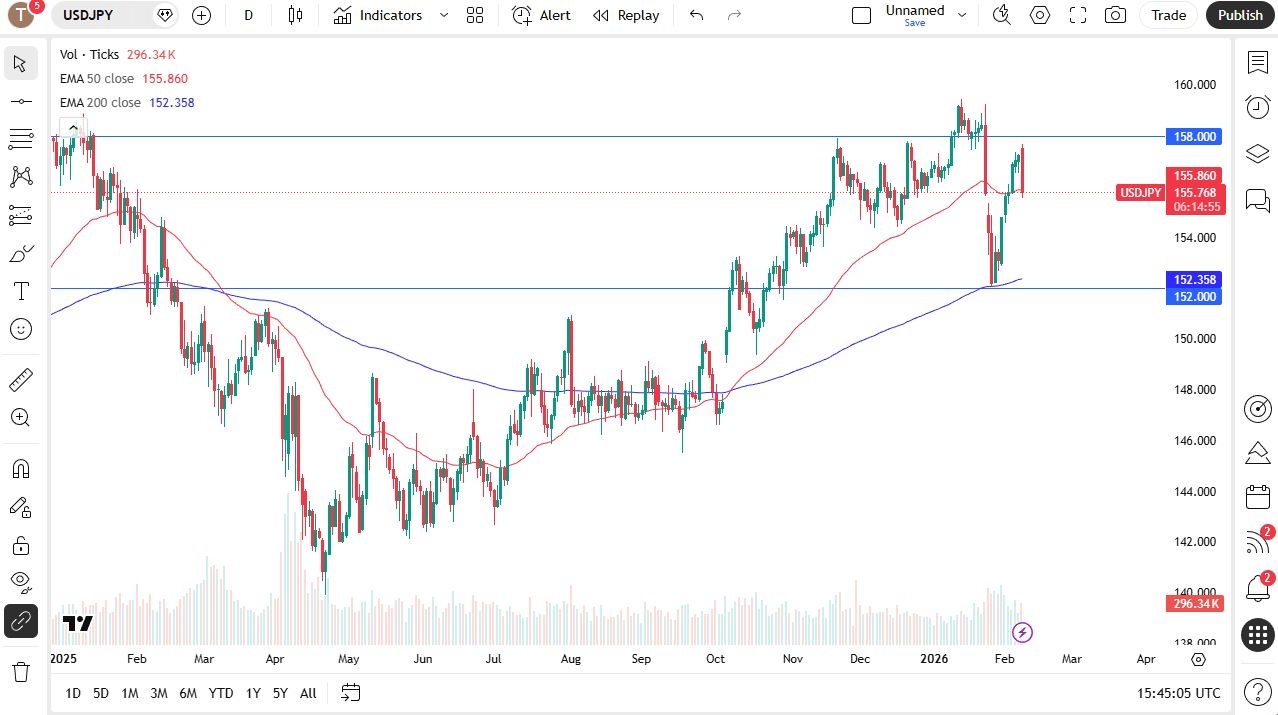
The US dollar plunged against the Japanese yen during the trading session on Monday as the 158 yen level continues to be a bit of a barrier. If we can break above the 158 yen level, then it is possible that the market could continue much higher. But I think ultimately at this point in time, we have a lot of questions asked about whether or not the Japanese yen can continue to sell off.
Quite frankly, with the election results over the weekend, I suspect that we will remain in a dovish type of situation when it comes to the Japanese yen. This pullback is probably simple profit taking and perhaps a little bit of a response to US dollar weakness on the whole. We are hanging around the 50-day EMA, which of course is a significant technical indicator that a lot of people will watch.
Even if we do break down below here, it is likely that the market could go looking to the 154 yen level, maybe even the 200-day EMA. All things being equal, this is a situation where the 152 yen level is your absolute floor.
If we turn around and go to the upside, we could break above the 158 yen level, maybe go looking to the 160 yen level. I do believe that the carry trade will continue to be a major player in the forex world. While the US dollar should eventually bounce here and offer a buying opportunity, I think you also have to look at other Japanese yen denominated currency pairs such as the British pound against the Japanese yen and the Aussie dollar against the Japanese yen. I am still very bearish on the yen.
Christopher Lewis has been trading Forex and has over 20 years experience in financial markets. Chris has been a regular contributor to Daily Forex since the early days of the site. He writes about Forex for several online publications, including FX Empire, Investing.com, and his own site, aptly named The Trader Guy. Chris favours technical analysis methods to identify his trades and likes to trade equity indices and commodities as well as Forex. He favours a longer-term trading style, and his trades often last for days or weeks.
Copper prices forced to provide slow trading recently, due to the contradiction between the main indicators, fluctuating near $5.8500 level without recording any new corrective target.
Reminding you that the stability below $5.9700 barrier makes us keep the bearish corrective scenario, which might target $5.7200 level reaching $5.5100 support, while breaching the barrier will reinforce the chances of forming new bullish waves, to attempt to record extra gains by reaching $6.1200.
The expected trading range for today is between $5.5100 and $5.9500
Trend forecast: Bearish
– Written by
Frank Davies
STORY LINK Euro to Dollar Forecast: EUR/USD Swings as Markets Reprice the Fed
The Euro to Dollar exchange rate (EUR/USD) is being driven almost entirely by Federal Reserve expectations, with investors reassessing the outlook for US rate cuts amid mixed labour-market signals, political uncertainty and growing scrutiny of the Fed’s next leadership.
After a sharp pullback from recent highs, EUR/USD has stabilised below 1.18 as markets weigh weakening US jobs data against the risk of a dollar rebound, leaving the pair highly sensitive to incoming payrolls and Fed rhetoric.
MUFG forecasts that the Euro to Dollar (EUR/USD) exchange rate will strengthen to 1.25 at the end of 2026 as the dollar is subjected to further pressure.
SocGen, however, expects that any near-term gains will fade with a retreat to 1.14 by the end of this year as the dollar recovers and the Euro fades.
EUR/USD posted sharp losses to below 1.18 amid a wider dollar rebound and unwinding of long Euro positions, but stabilised later in the week.
SocGen commented on potential selling above 1.20; “Client conviction still low over a sustained move above 1.20.”
Get better rates and lower fees on your next international money transfer.
Compare TorFX with top UK banks in seconds and see how much you could save.
A partial US shutdown delayed the latest US employment report. There was, however, an increase in jobless claims for the latest week and the JOLTS data also recorded a sharp decline in job openings to the lowest level since August 2020.
ING commented; “The Fed is becoming more relaxed about the US jobs market. Yet data this week makes that look complacent. And payroll numbers next week will be key.”
It added; “Major downward revisions to payrolls next week would add to the pressure to eventually resume rate cuts.”
Markets now see close to a 20% chance of a rate cut in March and close to a 75% chance of a move by June. Wider issues surrounding Fed policy remain crucial elements for the markets.
According to MUFG; “Further rates cuts and the predictable uncertainties associated with the Trump presidency points to further dollar depreciation this year. Trump described the dollar’s
performance as “great” in January and the Fed checking rates in USD/JPY will ensure investors continue to suspect the Trump administration wants a weaker Dollar.”
Any rhetoric from Fed Chair nominee Warsh will be watched closely.
Lloyds commented on the outlook; “How Warsh intends to reshape the Fed ought to become clearer during the Congressional confirmation hearings . The focus will be on how he could deliver rate cuts — which he must surely have promised to get the job.”
It added; “Whether Powell feels he needs to stay on as Governor, to help protect Fed independence, will be important too . It’ll become clear fairly soon whether the three rate cuts delivered at the end of last year have stabilised the labour market.”
The ECB held the deposit rate at 2.00%, in line with strong expectations. There was no formal guidance and President Lagarde played down the potential risks from a stronger Euro.
Rabobank commented; “We continue to see policy on hold through 2026.”
SocGen, however, sees scope for a looser ECB monetary policy; “We expect disinflation to dominate 2026, driven by moderating wage growth and supportive commodity dynamics, particularly in Brent and agricultural prices.”
International Money Transfer? Ask our resident FX expert a money transfer question or try John’s new, free, no-obligation personal service! ,where he helps every step of the way,
ensuring you get the best exchange rates on your currency requirements.
TAGS: Euro Dollar Forecasts
Silver pulled back sharply from its all-time high near 121.67 in late January, dropping over 40% before finding support around the 64.00 zone in early February. The daily chart shows a falling wedge pattern forming during this correction, with price testing the lower boundary multiple times before bouncing back toward 78.00. The 50-day Simple Moving Average (SMA) sits at 75.65, providing dynamic support, while the 200 SMA at 49.13 remains well below current price action, confirming the longer-term bullish structure still holds. The Relative Strength Index (RSI) recovered from oversold conditions below 30 and now reads 53.69, suggesting neutral momentum as Silver consolidates between 70.00 and 85.00.
The 4-hour timeframe displays a potential bullish reversal setup as price broke above the upper trendline of the descending channel near 78.00. The Moving Average Convergence-Divergence (MACD) crossed above the signal line with a widening positive histogram, signaling strengthening upside momentum. Immediate resistance stands at 86.25 where the 200-period SMA on the 4-hour chart converges with the 38.2% Fibonacci retracement of the recent decline. A clean break above this confluence zone opens the path toward 92.95, the 50% retracement level, with extended targets at 101.64 if bullish momentum accelerates. Key support remains at 75.00, and failure to hold this level would bring 71.30 back into focus.
Silver is a precious metal highly traded among investors. It has been historically used as a store of value and a medium of exchange. Although less popular than Gold, traders may turn to Silver to diversify their investment portfolio, for its intrinsic value or as a potential hedge during high-inflation periods. Investors can buy physical Silver, in coins or in bars, or trade it through vehicles such as Exchange Traded Funds, which track its price on international markets.
Silver prices can move due to a wide range of factors. Geopolitical instability or fears of a deep recession can make Silver price escalate due to its safe-haven status, although to a lesser extent than Gold’s. As a yieldless asset, Silver tends to rise with lower interest rates. Its moves also depend on how the US Dollar (USD) behaves as the asset is priced in dollars (XAG/USD). A strong Dollar tends to keep the price of Silver at bay, whereas a weaker Dollar is likely to propel prices up. Other factors such as investment demand, mining supply – Silver is much more abundant than Gold – and recycling rates can also affect prices.
Silver is widely used in industry, particularly in sectors such as electronics or solar energy, as it has one of the highest electric conductivity of all metals – more than Copper and Gold. A surge in demand can increase prices, while a decline tends to lower them. Dynamics in the US, Chinese and Indian economies can also contribute to price swings: for the US and particularly China, their big industrial sectors use Silver in various processes; in India, consumers’ demand for the precious metal for jewellery also plays a key role in setting prices.
Silver prices tend to follow Gold’s moves. When Gold prices rise, Silver typically follows suit, as their status as safe-haven assets is similar. The Gold/Silver ratio, which shows the number of ounces of Silver needed to equal the value of one ounce of Gold, may help to determine the relative valuation between both metals. Some investors may consider a high ratio as an indicator that Silver is undervalued, or Gold is overvalued. On the contrary, a low ratio might suggest that Gold is undervalued relative to Silver.
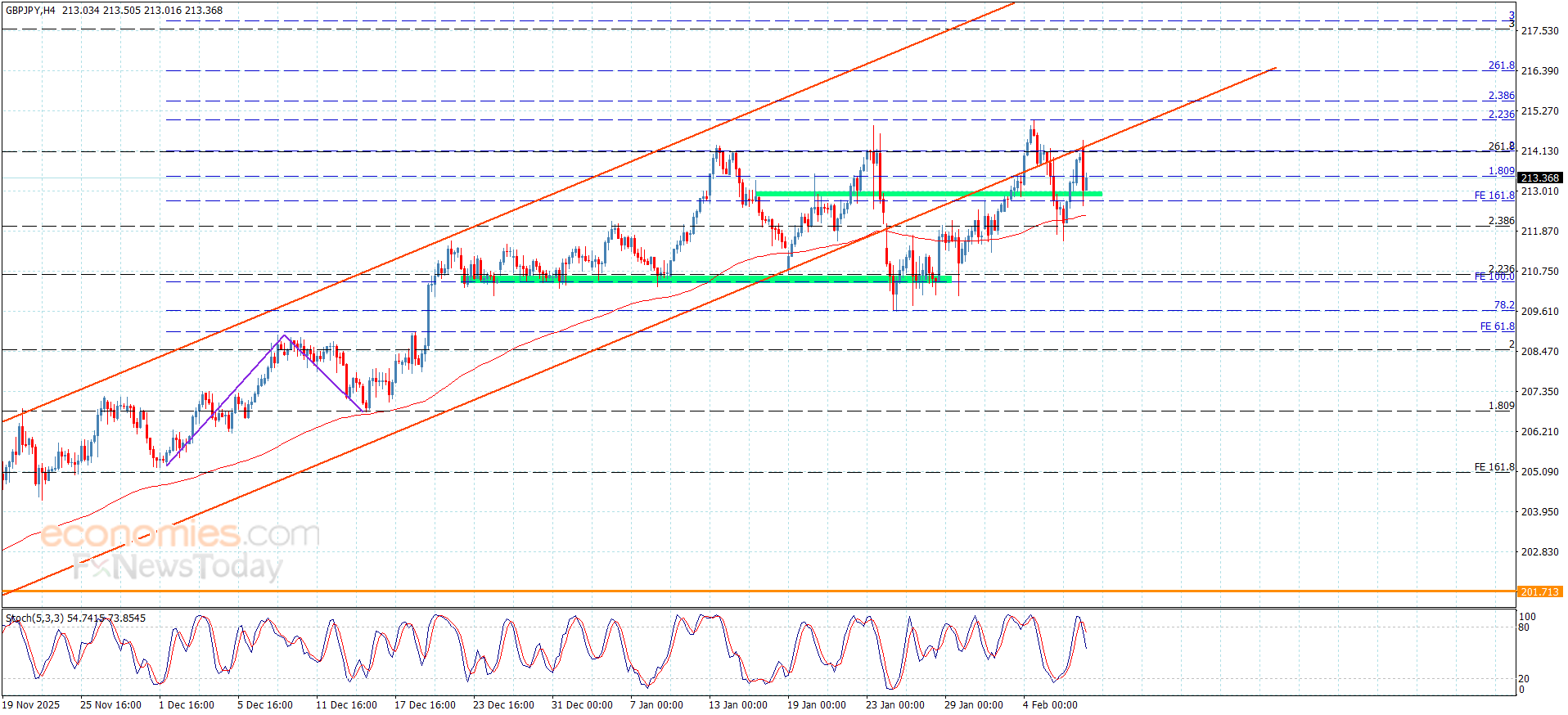
The GBPJPY pair failed to confirm breaking 212.85 level, which forces it to delay the previously suggested negative scenario, forming bullish waves to test the broken bullish channel’s support at 214.40 in this morning’s trading, forming a new bearish decline to settle near 213.40.
The contradiction between the main indicators might push the price to provide temporary trading, to keep waiting to confirm the negative scenario by reaching below 212.85, opening the way for targeting negative stations at 212.00 and 211.25, while breaching 214.40 and holding above it will confirm regaining the bullish track, providing strong chances to record new gains by its rally towards 215.50.
The expected trading range for today is between 211.25 and 213.85
Trend forecast: Sideways
The driving force today is the softer U.S. Dollar, which fell to its lowest level since January 30, down about 0.84%. A weaker dollar tends to drive up foreign demand for dollar-denominated assets like gold. The price action in both the dollar and gold suggests growing expectations for weak economic data, especially the labor market.
Last week’s Challenger January layoffs report, the mid-week ADP private-sector hirings report, and the government’s weekly initial claims report all pointed toward a feeble jobs market. This is leading investors to expect a weak U.S. Non-Farm Payrolls report on Wednesday.
According to a Reuters poll, non-farm payrolls are expected to have risen by 70,000 in January. A big miss to the downside will send investors scrambling to price in a rate cut as early as March, and that would be bad news for the dollar but good news for gold bulls. They have been on hold the past two weeks after the Fed implied at its January meeting that the focus had shifted to getting inflation under control and not labor. They felt that a premature cut in rates could boost inflation during a steady labor market period. However, a collapse in the jobs market will surely catch their eye and probably lead to increased speculation that an earlier-than-expected rate cut is forthcoming.
Providing additional support was the news that China’s central bank extended its gold-buying campaign for a 15th month in January, serving as proof that the dollar debasement trade is alive and well.
Finally, geopolitical concerns have kept a steady floor under the market to go along with China’s gold purchases. This is good for the long-term bullish foundation. Short-term, the market seems to be shedding its weaker buyers with excessive price swings, heightened volatility, and margin hikes by the CME Group. The market now looks as if it is getting ready to launch another rally, but buyers aren’t hitting offers yet without near-term catalysts. This extra confidence boost could come from Wednesday’s NFP report and/or Friday’s CPI data.