The main category of Forex News.
You can use the search box below to find what you need.
[wd_asp id=1]
The main category of Forex News.
You can use the search box below to find what you need.
[wd_asp id=1]
Silver price (XAG/USD) gains ground for the second successive session, trading around $80.80 per troy ounce during the Asian hours on Monday. The grey metal advances amid market caution ahead of key US economic data that could provide clearer guidance on the Federal Reserve’s (Fed) interest-rate outlook. The January jobs report, due Wednesday, is expected to signal stabilization in the labor market, with the US economy forecast to add 70,000 jobs, while the Unemployment Rate is seen holding steady at 4.4%.
Markets currently expect the Fed to keep interest rates unchanged in March, with potential rate cuts anticipated in June and possibly September. San Francisco Fed President Mary Daly said in a LinkedIn post on Friday that the economy may remain in a low-hiring, low-firing environment, though it could also shift toward a no-hiring, higher-firing phase.
Fed Governor Phillip Jefferson said future policy decisions will be guided by incoming data and assessments of the economic outlook, adding on Friday that the labor market is gradually stabilizing. Meanwhile, Atlanta Fed President Raphael Bostic noted that inflation has remained elevated for too long, stressing in a Bloomberg interview on Friday that the Fed cannot lose sight of inflationary risks.
Silver, a traditional hedge against inflation, finds support following the landslide victory of Prime Minister Sanae Takaichi’s ruling coalition in Japan’s weekend elections. This result strengthens the case for expansionary fiscal policies. Such policies tend to lift inflation expectations, underpinning demand for the precious metal.
Safe-haven demand for Silver also remains resilient despite the United States (US)–Iran talks held in Oman on Friday aimed at easing regional tensions. However, Tehran reiterated that it would not suspend nuclear fuel enrichment, with Foreign Minister Abbas Araghchi noting that further negotiations depend on consultations in Washington and Tehran and must proceed without threats. Meanwhile, US President Donald Trump said another round of talks is planned this week, warning of “very steep” consequences if an agreement is not reached.
(The story was corrected on February 9 at 2:40 GMT to say in the title that XAG/USD holds gains near $80.50 due to market caution and due to the Japanese election.)
Silver is a precious metal highly traded among investors. It has been historically used as a store of value and a medium of exchange. Although less popular than Gold, traders may turn to Silver to diversify their investment portfolio, for its intrinsic value or as a potential hedge during high-inflation periods. Investors can buy physical Silver, in coins or in bars, or trade it through vehicles such as Exchange Traded Funds, which track its price on international markets.
Silver prices can move due to a wide range of factors. Geopolitical instability or fears of a deep recession can make Silver price escalate due to its safe-haven status, although to a lesser extent than Gold’s. As a yieldless asset, Silver tends to rise with lower interest rates. Its moves also depend on how the US Dollar (USD) behaves as the asset is priced in dollars (XAG/USD). A strong Dollar tends to keep the price of Silver at bay, whereas a weaker Dollar is likely to propel prices up. Other factors such as investment demand, mining supply – Silver is much more abundant than Gold – and recycling rates can also affect prices.
Silver is widely used in industry, particularly in sectors such as electronics or solar energy, as it has one of the highest electric conductivity of all metals – more than Copper and Gold. A surge in demand can increase prices, while a decline tends to lower them. Dynamics in the US, Chinese and Indian economies can also contribute to price swings: for the US and particularly China, their big industrial sectors use Silver in various processes; in India, consumers’ demand for the precious metal for jewellery also plays a key role in setting prices.
Silver prices tend to follow Gold’s moves. When Gold prices rise, Silver typically follows suit, as their status as safe-haven assets is similar. The Gold/Silver ratio, which shows the number of ounces of Silver needed to equal the value of one ounce of Gold, may help to determine the relative valuation between both metals. Some investors may consider a high ratio as an indicator that Silver is undervalued, or Gold is overvalued. On the contrary, a low ratio might suggest that Gold is undervalued relative to Silver.
Gold starts the week of February 9, 2026, in a tense period of consolidation. Earlier this month, prices dropped sharply from a record $5,600 to a low near $4,400, but have now settled at $4,968 per ounce.
When markets reopen tomorrow, attention will move from selling to a contest between short-term sellers and long-term buyers. With the Chinese Lunar New Year on February 16 and a more aggressive Federal Reserve, high volatility is very likely.
The main reason for the recent $1,200 price swing is the nomination of Kevin Warsh as the next Federal Reserve Chair.
XAU/USD
Even after the sharp drop, gold is still seen as a safe investment because of rising trade and physical conflicts.
On the two-hour chart, gold is starting to form a base near $4,965. The strong rebound from the $4,718 support area, shown by heavy buying, suggests a local bottom might have formed.
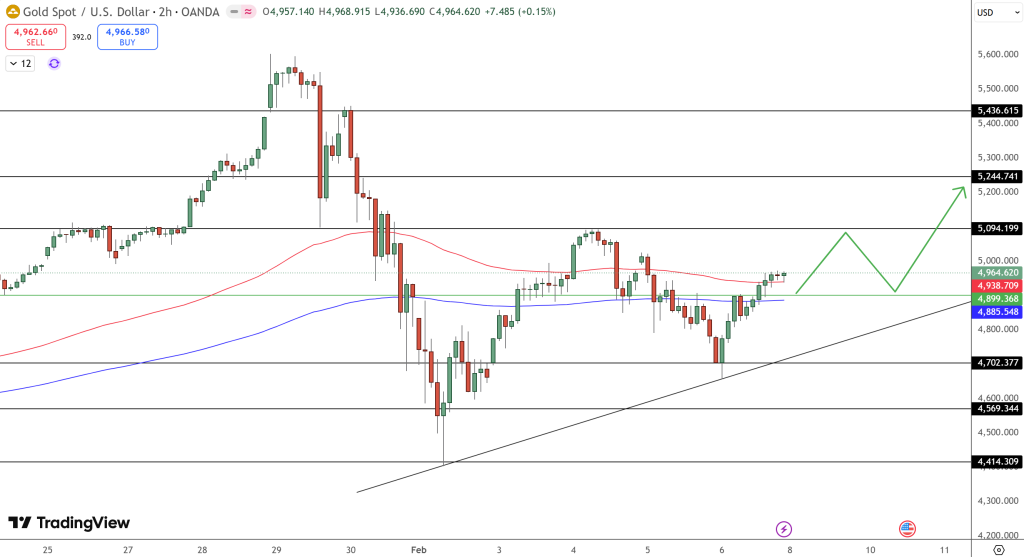
| Level Type | Price Target | Significance |
| Resistance 2 | $5,170 | 61.8% Fibonacci retracement level. |
| Resistance 1 | $5,057 | Immediate psychological barrier and 50 EMA. |
| Pivot Zone | $4,940 – $4,980 | Current consolidation range; must hold for bullish continuation. |
| Support 1 | $4,831 | First line of defense for the week ahead. |
| Support 2 | $4,718 | Major trendline support from January lows. |
Indicators Update:
Trade Strategy for Feb 9 – Feb 13
The long-term trend is still positive, with J.P. Morgan expecting prices above $6,000 by year-end. However, short-term trading needs careful timing.
Risk Management: Tight stops are essential. A daily close below $4,700 invalidates the recovery thesis and suggests a deeper correction toward $4,400.

Arslan Butt
Lead Markets Analyst – Multi-Asset (FX, Commodities, Crypto)
Arslan Butt serves as the Lead Commodities and Indices Analyst, bringing a wealth of expertise to the field. With an MBA in Behavioral Finance and active progress towards a Ph.D., Arslan possesses a deep understanding of market dynamics.
His professional journey includes a significant role as a senior analyst at a leading brokerage firm, complementing his extensive experience as a market analyst and day trader. Adept in educating others, Arslan has a commendable track record as an instructor and public speaker.
His incisive analyses, particularly within the realms of cryptocurrency and forex markets, are showcased across esteemed financial publications such as ForexCrunch, InsideBitcoins, and EconomyWatch, solidifying his reputation in the financial community.
The prospect of an LDP-JIP supermajority in the Lower House supports the bullish short-term outlook for USD/JPY. However, yen intervention threats are likely to continue capping the upside below 160 as seen in January.
Meanwhile, a supermajority would remove the need for Prime Minister Takaichi to make concessions with smaller coalition parties. Over the longer term, this is likely to give the LDP greater control over legislation and ensure prudent fiscal spending, supporting a bearish medium-term outlook for USD/JPY.
While the election result will be key to near-term price trends, Japanese economic data will influence the BoJ’s policy stance. On Monday, February 9, wage growth will fuel speculation about a BoJ rate hike. Economists expect average cash earnings to rise 3% year-on-year in December, following a 0.5% increase in November.
A sharp upswing in wage growth would align with the BoJ’s outlook on wages and growing support for rate hikes.
For context, higher wages could boost households’ purchasing power, offsetting the effects of rising import prices. Increased purchasing power, coupled with improving consumer sentiment, would indicate a pickup in spending. Higher spending would fuel demand-driven inflation and bolster the economy, given that private consumption accounts for around 55% of GDP.
Crucially, these scenarios would align with the BoJ’s hawkish quarterly projections, which sent USD/JPY down 1.64% on January 23.
However, leading inflation indicators will also be key given Tokyo’s softer consumer prices in January. Economists expect producer prices to rise 2.3% year-on-year in January, down from 2.4% in December. Holding above the BoJ’s 2% target may revive bets on an H1 2026 rate hike, boosting demand for the yen. A stronger yen would send USD/JPY lower, supporting the bearish medium-term price outlook.
Follow real-time updates to stay ahead of USD/JPY market developments.
While Japan’s election and Japanese economic data will affect the yen, US economic indicators and Fed rhetoric will influence buying interest in the US dollar.
On Tuesday, February 10, retail sales data will reflect consumer sentiment and economic momentum. Economists forecast retail sales will rise 0.5% month-on-month in December, down from 0.6% in November.
While resilient consumer spending may ease immediate fears of a US recession, the jobs report will be key on Wednesday, February 11.
Economists expect unemployment to remain at 4.4% in January, and wage growth to slow from 3.8% YoY in December to 3.6% YoY in January. Softer wage growth would indicate a drop in consumer spending, dampening demand-driven inflation. A cooler inflation outlook would suggest a more dovish Fed rate path, reaffirming the bearish medium-term price outlook for USD/JPY.
Beyond the data, traders should closely monitor Fed chatter for clues on the timing of a rate cut.
According to the CME FedWatch Tool, the chances of a March 2026 Fed rate cut increased from 13.4% on January 30 to 23.2% on February 6. Additionally, the probability of a June cut rose from 67.3% to 75%. Shifts in the chances of March and June cuts will be key for US dollar trends.
In my opinion, USD/JPY would likely fall toward 150 on market bets on multiple Fed rate cuts and a hawkish BoJ policy stance. Narrowing US-Japan rate differentials would affirm the bearish medium-term (4-8 weeks) outlook. A drop below 150 would reaffirm the longer-term (8-16 weeks) 145-140 range.
Upside risks include:
Despite the upside risks, yen intervention threats are likely to cap upside around 160. Given the upside risks, a breakout above 158 would pave the way toward January’s high of 159.453. A move toward 159.453 would invalidate the medium-term bearish structure.
On the daily chart, USD/JPY traded above its 50-day and 200-day Exponential Moving Averages (EMAs). The EMA positions signaled a bullish bias. However, favorable yen fundamentals continue to counter technicals, supporting the negative outlook for USD/JPY.
A drop below the 50-day EMA would expose 155. If breached, the 200-day EMA would be the next key technical support level. Crucially, a sustained fall through the EMAs would indicate a bearish trend reversal, bringing the 150 support level into play. A break below 150 would enable the bears to target the 145-140 range, aligning with the longer-term price projection.
I wrote on the 1st February that the best trades for the week would be:
A summary of last week’s most important data in the market:
The only two elements here which really affected the markets last week was the continued bullish performance of the US economy, which keeps rate cut expectations low, and the RBA’s rate hike which kept the Australian Dollar performing as the strongest major currency.

The other two relevant issues are
The coming week’s most important data points, in order of likely importance, are:
Wednesday will be a public holiday in Japan.
Currency Price Changes and Interest Rates
For the month of February, I forecasted that the EUR/USD currency pair would rise in value.

February 2026 Monthly Forecast Performance to Date
Last week saw one cross with excessive volatility, so I made the following weekly forecast:
The Australian Dollar was the strongest major currency last week, while the Japanese Yen was the weakest. Directional volatility rose significantly last week, with one third of all major pairs and crosses changing in value by more than 1%.
Next week’s volatility is likely to be similar.
You can trade these forecasts in a real or demo Forex brokerage account.
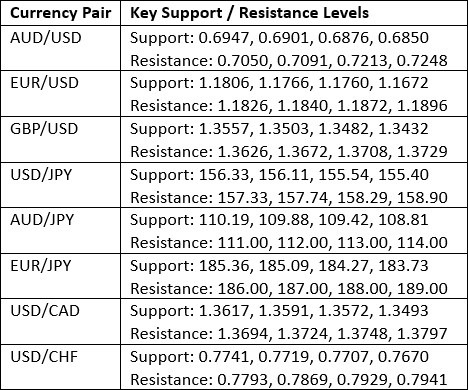
Key Support and Resistance Levels
Last week, the US Dollar Index printed a bullish candlestick which closed higher but with a significant upper wick, signifying some indecision. This is weakly bullish by itself, but we also have a long-term bearish trend with the price below its levels of both 13 and 26 weeks ago. This gives us a conflicted technical picture about the US Dollar.
So, I see the outlook now as uncertain and the best market opportunities will probably not be US Dollar-dependent.
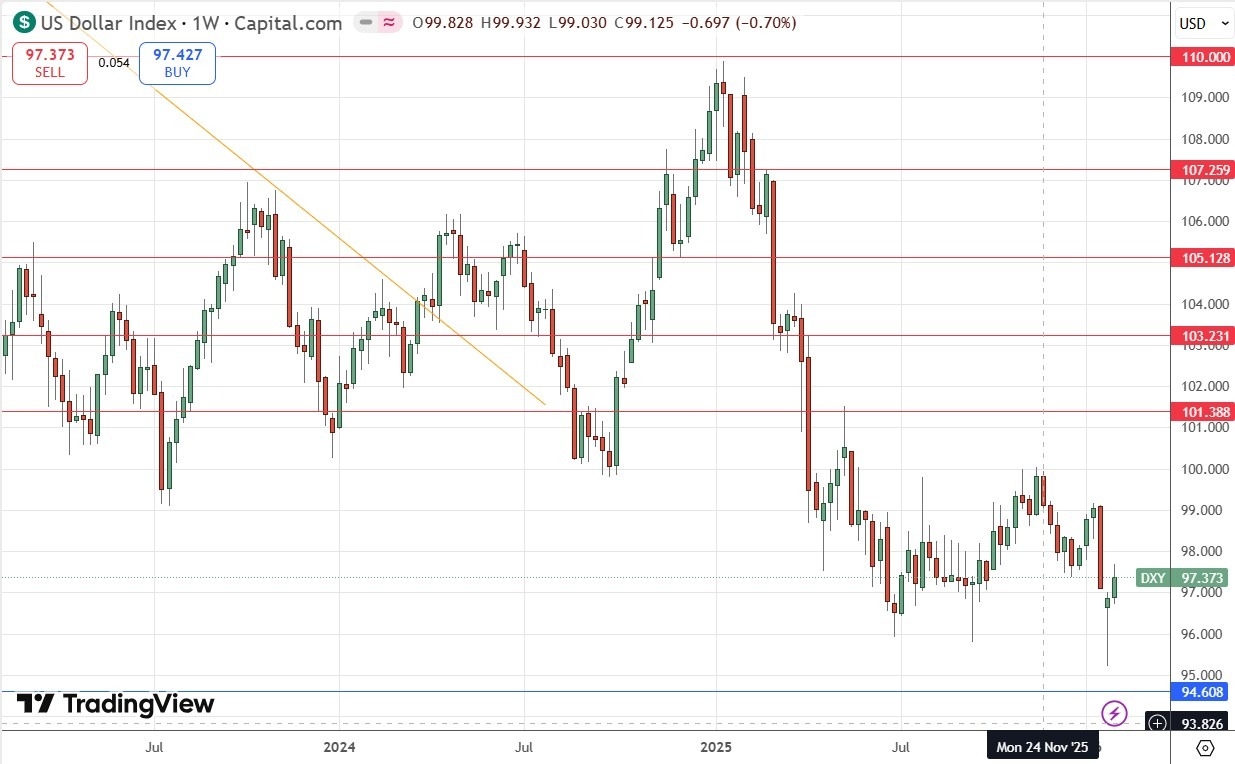
US Dollar Index Weekly Price Chart
The AUD/JPY currency cross made a very strong upwards move, with the weekly close almost right at the high of the range, with unusually high volatility. The price made a bullish breakout to a new 30+ year high.
These are very bullish signs, as are the facts that the Australian Dollar was the strongest major currency last week, backed by an RBA rate hike, while the Japanese Yen continues to depreciate against most currencies as part of its long-term bearish trend, driven by the massive level of Japanese debt.
While this may look like the perfect bullish storm, an excessive weekly move like this is often followed by a retracement for at least a few days, so a drop in price over the next week would not surprise me.
This pair is likely to see the most action in the Forex market next week, at least until the US CPI data is released, so it might be interesting for swing traders on the long side or day traders on the short side.
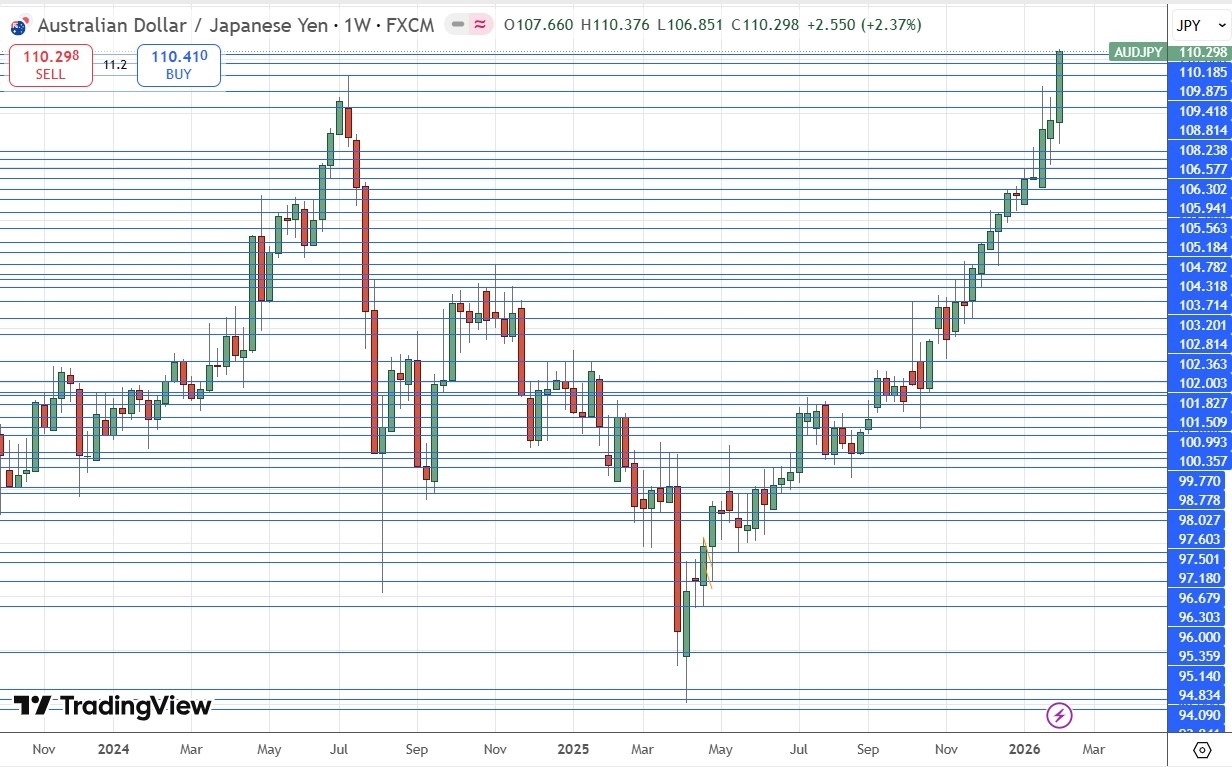
AUD/JPY Weekly Price Chart
The major US equity indices like the S&P 500 Index and the tech-focused NASDAQ 100 Index are looking very choppy as they struggle to make new highs, showing swings with high volatility. This suggests an unstable market which, although bullish, may be about to reverse.
Yet, the old fashioned, old economy Dow Jones Industrial Average had a very strong week, closing right on its high at a new record, and breaking the big round number at 50,000 too. These are bullish signs, suggesting that it is the big tech firms which dominate the major indices which are causing poor price action. Away from the big tech giants, we see the basic sectors of the old economy doing well enough to make new record highs.
I am not strongly confident of this trade, but I think a long trade here with a trailing stop loss, due to the US economy’s historically strong track record, is worth taking. You might want to use a smaller than usual position size, like 50% for example.
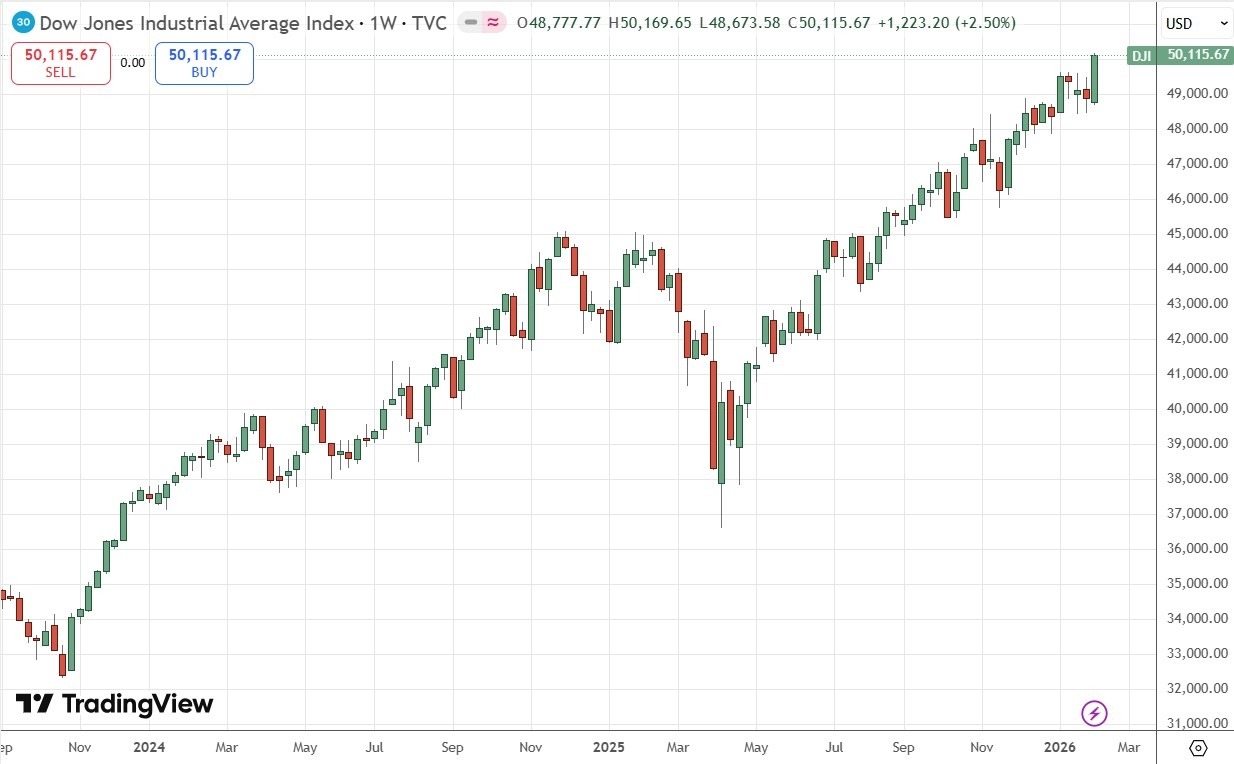
Dow Jones Industrial Average Weekly Price Chart
BTC/USD has continued to make significant bearish breakdowns below a few long-term support levels from just above $81,000 and has recently reached a new 16-month low. This is technically very significant in a bearish way.
While stocks and precious metals were rising strongly over recent months, Bitcoin fell from a record high a few months ago and continued to decline. It is clear the crypto sector is in decline, and that Bitcoin is in serious trouble. Bitcoin was meant to change the world, but outside of Africa, is just has not – you still can’t use it and it is unclear what value it really holds.
I do not like shorting assets, and Bitcoin now seems to be staging a recovery, with a significantly long lower wick now showing on the current weekly candlestick.
I think the price to watch is the support level at about $68,500. If the price action settles above this support, the fall will likely at least pause for a while. If the price action settles below this level, we will likely see a further drop towards the $50,000 area soon.
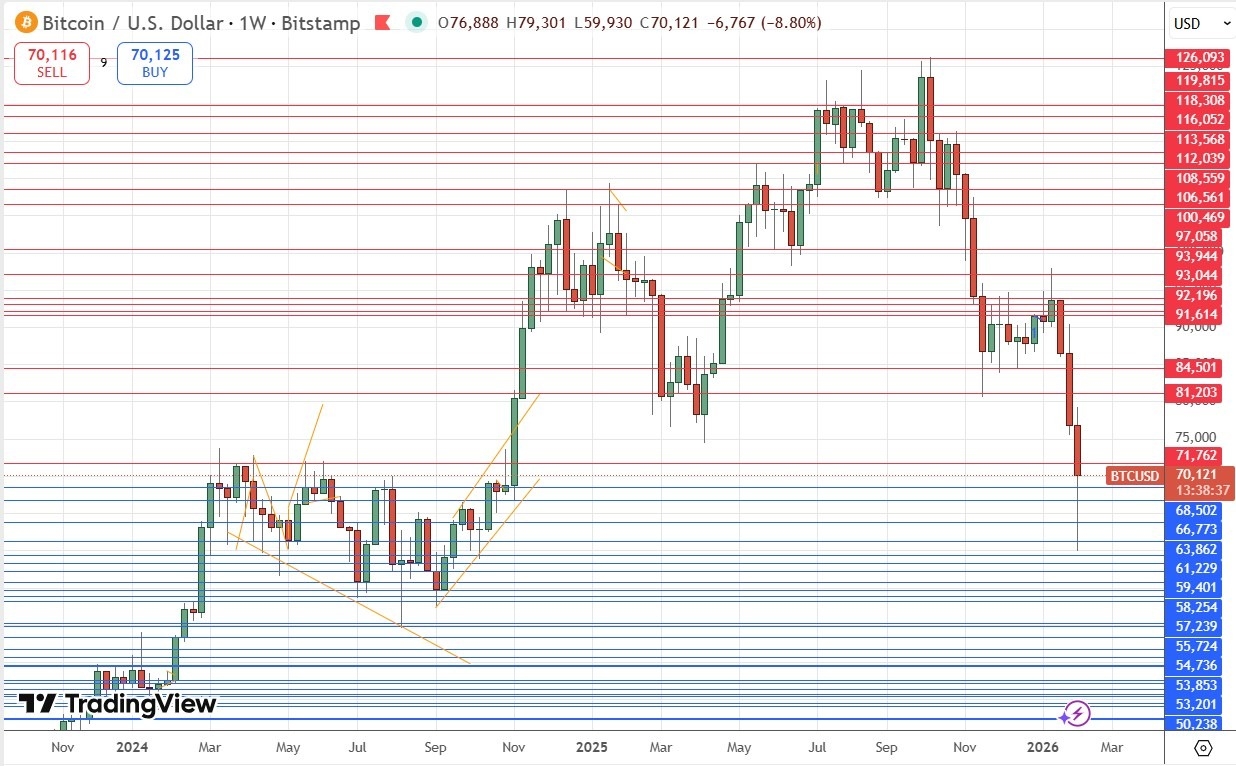
Bitcoin Weekly Price Chart
Gold, like Silver, saw a massive drop in just a day or two at the end of January. The drop is Silver was stronger, but Gold fell quickly from a record high at about $5,600 to a low at $4,400 by the end of the week, which is shown within the daily price chart below.
Applying a Fibonacci retracement study, we can see that the halfway level of this movement is very confluent with a major round number at $5,000 and this has held firmly as resistance.
The price action suggests we are going to get a consolidation now on gradually declining volatility, like a struck tuning fork playing itself out.
I think short trades from rejections of the $5,000 level as this plays out, provided they are handled skillfully as short-term trades on lower timeframes, is probably going to be the best strategy for trading Gold over the coming week.
If the price gets established above $5,000 that will be a contradictory bullish sign.
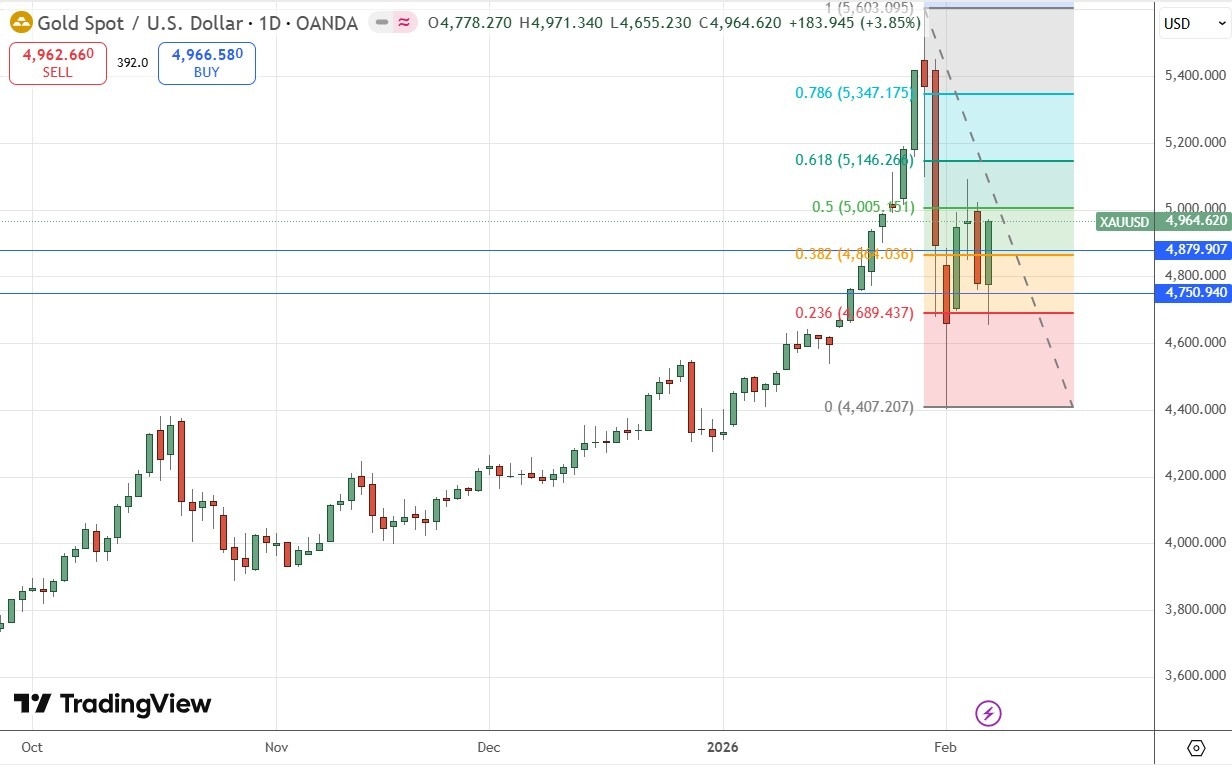
Gold Daily Price Chart
I see the best trades this week as:
Ready to trade our Forex weekly forecast? Check out our list of the best Forex brokers.
Silver (XAG/USD) is trimming some losses during Friday’s early European session, trading right above $74.00 at the time of writing, after hitting fresh seven-month lows near $64.00 earlier on the day. The pair, however, remains capped below a previous support area, in the vicinity of $75.00.
The white metal has dropped nearly 30% over the last two weeks, weighed down by investors’ relief after US President Trump appointed Kevin Warsh as the replacement for Jerome Powell as the central bank’s chairman, and by easing geopolitical tensions, as the US and Iran opened negotiations to avoid a conflict.
XAG/USD is picking up from lows, with the technical picture showing a bearish scenario. The 50-period Simple Moving Average (SMA), which acted as a dynamic support during the bullish cycle, extends its decline, with the pair holding beneath it. The Moving Average Convergence Divergence (MACD) line has slipped back below the zero line, and the Relative Strength Index (RSI) remains below 50, indicating weak traction.
Silver’s recovery found resistance at the $75.00 area, which is holding bulls for now. Further up, the pair might find resistance at an intraday level around $81.00. Key resistance is at Wednesday’s high in the area of $92.00.
Immediate support is at the daily low of $64.08, below that level, the $60.00 round level, and early December lows, in the $56.00 area, might come into focus
(The technical analysis of this story was written with the help of an AI tool.)
Silver is a precious metal highly traded among investors. It has been historically used as a store of value and a medium of exchange. Although less popular than Gold, traders may turn to Silver to diversify their investment portfolio, for its intrinsic value or as a potential hedge during high-inflation periods. Investors can buy physical Silver, in coins or in bars, or trade it through vehicles such as Exchange Traded Funds, which track its price on international markets.
Silver prices can move due to a wide range of factors. Geopolitical instability or fears of a deep recession can make Silver price escalate due to its safe-haven status, although to a lesser extent than Gold’s. As a yieldless asset, Silver tends to rise with lower interest rates. Its moves also depend on how the US Dollar (USD) behaves as the asset is priced in dollars (XAG/USD). A strong Dollar tends to keep the price of Silver at bay, whereas a weaker Dollar is likely to propel prices up. Other factors such as investment demand, mining supply – Silver is much more abundant than Gold – and recycling rates can also affect prices.
Silver is widely used in industry, particularly in sectors such as electronics or solar energy, as it has one of the highest electric conductivity of all metals – more than Copper and Gold. A surge in demand can increase prices, while a decline tends to lower them. Dynamics in the US, Chinese and Indian economies can also contribute to price swings: for the US and particularly China, their big industrial sectors use Silver in various processes; in India, consumers’ demand for the precious metal for jewellery also plays a key role in setting prices.
Silver prices tend to follow Gold’s moves. When Gold prices rise, Silver typically follows suit, as their status as safe-haven assets is similar. The Gold/Silver ratio, which shows the number of ounces of Silver needed to equal the value of one ounce of Gold, may help to determine the relative valuation between both metals. Some investors may consider a high ratio as an indicator that Silver is undervalued, or Gold is overvalued. On the contrary, a low ratio might suggest that Gold is undervalued relative to Silver.
,
BitcoinWorld
EUR/GBP Forecast: UBS Reveals Crucial Range-Bound Outlook as Budget Fears Subside
LONDON, March 2025 – The EUR/GBP currency pair enters a critical consolidation phase as UBS analysts project sustained range-bound trading following the dissipation of UK budget risk premiums. This development signals a pivotal shift in cross-channel currency dynamics that will influence international trade, investment flows, and monetary policy coordination between the Eurozone and United Kingdom.
UBS Global Wealth Management recently published comprehensive analysis indicating the EUR/GBP pair will likely trade within a narrow band of 0.8550 to 0.8750 throughout 2025. This projection emerges from converging economic fundamentals between the Eurozone and United Kingdom. The Swiss financial institution bases its assessment on multiple quantitative models incorporating inflation differentials, interest rate expectations, and trade balance developments.
Market participants initially priced significant risk premiums into Sterling during the UK’s autumn budget uncertainty. However, subsequent fiscal clarity and improved debt sustainability metrics have gradually eroded these premiums. Consequently, the currency pair has stabilized around technical support and resistance levels established over the past eighteen months. This stabilization reflects broader market recognition that both economies face similar structural challenges despite different monetary policy approaches.
The concept of budget risk premium refers to the additional yield or currency depreciation investors demand when sovereign fiscal policy appears unsustainable. During the UK’s budget formulation process last autumn, markets expressed concern through Sterling weakness against major counterparts. UBS tracking data reveals this premium reached approximately 1.5% at its peak in November 2024.
Several factors contributed to the premium’s subsequent decline:
As the premium evaporated, EUR/GBP volatility declined significantly. The 30-day realized volatility metric dropped from 8.2% in December 2024 to 5.1% by February 2025. This compression created ideal conditions for range-bound behavior as directional catalysts diminished.
Currency analysts observe remarkable alignment between technical patterns and fundamental drivers. The pair has established clear support near the 0.8550 level, corresponding with the 200-day moving average and the psychological 0.8500-0.8550 zone where substantial option barriers reside. Resistance consistently emerges around 0.8750, aligning with the 61.8% Fibonacci retracement of the 2023-2024 downward move.
Fundamentally, both economies exhibit parallel characteristics:
| Metric | Eurozone | United Kingdom |
|---|---|---|
| Core Inflation | 2.8% | 3.1% |
| GDP Growth Forecast | 1.2% | 1.4% |
| Central Bank Policy Rate | 2.75% | 3.25% |
| Current Account Balance | +2.1% of GDP | -1.8% of GDP |
These converging metrics reduce the likelihood of significant divergence that would typically drive sustained directional moves. Market participants increasingly recognize that relative performance matters more than absolute outcomes for currency pair dynamics.
The European Central Bank and Bank of England maintain cautiously divergent policy stances, yet their ultimate trajectories appear more synchronized than markets previously anticipated. Both institutions have signaled a gradual normalization process rather than aggressive easing cycles. This policy parallelism reinforces the range-bound thesis.
ECB President Christine Lagarde emphasized data-dependent approach during her latest press conference, specifically noting that “monetary policy transmission remains strong but uneven across member states.” Simultaneously, Bank of England Governor emphasized the need to “see sustained evidence of inflation returning to target” before considering rate adjustments. These communications create a policy environment where interest rate differentials should remain relatively stable.
Forward rate agreements currently price approximately 50 basis points of easing from both central banks over the next twelve months. This synchronized expectation further supports the range-bound forecast, as currency markets typically respond to differentials rather than absolute rate levels.
Bilateral trade between the Eurozone and United Kingdom has stabilized following post-Brexit adjustments. Goods trade now flows through established customs procedures, while services trade has developed new regulatory frameworks. The resulting predictability reduces currency volatility associated with trade surprises.
Investment patterns reveal similar stabilization. UK-based investors continue allocating to Eurozone equities and bonds, while European investors maintain substantial UK asset holdings. These cross-border investments create natural hedging flows that dampen currency movements. Portfolio rebalancing typically occurs within established ranges unless fundamental dislocations emerge.
The current range-bound projection contrasts sharply with historical EUR/GBP behavior. The pair experienced significant volatility during several previous periods:
Present conditions differ fundamentally because both economies face similar external shocks and internal adjustments. Energy security improvements, supply chain diversification, and inflation management approaches show remarkable convergence. This synchronization reduces the probability of asymmetric shocks that would typically drive sustained currency moves.
Comparative analysis with other major currency pairs reinforces the uniqueness of current EUR/GBP dynamics. While USD pairs experience Federal Reserve-driven volatility and JPY pairs respond to Bank of Japan policy shifts, EUR/GBP benefits from regional economic integration despite political separation. This creates a distinctive market microstructure where range-trading strategies often outperform directional approaches.
The range-bound forecast carries significant implications for different market participants:
Corporate treasurers can implement more predictable hedging programs with reduced volatility premiums. Institutional investors may adjust currency overlay strategies to emphasize yield capture rather than directional positioning. Retail traders might find range-trading approaches more effective than breakout strategies that dominated previous periods.
Several specific strategies gain prominence in this environment:
Risk management considerations shift accordingly. Tail risk protection becomes less expensive as implied volatility declines, while position sizing may increase due to reduced uncertainty. However, traders must remain vigilant for potential range breaks if unexpected divergence emerges between the two economies.
Ongoing EU-UK regulatory alignment discussions create additional stability. Financial services equivalence negotiations, though progressing slowly, establish frameworks for cross-border activity. Meanwhile, the Windsor Framework implementation has reduced Northern Ireland-related uncertainties that previously affected Sterling sentiment.
Geopolitical developments affect both currencies similarly. Energy security initiatives, climate transition investments, and defense spending increases show parallel trajectories. This common exposure means external shocks typically impact both currencies in comparable magnitude, preserving their relative valuation.
The EUR/GBP currency pair appears destined for extended range-bound trading as budget risk premiums fade and economic fundamentals converge. UBS analysis correctly identifies the diminishing catalysts for sustained directional moves, pointing toward a consolidation phase where technical boundaries gain increased significance. Market participants should prepare for an environment where relative value analysis and range-trading strategies outperform directional approaches. This EUR/GBP forecast reflects broader financial market normalization following years of exceptional volatility, representing a maturation in cross-channel economic relations that benefits traders, corporations, and policymakers alike.
Q1: What does “range-bound” mean for EUR/GBP?
A range-bound market refers to a currency pair trading within established upper and lower boundaries without breaking out to new highs or lows. For EUR/GBP, UBS identifies 0.8550 as key support and 0.8750 as primary resistance.
Q2: How long might this range-bound period last?
While precise timing remains uncertain, UBS analysis suggests the range could persist throughout 2025 unless unexpected economic divergence emerges between the Eurozone and United Kingdom.
Q3: What would break the EUR/GBP out of its range?
Sustained breakout would require significant divergence in monetary policy, unexpected inflation developments, geopolitical events affecting one region disproportionately, or substantial changes in trade or capital flows.
Q4: How does budget risk premium affect currency values?
Budget risk premium represents the additional compensation investors demand when fiscal policy appears unsustainable. As this premium increases, the affected currency typically weakens. Conversely, premium reduction supports currency stabilization or strengthening.
Q5: What trading strategies work best in range-bound markets?
Range-trading approaches like buying near support and selling near resistance often prove effective. Option strategies that benefit from time decay and volatility compression also perform well, while breakout strategies typically underperform during consolidation phases.
This post EUR/GBP Forecast: UBS Reveals Crucial Range-Bound Outlook as Budget Fears Subside first appeared on BitcoinWorld.
96
Nostradamus Prediction 2026: The predictions that French astrologer Nostradamus made continue to attract public interest in the present times. People connect his mysterious writings to financial markets because current global uncertainty, inflation concerns, and geopolitical conflicts are increasing. The year 2026 will bring metals such as gold, silver, and copper back into public attention because both market predictions and actual market conditions will drive their value.
Nostradamus never directly mentioned gold or silver prices. His writings about economic instability, currency weakness, and social unrest revealed his belief about these economic conditions. People throughout history have used gold and silver to preserve their wealth during times when these economic factors became evident, according to expert interpretation of these themes.
Gold exists as the primary safe-haven investment. Gold prices will increase during 2026 because central banks increase their purchases, inflation causes market trends, and global conflicts create demand, according to current market trends. Investors seek dependable assets during periods of market uncertainty, which will keep gold prices high, according to analysts. (ESTIMATE PRICE)
Silver functions as both a precious metal and an industrial material. The increasing requirement for solar panels, electronics, and electric vehicles will cause silver prices to experience fluctuating yet upward price movements during 2026. The Nostradamus-style analysis of industrial growth and warfare establishes a foundation for predicting silver demand throughout time. (ESTIMATE PRICE)
Copper serves as an essential component of economic development. Electric vehicles, renewable energy sources, and infrastructure development will create increased demand for copper. The combination of supply shortages and slow mining industry expansion will lead to higher copper prices, which will continue until 2026. (ESTIMATE PRICE)
The current market indicators show strong demand for metals while their supply levels remain restricted. The ongoing inflation, together with interest rate uncertainties and global economic instability, has resulted in increased metal prices.
Nostradamus and modern economics both show that gold, silver, and copper will remain valuable assets in 2026. The actual market prices will depend on economic and geopolitical events.
Disclaimer- This is for informational purposes only and not investment advice; metal prices can fluctuate due to market risks.
WTI futures CL=F are holding in a tight but heavy band in the low-$60s, recently orbiting roughly $62.5–$64.0 per barrel after another soft session, while Brent BZ=F is sitting just under $68, with recent prints around $67–$68.5. Brent has traded near $68.09 and WTI around $63.9, modestly above Thursday’s close but clearly below Monday’s marks, locking in the first weekly decline of 2026 after a seven-week run-up driven more by risk premium than by demand strength. Intraday behavior is classic late-trend fatigue: one-day pops of 2–3% on U.S.–Iran headlines that fade into closes lower in the week, with CL=F oscillating around $62–$64 and BZ=F chopping between about $66.9 and $68.8 rather than establishing new momentum higher.
The core geopolitical driver for BZ=F is the negotiation track between Washington and Tehran in Oman. Iran exports roughly 3.4 million barrels per day and controls the Strait of Hormuz, which carries close to 20% of global oil liquids. That is why a single report about talks being “called off” can push Brent up more than 3%, as happened when BZ=F spiked toward $69.5 before retracing once Iran’s foreign minister confirmed the meeting was still on. The market is already pricing a non-zero probability of a misstep that briefly disrupts flows or triggers naval incidents around Hormuz, and that premium is embedded in BZ=F at ~$68. At the same time, the longer the two sides sit in the same room without missiles flying, the easier it becomes for macro desks to fade that risk premium and re-anchor valuations to supply, demand and inventory data rather than “what-if” scenarios.
The sharpest fundamental tell for BZ=F is Saudi Aramco’s decision to cut official selling prices again. For March, Aramco moved Arab Light to Asia down to parity with the Oman/Dubai average, a 30-cent cut from February and the lowest differential since December 2020. Heavier grades to Asia were cut by about $0.40 a barrel, and prices for all grades into the U.S., Northwest Europe and the Mediterranean were also reduced. When the largest exporter in the system pushes its flagship grade down to benchmark rather than commanding a premium, it is effectively admitting that refiners are pushing back on pricing and that demand does not justify aggressive differentials. For BZ=F, that means the futures strip is being held up by OPEC+ policy and geopolitics while the physical barrel is quietly being discounted to keep flows moving. That divergence is not sustainable indefinitely: either Asian product margins and refinery runs improve, or Brent’s paper market needs to adjust lower to reflect weaker realized buying power.
OPEC+ left output policy unchanged for March and provided no firm guidance beyond Q1. That effectively keeps a soft floor under CL=F and BZ=F: the group is willing to defend prices from collapsing into the mid-$50s but does not want to reignite a rush toward $80+ that would trigger fresh non-OPEC supply and political backlash. U.S. inventory data fit that narrative. Commercial crude stocks, excluding the SPR, fell by around 3.5 million barrels to roughly 420 million, about 4% below the five-year seasonal average. On a headline level, that looks constructive for CL=F, but it needs to be read against Saudi OSP cuts and a relatively calm spot market. Draws of a few million barrels in a world with slowing demand growth and weaker product cracks do not justify a new bull leg by themselves. OPEC+ is essentially buying time: the cartel’s discipline prevents a disorderly crash in CL=F, but absent a demand surprise the same policy also caps the upside because every rally encourages cheating, hedging and opportunistic supply.
On the sanctions front, the European Union has moved from calibration to escalation. The new package bans EU financial, legal, insurance and other maritime services for any shipment of Russian crude or refined products, effectively making the G7 price cap irrelevant inside EU jurisdiction because there is no longer a compliance carve-out: Russian cargoes simply cannot access EU-linked service providers, regardless of price. That forces more Russian barrels into a smaller “shadow fleet” of older tankers operating under opaque flags and insurance, and concentrates flows into buyers such as India and China who demand deeper discounts to compensate for sanctions, logistics and financing risk. For BZ=F, this is structurally supportive. European and aligned refiners are pushed further toward non-Russian grades, strengthening demand for Brent-linked streams and North Sea blends. The impact is greatest on differentials and spreads rather than outright price: Urals and other Russian grades must trade at steeper discounts, while BZ=F maintains a firmer floor than it otherwise would at the same macro backdrop.
Technically, CL=F is trading in a defined range with an upward bias. On the daily timeframe, WTI has been consolidating between roughly $66.4 on the topside and $62.4 on the downside in recent weeks, with a rising trendline under price that originates from the autumn lows. That trendline is where systematic and discretionary accounts repeatedly step in: each time CL=F drifts into the lower $60s and tags that line, buy programs appear, and price rotates back toward the upper band. On the four-hour chart, that dynamic is even clearer. The line is acting as a pivot for short-horizon strategies that run tight risk below it and targets toward previous local highs. The first real technical warning shot only comes if CL=F breaks decisively below that trendline and pushes toward the $58.8 region that many desks mark as the next strong support. BZ=F is behaving slightly better than CL=F, consistently holding a multi-dollar premium and finding demand when it dips into the mid-$60s. That reflects the Hormuz risk premium and stronger pull from sanctions-constrained refiners, and it keeps the Brent–WTI spread wide enough to incentivize some seaborne arbitrage into the Atlantic Basin.
Macro conditions are not set up for a runaway rally in CL=F or BZ=F. The dollar index has bounced off its lows as Fed officials lean more hawkish, explicitly saying they are not prepared to cut rates again without clean evidence that disinflation has resumed. A stronger dollar directly raises the local-currency price of WTI and Brent for non-U.S. buyers, dampening incremental demand. At the same time, risk assets more broadly are under pressure: crypto has endured forced deleveraging, equities have rolled over from recent highs and even gold and silver have seen violent two-way swings. When cross-asset volatility spikes, capital allocators reduce gross exposure across the board, and commodities are not exempt. In that environment, CL=F in the low-$60s and BZ=F near $68 are high enough that profit-taking is rational but not high enough to trigger panicked short-covering. The macro message is simple: conditions are too fragile to support a sustainable move back above the low-$70s on WTI without a new shock, yet not weak enough to justify a structural collapse below the high-$50s unless global growth data deteriorate sharply.
Positioning in CL=F and BZ=F has normalized from the extremes seen earlier in the risk-premium build-up. Managed money has reduced net long exposure, shedding some of the trend-following length accumulated during the seven-week rally, but has not flipped into a large structural short. Books are smaller and turnover is higher, which is exactly what you expect in a noisy, headline-driven market where no single narrative dominates. Physical flows reinforce that two-sided picture. India continues to buy discounted Russian crude while watching U.S.–India trade dynamics; China is opportunistic rather than aggressive; U.S. shale producers are maintaining capital discipline and are not rushing to flood the market with incremental barrels at $62–$64 WTI. That combination means there is no obvious supply shock on the horizon, but also no wall of new demand to absorb every dip. The result is a market where CL=F can trade between roughly $58 and $68 for an extended period, with temporary breakouts on geopolitical noise and quick mean-reversions when those headlines fade.
Putting the pieces together, the picture is precise. CL=F around the low-$60s and BZ=F near $68 are sitting on the intersection of four forces: a stubborn but not unlimited U.S.–Iran risk premium, Saudi and OPEC+ policy engineered to protect a floor but not a spike, sanctions that structurally support non-Russian benchmarks, and macro conditions that lean against aggressive risk-on behavior. The tape is not screaming for a collapse, because OPEC+ discipline, EU sanctions on Russian flows and U.S. inventory levels prevent a disorderly oversupply. It is also not signaling a sustainable surge, because Saudi OSP cuts, cautious Asian demand and a firm dollar cap the willingness of refiners and macro funds to pay materially higher prices. In that setting, oil exposure via CL=F and BZ=F at current levels is best treated as a controlled-risk Buy with a hard line in the sand around $58–$60 on WTI. Above that zone, the structural support from sanctions and producer discipline, plus the ever-present Hormuz premium, argues that dips are more attractive than rips. A clean break of $58 in CL=F, accompanied by weaker demand data and softer Brent, would flip that stance to neutral or outright short, but until that technical damage is done, the balance of fact-based evidence still favors maintaining upside exposure with disciplined risk controls rather than abandoning oil altogether.
– Written by
Frank Davies
STORY LINK Pound to Dollar Forecast: GBP Under Pressure as BoE Signals Cuts Ahead
The Pound to Dollar exchange rate (GBP/USD) has come under renewed pressure as a knife-edge Bank of England decision collides with rising UK political uncertainty, reviving downside risks for Sterling just as markets begin to price earlier interest-rate cuts.
A sharply divided Monetary Policy Committee and leadership speculation surrounding Prime Minister Starmer have unsettled investors, leaving GBP/USD vulnerable near key support levels amid broader FX volatility.
The Pound to Dollar (GBP/USD) exchange rate was subjected to heavy losses after the Thursday open amid UK political fears.
After a tentative recovery, there was a fresh U-turn following a dovish Bank of England policy decision with GBP/USD sliding to 10-day lows below 1.3550 before a recovery to 1.3590 as wider FX volatility spiked.
ING commented; “Today’s dovish communication from the BoE has added to a softer pound – already under pressure from local politics.”
A sustained break below the 1.3550-70 support area would risk further losses.
Get better rates and lower fees on your next international money transfer.
Compare TorFX with top UK banks in seconds and see how much you could save.
The dollar secured wider gains amid weaker equities, but then retreated after a higher than expected figure for US jobless claims.
ING pointed to underlying market stresses; “A burgeoning sell-off in US tech stocks and ongoing volatility in the metals markets are providing many cross-currents for FX.”
The Bank of England (BoE) Monetary Policy Committee (MPC) held interest rates at 3.75% following the latest policy decision, in line with strong consensus forecasts.
There was, however, a very narrow 5-4 vote for the decision as Dhingra, Taylor, Ramsden and Breedon voted for a further 25 basis-point cut to 3.50%.
The majority commented that further evidence was needed on wages and inflation before having confidence in another cut.
Bailey and Mann, however, had greater confidence in the inflation outlook which suggested that they were very close to backing a cut at this meeting.
According to the dissenters, inflation risks had declined further and that policy was too restrictive which justified a further cut.

There was some relief in the bond market with the 10-year yield retreating to around 4.53% from 4.58% earlier in the session.
Following the decision, markets are pricing in 50 basis points in cuts this year compared with 35 basis points ahead of the latest decision.
According to MUFG; “It certainly looks like we could get a cut as early as the next policy meeting.”
Danske Bank Analyst Kirstine Kundby-Nielsen commented; “I think it will be pretty tight whether it will be a March or April cut, but I think the point is that, prior to this it was priced that we would see only one more cut, but now two could definitely be in play.”
According to Schroders senior economist George Brown; “Today’s rate decision was seen as a foregone conclusion, but the Bank’s close vote to hold rates suggests cuts are not a matter of if, but when.”
He sees scope for Governor Bailey to back one or two cuts over the next few months.
Nevertheless, he added; “However, the Bank will have to act soon if it intends to cut, before that window closes and the opportunity for further easing slams shut in the second half of the year.”
Political difficulties for Prime Minister Starmer have also undermined the Pound amid concerns over a challenge on Starmer which could jeopardise the position of Chancellor Reeves.
BBH commented; “GBP and gilts plunged, driven by UK political uncertainty. Prime Minister Keir Starmer is facing intense leadership speculation over his decision to appoint Peter Mandelson as US ambassador, despite knowing about his connection to Jeffrey Epstein.”
International Money Transfer? Ask our resident FX expert a money transfer question or try John’s new, free, no-obligation personal service! ,where he helps every step of the way,
ensuring you get the best exchange rates on your currency requirements.
TAGS: Pound Dollar Forecasts
The world’s oil demand growth is set to rise by 930,000 barrels per day (bpd) in 2026, thanks to lower oil prices and a normalization of economies after the 2025 tariff chaos, the International Energy Agency (IEA) said on Wednesday, raising its demand growth estimate by 70,000 bpd from last month.
Oil demand is forecast to grow by an average 930,000 bpd this year, accelerating from 850,000 bpd in 2025, the agency said in its closely-watched Oil Market Report for January.
In the December report, the IEA had expected global oil demand growth at 860,000 bpd for 2026.
The upgrade reflects a recovery in feedstock demand in the petrochemicals industry, on top of expectations of normalized economic conditions after the unpredictable and chaotic tariff policy of the Trump Administration last year.
The tariff threats haven’t gone away, but global trade and economies appear to have overcome the initial shock.
Despite lower output from Kazakhstan and a number of Middle Eastern OPEC producers in recent weeks, global oil supply is now projected to rise by 2.5 million bpd this year to 108.7 million bpd, following a jump of 3 million bpd in 2025, according to the IEA.
Yet, the implied surplus on the global oil market would be lower compared to last month’s estimate. In December, the IEA expected an implied surplus of 3.84 million bpd, while in the January report the implied glut is 3.69 million bpd, mostly due to the increase in the IEA’s demand growth forecast.
Inventories are rising, in both crude and products, and weigh on global oil prices, despite brief spikes driven by geopolitical developments in Venezuela and Iran, the Paris-based agency noted.
“Indeed, benchmark crude oil prices remain $16/bbl lower than a year ago, reflecting the large global supply surplus that built up over the past 12 months, in line with our forecasts,” the IEA said.
Observed global oil stocks rose by 1.3 million bpd on average in 2025, visible in the surge in oil on water, higher Chinese crude stocks, and a rise in U.S. gas liquids inventories, the agency noted.
“For now, bloated balances provide some comfort to market participants and have kept prices in check,” the IEA said.
By Tsvetana Paraskova for Oilprice.com
More Top Reads From Oilprice.com