The main category of Forex News.
You can use the search box below to find what you need.
[wd_asp id=1]
The main category of Forex News.
You can use the search box below to find what you need.
[wd_asp id=1]
After closing the previous week in positive territory, GBP/USD stretched higher early Monday and touched its strongest level since December 18 at 1.2690. The pair seems to have entered a consolidation phase following the bullish weekly opening and it was last seen trading below 1.2650.
The table below shows the percentage change of British Pound (GBP) against listed major currencies last 7 days. British Pound was the strongest against the Canadian Dollar.
| USD | EUR | GBP | JPY | CAD | AUD | NZD | CHF | |
|---|---|---|---|---|---|---|---|---|
| USD | 0.22% | -0.39% | -1.72% | 0.24% | -0.22% | -0.40% | -0.03% | |
| EUR | -0.22% | -0.46% | -1.97% | 0.12% | -0.36% | -0.52% | -0.15% | |
| GBP | 0.39% | 0.46% | -1.44% | 0.58% | 0.16% | -0.06% | 0.31% | |
| JPY | 1.72% | 1.97% | 1.44% | 2.00% | 1.56% | 1.56% | 1.69% | |
| CAD | -0.24% | -0.12% | -0.58% | -2.00% | -0.44% | -0.64% | -0.28% | |
| AUD | 0.22% | 0.36% | -0.16% | -1.56% | 0.44% | -0.16% | 0.20% | |
| NZD | 0.40% | 0.52% | 0.06% | -1.56% | 0.64% | 0.16% | 0.37% | |
| CHF | 0.03% | 0.15% | -0.31% | -1.69% | 0.28% | -0.20% | -0.37% |
The heat map shows percentage changes of major currencies against each other. The base currency is picked from the left column, while the quote currency is picked from the top row. For example, if you pick the British Pound from the left column and move along the horizontal line to the US Dollar, the percentage change displayed in the box will represent GBP (base)/USD (quote).
The risk-positive market atmosphere in the early Asian session caused the US Dollar (USD) to come under selling pressure and helped GBP/USD gain traction. Although the market mood remains upbeat, with US stock index futures gaining between 0.5% and 0.7%, GBP/USD finds it difficult to preserve its bullish momentum.
In the second half of the day, the Federal Reserve Bank of Chicago’s National Activity Index will be the only data featured in the US economic docket, which is unlikely to trigger a noticeable market reaction. Meanwhile, investors will pay close attention to comments from Bank of England (BoE) Deputy Governor Dave Ramsden and BoE policymaker Swati Dhingra.
In case BoE officials adopt a cautious tone about the inflation outlook, the initial reaction could help Pound Sterling hold its ground. On the flip side, GBP/USD could push lower if policymakers voice their willingness to continue to ease the policy despite the stronger-than-forecast UK inflation readings for January.
On Tuesday, regional manufacturing surveys from the US and the Conference Board’s Consumer Confidence Index data from the US will be looked upon for fresh impetus.
The Relative Strength Index (RSI) indicator on the 4-hour chart retreats toward 50, reflecting a loss of bullish momentum. Additionally, GBP/USD failed to make a daily close above the 100-day Simple Moving Average (SMA), currently located at 1.2655, despite rising above this level for three consecutive trading days.
On the downside, first support could be seen at 1.2600 (round level, static level) ahead of 1.2530 (Fibonacci 61.8% retracement of the latest downtrend) and 1.2500 (round level, static level). In case GBP/USD rises above 1.2650-1.2655 (Fibonacci 78.6% retracement, 100-day SMA) and confirms that area as support, it could face next resistance levels at 1.2700-1.2710 (round level, static level) and 1.2750 (static level).
The Pound Sterling (GBP) is the oldest currency in the world (886 AD) and the official currency of the United Kingdom. It is the fourth most traded unit for foreign exchange (FX) in the world, accounting for 12% of all transactions, averaging $630 billion a day, according to 2022 data. Its key trading pairs are GBP/USD, also known as ‘Cable’, which accounts for 11% of FX, GBP/JPY, or the ‘Dragon’ as it is known by traders (3%), and EUR/GBP (2%). The Pound Sterling is issued by the Bank of England (BoE).
The single most important factor influencing the value of the Pound Sterling is monetary policy decided by the Bank of England. The BoE bases its decisions on whether it has achieved its primary goal of “price stability” – a steady inflation rate of around 2%. Its primary tool for achieving this is the adjustment of interest rates. When inflation is too high, the BoE will try to rein it in by raising interest rates, making it more expensive for people and businesses to access credit. This is generally positive for GBP, as higher interest rates make the UK a more attractive place for global investors to park their money. When inflation falls too low it is a sign economic growth is slowing. In this scenario, the BoE will consider lowering interest rates to cheapen credit so businesses will borrow more to invest in growth-generating projects.
Data releases gauge the health of the economy and can impact the value of the Pound Sterling. Indicators such as GDP, Manufacturing and Services PMIs, and employment can all influence the direction of the GBP. A strong economy is good for Sterling. Not only does it attract more foreign investment but it may encourage the BoE to put up interest rates, which will directly strengthen GBP. Otherwise, if economic data is weak, the Pound Sterling is likely to fall.
Another significant data release for the Pound Sterling is the Trade Balance. This indicator measures the difference between what a country earns from its exports and what it spends on imports over a given period. If a country produces highly sought-after exports, its currency will benefit purely from the extra demand created from foreign buyers seeking to purchase these goods. Therefore, a positive net Trade Balance strengthens a currency and vice versa for a negative balance.
Although Monday’s low completes what could be a minimum pullback for the developing uptrend, it wouldn’t be surprising to see a deeper pullback or consolidation before the bull trend is ready to resume. Notice the recent accelerated advance following a test of support at the 50-Day MA on February 18.
This is bullish behavior, but it also indicates that the price of natural gas may have gone too far too fast and may need a rest. Resistance from the advance was seen around a top trendline of a rising parallel trend channel. The line was recently recognized by the market several times in January when it represented resistance. Also, notice that an earlier rising trendline (dotted) converges with the channel line around recent highs.
Despite support being seen today at $3.91, a decisive decline below today’s low will trigger a likely continuation of the bearish retracement. The next lower potential support zone is then around $3.75 to $3.73, consisting of a 78.6% retracement and a 50% retracement level, respectively. Further down is the 50-Day MA at $3.66 and the 20-Day MA at $3.58.
Each represents a potential support level, and those price levels should be considered within a price zone that includes the 61.8% Fibonacci retracement at $3.56. It is also important to realize that there is a weekly low from last week at $3.55. Therefore, a drop below that price level will violate the developing weekly bullish pattern of higher weekly highs and higher weekly lows.
For a look at all of today’s economic events, check out our economic calendar.
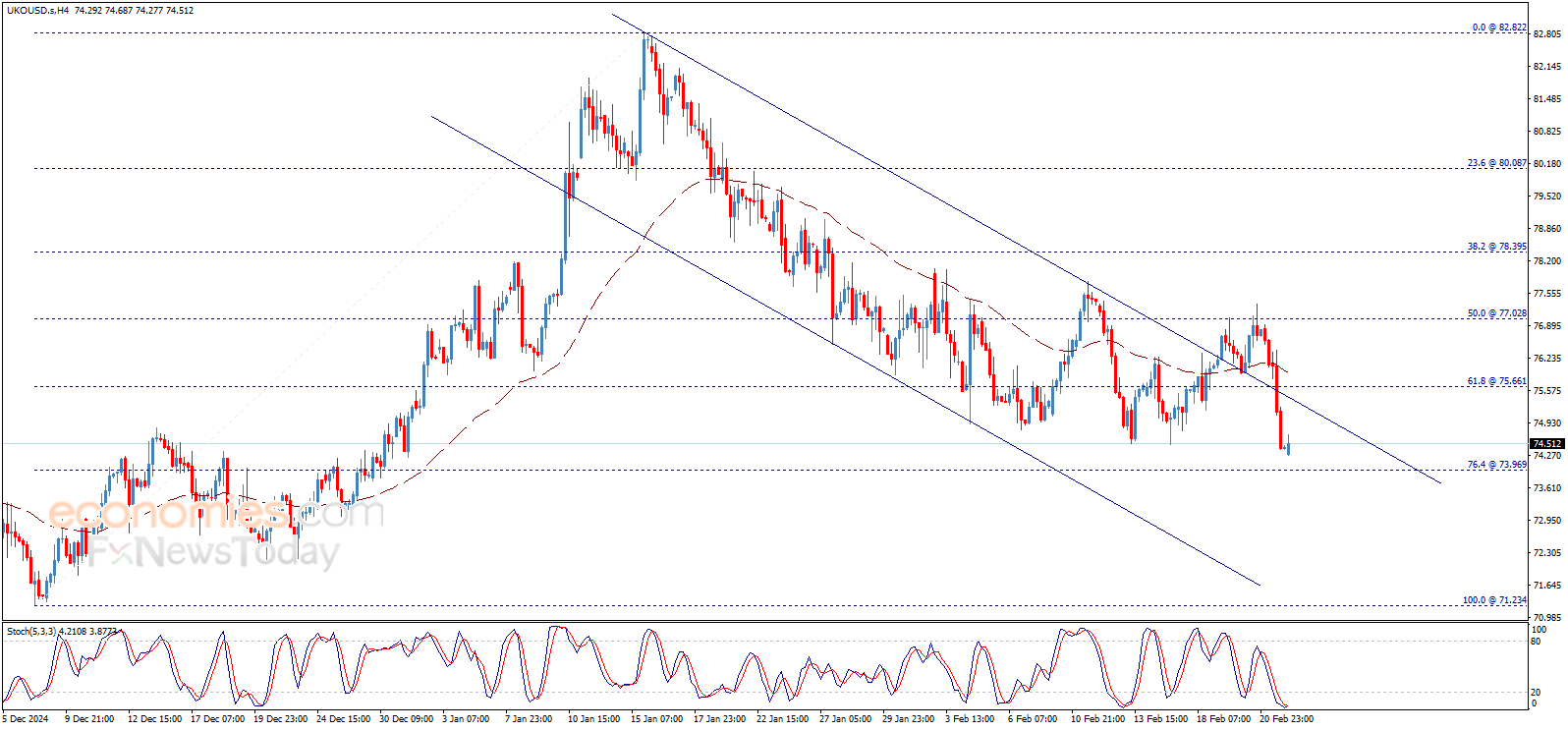
Brent oil price declined strongly in the previous sessions to surpass our waited target at 75.66$ and open the way to continue the decline on the intraday and short term basis, as it approaches our second waited target at 74.00$, noting that the price moves within the bearish channel that appears on the chart, which supports the chances of achieving more decline in the upcoming period.
For more: please follow us on Telegram channel.
Spot Gold maintained its positive momentum heading into the American opening, hitting a fresh record high of $2,956.25. The bright metal advanced despite the market’s optimism at the weekly opening.
Investors welcomed the result of the German election, as the Conservatives Party clinched a victory, although with less than 30% of the total votes. Still, a coalition government with the “failed” Social Democratic Party, which came third, fueled hopes for the country’s economic outlook.
XAU/USD, however, retreated roughly $20 after Wall Street’s opening amid a souring market mood. US indexes trimmed early gains, and only the Dow Jones Industrial Average (DJIA) holds on to modest gains. As a result, the US Dollar (USD) trades with a firmer tone across the FX board.
Attention remains on geopolitical woes. On the one hand, the United States (US) government is looking for a $500bn minerals deal with Ukraine, with Washington seeking ta tough payback for any future military aid to Kyiv. On the other hand, Russia launched its biggest-ever aerial attack on Ukraine, using 267 drones, despite claiming its willingness to reach a deal.
The macroeconomic calendar has little relevant to offer until next Friday, when the US will release an update on the Personal Consumption Expenditures (PCE) Price Index, the Federal Reserve’s (Fed) favourite inflation gauge.
Technically, the daily chart for the XAU/USD pair shows it trades within a well-limited range for a fourth consecutive day, albeit the risk remains skewed to the upside. The Relative Strength Index (RSI) indicator extends its consolidative phase at around 71, while the Momentum indicator eased from its recent highs but remains well above its midline. Finally, moving averages maintain their firmly bullish slopes far above the current level, with the 20 Simple Moving Average (SMA) providing dynamic support at around $2,872.
In the near term, and according to the 4-hour chart, XAU/USD trades above a flat 20 SMA, while the 100 and 200 SMAs head firmly north far below the current level. Technical indicators, in the meantime, turned south, with the Momentum crossing its midline into negative territory. Still, buyers are taking their chances on dips, limiting the bearish potential of Gold.
Support levels: 2,934.70 2,924.10 2,913.05
Resistance levels: 2,960.00 2,975.00 2,990.00
In the US, the personal consumption expenditure report and comments from US Federal Reserve officials will be the centre of attention. Personal consumption expenditure prices will provide crucial insights into evolving price pressures, following US consumer price index and producer price index figures that came in higher than expected. US personal spending growth is expected to slow to 0.2%, while personal income is likely to rise by 0.4%, in line with the increase in December.
Meanwhile, the second estimate of GDP growth for the first quarter of 2025 is expected to confirm that the US economy grew at an annual rate of 2.3%, in line with the initial estimate. Additionally, durable goods orders are expected to rise 1.3% after a 2.2% decline in December.

” dir=”auto” id=”content-1686574122635″>
Watch the recent performance of the US dollar against the Japanese yen carefully as it moves towards good buying levels, so be on time to seize the most suitable trading opportunities, but without risk
Bank of Japan Governor Kazuo Ueda said that the Japanese central bank is ready to intensify its purchases of government bonds if long-term interest rates rise sharply. Speaking before parliament last Friday, he acknowledged that bond yields fluctuate, but he stressed that the Bank of Japan will move quickly in exceptional cases to ensure stable yield formation. Ueda pointed out that the recent increase in bond yields indicates market expectations for economic recovery in Japan and strengthening core inflation.
The Japanese central bank ended its massive stimulus program, which lasted for a decade last year, which included setting 10-year yields around zero through aggressive bond purchases, as it saw Japan approaching its 2% inflation target. In addition, the Bank of Japan reduced its bond purchases under a plan announced in July, with the aim of halving monthly purchases to 3 trillion yen by March 2026.
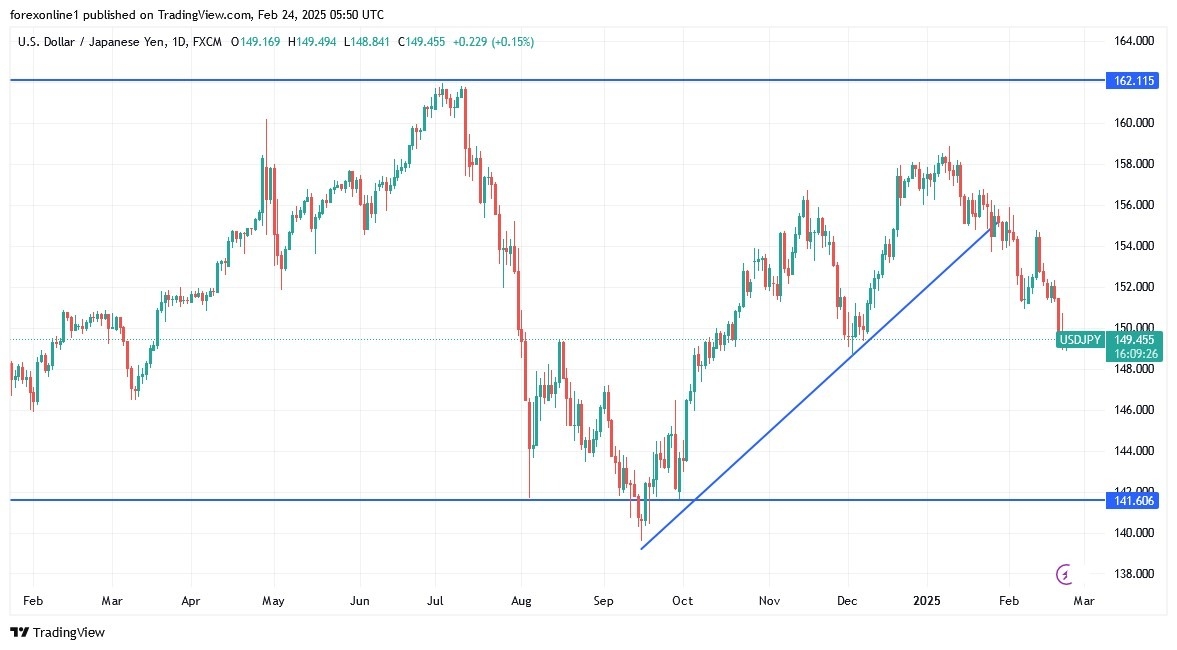
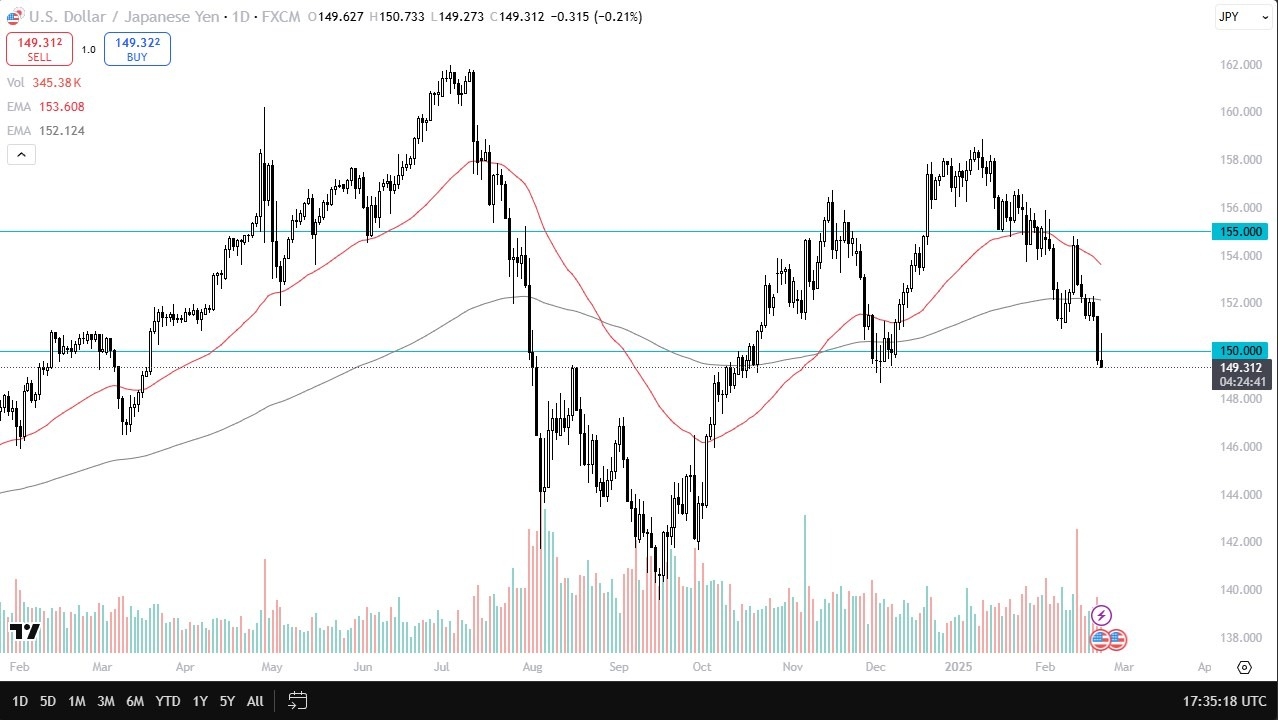
According to trading on the daily chart, the general downward trend of the USD/JPY pair is increasing in strength. As mentioned before, the movement of the currency pair below the psychological support level of 150.00 will strengthen the bears’ control over the direction and thus prepare for stronger downward breaches. The technical indicators are now closer to testing strong oversold levels, and this may be confirmed if the bears move towards the support levels of 148.70 and 147.00, respectively. In contrast, and over the same time period, a first break of the downward trend will not occur without moving towards the resistance levels of 152.40 and 154.60, respectively. The path of central bank policies, especially from the Japanese central bank, will continue to affect the performance of the USD/JPY currency pair.
Want to trade our USD/JPY forex analysis and predictions? Here’s a list of forex brokers in Japan to check out.
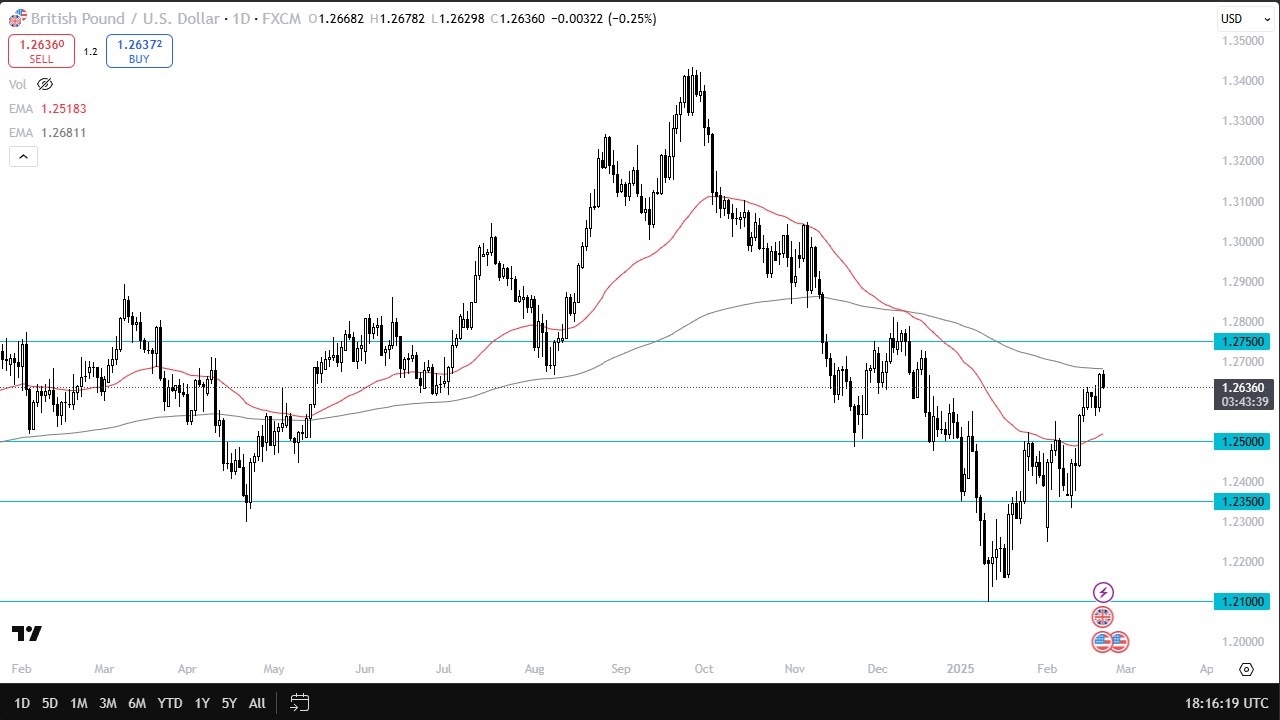
In the United States, we have seen services PMI come out lower than anticipated, but manufacturing coming out higher to previous announcements. So pretty mixed story here. And I think at this point in time, you have to look at this through the prism of whether or not we are actually a little overextended, which I think that might be part of the case here as well. Ultimately, I think we need to watch this area between the 200-day EMA and the 50-day EMA for potential consolidation.
I don’t know that we have enough information to get moving longer term one way or the other at the moment, but I certainly am cognizant of the fact that a move above maybe 1.2750 or even 1.28 could open up a much bigger move, but that is a significant resistance barrier that will have to be dealt with and will more likely than not be very difficult to deal with for those who are trying to send the market higher.
On the downside, if we were to break down below the 1.25 level, I think at that point in time, the British pound falls under serious pressure, and this would probably be a pro-US dollar move across the forex world. So we’ll see how that plays out. But this is how I see the British pound at the moment. I think it is in a state of flux. We’ll have to see whether or not the trend changes or if this was just simply a relief rally.
Ready to trade our daily Forex GBP/USD analysis? We’ve made this UK forex brokers list for you to check out
Brent oil price declined strongly in the previous sessions to surpass our waited target at 75.66$ and open the way to continue the decline on the intraday and short term basis, as it approaches our second waited target at 74.00$, noting that the price moves within the bearish channel that appears on the chart, which supports the chances of achieving more decline in the upcoming period.
For more: please follow us on Telegram channel.
With that being the case, I think you’ve got a situation where traders will start to look at this through the possibility of trying to see if this area that we are in right now actually holds. If it does not, then the US dollar is probably plunging back down to the 142 yen level. This nonsense coming out of the Federal Reserve and the Bank of Japan has made trading very difficult. And then of course, people are worried about the tariff wars. So, I think volatility is going to get worse, not better. Japan increasing its interest rate to 0.75% isn’t much of a big deal, but traders right now are worried about the rate of change.
” dir=”auto” id=”content-1686574122635″>
The question then becomes will the Federal Reserve start cutting later this year? Maybe they do, maybe they don’t, and if they don’t, then eventually the Japanese yen will have to give up some of these gains. Right now though, it’s obvious that the US dollar is basically flat on its back when it comes to the yen, so while I don’t like buying this USD/JPY pair, I certainly wouldn’t sell it quite yet either below the 148 yen level, then I think we start to see a pretty significant acceleration to the downside. At this juncture, I think a lot of questions are still out there, and I do think this is one of the more difficult pairs to trade at the moment, as the fundamentals suggest more interest rates in Japan and inflation, but the inflation in the United States is very unlikely to go anywhere.
Want to trade our USD/JPY forex analysis and predictions? Here’s a list of forex brokers in Japan to check out.
Morgan Stanley’s stock price (MS) extended its losses in the intraday levels, amid negative signals from the RSI, while seeking a bottom to bounce it higher anew, as it also gathers positive momentum, thus leaning on the support of the 50-day SMA, and also leaning on the upward secondary trend line in the short term.
Therefore we expect the stock to return higher, targeting the resistance of $142.00, provided the support of $127.66 holds on.
Trend forecast for today: Likely Bullish
EUR/USD edged lower on Friday and closed the previous week marginally lower. The pair opened on a bullish note and climbed above 1.0500 early Monday as investors reacted to the outcome of the German election outcome. Although the pair inches lower in the European morning, the technical outlook and the improving risk sentiment suggests that it could post additional gains in the near term.
The table below shows the percentage change of Euro (EUR) against listed major currencies today. Euro was the strongest against the Japanese Yen.
| USD | EUR | GBP | JPY | CAD | AUD | NZD | CHF | |
|---|---|---|---|---|---|---|---|---|
| USD | -0.28% | -0.11% | 0.18% | -0.21% | -0.24% | -0.18% | -0.13% | |
| EUR | 0.28% | 0.08% | 0.30% | -0.11% | 0.03% | -0.09% | -0.01% | |
| GBP | 0.11% | -0.08% | 0.26% | -0.19% | -0.05% | -0.16% | -0.10% | |
| JPY | -0.18% | -0.30% | -0.26% | -0.40% | -0.35% | -0.29% | -0.22% | |
| CAD | 0.21% | 0.11% | 0.19% | 0.40% | -0.09% | 0.03% | 0.09% | |
| AUD | 0.24% | -0.03% | 0.05% | 0.35% | 0.09% | -0.12% | -0.05% | |
| NZD | 0.18% | 0.09% | 0.16% | 0.29% | -0.03% | 0.12% | 0.08% | |
| CHF | 0.13% | 0.01% | 0.10% | 0.22% | -0.09% | 0.05% | -0.08% |
The heat map shows percentage changes of major currencies against each other. The base currency is picked from the left column, while the quote currency is picked from the top row. For example, if you pick the Euro from the left column and move along the horizontal line to the US Dollar, the percentage change displayed in the box will represent EUR (base)/USD (quote).
The CDU/CSU, led by Friedrich Merz, won the German election by securing about 28.6% of total votes, while the far-right AfD came second with 20.8%. Finally, Olaf Scholz’s SPD received 16.4% of votes to drop to third. The Euro gathered strength as these results offered no major surprises. Experts now expect a two-party coalition to be formed with CDU/CSU and SPD.
In the second half of the day, the US economic calendar will not feature any high-impact data releases that could influence the US Dollar’s (USD) valuation in a noticeable way.
Meanwhile, US stock index futures were last seen rising between 0.3% and 0.45%. A bullish opening in Wall Street could make it difficult for the USD to stage a rebound and support EUR/USD.
On Tuesday, the Conference Board will release the US Consumer Confidence Index data for February.
The Relative Strength Index (RSI) indicator on the 4-hour chart holds above 50, suggesting that the bullish bias remains intact.
EUR/USD faces the first resistance area at 1.0500-1.0510 (round level, Fibonacci 78.6% retracement of the latest downtrend). Once the pair flips that area into support, 1.0550 (static level) could be seen as the next resistance level before 1.0600 (beginning point of the downtrend).
Looking south, supports could be spotted at 1.0440 (Fibonacci 61.8% retracement), 1.0390-1.0400 (100-period Simple Moving Average (SMA), 50-day SMA, Fibonacci 50% retracement of the latest downtrend) and 1.0375 (200-period SMA).
The Euro is the currency for the 19 European Union countries that belong to the Eurozone. It is the second most heavily traded currency in the world behind the US Dollar. In 2022, it accounted for 31% of all foreign exchange transactions, with an average daily turnover of over $2.2 trillion a day. EUR/USD is the most heavily traded currency pair in the world, accounting for an estimated 30% off all transactions, followed by EUR/JPY (4%), EUR/GBP (3%) and EUR/AUD (2%).
The European Central Bank (ECB) in Frankfurt, Germany, is the reserve bank for the Eurozone. The ECB sets interest rates and manages monetary policy. The ECB’s primary mandate is to maintain price stability, which means either controlling inflation or stimulating growth. Its primary tool is the raising or lowering of interest rates. Relatively high interest rates – or the expectation of higher rates – will usually benefit the Euro and vice versa. The ECB Governing Council makes monetary policy decisions at meetings held eight times a year. Decisions are made by heads of the Eurozone national banks and six permanent members, including the President of the ECB, Christine Lagarde.
Eurozone inflation data, measured by the Harmonized Index of Consumer Prices (HICP), is an important econometric for the Euro. If inflation rises more than expected, especially if above the ECB’s 2% target, it obliges the ECB to raise interest rates to bring it back under control. Relatively high interest rates compared to its counterparts will usually benefit the Euro, as it makes the region more attractive as a place for global investors to park their money.
Data releases gauge the health of the economy and can impact on the Euro. Indicators such as GDP, Manufacturing and Services PMIs, employment, and consumer sentiment surveys can all influence the direction of the single currency. A strong economy is good for the Euro. Not only does it attract more foreign investment but it may encourage the ECB to put up interest rates, which will directly strengthen the Euro. Otherwise, if economic data is weak, the Euro is likely to fall. Economic data for the four largest economies in the euro area (Germany, France, Italy and Spain) are especially significant, as they account for 75% of the Eurozone’s economy.
Another significant data release for the Euro is the Trade Balance. This indicator measures the difference between what a country earns from its exports and what it spends on imports over a given period. If a country produces highly sought after exports then its currency will gain in value purely from the extra demand created from foreign buyers seeking to purchase these goods. Therefore, a positive net Trade Balance strengthens a currency and vice versa for a negative balance.