The main category of Forex News.
You can use the search box below to find what you need.
[wd_asp id=1]
The main category of Forex News.
You can use the search box below to find what you need.
[wd_asp id=1]
The Betsy has risen to a new record high, rising about Friday and closing at 8505, the previous record. The index was led higher by a broad range of sectors, including miners, banks, and utilities.
The FTSE 100 is supported after soft data last week, which reassured expectations that the Bank of England could cut interest rates more aggressively than the 1 cut the market had priced in.
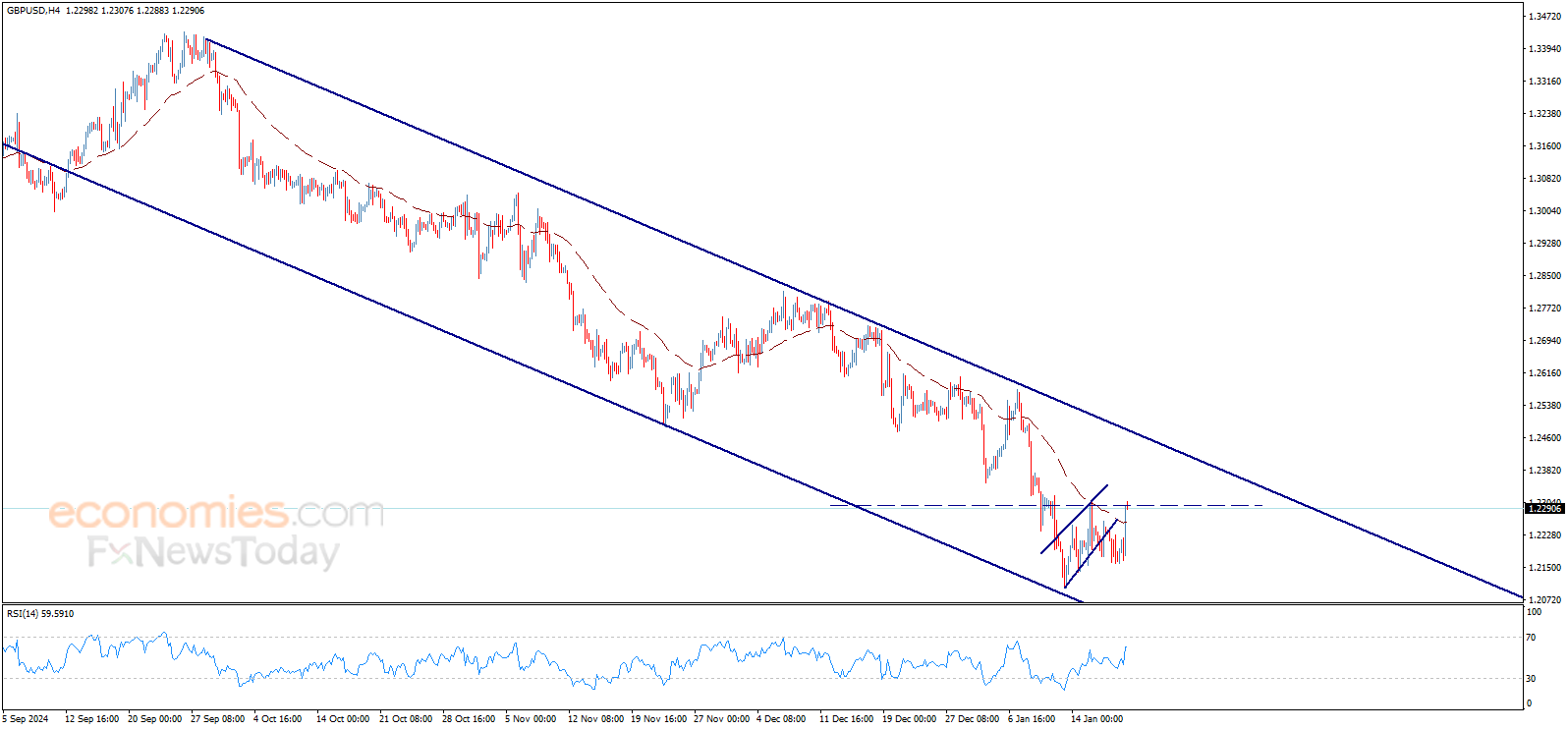
GBP/US struggles below 1.22 at the multi-year low, which fits the multinationals that make up the large majority of the FTSE index.
Attention is on Donald Trump’s second inauguration and the measures he will implement immediately. While the UK isn’t necessarily in line for a direct hit from trade tariffs, it will likely be impacted indirectly should Trump adopt an aggressive stance. The US stock market is closed today.
The UK economic calendar is quiet, and figures from Rightmove have failed to buoy the house-building sector. Average asking prices for newly listed homes in the UK have seen the biggest start-of-the-year increase since 2020. According to Rightmove, the average price rose by 1.7% between December 8th and January 11th compared to the same period a year ago.
While the housing market gained some momentum on hopes that borrowing costs would continue to fall, the uncertainties surrounding BoE could limit gains going forward. The market is pricing two 25 basis point cuts this year, up from one at the start of last week. However, the BoE has guided towards four rate cuts.
The FTSE has broken out of range, rising above 8490 to fresh all-time highs. With blue skies above, buyers could consider the 8600 round number.
However, the RSI is very overbought, so buyers should be cautious some consolidation could be on the cards. Immediate support is at 8490 and 8400 below here. Should sellers take out 8325, the price returns to the familiar range within which it traded for much of the past 9-months.
USD/JPY is holding steady at the start of the new week as investors await cautiously ahead of chumps inauguration. President-elect Donald Trump is expected to make a flurry of policy announcements in the first hours of his second presidency. Meanwhile, the Bank of Japan is expected to hike interest rates at the end of the week.
Trump will take the oath at noon Eastern Time (19:00 GMT). He is expected to sign a slew of executive orders that will set the tone for his presidency. Monday is a US holiday, with stock markets closed for Martin Luther King Day. So, the forex market will see an immediate reaction to his inauguration pledges, while the stock markets will likely react when they open on Tuesday.
Where the US dollar goes from here greatly depends on how aggressively Trump implements trade tariffs and tax cuts. These measures are inflationary. The USD has rallied on expectations of few rate cuts since Trump’s victory. Any sense of a more relaxed approach could pull the US dollar lower.
The USD fell last week after weaker-than-expected underlying US inflation saw the market ramp up Fed rate cut expectations. Dovish comments from Federal Reserve governor Christopher Waller also weighed on the USD.
The yen rallied last week on hints from the BoJ that a rate hike could be discussed at this week’s BoJ rate meeting.
Before the BoJ meeting on Friday, Japanese inflation data will be released.

USD/JPY eased back from a six-month high of 158.90 reached last week before finding support at 155.00, around the 50 SMA. The price holds steady around 156.20, while the RSI gives away few clues at its neutral level.
Buyers will need to rise above 156.20 and 157.00, the 78.6% Fib retracement level, to bring 158.90 into focus. A rise above here is needed to create a higher high and turn attention to 160.00.
Support is seen at 155.00, ahead of 154, the rising trendline dating back to 2022, and 153.30, the 61.8% fib retracement.

“The inflation crisis was caused by massive overspending and escalating energy prices, and that is why today I will also declare a national energy emergency. We will ‘Drill, baby, drill!'” Trump said during his inauguration speech.
The focus is on what executive orders Trump will sign over the next 24 hours, said UBS analyst Giovanni Staunovo.
Trump is also expected to make policy announcements that include an end to a moratorium on LNG export licences as part of a wider strategy to strengthen the economy.
The Brent and WTI benchmarks advanced more than 1 per cent last week for a fourth-consecutive weekly gain after the Biden administration imposed sanctions on more than 100 tankers and two Russian oil producers.
That led to a scramble by top buyers China and India for prompt oil cargoes and a rush for ship supply, as dealers of Russian and Iranian oil sought tankers not under sanctions for oil shipment.
While the new sanctions could cut supply from Russia by nearly 1 million barrels per day, recent price gains could be short-lived depending on Trump’s actions, ANZ analysts said in a client note.
Trump has promised to help to end the Russia-Ukraine war quickly, which could involve relaxing some curbs to enable an accord, they said.
Easing tension in the Middle East also kept a lid on oil prices. Hamas and Israel exchanged hostages and prisoners on Sunday that marked the first day of a ceasefire after 15 months of war. Yemen’s Houthis will target only Israel-linked vessels following the Gaza ceasefire, the Sanaa-based Humanitarian Operations Coordination Center said.
Q1. What are key indexes of Crude oil?
A1. Two key indexes of Crude oil are Brent crude futures and U.S. West Texas Intermediate crude futures.
Q2. What has Donald Trump said about Russia-Ukraine war?
A2. Donald Trump has promised to help to end the Russia-Ukraine war quickly.
Disclaimer Statement: This content is authored by a 3rd party. The views expressed here are that of the respective authors/ entities and do not represent the views of Economic Times (ET). ET does not guarantee, vouch for or endorse any of its contents nor is responsible for them in any manner whatsoever. Please take all steps necessary to ascertain that any information and content provided is correct, updated, and verified. ET hereby disclaims any and all warranties, express or implied, relating to the report and any content therein.
Image © Adobe Images
Pound Sterling has entered a technical downtrend against the Euro, with Tuesday’s labour market report posing new downside risks.
The Pound to Euro exchange rate (GBPEUR) is at 1.1850 after falling for three weeks in succession, and there is little in the technical charts or fundamental setup to advocate for a major recovery.
Weakness culminated in a break below the 200-day exponential moving average (EMA) last Tuesday (1.1890), and the exchange rate has so far failed to reclaim this technical level. A rule of Pound Sterling Live’s Week Ahead model is that a break below the 200 EMA signals an exchange rate has entered a multi-week downtrend.

In fact, it looks as though the 200 EMA will now act as a resistance level that will block any recovery attempts, suggesting any GBP/EUR strength in the coming days will be shallow.
The selloff has, nevertheless, slowed. The Relative Strength Index (RSI) reached oversold conditions last week (after hitting 30), which meant a period of recovery or consolidation was needed. It appears that consolidation has played out, allowing the RSI to unwind from oversold.
There also appears to be some graphical support forming at approximately 1.18450-1.1900, which goes back to periods of weakness in September and October of last year (see the turquoise line on the chart). This could offer some support in the run-up to Tuesday’s UK labour market report before ultimately giving way to a fresh leg lower.
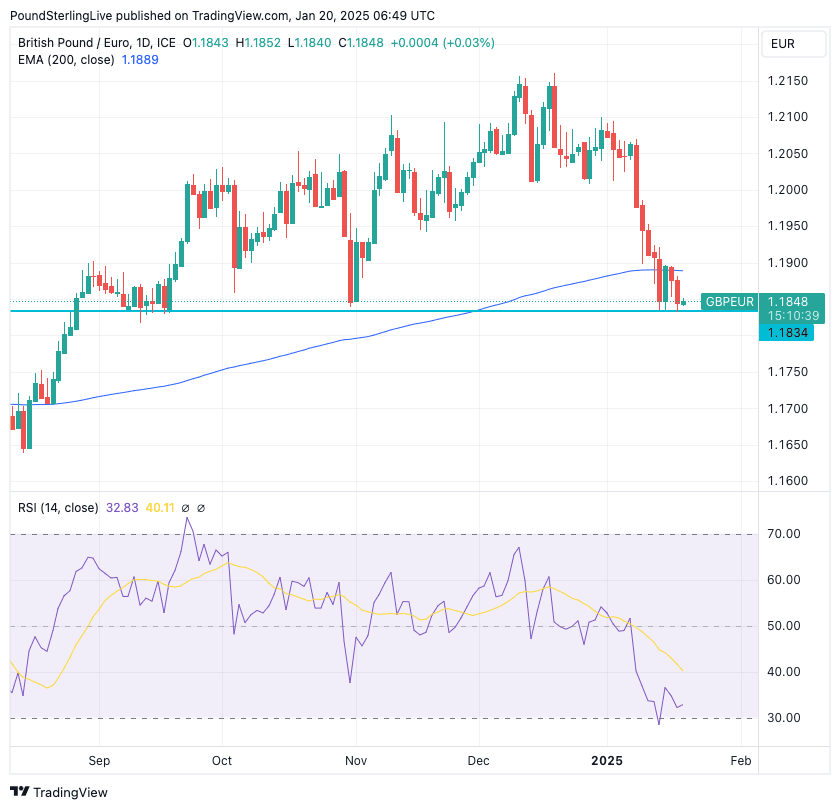
Above: GBP/EUR at daily intervals, showing the break below the 200 EMA and the recent recovery from oversold in the RSI (lower panel).
Pound Sterling has been hit by a run of poor data over recent weeks that speaks of an economy that has run out of momentum owing to the significant taxes placed on businesses by the government. In addition, an inflation-busting increase to the minimum wage is due to come into effect, as is further red tape on employing people.
All this points to the labour market as a key cost driver and headwind for businesses operating in the UK, and this is why this week’s labour market report will be of particular interest. The outcome is likely to influence expectations for the amount of interest rate cuts the Bank of England will likely make this year.
The consensus looks for the unemployment rate to edge up to 4.4% from 4.3% in light of survey evidence of growing job losses and a slowdown in hiring intentions. In particular, the PMI surveys have been warning of a deterioration in the labour market for a couple of months now.
GBP/EUR investment bank consensus forecast for 2025. See the median, mean, highest and lowest point targets, giving a highly accurate forecasting resource. Request it Now.
“Employment indicators are pointing firmly to a decline in payrolled employment in the coming months,” says Sam Hill, Head of Market Insights at Lloyds Bank.
The Pound is likely to fall should unemployment rise faster than was expected and the opposite reaction is likely if the data proves stronger than expected.
“A payrolls rise would be a big surprise, suggesting business sentiment is overegging the jobs slowdown and likely pushing the market back to pricing fewer than two cuts,” says Robert Wood, an economist at Pantheon Macroeconomics.
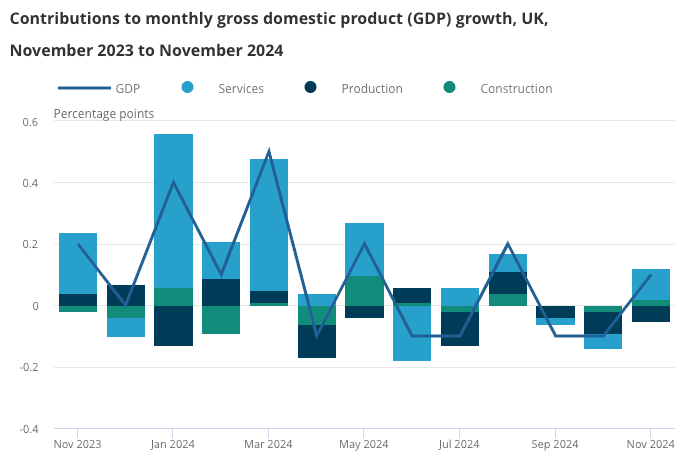
Above: The economy has essentially flatlined following strong growth in the first half of 2024.
Of importance to traders will be the wage data that is released alongside the job figures. Here, The consensus expects wages to rise 5.5% in November, up from 5.2% in October. In isolation, the rule is that the pound will fall if wages undershoot expectations, but it will rise if the data beats.
The Bank of England is watching employment and wage dynamics, judging that high wages are inflationary and must be met with higher-for-longer interest rates.
However, rising unemployment will suggest to the Bank that wage pressures will fall notably in the coming months, which will allow them to cut interest rates further.
For the Pound, rising expectations for rate cuts will result in weakness and this is why we forecast further GBP downside in the coming days, judging that the process has further to run.
Money market pricing shows investors have raised bets for more rate cuts from the Bank of England this year, which has contributed to the weaker Pound. However, the market is still only expecting two rate cuts, with a third being a possibility.
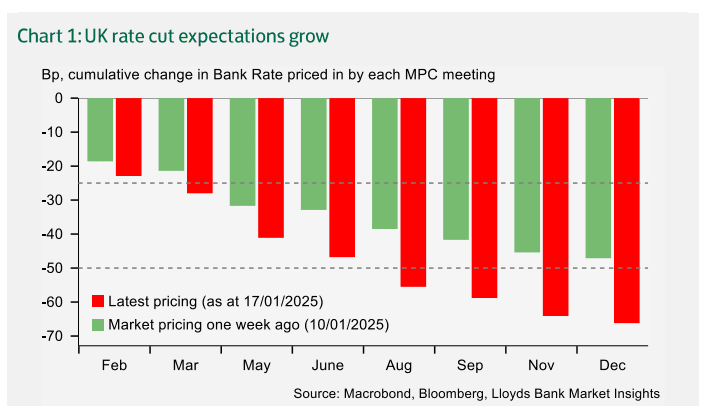
Above: Markets see more rate cuts ahead than was the case just one week ago, and there is scope for this trend to continue.
Most economists we follow suggest four cuts is the most likely outcome. This means the market can continue to ‘price in’ rate cuts from here, resulting in further weakness in Pound Sterling.
Keep an eye on Friday’s release of PMI survey data for January as this will be the first major snapshot of how the UK and Eurozone economies performed in January.
The consensus looks for Eurozone output to have improved, driven by a recovery in Germany. This can bolster the Euro relative to the Pound.
The UK is meanwhile expected to show a slowdown in activity:
“Flash PMIs on Friday will likely show continued weak momentum; we expect the services PMI to drop to 50.5. But the details are as important as the headline now. The crucial question for the economic outlook and the MPC’s decisions is how much tax hikes are cutting employment or raising prices,” says Wood.
Our setup for the Pound-Euro is bearish owing to the event risks associated with the labour market data and the downbeat technical setup. However, we do note that some investment bank technical strategists now think weakness has gone too far and are looking to buy the pound against the euro at these levels.
“We go short EURGBP,” says a strategy note from Citi, citing expectations for a reversal in negative sentiment towards the UK.
However, we think this week will be too soon for sentiment to improve, given expectations for a poor labour market report.
Important DisclaimersThe content provided on the website includes general news and publications, our personal analysis and opinions, and contents provided by third parties, which are intended for educational and research purposes only. It does not constitute, and should not be read as, any recommendation or advice to take any action whatsoever, including to make any investment or buy any product. When making any financial decision, you should perform your own due diligence checks, apply your own discretion and consult your competent advisors. The content of the website is not personally directed to you, and we does not take into account your financial situation or needs.The information contained in this website is not necessarily provided in real-time nor is it necessarily accurate. Prices provided herein may be provided by market makers and not by exchanges.Any trading or other financial decision you make shall be at your full responsibility, and you must not rely on any information provided through the website. FX Empire does not provide any warranty regarding any of the information contained in the website, and shall bear no responsibility for any trading losses you might incur as a result of using any information contained in the website.The website may include advertisements and other promotional contents, and FX Empire may receive compensation from third parties in connection with the content. FX Empire does not endorse any third party or recommends using any third party’s services, and does not assume responsibility for your use of any such third party’s website or services.FX Empire and its employees, officers, subsidiaries and associates, are not liable nor shall they be held liable for any loss or damage resulting from your use of the website or reliance on the information provided on this website.Risk DisclaimersThis website includes information about cryptocurrencies, contracts for difference (CFDs) and other financial instruments, and about brokers, exchanges and other entities trading in such instruments. Both cryptocurrencies and CFDs are complex instruments and come with a high risk of losing money. You should carefully consider whether you understand how these instruments work and whether you can afford to take the high risk of losing your money.FX Empire encourages you to perform your own research before making any investment decision, and to avoid investing in any financial instrument which you do not fully understand how it works and what are the risks involved.
Bitcoin price (BTCUSD) rallied upwards sharply to succeed touching our waited target at 108350.45$ and approached 110000.00$ barrier, and the way seems open to continue the rise to achieve additional gains that extend to 112000.00$, noting that breaking 104900.00$ will put the price under negative pressure to head towards testing key support levels that start at 98930.00$.
The expected trading range for today is between 106500.00$ support and 111000.00$ resistance.
Trend forecast: Bullish
Gold prices (XAU/USD) continued their bullish momentum near the $2,700 mark at the start of the week, amid thin trading conditions due to Martin Luther King Jr. Day and heightened anticipation ahead of President Trump’s Inauguration Day.
The US Dollar (USD) weakened throughout Monday’s session as investors adopted a risk-on approach in anticipation of Donald Trump beginning his second term as President.
Looking ahead, developments surrounding the White House are expected to dominate the immediate market focus during a week light on significant data releases. Meanwhile, attention is gradually shifting toward the January 28–29 FOMC meeting, where the Federal Reserve is widely expected to keep interest rates unchanged.
Gold’s next major upward target is $2,724, the 2025 peak reached on January 16. Just beyond that lie the December high of $2,726 (December 12) and the all-time top of $2,790 set on October 31. If prices break these levels, Fibonacci projections suggest potential new milestones at $3,009, $3,123, and $3,288.
On the downside, immediate support stands at the monthly low of $2,582 from December 19, seconded by $2,536, the November low (November 14), and the critical 200-day simple moving average at $2,511. A deeper pullback might retest $2,471, the September low (September 4). Beyond that, $2,353 (the weekly low from July 25) and $2,286 (the June low from June 7) could come into play.
If gold prices breach this lower region, the May low of $2,277 (May 3) might resurface on traders’ radar, followed by the weekly low of $2,146 (March 18). The ultimate downside target for now remains the 2024 bottom of $1,984, recorded on February 14.
Gold daily chart
The Betsy has risen to a new record high, rising about Friday and closing at 8505, the previous record. The index was led higher by a broad range of sectors, including miners, banks, and utilities.
The FTSE 100 is supported after soft data last week, which reassured expectations that the Bank of England could cut interest rates more aggressively than the 1 cut the market had priced in.
GBP/US struggles below 1.22 at the multi-year low, which fits the multinationals that make up the large majority of the FTSE index.
Attention is on Donald Trump’s second inauguration and the measures he will implement immediately. While the UK isn’t necessarily in line for a direct hit from trade tariffs, it will likely be impacted indirectly should Trump adopt an aggressive stance. The US stock market is closed today.
The UK economic calendar is quiet, and figures from Rightmove have failed to buoy the house-building sector. Average asking prices for newly listed homes in the UK have seen the biggest start-of-the-year increase since 2020. According to Rightmove, the average price rose by 1.7% between December 8th and January 11th compared to the same period a year ago.
While the housing market gained some momentum on hopes that borrowing costs would continue to fall, the uncertainties surrounding BoE could limit gains going forward. The market is pricing two 25 basis point cuts this year, up from one at the start of last week. However, the BoE has guided towards four rate cuts.
The FTSE has broken out of range, rising above 8490 to fresh all-time highs. With blue skies above, buyers could consider the 8600 round number.
However, the RSI is very overbought, so buyers should be cautious some consolidation could be on the cards. Immediate support is at 8490 and 8400 below here. Should sellers take out 8325, the price returns to the familiar range within which it traded for much of the past 9-months.
USD/JPY is holding steady at the start of the new week as investors await cautiously ahead of chumps inauguration. President-elect Donald Trump is expected to make a flurry of policy announcements in the first hours of his second presidency. Meanwhile, the Bank of Japan is expected to hike interest rates at the end of the week.
Trump will take the oath at noon Eastern Time (19:00 GMT). He is expected to sign a slew of executive orders that will set the tone for his presidency. Monday is a US holiday, with stock markets closed for Martin Luther King Day. So, the forex market will see an immediate reaction to his inauguration pledges, while the stock markets will likely react when they open on Tuesday.
Where the US dollar goes from here greatly depends on how aggressively Trump implements trade tariffs and tax cuts. These measures are inflationary. The USD has rallied on expectations of few rate cuts since Trump’s victory. Any sense of a more relaxed approach could pull the US dollar lower.
The USD fell last week after weaker-than-expected underlying US inflation saw the market ramp up Fed rate cut expectations. Dovish comments from Federal Reserve governor Christopher Waller also weighed on the USD.
The yen rallied last week on hints from the BoJ that a rate hike could be discussed at this week’s BoJ rate meeting.
Before the BoJ meeting on Friday, Japanese inflation data will be released.

USD/JPY eased back from a six-month high of 158.90 reached last week before finding support at 155.00, around the 50 SMA. The price holds steady around 156.20, while the RSI gives away few clues at its neutral level.
Buyers will need to rise above 156.20 and 157.00, the 78.6% Fib retracement level, to bring 158.90 into focus. A rise above here is needed to create a higher high and turn attention to 160.00.
Support is seen at 155.00, ahead of 154, the rising trendline dating back to 2022, and 153.30, the 61.8% fib retracement.

EUR/USD started the week on a firm footing and climbed above 1.0300. The upbeat market mood makes it difficult for the US Dollar (USD) to stay resilient against its rivals and allows the pair to continue to stretch higher.
The table below shows the percentage change of Euro (EUR) against listed major currencies today. Euro was the strongest against the US Dollar.
| USD | EUR | GBP | JPY | CAD | AUD | NZD | CHF | |
|---|---|---|---|---|---|---|---|---|
| USD | -0.44% | -0.25% | 0.09% | -0.05% | -0.24% | -0.25% | 0.08% | |
| EUR | 0.44% | 0.14% | 0.44% | 0.28% | 0.26% | 0.08% | 0.40% | |
| GBP | 0.25% | -0.14% | 0.25% | 0.13% | 0.13% | -0.06% | 0.26% | |
| JPY | -0.09% | -0.44% | -0.25% | -0.14% | -0.30% | -0.45% | -0.19% | |
| CAD | 0.05% | -0.28% | -0.13% | 0.14% | -0.13% | -0.20% | 0.12% | |
| AUD | 0.24% | -0.26% | -0.13% | 0.30% | 0.13% | -0.27% | 0.07% | |
| NZD | 0.25% | -0.08% | 0.06% | 0.45% | 0.20% | 0.27% | 0.14% | |
| CHF | -0.08% | -0.40% | -0.26% | 0.19% | -0.12% | -0.07% | -0.14% |
The heat map shows percentage changes of major currencies against each other. The base currency is picked from the left column, while the quote currency is picked from the top row. For example, if you pick the Euro from the left column and move along the horizontal line to the US Dollar, the percentage change displayed in the box will represent EUR (base)/USD (quote).
Stock and bond markets in the United States (US) will be closed in observance of the Martin Luther King Jr. Day holiday on Monday. Hence, EUR/USD’s action could remain subdued in the first half of the American session. Later in the day, Donald Trump will deliver a speech at his inauguration ceremony.
Investors remain optimistic about Trump’s refraining from introducing an aggressive tariff policy right away. On his call with Chinese President Xi Jinping, Trump said: “It is my expectation that we will solve many problems together, and starting immediately.”
Earlier in the day, the data from Germany showed that the Producer Price Index (PPI) declined by 0.1% on a monthly basis in December, against the market expectation for an increase of 0.3%. This data, however, failed to trigger a noticeable market reaction.
On Tuesday, the ZEW Survey – Economic Sentiment for the Euro area and Germany will be scrutinized by investors.
The Relative Strength Index (RSI) indicator on the 4-hour chart stays near 60, reflecting a buildup of bullish momentum. At the time of press, EUR/USD was trading at around 1.0325, where the 100-period Simple Moving Average (SMA) is located. Once the pair rises above this level and confirms it as support, technical buyers could remain interested. In this scenario, 1.0390-1.0400 (Fibonacci 50% retracement of the latest downtrend, 200-period SMA) could be seen as the next bullish target before 1.0440 (Fibonacci 61.8% retracement).
On the downside, first support could be spotted at 1.0290-1.0300 (50-period SMA; 20-period SMA, Fibonacci 23.6% retracement) ahead of 1.0250 (static level) and 1.0200 (end-point of the downtrend).
The Euro is the currency for the 19 European Union countries that belong to the Eurozone. It is the second most heavily traded currency in the world behind the US Dollar. In 2022, it accounted for 31% of all foreign exchange transactions, with an average daily turnover of over $2.2 trillion a day. EUR/USD is the most heavily traded currency pair in the world, accounting for an estimated 30% off all transactions, followed by EUR/JPY (4%), EUR/GBP (3%) and EUR/AUD (2%).
The European Central Bank (ECB) in Frankfurt, Germany, is the reserve bank for the Eurozone. The ECB sets interest rates and manages monetary policy. The ECB’s primary mandate is to maintain price stability, which means either controlling inflation or stimulating growth. Its primary tool is the raising or lowering of interest rates. Relatively high interest rates – or the expectation of higher rates – will usually benefit the Euro and vice versa. The ECB Governing Council makes monetary policy decisions at meetings held eight times a year. Decisions are made by heads of the Eurozone national banks and six permanent members, including the President of the ECB, Christine Lagarde.
Eurozone inflation data, measured by the Harmonized Index of Consumer Prices (HICP), is an important econometric for the Euro. If inflation rises more than expected, especially if above the ECB’s 2% target, it obliges the ECB to raise interest rates to bring it back under control. Relatively high interest rates compared to its counterparts will usually benefit the Euro, as it makes the region more attractive as a place for global investors to park their money.
Data releases gauge the health of the economy and can impact on the Euro. Indicators such as GDP, Manufacturing and Services PMIs, employment, and consumer sentiment surveys can all influence the direction of the single currency. A strong economy is good for the Euro. Not only does it attract more foreign investment but it may encourage the ECB to put up interest rates, which will directly strengthen the Euro. Otherwise, if economic data is weak, the Euro is likely to fall. Economic data for the four largest economies in the euro area (Germany, France, Italy and Spain) are especially significant, as they account for 75% of the Eurozone’s economy.
Another significant data release for the Euro is the Trade Balance. This indicator measures the difference between what a country earns from its exports and what it spends on imports over a given period. If a country produces highly sought after exports then its currency will gain in value purely from the extra demand created from foreign buyers seeking to purchase these goods. Therefore, a positive net Trade Balance strengthens a currency and vice versa for a negative balance.
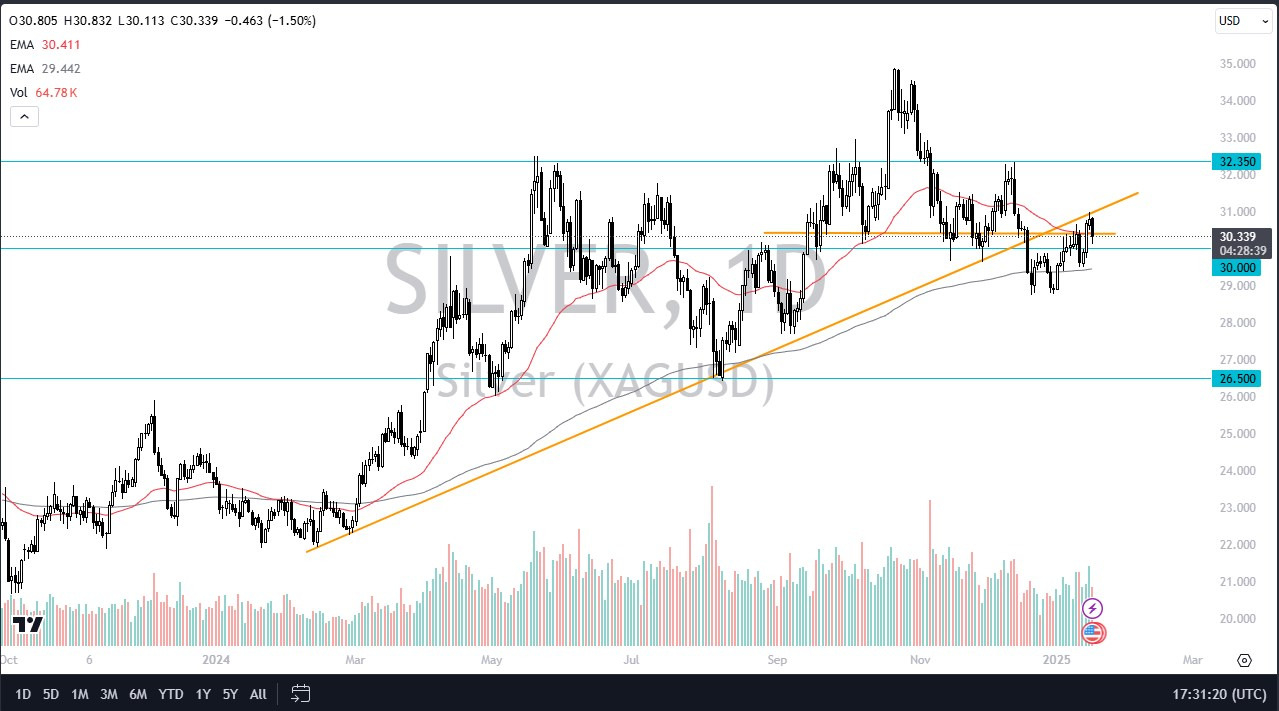
While the gold market did pull back a little bit in the early hours of Friday, silver really got hammered at one point in time, the XAG/USD pair was down about 2%. Now it looks like we are at least trying to hang on to the $30 level as support, which makes a certain amount of sense considering that it’s a large round psychologically significant figure and an area where I would imagine a lot of options traders are watching. If we were to break down below there, then it opens up the possibility of a move down to the 200 day EMA currently hanging around the $29.30 level or so.

To the upside, if we can break above the $31 level, I think that opens up the possibility of silver to go much higher, probably to $32.50. The previous uptrend line has offered resistance. So that dissects right about where I think the buy and sell orders probably end up being, especially around that $31 level. So it all ties together for a market that’s very noisy but still trying to figure out what to do with the longer term. I think we’re probably neutral to somewhat negative right now. That being said, the $31 level and the double bottom down at $28.75, I think are the two main points to watch if we break above or below that should give you a heads up as to which direction we are going.
Ready to trade our daily Forex forecast? Here’s a list of some of the Top Silver Trading Brokers to choose from.
Investing.com – Sterling has struggled of late, weighed by concerns surrounding the UK’s financial position. UBS sees the potential for further losses near term, but thinks the fiscal concerns are undone and gains are likely later in the year.
At 06:15 ET (11:15 GMT), rose 0.2% to $1.2201, but has dropped over 3% over the last month in the wake of the UK gilts turmoil as yields soared.
The recent rise in UK gilt yields has been compared in the media with the “Truss moment”, when Liz Truss became the UK’s shortest-serving PM as she was forced to resign after just 49 days in office when borrowing costs soared in the aftermath of her government’s mini-budget.
However, UBS maintains that comparisons to the 2022 “Truss saga” are overdone.
“We do not expect the recent market wobbles in the UK to result in a situation comparable to the 2022 turmoil. Pension regulations are in a better place and policymakers are (hopefully) well aware of the risks,” analysts at the Swiss bank added, in a note dated Jan. 17.
With major risks lined up in the coming weeks that could push US yields even higher, the bank cannot rule out GBP/USD breaking below $1.20.
However, this is not our base case and while we like selling upside, we prefer to remain on the sidelines in GBP/USD for the time being, as we are particularly wary of Trump inauguration risks.
“We expect GBP/USD to recover losses later in the year as we see USD strength waning, but it will take some time and potentially pain to get there,” UBS added.
The Swiss bank sees GBP/USD climbing to $1.29 by the year’s end.