The main category of Forex News.
You can use the search box below to find what you need.
[wd_asp id=1]
The main category of Forex News.
You can use the search box below to find what you need.
[wd_asp id=1]
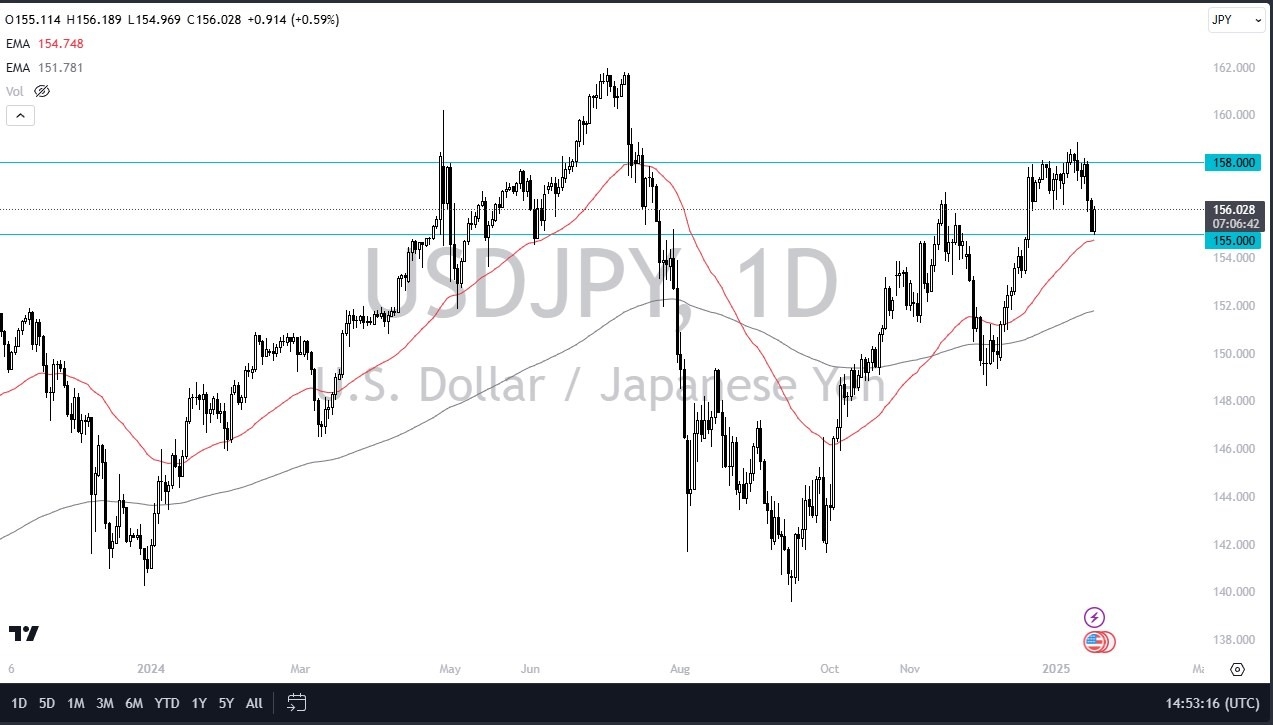
Furthermore, you should also keep in mind that the 50 Day EMA sits underneath the ¥155 level, and that of course in and of itself probably causes a little bit of technical support. With this being the case, the market is likely to continue to look at this as a market that is a “buy on the dips market”, for a whole plethora of reasons, not the least of which would be the way the market behaved during the last day or so. Ultimately, this is a market that still has a major interest rate differential, but there are some questions about things going forward.
Keep in mind that the central banks are very heavily influential in this pair, as we have seen the Federal Reserve look likely to be higher for longer at this point, and therefore it does make a certain amount of sense that we would see the US dollar remains somewhat strong. That being said, the market is also paying close attention to the Bank of Japan, which may have to tighten monetary policy sometime this year, but the interest rate differential would still be huge between the Americans and the Japanese. With that being the case, I think we continue to go higher over the longer term, but the last couple of days were probably necessary to shake out some of the “weak hands.”

Short-term dips should continue to be buying opportunities, and I have no interest in shorting this pair anytime soon. While things could change down the road, right now it looks like the Federal Reserve is light years away from starting to cut rates.
Ready to trade our Daily Forex forecast? Here’s a list of some of the top forex brokers in USA to check out.
January 19, 2025 – Written by David Woodsmith
STORY LINK Pound to Euro Week Ahead Forecast: Trump Inauguration, Sterling Vulnerability
Nomura notes Pound vulnerability, but it is still targeting a Pound to Euro (GBP/EUR) exchange rate to strengthen to 1.2270 at the end of 2025.
ING has shifted its forecasts and now expects GBP/EUR will weaken to 1.1765 at the end of the year.
Pound confidence dipped sharply early in the week amid a slide in UK bonds, with a jump in the 10-year yield to 16-year highs above 4.90%.
There were some fears over a re-run of the 2022 crisis,s with higher yields jeopardising the government’s economic strategy.
There was some stabilisation later in the week as the bond market recovered and yields declined.
Credit Agricole notes that the Pound has tended to come under pressure when there is a sell-off in bonds; “The UK has displayed, since Brexit essentially, and even more acutely over the past four years, a negative FX-bond differential correlation during some stress episodes.”
It added, “This underlines that FX moves in GBP and rates are driven more by inflows and outflows of capital than by the pure rate differential. The external financing issue can increase if the market cannot absorb even more public deficit but we remain far from the context of autumn 2022.”

According to ING, “Though we do not think UK comparisons to Liz Truss/Sep 2022 are fully justified, the FX options market is far more alarmed.”
Nomura considers that there is good value in buying the Pound on dips, but there are significant warning signs.
The banknotes several structural vulnerabilities; “The first is that these occurrences are becoming more common and longer lasting than in previous years. The second is that GBP’s external deficit is funded increasingly by volatile short-term inflows. The third is that valuations are rich and speculators haven’t yet shifted their positioning to be as short GBP as other currencies. The final issue is that the UK’s growth-inflation mix is worsening.”
Danske Bank; “With global financial conditions tightening and long-end global real rates moving higher, the UK is left vulnerable given its fragile fiscal position as it runs a large public debt and deficits.”
It added, “We are cautiously optimistic that the move in UK markets is overdone and expect long-end global yields to decline. More broadly, we think a relatively hawkish BoE and a growth pickup in the UK relative to the euro area in 2025 will weigh on the cross in the coming quarters.”
UK data was generally weak with November GDP growth held to 0.1% while the inflation data was weaker than expected with the core rate declining to 3.2% from 3.5%.
ING expects more substantial Bank of England interest rate cuts amid weak growth and declining inflation, which will undermine the Pound; “When it comes to BoE versus ECB market pricing of the 2025 easing cycles, the risks here are clearly to the upside for EUR/GBP. We think the BoE easing cycle will be far deeper than what is currently priced. Again, UK services inflation is key here.”
According to UBS, “Fiscal uncertainty motivated us to lift the EURGBP forecast for March to 0.84 (prev. 0.82). With our expectation for better economic growth in the UK during 2025, EURGBP should still gravitate back to 0.82 by year-end. (1.22 for GBP/EUR)
ING noted that GDP contracted in 2023 and 2024.
It expects a further struggle in 2025; “it is also becoming increasingly clear that even in a best-case scenario with reforms and investments, any new government will not try to overhaul the old economic business model, but rather try to rejuvenate the old one.”
Bank of America suggests that Euro pessimism may be overdone; “with the market consensus already being so negative and very low expectations for any EU reaction to address its challenges, including in response to US policies, we see risks for the EUR as asymmetrically positive beyond the short term and we believe that the bar is relatively low.”
International Money Transfer? Ask our resident FX expert a money transfer question or try John’s new, free, no-obligation personal service! ,where he helps every step of the way,
ensuring you get the best exchange rates on your currency requirements.
TAGS: Pound Euro Forecasts
Long of Corn futures following a daily close above 475 (CORN etf can also be used). This set up on Monday, and the price rose by a further 1.64% over the rest of the week.
The weekly loss of 7.28% equals 2.43% per asset.
Last week saw several key data releases, although the directional movement was a little below average:
US PPI – this inflation indicator rose by only 0.2% month-on-month, while an increase of 0.4% was expected, giving a dovish surprise and helping to produce a market where stocks could rise.
US Retail Sales – this was notably slower than expected, at a month-on-month increase of only 0.4% when 0.6% was expected, supporting the inflation-indicated outlook of a slowing US economy.
UK CPI (inflation) – this came in a fraction lower than expected at an annualized rate of 2.5% when 2.6% was expected.
UK GDP – lower than expected, showing a month-on-month increase of only 0.1%, together with the inflation data, it is suggestive of a slowing economy.
US Unemployment Claims – this was as expected.
UK Retail Sales – this was much worse than expected, showing a month-on-month decline of 0.3% when an increase of 0.4% was seen as likely. This suggests a markedly slowing British economy.
Australian Unemployment Rate – as expected this was unchanged at 4.0%.
Last week’s key takeaway was an improvement in risk sentiment and a minor decline in the US Dollar due to weaker than expected US inflation and PPI data, which boosted the chance of a rate hike at the Fed’s March meeting.
The British Pound is notably weak in the Forex market, while the Japanese Yen is particularly strong. The weakness in the Pound was given legs by weaker than expected UK CPI (inflation) and retail sales data. The Japanese Yen has a tailwind because markets increasingly expect that the Bank of Japan might raise its interest rate at its policy meeting this week.
The coming week has a lighter schedule of releases, so we are very likely to see a relatively low level of activity and volatility in the Forex market.
The coming week’s important data points, in order of likely importance, are:
Bank of Japan Policy Rate & Monetary Policy Statement
New Zealand CPI (inflation)
USA, Germany, UK, France Flash Services & Manufacturing PMI
UK Claimant Count Change (Unemployment Claims)
Canada Unemployment Claims
Monday is a public holiday in the USA.
For January, I forecasted that the USD/JPY currency pair would rise in value and that the EUR/USD currency pair would fall in value. The performance so far of this forecast is:

Last week, I made no weekly forecast as there were no unusually strong price movements in currency crosses, which is the basis of my trading strategy.
The Japanese Yen was the strongest major currency last week, while the British Pound was again the weakest. Volatility was lower last week, with only 7% of the most important Forex currency pairs and crosses changing in value by more than 1%. It is likely to increase or remain at a similar level over the coming week.
Last week, the US Dollar Index printed a near-doji candlestick that continued the long-term bullish trend, again bullishly breaking out to make its highest close in more than 2 years. However, the week did close slightly down, indicating a bearish retracement. The price is above its price from three and six months ago, suggesting a healthy long-term bullish trend in the greenback that should be exploitable. Bullish signs remain present.
The US Dollar took a bit of a knock last week, mostly due to natural profit-taking but also due to lower-than-expected inflation and PPI data, which suggest a stronger case for rate cuts by the Federal Reserve in 2025.
The Dollar is likely to rise over the coming week. The price has room to rise to at least the next resistance level at 110.00. However, it is worth noting that the price is not far from that level.

The GBP/USD currency pair is in a valid long-term bearish trend. It fell again last week, although the weekly candlestick shown in the price chart below looks a little indecisive, suggesting bearish momentum has slowed.
The British Pound was the weakest of all major currencies last week and this pair is in focus because both currencies are newsworthy.
The British Pound is weak due to continually poor UK economic data releases which suggest the British economy is strongly slowing down and might even go into recession. Another problem is that the markets just do not really believe in the new British government’s economic projections, causing a credibility gap which has led options markets to short the Pound quite strongly.
The US Dollar hit a new 2-year high last week, and although it has pulled back on an increasing likelihood of Fed rate cuts following weaker Core CPI data, there is plenty of residual strength left in the Dollar.
I see this currency pair as an obvious sell, although not as much as I did last week. Technically, bears should watch out as the price is near a major bullish inflection point just above $1.2100, which can be seen quickly by glancing at the price chart below.

The EUR/USD currency pair is in a valid long-term bearish trend. The price again reached a new 2-year low last week but rebounded to end the week higher for the first time in 5 weeks.
This currency pair often has very reliable trends, so I am generally interested in being short. The bearish retracement we have just seen is probably over, with the price falling over the course of Friday last week.
The Euro is not especially weak, with the bearish momentum being driven mostly by a strong US Dollar which is advancing almost everywhere.
I see this currency pair as a sell. It is probably the most reliable trade opportunity right now in the entire Forex market, except maybe the GBP/USD currency pair, which is probably dragging the price here lower.

The USD/JPY currency pair is still technically within a long-term bearish trend, as its volatility has become so high that it can retrace several hundred pips in price and yet remain within 3 ATRs of its peak.
The US Dollar is in a long-term bullish trend, but the problem for bulls here is that the Japanese Yen has really strengthened as markets start to expect the Bank of Japan will be likely to hike its interest rate this coming week. Bank officials have strongly hinted that they want to do this, if they can justify it by the latest economic data releases showing Japanese wage growth.
I do not have much faith in the long-term bullish trend, but this pair has volatility and so it can be very interesting to skilled traders, especially day traders, who can read the days where directional price movement is likely.

Since falling to a new 2-month low below $91k a couple of weeks ago, the Bitcoin price printed a daily pin bar which was very bullish as it rejected that low, and Bitcoin has continued to rise ever since. It is now in sight of the record high it printed last month. A daily close above $106,187 will be a new record closing price in New York and could be a good long trade entry signal.
Bitcoin got a major boost after President-Elect Trump won the US Presidential election last November, as he was seen as much more sympathetic to cryptocurrency than the Democratic candidate. However, the strong post-election rally quickly faltered after breaking above the big round number at $100,000. As President-Elect Trump is sworn into office tomorrow, we may see Bitcoin get another psychologically driven boost.
Bitcoin is also getting a tailwind from improving stock markets, especially in the USA, as Bitcoin behaves like a risk asset, and not like a hedge as is commonly supposed.
Bitcoin has made some meteoric and highly profitable bullish breakouts in recent years, and I think they are all worth trying to participate in, so I will be going long if we get a new record high daily close in New York this week.

Last Friday, Corn futures printed a strong and large bullish candlestick, which closed at a new 1-year high closing price. The price also cleared the inflection point at 475 last week. The price closed very near its weekly high at the end of last week. These are all bullish signs.
Taking long trades when major commodities break out to new 6-month highs has historically been a very profitable trading strategy, which is the main reason that I want to be long here.
Unfortunately, Corn futures are quite expensive and just too large for retail traders, but there is an ETF called CORN which can be used to participate in increases in the price of corn. Here, this ETF is outperforming the relevant futures, which puts a bit of a question mark above corn.

I see the best trading opportunities this week as:
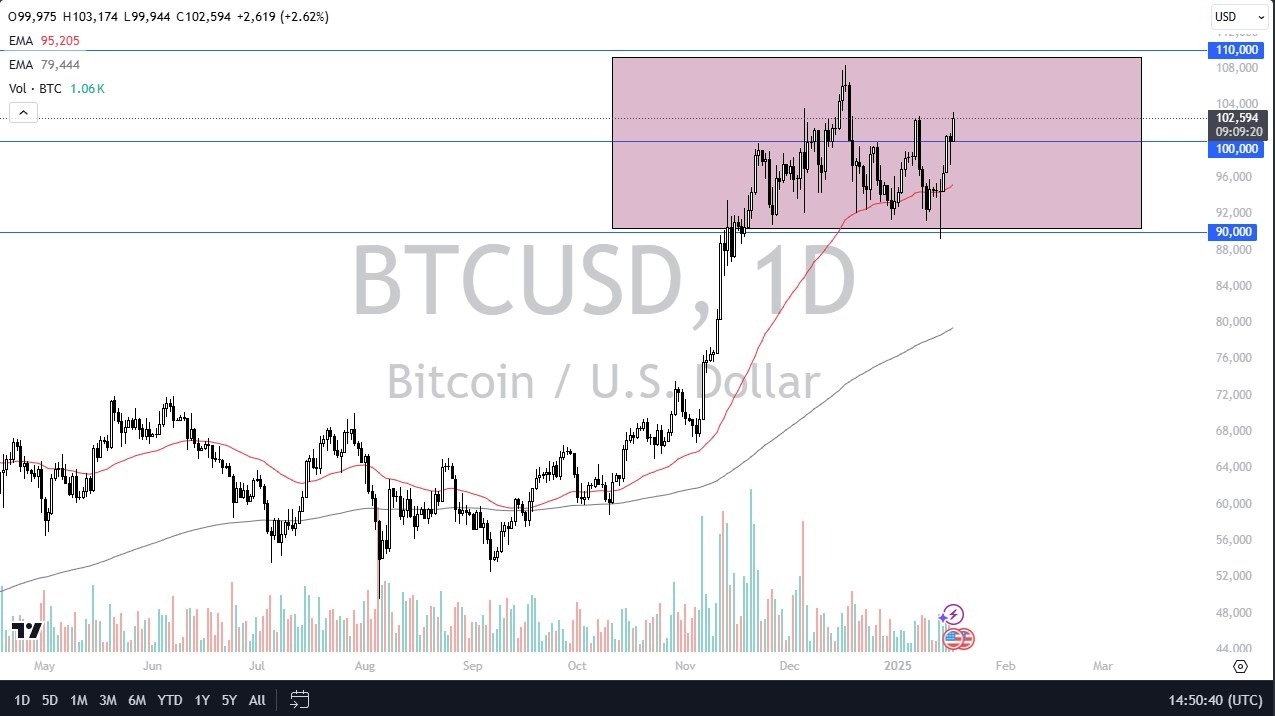
The technical analysis for this pair is somewhat sideways at this point in time, but at this point in time it certainly looks as if the market favors the upside in general. The $90,000 level underneath was a major support level, while the $110,000 level is a major resistance barrier. All things being equal, this is a market that will continue to be noisy, but given enough time, I would finally expect this market to go to the upside and breakout, but the question is what will cause it to happen? After all, the Trump administration is already known to be pro crypto, but now we have to see them actually do something to really get the markets moving.
It’s also worth noting that the market had gone sideways for a while due to the fact that we had exploded to the upside, and with that being said I think we’ve got work off some of the noisy behavior that had previously been such a prominent part of this market. Nonetheless, I think this is a scenario where traders will continue to buy each and every dip, because it offers value that you can take advantage of. I have no interest in shorting Bitcoin, and quite frankly I think that the range holds as long as we can stay above the crucial $88,000 level, as the $90,000 level is essentially a “range of support.”
Ready to trade our Daily Forex forecast? Here’s a list of some of the top forex brokers in Bitcoin to check out.
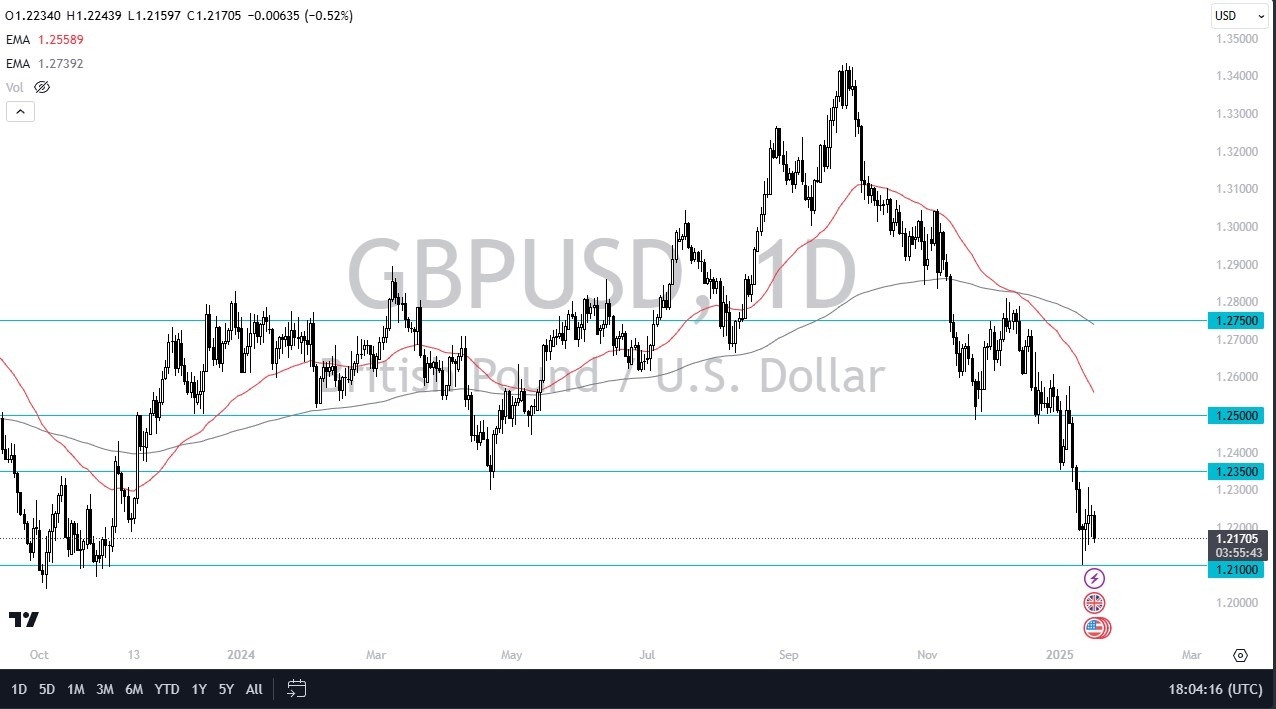
The 1.21 level underneath of course is a significant area from the past that I think comes into play with Market Memory 4 support. If we break down below the 1.21 level, then it opens up the possibility of a move to the 1.20 level. Any rally at this point in time should end up being a nice selling opportunity at the first signs of exhaustion, and that’s exactly how I’ve been playing this pair.
The 1.2350 level is an area that I think will be very difficult to get above. And if we can clear that, then you would be looking at 1.25. It’s really not until we get above there that I’d be convinced about the strength of the British pound, and I would also have to see the U S dollar fall apart in multiple currencies, not just this one. This is not a British pound story as much as it is a U S dollar story over the longer term.
Yes, there are budgetary concerns in Great Britain, but right now the US dollar is like a wrecking ball for pretty much everything, and the pound of course will not be immune to that. A breakdown below the 1.21 level again opens up the 1.20 level. Anything below there becomes really ugly, really fast. You can see that the trajectory of this market has been on the downside for a while, and it was quite vicious to get down here so it’s not a huge surprise that occasionally we will consolidate like we have been over the last week or so.
Ready to trade our daily Forex forecast? Here’s a list of some of the top forex brokers UK to check out.
Gold, often seen as a companion asset, remains a key influence on silver prices. Gold’s movement near critical resistance levels provided some support for silver sentiment. However, silver’s substantial industrial demand component introduces additional challenges, particularly as global economic uncertainty clouds growth prospects.
Silver’s ability to overcome $30.44 will determine the market’s short-term outlook. A breakout above this resistance could drive prices toward $32.33, with potential for further gains if macroeconomic data aligns favorably. Failure to clear this level, however, could see the metal retreat to $28.75. This level could act as a floor, or the trigger point for further losses.
The week ahead presents significant data points, including U.S. manufacturing reports, inflation figures, and Federal Reserve commentary. Traders should prepare for increased volatility, as silver’s dual role as a monetary and industrial asset ensures it remains at the crossroads of economic and geopolitical forces.
Bitcoin price (BTCUSD) opened today’s trading with clear positivity to surpass 100000.00$ barrier and confirm the continuation of the bullish trend domination on the intraday basis, and the way is open to achieve our next waited target at 103500.00$, noting that surpassing this level will push the price to head towards the historical high at 108350.45$ as a next main station.
Therefore, we will continue to suggest the bullish trend for the upcoming period, noting that breaking 99695.00$ will put the price under negative pressure and might target the key support 95195.00$ before any new attempt to rise.
The expected trading range for today is between 99500.00$ support and 104500.00$ resistance.
Trend forecast: Bullish
The USD/JPY weekly forecast indicates growing anticipation for a Bank of Japan rate hike that is supporting the yen.
The USD/JPY pair ended the week lower as the dollar eased on downbeat data, and the yen gained due to a surge in BoJ rate hike expectations. The greenback and Treasury yields eased after data revealed that US core inflation missed forecasts in December. The report raised expectations for Fed rate cuts in 2025. Additionally, retail sales increased by a smaller-than-expected figure, pointing to weak consumer spending.
-Are you interested in learning about forex tips? Click here for details-
Meanwhile, Bank of Japan policymakers signaled a willingness to hike interest rates due to the improving economy and weak yen. Consequently, rate hike bets increased, boosting the yen.

Next week, market participants will watch the Bank of Japan policy meeting on Friday. The yen has faced significant downward pressure due to the rising dollar and a less dovish outlook for Fed policy. At the same time, the BoJ has remained cautious about rate hikes, citing uncertainty about Trump’s policies.
However, recent yen weakness has increased pressure on the central bank to hike rates. As a result, policymakers have shifted their tone to a more hawkish one, boosting rate hike expectations. If policymakers vote to hike rates on Friday, the yen will rally.
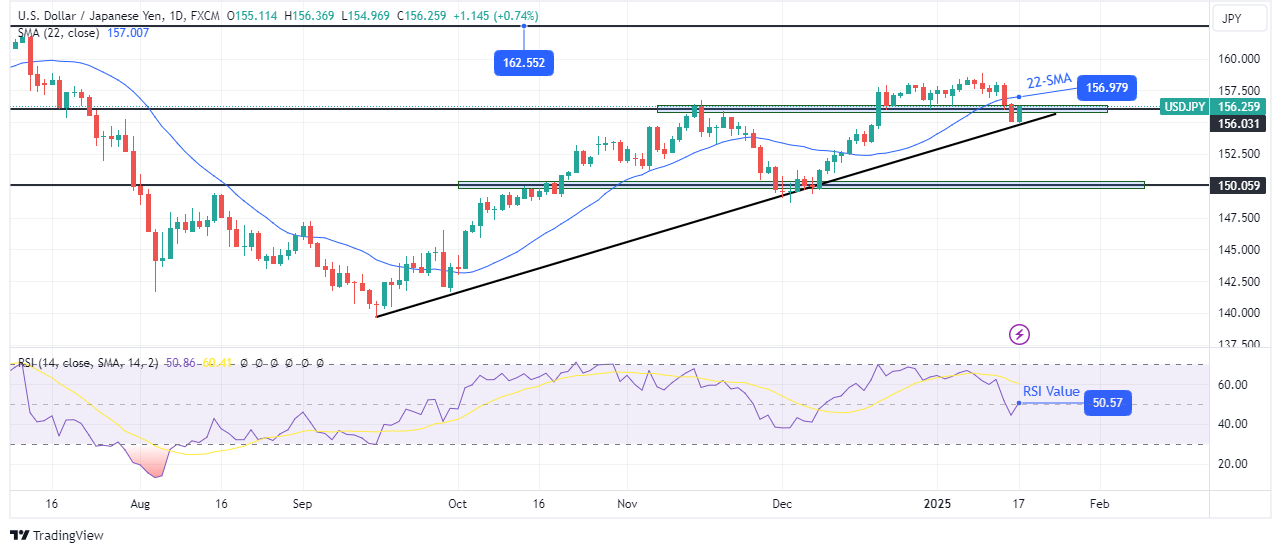
On the technical side, the USD/JPY price has paused at its support trendline after breaking below the 22-SMA. The SMA break indicates a bearish shift in sentiment. However, on a larger scale, the price trades in a bullish trend with a clear support trendline.
-Are you interested in learning about the forex basics? Click here for details-
Therefore, although bears are in the lead in the short term, the price is making higher highs and lows. Bulls might resurface next week to push the price off the support. However, they must make a higher high to confirm a continuation of the bullish trend.
However, while the price has made higher highs, the RSI has stalled, failing to enter the overbought region. This could be because the uptrend is a corrective after a strong trend. If this happens, the price will likely break below the trendline to make another impulsive leg. Therefore, it would breach the 150.05 support level.
Looking to trade forex now? Invest at eToro!
68% of retail investor accounts lose money when trading CFDs with this provider. You should consider whether you can afford to take the high risk of losing your money.
This analysis note explores the evolving drivers of USD/JPY, including the recent breakdown of its correlation with Treasury yields and other influences. With Donald Trump’s inauguration and the BoJ’s rate decision as focal points, it outlines key scenarios and their implications. Technical levels and momentum signals are highlighted to frame the risks and opportunities ahead for traders.
US Treasury yields have been a dominant force driving USD/JPY direction for much of the past year, but that has changed in early 2025. As seen in the chart below, its near-perfect correlation with longer-dated Treasury yields has disintegrated on a daily timeframe over the past month. Nor has there been any relationship with Japanese yields across the entire JGB curve, or with risk assets such as US stocks. While there has been a positive relationship with benchmark yield spreads between the United States and Japan—at 0.56 over the past month—even that relationship has weakened significantly.
Source: TradingView
While doubtful the relationship with interest rate markets has permanently broken down, for the first time in a while, USD/JPY is doing its own thing. Along with positioning over the calendar turn, which can deliver powerful yet temporary movements, the breakdown is likely explained by speculation about what Donald Trump will do when he takes office, along with what the BoJ will do with interest rates next week. Neither event has an obvious answer, creating an environment of extreme uncertainty.
After Trump’s inauguration on Monday, markets will focus on what executive orders he puts in place regarding tariffs on imports entering the United States. During the election campaign, Trump flagged 25% tariffs on Canada and Mexico, up to 60% on China, and 10% on other nations. More recently, there has been speculation tariffs will be implemented gradually to avoid a sudden spike in inflation, rather than immediately.
It is impossible to say what markets have priced in, despite some of the commentary circulating in recent weeks. Depending on what is announced, there will be a sizeable market reaction, potentially violent if the details sit toward the extreme of plausible scenarios.
For USD/JPY, directional risks surrounding the inauguration look skewed to the upside.
While staggered tariffs and evidence of a willingness to negotiate will likely push Treasury yields lower, they would also deliver a significant boost to risk appetite. Directional risks under this scenario therefore screen as higher, as likely gains in riskier asset classes boost the appeal of yen carry trades.
At the other end of the spectrum, if Trump announces immediate and aggressive tariffs, it’s likely to spark a major risk-off episode in markets, potentially capping the rise in Treasury yields while losses in riskier asset classes pressure yen carry trades. That could lead to sizeable declines in USD/JPY.
A scenario somewhere in between may promote USD/JPY upside, as modestly higher Treasury yields and relief that extreme tariff risks have been avoided create an environment that may pressure the yen.
As for Trump’s approach, a look back to his first term as President suggests he tends to grade himself using the performance of the US stock market. Big losses on day one of his presidency would signal failure and deliver a substantial mark-to-market loss when he likely desires the opposite outcome. Therefore, on the balance of probabilities, the worst-case scenario screens as low to this scribe.

Friday’s BoJ interest rate decision is the other big event for USD/JPY traders this week. Like Trump’s inauguration, the outcome is anything but clear. Not only is the announcement time uncertain – typically around 12:30 pm JST unless there is a significant policy change – but there is also no certainty about how much rates will be increased, if at all. Unlike other central banks that tend to move in quarter-point increments, the BoJ has raised rates by 20 and 15 basis points during this tightening cycle, leaving the key overnight rate at 0.25%.

Source: Bloomberg
After positive remarks on wages growth last week from BoJ Governor Ueda and his deputy Ryozo Himino, swaps markets have ramped up bets for a 25bp move on Friday, with the implied probability sitting at 88%. That is aggressive, leaving only modest room for yen appreciation if the bank follows through. A smaller hike or no change would see USD/JPY surge higher. A positive market reaction to Trump’s inauguration would increase the likelihood of the BoJ delivering a hike in line with expectations.
With markets pricing in two 25bp hikes this year, the BoJ’s updated inflation forecasts will need to support further hikes to avoid triggering a yen sell-off. When last updated in October, the BoJ forecast CPI less fresh food prices and CPI less fresh food and energy prices to rise by 1.9% in 2025, just shy of the BoJ’s 2% target. Similar or higher forecasts will likely be required to prevent yen weakness. Also watch for commentary on wages and inflation trends from Governor Ueda during his regular press conference at 3:30pm JST.

Source: BoJ
The remaining events calendar for the week ahead is found below. Other than the BoJ decision, none screen as particularly important, although Japan’s inflation report would generate volatility if an unlikely sizeable downside surprise were to occur. All times shown are US eastern time.

Source: Refinitiv
USD/JPY suffered a rare weekly decline heading into the inauguration and BoJ decision, with a sizeable reversal in US Treasury yields likely contributing to the downside break of the rising wedge it had been sitting in over the past month. Recent price action, alongside bearish signals from momentum indicators such as RSI (14) and MACD, suggests selling rallies and downside breaks may be the preferred strategy. However, given the event risk and assessment that upside risks could dominate, this signal arguably carries less weight than usual.

Source: TradingView
155.00 is where the recent downturn stalled, making it an initial focal point for traders. The key 50-day moving average and the September uptrend are other downside levels to watch. A break below the latter appears unlikely in the near term, especially with the important 200-day moving average nearby.
On the topside, dips toward 156.00 were bought before the latest leg lower, suggesting sellers may now be active around this level. Other notable resistance levels include 158.88, 160.23, and 161.95.
— Written by David Scutt
Follow David on Twitter @scutty
This analysis note explores the evolving drivers of USD/JPY, including the recent breakdown of its correlation with Treasury yields and other influences. With Donald Trump’s inauguration and the BoJ’s rate decision as focal points, it outlines key scenarios and their implications. Technical levels and momentum signals are highlighted to frame the risks and opportunities ahead for traders.
US Treasury yields have been a dominant force driving USD/JPY direction for much of the past year, but that has changed in early 2025. As seen in the chart below, its near-perfect correlation with longer-dated Treasury yields has disintegrated on a daily timeframe over the past month. Nor has there been any relationship with Japanese yields across the entire JGB curve, or with risk assets such as US stocks. While there has been a positive relationship with benchmark yield spreads between the United States and Japan—at 0.56 over the past month—even that relationship has weakened significantly.
Source: TradingView
While doubtful the relationship with interest rate markets has permanently broken down, for the first time in a while, USD/JPY is doing its own thing. Along with positioning over the calendar turn, which can deliver powerful yet temporary movements, the breakdown is likely explained by speculation about what Donald Trump will do when he takes office, along with what the BoJ will do with interest rates next week. Neither event has an obvious answer, creating an environment of extreme uncertainty.
After Trump’s inauguration on Monday, markets will focus on what executive orders he puts in place regarding tariffs on imports entering the United States. During the election campaign, Trump flagged 25% tariffs on Canada and Mexico, up to 60% on China, and 10% on other nations. More recently, there has been speculation tariffs will be implemented gradually to avoid a sudden spike in inflation, rather than immediately.
It is impossible to say what markets have priced in, despite some of the commentary circulating in recent weeks. Depending on what is announced, there will be a sizeable market reaction, potentially violent if the details sit toward the extreme of plausible scenarios.
For USD/JPY, directional risks surrounding the inauguration look skewed to the upside.
While staggered tariffs and evidence of a willingness to negotiate will likely push Treasury yields lower, they would also deliver a significant boost to risk appetite. Directional risks under this scenario therefore screen as higher, as likely gains in riskier asset classes boost the appeal of yen carry trades.
At the other end of the spectrum, if Trump announces immediate and aggressive tariffs, it’s likely to spark a major risk-off episode in markets, potentially capping the rise in Treasury yields while losses in riskier asset classes pressure yen carry trades. That could lead to sizeable declines in USD/JPY.
A scenario somewhere in between may promote USD/JPY upside, as modestly higher Treasury yields and relief that extreme tariff risks have been avoided create an environment that may pressure the yen.
As for Trump’s approach, a look back to his first term as President suggests he tends to grade himself using the performance of the US stock market. Big losses on day one of his presidency would signal failure and deliver a substantial mark-to-market loss when he likely desires the opposite outcome. Therefore, on the balance of probabilities, the worst-case scenario screens as low to this scribe.

Friday’s BoJ interest rate decision is the other big event for USD/JPY traders this week. Like Trump’s inauguration, the outcome is anything but clear. Not only is the announcement time uncertain – typically around 12:30 pm JST unless there is a significant policy change – but there is also no certainty about how much rates will be increased, if at all. Unlike other central banks that tend to move in quarter-point increments, the BoJ has raised rates by 20 and 15 basis points during this tightening cycle, leaving the key overnight rate at 0.25%.

Source: Bloomberg
After positive remarks on wages growth last week from BoJ Governor Ueda and his deputy Ryozo Himino, swaps markets have ramped up bets for a 25bp move on Friday, with the implied probability sitting at 88%. That is aggressive, leaving only modest room for yen appreciation if the bank follows through. A smaller hike or no change would see USD/JPY surge higher. A positive market reaction to Trump’s inauguration would increase the likelihood of the BoJ delivering a hike in line with expectations.
With markets pricing in two 25bp hikes this year, the BoJ’s updated inflation forecasts will need to support further hikes to avoid triggering a yen sell-off. When last updated in October, the BoJ forecast CPI less fresh food prices and CPI less fresh food and energy prices to rise by 1.9% in 2025, just shy of the BoJ’s 2% target. Similar or higher forecasts will likely be required to prevent yen weakness. Also watch for commentary on wages and inflation trends from Governor Ueda during his regular press conference at 3:30pm JST.

Source: BoJ
The remaining events calendar for the week ahead is found below. Other than the BoJ decision, none screen as particularly important, although Japan’s inflation report would generate volatility if an unlikely sizeable downside surprise were to occur. All times shown are US eastern time.

Source: Refinitiv
USD/JPY suffered a rare weekly decline heading into the inauguration and BoJ decision, with a sizeable reversal in US Treasury yields likely contributing to the downside break of the rising wedge it had been sitting in over the past month. Recent price action, alongside bearish signals from momentum indicators such as RSI (14) and MACD, suggests selling rallies and downside breaks may be the preferred strategy. However, given the event risk and assessment that upside risks could dominate, this signal arguably carries less weight than usual.

Source: TradingView
155.00 is where the recent downturn stalled, making it an initial focal point for traders. The key 50-day moving average and the September uptrend are other downside levels to watch. A break below the latter appears unlikely in the near term, especially with the important 200-day moving average nearby.
On the topside, dips toward 156.00 were bought before the latest leg lower, suggesting sellers may now be active around this level. Other notable resistance levels include 158.88, 160.23, and 161.95.
— Written by David Scutt
Follow David on Twitter @scutty