The main category of Forex News.
You can use the search box below to find what you need.
[wd_asp id=1]
The main category of Forex News.
You can use the search box below to find what you need.
[wd_asp id=1]
The EURUSD currency pair is one of the most popular and traded pairs in the global currency market. Its rate reflects shifts in economic conditions across the US and the Eurozone. The pair’s fluctuations are sensitive to the Fed and the ECB, the inflation rate, and global events.
This article delves into EURUSD forecasts for 2026 and beyond, assessing market sentiment and considering technical and fundamental factors. Read this article to get an answer to the main question: Is it worth investing in this currency pair now?
The article covers the following subjects:
The EURUSD currency pair is trading at $1.15948 as of 23.03.2026.
When analyzing the EURUSD pair, it is essential to consider the ECB and Fed decisions regarding interest rates, inflation, and employment in the US and the eurozone. These indicators shape the pair’s trajectory. Historical extremes can reveal important technical levels, while technical analysis can help determine optimal entry and exit points.
|
Indicator |
Value |
|
ECB interest rate |
2.15% |
|
Fed interest rate |
3.75% |
|
EU inflation |
1.9% |
|
US inflation |
2.4% |
|
All-time high |
$1.6039 |
|
All-time low |
$0.8227 |
|
52-Week Range |
$1.0471–$1.2079 |
|
Change over 12 months |
-0.98% |
|
Current trend |
Bearish |
Last week, the euro price increased during a correction within the medium-term downtrend. The asset approached the resistance A at 1.1648–1.1626 but has not yet tested it. Therefore, the correction is likely to continue this week, with the price testing the resistance A. Once it is tested, consider short trades with the first target at 1.1529 and a second one around 1.1410.
If the EURUSD pair breaks above the resistance A this week, the correction will extend toward the trend boundary at 1.1767–1.1734. Short trades can be considered near this zone.
Sell at resistance A at 1.1648–1.1626. TakeProfit: 1.1529, 1.1410. StopLoss: 1.1702.
Technical analysis based on margin zones methodology is presented by an independent analyst, Alex Rodionov.
The EUR/USD pair reached the $1.22 resistance level but failed to consolidate above it, after which it began to decline. Quotes are gradually falling. The support level is located at $1.12–1.13.
MACD is turning down, and the RSI is falling to 35–40, indicating increased selling pressure. The SMA50 and SMA200 are already above the market price, signaling a bearish trend.
The base scenario suggests a decline in quotes with possible short-term pullbacks to key support levels.
Below are the projected price levels for EUR/USD over the next 12 months:
|
Month |
Minimum, $ |
Average, $ |
Maximum, $ |
|
March 2026 |
1.148 |
1.160 |
1.175 |
|
April 2026 |
1.138 |
1.151 |
1.167 |
|
May 2026 |
1.123 |
1.136 |
1.154 |
|
June 2026 |
1.120 |
1.134 |
1.150 |
|
July 2026 |
1.118 |
1.131 |
1.147 |
|
August 2026 |
1.120 |
1.133 |
1.149 |
|
September 2026 |
1.115 |
1.129 |
1.145 |
|
October 2026 |
1.110 |
1.125 |
1.141 |
|
November 2026 |
1.114 |
1.128 |
1.145 |
|
December 2026 |
1.118 |
1.132 |
1.148 |
|
January 2027 |
1.120 |
1.134 |
1.150 |
|
February 2027 |
1.123 |
1.137 |
1.153 |
In 2026, short trades can be considered after the pair ends upward corrections. Positions can be opened in the $1.16–1.17 area upon confirmation of reversal signals.
Profit-taking targets are located at the $1.12–1.13 support level, where positions can be partially closed.
An alternative scenario implies that the euro settles above $1.18. In this case, it would be better to revise the trading strategy.
Forecasts for EUR/USD in 2026 vary. Analysts factor in macroeconomic expectations, central bank policies, and geopolitical factors, including the conflict in the Middle East. Most analysts expect a choppy market, but a decline in quotes cannot be ruled out.
Price range: $1.192–$1.216.
WalletInvestor predicts growth for the EUR/USD pair. In the spring, the price will likely remain around $1.20, followed by a gradual strengthening. By year-end, the price is expected to reach a high of $1.215.
|
Month |
Minimum, $ |
Average, $ |
Maximum, $ |
|
April |
1.193 |
1.200 |
1.201 |
|
May |
1.192 |
1.197 |
1.200 |
|
June |
1.197 |
1.204 |
1.204 |
|
July |
1.204 |
1.215 |
1.215 |
|
August |
1.213 |
1.214 |
1.216 |
|
September |
1.214 |
1.214 |
1.216 |
|
October |
1.211 |
1.211 |
1.214 |
|
November |
1.202 |
1.205 |
1.210 |
|
December |
1.206 |
1.213 |
1.215 |
Price range: $1.09–$1.17.
CoinCodex anticipates a decline in the EUR/USD pair. By June, the average price will trade near $1.12, and by November, it will likely slide to a low of $1.09. A recovery is possible in December.
|
Month |
Minimum, $ |
Average, $ |
Maximum, $ |
|
March |
1.14 |
1.15 |
1.17 |
|
April |
1.11 |
1.12 |
1.15 |
|
May |
1.13 |
1.13 |
1.15 |
|
June |
1.11 |
1.12 |
1.13 |
|
July |
1.11 |
1.12 |
1.15 |
|
August |
1.13 |
1.13 |
1.14 |
|
September |
1.11 |
1.12 |
1.13 |
|
October |
1.10 |
1.11 |
1.12 |
|
November |
1.09 |
1.10 |
1.11 |
|
December |
1.11 |
1.12 |
1.12 |
Price range: $1.114–$1.195.
According to LongForecast, the EUR/USD pair is expected to trade sideways. In the spring, quotes will likely remain in the $1.11–1.18 range, and by August, they may reach $1.18. However, in December, the pair may decline to $1.14.
|
Month |
Minimum, $ |
Average, $ |
Maximum, $ |
|
March |
1.120 |
1.150 |
1.183 |
|
April |
1.114 |
1.137 |
1.166 |
|
May |
1.117 |
1.134 |
1.151 |
|
June |
1.127 |
1.144 |
1.161 |
|
July |
1.142 |
1.159 |
1.176 |
|
August |
1.148 |
1.165 |
1.182 |
|
September |
1.128 |
1.145 |
1.165 |
|
October |
1.132 |
1.149 |
1.166 |
|
November |
1.149 |
1.177 |
1.195 |
|
December |
1.125 |
1.142 |
1.177 |
Forecasts for the EURUSD for 2027 remain mixed. Some analysts predict a strengthening of the euro, while others anticipate a decline in the exchange rate amid deteriorating economic conditions in the EU.
Note: The price ranges reflect the asset's expected volatility throughout the year. Lows and highs may not be shown in the summary tables.
Price range: $1.208–$1.243.
According to WalletInvestor, the EUR/USD rate may rise in 2027. By summer, the average price will likely reach $1.228, and the yearly high is expected in the third quarter at $1.243. In December, quotes may decline.
|
Quarter |
Minimum, $ |
Average, $ |
Maximum, $ |
|
Q1 |
1.208 |
1.213 |
1.220 |
|
Q2 |
1.220 |
1.228 |
1.231 |
|
Q3 |
1.232 |
1.242 |
1.243 |
|
Q4 |
1.230 |
1.237 |
1.242 |
Price range: $1.04–$1.16.
CoinCodex projects that the EUR/USD pair may decline in 2027. In the first half of the year, the euro may trade above $1.12, but a downward trend is expected to begin later. By December, the pair may fall to a low of $1.04.
|
Quarter |
Minimum, $ |
Average, $ |
Maximum, $ |
|
Q1 |
1.10 |
1.12 |
1.15 |
|
Q2 |
1.11 |
1.14 |
1.16 |
|
Q3 |
1.10 |
1.12 |
1.14 |
|
Q4 |
1.04 |
1.08 |
1.13 |
Price range: $1.142–$1.270.
LongForecast predicts a wave-like movement for the EUR/USD pair. In the first half of the year, analysts expect the euro to strengthen to $1.27 against the greenback. However, by December, the euro may correct to $1.19.
|
Quarter |
Minimum, $ |
Average, $ |
Maximum, $ |
|
Q1 |
1.142 |
1.188 |
1.230 |
|
Q2 |
1.212 |
1.250 |
1.270 |
|
Q3 |
1.146 |
1.192 |
1.251 |
|
Q4 |
1.154 |
1.191 |
1.224 |
The outlook for the EURUSD for 2028 remains uncertain. Some analysts predict a moderate strengthening of the euro, while others expect high volatility.
Price range: $1.235–$1.271.
WalletInvestor predicts moderate growth for the pair. By summer, quotes will rise above $1.25. The bullish trend will continue, and by November, the rate will reach a high of $1.271. A correction is possible in December.
|
Quarter |
Minimum, $ |
Average, $ |
Maximum, $ |
|
Q1 |
1.235 |
1.241 |
1.248 |
|
Q2 |
1.247 |
1.255 |
1.259 |
|
Q3 |
1.259 |
1.266 |
1.271 |
|
Q4 |
1.257 |
1.264 |
1.269 |
Price range: $1.04–$1.21.
CoinCodex predicts a moderate upward trend. By summer, the average price will reach $1.11, and by year-end, the pair could reach a high of $1.21.
|
Quarter |
Minimum, $ |
Average, $ |
Maximum, $ |
|
Q1 |
1.04 |
1.07 |
1.09 |
|
Q2 |
1.06 |
1.11 |
1.15 |
|
Q3 |
1.14 |
1.18 |
1.21 |
|
Q4 |
1.16 |
1.18 |
1.21 |
Price range: $1.156–$1.244.
LongForecast anticipates continued sideways movement. After a smooth start to the year, the pair may decline in the second quarter. In the third quarter, the price may reach a yearly high of $1.244, after which a correction is expected.
|
Quarter |
Minimum, $ |
Average, $ |
Maximum, $ |
|
Q1 |
1.176 |
1.203 |
1.232 |
|
Q2 |
1.156 |
1.190 |
1.217 |
|
Q3 |
1.172 |
1.214 |
1.244 |
|
Q4 |
1.160 |
1.187 |
1.226 |
Forecasts for EURUSD in 2029 vary significantly. Some experts predict a gradual strengthening of the euro, while others expect a correction after a prolonged bullish trend.
Price range: $1.262–$1.298.
WalletInvestor anticipates a moderate strengthening for the major currency pair. At the beginning of the year, the euro may remain slightly above $1.26. By summer, quotes will rise to $1.28, and by November, they will reach a high of $1.298.
|
Quarter |
Minimum, $ |
Average, $ |
Maximum, $ |
|
Q1 |
1.262 |
1.268 |
1.275 |
|
Q2 |
1.275 |
1.282 |
1.286 |
|
Q3 |
1.286 |
1.296 |
1.298 |
|
Q4 |
1.284 |
1.291 |
1.297 |
Price range: $1.13–$1.26.
CoinCodex projects that the euro will weaken against the US dollar. By June, the average price will be around $1.2. In the second half of the year, the bearish trend will continue, and by December, the rate may fall to $1.13.
|
Quarter |
Minimum, $ |
Average, $ |
Maximum, $ |
|
Q1 |
1.20 |
1.24 |
1.26 |
|
Q2 |
1.16 |
1.20 |
1.25 |
|
Q3 |
1.14 |
1.17 |
1.19 |
|
Q4 |
1.13 |
1.14 |
1.17 |
Price range: $1.158–$1.311.
LongForecast suggests the EUR/USD pair will rise gradually, reaching a high of $1.311 by the third quarter. After that, a slight correction is expected.
|
Quarter |
Minimum, $ |
Average, $ |
Maximum, $ |
|
Q1 |
1.158 |
1.194 |
1.230 |
|
Q2 |
1.175 |
1.209 |
1.243 |
|
Q3 |
1.210 |
1.272 |
1.311 |
|
Q4 |
1.189 |
1.235 |
1.292 |
Predictions for the EUR/USD pair’s performance in 2030 reflect a variety of scenarios. Some experts anticipate a gradual strengthening of the euro, while others predict a slight decline. Meanwhile, moderate volatility is expected.
Price range: $1.290–$1.325.
According to WalletInvestor, the EUR/USD pair will continue to increase in 2030. By summer, the average price will trade around $1.3. By the third quarter, quotes may reach a high of $1.325, followed by a possible correction.
|
Quarter |
Minimum, $ |
Average, $ |
Maximum, $ |
|
Q1 |
1.290 |
1.295 |
1.302 |
|
Q2 |
1.302 |
1.309 |
1.314 |
|
Q3 |
1.313 |
1.324 |
1.325 |
|
Q4 |
1.311 |
1.319 |
1.324 |
Price range: $1.10–$1.16.
CoinCodex projects that EUR/USD quotes will decline. By the end of June, the pair will likely fall to $1.13, and by December, it will likely reach a yearly low of $1.1.
|
Quarter |
Minimum, $ |
Average, $ |
Maximum, $ |
|
Q1 |
1.13 |
1.14 |
1.16 |
|
Q2 |
1.12 |
1.13 |
1.15 |
|
Q3 |
1.10 |
1.12 |
1.14 |
|
Q4 |
1.10 |
1.11 |
1.13 |
It is challenging to forecast currency exchange rates for the next 15–25 years. The global economy, geopolitics, and innovations are constantly changing, making it nearly impossible to predict the price trajectory.
Inflation, employment, and economic growth are hard to predict in the long run. A new reserve currency may emerge, global trade may change, or new financial instruments may appear, completely transforming the financial market. Any attempts to predict the price for 2040–2050 should be treated with caution.
Media sentiment on the EUR/USD pair may influence its short-term trend. A positive tone on social media may boost bullish momentum. Conversely, negative posts may temporarily increase volatility.
User @MBForex offers a cautious forecast: quotes may fall to key support levels. The pair’s direction will depend on fundamental factors.
User @ryukXBT expects the euro to decline. The author believes that now is the perfect time to open a short position. However, a recovery cannot be ruled out.
In general, media sentiment is rather neutral to bearish: traders and analysts expect the pair to decline further, but are monitoring how the price will change near the key support level. Before making trading and investment decisions, it is essential to conduct technical and fundamental analysis and study the latest expert reviews.
The EURUSD pair reached its all-time high of $1.6039 on 15.07.2008.
The lowest price of the EURUSD pair was recorded on 26.10.2000 and reached $0.8227.
To make our forecasts as accurate as possible, it is crucial to evaluate historical data. The chart below shows EURUSD’s performance over the last ten years.
Fundamental analysis provides the context necessary to understand what causes the EURUSD to move in one direction or another. In contrast to the technical approach, fundamental analysis relies on economic and political data that reflect the actual state of the US and eurozone economies. These indicators influence market participants’ expectations, shaping long-term trends for the EURUSD currency pair.
The EUR/USD pair is sensitive to the following key macroeconomic indicators:
These factors have the potential to strengthen or weaken the euro and the US dollar, leading to short-term fluctuations or stable market trends.
The EURUSD pair is the world’s most traded trading instrument on Forex, reflecting the ratio of the euro (the currency of the eurozone) to the US dollar. It attracts both speculative traders and long-term investors.
This pair is characterized by high liquidity, narrow spreads, and quick reaction to macroeconomic news. This pair is particularly sensitive to macroeconomic data, including interest rates, inflation, GDP, and employment data. The decisions of the European Central Bank and the US Federal Reserve directly impact the EURUSD rate.
Meanwhile, the EURUSD pair is exposed to global risks. In times of uncertainty, the US dollar strengthens as a protective asset, while in times of economic recovery, the euro can grow.
Analyzing this pair requires a multifaceted approach, incorporating a fundamental focus on economic indicators, technical analysis to identify entry and exit points, and ongoing monitoring of market sentiment. Such a comprehensive approach makes the EURUSD pair a crucial barometer of global financial health.
The EURUSD is the most liquid currency pair in the Forex market, suitable for short-term speculation and long-term investment. However, like any instrument, it has its pros and cons.
The EURUSD pair continues to be regarded as an appealing investment due to its clarity and accessibility. However, it is essential to exercise caution and always conduct thorough technical and fundamental analyses.
Our forecasts are based on a combination of technical and fundamental analysis.
Such a comprehensive approach enables us to assess the current price movement and the future trajectory of the analyzed currency pair.
EURUSD remains one of the most liquid pairs in the FX market, which makes it a convenient tool for active trading and hedging USD risk. The technical picture and consensus forecasts point to moderate, mostly range-bound movement in the coming years, without a clear long-term trend. In such conditions, return potential depends largely on the ability to navigate market cycles.
For short- and medium-term traders, EURUSD may be attractive thanks to clear support and resistance levels, high liquidity, and available leverage. In a long-term portfolio, the pair serves mainly as a diversification tool rather than a standalone position. The best approach to EURUSD is to treat it as a practical portfolio tool and base decisions on technical analysis and the chosen time horizon, rather than on a single forecast.
The content of this article reflects the author’s opinion and does not necessarily reflect the official position of LiteFinance broker. The material published on this page is provided for informational purposes only and should not be considered as the provision of investment advice for the purposes of Directive 2014/65/EU.
According to copyright law, this article is considered intellectual property, which includes a prohibition on copying and distributing it without consent.
Gold continued its sharp decline during its latest intraday trading, reaching a key support level at $4,400, amid the dominance of a short-term bearish corrective trend. This comes alongside negative pressure due to trading below EMA50, reinforcing the dominance of the bearish trend.
On the other hand, we notice the beginning of a positive crossover of the relative strength indicators after reaching deeply oversold levels, which may support some corrective rebounds in the coming period, especially if the current support level holds, aiming to recover part of the previous losses.
The EURJPY pair moves away from 182.00 support, affected by the positivity of the main indicators, attacking the barrier at 184.20 which represents %66.8 Fibonacci corrective level as appears in the above image.
Note that the continuation of the stability below the barrier that might push it to provide new bearish trading, reaching 183.40 and 182.65, while breaching the barrier and holding above it will confirm its readiness to form strong bullish waves, to expect reaching 184.80, attempting to reach the next target near 185.45.
The expected trading range for today is between 183.40 and 184.20
Trend forecast: Fluctuating
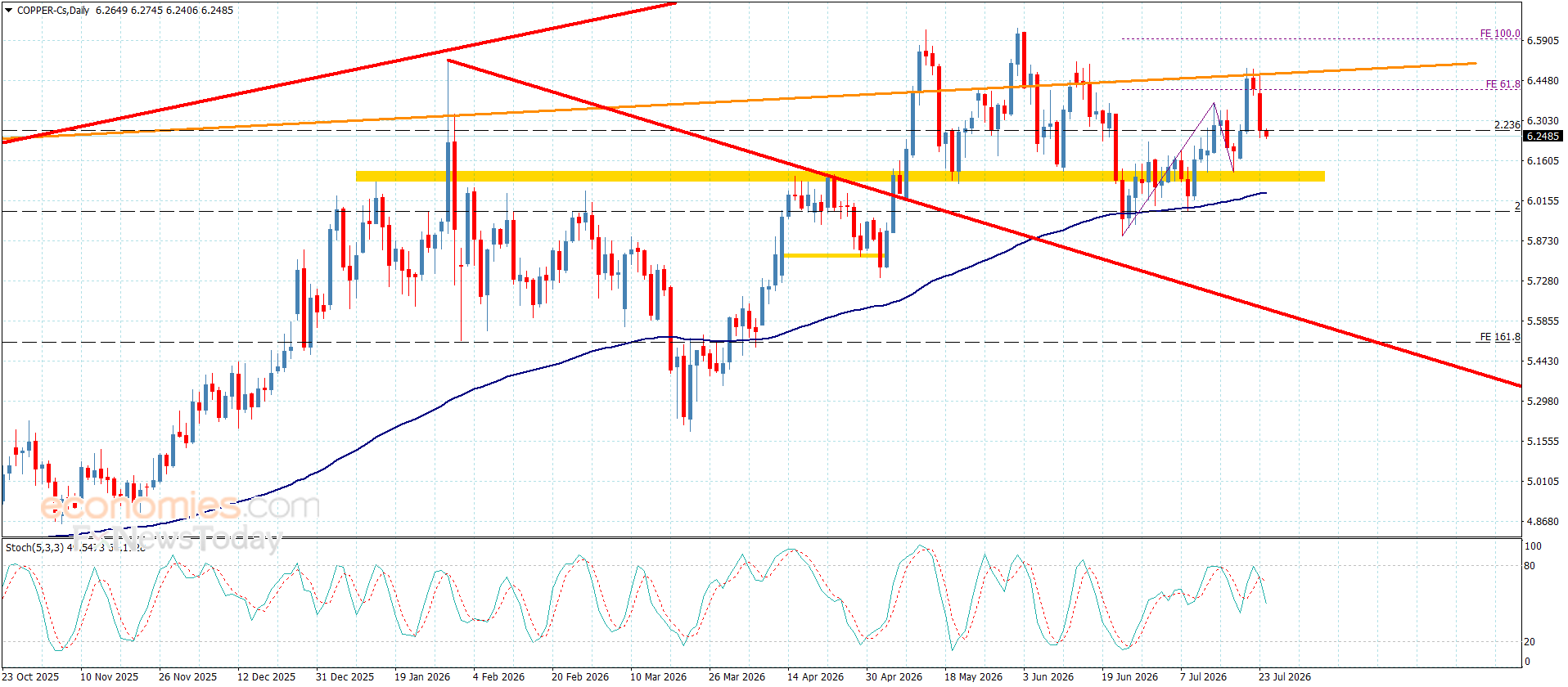
Copper price confirmed its surrender to the bearish corrective bias, by providing several closes below the broken support that is represented by $5.5100 level, recording negative targets by reaching $5.1900.
The continuation of providing negative momentum by the main indicators might push the price to resume the corrective moves, to reach $5.0500 that might form an extra support, breaking this support will open a new way for targeting extra negative stations that might begin at $4.9500, while the stability above it might provide a chance for forming some bullish waves, to target $5.4200 level.
The expected trading range for today is between $5.0500 and $5.4000
Trend forecast: Bearish
– Written by
Tim Boyer
STORY LINK Pound to Dollar Week Ahead Forecast: Yield Spike Fails to Sustain GBP Rally
The Pound to Dollar exchange rate (GBP/USD) fell back toward 1.3300 after a sharp post-BoE rally, as a surge in UK bond yields and renewed energy price shocks triggered a fresh bout of Sterling volatility.
While higher yields initially supported the Pound, a sharp sell-off in gilts and deteriorating risk sentiment have raised concerns that tightening financial conditions could weigh heavily on the UK economy and limit GBP/USD upside.
Standard Chartered has a 12-month Pound to Dollar (GBP/USD) exchange rate forecast of 1.30.
JP Morgan has cut its June 2026 GBP/USD forecast to 1.34 from 1.41 previously.
According to JP Morgan; “The closure of the Strait of Hormuz led us to turn neutral on the dollar for the first time in a year and we are now shifting to a tactically bullish view on the dollar.”
GBP/USD rallied strongly to highs near 1.3450 after the Bank of England policy decision, but there was a slide to 1.3300 on Friday amid a collapse in UK bonds.
Get better rates and lower fees on your next international money transfer.
Compare TorFX with top UK banks in seconds and see how much you could save.
Energy prices and central bank policy decisions dominated during the week with volatile trading conditions.
There was a surge in UK yields and a further big shift in expectations surrounding interest rates with traders pricing in at least two rate hikes this year and a high risk of three hikes.
The 2-year yield jumped to 4.60% from 3.50% at the end of February while the 10-year yield hit a 16-year high near 5.00%
Energy prices surged again following attacks on Middle East gas infrastructure and the dollar still generated defensive demand amid vulnerable risk conditions and weaker equity markets.
On the UK, Standard Chartered noted; “The recent spike in energy prices has revived a familiar dilemma for the BoE – tackle inflation or support softer demand.”
The combination of higher energy prices and yields will have a major negative impact on the economy.
According to MUFG; “The pound is deriving support from the surge in yields (although less support than usual for such a scale of rates move) and that will likely give way if broader risk conditions worsen.”
The Bank of England (BoE) held interest rates at 3.75%, in line with consensus forecasts.
There was a 9-0 vote for unchanged rates compared with expectations that two members would continue to back rate cuts. The central bank also warned that it was watching the impact of energy prices closely amid concerns over the risk of second-round impacts on inflation.
ING commented; “The Bank of England’s unquestionably hawkish decision to hold rates has opened the door to future hikes if energy prices stay elevated.”
It added; “Yet we’d be careful in drawing clear signals from today’s move, which also floated the possibility of faster rate cuts. Under ING’s base case energy scenario, we think the most likely path forward is a prolonged pause.”
The Federal Reserve held interest rates at 3.75% at the latest policy meeting, in line with consensus forecasts.
Chair Powell emphasised that there was a high degree of uncertainty over the outlook.
The interest rate forecasts from individual committee members continued to have a mean projection of one cut for this year.
International Money Transfer? Ask our resident FX expert a money transfer question or try John’s new, free, no-obligation personal service! ,where he helps every step of the way,
ensuring you get the best exchange rates on your currency requirements.
TAGS: Pound Dollar Forecasts
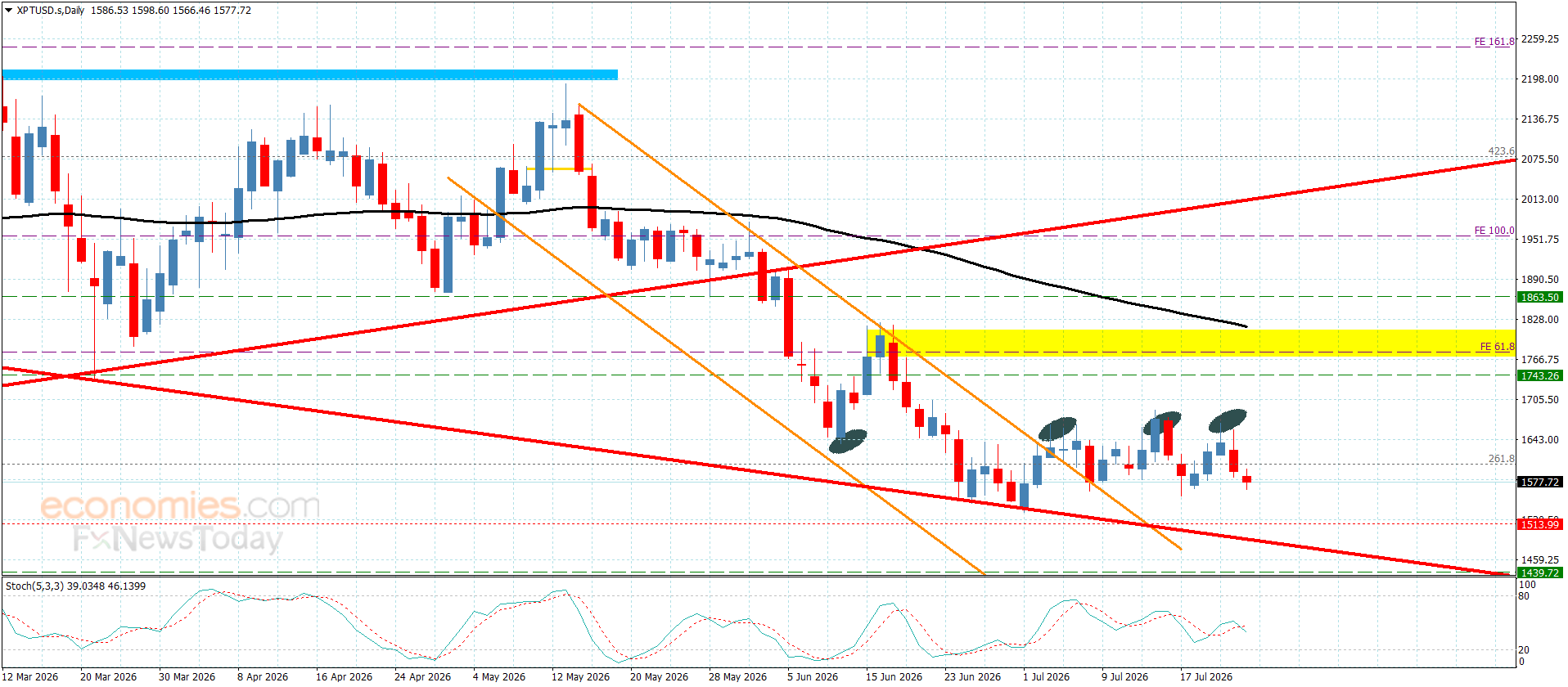
Price movements in platinum are often sharper than gold or silver due to its limited availability and reliance on a few global mining regions. Automotive regulations, global production levels, and technology usage influence the platinum price today. As platinum becomes more relevant in clean energy applications, its daily rate has gained importance for both buyers and investors.
The rise in oil prices is linked to tension between the United States and Iran, threats to energy infrastructure, and disruption in the Strait of Hormuz. Markets are reacting to supply risks and uncertainty. Brent futures closed at a high level before the weekend, showing strong demand concerns. Analysts say the situation has created pressure on supply chains and raised fears of further escalation. These developments are pushing traders to expect higher prices when markets reopen on Monday.
Brent futures are rising due to supply disruption and rising geopolitical risk. The closure of the Strait of Hormuz has reduced global oil supply. Iran’s attacks on ports and refineries across Gulf countries have also affected output. The market is pricing in risk linked to further damage to infrastructure. Brent gained about 8.8% last week and settled at $112.19 per barrel, which is the highest level since July 2022. Traders are reacting to uncertainty and limited supply availability.
Oil prices are expected to rise due to the 48-hour ultimatum issued by U.S. President Donald Trump to Iran. The warning includes possible action against Iranian power plants if the Strait of Hormuz is not reopened. Iran has responded with threats to attack U.S.-linked infrastructure in the Gulf. Analysts say this exchange increases the chance of escalation. This situation is likely to trigger a strong market reaction when trading begins on Monday.
Oil markets are reacting to statements from U.S. President Donald Trump and responses from Iran. Trump issued a 48-hour ultimatum to Iran to reopen the Strait of Hormuz. He also warned of action against Iranian power plants. Iran responded by stating it would target U.S.-linked infrastructure in the Gulf. This includes energy and desalination facilities. Analysts say this exchange has increased the risk of further escalation. Brent futures for May settled at $112.19 per barrel on Friday. This marked the highest level since July 2022. The weekly gain for Brent stood at about 8.8%.
The Strait of Hormuz plays a central role in global oil supply. The closure during the conflict has already removed around 440 million barrels from the market over 22 days. Iran has carried out attacks on ports and refineries in Saudi Arabia, Kuwait, Bahrain, the UAE, and Qatar. These actions have reduced supply flow and increased concern among traders. So far, Iran has not targeted major desalination plants. These plants provide water to millions in the region. Experts say damage to such facilities could disrupt daily life and force evacuations.
Experts say oil prices may rise further if tensions continue. Restoring supply from the Middle East Gulf may take up to six months, according to the International Energy Agency. Reports suggest the U.S. is considering steps involving Iran’s Kharg Island. Such moves could further impact supply and market stability. Markets will track developments around the Strait of Hormuz and any military action. Oil prices are expected to remain sensitive to updates.
Analysts say uncertainty is driving prices higher. Market analyst Tony Sycamore said the 48-hour deadline creates a situation that could push prices up if not resolved. Energy analyst Amrita Sen said the situation shows continued escalation. She added that expectations of Iran backing down may not hold. The price gap between WTI and Brent has also widened. WTI settled slightly lower last week, while Brent gained. The discount reached its widest level in 11 years.
Investors are closely watching why are Brent futures up and oil prices looking to surge on Monday, and what to expect next as volatility increases. Market participants are tracking updates on the Strait of Hormuz, supply restoration, and any military developments. Experts suggest monitoring global supply data and policy decisions before making moves. Oil prices may remain unstable in the short term due to ongoing tension. Investors are expected to focus on risk management and avoid decisions based only on short-term price movements.
Q1. Why are oil prices going to surge on Monday?
Oil prices are expected to surge on Monday due to rising U.S.-Iran tension, threats to energy infrastructure, and disruption in the Strait of Hormuz, which has reduced global supply and increased market uncertainty.
Q2. What factors will decide oil prices next?
Oil prices will depend on Strait of Hormuz reopening, Middle East developments, supply restoration timelines, U.S.-Iran actions, global demand levels, and the stability of energy infrastructure across Gulf countries in coming weeks.
EUR/USD stays in a consolidation phase above 1.1550 after posting impressive gains on Thursday. Comments from policymakers could impact the pair’s action in the near term.
The table below shows the percentage change of Euro (EUR) against listed major currencies this week. Euro was the strongest against the US Dollar.
| USD | EUR | GBP | JPY | CAD | AUD | NZD | CHF | |
|---|---|---|---|---|---|---|---|---|
| USD | -1.30% | -1.39% | -0.76% | -0.07% | -1.32% | -1.58% | -0.16% | |
| EUR | 1.30% | -0.07% | 0.48% | 1.24% | -0.02% | -0.29% | 1.14% | |
| GBP | 1.39% | 0.07% | 0.68% | 1.31% | 0.06% | -0.21% | 1.28% | |
| JPY | 0.76% | -0.48% | -0.68% | 0.72% | -0.57% | -0.80% | 0.62% | |
| CAD | 0.07% | -1.24% | -1.31% | -0.72% | -1.30% | -1.51% | -0.09% | |
| AUD | 1.32% | 0.02% | -0.06% | 0.57% | 1.30% | -0.27% | 1.17% | |
| NZD | 1.58% | 0.29% | 0.21% | 0.80% | 1.51% | 0.27% | 1.41% | |
| CHF | 0.16% | -1.14% | -1.28% | -0.62% | 0.09% | -1.17% | -1.41% |
The heat map shows percentage changes of major currencies against each other. The base currency is picked from the left column, while the quote currency is picked from the top row. For example, if you pick the Euro from the left column and move along the horizontal line to the US Dollar, the percentage change displayed in the box will represent EUR (base)/USD (quote).
Following Wednesday’s sharp decline, EUR/USD reversed its direction on Thursday and gained more than 1% on the day, supported by the European Central Bank’s relatively hawkish guidance.
The ECB left policy settings unchanged, as anticipated, after the March meeting. “The war in the Middle East has made outlook significantly more uncertain, creating upside risks for inflation and downside risks for economic growth,” the ECB noted in its policy statement.
In the post-meeting press conference, ECB President Christine Lagarde acknowledged that a prolonged war could increase energy prices for longer and erode incomes. Lagarde further added that risks to inflation are tilted to the upside in the near term and said that they could have a “temporary, targeted and tailored” response to the energy shock.
Early Friday, ECB policymaker Joachim Nagel argued that the ECB would need to raise rates in April if the price outlook sours. On a more neutral note, policymaker José Luis Escrivá said that the situation is highly uncertain and volatile, adding that they must continues to assess a wealth of information before taking a policy step.
The economic calendar will not feature any high-tier data releases on Friday. Hence, investors will continue to pay close attention to comments from policymakers.
In case ECB officials voice their willingness to consider policy-tightening in response to rising inflation, the Euro could preserve its strength.
In the 4-hours chart, EUR/USD trades at 1.1576. The near-term bias is mildly bullish as price holds above the 20-period Simple Moving Average (SMA) at 1.1522 and the 50-period SMA near 1.1528, while remaining below the declining 100- and 200-period SMAs around 1.1600 and 1.1715, respectively. This alignment suggests a recovery phase within a broader downside context, with the recent push away from the lower Bollinger Band toward the mid-band reinforcing improving momentum. The Relative Strength Index (RSI) at 59.7 stays above the 50 line, signaling steady bullish pressure without overbought conditions.
Immediate support is seen at 1.1530 (static level), reinforced by the nearby 20- and 50-period SMA, with a deeper floor at 1.1500 (round level) ahead of 1.1460 (static level) if sellers regain control. On the upside, initial resistance comes at 1.1600 (100-period SMA, upper line of the Bollinger Band) ahead of the horizontal barrier near 1.1670 and the 200-period SMA at 1.1715.
(The technical analysis of this story was written with the help of an AI tool.)
The Euro is the currency for the 20 European Union countries that belong to the Eurozone. It is the second most heavily traded currency in the world behind the US Dollar. In 2022, it accounted for 31% of all foreign exchange transactions, with an average daily turnover of over $2.2 trillion a day.
EUR/USD is the most heavily traded currency pair in the world, accounting for an estimated 30% off all transactions, followed by EUR/JPY (4%), EUR/GBP (3%) and EUR/AUD (2%).
The European Central Bank (ECB) in Frankfurt, Germany, is the reserve bank for the Eurozone. The ECB sets interest rates and manages monetary policy.
The ECB’s primary mandate is to maintain price stability, which means either controlling inflation or stimulating growth. Its primary tool is the raising or lowering of interest rates. Relatively high interest rates – or the expectation of higher rates – will usually benefit the Euro and vice versa.
The ECB Governing Council makes monetary policy decisions at meetings held eight times a year. Decisions are made by heads of the Eurozone national banks and six permanent members, including the President of the ECB, Christine Lagarde.
Eurozone inflation data, measured by the Harmonized Index of Consumer Prices (HICP), is an important econometric for the Euro. If inflation rises more than expected, especially if above the ECB’s 2% target, it obliges the ECB to raise interest rates to bring it back under control.
Relatively high interest rates compared to its counterparts will usually benefit the Euro, as it makes the region more attractive as a place for global investors to park their money.
Data releases gauge the health of the economy and can impact on the Euro. Indicators such as GDP, Manufacturing and Services PMIs, employment, and consumer sentiment surveys can all influence the direction of the single currency.
A strong economy is good for the Euro. Not only does it attract more foreign investment but it may encourage the ECB to put up interest rates, which will directly strengthen the Euro. Otherwise, if economic data is weak, the Euro is likely to fall.
Economic data for the four largest economies in the euro area (Germany, France, Italy and Spain) are especially significant, as they account for 75% of the Eurozone’s economy.
Another significant data release for the Euro is the Trade Balance. This indicator measures the difference between what a country earns from its exports and what it spends on imports over a given period.
If a country produces highly sought after exports then its currency will gain in value purely from the extra demand created from foreign buyers seeking to purchase these goods. Therefore, a positive net Trade Balance strengthens a currency and vice versa for a negative balance.
NEW YORK, March 22, 2026, 2:24 PM EDT
U.S. natural gas opens the week trading close to $3.10 per mmBtu, following Friday’s settlement for the front-month April Henry Hub contract at $3.095. The main issue up ahead: will renewed U.S.-Iran tensions targeting Gulf energy sites send gas prices higher along with the broader energy sector as trading kicks back in? MarketWatch
Timing’s in play here. Henry Hub heads into the spring shoulder season—right between peak winter heating and the ramp-up for summer cooling—just as the global LNG crunch gets sharper. After Thursday’s price jump, Reuters said Saturday that the EU pushed members to scale back gas-storage refill goals to 80% from 90%. Officials, it seems, want to avoid fueling more upside. Reuters
Right now, U.S. weather looks mild. NOAA’s new 6-10 day and 8-14 day forecasts show most of the lower 48 heading for warmer-than-average temperatures, except the Northeast, which still stands apart. That mix suggests heating demand should ease off heading through late March into early April. Climate Prediction Center
Storage numbers are pointing in that direction. The Energy Information Administration logged a 35 billion cubic feet injection for the week ending March 13, taking total inventories up to 1.883 trillion cubic feet—2.6% higher than the five-year average. The next update lands March 26. EIA Information Releases
The bullish factor is coming from abroad. On Thursday, Reuters reported that Iranian strikes have taken out 17% of Qatar’s LNG export capacity — that’s 12.8 million tonnes per year — and repairs could stretch from three up to five years. QatarEnergy CEO Saad al-Kaabi said force majeure might have to be declared on some long-term supply deals to Europe and Asia, a move that would let the company suspend deliveries after such disruptions. Reuters
Analysts aren’t ignoring the risks. Saul Kavonic at MST Financial described the situation as a “doomsday gas-crisis scenario.” Tom Marzec-Manser of Wood Mackenzie added that gas prices in Europe and Asia are set to “remain elevated for longer,” as power generators and industrial players look to alternative fuels when possible. Reuters
Politics over the weekend just added to the confusion. On Sunday, Reuters said President Donald Trump warned he’d destroy Iran’s power infrastructure unless the Strait of Hormuz was cleared for shipping in 48 hours. Iran, for its part, fired back, threatening energy and desalination facilities across the Gulf. IG analyst Tony Sycamore labeled the standoff a “48-hour ticking time bomb” for markets. Reuters
Domestic supply isn’t looking tight enough yet to spark a breakout. U.S. gas rigs fell by two to 131 this week, according to Baker Hughes—the lowest count since early February. Even so, the EIA projects U.S. gas output will climb, reaching 109.5 billion cubic feet per day in 2026 from 107.7 bcfd in 2025. Reuters
That’s part of the reason gas-linked stocks can move out of sync with prompt futures. Cheniere and Venture Global both jumped after Qatar revealed the extent of the damage, while Reuters noted buyers are putting more focus on supply outside the Middle East. Companies like NextDecade and Sempra are increasingly seen as players in the longer-term replacement mix. Reuters
The week sets up for a clear divide. No new Gulf gas or LNG disruptions? Traders may pivot back to the mild U.S. forecast and the early pace of storage injections. But if weekend threats materialize and outages crop up, Henry Hub might begin tracking global moves more closely than it has recently. Climate Prediction Center
Summer’s still in focus on the strip. CME quotes put May at about $3.07 per mmBtu, with June bumped up to $3.20, July holding $3.47, and August at $3.56. Each contract remains above April’s $3.10. Traders are watching three things to break the standoff: Thursday’s storage print, the latest weather models, and any sudden headlines from the Gulf. CME Group
Price movements in platinum are often sharper than gold or silver due to its limited availability and reliance on a few global mining regions. Automotive regulations, global production levels, and technology usage influence the platinum price today. As platinum becomes more relevant in clean energy applications, its daily rate has gained importance for both buyers and investors.