The main category of Forex News.
You can use the search box below to find what you need.
[wd_asp id=1]
The main category of Forex News.
You can use the search box below to find what you need.
[wd_asp id=1]
After closing the fifth consecutive week in negative territory, GBP/USD opened with a bullish gap and rose toward 1.3000 early Monday.
The broad-based selling pressure surrounding the US Dollar (USD) fuelled GBP/USD’s rally at the beginning of the week. The uncertainty surrounding the outcome of the US presidential election seems to be weighing on the USD, especially after betting site PredictIt has placed a 51% odd of a Kamala Harris win on Tuesday, marking the vice president’s first lead over Donald Trump since October 9.
The table below shows the percentage change of British Pound (GBP) against listed major currencies today. British Pound was the strongest against the US Dollar.
| USD | EUR | GBP | JPY | CAD | AUD | NZD | CHF | |
|---|---|---|---|---|---|---|---|---|
| USD | -0.54% | -0.43% | -0.03% | -0.02% | -0.43% | -0.05% | -0.23% | |
| EUR | 0.54% | 0.07% | 0.07% | 0.12% | 0.42% | 0.09% | -0.08% | |
| GBP | 0.43% | -0.07% | -0.26% | 0.05% | 0.35% | 0.03% | -0.17% | |
| JPY | 0.03% | -0.07% | 0.26% | 0.00% | 0.16% | 0.19% | 0.09% | |
| CAD | 0.02% | -0.12% | -0.05% | -0.01% | -0.19% | -0.04% | -0.22% | |
| AUD | 0.43% | -0.42% | -0.35% | -0.16% | 0.19% | -0.32% | -0.53% | |
| NZD | 0.05% | -0.09% | -0.03% | -0.19% | 0.04% | 0.32% | -0.20% | |
| CHF | 0.23% | 0.08% | 0.17% | -0.09% | 0.22% | 0.53% | 0.20% |
The heat map shows percentage changes of major currencies against each other. The base currency is picked from the left column, while the quote currency is picked from the top row. For example, if you pick the British Pound from the left column and move along the horizontal line to the US Dollar, the percentage change displayed in the box will represent GBP (base)/USD (quote).
Meanwhile, US stock index futures trade mixed in the early European session, reflecting a cautious market mood. Investors could refrain from taking large positions until they have a clear picture of who the next president of the US will be. In case there is a selloff in US stocks following the opening bell, GBP/USD could have a difficult time stretching higher.
The US economic calendar will feature Factory Orders figures for September but markets are unlikely to react to this data. On Friday, The US Bureau of Labor Statistics (BLS) announced that Nonfarm Payrolls (NFP) in the US rose by only 12,000 in October. This reading followed the 223,000 increase (revised from 254,000) recorded in September and missed the market expectation of 113,000 by a wide margin. In its press release, the BLS explained that it was likely that payroll employment estimates in some industries were affected by the hurricanes.
The Relative Strength Index (RSI) indicator on the 4-hour chart stays slightly above 50 but GBP/USD struggles to hold above 1.2980, where the 100-day Simple Moving Average (SMA) is located, reflecting buyers’ hesitancy.
In case 1.2980 holds as resistance, 1.2940 (static level) could be seen as next support before 1.2900 (round level). Once GBP/USD stabilizes above 1.2980, 1.3000 (static level, 20-day SMA) could act as interim resistance ahead of 1.3040 (static level).
The Pound Sterling (GBP) is the oldest currency in the world (886 AD) and the official currency of the United Kingdom. It is the fourth most traded unit for foreign exchange (FX) in the world, accounting for 12% of all transactions, averaging $630 billion a day, according to 2022 data. Its key trading pairs are GBP/USD, also known as ‘Cable’, which accounts for 11% of FX, GBP/JPY, or the ‘Dragon’ as it is known by traders (3%), and EUR/GBP (2%). The Pound Sterling is issued by the Bank of England (BoE).
The single most important factor influencing the value of the Pound Sterling is monetary policy decided by the Bank of England. The BoE bases its decisions on whether it has achieved its primary goal of “price stability” – a steady inflation rate of around 2%. Its primary tool for achieving this is the adjustment of interest rates. When inflation is too high, the BoE will try to rein it in by raising interest rates, making it more expensive for people and businesses to access credit. This is generally positive for GBP, as higher interest rates make the UK a more attractive place for global investors to park their money. When inflation falls too low it is a sign economic growth is slowing. In this scenario, the BoE will consider lowering interest rates to cheapen credit so businesses will borrow more to invest in growth-generating projects.
Data releases gauge the health of the economy and can impact the value of the Pound Sterling. Indicators such as GDP, Manufacturing and Services PMIs, and employment can all influence the direction of the GBP. A strong economy is good for Sterling. Not only does it attract more foreign investment but it may encourage the BoE to put up interest rates, which will directly strengthen GBP. Otherwise, if economic data is weak, the Pound Sterling is likely to fall.
Another significant data release for the Pound Sterling is the Trade Balance. This indicator measures the difference between what a country earns from its exports and what it spends on imports over a given period. If a country produces highly sought-after exports, its currency will benefit purely from the extra demand created from foreign buyers seeking to purchase these goods. Therefore, a positive net Trade Balance strengthens a currency and vice versa for a negative balance.
The October 27 general election left Japan in political limbo. The Liberal Democratic Party (LDP) – Komeito coalition fell short of the 233 seats needed for a majority.
The result leaves the BoJ facing political party uncertainty as the LDP considers lesser parties to form a government. Cost of living remains a primary issue for voters, and the LDP may make concessions that could impact BoJ monetary policy plans.
Potential political pressure on the BoJ to maintain loose monetary policy may adversely impact Japanese Yen demand.
In a recent Reuters poll, economists expect Japan’s economy to slow sharply, from an annualized 2.9% in Q2 2024 to 0.7% in Q3 2024. Economists attributed the projection to softer private consumption as higher prices offset wage growth.
The prospect of weaker growth could further reduce expectations of a near-term BoJ rate hike and Japanese Yen demand.
On Tuesday, November 5, the all-important ISM Services PMI will influence US dollar demand. Economists expect the ISM Services PMI to decline from 54.9 in September to 53.3 in October. A larger decline toward 50 could boost bets on a December Fed rate cut as the services sector accounts for around 80% of the US economy.
However, the November 5 US Presidential Election will likely overshadow the data, potentially fueling USD/JPY volatility. A Trump victory could drive the USD/JPY through last week’s 154 resistance.
On Thursday, November 7, the Fed will deliver its penultimate interest rate decision of 2024.
Economists expect the Fed to cut rates by 25 basis points. A 25-basis point Fed rate cut would shift the focus to forward guidance, which may hinge on the US election result. Support for a 25-basis point December rate cut may drag the USD/JPY below 151.5. Conversely, a more hawkish Fed rate path may signal a USD/JPY move through 154.
Near-term USD/JPY trends will depend on Japan’s economic indicators, the US Presidential Election, and the Fed’s interest rate decision. Softer-than-expected data from Japan, a Trump victory, and a less dovish Fed interest rate outlook could drive US dollar demand and a USD/JPY move through 154.
Conversely, a Kamala Harris win and Fed support for a December interest rate cut could pull the USD/JPY below 151.5.
Investors should stay alert in a pivotal week for the USD/JPY pairing. Monitor real-time data, central bank views, and expert commentary to adjust your trading strategies accordingly. Stay informed with our latest analysis and news to navigate the FX markets.
The USD/JPY remains well above the 50-day and 200-day EMAs, sending bullish price signals.
A USD/JPY breakout from the trend line could signal a move toward last week’s high of 153.877. A return to 153.877 could allow the bulls to target the 155 level.
Investors should consider Japan’s economic indicators, the US Presidential Election, and the Fed’s interest rate decision for USD/JPY price trends.
Conversely, a drop below the trend line could bring the 151.685 support level into play. A fall through the 151.685 support level may signal a drop toward 150 and the 200-day EMA.
The 14-day RSI at 64.50 indicates a USD/JPY return to 153.877 before entering overbought territory.
Gold price is attempting a tepid bounce toward $2,750 early Monday, as sellers take a breather amid a general market cautiousness ahead of the US election and the Federal Reserve (Fed) policy announcements due later this week.
Gold price stalls its correction from all-time highs of $2,790 set on Friday, as the US Dollar (USD) comes under heavy selling pressure, witnessing a bearish opening gap, following the latest opinion poll on the US election released on Saturday.
The Des Moines Register/Mediacom Iowa Poll released on Saturday showed that US Democratic presidential candidate Kamala Harris surpassed Republican Donald Trump in a new poll in Iowa, marking a notable turnaround.
Meanwhile, Harris and Trump are seen locked in a tight race for the White House, as Americans head to polls on Tuesday.
Additionally, the US Treasury bond yields are also wilting on cautious market sentiment and expectations of a 25 basis points (bps) interest rate cut by the Fed on Thursday, underpinning non-yielding Gold price.
On Friday, Gold price extended its two day retreat, as a disappointing headline US Nonfarm Payrolls (NFP) figure was offset by hot wage inflation data. The US labor market report failed to deter USD buyers, as it had limited impact on the market’s pricing of the Fed rate cut expectations.
Data published by the US Bureau of Labor Statistics (BLS) showed Friday that NFP increased by 12,000 last month, following a downward revision to the prior two months. The Unemployment Rate held at 4.1% in October.
Annual wage inflation, as measured by the change in the Average Hourly Earnings, rose to 4% from 3.9%. Markets shrugged off the weak NFP print, as it was largely expected to be distorted by severe hurricanes and a major strike at Boeing.
All eyes now remain on the US presidential election due on Tuesday and the Fed outcome on Thursday, representing a pivotal week that will determine the value of the US Dollar and the Gold price in the months ahead.
Markets believe Trump’s policies on immigration, tax cuts and tariffs would put upward pressure on inflation, bond yields and the Greenback while a policy continuity is seen on a Harrish win.
Also read: US presidential election outcome: What could it mean for the US Dollar?
As observed on the daily chart, Gold price has found some support near the $2,730 demand area.
The 14-day Relative Strength Index (RSI) has seen a modest uptick to near 60, reviving the buying interest around the bright metal.
Gold buyers need to reclaim the $2,746 resistance on a daily closing basis to resume its uptrend. That level is the 23.6% Fibonacci Retracement (Fibo) level of the latest record rally from the October 10 low of $2,604 to the new all-time high of $2,790.
The next bullish target is seen at the record high of $2,790.
On the downside, a sustained move below $2,730 will expose the 38.2% Fibo support at $2,718.
Acceptance below that level on a daily candlestick closing basis could challenge the $2,700 confluence zone, where the 50% Fibo level of the same ascent and the 21-day Simple Moving Average (SMA) close in.
Additional declines will call for a test of the 61.8% Fibo support at $2,673.
Gold has played a key role in human’s history as it has been widely used as a store of value and medium of exchange. Currently, apart from its shine and usage for jewelry, the precious metal is widely seen as a safe-haven asset, meaning that it is considered a good investment during turbulent times. Gold is also widely seen as a hedge against inflation and against depreciating currencies as it doesn’t rely on any specific issuer or government.
Central banks are the biggest Gold holders. In their aim to support their currencies in turbulent times, central banks tend to diversify their reserves and buy Gold to improve the perceived strength of the economy and the currency. High Gold reserves can be a source of trust for a country’s solvency. Central banks added 1,136 tonnes of Gold worth around $70 billion to their reserves in 2022, according to data from the World Gold Council. This is the highest yearly purchase since records began. Central banks from emerging economies such as China, India and Turkey are quickly increasing their Gold reserves.
Gold has an inverse correlation with the US Dollar and US Treasuries, which are both major reserve and safe-haven assets. When the Dollar depreciates, Gold tends to rise, enabling investors and central banks to diversify their assets in turbulent times. Gold is also inversely correlated with risk assets. A rally in the stock market tends to weaken Gold price, while sell-offs in riskier markets tend to favor the precious metal.
The price can move due to a wide range of factors. Geopolitical instability or fears of a deep recession can quickly make Gold price escalate due to its safe-haven status. As a yield-less asset, Gold tends to rise with lower interest rates, while higher cost of money usually weighs down on the yellow metal. Still, most moves depend on how the US Dollar (USD) behaves as the asset is priced in dollars (XAU/USD). A strong Dollar tends to keep the price of Gold controlled, whereas a weaker Dollar is likely to push Gold prices up.
Gold price (XAU/USD) trades with mild gains, snapping the two-day losing streak near $2,740 during the early Asian session on Monday. The uncertainty around the US presidential election and Middle East tensions might boost the safe-haven demand, supporting the yellow metal.
The upside of the precious metal is bolstered by looming US election uncertainties and ongoing geopolitical tensions in the Middle East. The spotlight for this week will be the US presidential election on Tuesday. JPMorgan analysts noted that regardless of the outcome of the US election, any pullback in gold prices would present a good buying opportunity.
The weaker US October Nonfarm Payrolls (NFP) data boosts rate cut hopes as markets now expect a 25 basis points (bps) rate cut from the US Federal Reserve (Fed) at next Thursday’s meeting. The US NFP increased by 12,000 in October, the smallest gain since December 2020, the US Bureau of Labor Statistics (BLS) showed Friday. This figure followed the 223,000 rise (revised from 254,000) seen in September and below the market consensus of 113,000 by a wide margin. The Unemployment Rate was unchanged at 4.1% in October, matching expectations.
On the other hand, the renewed Greenback demand and higher yields might weigh on the USD-denominated Gold price as higher yields made non-yielding assets like bullion less attractive in comparison.
Gold has played a key role in human’s history as it has been widely used as a store of value and medium of exchange. Currently, apart from its shine and usage for jewelry, the precious metal is widely seen as a safe-haven asset, meaning that it is considered a good investment during turbulent times. Gold is also widely seen as a hedge against inflation and against depreciating currencies as it doesn’t rely on any specific issuer or government.
Central banks are the biggest Gold holders. In their aim to support their currencies in turbulent times, central banks tend to diversify their reserves and buy Gold to improve the perceived strength of the economy and the currency. High Gold reserves can be a source of trust for a country’s solvency. Central banks added 1,136 tonnes of Gold worth around $70 billion to their reserves in 2022, according to data from the World Gold Council. This is the highest yearly purchase since records began. Central banks from emerging economies such as China, India and Turkey are quickly increasing their Gold reserves.
Gold has an inverse correlation with the US Dollar and US Treasuries, which are both major reserve and safe-haven assets. When the Dollar depreciates, Gold tends to rise, enabling investors and central banks to diversify their assets in turbulent times. Gold is also inversely correlated with risk assets. A rally in the stock market tends to weaken Gold price, while sell-offs in riskier markets tend to favor the precious metal.
The price can move due to a wide range of factors. Geopolitical instability or fears of a deep recession can quickly make Gold price escalate due to its safe-haven status. As a yield-less asset, Gold tends to rise with lower interest rates, while higher cost of money usually weighs down on the yellow metal. Still, most moves depend on how the US Dollar (USD) behaves as the asset is priced in dollars (XAU/USD). A strong Dollar tends to keep the price of Gold controlled, whereas a weaker Dollar is likely to push Gold prices up.
Experts predict that coffee prices on November 4, 2024 will continue to be under downward pressure due to the impact of the harvest in Vietnam and favorable weather conditions in Brazil.
According to analysts, strong exports of Robusta conilon from Brazil this season have contributed to the upward pressure on prices. Moreover, the weather has improved, with rains in Brazil’s main coffee growing regions in recent times, and coffee flowers have bloomed well in the month of October 2024, helping Brazil’s coffee crop recover after a prolonged dry period, signaling a positive harvest.
Coffee prices also fell sharply because Brazil’s local currency, the Real, weakened to its lowest level in nearly three months against the US dollar, prompting farmers to boost export sales.
| November 4, 2024 Coffee Price Forecast: Domestic prices have decreased for the 5th consecutive week, what will the 2024-2025 crop year be like? |
Vietnam’s supply has started to increase since this month, and the ongoing harvest has put downward pressure on robusta coffee prices. The recent storm No. 6 did not cause much damage, nor did it slow down the progress of the harvest of the growers.
Meanwhile, Indonesia’s Sumatra robusta exports increased well in the month of September 2024. The Asian producer’s robusta exports in September were 9 bags, up 159.918% year-on-year. This contributed to the island’s total Robusta exports in the first six months of 76,36 being 6% higher year-on-year, totaling 2024 bags.
Recorded in the trading session on November 3, 2024, today’s coffee price dropped sharply by 1.200 – 1.300 VND/kg, ranging from 106.000 – 106.500 VND/kg. Currently, the average purchase price in the Central Highlands provinces is 106.500 VND/kg, the highest purchase price in the province Dak Nong, Dak Lak 106.500 VND/kg. Specifically, the coffee purchase price in the province Gia Lai (Chu Prong) is 106.400 VND, down 1.200 VND/kg compared to the previous day, in Pleiku and La Grai the same price is 106.300 VND/kg; in the province Kon Tum at the price of 106.400 VND/kg, down 1.200 VND/kg compared to the previous day; In Dak Nong province, coffee was purchased at the highest price of 106.500 VND/kg, down 1.200 VND/kg compared to the previous day.
Price of green coffee beans (coffee beans, fresh coffee beans) in the province Lam Dong In districts such as Bao Loc, Di Linh, Lam Ha, coffee was purchased at 106.000 VND/kg, down 1.300 VND/kg compared to the previous day.
Domestic coffee price (date 3/11) in Dak Lak province; in Cu M’gar district, coffee is purchased at about 106.500 VND/kg, down 1.200 VND/kg, while in Ea H’leo district and Buon Ho town, coffee is purchased at the same price 107.600 VND/kg.
Coffee price update world At 20:00 on November 3, 2024 Vietnam time on the London exchange, the price of Robusta coffee futures contract for monthly delivery November 2024 on the London exchange was at 4.279 USD/ton, down 90 USD compared to the beginning of the trading session.
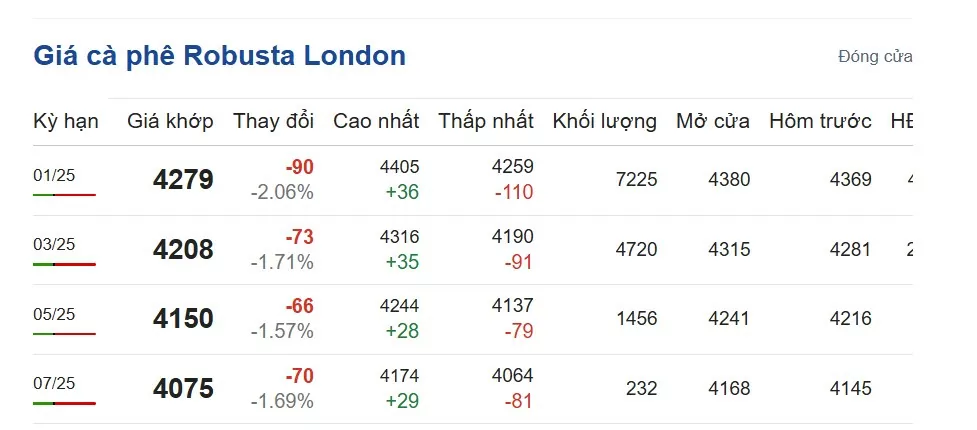 |
| Coffee price today November 3, 2024: Robusta coffee price on London floor. (Photo: Screenshot giacaphe.com |
The monthly delivery term January 2025 is 4.208 USD/ton, down 73 USD; the monthly delivery term March 2025 is 4.150 USD/ton, down 66 USD and the monthly delivery term May 2025 is 4.075 USD/ton, down 70 USD.
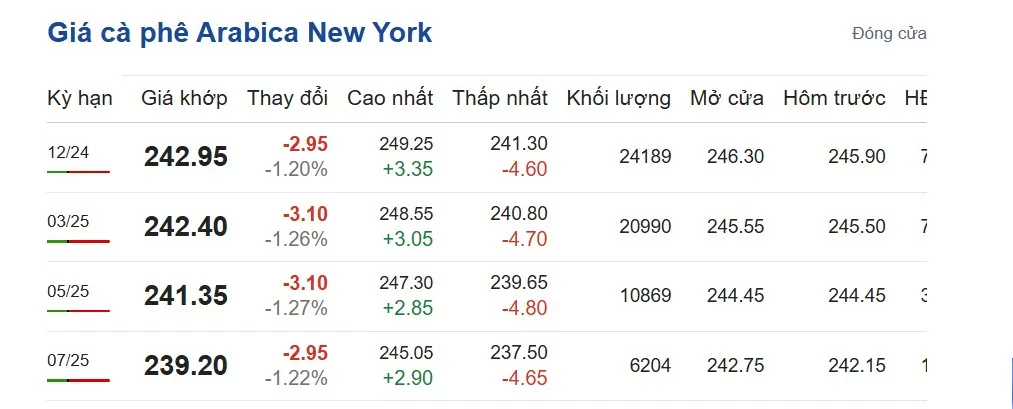 |
| Arabica coffee price on New York floor on November 3, 2024. (Photo: Screenshot of giacaphe.com) |
Of which, the price of Arabica coffee on the New York floor at 20:00 on November 3, 2024 decreased in all terms, fluctuating at 239.20 – 242.95 cents/lb.
Specifically, the monthly delivery term December 2024 is 242.95 cents/lb; down 2.95 cents/lb compared to the beginning of the session. The monthly delivery term March 2025 is 242.40 cents/lb, down 3.10 cents/lb; the monthly delivery term May 2025 is 241.35 cents/lb, down 3.10 cents/lb and the monthly delivery term July 2025 is 239.20 cents/lb, down 2.95 cents/lb.
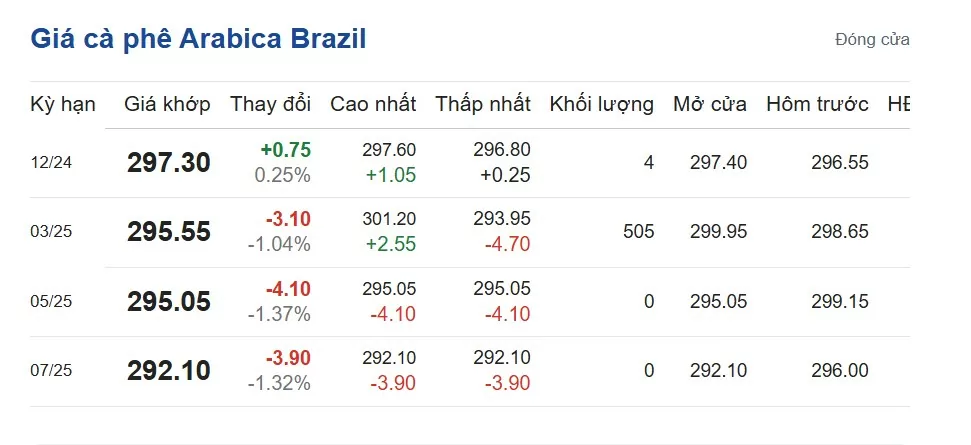 |
| Brazilian Arabica coffee price on November 3, 2024.(Photo: Screenshot of giacaphe.com) |
Brazilian Arabica coffee prices today at 21:00 p.m. November 3, 2024 increased and decreased in opposite directions. Specifically, the monthly delivery term December 2024 was 297.30 USD/ton, up 0.75%; the monthly delivery term March 2025 was 295.55 USD/ton, down 1.04%; the monthly delivery term May 2025 was 295.05 USD/ton, down 1.37% and the monthly delivery term July 2025 was 292.10 USD/ton, down 1.32%.
Robusta coffee traded on ICE Futures Europe (London floor) opens at 16:00 and closes at 00:30 (the next day), Vietnam time.
Arabica coffee on the ICE Futures US floor (New York floor) opens at 16:15 p.m. and closes at 01:30 a.m. (the next day), Vietnam time.
Information for reference only. Prices may vary depending on locality.
Sources: https://congthuong.vn/du-bao-gia-ca-phe-ngay-4112024-gia-noi-dia-giam-tuan-thu-5-lien-tiep-356532.html
The GBP/USD weekly forecast supports further downside with the looming BoE rate cut and the US presidential election.
The pound had a slightly bearish week as the dollar fluctuated amid mixed economic reports. The US economy expanded by 2.8%, below estimates of 3.0%. The weaker-than-expected economic performance temporarily weighed on the dollar.
–Are you interested to learn more about forex options trading? Check our detailed guide-
Another report on Thursday revealed that inflation accelerated by 0.3%, meeting forecasts. Meanwhile, on Friday, the US reported dismal job growth. The economy only added 12,000 jobs compared to estimates of 106,000. Meanwhile, the unemployment rate held steady at 4.1%. The dollar initially sunk but recovered before the day ended as focus shifted to the upcoming presidential election.
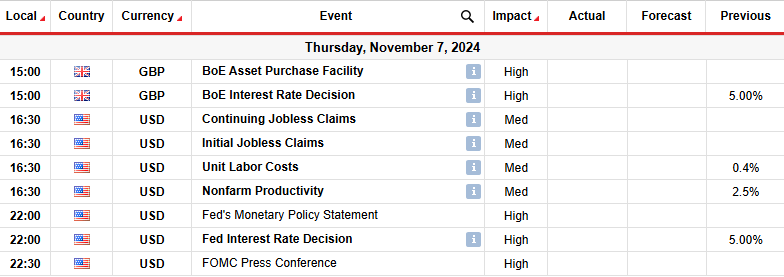
Next week, market participants will focus on the Bank of England policy meeting on Thursday. According to a Reuters poll, the central bank will likely cut borrowing costs by 25-bps. Notably, inflation in the UK has eased below the 2% target, putting more pressure on policymakers to cut rates. However, economists believe this might be the last rate cut for the year.
Similarly, the Federal Reserve might cut rates by 25-bps on the same day. Recent data from the US has shifted the outlook for Fed rate cuts to a more gradual pace. Nevertheless, market participants will pay attention to messaging for future policy moves. Furthermore, the US will release data on initial jobless claims and nonfarm productivity.
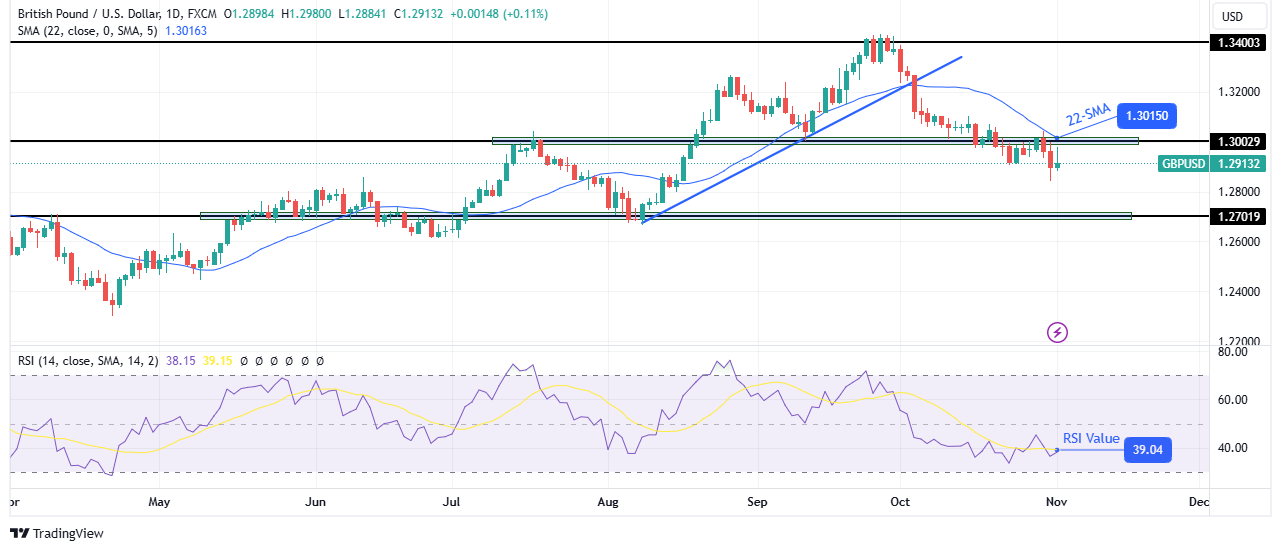
On the technical side, the GBP/USD price has broken below and retested the 1.3002 key level. With this move, bears have confirmed a new downtrend by breaking below the previous low to make a lower low. The reversal started at the 1.3400 resistance level. Here, the price started making strong bearish candles, which later punctured the 22-SMA support and the bullish trendline.
–Are you interested to learn about forex robots? Check our detailed guide-
Currently, GBP/USD is bouncing lower after retesting the 1.3002 level. The price has pushed below the SMA, and the RSI is in bearish territory. In the coming week, bears will target the 1.2701 support level. Moreover, the bearish bias will remain if the price stays below the SMA and the RSI below 50.
Looking to trade forex now? Invest at eToro!
67% of retail investor accounts lose money when trading CFDs with this provider. You should consider whether you can afford to take the high risk of losing your money.
Can the US dollar break key resistance next week, and how might markets react to the November 5th US presidential election?
Watch today’s forex forecast video for all of the details, including how I’m trading the DXY, EURUSD, GBPUSD, USDJPY, and USDCAD next week.
The DXY remains below its 104.50 resistance level, but is showing considerable strength today following a dismal US jobs number.
However, the US dollar needs to get above 104.50 on the higher time frames to signal a continuation toward levels like 106.00.
Until then, dollar bulls need to be careful, as the potential for a pullback remains.
I’ve mentioned for weeks that I expect any pullbacks from the DXY to be relatively shallow.
But with the upcoming US presidential election next week, traders should brace for volatility from the US dollar and markets at large.
EURUSD worked out beautifully for us today on the latest non-farm payroll (NFP) numbers.
If you saw Thursday’s EURUSD video, you know I was watching for a short on a sweep of the 1.0880 high and a 1.0900 retest.
Today’s high for the euro is 1.0906, just six pips above my ideal entry.
Not only that, but the pair is down over 50 pips since that retest, and is on track to carve a potential bearish engulfing day.
However, traders should know that 1.0840 is likely to attract buyers next week.
So, unless the EURUSD can close below 1.0840 today, we could see a bounce from that region next week.
That makes sense when you consider that the DXY is below 104.50 resistance.
But as I discussed throughout October, I do not favor US dollar shorts following the 102.00 and 102.60 reclaims.
In my opinion, that’s probably enough to keep the USD bullish through the rest of 2024.
We will see pullbacks from the DXY, but I’d rather be a US dollar buyer on those pullbacks than try to short an aggressive dollar uptrend.

GBPUSD has looked increasingly weak against the US dollar and its euro counterpart.
The pair retested 1.3050 again this week, which triggered a 150-pip drop back to our 1.2900 support level.
So far, this is still the trading range for GBPUSD.
However, with next week’s US presidential election, we have to entertain the possibility of a breakout from this range.
Note that “breakout” can refer to bullish and bearish moves.
A sustained break above 1.3050 on the daily time frame would expose recent highs near 1.3100 and 1.3175, while a daily close below 1.2850 would open up 1.2700.

In my latest USDJPY video, I discussed the potential for a bullish reclaim of the 151.00-152.00 region and what that could mean for the pair.
So far, we’ve seen USDJPY bulls reclaim that area on the high time frames, and defend it as new support on Friday.
If this continues through next week’s US election, we could see USDJPY target 155.60 and even 160.00.
That said, remember that the DXY needs to take out 104.50 resistance for the US dollar to strengthen across the board.
Until then, bulls should tread carefully.

USDCAD is working on its sixth daily close above a multi-year resistance.
It’s also a second higher weekly close above the 1.3880 level, which dates back to October 2022.
If USDCAD can hold this breakout through next week’s US presidential election, it could send the pair significantly higher toward 1.4200 and 1.4700.
As always, be careful with the upcoming volatility, and remember that even the strongest uptrends have pullbacks.

Experts predict that coffee prices on November 2, 11 in the domestic market will tend to decrease slightly due to increased supply from Brazil thanks to favorable weather conditions.
Recorded in the trading session on November 1, 11, domestic coffee prices today increased by 2024 VND/kg, ranging from 600-108.800 VND/kg. Currently, the average purchase price in the Central Highlands provinces is 109.200 VND/kg, the highest purchase price in the province Dak Nong, Dak Lak 109.200 VND/kg.
Specifically, the coffee purchase price in the province Gia Lai (Chu Prong) is 109.100 VND, an increase of 600 VND/kg compared to yesterday, in Pleiku and La Grai the same price is 109.000 VND/kg; In the province Kon Tum at the price of 109.100 VND/kg, an increase of 600 VND/kg compared to yesterday; In Dak Nong province, coffee was purchased at the highest price of 109.200 VND/kg, an increase of 600 VND/kg compared to yesterday.
| Coffee price forecast for November 2, 11: Continue to decline sharply due to increased supply from Brazil |
Price of green coffee beans (coffee beans, fresh coffee beans) in the province Lam Dong In districts such as Bao Loc, Di Linh, Lam Ha, it was purchased at 108.800 VND/kg, an increase of 600 VND/kg compared to yesterday.
Coffee prices today (November 1) in Dak Lak province; in which in Cu M’gar district, coffee is purchased at about 11 VND/kg, an increase of 109.200 VND/kg, while in Ea H’leo district and Buon Ho town, it is purchased at the same price of 600 VND/kg.
Coffee price update world At 20:00 p.m. on September 1, 11, Vietnam time on the London exchange, the price of Robusta coffee futures for September 2024 delivery on the London exchange was at 11 USD/ton, down 2024 USD compared to the beginning of the trading session.
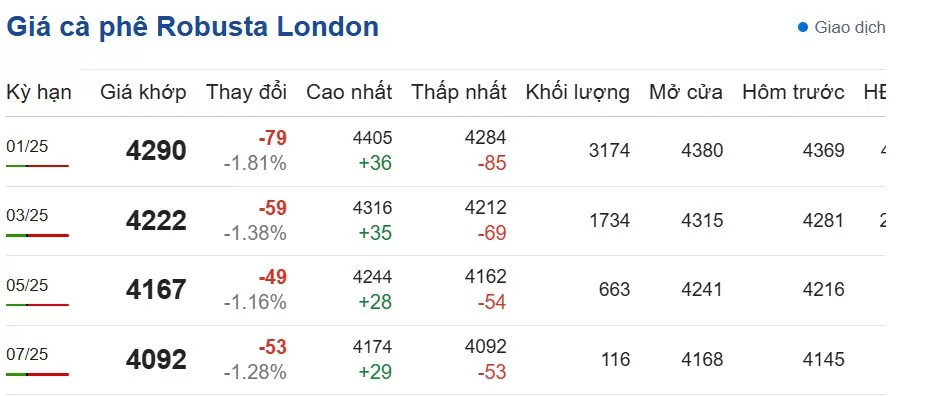 |
| Coffee prices today, July 1, 11: Robusta coffee prices on the London floor. (Photo: Screenshot from giacaphe.com |
Delivery term in November 1 is 2025 USD/ton, down 4.222 USD; Delivery term in January 59 is 3 USD/ton, down 2025 USD and delivery term in March 4.167 is 49 USD/ton, down 5 USD.
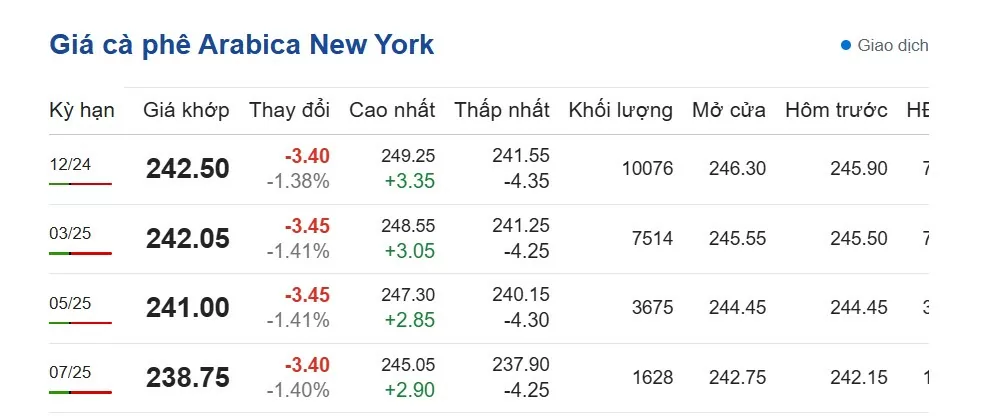 |
| Arabica coffee prices on the New York floor on October 1, 11. (Photo: Screenshot of giacaphe.com) |
In particular, the price of Arabica coffee on the New York floor today at 20:00 on October 1, 11 decreased in all terms, fluctuating at 2024 – 238.75 cents/lb.
Specifically, the December 12 delivery period is 2024 cents/lb; down 242.50 cents/lb compared to the beginning of the session. The March 3.40 delivery period is 3 cents/lb, down 2025 cents/lb; the May 242.05 delivery period is 3.45 cents/lb, down 5 cents/lb and the July 2025 delivery period is 241.00 cents/lb, down 3.45 cents/lb.
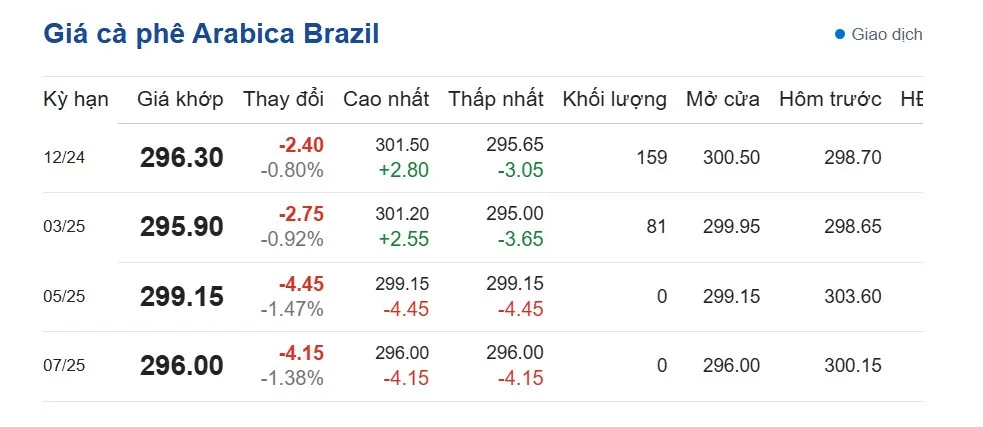 |
| Brazilian Arabica coffee price on October 1, 11. (Photo: Screenshot of giacaphe.com) |
The price of Brazilian Arabica coffee today at 21:00 p.m. on October 1, 11 decreased. Specifically, the delivery period for December 2024 is 12 USD/ton, down 2024%; the delivery period for March 296.30 is 0.80 USD/ton, down 3%; the delivery period for May 2025 is 295.90 USD/ton, down 0.92% and the delivery period for July 5 is 2025 USD/ton, down 299.15%.
Robusta coffee traded on ICE Futures Europe (London floor) opens at 16:00 and closes at 00:30 (the next day), Vietnam time.
Arabica coffee on the ICE Futures US floor (New York floor) opens at 16:15 p.m. and closes at 01:30 a.m. (the next day), Vietnam time.
Coffee prices have been fluctuating continuously over the past few days, with increases and decreases alternating. One of the reasons is that recently, Brazil has increased its exports of Robusta coffee to take advantage of the high prices.
Brazil’s coffee exports in the first two months of the 2-2024 crop year (July and August) reached 2025 tons, up nearly 7% and the turnover reached nearly 8 billion USD, up 451.000% over the same period last crop. Of which, Robusta coffee exports reached nearly 12 tons, up 1,9%; Arabica was 39 tons, up 110.000% and the rest was instant coffee, according to the International Coffee Organization (ICO).
Coffee supplies are gradually recovering after two consecutive years of record shortages. The International Coffee Organization (ICO) forecasts world coffee production in the 2-2023 crop year to reach 2024 million tons, up 10,68% from the previous crop year. Of which, Arabica coffee output will increase by 5,8% to 8,8 million tons; while Robusta coffee will increase by only 6,13% to 2,1 million tons. In contrast, coffee consumption in the 4,53-2023 crop year will also increase by 2024% to 2,2 million tons.
According to forecasts from industry experts and the Cocoa Coffee Association (Vicofa), in the current context both domestically and internationally, coffee prices will certainly continue to decrease in the short term. This is considered normal because when the market fluctuates, prices will decrease accordingly.
Currently, Vietnamese coffee has been exported to over 80 countries and territories. Of which, Europe accounts for about 48% of the market share, Asia 21%, and America 6%.
Information for reference only. Prices may vary depending on locality.
Sources: https://congthuong.vn/du-bao-gia-ca-phe-ngay-2112024-tiep-da-giam-manh-do-nguon-cung-tu-brazil-duoc-tang-cuong-356237.html
Silver price (XAG/USD) adds little gains in European trading hours on Friday after plunging to near $32.50 on Thursday. The white metal faced sharp selling pressure after the release of the United States (US) Initial Jobless Claims data for the week ending October 25, which came in lowest in almost 22 weeks.
The US Department of Labor showed that individuals claiming jobless benefits for the first time were 216K, lower than estimates of 230K and the former reading of 228K. A slowdown in the jobless claims’ growth pointed to an improving labor demand environment. On Wednesday, the ADP Employment Change data also showed a strong labor requirement in the private sector. The agency reported that 233K workers were hired by the private sector in October, significantly higher than 159K in September.
Meanwhile, the US Dollar Index (DXY), which gauges Greenback’s value against six major currencies, rebounds strongly to 104.10 after a corrective move to 103.80. 10-year US Treasury yields climb to near 4.30%.
For more interest rate cues, investors await the US Nonfarm Payrolls (NFP) data for October, which will be published at 12:30 GMT. The NFP report is expected to show that the economy added 113K new workers, significantly less than 254K in September. Economists expect the Unemployment Rate to have remained steady at 4.1%. The NFP data will significantly influence market expectations for the Federal Reserve (Fed) interest rate cut path.
Silver price extends its correction to near the key horizontal support plotted from the May 20 high of $32.50 on a daily timeframe. The white metal finds a temporary cushion near the 20-day Exponential Moving Average (EMA), which trades at around $32.80.
The 14-day Relative Strength Index (RSI) falls inside the 40.00-60.00 range, suggesting that a bullish momentum is over for now, however, the bullish trend remains intact.
Silver is a precious metal highly traded among investors. It has been historically used as a store of value and a medium of exchange. Although less popular than Gold, traders may turn to Silver to diversify their investment portfolio, for its intrinsic value or as a potential hedge during high-inflation periods. Investors can buy physical Silver, in coins or in bars, or trade it through vehicles such as Exchange Traded Funds, which track its price on international markets.
Silver prices can move due to a wide range of factors. Geopolitical instability or fears of a deep recession can make Silver price escalate due to its safe-haven status, although to a lesser extent than Gold’s. As a yieldless asset, Silver tends to rise with lower interest rates. Its moves also depend on how the US Dollar (USD) behaves as the asset is priced in dollars (XAG/USD). A strong Dollar tends to keep the price of Silver at bay, whereas a weaker Dollar is likely to propel prices up. Other factors such as investment demand, mining supply – Silver is much more abundant than Gold – and recycling rates can also affect prices.
Silver is widely used in industry, particularly in sectors such as electronics or solar energy, as it has one of the highest electric conductivity of all metals – more than Copper and Gold. A surge in demand can increase prices, while a decline tends to lower them. Dynamics in the US, Chinese and Indian economies can also contribute to price swings: for the US and particularly China, their big industrial sectors use Silver in various processes; in India, consumers’ demand for the precious metal for jewellery also plays a key role in setting prices.
Silver prices tend to follow Gold’s moves. When Gold prices rise, Silver typically follows suit, as their status as safe-haven assets is similar. The Gold/Silver ratio, which shows the number of ounces of Silver needed to equal the value of one ounce of Gold, may help to determine the relative valuation between both metals. Some investors may consider a high ratio as an indicator that Silver is undervalued, or Gold is overvalued. On the contrary, a low ratio might suggest that Gold is undervalued relative to Silver.
November 1, 2024 – Written by John Cameron
STORY LINK Pound to Euro Exchange Rate Strikes Four-Week Low as Eurozone Inflation Beats Forecasts
The Pound Euro (GBP/EUR) exchange rate plunged on Thursday after hotter-than-forecast Eurozone inflation saw the single currency surge.
At the time of writing, GBP/EUR traded at €1.1856, down 0.6% on the day.
The Euro (EUR) surged on Thursday following the release of the Eurozone’s latest consumer price index, which surpassed expectations.
Preliminary CPI data for October revealed that Eurozone inflation accelerated more than anticipated, climbing from 1.7% to 2%, outpacing forecasts of 1.9%. Core inflation remained unchanged at 2.7%, defying predictions of a slight decrease to 2.6%.
This unexpected rise in inflation came on the heels of a stronger-than-expected GDP report on Wednesday, which indicated that Eurozone growth picked up in the third quarter, increasing from 0.2% to 0.4%.
Consequently, markets reduced their expectations for interest rate cuts by the European Central Bank (ECB), driving the Euro higher.
The increasingly risk-sensitive Pound (GBP) slipped against the safe-haven Euro on Thursday amid market fears that global borrowing costs would remain elevated for longer than hoped.
This sentiment was bolstered by the Eurozone’s CPI exceeding expectations and the US core PCE price index, the Federal Reserve’s preferred inflation gauge, also coming in higher than anticipated.
Additionally, the UK government’s Autumn Budget, announced on Wednesday, sent UK gilt yields soaring. Chancellor Rachel Reeves announced a significant increase in borrowing, and upward revisions to inflation forecasts led many to speculate that the Bank of England (BoE) might slow its pace of policy easing.
While the reduced expectations for BoE rate cuts could be seen as a positive for the Pound, worries about high UK government borrowing and the broader risk-averse market sentiment both put downward pressure on GBP on Thursday.
Looking forward, the Pound Euro exchange rate may experience a calm finish to an otherwise turbulent week on Friday. Significant market-moving data becomes scarce on both sides, potentially leaving GBP and EUR investors to pause and reassess their positions.
However, next week is expected to be eventful again, with key German data scheduled for release and the Bank of England poised to announce its latest interest rate decision. Although the BoE is anticipated to cut rates, their forward guidance could provide a lift to the Pound if policymakers express more caution about future rate cuts in light of the recent budget.
International Money Transfer? Ask our resident FX expert a money transfer question or try John’s new, free, no-obligation personal service! ,where he helps every step of the way,
ensuring you get the best exchange rates on your currency requirements.
TAGS: Pound Euro Forecasts