The main category of Forex News.
You can use the search box below to find what you need.
[wd_asp id=1]
The main category of Forex News.
You can use the search box below to find what you need.
[wd_asp id=1]
GBP/EUR Year-End 2025 Forecast
Consensus from major banks.
Image © Pound Sterling Live
Our stance this December was that the pound to euro exchange rate (GBP/EUR) would deliver a year-end rally, offering euro buyers some tactical buying opportunities.
However, the euro has proven to be an outperformer amongst the world’s major currencies over the course of the past week, stymying GBP/EUR’s ambitions.
Find out how much you could save on your international transfer
Estimated saving compared to high street banks:
£25.00
Compare Rates from Leading Providers →
Free • No obligation • Takes 2 minutes
The pair peaked at 1.1463 last Tuesday and we were confident upside momentum was building as it had crossed the 55-day exponential moving average (EMA); typically a sign that an uptrend is building.
However, last Thursday’s 0.30% drop in GBP/EUR sliced through the 55-day and 21-day EMA, both of which are likely to act as resistance levels in the coming days.
Momentum is turning lower again and we are left considering the possibility that the year-end rally burned out before the mid-month mark.
Above: GBP/EUR at daily intervals.
Losses to 1.1360 are possible this week, ahead of a move back to 1.1320 support early in the new year.
The problem for those wanting a stronger pound is that fundamentals are pitted against it: the economic data has deteriorated, as confirmed by four successive months of no economic growth, and this is raising the odds of further BoE interest rate cuts.
This is unhelpful to sterling, given most G10 central banks have ended their rate cutting cycles and many are expected to raise interest rates at some point next year.
Image courtesy of Lloyds Bank
The BoE is almost certainly set to lower Bank Rate by 25 basis points on Thursday, meaning the decision itself won’t come as a surprise.
Instead, what will be of interest is how the Bank shapes expectations for what happens early next year.
Ahead of the decision, we will receive labour market and PMI data (Tuesday) and inflation numbers (Wednesday).

The market is presently priced for one further BoE cut before April 2026, but if the data disappoints, more cuts will be built into the outlook, which would inevitably weigh on the pound.
“A BoE cut combined with the market adding to expectations of another cut in Q1 26 can weigh on the GBP,” says a note from TD Securities.
Economists look for the UK’s unemployment rate to rise to 5.1% when labour market statistics are released Tuesday, confirmation of an ongoing deterioration in the jobs market.
The Bank will believe it can address this by lowering rates, which would take pressure off households and businesses.
In short, if the data undershoots, the pound will sink to 1.1350 and lower.
However, lowering interest rates could prove risky if it stimulates inflation: Wednesday should see the ONS confirm inflation comes in at 3.6%, which is well ahead of the Bank’s 2.0% target.
If the data comes in ahead of expectations, we would expect pricing for further Bank rate cuts to halt and reverse, helping the pound recover.
A series of above-consensus data prints would help pound-euro recover back above 1.14 and restart the year-end rally.
But given the nature of survey data that showed the economy struggled ahead of the November budget, we see this as a lower probability outcome.
Silver price today (15 December 2025) is back on the front page of global markets after last week’s record run. The white metal is trading in the low-to-mid $63 per ounce area—firmly higher on the day—supported by a softer U.S. dollar and easing Treasury yields as traders position ahead of key U.S. labor data. [1]
Just as important as the price itself is the message behind it: silver is behaving like a hybrid asset again—part precious-metal hedge, part high-demand industrial input—meaning it can move quickly when macro tailwinds and physical-market narratives align.
Silver’s pricing on December 15 has been notably dynamic, with different feeds reflecting different points in the day:
Taken together, the story is consistent: silver price today is holding above $63/oz, rebounding after profit-taking and volatility around last week’s record high.
Reuters highlighted the U.S. dollar hovering near a two‑month low and benchmark 10‑year Treasury yields edging lower, a combination that tends to support non-yielding metals like silver. [7]
Markets are still digesting last week’s 25-basis-point Fed rate cut, delivered in a rare split decision, alongside signals that policy may pause as inflation remains sticky and the labor outlook uncertain. [8]
Lower-rate expectations matter for silver in two ways:
Reuters pointed to U.S. non-farm payrolls due Tuesday, a key event risk that can swing yields, the dollar, and—by extension—precious metals. [9]
One of the more structurally interesting developments today: Reuters reported that India moved to allow pension funds to invest in gold and silver ETFs, and ANZ suggested this could lift institutional participation by broadening the investor base. [10]
While this won’t necessarily move prices overnight, it matters because it speaks to the depth of potential long-term investment demand—especially at a time when silver is already attracting attention after a historic rally.
A separate Reuters report said Korea Zinc plans to build a $7.4 billion smelter project in the U.S., producing metals including silver, with operations planned to start progressively from 2027. [11]
This is not an immediate supply fix—but it reinforces a key theme behind silver’s 2025 surge: governments and industry are increasingly framing metals supply chains as strategic.
Silver’s rally has also sparked a wave of same-day technical analysis and near-term forecasting. Here’s what major market commentary published on December 15, 2025 is emphasizing.
FXEmpire (Dec 15, 06:31 GMT) described silver as stabilizing near $62.65, with upside targets at $63.80 and $65.55—as long as support near $61.45 holds. [12]
That framing captures the market’s current tug-of-war: strong trend structure, but a need to digest sharp gains.
FXLeaders (Dec 15) focused on silver trading near $63.28 inside a rising channel and laid out a clear set of levels:
In other words: the bullish roadmap many traders are watching is a hold above ~$62, followed by a push back toward the highs—and potentially beyond.
Investing.com’s Silver Futures Technical Analysis showed a “Strong Buy” summary on December 15, with multiple indicators aligned bullishly, while also flagging some overbought readings (for example, StochRSI and Williams %R showing overbought conditions). [14]
That mix is important: it suggests trend strength, but also supports the case for consolidation or sharp pullbacks even within a broader uptrend.
An Investing.com analysis piece published today framed silver’s move around cycle behavior and pointed to a resistance “arc” in the $64.80–$65.20 region, with other referenced levels clustering around the low $60s and upper $50s depending on the scenario. [15]
Whether or not you follow cycle models, it’s notable that this zone sits close to where many classic technical tools would also focus attention: near recent highs and psychologically significant “mid‑$60s” territory.
Saxo Bank’s “Market Quick Take” dated December 15 highlighted a sharp peak-to-trough pullback on Friday from near $64.5, but said silver still ended the week up and bounced in the Asian session to trade around $63.2, underpinned by demand for hard assets and a tight supply backdrop. [16]
DailyForex’s December 15 market note said precious metals were rising strongly and that silver might test its record high made last week, reflecting the broader momentum tone across the complex. [17]
Even on a strong day, today’s coverage flagged real risks.
Reuters reported that ANZ warned of potential downside risks tied to the possibility of a U.S. tariff exemption that could ease perceived supply tightness, alongside stretched valuations versus gold that could encourage rotation. [18]
Silver is historically more volatile than gold. When technical dashboards flash “strong buy” and “overbought” simultaneously, markets can still rise—but they can also snap back fast on profit-taking. [19]
A hotter-than-expected payrolls report could lift yields and the dollar, pressuring metals—while a weaker report could do the opposite. Reuters explicitly noted the market focus on upcoming payrolls as a policy and pricing catalyst. [20]
Silver’s near-term roadmap is unusually clear because so many analysts are clustering around similar zones:
If silver decisively reclaims the area near last week’s highs, the next phase could quickly become a debate about whether this is a “blow-off” or a new, higher plateau—especially with ongoing attention on inventories, industrial demand, and policy.
On December 15, 2025, silver is once again acting like one of the market’s most important macro-and-industrial bellwethers: it’s higher on dollar softness and lower yields, still digesting last week’s record, and drawing an unusually dense set of bullish (but volatility-aware) forecasts that cluster between $65 and $67 as the next key test. [25]
Note: This article is for informational purposes only and is not investment advice.
1. www.reuters.com, 2. www.reuters.com, 3. fixedincome.fidelity.com, 4. www.kitco.com, 5. www.jmbullion.com, 6. www.investing.com, 7. www.reuters.com, 8. www.reuters.com, 9. www.reuters.com, 10. www.reuters.com, 11. www.reuters.com, 12. www.fxempire.com, 13. www.fxleaders.com, 14. www.investing.com, 15. www.investing.com, 16. www.home.saxo, 17. www.dailyforex.com, 18. www.reuters.com, 19. www.investing.com, 20. www.reuters.com, 21. www.fxempire.com, 22. www.fxempire.com, 23. www.fxleaders.com, 24. www.reuters.com, 25. www.reuters.com
The US dollar has rallied against the Japanese yen during the trading session on Friday as traders start to ask questions about whether or not the Federal Reserve is going to start cutting rapidly, or if it is a situation where they do not. And the FOMC statement, once you read into it and read the transcripts of the FOMC press conference, gives a little bit of hesitation to the idea that the Federal Reserve is just simply on autopilot.
Conversely, on the other side of the Pacific Ocean, we have the Bank of Japan, which is going to be in a situation where it is difficult to cut rates at least drastically. And therefore, the interest rate differential should continue to favor the United States, as it historically has for years, almost an entire career, and in fact probably even longer than that.
So, with that being said, it makes a certain amount of sense that the US dollar is somewhat resilient against the yen. And now it looks a lot like a market that is trying to find some type of consolidation area. The consolidation area is an area that is presently defined with 158 yen being the ceiling and 155 yen being the first floor.
Underneath, we have another floor near the 153 yen level. And as long as we stay above there, I think you have a situation where you will be looking to buy dips. That does not mean that it is easy, and it does not mean that it is going to be a slam dunk, but I do recognize that finding value in this pair on dips and taking advantage of cheap US dollars probably remains the way to go forward.
I like the idea of buying dips as we had just seen and taking advantage of the interest rate differential, just simply holding on to the pair and collecting a little bit of profit at the end of every day, and riding the trend as it gains nominal gains, perhaps to the 158 yen level, maybe even higher than that. I have no interest in shorting as things stand right now.
Want to trade our USD/JPY forex analysis and predictions? Here’s a list of forex brokers in Japan to check out.
The coffee outlook for Q3 2025 shows steady consumption across major regions, supported by strong demand from retail, foodservice, and café segments. Reliable supply from producing countries, stable trade flows, and seasonal harvesting patterns influenced regional performance, while logistics, labor conditions, and consumer trends shaped overall movement during the quarter.
North America Coffee Prices Movement Q3 2025:
Coffee Prices in United States:
In Q3 2025, the coffee price trend in the USA reflected an average of USD 8305/MT, supported by strong demand from retail chains, cafés, and foodservice operators. Steady import volumes ensured supply continuity, while rising logistics and labor costs added moderate pressure, keeping prices firm throughout the quarter.
Get the Real-Time Prices Analysis: https://www.imarcgroup.com/coffee-pricing-report/requestsample
Note: The analysis can be tailored to align with the customer’s specific needs.
Coffee Prices in Canada:
In Q3 2025, coffee prices in Canada averaged USD 8309/MT. Strong demand from households and foodservice outlets supported firm pricing. Adequate import availability and efficient distribution networks maintained supply stability. Minor cost pressures from transportation and currency fluctuations influenced pricing, but overall market conditions remained steady with sustained consumer demand throughout the quarter.
APAC Coffee Prices Movement Q3 2025:
Coffee Prices in Vietnam:
Vietnam recorded coffee prices at USD 4212/MT during Q3 2025. Healthy export demand and stable Robusta production supported market activity. Favorable weather conditions and efficient harvesting ensured adequate supply, while competitive pricing attracted international buyers. Minor fluctuations in freight rates influenced short-term price movement, but overall market sentiment remained balanced and supportive across the quarter.
Regional Analysis: The price analysis can be extended to provide detailed Coffee price information for the following list of countries.
China, India, Indonesia, Pakistan, Bangladesh, Japan, Philippines, Vietnam, Thailand, South Korea, Malaysia, Nepal, Taiwan, Sri Lanka, Hongkong, Singapore, Australia, and New Zealand, among other Asian countries.
Europe Coffee Prices Movement Q3 2025:
Coffee Prices in France:
France reported coffee prices of USD 7432/MT in Q3 2025, reflecting consistent demand from retail, hospitality, and specialty coffee segments. Reliable imports from Latin America and Africa ensured steady supply. Higher energy and processing costs influenced pricing, though stable consumption and predictable procurement patterns helped maintain balanced market conditions across the country.
Latin America Coffee Prices Movement Q3 2025:
Coffee Prices in Brazil:
In Brazil, coffee prices averaged USD 6219/MT in Q3 2025. Strong global demand and steady export shipments supported pricing. Favorable crop conditions and efficient logistics helped maintain supply stability. Currency movements and transportation costs caused occasional price adjustments, yet overall market conditions remained firm, driven by Brazil’s key role as a leading global coffee producer.
Regional Analysis: The price analysis can be extended to provide detailed Coffee price information for the following list of countries.
Brazil, Mexico, Argentina, Columbia, Chile, Ecuador, and Peru, among other Latin American countries.
Factors Affecting Coffee Supply and Prices
Coffee supply and prices are influenced by weather conditions, crop yields, and harvesting cycles in major producing regions. Demand from beverage and retail sectors impacts pricing. Additionally, currency fluctuations, export policies, logistics costs, and sustainability regulations affect availability, while global consumption trends shape overall market stability and price movements.
Speak to An Analyst: https://www.imarcgroup.com/request?type=report&id=24122&flag=C
Key Coverage:
How IMARC Pricing Database Can Help
The latest IMARC Group study, “Coffee Prices, Trend, Chart, Demand, Market Analysis, News, Historical and Forecast Data 2025 Edition,” presents a detailed analysis of Coffee price trend, offering key insights into global Coffee market dynamics. This report includes comprehensive price charts, which trace historical data and highlights major shifts in the market.
The analysis delves into the factors driving these trends, including raw material costs, production fluctuations, and geopolitical influences. Moreover, the report examines Coffee demand, illustrating how consumer behaviour and industrial needs affect overall market dynamics. By exploring the intricate relationship between supply and demand, the prices report uncovers critical factors influencing current and future prices.
About Us:
IMARC Group is a global management consulting firm that provides a comprehensive suite of services to support market entry and expansion efforts. The company offers detailed market assessments, feasibility studies, regulatory approvals and licensing support, and pricing analysis, including spot pricing and regional price trends. Its expertise spans demand-supply analysis alongside regional insights covering Asia-Pacific, Europe, North America, Latin America, and the Middle East and Africa. IMARC also specializes in competitive landscape evaluations, profiling key market players, and conducting research into market drivers, restraints, and opportunities. IMARC’s data-driven approach helps businesses navigate complex markets with precision and confidence.
Contact us:
IMARC Group
134 N 4th St. Brooklyn, NY 11249, USA
Email: sales@imarcgroup.com
Tel No: (D) +91 120 433 0800
United States: +1-631-791-1145
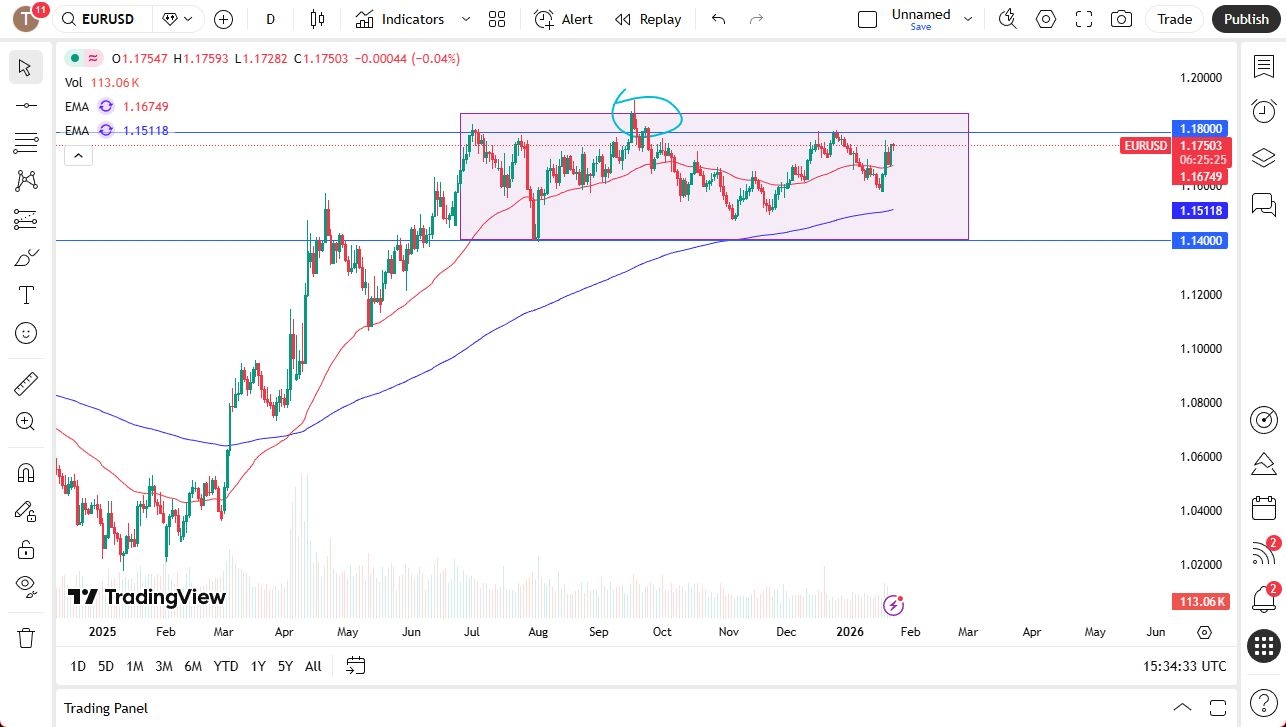
The EUR/USD pair continues to receive positive momentum from the divergence in the future policies of both the US Federal Reserve and the European Central Bank (ECB). Consequently, and according to reliable trading platforms, the Euro/Dollar price recently rose to the 1.1762 resistance level, the pair’s highest in two months, before settling around 1.1733 at the time of writing this analysis. This stability is in anticipation of the crucial reaction this week to the ECB’s policy announcement and the US jobs figures, the latter of which has been long-awaited due to the longest government shutdown in US history.
As is well known, US jobs figures and inflation levels are key factors influencing the Federal Reserve’s policy decisions at upcoming meetings.
Obviously, the technical indicators confirm an upward technical correction for the EUR/USD pair. As shown on the daily chart, the 14-day Relative Strength Index (RSI) has moved towards the 67 resistance level after recent gains, with the nearest point to the overbought line being 70.
Simultaneously, the MACD lines are steadily trending upwards, confirming the bulls’ readiness for further gains if the factors driving the currency’s price increase continue. Breaking above the psychological resistance level of 1.1800 remains crucial to confirming the overall trend shift and simultaneously supports the potential for a move towards the psychological resistance level of 1.2000, which has been identified as a target for trading in 2026.
A scenario for a EUR/USD decline on the same daily chart would require a return to the 1.1500 psychological support level. No major economic data releases are expected today, suggesting that the pair may trade within a narrow range around its current levels.
The EUR/USD pair is expected to remain within its recent range. Therefore, avoid placing trades within narrow price movements and wait for the reaction to this week’s key events to determine the most suitable buy or sell opportunities.
According to currency trading experts’ forecasts, the Euro/Dollar exchange rate will remain supported in this regard. As the new year’s trades approach, currency investors will continue to monitor this divergence. Currently, they are focused on reassessing the possibility that the ECB may become one of the few G10 central banks with serious indications of monetary policy tightening in 2026. This shift would carry positive, albeit limited, implications for the single European currency.
Currency analysts believe that signs of interest rate hikes are beginning to emerge in several G10 markets, supporting currencies like the Australian Dollar, New Zealand Dollar, and Swedish Krona. They predict that, in the baseline scenario, the ECB will keep its monetary policy unchanged in 2026. However, if the market starts pricing in a more hawkish scenario, the Euro price will clearly benefit.
Experts also indicate that financial markets quickly shifted from expecting rate cuts to tentatively pricing in rate hikes in 2026 for the Australian Dollar, New Zealand Dollar, Canadian Dollar, and Swedish Krona—dynamics that have already supported these currencies. As for the Euro, a rate cut has been almost entirely ruled out.
Ready to trade our Forex daily forecast? We’ve shortlisted the best forex broker list for you to check out.
Gold prices started the week firm on Monday, 15 December 2025, extending a multi-day upswing as the U.S. dollar hovered near a two‑month low and Treasury yields eased ahead of a crucial backlog of U.S. economic releases. The precious metal is once again within striking distance of its October record, keeping traders focused on whether this week’s data and central-bank decisions will push XAU/USD into fresh highs—or trigger a year‑end pullback.
In early trading, spot gold climbed 1% to $4,344.40 an ounce by 06:56 GMT, while U.S. gold futures rose 1.1% to $4,377.40. [1]
Pricing snapshots from major market trackers showed gold holding around the same zone:
Gold’s recent strength matters because it’s not just a bounce: Reuters noted bullion hit its highest since 21 October on Friday, and markets have been treating dips as buying opportunities. [4]
Gold is typically most comfortable when the dollar and yields fall together—because a weaker greenback makes dollar‑priced bullion cheaper for non‑U.S. buyers, and lower yields reduce the opportunity cost of holding a non‑interest‑bearing asset.
That setup was visible again on Monday: Reuters reported the dollar near a two‑month low and 10‑year U.S. yields edging lower, both supportive for bullion. [5]
Markets remain laser-focused on the Federal Reserve’s trajectory after last week’s 25-basis-point rate cut, which Reuters described as a rare split decision, alongside signals that the Fed may pause because inflation remains sticky and the labour outlook is uncertain. [6]
That nuance is important for gold:
Reuters also highlighted that investors were pricing in two rate cuts next year, with this week’s jobs report seen as a major test of those expectations. [7]
Gold is heading into one of the most event‑heavy weeks of the year:
In short: gold has a strong macro tailwind and a packed catalyst calendar—often a recipe for sharp moves.
A key reason gold traders are fixated on this week is that price is approaching an area that has acted like a “ceiling” since October.
Reuters quoted OANDA senior market analyst Kelvin Wong saying gold is likely to remain well bid into the nonfarm payrolls release, and that a supportive read could help drive a push toward $4,380–$4,440 after a rebound from a $4,243 support zone. [11]
That aligns with where broader market commentary has placed the “line in the sand”:
Several daily and weekly technical outlooks published on 15 December converged on a similar map:
FXEmpire’s 15 December forecast put it plainly: gold was holding $4,300 support and “eyes” $4,355–$4,395 as the next upside zone in the near term. [16]
FXStreet’s 15 December note similarly framed the move as gold rising to seven‑week highs near $4,350, supported by rate‑cut expectations and safe‑haven flows, with traders waiting for the next push from U.S. labour data. [17]
Today’s gold rally isn’t happening in a vacuum—markets are positioning ahead of data that can swing rate expectations quickly.
Both Reuters and FXStreet highlighted that markets are now awaiting the Nonfarm Payrolls report (with delayed prints for prior months), while attention later in the week shifts to U.S. CPI—the combination most likely to reprice the Fed path. [18]
FXStreet’s “week ahead” analysis laid out the binary risk clearly: if delayed data shows inflation is hotter and jobs stronger than expected, markets could question whether the Fed cuts were the right call—potentially creating a volatility spike that can also drive haven demand for gold. [19]
Beyond daily macro headlines, one policy change is adding a longer-duration bid: India’s move to permit pension funds to invest in gold and silver ETFs.
Reuters reported that the regulatory change could lift institutional participation, and ANZ said such rules can “boost confidence” and support higher allocations across portfolios. [20]
FXEmpire also pointed to the same development as a constructive factor for precious metals demand. [21]
Gold’s rally is also happening alongside extraordinary moves in silver, which has been one of 2025’s standout trades.
On Monday, Reuters put spot silver up 2% to $63.23, after it hit a record $64.65 on Friday. [22]
That silver strength matters for gold because flows often move through the metals complex together. Earlier in the month, Reuters quoted an analyst noting that silver momentum was pulling gold (and other precious metals) higher. [23]
Even with gold already near the top of its recent range, Wall Street and institutional research remains broadly constructive about 2026—though the “how” and “how fast” differ.
Here are some of the most-cited outlooks circulating into year‑end:
The takeaway for readers: the base case across institutions is not “gold collapses”—it’s either consolidation near elevated levels or continued upside if growth slows, inflation stays sticky, or geopolitics deteriorate. The main bearish scenario tends to be a combination of stronger growth, higher rates and a stronger dollar—exactly the mix that upcoming U.S. data and central bank decisions could begin to signal.
If you’re tracking gold price today (15.12.2025) and trying to understand what comes next, these are the near-term signposts:
For now, the trend remains bullish: gold is holding above widely watched support while the market heads into a high‑stakes data week with the dollar still weak and yields capped. Whether this turns into a clean break to new highs—or a volatility-driven shakeout—likely hinges on how Tuesday’s labour prints and Thursday’s inflation numbers reshape the Fed narrative.
1. www.reuters.com, 2. www.investing.com, 3. www.investing.com, 4. www.reuters.com, 5. www.reuters.com, 6. www.reuters.com, 7. www.reuters.com, 8. www.reuters.com, 9. www.fxstreet.com, 10. www.reuters.com, 11. www.reuters.com, 12. www.reuters.com, 13. www.home.saxo, 14. www.fxempire.com, 15. www.fxempire.com, 16. www.fxempire.com, 17. www.fxstreet.com, 18. www.reuters.com, 19. www.fxstreet.com, 20. www.reuters.com, 21. www.fxempire.com, 22. www.reuters.com, 23. www.reuters.com, 24. www.investing.com, 25. www.reuters.com, 26. markets.businessinsider.com, 27. www.citigroup.com, 28. www.gold.org, 29. www.reuters.com, 30. za.investing.com, 31. www.reuters.com, 32. www.reuters.com
The British pound initially tried to rally, but it failed a bit during the trading session on Friday. Ultimately, this is a market that continues to ask a lot of questions about the 1.34 level as a potential barrier and perhaps even a ceiling.
This is a market that is trying to figure out what to do with the idea of the Federal Reserve potentially being on hold next year, while the British are most certainly going to be cutting rates soon. A lot of what happens from here comes down to the reality that the interest rate differential will not have changed, and that has a lot to do with how this pair behaves.
It was somewhat odd that the pair sold the US dollar the way it did, because this is a market that looks to be in the process of retesting the previous selloff to see whether or not downward pressure continues. That does appear to be the case.
If the market breaks down below the 50-day EMA and the 200-day EMA, there is a real chance of a much more significant breakdown. All things being equal, this looks more like a grind lower rather than an explosive move, although that possibility always exists.
On the other hand, if the market were to break above the 1.3450 level, this area on the chart opens the door to a strong move higher. That would align with a scenario in which the US dollar sells off broadly. It is important to pay close attention to that because when the dollar sells off, it typically does so against everything at the same time.
Ready to trade our daily GBP/USD Forex forecast? Here’s some of the best forex broker UK reviews to check out.
Christopher Lewis has been trading Forex and has over 20 years experience in financial markets. Chris has been a regular contributor to Daily Forex since the early days of the site. He writes about Forex for several online publications, including FX Empire, Investing.com, and his own site, aptly named The Trader Guy. Chris favours technical analysis methods to identify his trades and likes to trade equity indices and commodities as well as Forex. He favours a longer-term trading style, and his trades often last for days or weeks.
Anglo American plc stock (LSE: AAL, ticker often shown as AAL.L) is trading in a market that’s trying to price two big things at once: a copper-heavy future shaped by a transformational merger with Teck Resources, and the very real execution risk that comes with mega-deals, regulatory scrutiny, and operational bottlenecks.
In London trading on 15 December 2025, Anglo American shares hovered around the mid‑2,800p level (roughly £28–£29 per share), after a volatile stretch that included a sharp drop late last week. [1]
After a strong run earlier in 2025, Anglo American shares have recently been choppy. Financial market data for Monday, 15 December 2025 shows the stock closing around 2,837.9p. [6]
On a total-return basis (including dividends), Anglo American’s year-to-date performance has remained positive in 2025, underscoring that investors have largely rewarded the company’s strategic pivot—despite the turbulence around corporate actions. [7]
Why the volatility? In plain terms: when a company proposes a deal that can redefine its commodity exposure and geographic footprint, the market tends to swing between “this is brilliant” and “this is going to be a regulatory and operational headache.”
Anglo American and Teck Resources shareholders have approved a $53 billion, all‑stock, nil‑premium merger that would create a combined company widely described as Anglo‑Teck / Anglo Teck. [8]
Key deal headlines investors are using to value the upside include:
Teck has secured a final order from the Supreme Court of British Columbia approving the plan of arrangement for the merger—an important procedural step that reduces uncertainty around the transaction’s legal pathway. [12]
The market’s focus now shifts to regulators—including Canadian “net benefit” considerations and competition reviews in multiple jurisdictions (with copper’s “critical mineral” status adding a political layer). Reuters has described regulatory approvals as the final major hurdle following the shareholder votes. [13]
Stock implication: until the regulatory timeline becomes clearer, Anglo American shares may trade with a “deal overhang”—where good news helps, but uncertainty caps near-term enthusiasm.
The strategic logic of the merger—and much of the bull case for Anglo American stock—rests on copper.
Reuters reporting this month described copper moving close to $12,000 per metric ton, driven by strong demand (including AI-powered data centers) and tight supply. Reuters also cited expectations for copper market deficits—124,000 tons in 2025 and 150,000 tons in 2026—illustrating why miners with scalable copper exposure are being re-rated. [14]
An outlook report from ING similarly highlights a structurally bullish copper narrative tied to grids, electrification, renewables, and—increasingly—data centers and AI infrastructure. [15]
One of the most repeated industrial logics behind the merger is the possibility of optimizing value from adjacent copper assets in Chile—Teck’s Quebrada Blanca and Anglo’s Collahuasi—via operational coordination. [16]
Stock implication: if investors become more confident that copper stays tight into 2026 and beyond, Anglo American’s copper-heavy trajectory can support higher valuation multiples. But that confidence hinges on output reliability and execution.
The copper thesis is powerful, but miners don’t get paid on PowerPoint—they get paid on tonnes shipped.
Reuters reported that Chilean authorities raised concerns in 2025 about a large crack and water leaks at Teck’s Quebrada Blanca tailings facility, with criticism around reporting speed and ongoing scrutiny. [17]
This matters for Anglo American stock because markets tend to discount “synergies” when there’s a risk that the underlying assets can’t consistently deliver planned volumes.
A market note carried by MarketScreener argued that, even after shareholder approval, translating copper growth ambitions into reality looks challenging, and that uncertainty around restructuring/disposals can limit near-term upside for the shares. [18]
Stock implication: the more the market believes the merger is “hard but doable,” the more Anglo American stock can trade on copper upside and synergy targets. The more the market believes it’s “hard and messy,” the more the stock may be range-bound until milestones are cleared.
Anglo American’s equity story in late 2025 isn’t just “buy copper.” It’s also “sell what doesn’t fit.”
A Reuters report today (15 December 2025) on South Africa’s balance-of-payments data cited Anglo American’s sale of its remaining stake in Valterra Platinum as a driver behind a sharp decline in South Africa’s recorded foreign direct investment outflows in Q3. [19]
While that Reuters item is written as a macro story, equity investors read it as a reminder that Anglo’s simplification program continues to have real financial flows attached to it.
Industry reporting today notes that Anglo American is in the process of selling its 85% stake in De Beers, while Botswana has expressed interest in increasing its ownership (it currently holds 15%). [20]
Separately, reporting in 2025 has pointed to other interested parties, including Angola’s state diamond company pursuing a bid for Anglo’s majority stake. [21]
Stock implication: any credible steps toward a De Beers transaction—price, structure, timeline, or political conditions—can move Anglo American stock quickly, because it affects both cash flow expectations and the clarity of the “new Anglo” portfolio.
Even when shareholders like the strategic direction, they often dislike paying executives extra for doing the job they were hired to do.
Reuters reported that Anglo American withdrew a proposed change to executive bonus awards ahead of the Teck merger vote after investors raised concerns. [22]
UK media coverage also highlighted investor backlash around the size and structure of proposed transaction-linked bonuses. [23]
Stock implication: this isn’t just “corporate drama.” In mega-deals, governance fights can affect investor trust and—at the margin—the shareholder base willing to underwrite risk through a long regulatory process.
Analyst targets and ratings vary widely, which is usually a sign that the market is trying to price a genuinely uncertain path—rather than merely arguing over short-term commodity noise.
That spread basically maps to two competing narratives:
Markets typically reprice deal probability in chunks—when an agency opens a formal review, asks for remedies, or grants clearance.
With copper already up sharply in 2025, incremental upside may depend on whether deficits deepen and whether demand linked to electrification and data centers continues to surprise to the upside. [26]
Any firm timeline, shortlist, or binding agreement around De Beers could be a major valuation event. [27]
Anglo American’s investor calendar shows two key upcoming dates:
Anglo American plc stock is in a classic “strategic transition” phase: it’s being valued less as a diversified legacy miner and more as a future-facing copper platform—especially with the Anglo‑Teck deal moving through major checkpoints.
The opportunity is real: copper fundamentals have strengthened, and the merger’s synergy targets are meaningful on paper. [29]
The risk is equally real: regulators can slow everything down, and operational constraints (especially in Chile) can quickly turn a copper growth story into a confidence problem. [30]
1. markets.ft.com, 2. www.reuters.com, 3. www.reuters.com, 4. www.reuters.com, 5. www.marketbeat.com, 6. markets.ft.com, 7. finance.yahoo.com, 8. www.reuters.com, 9. www.reuters.com, 10. www.angloamerican.com, 11. www.ft.com, 12. www.teck.com, 13. www.reuters.com, 14. www.reuters.com, 15. think.ing.com, 16. www.reuters.com, 17. www.reuters.com, 18. www.marketscreener.com, 19. www.reuters.com, 20. rapaport.com, 21. www.bloomberg.com, 22. www.reuters.com, 23. www.theguardian.com, 24. www.marketbeat.com, 25. valueinvesting.io, 26. www.reuters.com, 27. rapaport.com, 28. www.angloamerican.com, 29. www.reuters.com, 30. www.reuters.com
– Written by
Frank Davies
STORY LINK Euro to Dollar Forecast: EUR/USD Near 1.18 as Fed Uncertainty Dominates
The Euro to US Dollar exchange rate (EUR/USD) jumped to two-month highs above 1.1750 after the Federal Reserve delivered a widely expected rate cut but revealed deeper internal divisions.
Markets read the split vote and Powell’s data-dependent tone as a negative for the dollar, keeping the euro supported. Attention now turns to the Fed’s 2026 path and uncertainty over Powell’s successor.
Scotiabank forecasts Euro to Dollar (EUR/USD) exchange rate gains to 1.22 by the end of 2026 with a further advance to 1.24 the following year.
SocGen does see scope for EUR/USD gains to 1.20 early next year, but forecasts a steady retreat to 1.14 at the end of 2026.
EUR/USD jumped to 2-month highs above 1.1750 after the Federal Reserve policy decision before consolidating.
The Fed cut interest rates by a further 25 basis points to 3.75% at the latest policy meeting, in line with strong consensus forecasts, but divisions intensified.
Get better rates and lower fees on your next international money transfer.
Compare TorFX with top UK banks in seconds and see how much you could save.
There were three dissents against the decision with Schmid and Goolsbee wanting to leave rates on hold while Miran called for a 50 basis-point cut.
Chair Powell emphasised the difficulty in policymaking with higher inflation and weaker employment. He insisted that policy would be data dependent.
According to the latest updates, the median projection is for one further cut in 2026, although there was a wide divergence in forecasts.
Fed policy will remain a key element next year with Chair Powell’s term ending in May and there is a high degree of uncertainty.
Scotiabank commented; “The search for Powell’s successor remains another key risk for the USD, as the current top contender for the role is the dovish-leaning Hassett. Powell’s term (as Chair) officially ends in May, but President Trump has suggested that he could announce his choice as soon as January—setting off a sequence of events that would add significant pressure to the USD into the confirmation and arrival of a new Fed Chair.”
Scotiabank also sees scope for a relatively hawkish ECB stance which would underpin the Euro; “Policymakers had been offering subtle hints over the past few weeks, signaling concerns about upside risks to inflation within the context of an overall balanced outlook.”
Mizuho has an end-2026 EUR/USD forecast of 1.22 and noted; “Fed cuts, German fiscal spending and higher levels of USD FX hedging will lead to a 2017 analogue playing out in 2025/26 but it’s hard to go further than that.”
SocGen also postulated historical comparisons, but does not see a happy ending for the Euro; “There are echoes here of 2020/21 and 2016/17. In both cases, hope that Euro-Zone growth prospects would improve, and monetary policy normalise contrasted with fears that the US economy would suffer a longer-term hangover. In both cases, EUR/USD made it above 1.20, but never got near 1.30 and before long was falling again.”
It added; “over the next few years, unless European economic policy becomes more growth-orientated, a return to the EUR/USD post-2024 average and occasional spikes below 1.10 look depressingly likely.”
International Money Transfer? Ask our resident FX expert a money transfer question or try John’s new, free, no-obligation personal service! ,where he helps every step of the way,
ensuring you get the best exchange rates on your currency requirements.
TAGS: Euro Dollar Forecasts
Copper price ended Friday’s trading by providing new bullish close above $5.1300 level, confirming the continuation of the bullish scenario in the near and medium period, attacking the barrier at $5.3200.
The price needs a new bullish momentum to confirm breaching the obstacle, recording new gains that might extend towards $5.5000, if the next main target in the positive trading, while the decline below $5.1300 and providing negative close will push it to form strong corrective waves, suffering several losses by reaching $4.9500.
The expected trading range for today is between $5.2000 and $5.5000
Trend forecast: Bullish