The main category of Forex News.
You can use the search box below to find what you need.
[wd_asp id=1]
The main category of Forex News.
You can use the search box below to find what you need.
[wd_asp id=1]
According to Forex trading, the pound received a boost against the US dollar GBP/USD last week on the back of clear leaks from the Federal Reserve that gave a strong hint that it would start with a decisive 50 basis point rate cut instead of the usual 25 basis point move. The leaks came via a number of financial news outlets, most notably from a Wall Street Journal journalist known for his close connections to policymakers. Analysts suggest that the US Federal Reserve may have preferred a little bit of room in pricing to reflect the differences in the discussion. “But actively encouraging the market to add more bets (via comments from former staffers and Nick Timiraos of the Wall Street Journal), and then offer less, could raise questions about the credibility of the ‘quiet period’ communications process.
Overall, the improved odds of a 50bp cut have weakened the US dollar, breaking the September low in GBP/USD. From a technical perspective, the pullback was necessary as the exchange rate rallied very rapidly in August, making it technically overbought.

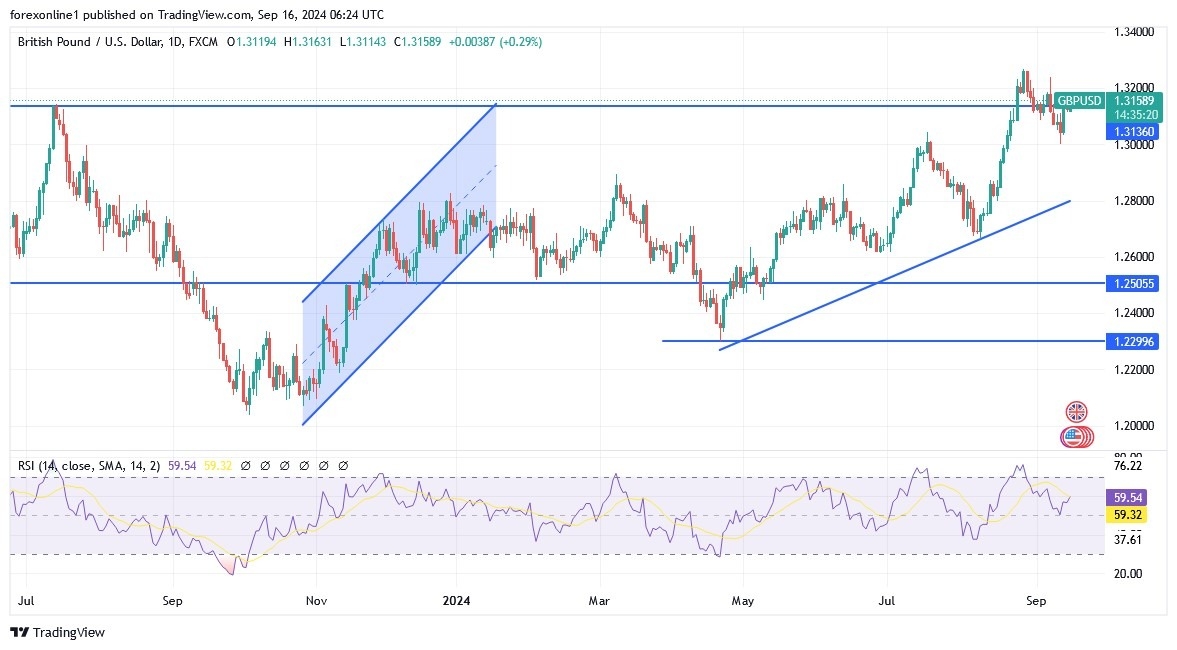
It’s interesting to note that the decline has touched the 23.6% Fibonacci retracement level of the current medium-term uptrend, which gives us a strong technical support level to consider in the coming days if the Fed rumours prove unfounded and they opt for a smaller 25 basis point rate cut. Therefore, the decline in GBP/USD from 1.3250 to 1.30 (the lowest level last week) alleviates the previous overbought conditions, removes some “long” Pound positions from the setup, and prepares the exchange rate for new gains in the coming days.
As always, this week’s forecast model is conservative, but we believe a rally towards 1.3250 resistance could re-emerge in the next 1-2 weeks, based on the assumption that the US Federal Reserve cuts interest rates by 50bp. However, fresh multi-year highs are now a distinct possibility as the broader US dollar decline develops in sympathy with the start of the Fed’s rate-cutting cycle.
Overall, it’s a busy week in the UK too, with the UK inflation report on Wednesday and the Bank of England decision on Thursday providing some local flavour. According to the economic calendar, core CPI inflation is expected to rise by consensus from 0.0% to 0.4% on a monthly basis, taking the annual rate from 3.3% to 3.5%. The headline CPI is forecast to jump from -0.4% on a monthly basis to 0.3%, while the annual rate is expected to remain at 2.2%.
Any downside in the data could weigh on the pound. However, the survey data continues to show a resilient economy and there are no signs of a major inflationary downturn. The Bank of England and institutional economists believe that UK inflation will rise slightly over the rest of 2024, and this week’s data should confirm that. Furthermore, the BoE will acknowledge these inflation dynamics on Thursday by leaving interest rates unchanged at 5.0% and announcing that it will continue to monitor the data when deciding on future rate cuts.
Given that there is no monetary policy report or press conference this week, financial markets will closely monitor the minutes of the meeting and the voting pattern on the Monetary Policy Committee. In this regard, analysts say, “The focus may be on the voting pattern among committee members. We are preparing for an 8-1 or 7-2 vote, with Dave Ramsden possibly joining Swati Dhingra in opting for an immediate rate cut.” “A closer vote, where we see more balance between hawks and doves, could lead to Pound sales as markets increase bets on more frequent cuts than once per quarter.” The base case among economists is that the vote will end in either an 8-1 or 7-2 vote, which, if true, would support our bullish stance on GBP/USD.
Ready to trade our GBP/USD Forex forecast? Here’s some of the best forex broker UK reviews to check out
The EUR/USD pair maintains its positive tone on Tuesday, currently retreating from an intraday high of 1.1145, ahead of the United States (US) opening. Financial markets trade with a cautious stance as the US Federal Reserve’s (Fed) monetary policy decision looms. The Fed is expected to trim interest rates on Wednesday after pushing them towards record highs in the aftermath of the pandemic. As a result, the US Dollar remains pressured across the FX board.
Meanwhile, the macroeconomic calendar had some relevant figures to offer. In the Eurozone, Germany released the September ZEW Survey on Economic Sentiment, which showed a sharp, unexpected contraction. Germany’s index fell to 3.6, while the EU’s shrank to 9.3, much worse than the 17.1 and 17.6 expected. Even further, the assessment of the current situation in Germany deteriorated to -84.5 from -77.3 in August.
The US published August Retail Sales, which rose a modest 0.1% compared to a 1.1% increase posted in July. The reading, however, surpassed expectations of a 0.2% slide. The Greenback gathered near-term momentum with the news, pushing EUR/USD towards the current 1.1120 price zone. The country will later unveil August Industrial Production and Capacity Utilization for the same month, as well as July Business Inventories.
From a technical point of view, the EUR/USD pair offers a neutral-to-bullish bias. In the daily chart, the pair develops above all its moving averages, although the 20 Simple Moving Average has lost its upward strength and turned flat at around 1.1090, providing near-term support. Still, the longer moving averages stand far below the shorter one and gain bullish traction, limiting the bearish potential of the pair. Technical indicators, in the meantime, lack directional strength. The Momentum indicator is stuck at around its midline, while the Relative Strength Index (RSI) indicator hovers around 58, hinting at limited selling interest.
In the near term, and according to the 4-hour chart, EUR/USD could extend its corrective slide. Technical indicators keep retreating from their recent highs, maintaining firm downward slopes, albeit within positive levels. At the same time, a bullish 20 SMA is crossing above a flat 100 SMA, while the 200 SMA gains upward traction below the shorter ones, usually a sign of bulls´dominance.
Support levels: 1.0990 1.0950 1.0910
Resistance levels: 1.1050 1.1090 1.1140
The GBP/USD price analysis indicates continued strength as the pound climbs to new highs while the dollar falls due to a surge in bets for a 50-bps Fed rate cut. At the same time, market participants eagerly anticipate UK inflation data and the Bank of England policy meeting.
–Are you interested in learning more about STP brokers? Check our detailed guide-
On Tuesday, the greenback was on the back foot as traders positioned themselves ahead of the FOMC policy meeting. Futures show a higher chance of a 50-bps rate cut than a 25-bps rate cut. This shift in expectations came on Friday after dovish reports from major US news outlets. At the same time, a retired Fed official said there was a strong case for a significant rate cut on Wednesday.
However, this outlook might change again after the US retail sales report. Economists predict a 0.2% decline in sales. A bigger-than-expected drop in sales could bolster bets for a massive cut, further weighing on the dollar. On the other hand, if sales come in higher than expected, bets for a smaller cut will increase. In this case, the dollar would climb.
Meanwhile, in the UK, market participants are waiting to see the state of inflation. According to forecasts, consumer inflation might hold at 2.2%. However, the core rate might increase. Currently, the market expects the Bank of England to keep rates unchanged. Nevertheless, rate cut expectations have risen, with the likelihood of a 25-bps cut climbing from 20% to 38%.
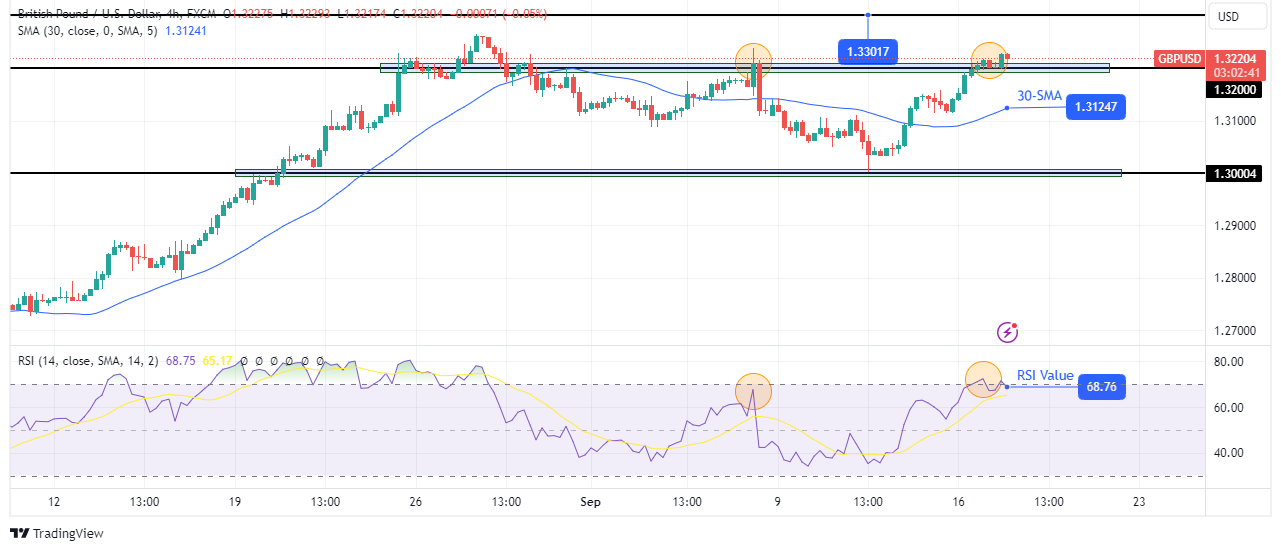
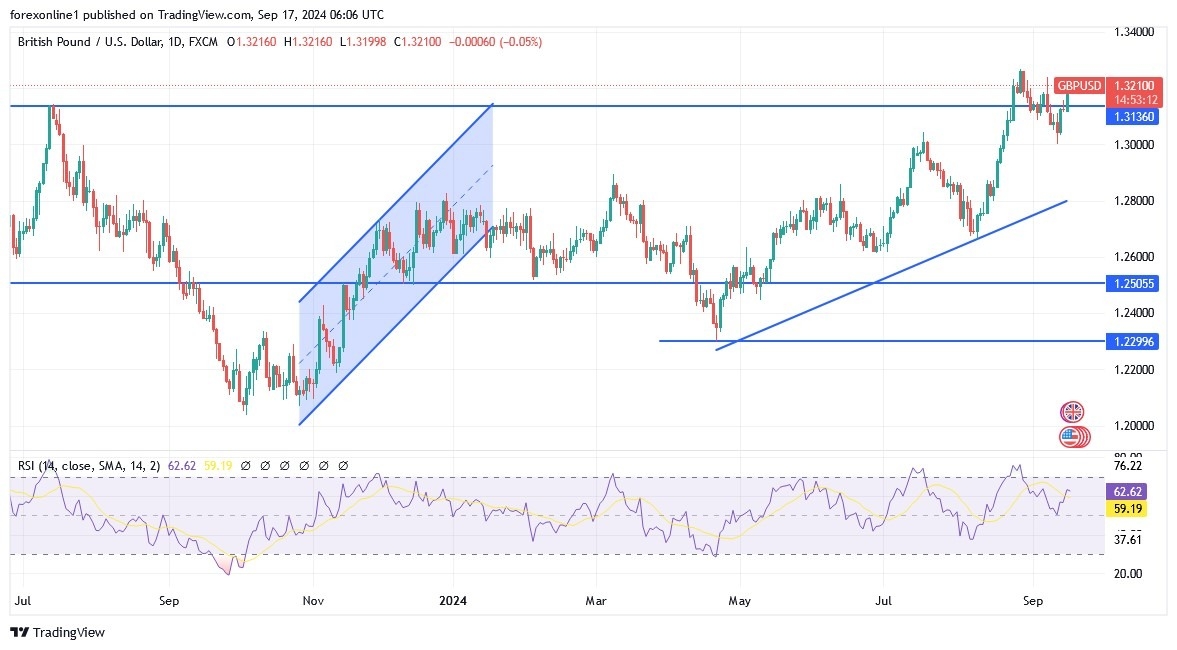
On the technical side, the GBP/USD price has broken above the pivotal 1.3200 level. The bullish bias is strong since the price sits well above the SMA. At the same time, the RSI trades near the overbought region.
–Are you interested in learning more about forex robots? Check our detailed guide-
Notably, the last time the price reached the 1.3200 resistance, bears quickly took over with a massive candle. Furthermore, the RSI did not enter the overbought region. However, this time, bullish momentum is stronger. Therefore, the price might soon reach the 1.3301 level.
Looking to trade forex now? Invest at eToro!
68% of retail investor accounts lose money when trading CFDs with this provider. You should consider whether you can afford to take the high risk of losing your money
EUR/USD benefited from the selling pressure surrounding the US Dollar (USD) and climbed to its highest level in 10 days above 1.1100 on Monday. The pair stays relatively quiet and trades in a tight channel early Tuesday. The technical outlook suggests that the bullish outlook remains unchanged, with a possibility of a technical correction in the near term.
The table below shows the percentage change of Euro (EUR) against listed major currencies this week. Euro was the strongest against the US Dollar.
| USD | EUR | GBP | JPY | CAD | AUD | NZD | CHF | |
|---|---|---|---|---|---|---|---|---|
| USD | -0.50% | -0.66% | -0.13% | -0.12% | -0.83% | -0.60% | -0.46% | |
| EUR | 0.50% | -0.21% | 0.33% | 0.35% | -0.39% | -0.15% | -0.00% | |
| GBP | 0.66% | 0.21% | 0.46% | 0.56% | -0.18% | 0.07% | 0.22% | |
| JPY | 0.13% | -0.33% | -0.46% | 0.00% | -0.65% | -0.46% | -0.40% | |
| CAD | 0.12% | -0.35% | -0.56% | -0.01% | -0.80% | -0.48% | -0.45% | |
| AUD | 0.83% | 0.39% | 0.18% | 0.65% | 0.80% | 0.24% | 0.37% | |
| NZD | 0.60% | 0.15% | -0.07% | 0.46% | 0.48% | -0.24% | 0.14% | |
| CHF | 0.46% | 0.00% | -0.22% | 0.40% | 0.45% | -0.37% | -0.14% |
The heat map shows percentage changes of major currencies against each other. The base currency is picked from the left column, while the quote currency is picked from the top row. For example, if you pick the Euro from the left column and move along the horizontal line to the US Dollar, the percentage change displayed in the box will represent EUR (base)/USD (quote).
The improving risk mood and heightened odds of a large Federal Reserve (Fed) rate cut at this week’s meeting caused the USD to weaken against its major rivals at the beginning of the week.
Meanwhile, hawkish comments from European Central Bank (ECB) officials further supported the Euro. ECB policymaker Peter Kazimir said argued that it would take a significant shift in the outlook for the ECB to lower the policy rate further in October, adding that they will “almost surely” have to wait until December for the next rate cut. Additionally, ECB Chief Economist Philip Lane said that the ECB should retain optionality about the speed of policy adjustments.
The US Census Bureau will publish Retail Sales data for August later in the day and the Fed will release Industrial Production figures for the same period. These data releases are unlikely to influence the market pricing of the Fed rate decision. Hence, their impact on the USD’s valuation could remain short-lived. According to the CME FedWatch Tool, markets are currently pricing in a 67% probability of the Fed opting for a large 50 basis points rate cut on Wednesday.
The Relative Strength Index (RSI) indicator on the 4-hour chart stays slightly above 70, suggesting that EUR/USD could have a difficult time pushing higher before making a technical correction.
On the downside, the Fibonacci 23.6% retracement level of the latest uptrend and the 100-period Simple Moving Average (SMA) form a strong support area at 1.1100-1.1090 ahead of 1.1040-1.1035 (Fibonacci 38.2% retracement, 200-period SMA).
Looking north, first resistance could be spotted at 1.1160 (static level) before 1.1200 and 1.1275 (July 18, 2023, high).
The Euro is the currency for the 20 European Union countries that belong to the Eurozone. It is the second most heavily traded currency in the world behind the US Dollar. In 2022, it accounted for 31% of all foreign exchange transactions, with an average daily turnover of over $2.2 trillion a day. EUR/USD is the most heavily traded currency pair in the world, accounting for an estimated 30% off all transactions, followed by EUR/JPY (4%), EUR/GBP (3%) and EUR/AUD (2%).
The European Central Bank (ECB) in Frankfurt, Germany, is the reserve bank for the Eurozone. The ECB sets interest rates and manages monetary policy. The ECB’s primary mandate is to maintain price stability, which means either controlling inflation or stimulating growth. Its primary tool is the raising or lowering of interest rates. Relatively high interest rates – or the expectation of higher rates – will usually benefit the Euro and vice versa. The ECB Governing Council makes monetary policy decisions at meetings held eight times a year. Decisions are made by heads of the Eurozone national banks and six permanent members, including the President of the ECB, Christine Lagarde.
Eurozone inflation data, measured by the Harmonized Index of Consumer Prices (HICP), is an important econometric for the Euro. If inflation rises more than expected, especially if above the ECB’s 2% target, it obliges the ECB to raise interest rates to bring it back under control. Relatively high interest rates compared to its counterparts will usually benefit the Euro, as it makes the region more attractive as a place for global investors to park their money.
Data releases gauge the health of the economy and can impact on the Euro. Indicators such as GDP, Manufacturing and Services PMIs, employment, and consumer sentiment surveys can all influence the direction of the single currency. A strong economy is good for the Euro. Not only does it attract more foreign investment but it may encourage the ECB to put up interest rates, which will directly strengthen the Euro. Otherwise, if economic data is weak, the Euro is likely to fall. Economic data for the four largest economies in the euro area (Germany, France, Italy and Spain) are especially significant, as they account for 75% of the Eurozone’s economy.
Another significant data release for the Euro is the Trade Balance. This indicator measures the difference between what a country earns from its exports and what it spends on imports over a given period. If a country produces highly sought after exports then its currency will gain in value purely from the extra demand created from foreign buyers seeking to purchase these goods. Therefore, a positive net Trade Balance strengthens a currency and vice versa for a negative balance.
STORY LINK Pound to Euro Week Ahead Forecast: GBP/EUR’s Future Uncertain Among Analysts
RBC Capital Markets (RBC) forecasts that the Pound to Euro (GBP/EUR) exchange rate will weaken gradually to 1.1240 on a 12-month view.
In contrast, Barclays expects GBP/EUR to strengthen to 1.25.
GBP/EUR was held in relatively tight ranges during the week and settled just above 1.1850.
Barclays is positive on the UK outlook; “Demand resilience has been in evidence across recent data releases, supporting the case for a slow and relatively shallow cutting cycle by the MPC that maintains the pound’s carry advantage. Supply-side gains are also likely given the new UK government’s intention to pursue a closer EU-UK relationship.”
RBC admits that yields will tend to favour the Pound, but will not be sufficient to support the UK currency; “Although our expectation for a shallow BoE rate cutting cycle suggests markets are overpricing rate cuts over the next 12m, and we expect the UK will retain a yield advantage in G10, we think GBP faces more downside than upside risk, as the most recent market rout showed in early August.”
RBC notes that there are substantial long Pound positions amongst global traders and that the currency is overvalued from an historical perspective.
It added; “A currency being overvalued does not automatically mean that the currency will fall, but if any concerns about the growth outlook or fiscal credibility rise or there is an external risk-off shock, then GBP is vulnerable.”
UK GDP was unchanged in July for the second successive month.
HSBC commented; “None of this is good news for an economy which relied on government spending and inventories for growth in Q2.”
There are strong expectations of tax increases in the October budget.
Barclays expects only a limited and short-lived Pound setback; “Perceived anti-growth measures such as tax hikes and fiscal tightening tend to weigh on the pound; however, their size (c.0.5-1% of GDP) does not appear large enough to derail sterling’s positive momentum.”
Credit Agricole sees barriers to Pound gains; “In all, we believe that many positives are already in the price of the overbought GBP by now and it could take hawkish BoE surprises or evidence of stickier inflation or more resilient retail sales to see the currency gaining more ground.”
MUFG sees Pound vulnerability in the fourth quarter; “We do not expect the BoE to cut rates again until the November MPC meeting, but there is an increasing likelihood that the BoE could deliver back-to-back cuts in November and December that could trigger some reversal of pound strength if the BoE shifts to a faster pace of cuts later this year.”
The ECB cut the deposit rate by 25 basis points to 3.50% at the latest policy meeting, in line with strong market expectations.
The central bank continued to insist that it was data dependent with only a slow rate of easing and the Euro was resilient.
Unicredit commented; “We remain confident with our forecast that the deposit rate will decline by 25bp per quarter throughout 2025, with the next move due in December.”
Credit Agricole commented on potential economic risks; “the EUR could suffer if Eurozone stocks weaken while peripheral spreads start to widen once again.
International Money Transfer? Ask our resident FX expert a money transfer question or try John’s new, free, no-obligation personal service! ,where he helps every step of the way,
ensuring you get the best exchange rates on your currency requirements.
TAGS: Pound Euro Forecasts
Silver (XAG/USD) trades with a positive bias around the $30.80-$30.85 area during the Asian session on Tuesday and remains well within the striking distance of a two-month peak touched the previous day.
From a technical perspective, Friday’s convincing breakout through the $30.00 psychological mark barrier, which coincided with a short-term descending trend line, was seen as a fresh trigger for bullish traders. Moreover, oscillators on the daily chart have just started gaining positive traction and support prospects for a further near-term appreciating move for the XAG/USD.
Acceptance above the $31.00 mark will reaffirm the constructive outlook and lift the white metal to the next relevant hurdle near the $31.45-$31.50 supply zone. Some follow-through buying should allow bulls to aim back to reclaim the $32.00 mark. The momentum should allow the XAG/USD to aim back to challenge a one-decade high, around mid-$32.00s touched in May.
On the flip side, any meaningful corrective slide below the $30.50 immediate support is likely to attract fresh buyers and remain cushioned near the aforementioned descending trend-line resistance breakpoint, now turned support, near the $30.00 mark. The latter could act as a key pivotal point, which if broken might prompt some technical selling and make the XAG/USD vulnerable.
The subsequent fall could get extended towards the $29.40-$29.35 intermediate support en route to the $29.00 round figure. Some follow-through selling could drag the XAG/USD to the next relevant support near the $28.20-$28.15 zone. This is followed by the $28.00 mark and the monthly low, around the $27.70 area, which if broken might shift the bias back in favor of bearish traders.
Silver is a precious metal highly traded among investors. It has been historically used as a store of value and a medium of exchange. Although less popular than Gold, traders may turn to Silver to diversify their investment portfolio, for its intrinsic value or as a potential hedge during high-inflation periods. Investors can buy physical Silver, in coins or in bars, or trade it through vehicles such as Exchange Traded Funds, which track its price on international markets.
Silver prices can move due to a wide range of factors. Geopolitical instability or fears of a deep recession can make Silver price escalate due to its safe-haven status, although to a lesser extent than Gold’s. As a yieldless asset, Silver tends to rise with lower interest rates. Its moves also depend on how the US Dollar (USD) behaves as the asset is priced in dollars (XAG/USD). A strong Dollar tends to keep the price of Silver at bay, whereas a weaker Dollar is likely to propel prices up. Other factors such as investment demand, mining supply – Silver is much more abundant than Gold – and recycling rates can also affect prices.
Silver is widely used in industry, particularly in sectors such as electronics or solar energy, as it has one of the highest electric conductivity of all metals – more than Copper and Gold. A surge in demand can increase prices, while a decline tends to lower them. Dynamics in the US, Chinese and Indian economies can also contribute to price swings: for the US and particularly China, their big industrial sectors use Silver in various processes; in India, consumers’ demand for the precious metal for jewellery also plays a key role in setting prices.
Silver prices tend to follow Gold’s moves. When Gold prices rise, Silver typically follows suit, as their status as safe-haven assets is similar. The Gold/Silver ratio, which shows the number of ounces of Silver needed to equal the value of one ounce of Gold, may help to determine the relative valuation between both metals. Some investors may consider a high ratio as an indicator that Silver is undervalued, or Gold is overvalued. On the contrary, a low ratio might suggest that Gold is undervalued relative to Silver.
However, growing concerns that a weak US Labor market could push the Federal Reserve into an aggressive easing cycle in the near term have undermined the US dollar’s upside potential. On the other hand, the latest initial US jobless claims report rose as expected to 230,000, revealing another increase in the number of unemployed US citizens claiming unemployment benefits.
The figure held above averages seen at the start of the year, reinforcing concerns about a weak US labour market in the wake of a bleak US payrolls report in August. As a result, this offset any potential shifts in the current market consensus around multiple US interest rate cuts by the Federal Reserve this year, as the spectre of a US hiring slowdown weighed on the US dollar.
Elsewhere, a slight decline in US Treasury yields put further pressure on the US dollar, leaving the greenback languishing near recent lows.
In contrast, the pound (GBP) has struggled to attract investor interest recently amid a lack of fresh US data. Overall, the lack of fresh information has led to uncertainty in market sentiment, which in turn has dampened investor interest in sterling, which is now more risk sensitive. In addition, the impact of disappointing UK growth figures continues to weigh on sterling, with no new factors to offset this effect.
Commenting on this, Chris Turner, global markets analyst at ING, said: “UK interest rates have come down quite a bit so far, with 2-year GBP swap rates down by around 30bps. It is unclear whether this is a result of weak UK GDP data or simply a belief that interest rates will come down across the world and that the UK should not be an exception – despite the silence from the Bank of England.”
Despite recent speculation that the BoE may introduce a less aggressive policy easing cycle than other major central banks, the combination of global political shifts and slower economic growth in the UK appears to be limiting any potential recovery for sterling.
Looking ahead, we may see the data-free end of the week in both the US and the UK affect global risk dynamics and the movement of the currency pair. Accordingly, any gloomy trade could support the US dollar as a safe haven, while an improvement in market sentiment could boost the risk-sensitive pound sterling against its safer competitors. As far as the UK is concerned, the recent RICS housing index improved sharply to 1 for August from a previously revised -18, which was well above consensus forecasts and the strongest reading since October 2022.
UBS commented on the monetary policy decision this week, saying, “We expect a majority of Monetary Policy Committee members to vote to keep interest rates unchanged next week by a 7-2 margin.”
In the UK, too, attention will be focused on upcoming inflation data and the Bank of England’s policy meeting. Widely, the BoE is expected to maintain interest rates, after cutting rates by 25 basis points last month. The main factor influencing the BoE’s decision will be UK inflation data, due out on Wednesday, just a day before the central bank announces policy. Annual inflation is expected to remain steady at 2.2% in August, remaining above the Bank of England’s 2.0% target. Later in the week, markets will also be closely watching retail sales figures and public sector net borrowing data for further economic insights.
With the recent gains of the GBP/USD, the currency pair has returned to its broader upward trend and the 1.3250 resistance on the daily chart will remain the most prominent to confirm the bulls’ strong control of the trend. Technically, we expect the GBP/USD to remain in its current trajectory until the markets and investors react to the announcements of both the Bank of England and the US Federal Reserve this week. The more hawkish the bank, the more supportive it will be for its currency, and we will see. Conversely, the psychological support of 1.3000 will remain the most important for a reversal of the current bullish outlook.
Ready to trade our Forex daily analysis and predictions? Here are the best forex trading platforms UK to choose from.
In addition to Japan’s data, US retail sales later in the session on Tuesday could also influence USD/JPY movements.
Economists expect retail sales will increase by 0.2% in August, down from a 1.0% rise in July.
Accounting for 60% of GDP, better-than-expected figures may boost expectations of a soft US economic landing and strengthen the US dollar. A pickup in consumer spending could push the US dollar toward 142 ahead of Wednesday’s Fed interest rate decision. Easing fears of a hard US economic landing may temper expectations of aggressive Fed rate cuts to support the US economy.
USD/JPY trends will likely depend on Bank of Japan commentary and Wednesday’s Fed interest rate decision. Hawkish comments from the BoJ and a more dovish-than-expected Fed rate path may drag the USD/JPY below 139.500.
However, investors should also consider key economic indicators from Japan and the US that could fuel USD/JPY volatility.
Investors should remain alert with Wednesday’s Fed interest rate decision looming. Monitor real-time data, central bank insights, and expert commentary to adjust your trading strategies accordingly. Stay updated with our latest news and analysis to manage USD/JPY volatility.
The USD/JPY remains well below the 50-day and 200-day EMAs, affirming bearish price signals.
A USD/JPY break above the 141.032 resistance level could support a move toward the 142.500 level. Furthermore, a USD/JPY return to the 142.500 level may give the bulls a run at the 143.495 resistance level.
Japan’s Tertiary Industry Activity Index, Bank of Japan commentary, and US retail sales numbers require consideration.
Conversely, a drop below the September 16 low of 139.576 could bring the 137.712 support level into play.
The 14-day RSI at 31.12 suggests a USD/JPY drop below 140 before entering oversold territory.
The EUR/JPY recovered some ground on Monday, registering gains of over 0.40% and climbing past the 156.00 figure. As Tuesday’s Asian session begins, the cross-currency pair exchanges hands at 156.51, virtually unchanged.
Last week, the European Central Bank (ECB) lowered rates by 0.25%, yet signaled that it would most likely pause at the October meeting due to the lack of data policymakers would have at their disposal. This boosted the Euro, though the jump could be short-lived as a Bank of Japan (BoJ) monetary policy decision looms.
The pair remains downward biased despite recovering from an over 4.70% fall. The momentum is bearish but has flatlined, hinting that consolidation lies ahead. That said, the EUR/JPY could remain range-bound within a 150-pip volatility range.
If EUR/JPY climbs above 157.00, the next resistance will be the Tenkan-Sen at 157.46. A breach of the latter will expose the Senkou Span A at 158.49, followed by the Kijun-Sen at 159.52.
Conversely, for a bearish continuation, EUR/JPY must drop below the September 16 low of 155.14. The next support would be the year-to-date (YTD) low of 154.39.
The table below shows the percentage change of Euro (EUR) against listed major currencies today. Euro was the strongest against the Swiss Franc.
| USD | EUR | GBP | JPY | CAD | AUD | NZD | CHF | |
|---|---|---|---|---|---|---|---|---|
| USD | 0.00% | 0.02% | 0.01% | -0.01% | -0.01% | -0.03% | 0.03% | |
| EUR | -0.01% | 0.00% | -0.02% | -0.03% | -0.02% | -0.04% | 0.03% | |
| GBP | -0.02% | -0.01% | 0.00% | -0.02% | -0.02% | -0.04% | -0.01% | |
| JPY | -0.01% | 0.02% | 0.00% | 0.01% | -0.02% | -0.03% | -0.02% | |
| CAD | 0.01% | 0.03% | 0.02% | -0.01% | 0.00% | -0.01% | 0.01% | |
| AUD | 0.00% | 0.02% | 0.02% | 0.02% | -0.00% | -0.01% | -0.02% | |
| NZD | 0.03% | 0.04% | 0.04% | 0.03% | 0.00% | 0.01% | 0.02% | |
| CHF | -0.03% | -0.03% | 0.00% | 0.02% | -0.01% | 0.02% | -0.02% |
The heat map shows percentage changes of major currencies against each other. The base currency is picked from the left column, while the quote currency is picked from the top row. For example, if you pick the Euro from the left column and move along the horizontal line to the US Dollar, the percentage change displayed in the box will represent EUR (base)/USD (quote).
The Pound Sterling rallied in early trading during the North American session against the Greenback, registering gains of over 0.60% and hitting a five-day peak of 1.3214. At the time of writing, the GBP/USD trades at 1.3199.
The GBP/USD has risen sharply, as bullish momentum picked up, as portrayed by the Relative Strength Index (RSI). In addition, bulls buying the dip at 1.3001 lifted spot prices to the current exchange rate.
Still, GBP/USD remains shy of testing the September 6 high of 1.3239. In that outcome, the next resistance level would be the year-to-date (YTD) high at 1.3266. Once surpassed, the daily high on March 23, 2022, would be up for grabs at 1.3298 before the pair hits the March 1, 2022, high at 1.3437.
Conversely, if GBP/USD stands below 1.3200, this could exacerbate a re-test of the 1.3100 figure. But firstly, sellers need to challenge 1.3150. Further losses lie at 1.3044, and the July 17 high turned support.
The table below shows the percentage change of British Pound (GBP) against listed major currencies today. British Pound was the strongest against the US Dollar.
| USD | EUR | GBP | JPY | CAD | AUD | NZD | CHF | |
|---|---|---|---|---|---|---|---|---|
| USD | -0.42% | -0.54% | -0.21% | -0.02% | -0.48% | -0.41% | -0.31% | |
| EUR | 0.42% | -0.18% | 0.17% | 0.37% | -0.12% | -0.04% | 0.07% | |
| GBP | 0.54% | 0.18% | 0.28% | 0.54% | 0.06% | 0.15% | 0.26% | |
| JPY | 0.21% | -0.17% | -0.28% | 0.20% | -0.21% | -0.17% | -0.15% | |
| CAD | 0.02% | -0.37% | -0.54% | -0.20% | -0.54% | -0.40% | -0.40% | |
| AUD | 0.48% | 0.12% | -0.06% | 0.21% | 0.54% | 0.08% | 0.17% | |
| NZD | 0.41% | 0.04% | -0.15% | 0.17% | 0.40% | -0.08% | 0.11% | |
| CHF | 0.31% | -0.07% | -0.26% | 0.15% | 0.40% | -0.17% | -0.11% |
The heat map shows percentage changes of major currencies against each other. The base currency is picked from the left column, while the quote currency is picked from the top row. For example, if you pick the British Pound from the left column and move along the horizontal line to the US Dollar, the percentage change displayed in the box will represent GBP (base)/USD (quote).