The main category of Forex News.
You can use the search box below to find what you need.
[wd_asp id=1]
The main category of Forex News.
You can use the search box below to find what you need.
[wd_asp id=1]
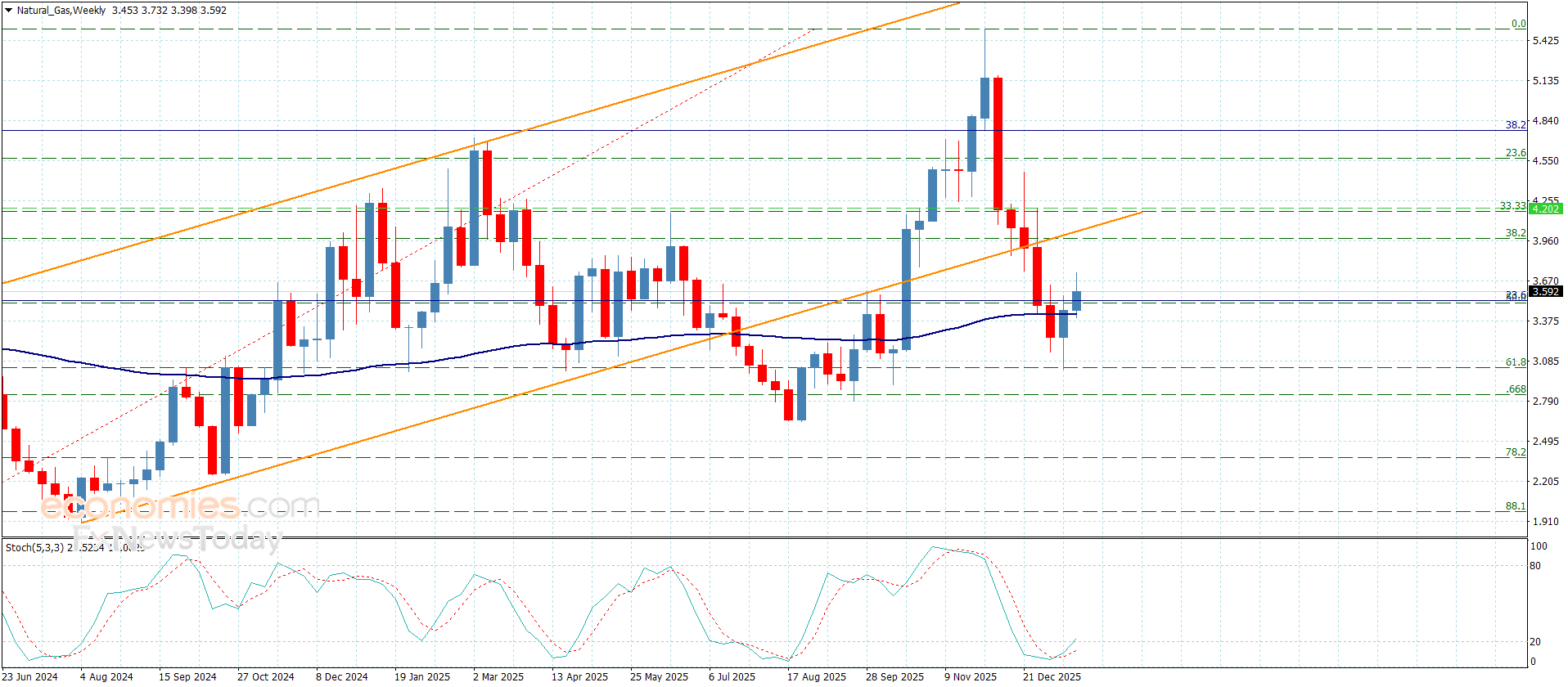
Natural gas price continued forming strong bullish waves since yesterday, to notice achieving the suggested targets by reaching $4.00 level, to reach the support of the broken bullish channel’s support, which represents a key resistance.
Noticing that stochastic begins to exit the oversold level, attempting to provide a new bullish momentum, to increase the chances of surpassing the current resistance, and its stability above this level will confirm its readiness to record new gains by its rally towards $4.185, while the failure to breach it will support the dominance of the sideways bias in the current trading, and there is a chance to retest $3.620 level before reaching extra bullish target.
The expected trading range for today is between $3.780 and $4.185
Trend forecast: Bullish
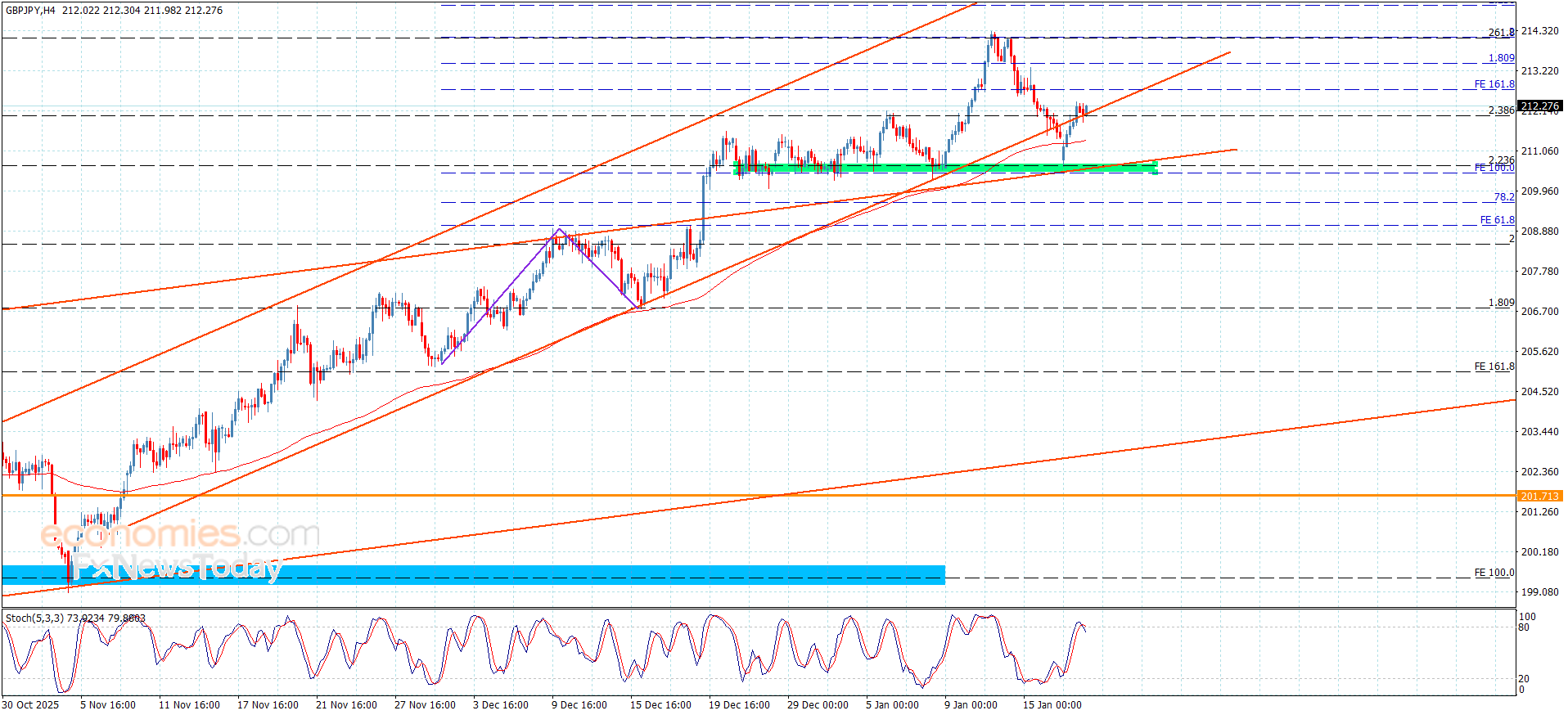
The GBPJPY pair ended its last bullish rally by recording the target at 213.45, to form a strong obstacle against the attempts of resuming the bullish trend, which forces it to activate with the stochastic negativity by forming corrective rebound, to notice testing the bullish channel’s support at 212.30.
Reminding you that the repeated rise above 212.00 level which represents %2.380 Fibonacci extension level supports the chances of renewing the bullish attempts, to expect targeting 213.00 level, to attempt to surpass the mentioned obstacle, while declining below 212.00 and providing a negative close will confirm its surrender to the dominance of the bearish corrective bias, to expect suffering some losses by reaching 211.45 initially.
The expected trading range for today is between 212.00 and 213.45
Trend forecast: Bullish
Gold price ( XAU/USD) climbs to near $4,775 during the early Asian trading hours on Wednesday. The precious metal extends the rally and is poised for another record high amid a time of political and economic uncertainty. The speech by US President Donald Trump at the World Economic Forum in Davos, Switzerland, will be in the spotlight later on Wednesday.
Traders continue to pile into safe-haven assets amid tensions between the US and Europe over Greenland. US President Donald Trump over the weekend threatened to impose tariffs on eight European nations that oppose his plans to take control of Greenland.
The BBC reported on Wednesday that the European Parliament is planning to suspend approval of the US trade deal agreed in July, according to sources close to its international trade committee. The suspension is scheduled to be announced in Strasbourg, France, on Wednesday. Escalation in tensions between the US and Europe could boost traditional safe-haven assets such as Gold in the near term.
Traders push back their bets that the US Federal Reserve (Fed) would cut interest rates later this month after signs of an improving US labour market. Traders are now pricing in the next rate reduction coming in June, the month after Fed Chair Jerome Powell’s tenure ends, with another easing to follow in the fourth quarter. The view that the US central bank can keep interest rates higher for longer generally underpins the US Dollar (USD) and weighs on the non-interest-bearing assets like Gold.
Gold has played a key role in human’s history as it has been widely used as a store of value and medium of exchange. Currently, apart from its shine and usage for jewelry, the precious metal is widely seen as a safe-haven asset, meaning that it is considered a good investment during turbulent times. Gold is also widely seen as a hedge against inflation and against depreciating currencies as it doesn’t rely on any specific issuer or government.
Central banks are the biggest Gold holders. In their aim to support their currencies in turbulent times, central banks tend to diversify their reserves and buy Gold to improve the perceived strength of the economy and the currency. High Gold reserves can be a source of trust for a country’s solvency. Central banks added 1,136 tonnes of Gold worth around $70 billion to their reserves in 2022, according to data from the World Gold Council. This is the highest yearly purchase since records began. Central banks from emerging economies such as China, India and Turkey are quickly increasing their Gold reserves.
Gold has an inverse correlation with the US Dollar and US Treasuries, which are both major reserve and safe-haven assets. When the Dollar depreciates, Gold tends to rise, enabling investors and central banks to diversify their assets in turbulent times. Gold is also inversely correlated with risk assets. A rally in the stock market tends to weaken Gold price, while sell-offs in riskier markets tend to favor the precious metal.
The price can move due to a wide range of factors. Geopolitical instability or fears of a deep recession can quickly make Gold price escalate due to its safe-haven status. As a yield-less asset, Gold tends to rise with lower interest rates, while higher cost of money usually weighs down on the yellow metal. Still, most moves depend on how the US Dollar (USD) behaves as the asset is priced in dollars (XAU/USD). A strong Dollar tends to keep the price of Gold controlled, whereas a weaker Dollar is likely to push Gold prices up.
The Euro had rallied against the US Dollar, but the British Pound has given back most of the gains already. So, with that being the case, I think you have to look at this as a situation where the 1.35 level continues to be a major barrier that just can’t be broken. If we do break above there, it’s really not until we break above 1.3550 that you start to talk about a move to the upside. This to me looks like a drop, a bounce, and perhaps a rollover. We’ll just have to wait and see. We did get claimant count change numbers earlier in the session, but it was slightly more negative, not really enough to affect the currency market, though in my estimation, directly.
You can see what the strength of the Euro has done to the Euro against the British Pound. I still think this is a market that rolls over, but now we have to reset, and we’ll have to keep an eye on that 0.8750 level because this is an area that’s been important multiple times. If we do start to see the Euro roll over against the dollar, we’ll have to wait, but I think that probably will have an influence here as well.
So, with all of that being said, I like fading signs of exhaustion. We could send this market down to the 200-day EMA again, but if we clear 0.8750, I probably step back from this pair for a while.
For a look at all of today’s economic events, check out our economic calendar.
Overcoming the 50-day moving average and the 50% level at $4.014 could launch another surge into the resistance cluster formed by the 200-day moving average at $4.248 and the intermediate 61.8% retracement level at $4.252. This zone is the last major barrier before the December 5 main top at $5.022.
So far, we’ve been witnessing a massive short-covering rally with some speculative buying. In order to produce a prolonged rally, we’re going to have to see some real buying. This makes the market vulnerable to a pullback into the short-term retracement zone at $3.498 to $3.246.
The question traders are asking is: are we facing a cold snap, which means the current rally is going to be a one-and-done event, or is something bigger developing? This will determine whether traders chase this market higher through resistance, or play for a short-term pullback into the support zone.
Tuesday’s gains are being fueled by intensifying cold weather that is driving heating demand sharply higher. The surprise cold pattern is being shaped by the alignment of two winter storms.
NatGasWeather explains the current situation this way. Prices are higher after the weekend weather trended “massively” colder since the middle of last week. It is said to be capable of bringing a dangerously cold weather system late this week and into early next week with lows of -20°F to 20s, including 10s to 20s deep into Texas and the South.
In addition to the near-term cold, traders are also watching the February 1-3 period, which has trended colder over the past few days as well.
– Written by
Frank Davies
STORY LINK GBP/USD Forecast: Pound Sterling Advances as Dollar Falters on Tariff Threats
The Pound to US Dollar exchange rate (GBP/USD) pushed higher on Tuesday, touching a one-week peak amid escalating tariff concerns linked to Greenland and a mixed UK labour market report.
At the time of writing, GBP/USD was trading at $1.3450, up approximately 0.2% on the session, although it had slipped back slightly from earlier highs.
The US Dollar (USD) struggled to find support as renewed tariff warnings from President Donald Trump weighed on the American currency.
Trump signalled his intention to impose new trade levies on eight European countries opposing his proposed acquisition of Greenland, sharpening tensions between the US and several long-standing allies.
The prospect of a broader US-EU trade dispute unsettled markets, with investors increasingly uneasy about the potential drag on US growth and the risk that European governments could curb their holdings of US Treasuries.
These concerns lingered into the session as Trump doubled down on his position, brushing aside diplomatic criticism from European leaders and keeping the ‘Greenback’ under pressure.
Meanwhile, the Pound (GBP) advanced against the US Dollar as markets took a broadly constructive view of the UK’s latest labour market data, despite the figures offering a mixed picture.
Get better rates and lower fees on your next international money transfer.
Compare TorFX with top UK banks in seconds and see how much you could save.
Employment rose by 82,000 in the three months to November, comfortably beating expectations for a 27,000 increase. However, the unemployment rate remained stuck at a multi-year high of 5.1%.
Wage growth continued to cool, although pay increases still outpaced inflation.
Taken together, the data proved sufficient to underpin Sterling on Tuesday, allowing the Pound to gain ground against a weaker US Dollar.
Looking ahead, attention is likely to turn to the UK’s forthcoming consumer price index release, which could shape near-term direction in the Pound to US Dollar exchange rate.
Markets expect headline inflation to have edged higher in December, rising from 3.2% to 3.3%, while core inflation is forecast to have held steady at 3.2%.
If inflation proves stubborn, traders may scale back expectations for a near-term Bank of England rate cut, potentially offering Sterling further support. Conversely, any downside surprise could revive dovish expectations and place the Pound under renewed pressure.

For the US Dollar, the data calendar remains light, leaving USD sentiment closely tied to political developments.
Continued focus on President Trump’s tariff threats and rhetoric surrounding Greenland may sustain a broader ‘sell-America’ tone, keeping the ‘Greenback’ on the defensive.
International Money Transfer? Ask our resident FX expert a money transfer question or try John’s new, free, no-obligation personal service! ,where he helps every step of the way,
ensuring you get the best exchange rates on your currency requirements.
TAGS: Pound Dollar Forecasts
No change for copper price attempts to activate the bearish corrective scenario due to the stability below the barrier at $5.9700 in the last trading, and stochastic exit from overbought level confirms facing intraday bearish pressures, keeping our expectations of targeting $5.6500 level reaching $5.5100 support.
While the price return to settle above the barrier and providing positive close will reinforce the chances of resuming the main bullish movement by its rally towards $6.1900 directly, to face the resistance of the bullish channel’s resistance, to monitor its behavior to detect the expected trend in the upcoming trading.
The expected trading range for today is between $5.7500 and $5.9500
Trend forecast: Bearish
The US dollar initially fell against the Japanese yen on Monday as traders ran to safety during Asian trading. However, cooler heads have prevailed.
The US dollar initially fell against the Japanese yen on Monday as everybody lost their minds about the latest comments coming out of Donald Trump and the European Union, suggesting that the trade deal between the US and the EU was over.

This had people running to safety. The US dollar sold off against multiple currencies around the world, and it does make a certain amount of sense that people ran to the Yen, but the reality is this is an ongoing game that we’ve been playing for months, and I think traders have realized that this is just more of the same. Nothing has actually changed. So what if there’s no trade agreement between the United States and the European Union? That was how we functioned for several months, and the world didn’t fall apart.
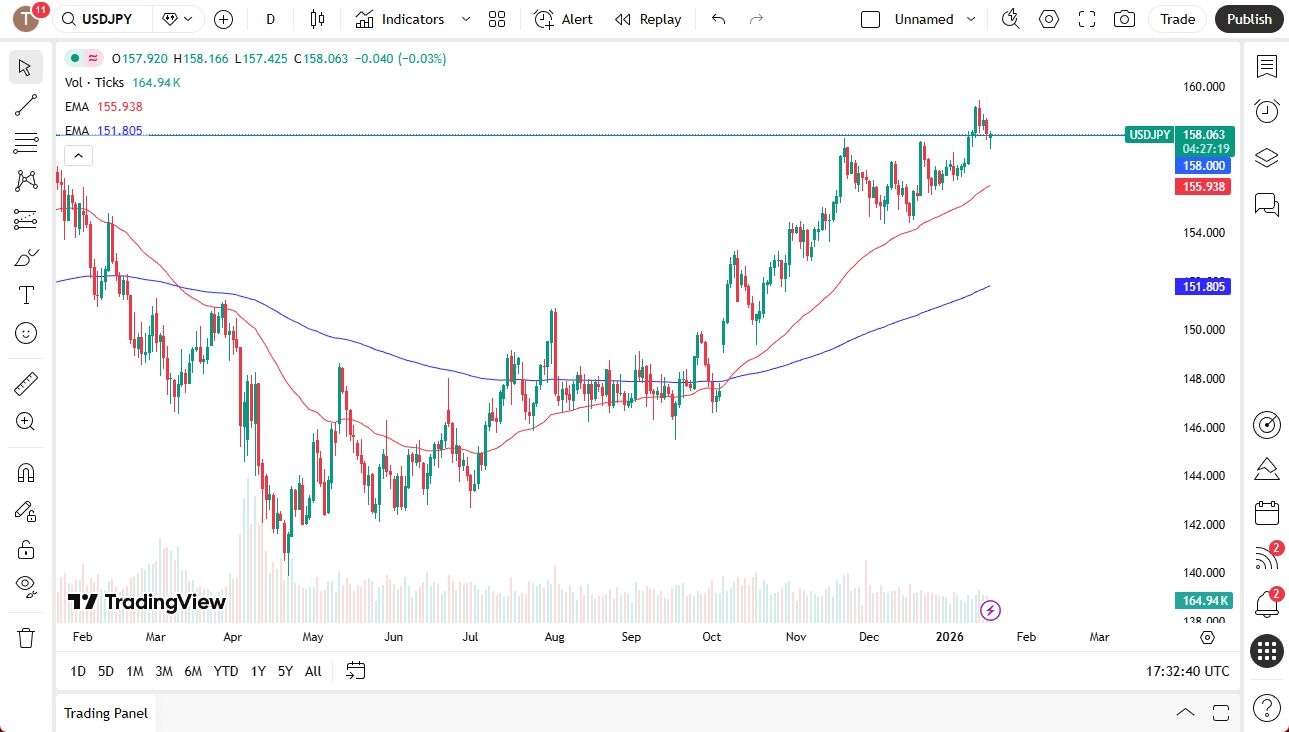
The Bank of Japan does have a meeting this week, and that’s something to pay attention to, but at the end of the day, the Japanese can only raise rates so high. Their bond market is already doing it for them, and it’s causing some pain. The Yen could very well find its way to the 160 level against the US dollar, maybe even higher than that. In fact, some pundits that I know are calling for something like 250 before this is all said and done.
Now that doesn’t mean it happens overnight, obviously it wouldn’t, but this little consolidation area that we had been in, we had broken out of, we pulled back to 158, and it looks like the buyers are returning.
Because of this, I like the idea of buying this pair. I think the 50-day EMA also confirms that there is support underneath. As far as this pair is concerned, you get paid at the end of every day, so you get to collect that interest rate differential and continue to ride the wave higher.
Want to trade our USD/JPY forex analysis and predictions? Here’s a list of forex brokers in Japan to check out.
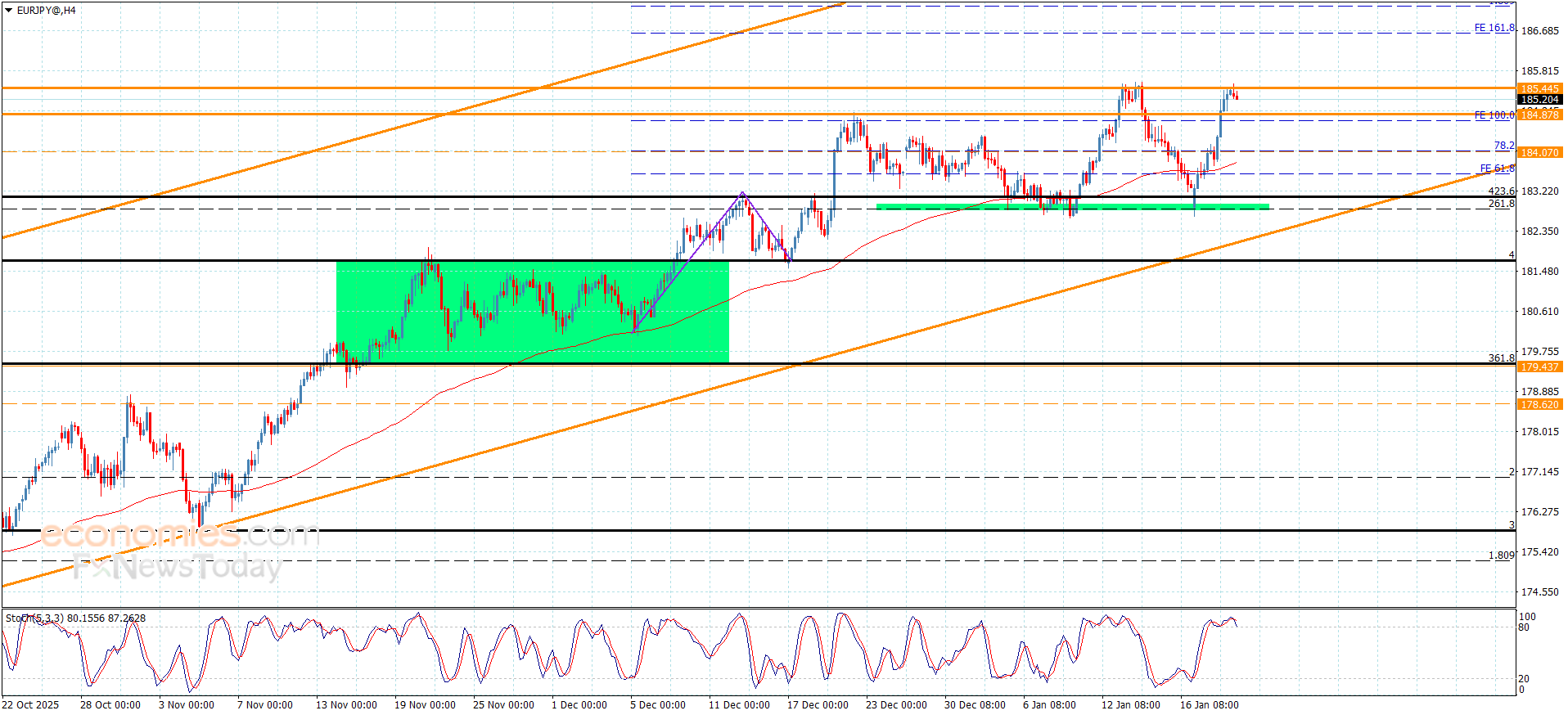
The EURJPY pair settled above the moving average 55, which forms extra support at 183.65 level, to notice its rally strongly to surpass the initial target at 184.10, announcing the continuation of the previously suggested bullish scenario.
The price might face difficulty in surpassing the barrier at 184.55 level, to expect forming intraday sideways trading, to wait for gathering positive momentum to ease the mission of resuming the rise and reaching towards 184.85 and 185.20.
The expected trading range for today is between 183.90 and 184.85
Trend forecast: Bullish
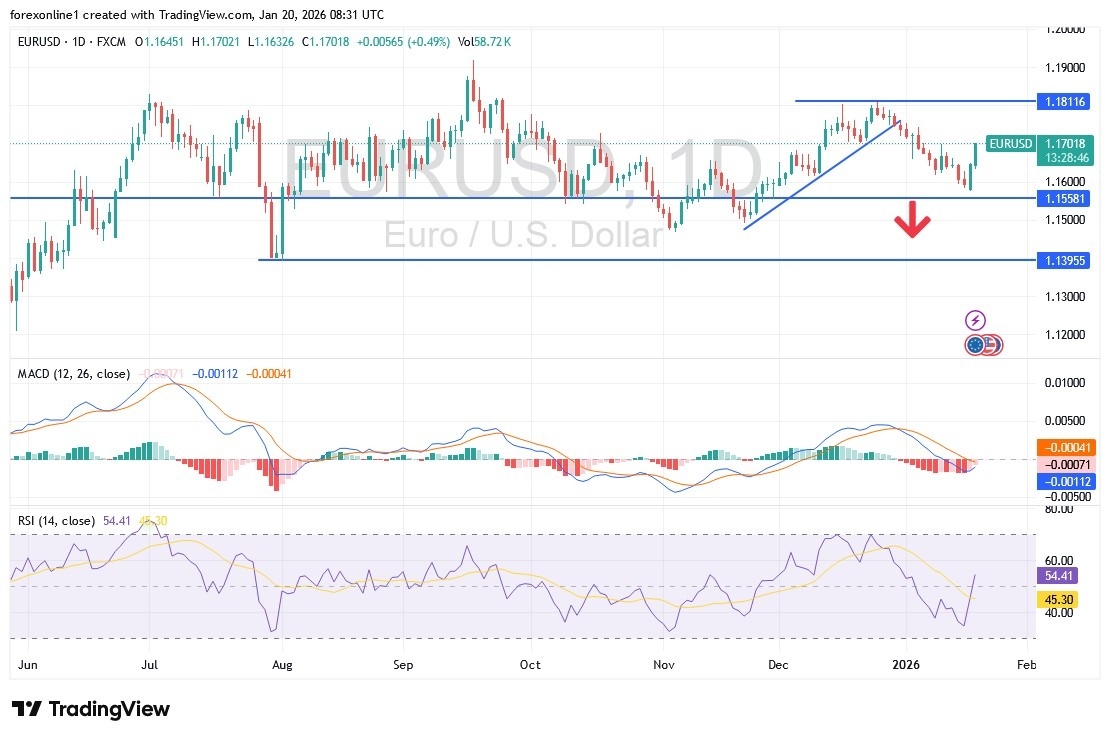
Concerns regarding Greenland have dominated Euro trading against other major currencies. This follows recent market anxiety over the future of U.S. Federal Reserve policies. According to performance data from trusted trading platforms, the EUR/USD price plummeted at the start of the trading week to the support level of 1.1576—the pair’s lowest level in nearly two months—before quickly rebounding to settle around the 1.1645 resistance level at the time of writing.
From a technical perspective, the EUR/USD bias remains bearish. It could quickly drop toward the psychological support level of 1.1500 in the coming days if fears of a persistent conflict between the U.S. and Europe intensify, especially following mutual threats of imposing tariffs. The 14-day RSI is reading around 45, supporting “bear” control, while the MACD signal lines remain steadily downward. Conversely, the psychological resistance at 1.1800 remains the key target to confirm a shift to a bullish trend.
For economic calender today, The euro’s price will be affected today by the release of the German Producer Price Index (PPI) at 9:00 AM Egypt time, followed by the Eurozone current account figures at 11:00 AM Egypt time. An hour later, the German ZEW index will be released. No major economic releases are expected from the US.
The EUR/USD exchange rate has retreated from its recent highs, falling back toward 1.16 as investors grow cautious about the timing and scale of Fed interest rate cuts. While some banks still see room for the Euro to rise in the medium term, strong U.S. economic data and a strengthening Dollar have capped these gains for now. Increasingly, markets are focused on the Fed’s credibility and whether U.S. rates could remain high well into 2026.
In this regard, RBC Capital Markets expects the EUR/USD exchange rate to strengthen in 2026, but has lowered its year-end forecast to 1.20 from 1.24, now anticipating it will reach that level by the end of 2024. However, after a slight initial shift, ING still supports a rise to 1.22 by the end of 2026, driven by continued US interest rate hikes.
Overall, markets anticipate two US interest rate cuts by the Federal Reserve in 2026. Crédit Agricole expects the euro to depreciate further as the Fed resists further rate cuts: “We still expect interest rates to remain unchanged in January. After that, our current baseline forecast suggests the pause will extend throughout 2026, subject to the stability of the labor market in upcoming reports. Weaker-than-expected data would increase the risk of a shorter pause and/or greater monetary easing than we currently anticipate.”
Meanwhile, the independence of the US Federal Reserve will remain a pivotal issue for currency exchange rates.
Earlier this week, the Justice Department issued subpoenas against the Federal Reserve and its chairman, Jerome Powell, for alleged misconduct related to renovations at the Fed headquarters. Powell strongly rejected the move and defended the bank. MUFG commented on the development, stating, “The continued attacks on the Fed’s independence, in response to President Trump’s desire to lower interest rates, pose a downside risk to the US dollar and support our expectations of a decline.” The bank added, “However, this could backfire on President Trump if Fed officials maintain their stance and keep US interest rates unchanged, challenging the Fed’s continued independence in setting monetary policy.”
RBC Bank, for its part, still anticipates net losses for the dollar against the euro for three reasons: lower interest rates between the two countries, increased hedging against US assets, and a shift towards European assets and stronger growth in the Eurozone. RBC remains cautious about the potential for significant gains.
We advise waiting for upcoming selling pressure on the EUR/USD. Obvioulsy, this will allow for “Buy” positions from the lowest possible prices. However, we strongly advise against over-leveraging or taking unnecessary risks.
Ready to trade our daily Forex analysis? We’ve made this forex brokers list for you to check out.