The main category of Forex News.
You can use the search box below to find what you need.
[wd_asp id=1]
The main category of Forex News.
You can use the search box below to find what you need.
[wd_asp id=1]
Growing coffee culture driven by a rising level of disposable incomes among the region’s consumers is expected to drive the GCC Coffee Machine Market during the forecast period between 2024 and 2030.
Read the Market Summary Here:-https://reportocean.com/industry-verticals/sample-request?report_id=UAE102
GCC Coffee Machine Market – Industry Trends & Forecast Report, 2030
GCC Coffee Machine Market size was estimated at USD 2.87 billion in 2023. During the forecast period between 2024 and 2030, the GCC Coffee Machine Market size is projected to grow at a CAGR of 4.05% reaching a value of USD 3.79 billion by 2030. A prominent driver of the increasing coffee consumption across the region. Notably, the demand for coffee is prominent in residential areas, commercial establishments, and public infrastructures within the GCC. The ongoing construction of these infrastructures is poised to amplify the requirement for coffee machines, facilitating food and beverage services, particularly the provision of coffee to individuals, employees, and customers. In these settings, individuals seek coffee not only for its stress-relieving properties but also for its ability to enhance energy levels, thereby optimizing task performance. Caffeine, a central nervous system stimulant present in coffee, is recognized for combating fatigue and elevating consumer energy levels. Also, the introduction of green and organic coffee in the region has spurred significant demand, contributing to an increased need for coffee machines among end users. The thriving tourism sector in the region, attributed to diverse attractions such as theme parks, aquariums, museums, and heritage sites, is expected to drive coffee consumption in GCC countries. Public spaces, including metro stations, railway stations, and airports, witness coffee consumption as individuals opt for coffee to refresh themselves while awaiting transportation. The rising coffee consumption has led to the establishment of several restaurants, cafes, and coffee shops in the region, consequently bolstering the demand for coffee machines across the GCC.
Request To Download Free Sample of This Strategic Report @-https://reportocean.com/industry-verticals/sample-request?report_id=UAE102
Coffee Machine – Overview
Coffee machine is a widely utilized appliance in residential, commercial, industrial, and various settings, designed for the preparation of coffee. In the brewing process, the machine combines coffee powder with hot water. Users manually introduce coffee powder and cold water into the machine, prompting it to heat the water within the chamber before initiating the brewing process. These machines find extensive application for personal use or business endeavors, being popular in households, corporate offices, institutions, restaurants, and various venues. This trend is expected to contribute to an increased demand for coffee machines in the future.
GCC Coffee Machine Market
Growth Drivers
Growing Coffee Culture
The GCC Coffee Machine Market has seen a significant shift with the introduction of smart coffee machines that integrate Bluetooth, Wi-Fi, and artificial intelligence (AI). This adoption of technological advancements allows consumers to control their coffee machines using smart devices and have their coffee prepared to their liking. The connectivity features enable customers to customize the caffeine dose and monitor critical parameters like water levels, coffee bean quantities, and flavor preferences. Also, these smart coffee machines can be programmed to prepare coffee based on the set schedule or routine of the customers. The increasing adoption of smart coffee machines is expected in the coming years due to their advanced features, and this trend is particularly fueled by the growing coffee culture and high disposable income among the population in the GCC region.
Challenges
High Initial Cost
The GCC Coffee Machine Market growth faces a significant impediment in the form of high initial costs. This financial barrier poses a restraint, hindering potential market entrants and impacting overall market growth. The capital-intensive nature of acquiring and establishing coffee machine infrastructure can limit accessibility, particularly for smaller businesses or startups. Addressing this challenge is crucial for fostering market expansion, as reducing initial costs could enhance market participation and contribute to a more robust and inclusive coffee machine industry in the GCC region.
For an in-depth analysis, you can refer sample copy of the report @-https://reportocean.com/industry-verticals/sample-request?report_id=UAE102
Impact of Geopolitical Tensions on GCC Coffee Machine Market
The GCC Coffee Machine Market is impacted by geopolitical tensions in several ways. Trade wars, particularly between major economies like the United States and China, introduce the potential for increased tariffs on electronic components and manufacturing materials. Such tariff escalations can elevate production costs for coffee machine manufacturers, potentially translating into higher prices for consumers and a subsequent reduction in demand. Furthermore, geopolitical conflicts or natural disasters have the capacity to disrupt global supply chains, affecting the production and distribution of coffee machines, especially for companies relying on specific regions for component manufacturing or assembly. Economic recessions exacerbate challenges by inducing reduced consumer spending, particularly on discretionary items like coffee machines. As consumers become more price-sensitive during downturns, manufacturers may need to adjust pricing strategies to stay competitive, potentially impacting profit margins.
GCC Coffee Machine Market
Segmental Coverage
GCC Coffee Machine Market – By Type of Machine
By type of machine, the GCC Coffee Machine Market is divided into Drip Coffee Machine, Steam Coffee Machine, and Capsule Coffee Machine segments. The drip coffee machine segment holds the highest share in the GCC Coffee Machine Market by type of machine, primarily due to their reusability feature. Various components of these machines, including filters and cones, are designed for reuse, fostering a heightened demand for drip coffee machines. Also, the infusion of innovative technologies into drip coffee machines is anticipated to be a key driver for the growth of the Coffee Machine market in the region. Meanwhile, the capsule coffee machine segment is expected to witness the fastest growth rate during the forecast period. It can be attributed to its user-friendly design, lightweight construction, and cost-effectiveness in comparison to alternative coffee machines. Additionally, the appeal of lower energy consumption and maintenance costs is expected to attract a growing number of residential end-users towards opting for capsule coffee machines in the upcoming years.
Get a Free Sample PDF copy of the report @-https://reportocean.com/industry-verticals/sample-request?report_id=UAE102
GCC Coffee Machine Market – By Mode of Operation
Based on mode of operation, the GCC Coffee Machine Market is divided into Manual, Automatic, and Semi-Automatic segments.
GCC Coffee Machine Market – By Sales Channel
On the basis of sales channel, the GCC Coffee Machine Market is divided into Direct Sales, Wholesalers/Retailers, and Online segments. The wholesales/retailers segment holds the highest share of the GCC Coffee Machine Market by sales channel. It can be attributed to the availability of a broad range of choices and the ability to compare prices among different coffee machine brands and models. Customers commonly opt to acquire coffee machines from wholesalers or retailers that provide an extensive selection encompassing diverse brands like Nestle, Electrolux, Panasonic, and others, all available at a single point of purchase. Furthermore, these wholesalers or retailers frequently present various discount options for coffee machine purchases.
GCC Coffee Machine Market – By End User
Based on end user, the GCC Coffee Machine Market is divided into Hotels, Restaurants & Caf?, Corporates & Institutions, and Residential segments. The corporates & institutions segment holds the highest share in the GCC Coffee Machine Market by end user. The growing inclination of individuals towards coffee consumption has emerged as a prominent factor fueling the demand for coffee machines in hotel and corporate settings. Also, the rising preference for non-alcoholic beverages among millennials, heightened awareness of low-sugar drink options, and the busy schedules prevalent in these industries contribute to the increasing popularity of coffee. The adoption of coffee as a beverage not only alleviates work-related stress among employees but also addresses fatigue experienced by travelers. Consequently, there has been a notable surge in the demand for coffee machines, aimed at offering enhanced refreshments and beverages to cater to the needs of both employees and tourists.
Get an Exclusive Sample Copy of the Report at:-https://reportocean.com/industry-verticals/sample-request?report_id=UAE102
GCC Coffee Machine Market – By Country
The in-depth research report on the GCC Coffee Machine Market covers the market in the region?s member countries: Saudi Arabia, UAE, Qatar, Bahrain, Kuwait, and Oman. The UAE dominates the GCC Coffee Machine Market and is expected to maintain its dominance throughout the forecast period. It is propelled by shifts in consumer preferences towards coffee and the country’s fast-paced lifestyle. Additionally, the increasing interest among the youth in blended and flavored coffee has spurred a heightened demand for coffee machines. The presence of expatriates in the country has further accentuated the desire for coffee, with consumers incorporating it into their daily routines due to perceived health benefits, appealing taste, and stress-relieving qualities. The ongoing upswing in residential and industrial construction, particularly in new towns and cities, has been instrumental in magnifying the demand for coffee machines in the UAE. Moreover, the expansion of corporate offices, leisure facilities, entertainment venues, and tourist destinations creates an opportunity for increased demand for coffee machines in establishments like hotels, restaurants, and cafes, aligning with the evolving coffee preferences of individuals across diverse settings.
Competitive Landscape
Major players operating in GCC Coffee Machine Market include Panasonic, Philips, VMCOGULF, Black & Decker, Nestl?, Robert Bosch GmbH, Electrolux, De?Longhi, and ATCOWORLD. To further enhance their market share, these companies employ various strategies, including mergers and acquisitions, partnerships, joint ventures, license agreements, and new product launches.
Recent Developments
In December 2023 – Brazilian coffee chain, The Coffee, announced plans to make its debut in the Middle East in 2024, targeting the UAE.
Buy Now and Get a Discount of 30% @-https://reportocean.com/industry-verticals/sample-request?report_id=UAE102
In October 2023 – Emirati-led Coffee Desk expanded into the GCC, extending its influence from Europe to the UAE and beyond.
By Type of Machine
Drip Coffee Machine
Steam Coffee Machine
Capsule Coffee Machine
By Mode of Operation
Manual
Automatic
Semi-Automatic
By Sales Channel
Direct Sales
Wholesalers/Retailers
Online
By End User
Hotels
Restaurants & Caf?
Corporates & Institutions
Residential
Request free 30 minutes analyst call :-https://reportocean.com/industry-verticals/sample-request?report_id=UAE102
By Country
Saudi Arabia
UAE
Qatar
Bahrain
Kuwait
Oman
Key Questions Addressed in the Market Report:
What are the consumer buying behaviors and preferences within the market?
What are the essential success factors and considerations for entering or expanding within the market?
What potential risks and challenges do market participants face?
What investment opportunities exist, and what are the expected returns?
How is the market segmented, and how should target markets be identified?
What marketing and advertising strategies are employed by successful market players?
What are the barriers to market entry and the level of competitive intensity?
What are the forecasts and projections for the market’s future?
What strategies are recommended for market participants to achieve success?
Access Full Report Description, TOC, Table of Figure, Chart, etc.-https://reportocean.com/industry-verticals/sample-request?report_id=UAE102
(*Note: The historical years and projected period in the report are flexible and can be tailored upon request. Additionally, the scope of the published report is adjustable to meet specific requirements, and customized analyses based on particular geographies or countries can be included as part of the customization.)
About Report Ocean:
Report Ocean is a renowned provider of market research reports, offering high-quality insights to clients in various industries. Their goal is to assist clients in achieving their top line and bottom line objectives, thereby enhancing their market share in today’s competitive environment. As a trusted source for innovative market research reports, Report Ocean serves as a comprehensive solution for individuals, organizations, and industries seeking valuable market intelligence.
Contact Information:
Email:[email protected]
Address: 500 N Michigan Ave, Suite 600, Chicago, Illinois 60611, United States
Telephone: +1 888 212 3539 (US – Toll-Free)
For more information and to explore their offerings, visit their website at:https://www.reportocean.com/
Despite losing the positive momentum, the price of platinum is still trading well above its key support of $940, and a new artificial intelligence (AI) model has delivered potential price targets for silver’s pricier cousin in the next year, based on the available information and predictions.
Indeed, the price movements of the rarest precious metal and a popular commodity among investors are still working their way up to $1,000, unlike gold, which has consistently beaten its own record highs. However, some predictions suggest it might happen in 2025.
In this context, Llama 3.1, the recent AI model by Meta Platforms (NASDAQ: META), has offered insights that might help forecast platinum’s potential price performance in 2025 and provided specific platinum price range predictions from the standpoint of August 23.
As it happens, Meta’s AI platform has drawn upon available predictions from sources such as ANZ Research, WalletInvestor, UBS Bank (NYSE: UBS), and the World Platinum Investment Council (WPIC), concluding that the potential price range for platinum in 2025 could be between $900 and $1,200 per ounce.
For instance, in January this year, experts at the WPIC expressed their expectation that the platinum market “would remain undersupplied through at least 2028,” with average supply deficits of 550 koz between 2025 and 2008, supporting higher prices, as their report demonstrates.
So, what is the price of platinum today? For now, it stands at $950.77, down 1.19% on the day, up 0.04% across the previous week, down 0.97% on its monthly chart, and declining 2.96% since the year’s turn. At the same time, the platinum price per gram at press time amounted to $33.85.
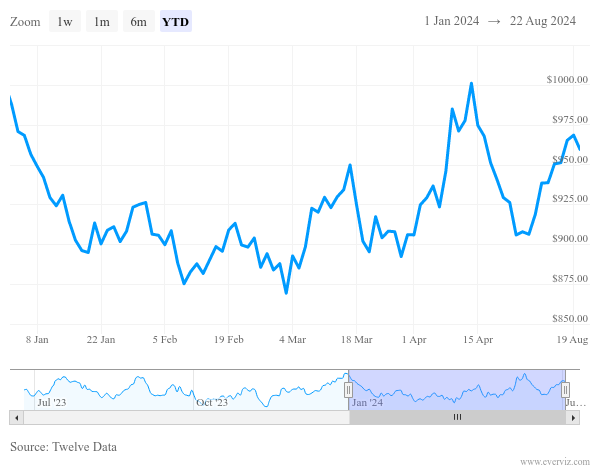
Ultimately, this precious metal might demonstrate mixed performance for now, but its limited supply could lead to continuous buying pressure, resulting in a steady price increase in 2025. That said, doing one’s own research is critical when investing significant amounts of money.
Disclaimer: The content on this site should not be considered investment advice. Investing is speculative. When investing, your capital is at risk.
The Pound Sterling (GBP) clinched a second consecutive weekly gain against the US Dollar (USD), as the GBP/USD pair reached its highest level since March 2022, above 1.3200.
GBP/USD witnessed another blockbuster week, devoid of high-impact economic events from the United Kingdom (UK). The underlying positive tone around the major was mainly driven by the sustained weakness in the US Dollar against its major rivals.
Traders continued to retain their bearish outlooks on the Greenback, as dovish US Federal Reserve (Fed) expectations heightened in the Jackson Hole Symposium week. USD buyers stayed on the back foot in the run-up to the Minutes of the Fed’s July meeting and Chairman Jerome Powell’s speech due later in the week.
Despite a risk-averse market environment, the US Dollar failed to find the safe-haven demand amid nervousness ahead of Powell’s appearance. The Greenback received a fresh blow following Wednesday’s release of the outright dovish Fed Minutes.
Most policymakers thought that “if the data continued to come in about as expected, it would likely be appropriate to ease policy at the next meeting,” the Minutes said. Further, the Minutes read that other policymakers would have even been willing to reduce borrowing costs in the July meeting itself.
The Nonfarm Payrolls Benchmark Revision further cemented a Fed rate cut for September. The US Labor Department said that the NFP for the period from April 2023 to March 2024 was lowered by 818,000. The revision represented a total downward change of about 0.5%.
Weak US S&P Global preliminary Manufacturing Purchasing Managers’ Index (PMI) and Jobless Claims data on Thursday bolstered bets for a dovish policy pivot as early as September.
Markets priced in a 27% probability of 50 basis points (bps) cut at the Fed’s September 17-18 meeting and a 73% chance of a 25 bps reduction, according to the CME Group’s FedWatch Tool.
With traders moving away from their US Dollar longs, GBP/USD hit a fresh 13-month high of 1.3130, also helped by strong UK S&P Global preliminary business PMIs. UK Manufacturing PMI improved from 52.1 in July to 52.5 in August. Markets had expected a 52.1 print. Meanwhile, the preliminary UK Services Business Activity Index rose to 53.3 in August, compared to July’s 52.5 and the estimated 52.8 figure.
The Fed-BoE monetary policy divergence remained in play and acted as a tailwind for the Pound Sterling, as the US Dollar stood on thin ice, awaiting Powell’s words.
Powell noted that the time has come for the monetary policy to adjust and said that they do not welcome a further cooling in labor market conditions. “We will do everything we can to support a strong labor market as we make further progress toward price stability,” he added. The USD came under renewed selling pressure with the immediate reaction, allowing GBP/USD to climb above 1.3200 for the first time since March 2022.
Following the volatility in the Jackson Hole Symposium week, Pound Sterling traders catch their breath amid a holiday-shortened week.
The UK markets closed on Monday in observance of the Summer Bank Holiday. Later that day, the US economic calendar will feature the Durable Good Orders but the data is unlikely to have a significant impact on the value of the US Dollar and the GBP/USD pair.
The main highlight of the week is expected to be the second estimate of the US Gross Domestic Product (GDP) report and the core Personal Consumption Expenditures (PCE) Price Index, the Fed’s preferred inflation measure.
In the first half of the week, the UK CBI Realized Sales and the US Conference Board Consumer Confidence data will offer some trading incentives.
Sentiment around the central banks’ policy expectations, speeches from Fed officials and the Middle East geopolitical risks will continue to drive the GBP/USD price action.
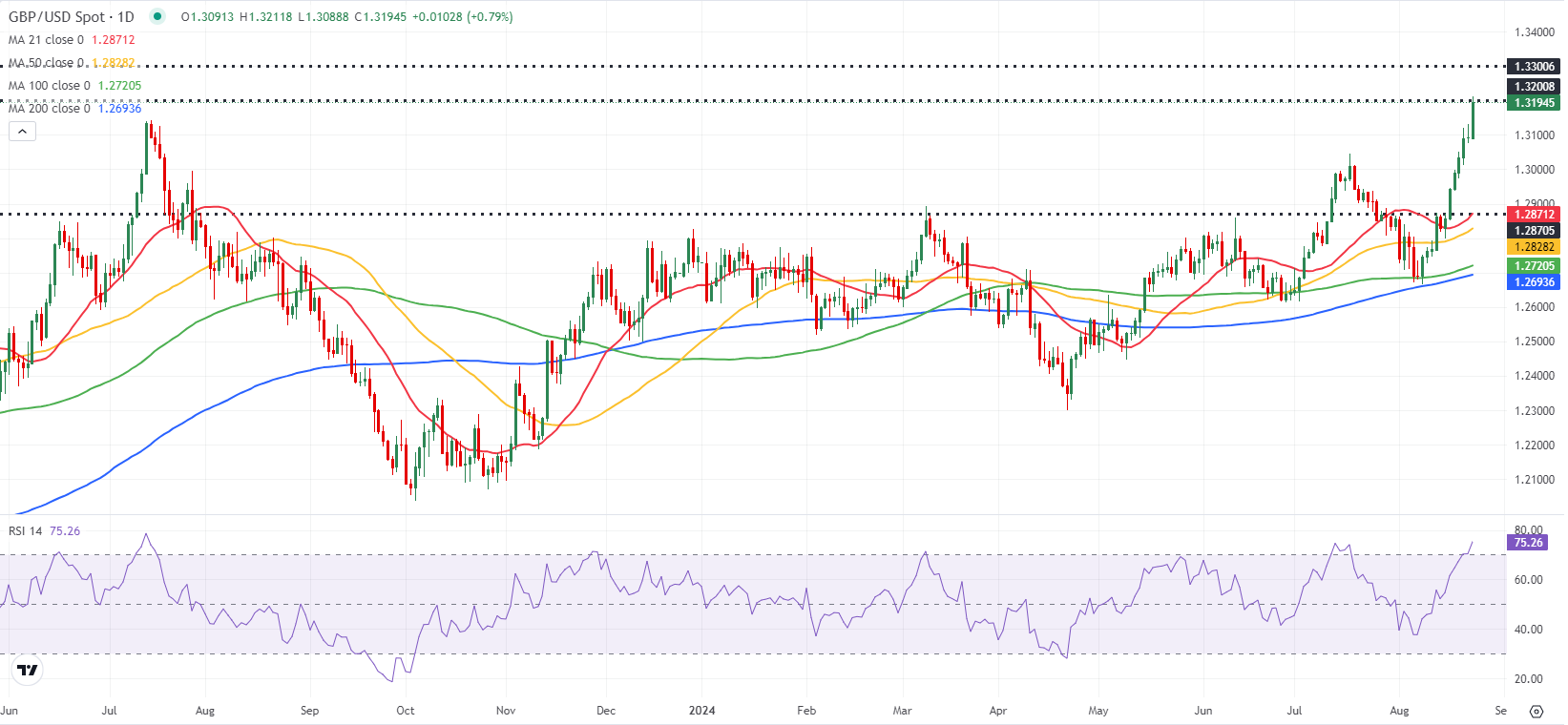
The GBP/USD recovery from five-week lows of 1.2665 gathered strength in the past week, as buyers stormed through the previous year-to-date (YTD) high at 1.3045 to reach a 29-month-high above 1.3200.
In doing so, Pound Sterling went further beyond all the key daily Simple Moving Averages (SMA). The 14-day Relative Strength Index (RSI) entered the overbought territory, currently near 75.
With overbought conditions, Pound Sterling traders could see a brief correction, with every pullback likely to be bought into so long as the leading indicator holds above the 50 level.
GBP/USD could meet interim resistance at 1.3250 before buyers aim for the 1.3300 round level.
In case of a corrective downside, the previous YTD high at 1.3045 will be the initial contention point, below which the 1.3000 key level will be tested.
If the selling momentum intensifies, the 1.2900 level will be threatened, followed by the confluence zone around 1.2850. At that level, the 50-day SMA and the 21-day SMA hang around.
The US Dollar (USD) is the official currency of the United States of America, and the ‘de facto’ currency of a significant number of other countries where it is found in circulation alongside local notes. It is the most heavily traded currency in the world, accounting for over 88% of all global foreign exchange turnover, or an average of $6.6 trillion in transactions per day, according to data from 2022. Following the second world war, the USD took over from the British Pound as the world’s reserve currency. For most of its history, the US Dollar was backed by Gold, until the Bretton Woods Agreement in 1971 when the Gold Standard went away.
The most important single factor impacting on the value of the US Dollar is monetary policy, which is shaped by the Federal Reserve (Fed). The Fed has two mandates: to achieve price stability (control inflation) and foster full employment. Its primary tool to achieve these two goals is by adjusting interest rates. When prices are rising too quickly and inflation is above the Fed’s 2% target, the Fed will raise rates, which helps the USD value. When inflation falls below 2% or the Unemployment Rate is too high, the Fed may lower interest rates, which weighs on the Greenback.
In extreme situations, the Federal Reserve can also print more Dollars and enact quantitative easing (QE). QE is the process by which the Fed substantially increases the flow of credit in a stuck financial system. It is a non-standard policy measure used when credit has dried up because banks will not lend to each other (out of the fear of counterparty default). It is a last resort when simply lowering interest rates is unlikely to achieve the necessary result. It was the Fed’s weapon of choice to combat the credit crunch that occurred during the Great Financial Crisis in 2008. It involves the Fed printing more Dollars and using them to buy US government bonds predominantly from financial institutions. QE usually leads to a weaker US Dollar.
Quantitative tightening (QT) is the reverse process whereby the Federal Reserve stops buying bonds from financial institutions and does not reinvest the principal from the bonds it holds maturing in new purchases. It is usually positive for the US Dollar.
Today’s bearish behavior in the price of natural gas improves the chance that it may be heading to lower price levels before the retracement is complete. In addition, on the weekly time frame a bearish weekly reversal triggered this week, and the week is set to end with a bearish red candlestick pattern and a close near the lows for the week. This will set up a bearish signal below this week’s low. The next lower price target is at the 78.6% Fibonacci retracement at 1.97. A little lower is the 161.8% extended target for a small declining ABCD pattern at 1.95.
Nonetheless, natural gas found support today at 2.00 and it could continue to hold above that price level leading to a bullish reversal. A rally above today’s high of 2.07 would be a sign of strength with natural gas first heading towards the 20-Day MA, now at 2.11. If the 20-Day line can be recaptured natural gas will have a chance to proceed higher.
The next higher key resistance zone that would need to be recaptured is the recent swing high and last week’s high of 2.30. However, there are two moving averages nearby that need to be considered as well. The 200-Day MA is also at 2.30 and the 50-Day MA is at 2.305. Therefore, recapturing the 2.30 high and moving averages will put natural gas in a position to proceed higher. Until then, they may continue to identify an area of potential resistance.
For a look at all of today’s economic events, check out our economic calendar.
The U.S. Dollar has fallen against the Japanese Yen during the week to test the 145 yen level but has also levitated a bit. The question is, now that we are below an uptrend line, do we stay below it or do we turn around and break out to the upside, giving a bit of a false breakout?
And that being said, I think we are trying to figure out which direction to go. And with that being said, if we can turn around and take out the 150 yen level, we could go much higher. That would bring back in the carry trade from what I see. And it’s worth noting that Jerome Powell has a speech late in the day on Friday from Jackson Hole that could give us a heads up as to just how loose the Federal Reserve may get.
If it sounds like not very, it’s probably only a matter of time before the carry trade picks up again and we go higher. On the other hand, if we turn around and break down below the 144 yen level, then we could see further selling and probably more wrecking of financial markets. In general, this is a market that I think continues to see a lot of volatility, but I do think you should remember, you get paid at the end of every day to hang on to this pair, so there is going to be a proclivity for people to try to get involved.
Furthermore, when I adjust the trend line, you could make it go through where we are right here as well. So, a lot is going on in this chart, and we do have a couple of major levels that could give us an idea of where we go for the next several weeks.
For a look at all of today’s economic events, check out our economic calendar.
This article was originally posted on FX Empire
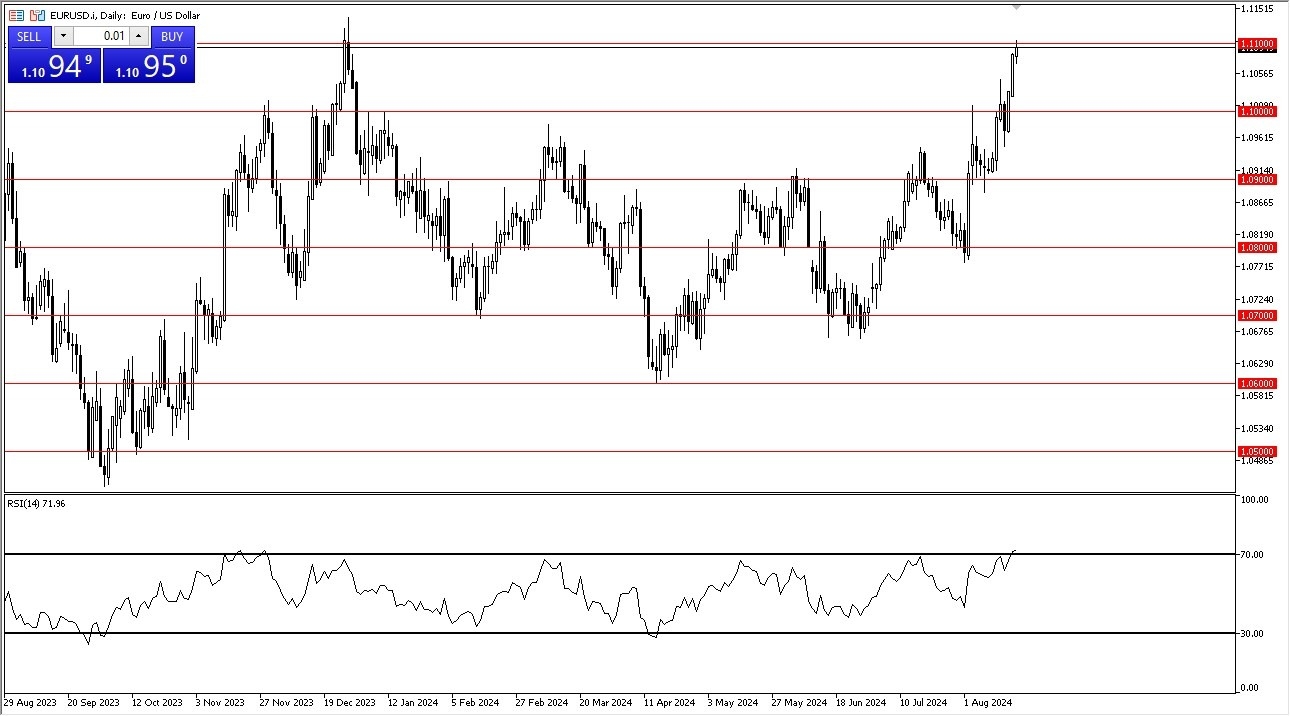
I have a sneaking suspicion that we are in fact due for a bit of a pullback and we’ll in fact see that happen sooner rather than later. This is not to say that we are going to see a major breakdown, just that momentum is a bit of a fickle thing and sooner or later traders will be looking to take some profit.

We have the Jackson Hole Symposium going on this week and that of course will have a major influence on what’s going on with the currencies around the world. And the markets will be paying attention to not only speeches by central bank governors, but for example, during Wednesday’s session, the FOMC meeting minutes come into the picture, and then we get PMI numbers on Thursday from various countries. So, there is probably a certain amount profit-taking going on during the session. And this of course leads to a healthy market. You can’t go in one direction forever. If we do get a pullback, the 1.10 level should be support. If we could continue to go higher, then the 1.1150 level would be the next target, followed by the 1.1250 level after that.
The one thing you can probably count on is that it is going to be very noisy and choppy, and with that being said, the market is likely to continue to focus on the Federal Reserve more than anything else, because it’s all about trying to get “Uncle Jerome” jumping into the market to save us all via liquidity.
Ready to trade our daily EUR/USD Forex analysis? We’ve made this forex brokers list for you to check out.
After reaching an all-time high of $2,531.60 on Tuesday, gold has retraced nearly 1% this week. The pullback is attributed to a stronger U.S. dollar and a rebound in Treasury yields, following an unexpected rise in the unemployment rate. Despite this, gold managed to inch higher on Friday, reflecting investor uncertainty and the potential for significant price moves depending on Powell’s remarks.
Market participants are closely monitoring Powell’s address at the Jackson Hole symposium for clues on the Fed’s future interest rate decisions. Traders have largely priced in a 76% probability of a 25-basis-point rate cut in September, with some speculating on a more substantial 50-basis-point reduction. This expectation has kept gold’s appeal intact, as a lower interest rate environment typically supports non-yielding assets like bullion.
However, there is concern that Powell’s speech could lead to a “buy the rumor, sell the fact” scenario, where gold could face selling pressure if the anticipated rate cut is confirmed without any surprises. This pattern may contribute to increased volatility and could limit gold’s upside potential in the near term.
Tim Waterer, Chief Market Analyst at KCM Trade, noted, “Gold’s stay below $2,500 could be temporary, with the fundamentals still appearing favorable for the precious metal.” However, the market remains on edge as any unexpected remarks from Powell could trigger significant price moves. A more dovish stance from the Fed could boost gold, while a hawkish tone might extend the metal’s recent losses.
If Powell confirms the anticipated rate cut, gold prices may resume their upward trend, potentially challenging the $2,500 level again. However, traders should be mindful of a potentially bearish closing price reversal top on the weekly chart if gold ends the session lower today. Such a pattern could signal a deeper correction, making a bearish scenario likely if Powell suggests that the economy is stable enough to delay cuts. As a result, traders should prepare for a session with the potential for significant price swings depending on the Fed’s direction.
The GBP/USD price analysis shows a solid bullish trend as the pound rallies to new highs after positive UK business activity data. At the same time, the dollar was frail as investors gained confidence in a September Fed cut ahead of Powell’s speech.
-Are you interested in learning about the forex signals telegram group? Click here for details-
On Thursday, the S&P 500 released UK flash composite PMI which revealed an increase from 52.8 to 53.4 in August. Meanwhile, economists had expected a smaller increase to 52.9. The surge in business activity was bullish for the pound, as it indicated a resilient economy, lowering BoE rate cut expectations.
The pound has gained 2% in August as the dollar weakened. Recent US data has raised the likelihood that the Fed will cut rates in September. Inflation is consistently easing towards the 2% target. At the same time, the labor market has shown cracks, putting more pressure on the Fed.
US central bank policymakers came out on Thursday, supporting a September rate cut. This was a clear shift from their previous cautious tone. With one more inflation report to go, the risk of a major shift in the rate-cut outlook has reduced.
Meanwhile, markets are awaiting Powell’s speech later in the day. Experts believe he will echo what other policymakers have said so far. However, investors will focus on his message regarding the size and pace of future rate cuts. A more dovish outlook beyond September might weaken the dollar further, lifting sterling.
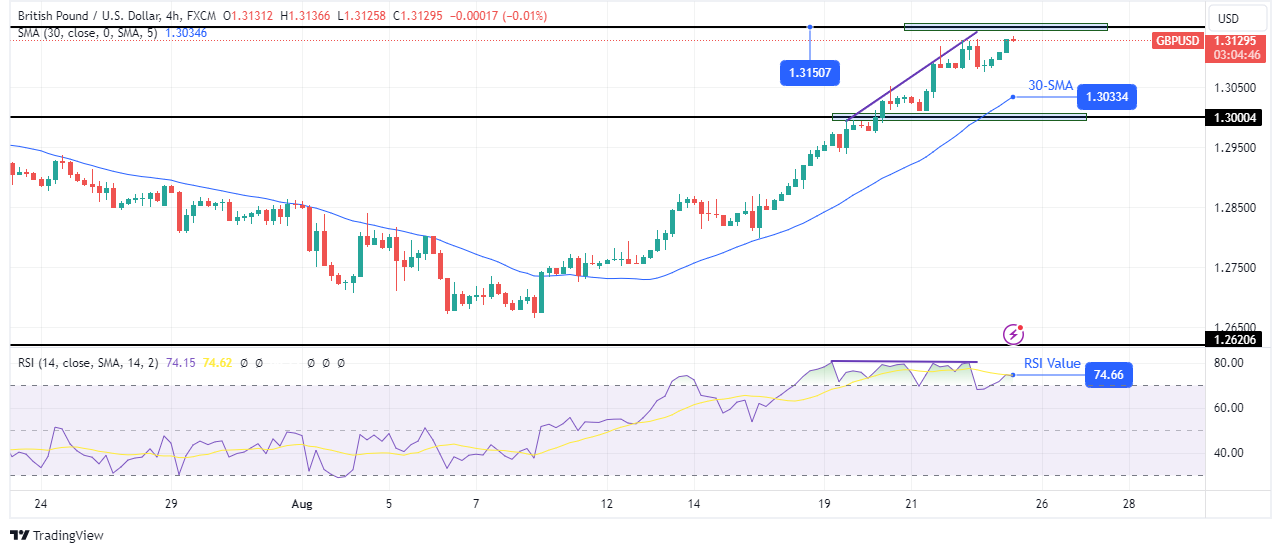
On the technical side, the GBP/USD price is approaching the 1.3150 key level. The bullish bias is strong because the price has traded above the 30-SMA for a long time without pulling back. At the same time, the RSI has traded in the overbought region as bulls maintained massive momentum.
-If you are interested in forex day trading then have a read of our guide to getting started-
However, as the price made new highs, the RSI has traded sideways, showing bulls have reached the limit. Therefore, bears may be ready to push the price lower and retest the 30-SMA support. Nevertheless, bulls might touch 1.3150 before temporarily giving up control.
Looking to trade forex now? Invest at eToro!
67% of retail investor accounts lose money when trading CFDs with this provider. You should consider whether you can afford to take the high risk of losing your money.
Silver price (XAG/USD) rises to near $29.30 in Friday’s North American session, with investors focusing on the Federal Reserve (Fed) Chair Jerome Powell’s speech at the Jackson Hole (JH) Symposium. The white metal gains as bond yields decline on expectations that Jerome Powell will deliver a dovish guidance on interest rates.
10-year US Treasury yields fall to near 3.84%. Lower yields on interest-bearing assets bode poorly for non-yielding assets, such as Silver, given that they reduce the opportunity cost of holding an investment in them.
The US Dollar Index (DXY), which tracks the Greenback’s value against six major currencies, recovers its intraday losses and rebounds to near 101.50.
Market participants are optimistic about Powell’s dovish guidance but they want more clarity on the likely size of interest rate cuts in September. According to the CME FedWatch tool, 30-day Federal Funds Futures pricing data shows that the probability of 50 basis points (bps) interest-rate cut in September is 28.5%. While rest is favoring a 25-bps interest rate reduction.
Investors will also focus on Powell’s speech to know about whether chances of ‘soft landing’ are intact. Market experts started anticipating a potential United States (US) recession after the Nonfarm Payrolls (NFP) report for July indicated a sharp slowdown in the labor demand and an increase in the Unemployment Rate to 4.3%, the highest level seen since November 2021.
Silver price turns sideways after a decisive break above August 2 high of $29.20, which faltered the lower high lower low formation on a four-hour timeframe. The 200-period Exponential Moving Average (EMA) near $28.77 acts as cushion for Silver price bulls.
The 14-period Relative Strength Index (RSI) falls to near 60.00, suggesting that the bullish momentum has concluded for now. However, the bullish bias remains intact.
Silver is a precious metal highly traded among investors. It has been historically used as a store of value and a medium of exchange. Although less popular than Gold, traders may turn to Silver to diversify their investment portfolio, for its intrinsic value or as a potential hedge during high-inflation periods. Investors can buy physical Silver, in coins or in bars, or trade it through vehicles such as Exchange Traded Funds, which track its price on international markets.
Silver prices can move due to a wide range of factors. Geopolitical instability or fears of a deep recession can make Silver price escalate due to its safe-haven status, although to a lesser extent than Gold’s. As a yieldless asset, Silver tends to rise with lower interest rates. Its moves also depend on how the US Dollar (USD) behaves as the asset is priced in dollars (XAG/USD). A strong Dollar tends to keep the price of Silver at bay, whereas a weaker Dollar is likely to propel prices up. Other factors such as investment demand, mining supply – Silver is much more abundant than Gold – and recycling rates can also affect prices.
Silver is widely used in industry, particularly in sectors such as electronics or solar energy, as it has one of the highest electric conductivity of all metals – more than Copper and Gold. A surge in demand can increase prices, while a decline tends to lower them. Dynamics in the US, Chinese and Indian economies can also contribute to price swings: for the US and particularly China, their big industrial sectors use Silver in various processes; in India, consumers’ demand for the precious metal for jewellery also plays a key role in setting prices.
Silver prices tend to follow Gold’s moves. When Gold prices rise, Silver typically follows suit, as their status as safe-haven assets is similar. The Gold/Silver ratio, which shows the number of ounces of Silver needed to equal the value of one ounce of Gold, may help to determine the relative valuation between both metals. Some investors may consider a high ratio as an indicator that Silver is undervalued, or Gold is overvalued. On the contrary, a low ratio might suggest that Gold is undervalued relative to Silver.
The USD/JPY outlook is mildly bearish as the yen strengthens after hawkish comments from the Bank of Japan Governor Kazuo Ueda. Meanwhile, the US dollar was under pressure ahead of Powell’s speech at the Jackson Hole symposium.
-Are you interested in learning about the forex signals telegram group? Click here for details-
On Friday, BoJ’s Ueda had to explain before parliament why the central bank surprised markets with a rate hike at the last meeting. He reaffirmed his commitment to hike rates if inflation rises sustainably. Economists believe Japan’s central bank will hike rates one more time before the year ends. The last rate hike caused turmoil in global markets as investors unwound the popular carry trade.
Initially, investors borrowed the low yielding yen to buy high yielding US assets. However, when the Bank of Japan started tightening its monetary policy, investors panicked. However, Ueda’s tone showed policymakers were ready to keep increasing borrowing costs.
Meanwhile, in the US, Fed policymakers on Thursday supported the outlook for a rate cut next month. They dropped the previous cautious tone, indicating confidence that inflation will reach the 2% target. At the same time, markets are implying a 73.5% chance the central bank will cut rates by 25 bps.
The focus is now on the Jackson Hole symposium. Powell’s speech might contain clues about the size and pace of future moves. Investors will likely react more to clues about policy after September.
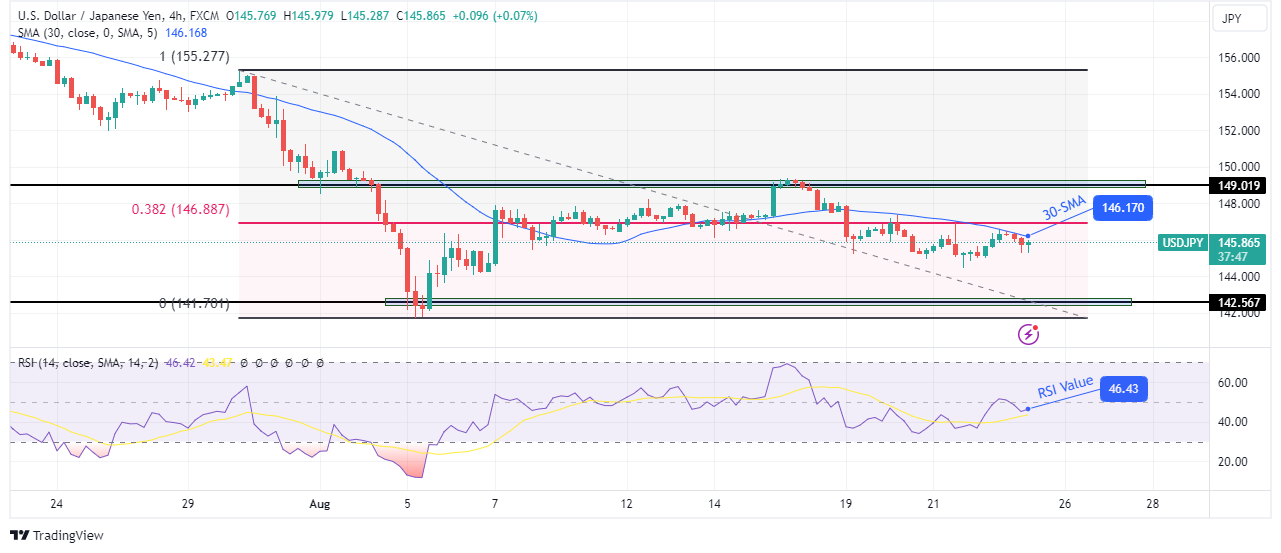
On the technical side, the USD/JPY price has risen to retest the 30-SMA resistance. However, the bias remains bearish since it has stayed below the SMA and the RSI is slightly under 50. Nevertheless, there is little enthusiasm to make large swings.
-If you are interested in forex day trading then have a read of our guide to getting started-
Neither bears nor bulls are ready to push the price too far away from the SMA. This is a sign of indecision. At the same time, the price has remained near the 0.382 Fib level. If bears regain momentum, USD/JPY will bounce lower to the 142.56 support level. Otherwise, it might break above the SMA to retest the 149.01 resistance.
Looking to trade forex now? Invest at eToro!
67% of retail investor accounts lose money when trading CFDs with this provider. You should consider whether you can afford to take the high risk of losing your money.