The main category of Forex News.
You can use the search box below to find what you need.
[wd_asp id=1]
The main category of Forex News.
You can use the search box below to find what you need.
[wd_asp id=1]
Silver price (XAG/USD) extends its winning streak for the fourth trading day on Wednesday. The white metal rallies further to near $90.00 during the Asian trading session as demand for safe-haven assets remains firm amid geopolitical tensions.
Civil unrest in Iran as the general public demands political change due to surging inflation, falling Rial against the US Dollar (USD), and the government’s corruption has resulted in the killing of hundreds of protesters.
In response, United States (US) President Donald Trump has warned the military action in Tehran if the government continues killing protesters.
Meanwhile, higher concerns over Federal Reserve’s (Fed) independence, following criminal charges on Chairman Jerome Powell over mismanaging funds allocated for the renovation of Washington’s headquarters, which he called as “pretext”, a consequence of Fed setting interest rates based on its assessment of the public interest rather than the president’s preferences”, have kept safe-haven assets on the front foot.
The event led to a sharp decline in the US Dollar, as market experts warned that an attack on the Fed’s autonomous status could weigh on US sovereign rating. However, the US Dollar has rebounded quickly after chiefs from global central banks have supported Fed’s Powell over his feud with President Trump.
“We stand in full solidarity with the Fed System and its Chair Jerome H. Powell,” heads of the European Central Bank (ECB), Bank of England (BoE), and nine other institutions said collectively on Tuesday.
XAG/USD trades higher near $90.00 as of writing. The advance remains firm, with buyers maintaining control as momentum stretches into overbought territory.
The 14-day Relative Strength Index (RSI) at 74.77 (overbought) and rising from 72.52 confirms strengthening bullish pressure. While the bias points higher, stretched conditions could cap follow-through and prompt consolidation.
A moderation in momentum with RSI easing toward 70 would help reset the move and support a steadier grind. Conversely, a renewed acceleration in RSI toward the prior extreme near 85.90 would leave the rally vulnerable to a sharper pullback as momentum fatigue builds.
(The technical analysis of this story was written with the help of an AI tool.)
Silver is a precious metal highly traded among investors. It has been historically used as a store of value and a medium of exchange. Although less popular than Gold, traders may turn to Silver to diversify their investment portfolio, for its intrinsic value or as a potential hedge during high-inflation periods. Investors can buy physical Silver, in coins or in bars, or trade it through vehicles such as Exchange Traded Funds, which track its price on international markets.
Silver prices can move due to a wide range of factors. Geopolitical instability or fears of a deep recession can make Silver price escalate due to its safe-haven status, although to a lesser extent than Gold’s. As a yieldless asset, Silver tends to rise with lower interest rates. Its moves also depend on how the US Dollar (USD) behaves as the asset is priced in dollars (XAG/USD). A strong Dollar tends to keep the price of Silver at bay, whereas a weaker Dollar is likely to propel prices up. Other factors such as investment demand, mining supply – Silver is much more abundant than Gold – and recycling rates can also affect prices.
Silver is widely used in industry, particularly in sectors such as electronics or solar energy, as it has one of the highest electric conductivity of all metals – more than Copper and Gold. A surge in demand can increase prices, while a decline tends to lower them. Dynamics in the US, Chinese and Indian economies can also contribute to price swings: for the US and particularly China, their big industrial sectors use Silver in various processes; in India, consumers’ demand for the precious metal for jewellery also plays a key role in setting prices.
Silver prices tend to follow Gold’s moves. When Gold prices rise, Silver typically follows suit, as their status as safe-haven assets is similar. The Gold/Silver ratio, which shows the number of ounces of Silver needed to equal the value of one ounce of Gold, may help to determine the relative valuation between both metals. Some investors may consider a high ratio as an indicator that Silver is undervalued, or Gold is overvalued. On the contrary, a low ratio might suggest that Gold is undervalued relative to Silver.
The Euro has peaked above the swing high during the trading session here on Tuesday as the Japanese yen continues to struggle overall.
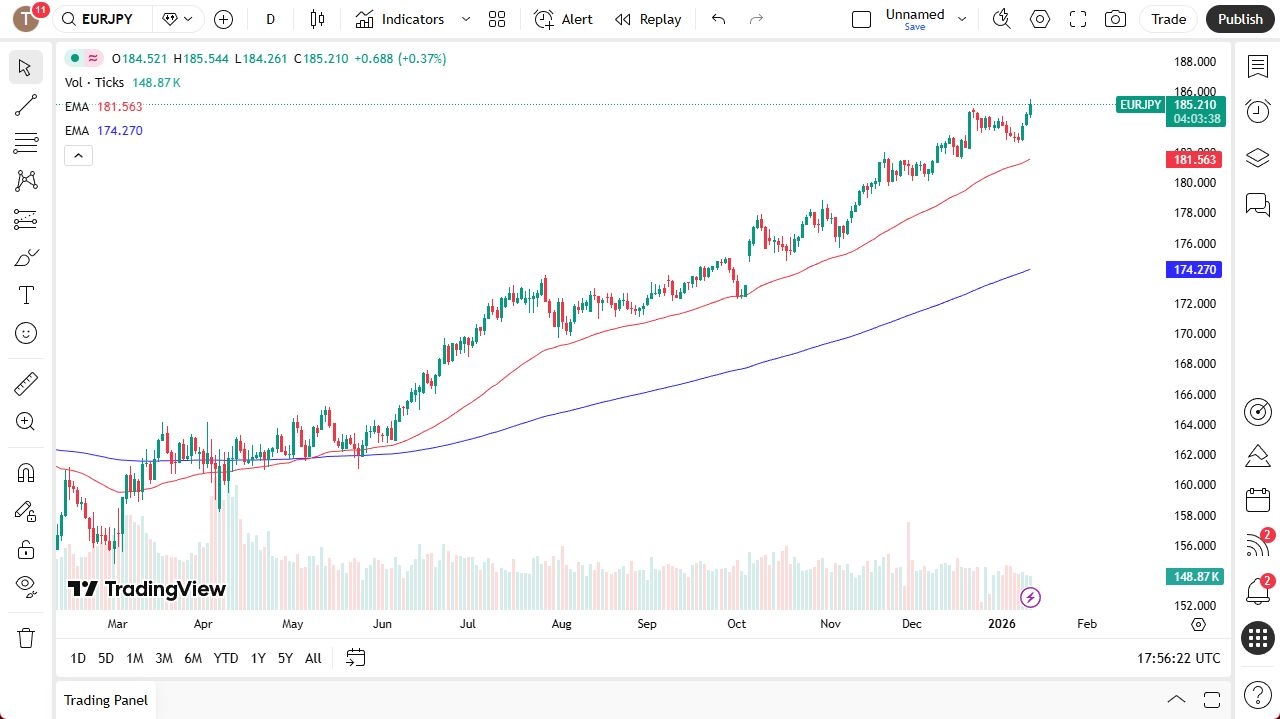
The Euro has peaked above the swing high during the trading session here on Tuesday against the Japanese Yen, and it does look to me like a market that is probably going to continue to find plenty of buyers. This is not necessarily a situation where I love the Euro; I just think the Japanese Yen is going to continue to be that weak.

We have been in a nice uptrend in all of the yen-denominated pairs for some time now, and one thing that you could look at on this chart, at least in the sense of whether or not you should trade this pair, is that at least you avoid the US dollar. There are a lot of questions about the US dollar at the moment.
That being said, the one thing that’s not a question is that the Japanese Yen continues to weaken, and I think there are a lot of problems in Japan that will continue to show themselves in the currency markets. Traders continue to look at the Bank of Japan and recognize that they can’t tighten policy too much.
And while the European Central Bank isn’t necessarily going to make big moves going forward, as we are essentially where we need to be there, the reality is that the Bank of Japan is going to have a problem where it cannot raise rates enough to avoid the carry trade.
I think this is a big situation where looking at the Japanese Yen as a funding currency and continuing the overall carry trade is going to appear in this pair as well as many others. I believe that as long as we can stay above the 50-day EMA, this is a strong market that could continue much higher, possibly even as high as 188 Yen.
Begin trading our daily forecasts and analysis. Here is a list of Forex brokers in Japan to work with.
Christopher Lewis has been trading Forex and has over 20 years experience in financial markets. Chris has been a regular contributor to Daily Forex since the early days of the site. He writes about Forex for several online publications, including FX Empire, Investing.com, and his own site, aptly named The Trader Guy. Chris favours technical analysis methods to identify his trades and likes to trade equity indices and commodities as well as Forex. He favours a longer-term trading style, and his trades often last for days or weeks.
The Euro has peaked above the swing high during the trading session here on Tuesday as the Japanese yen continues to struggle overall.
The Euro has peaked above the swing high during the trading session here on Tuesday against the Japanese Yen, and it does look to me like a market that is probably going to continue to find plenty of buyers. This is not necessarily a situation where I love the Euro; I just think the Japanese Yen is going to continue to be that weak.
We have been in a nice uptrend in all of the yen-denominated pairs for some time now, and one thing that you could look at on this chart, at least in the sense of whether or not you should trade this pair, is that at least you avoid the US dollar. There are a lot of questions about the US dollar at the moment.
That being said, the one thing that’s not a question is that the Japanese Yen continues to weaken, and I think there are a lot of problems in Japan that will continue to show themselves in the currency markets. Traders continue to look at the Bank of Japan and recognize that they can’t tighten policy too much.
And while the European Central Bank isn’t necessarily going to make big moves going forward, as we are essentially where we need to be there, the reality is that the Bank of Japan is going to have a problem where it cannot raise rates enough to avoid the carry trade.
I think this is a big situation where looking at the Japanese Yen as a funding currency and continuing the overall carry trade is going to appear in this pair as well as many others. I believe that as long as we can stay above the 50-day EMA, this is a strong market that could continue much higher, possibly even as high as 188 Yen.
Begin trading our daily forecasts and analysis. Here is a list of Forex brokers in Japan to work with.
Christopher Lewis has been trading Forex and has over 20 years experience in financial markets. Chris has been a regular contributor to Daily Forex since the early days of the site. He writes about Forex for several online publications, including FX Empire, Investing.com, and his own site, aptly named The Trader Guy. Chris favours technical analysis methods to identify his trades and likes to trade equity indices and commodities as well as Forex. He favours a longer-term trading style, and his trades often last for days or weeks.
Lululemon Athletica (LULU) stock price recorded gains in its latest intraday trading, amid continued dynamic support from trading above its SMA50, which reinforces the stability and strength of the short-term corrective upward trend. In addition, a positive divergence has begun to form on the RSI after it reached extremely oversold levels in an exaggerated manner compared to price action, alongside the start of a positive crossover.
Therefore we expect the stock price to rise in upcoming trading, as long as the $188.50 support level holds, to target the $234.85 resistance level.
Today’s price forecast: Bullish
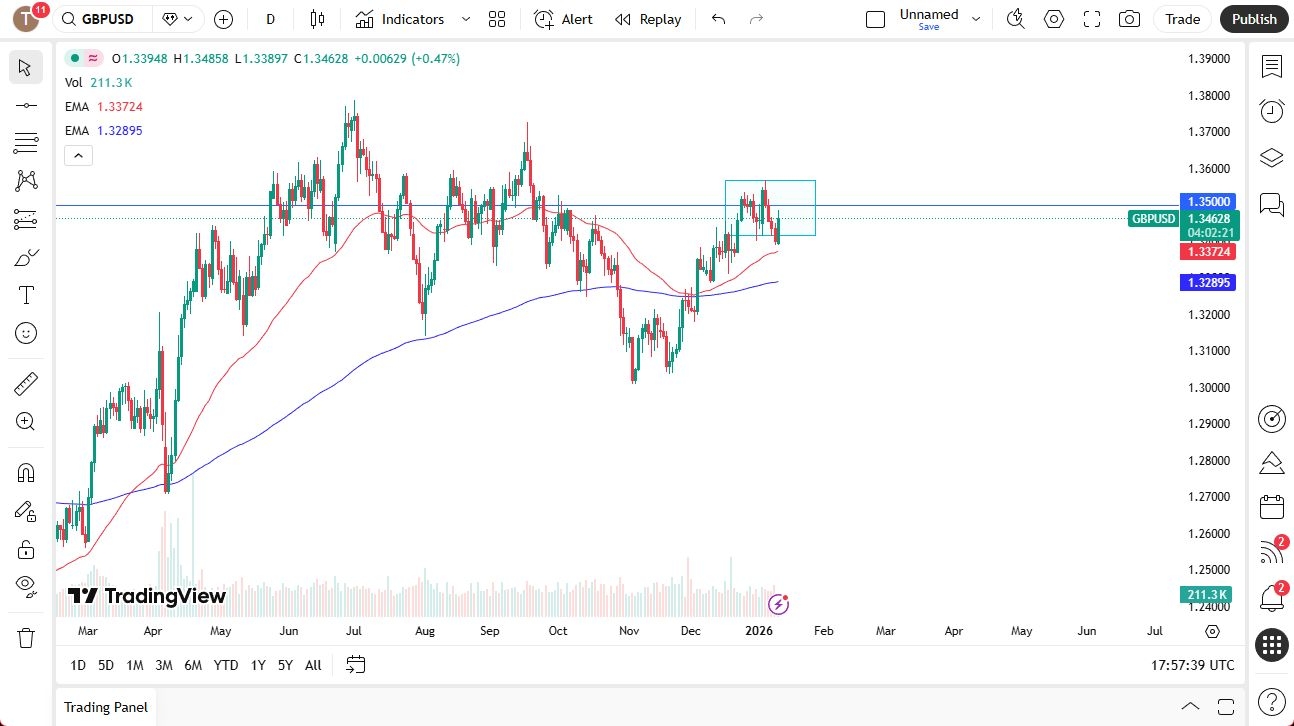
The British pound, of course, is looking very much like a market that is going to respect the 1.35 level as a magnet for price, but also for a barrier that extends possibly all the way to the 1.36 level.
With this being the case, I think you look at short-term rallies that show signs of exhaustion, like we are seeing early in the day, as a potential selling opportunity. I do believe the US dollar is turning the corner, and with that being the case, you have to look at this through the prism of a market that you are fading as it shows signs of exhaustion. If we break above the 1.36 level, that invalidates everything.
The euro continues to drift lower against the British pound, but we’re sitting right here at the 200-day EMA. It’ll be interesting to see if we can break down below there, because if we do, I think it opens up the door to 0.86, and then after that, much lower, maybe 0.84.
This is not a quick-moving pair, but when you look at the euro against the dollar, and you look at the British pound against the dollar, you can definitely see that the British pound is less bad. And that’s what I’m trading here. The ECB is already pretty low with its rates, and it’s not going to do anything, but the Bank of England, despite the fact that it just cut its rates, looks very much like it’s going to be hesitant to do so aggressively. I still like the downside here; I like fading rallies; I like shorting this pair below the 200-day EMA.
If you’d like to know more about trading major macro events like FOMC, CPI, and NFP, please visit our educational area.
Broad US Dollar (USD) weakness kept Gold afloat on Tuesday, with the XAU/USD pair trading above $4,600. The Greenback ticked lower at the beginning of the American session, following the release of the United States (US) Consumer Price Index (CPI), but quickly resumed its advance, amid a risk-averse environment.
The CPI rose at an annualized pace of 2.7% in December, while the monthly increase was of 0.3%, as expected. Core inflation was reported at 2.6% and 0.2%, respectively, slightly lower than anticipated but matching November readings. The figures reaffirmed the market’s view that the Federal Reserve (Fed) will keep interest rates unchanged in the near term, putting pressure on high-yielding assets such as equities and bonds.
XAU/USD initially rallied to a fresh all-time high of $4,634, later giving up to broad USD demand. Still, and as a dismal mood rules financial markets, the bright metal retracement was limited.
Meanwhile, US President Donald Trump added fuel to the fire: earlier in the day, the US leader announced tariffs of 25% on those countries doing business with the Islamic Republic of Iran. New levies will be effective immediately and apply to “any and all” business done between those countries and the USA.
The US will release November Retail Sales on Wednesday, another first-tier figure that could shape USD demand.
The 4-hour chart shows XAU/USD trades around $4,610, retaining its positive tone. The 20-period Simple Moving Average (SMA) stands above the 100- and 200-period SMAs, and all three slope higher, while the price develops above all of them, underscoring a firm bullish bias. The 20 SMA currently stands at $4,548.34, offering nearby dynamic support. Meanwhile, the Momentum indicator eases within positive levels, while the Relative Strength Index (RSI) indicator turned neutral at around 67, reflecting the ongoing pause in the latest run.
In the daily chart, XAU/USD is up for the fourth consecutive day. The 20-day SMA extends its advance above the 100- and 200-day SMAs, reinforcing a bullish structure. All three SMAs trend higher, and price holds above them, with the shorter one at $4,424 drawing a line in the sand. Finally, technical indicators are barely easing from extreme overbought readings, reflecting the ongoing correction and far from suggesting the bullish run is over.
(The technical analysis of this story was written with the help of an AI tool.)
The British pound has rallied Monday as the Department of Justice announced it was investigating Jerome Powell. However, we see the same resistance area.
The reality is it really does not change anything. With that being the case, the 1.3550 level continues to be significant resistance and I am looking for signs of exhaustion to start shorting. I do believe that we are starting to see that in short-term charts.
I am not looking for a big move to the downside; in fact, I think the 50-day EMA at the 1.3372 level continues to offer a floor. As a result, I think this is a short-term back and forth type of setup. But when I look at the longer-term charts, it is worth noting that despite the volatility, we are at the same place we were at in June.
Although it has been exhausting to trade this pair at times, the reality is nothing has changed. We have made a series of lower highs though, and that might be something looked at through the lens of a longer-term trader. If we break down below the 1.33 level, I think at that point in time the bottom falls out and it would not surprise me if that ends up being the case. Keep in mind that the British pound has outperformed its peers against the US dollar both up and down over the last couple of years and I think that will probably continue to be the case.
Ready to trade our daily GBP/USD Forex forecast? Here’s some of the best forex broker UK reviews to check out.
Christopher Lewis has been trading Forex and has over 20 years experience in financial markets. Chris has been a regular contributor to Daily Forex since the early days of the site. He writes about Forex for several online publications, including FX Empire, Investing.com, and his own site, aptly named The Trader Guy. Chris favours technical analysis methods to identify his trades and likes to trade equity indices and commodities as well as Forex. He favours a longer-term trading style, and his trades often last for days or weeks.
New York, January 13, 2026, 06:56 (EST) — Premarket
Shares of the United States Natural Gas Fund (UNG) surged 7.5% Monday, closing at $11.18 before dipping roughly 0.9% in after-hours to $11.08. (Yahoo Finance)
That rebound is crucial as weather swings have been driving U.S. natural gas prices, with the market moving into peak winter heating season. When the forecast shifts, traders follow suit.
UNG offers equity traders a quicker route to track natural gas price shifts without dealing with futures contracts themselves. The fund aims to mirror daily changes in natural gas by using NYMEX contracts, rolling over to the next month as the front-month contract gets close to expiration. (Uscfinvestments)
NYMEX February futures closed Monday at $3.409 per million British thermal units. Early Tuesday trading showed a drop of about 2.1%, with prices around $3.337. (MarketWatch)
Forecaster Atmospheric G2 reported Monday that temperatures are expected to drop across the eastern U.S. from Jan. 17-21, with even colder conditions forecast for Jan. 22-26. The update also highlighted short covering after natural gas prices fell to a 2.5-month low on Friday. (Nasdaq)
Supply remains a heavy drag, showing little sign of letting up. Aegis Hedging reported dry gas production has risen again to over 109 billion cubic feet per day, approaching record highs. They also highlighted forecasts projecting a drop below the 10-year average by the end of the week. (Aegis Hedging)
Leverage products moved as expected. ProShares Ultra Bloomberg Natural Gas (BOIL) jumped roughly 14% in premarket action, while its opposite, ProShares UltraShort Bloomberg Natural Gas (KOLD), dropped close to 15%.
Gas-linked names pushed higher early Tuesday. EQT rose around 2%, Antero Resources climbed about 3%, and LNG exporter Cheniere Energy added close to 2%.
By early Monday afternoon, natural gas prices had climbed roughly 5.9%, while UNG surged 6.9%, MT Newswires reported. The rally extended further into the trading session. (Fidelity Fixed Income)
That setup works both ways. If the cold snap fades or bypasses key demand hubs, gains can evaporate fast. UNG follows futures rather than the spot gas price, and returns often take a hit when the monthly roll sees later contracts priced higher than the front month.
On the longer-term demand front, LNG developers are racing to get projects into construction. Delfin Midstream announced it extended a letter of award with Samsung Heavy Industries and signed a purchase order for Siemens Energy gear. CEO Dudley Poston said the company aims to reach a final investment decision “in the next month.”
Tuesday’s session will see traders eyeing whether Henry Hub futures hold onto gains after Monday’s surge, along with ETF flows once regular trading kicks off.
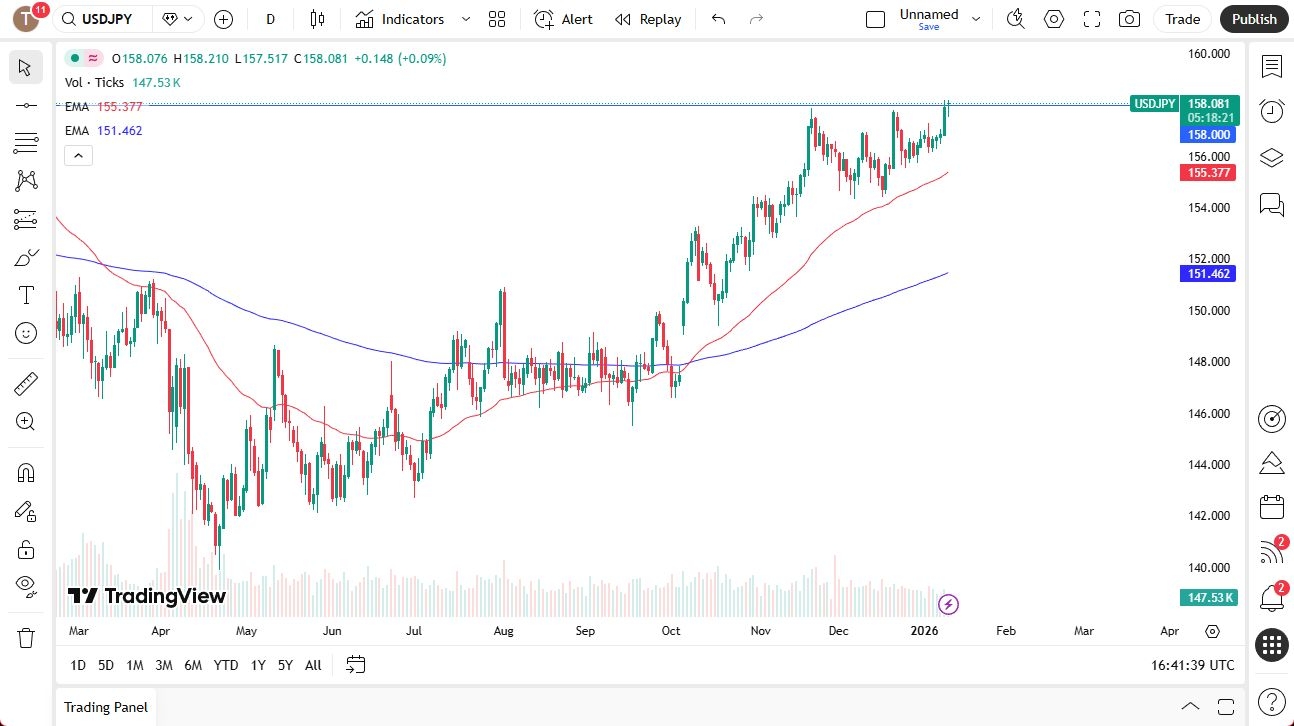
The fact that we look like we are trying to reclaim that and go higher is a very bullish sign, and in that environment, we could go looking to the 160 yen level. The 160 yen level is an area that we have seen the Bank of Japan intervene at previously.
But with this, I also keep in mind that the market is going to continue to see a lot of traders trying to take advantage of the carry trade, and although the US dollar is a little bit soft against multiple other currencies, the reality is that the Japanese yen is extraordinarily weak. It should be because the Bank of Japan has no real chance of raising rates significantly, as the debt level is far too high for the interest rates to be very elevated.
This being the case, I think you continue to see a lot of buy on the dip behavior with the 156 yen level offering support as the 50-day EMA is racing towards there. If we can break above the 160 yen level, we could really take off, and we could be talking about a multi-year rally.
I don’t know that’s going to happen yet, but I certainly know that I have no interest in shorting this pair. Therefore, I look at it as the same as I have for the last year or so, I just look at anytime the US dollar falls against the Japanese yen, you have to believe it’s an opportunity to get involved.
Want to trade our USD/JPY forex analysis and predictions? Here’s a list of forex brokers in Japan to check out.
Christopher Lewis has been trading Forex and has over 20 years experience in financial markets. Chris has been a regular contributor to Daily Forex since the early days of the site. He writes about Forex for several online publications, including FX Empire, Investing.com, and his own site, aptly named The Trader Guy. Chris favours technical analysis methods to identify his trades and likes to trade equity indices and commodities as well as Forex. He favours a longer-term trading style, and his trades often last for days or weeks.
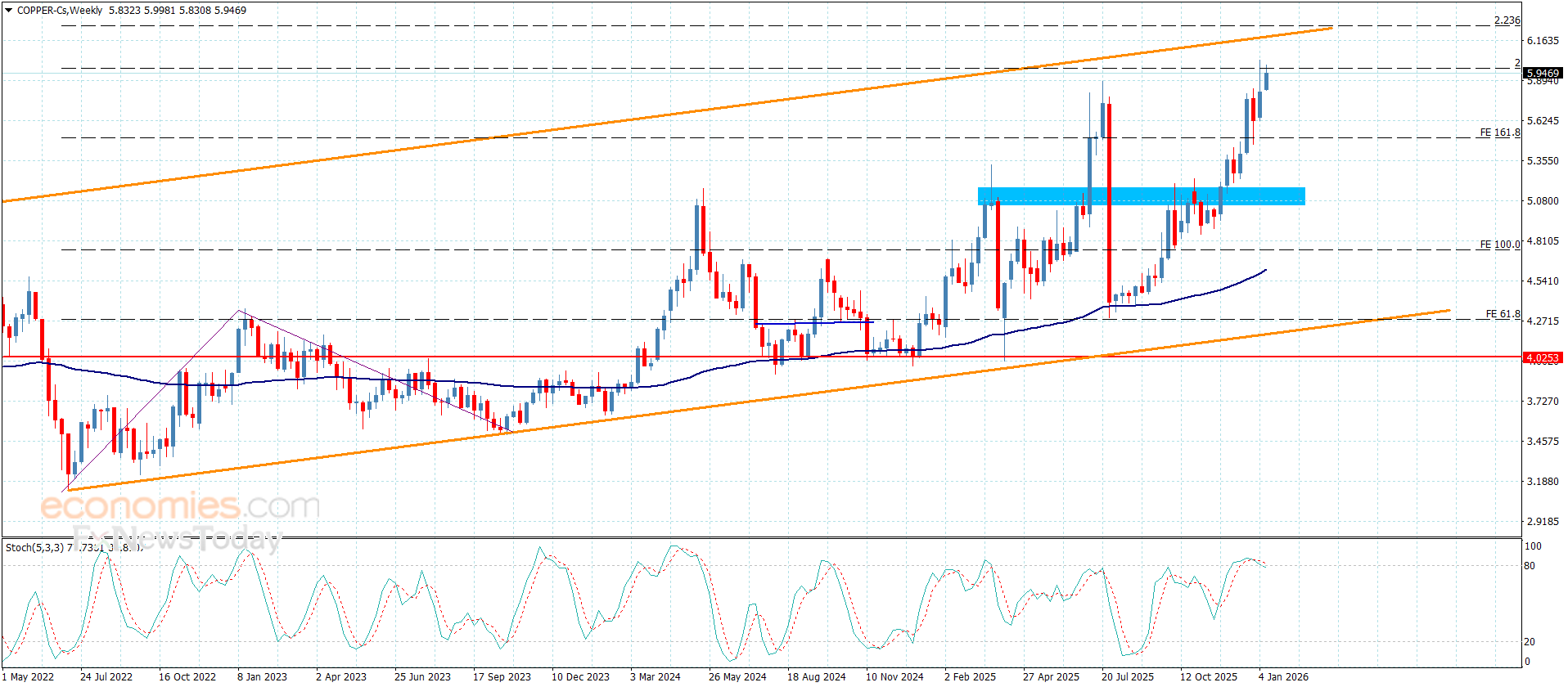
No new for copper price by its fluctuating below $5.9700 barrier, which obstructs the chances of achieving any new gains, to increase the chances of activating the bearish corrective track again, therefore, we will keep waiting to decline towards the corrective stations that are located near $5.7500 reaching the initial support at $5.5800 level.
Note that the success in breaching the barrier and holding above it will reinforce the chances of resuming the main bullish attack, to expect reaching $6.1200 directly, then press on the resistance of the main bullish channel’s resistance at $6.2000.
The expected trading range for today is between $5.7500 and $5.9700
Trend forecast: Fluctuating within the bullish trend