The main category of Forex News.
You can use the search box below to find what you need.
[wd_asp id=1]
The main category of Forex News.
You can use the search box below to find what you need.
[wd_asp id=1]
The Euro to Dollar (EUR/USD) exchange rate has recovered to around 1.1430 after rebounding from recent multi-month lows, although Citi believes the broader risks remain tilted to the downside.
Citi maintains its three-month EUR/USD forecast at 1.13 and expects the pair to trade around 1.14 over the following six to 12 months, with scope for only a gradual recovery.
The bank warns that EUR/USD “risks a move towards the 1.10 area” if US inflation remains sticky enough to keep markets pricing further Federal Reserve tightening, even if additional rate hikes are ultimately not delivered.
Citi also believes the European Central Bank could become less hawkish as commodity prices decline and the Middle East conflict continues to ease, opening the door to further scaling back of ECB tightening expectations.
Over the medium term, however, the bank expects some mean reversion once the US Dollar rally peaks. Citi argues that markets may eventually unwind overly aggressive Fed expectations, helping to limit further Dollar gains.
The bank also expects higher European defence spending to provide a gradual lift to economic growth, although it cautions that broader structural reforms are progressing only slowly.
While Citi remains cautious on EUR/USD in the near term, it believes a moderation in Dollar strength should allow the pair to stabilise around 1.14 over the longer horizon.

The EURJPY pair surrendered to the negative factors in yesterday’s trading, which are represented by the continuation of forming a strong barrier at 185.80 level besides providing negative momentum by stochastic, which forces it to form new bearish waves, to settle below the support level at 184.20.
Note that the attempt of forming extra barrier at 184.85 level will increase the chances of forming new bearish waves, to expect reaching 183.50 followed by the next support at 183.00, while surpassing the current barrier will provide a chances for recovering the previously achieved losses by its rally towards 185.40 and 185.80.
The expected trading range for today is between 183.50 and 184.60
Trend forecast: Bearish
GBP/JPY trades under pressure on Thursday as the Japanese Yen (JPY) strengthens across the board amid speculation that Japanese authorities may have intervened in the foreign exchange market after the Yen fell to a 40-year low against the US Dollar (USD) earlier this week.
At the time of writing, the cross is trading around 215, retreating from the two-month high of 216.08 touched during the Asian session.
According to Reuters, it was not immediately clear what drove the Yen’s sharp rebound, and Japan’s Ministry of Finance declined to comment. Some traders and strategists speculated that authorities had conducted a rate check.
Traders remain alert to the possibility of intervention by Japanese authorities. However, the downside in GBP/JPY could remain limited as investors continue to take advantage of Japan’s relatively low interest rates compared with other major economies, supporting carry trades. From a technical perspective, the broader trend also remains tilted to the upside.
In the 4-hour chart, GBP/JPY holds a mildly bullish bias as it stays above the 100-period simple moving average (SMA) at 214.25 and the 200-period SMA at 214.19. The pair is also trading just over the horizontal support at 215, suggesting near-term demand on dips, while the Relative Strength Index (RSI) at 52 leans slightly positive and the Average Directional Index (ADX) at 31 hints at a moderately established trend rather than a volatile reversal phase.
On the topside, immediate resistance is seen at the horizontal barrier at 216, where a clear break would open the way for a continuation of the broader advance. On the downside, initial support is located at 215, followed by the clustered moving average zone between the 100-period SMA at 214.25 and the 200-period SMA at 214.19, before a deeper floor emerges at 213.
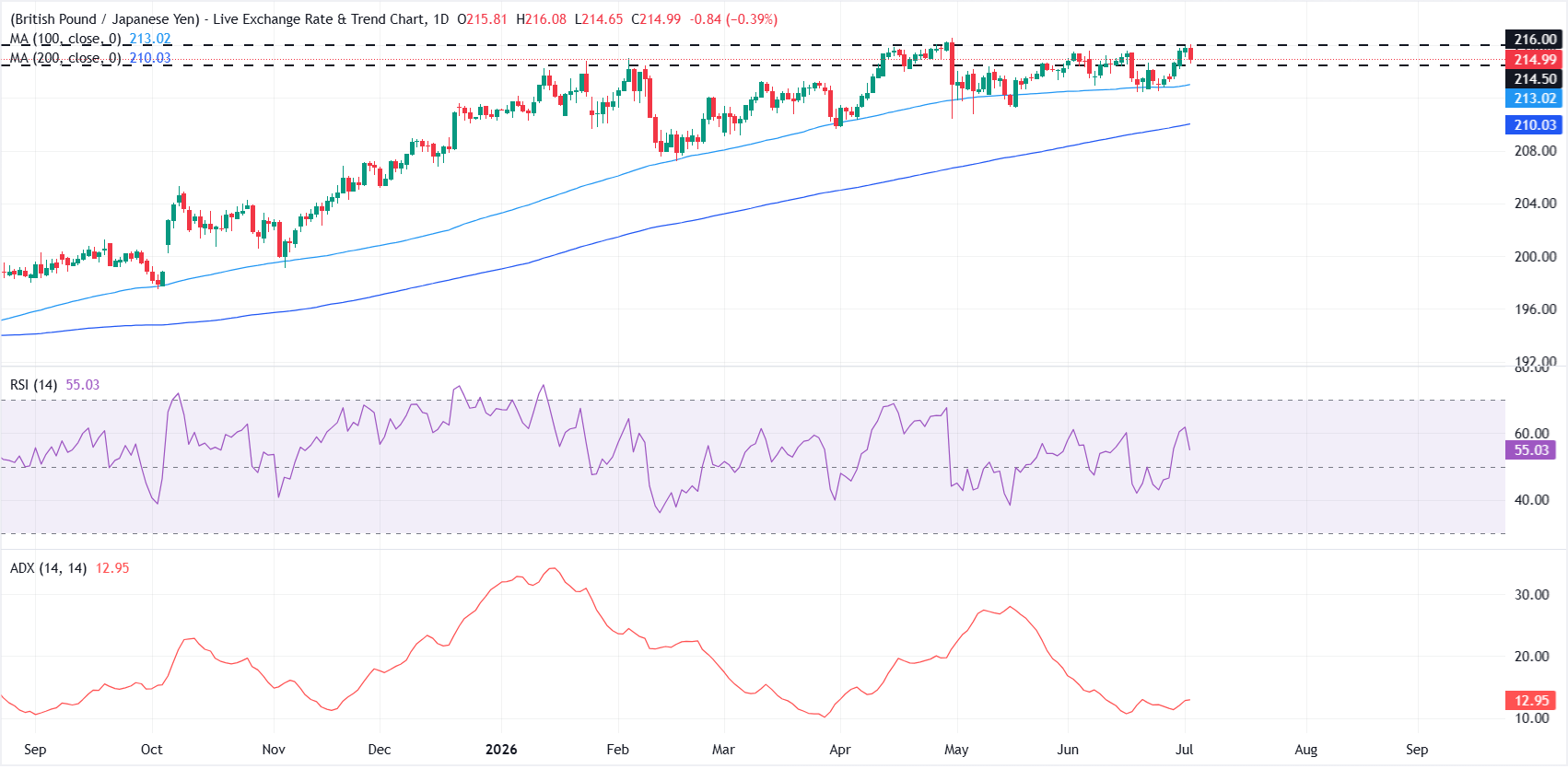
On the daily chart, GBP/JPY maintains a bullish near-term bias as it holds above both the 100-day and 200-day simple moving averages (SMAs) at 213.02 and 210.03 respectively. The pair is trading under the horizontal resistance at 216.00, while a mid-50s Relative Strength Index (RSI) suggests constructive momentum and the subdued Average Directional Index (ADX) around 13 hints at a trend that is firm but not strongly directional.
On the downside, initial support appears at 214.50, where a horizontal level underpins the latest advance, followed by the 100-day SMA at 213.02 and the 200-day SMA near 210.03. On the topside, a break above 216.00 would open the way for further gains, with the existing moving average structure reinforcing the broader supportive backdrop as long as price holds above 213.02.
(The technical analysis of this story was written with the help of an AI tool.)
The table below shows the percentage change of Japanese Yen (JPY) against listed major currencies today. Japanese Yen was the strongest against the Australian Dollar.
| USD | EUR | GBP | JPY | CAD | AUD | NZD | CHF | |
|---|---|---|---|---|---|---|---|---|
| USD | -0.23% | -0.28% | -0.68% | -0.00% | 0.05% | -0.02% | -0.35% | |
| EUR | 0.23% | -0.06% | -0.44% | 0.21% | 0.28% | 0.23% | -0.12% | |
| GBP | 0.28% | 0.06% | -0.39% | 0.24% | 0.33% | 0.28% | -0.07% | |
| JPY | 0.68% | 0.44% | 0.39% | 0.66% | 0.74% | 0.64% | 0.33% | |
| CAD | 0.00% | -0.21% | -0.24% | -0.66% | 0.06% | 0.01% | -0.34% | |
| AUD | -0.05% | -0.28% | -0.33% | -0.74% | -0.06% | -0.05% | -0.40% | |
| NZD | 0.02% | -0.23% | -0.28% | -0.64% | -0.01% | 0.05% | -0.35% | |
| CHF | 0.35% | 0.12% | 0.07% | -0.33% | 0.34% | 0.40% | 0.35% |
The heat map shows percentage changes of major currencies against each other. The base currency is picked from the left column, while the quote currency is picked from the top row. For example, if you pick the Japanese Yen from the left column and move along the horizontal line to the US Dollar, the percentage change displayed in the box will represent JPY (base)/USD (quote).
11
Brent Crude Oil Price Today (July 1): Brent crude and US West Texas Intermediate (WTI) oil prices traded higher in early Wednesday, July 1, after Iran ruled out direct negotiations with US officials, reviving concerns over the fragile Middle East ceasefire. Although crude prices posted modest gains, the broader market remains under pressure following one of the steepest quarterly declines in years as easing geopolitical tensions and improved supply outlook weighed on sentiment.
Brent crude futures rose 50 cents, or 0.69%, to $73.45 per barrel during early Wednesday trading. The benchmark crude oil contract gained after Iran confirmed it would not participate in direct talks with US officials, adding uncertainty to the ceasefire that has temporarily paused the four-month-long conflict between the two countries.
US West Texas Intermediate (WTI) crude futures climbed 63 cents, or 0.91%, to $70.13 per barrel. The gains reflected renewed geopolitical concerns, although analysts say improving global supply conditions continue to limit any sharp rally in oil prices.
Crude oil prices moved higher after Iran announced that it would not hold direct discussions with the United States. According to the White House, US special envoy Steve Witkoff and Jared Kushner, son-in-law of President Donald Trump, travelled to Doha for high-level diplomatic meetings.
However, Iranian and Qatari officials clarified that the American delegation would meet with mediators rather than Iranian representatives directly. Qatar also confirmed that Prime Minister Sheikh Mohammed bin Abdulrahman Al Thani participated in discussions with the US officials.
The lack of direct negotiations has renewed concerns about the durability of the ceasefire and raised fresh uncertainty over stability in the Middle East, a key oil-producing region.
Even with Wednesday’s rebound, oil prices remain significantly below recent highs after recording sharp losses during the previous quarter. Brent crude reportedly fell by nearly $45 per barrel between the first and second quarters of 2026, marking its largest quarterly decline since the 2008 global financial crisis. Meanwhile, WTI crude dropped approximately $31 per barrel, representing its steepest quarterly fall since 2020, when the COVID-19 pandemic severely reduced global fuel demand.
The decline followed easing geopolitical tensions, which removed much of the risk premium that had supported crude prices during the Iran-related conflict.
A Reuters survey published on Tuesday showed that analysts reduced their 2026 oil price forecasts for the first time since the Iran conflict began. The downward revision ended five consecutive months of higher forecasts as improving supply expectations outweighed geopolitical risks.
Analysts also noted that the reopening of the Strait of Hormuz has eased fears of prolonged disruptions to global crude exports, helping stabilise supply expectations.
US Vice President JD Vance said Washington would not allow Iran to impose transit fees on ships passing through the Strait of Hormuz. He stressed that the United States would not accept a scenario in which Iran began “collecting tolls” from vessels using one of the world’s most strategically important oil shipping routes. The comments reinforced expectations that global oil supply routes will remain open despite ongoing regional tensions.
Disclaimer: Oil prices are highly volatile and may change rapidly due to geopolitical developments, supply-demand dynamics, central bank policies, and global economic conditions. Prices mentioned are based on early trading data available on July 1, 2026.
– Written by
John Cameron
STORY LINK GBP/USD Forecast: Pound Sterling Surges as Weak US Payrolls Sinks USD
The Pound to US Dollar (GBP/USD) exchange rate rallied strongly on Thursday after weaker-than-expected US labour market data sparked a broad selloff in the ‘Greenback’.
At the time of writing, GBP/USD was trading near $1.3360, up around 0.6% compared with Thursday’s opening levels.
The US Dollar (USD) came under heavy pressure on Thursday following the release of the latest US non-farm payrolls report from the Bureau of Labor Statistics, which pointed to a marked slowdown in hiring during June.
The US economy added only 57,000 jobs over the month, significantly below expectations for an increase of roughly 110,000 and representing the weakest payroll gain for several months.
The report also included downward revisions to employment figures for both April and May, reinforcing concerns that conditions in the US labour market are cooling faster than previously believed.
The disappointing data prompted investors to reassess the outlook for Federal Reserve policy, with market pricing for an interest rate increase before the end of the summer falling sharply from around 70% to close to 50% in the aftermath of the release.
The Pound (GBP) also traded with a firmer tone on Thursday as investors became increasingly confident that the UK’s political transition will be smoother than previously feared.
Get better rates and lower fees on your next international money transfer.
Compare TorFX with top UK banks in seconds and see how much you could save.
With Andy Burnham expected to become the next Prime Minister without facing a leadership contest, markets have continued to unwind some of the political uncertainty that had weighed on Sterling in recent weeks.
Additional support came from Burnham’s repeated assurances that his government would continue to adhere to Labour’s existing fiscal framework, including commitments to balancing day-to-day public spending through tax receipts and reducing debt as a proportion of GDP over the longer term.
Looking ahead to Friday’s session, attention is likely to centre on a scheduled speech from Bank of England (BoE) Governor Andrew Bailey, which could provide fresh direction for the Pound to US Dollar (GBP/USD) exchange rate.
Bailey adopted a relatively hawkish stance earlier in the week, indicating that interest rate cuts are not currently under consideration while also warning that higher energy costs could yet feed through into inflation.
Should he reiterate this message, Sterling may be able to extend its recent gains.
For the US Dollar, however, volatility may be subdued heading into the weekend, with US financial markets closed in observance of the Independence Day holiday, resulting in lighter trading volumes.

International Money Transfer? Ask our resident FX expert a money transfer question or try John’s new, free, no-obligation personal service! ,where he helps every step of the way,
ensuring you get the best exchange rates on your currency requirements.
TAGS: Pound Dollar Forecasts
Silver price (XAG/USD) trades 0.9% higher to near $59.65 during the European trading session on Thursday. The white metal gains as the US Dollar (USD) slumps ahead of the United States (US) Nonfarm Payrolls (NFP) data for June, which will be published at 12:30 GMT.
As of writing, the US Dollar Index (DXY), which tracks the Greenback’s value against six major currencies, is down 0.4% to near 101.00.
The table below shows the percentage change of US Dollar (USD) against listed major currencies today. US Dollar was the weakest against the Japanese Yen.
| USD | EUR | GBP | JPY | CAD | AUD | NZD | CHF | |
|---|---|---|---|---|---|---|---|---|
| USD | -0.34% | -0.54% | -0.85% | -0.20% | -0.17% | -0.32% | -0.54% | |
| EUR | 0.34% | -0.20% | -0.52% | 0.12% | 0.18% | 0.04% | -0.20% | |
| GBP | 0.54% | 0.20% | -0.30% | 0.30% | 0.38% | 0.24% | 0.00% | |
| JPY | 0.85% | 0.52% | 0.30% | 0.62% | 0.68% | 0.50% | 0.30% | |
| CAD | 0.20% | -0.12% | -0.30% | -0.62% | 0.04% | -0.09% | -0.33% | |
| AUD | 0.17% | -0.18% | -0.38% | -0.68% | -0.04% | -0.13% | -0.37% | |
| NZD | 0.32% | -0.04% | -0.24% | -0.50% | 0.09% | 0.13% | -0.24% | |
| CHF | 0.54% | 0.20% | -0.00% | -0.30% | 0.33% | 0.37% | 0.24% |
The heat map shows percentage changes of major currencies against each other. The base currency is picked from the left column, while the quote currency is picked from the top row. For example, if you pick the US Dollar from the left column and move along the horizontal line to the Japanese Yen, the percentage change displayed in the box will represent USD (base)/JPY (quote).
Technically, a lower US Dollar makes the Silver price an attractive bet for investors.
Investors will pay close attention to the US NFP data to get fresh cues regarding the Federal Reserve’s (Fed) monetary policy outlook. The NFP report will likely show that employers hired 110K fresh workers, lower than 172K in May. The Unemployment Rate is expected to remain steady at 4.3%.
Currently, the CME FedWatch tool shows that traders see an almost 85% chance that the Fed will deliver at least one interest rate hike this year.
On Wednesday, the US ADP Employment Change and the ISM Manufacturing PMI data for June missed expectations. The ADP report showed that the private sector created 98K fresh jobs, lower than the estimates of 113K. The Manufacturing PMI arrived lower at 53.3, while it was expected to remain steady at 54.0.
XAG/USD trades higher at around $59.65 in the European trade. However, the index is keeping a bearish near-term tone as price holds below the 20-day Exponential Moving Average (EMA), which is at $63.74. The metal remains pressured by this overhead dynamic barrier, while the Relative Strength Index (RSI) at 36.24 stays just above oversold territory, hinting at lingering downside bias rather than a decisive recovery.
On the topside, initial resistance is located at the 20-day EMA around $63.74, which needs to be reclaimed to ease the current bearish pressure and open the way for a more sustainable rebound. On the downside, the June 24 low at $55.63 is the immediate support; a downside move below that would expose the pair to the psychologcial level of $50.00
(The technical analysis of this story was written with the help of an AI tool.)
The Nonfarm Payrolls release presents the number of new jobs created in the US during the previous month in all non-agricultural businesses; it is released by the US Bureau of Labor Statistics (BLS). The monthly changes in payrolls can be extremely volatile. The number is also subject to strong reviews, which can also trigger volatility in the Forex board. Generally speaking, a high reading is seen as bullish for the US Dollar (USD), while a low reading is seen as bearish, although previous months’ reviews and the Unemployment Rate are as relevant as the headline figure. The market’s reaction, therefore, depends on how the market assesses all the data contained in the BLS report as a whole.
The Japanese Yen remains under pressure despite the Bank of Japan’s latest rate hike, with MUFG arguing that stronger US interest-rate expectations continue to dominate the currency outlook.
USD/JPY traded near 161.23 on Wednesday after briefly touching 162.84, its highest level since 1986, earlier this week. The pair has climbed almost 4% this year and more than **2% during June.
USD/JPY Statistics
USD/JPY 2026 High: 162.84
Highest level since: 1986
MUFG: Fed Driving Dollar, Not BoJ
MUFG says the Bank of Japan’s June rate hike to 1.00% reinforces the case for further tightening, but has not been enough to reverse Yen weakness.
“The BOJ raised the policy rate by 25bp to 1.00% and signaled a hawkish stance.”
The bank expects another BoJ rate increase could come as early as September as higher energy costs continue feeding into inflation.
However, MUFG argues that Fed policy remains the dominant driver.
“We therefore expect continued dollar strength in the short term.”
The bank notes that markets are increasingly pricing another Fed rate hike this year after Chair Kevin Warsh’s hawkish June meeting.
Despite its near-term bullish Dollar view, MUFG believes USD/JPY gains may not be sustainable.
“Dollar strength driven by Fed rate-hike expectations may therefore not last long.”
The bank argues that falling oil and gasoline prices could reduce inflation pressures in the US, allowing President Trump to renew pressure on the Federal Reserve to cut interest rates ahead of the midterm elections.
MUFG also notes that intervention concerns remain elevated after USD/JPY climbed to its highest level in around 40 years, suggesting Japanese authorities could become more active if Yen weakness accelerates again.
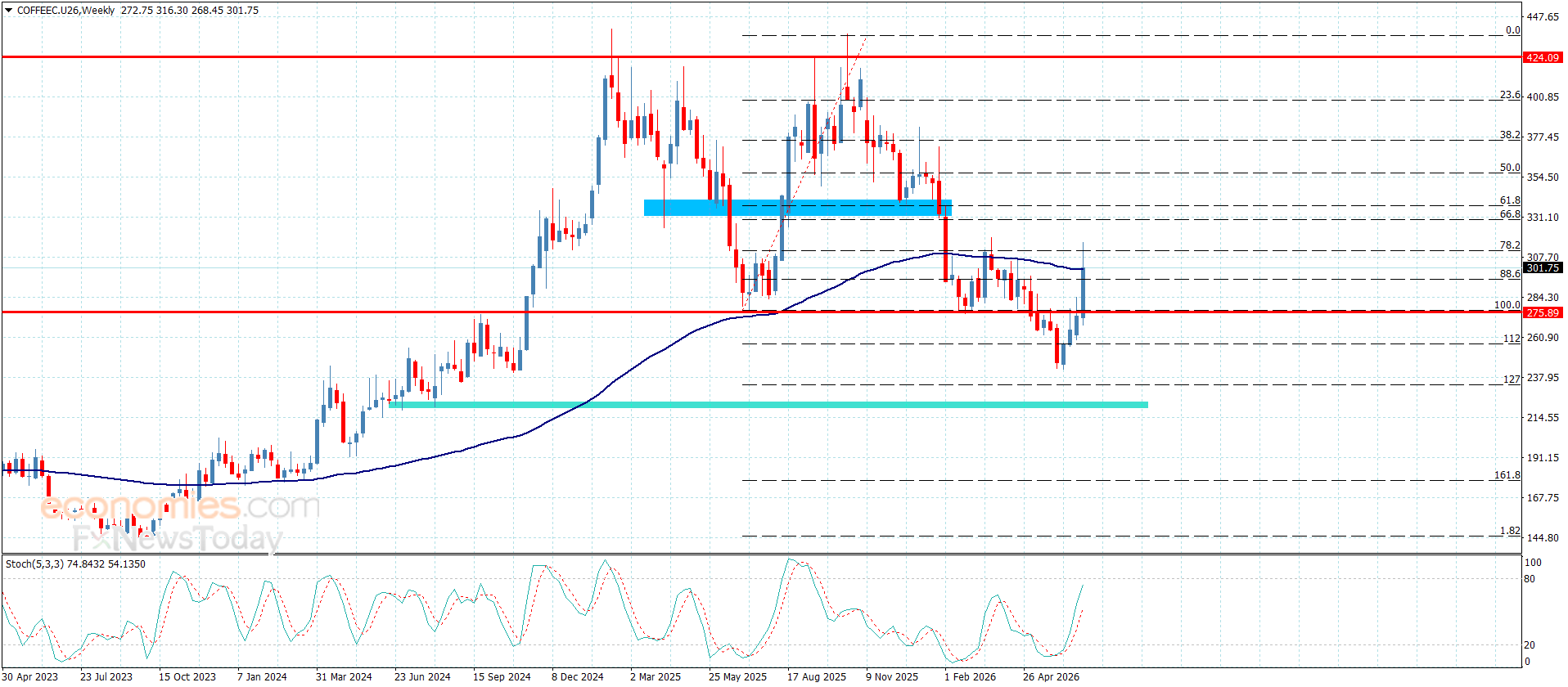
Coffee (KC) is trading at $308.62, down 1.89% on the day, with the price currently positioned above its short- and medium-term moving averages but remaining just below its longer-term trend levels.
Real-time Data
18:35
313.04

On the technical front, KC is trading above both the 20-period and 50-period moving averages on the working timeframe, but remains just under the 200-period moving average. The key Ichimoku Kijun support on the daily chart is at $304.96. The Moving Average Convergence Divergence (MACD) and the Average Directional Index (ADX) both register a Buy signal, while the Relative Strength Index (RSI) also indicates buying momentum. In contrast, the Stochastic RSI is oversold, Commodity Channel Index (CCI) sits at Neutral, and Bull/Bear Power shows intraday overbought conditions, highlighting buyer dominance. The Awesome Oscillator is neutral. This mix points to a divergence between strong short-term momentum and mixed oscillator readings.
Looking ahead to the next 2–3 trading days, the expected price range is $298.05 to $319.19, with a 70% probability of an upward move. The baseline scenario anticipates continued trading within this range. If KC decisively breaks above resistance, a move toward higher levels may follow; if price falls below the daily Ichimoku Kijun at $304.96, this would activate a bearish scenario.
Earlier, analysts noted that coffee futures were underpinned by sustained short-term bullish momentum, supported by favorable policy shifts and technical strength. The current setup reinforces this positive bias, but traders should be mindful of potential volatility around the $304.96 daily Ichimoku Kijun support, as a break below this level could shift momentum to the downside.
Rate spread dynamics are reasserting themselves as the dominant EUR/USD driver now that Middle East risk premium has largely unwound from oil prices. A narrowing gap between US and European yield expectations, as Fed hike pricing fades faster than ECB pricing, points to scope for the pair to grind higher through 2026 and into 2027. The bund curve has flattened alongside the drop in crude, with the 10-year yield already easing to reflect reduced inflation risk. Positioning around a potential final ECB insurance hike will be a key swing factor for European rates markets into year end.
—
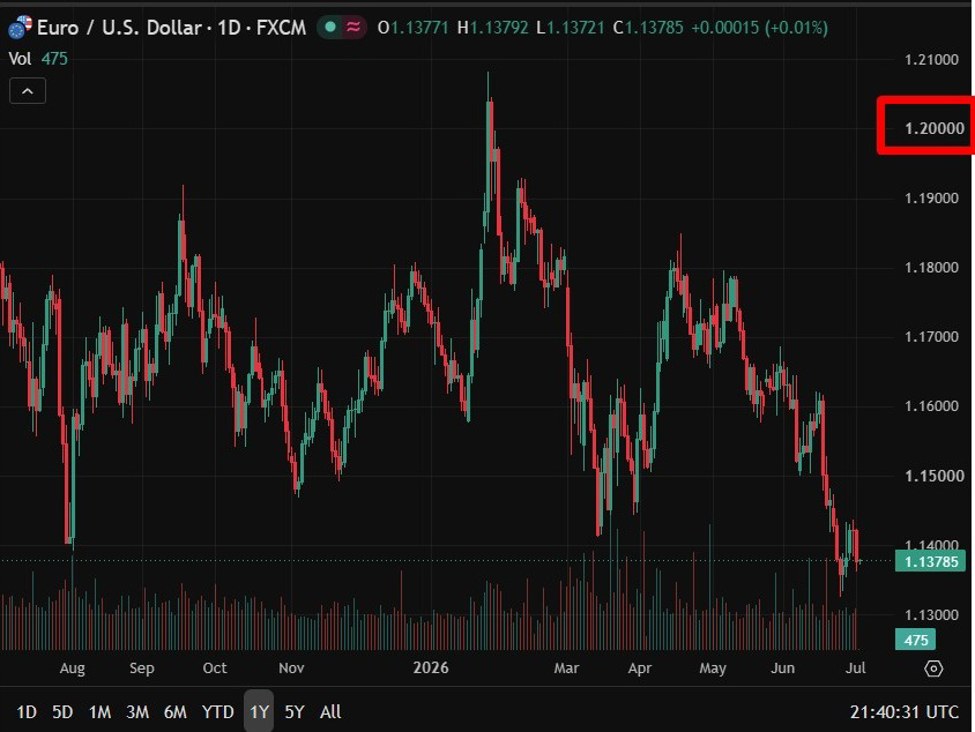
MUFG forecasts EUR/USD recovering to 1.20 by Q1 2027, above consensus, as fading Fed hike bets and one final ECB insurance hike reshape the rate spread outlook.
Summary:
The euro is set to claw back recent losses against the US dollar and climb to 1.20 by early 2027, according to MUFG, as fading expectations for further Federal Reserve tightening outpace the diminishing but still live prospect of one more European Central Bank rate hike. The euro weakened from 1.1683 to 1.1422 against the dollar in June, its longest run below the 1.15 level in over a year, after the ECB raised its deposit rate 25 basis points to 2.25%, its first increase since September 2023.
The rate move followed a rapid unwind of the geopolitical risk premium built into oil prices earlier this year. Brent crude has largely reversed its US-Iran conflict driven surge, easing energy pass through pressure on inflation faster than had been anticipated. Options market pricing has adjusted accordingly, with OIS markets shifting from pricing close to three ECB hikes before the June meeting to roughly one now.
Even so, a further insurance hike remains plausible. ECB Chief Economist Philip Lane has said the top of the neutral policy range likely drifted higher to 2.50%, suggesting a relatively low hurdle to one more move, while flagging that energy related inflation pass through risks could persist for some time. ECB President Christine Lagarde has separately argued the euro area economy has grown more resilient to external shocks, implying it could absorb a further hike if required.
With crude oil stabilising near current levels, MUFG expects rate spreads to reassert themselves as the dominant driver of EUR/USD, arguing that pricing for a Fed hike now looks less realistic than pricing for a final ECB move. That dynamic underpins the bank’s above consensus forecast profile, with EUR/USD seen rising to 1.1600 in the third quarter, 1.1800 by year end, and 1.2000 by the first quarter of 2027, a level it expects to hold into the following quarter. The 10-year German bund yield, which fell 8 basis points in June to 2.86%, is expected to ease further over the same period as inflation risks continue to recede.
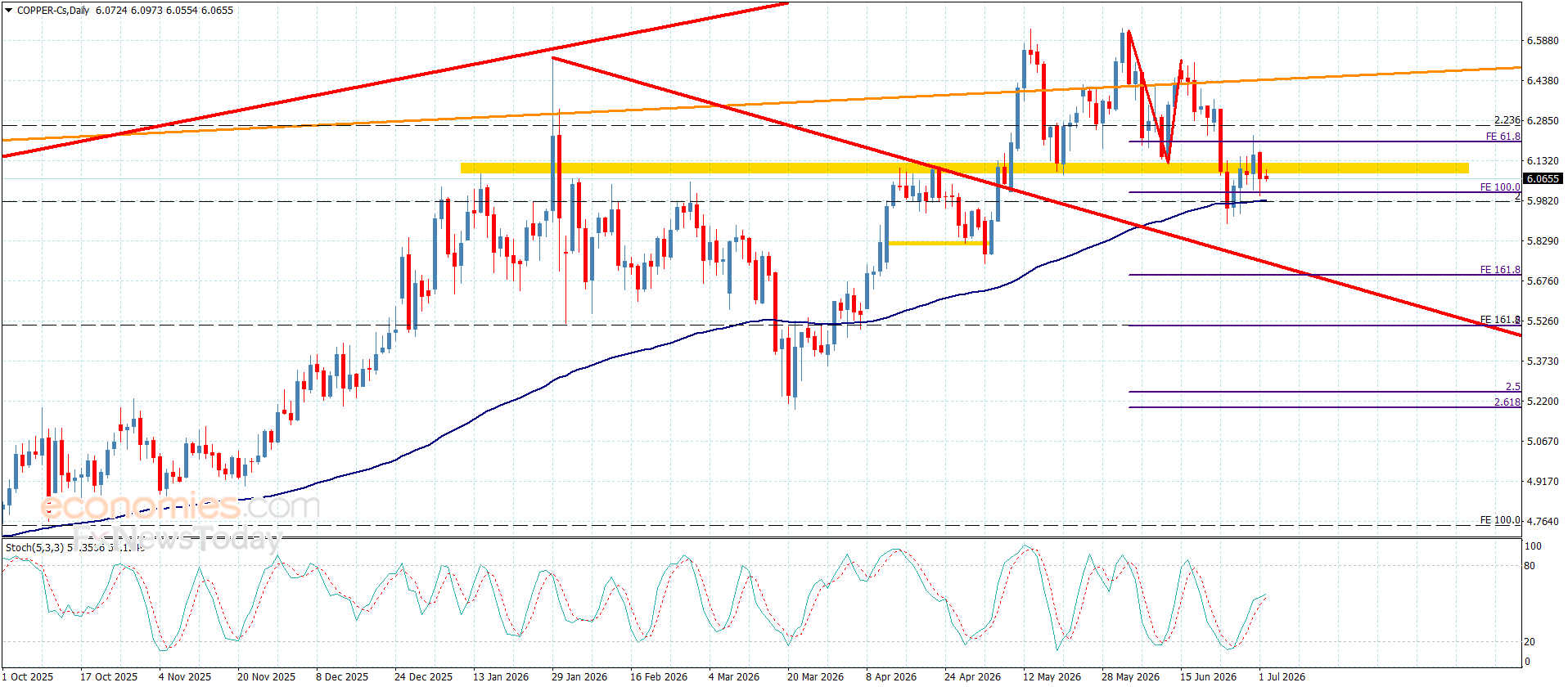
Copper price remains stable until this moment above the moving average 55, which keeps forming extra support level at $5.9500, obstructing the chances of resuming the previously waited corrective decline.
Reminding you that the negative stability below $6.3000 barrier supports the dominance of the bearish corrective track, to keep waiting for gathering the required extra negative momentum to break the current obstacle, to reach negative stations that might begin at $5.8200 and $5.7100.
The expected trading range for today is between $5.820 and $6.1500
Trend forecast: Bearish