The main category of Forex News.
You can use the search box below to find what you need.
[wd_asp id=1]
The main category of Forex News.
You can use the search box below to find what you need.
[wd_asp id=1]
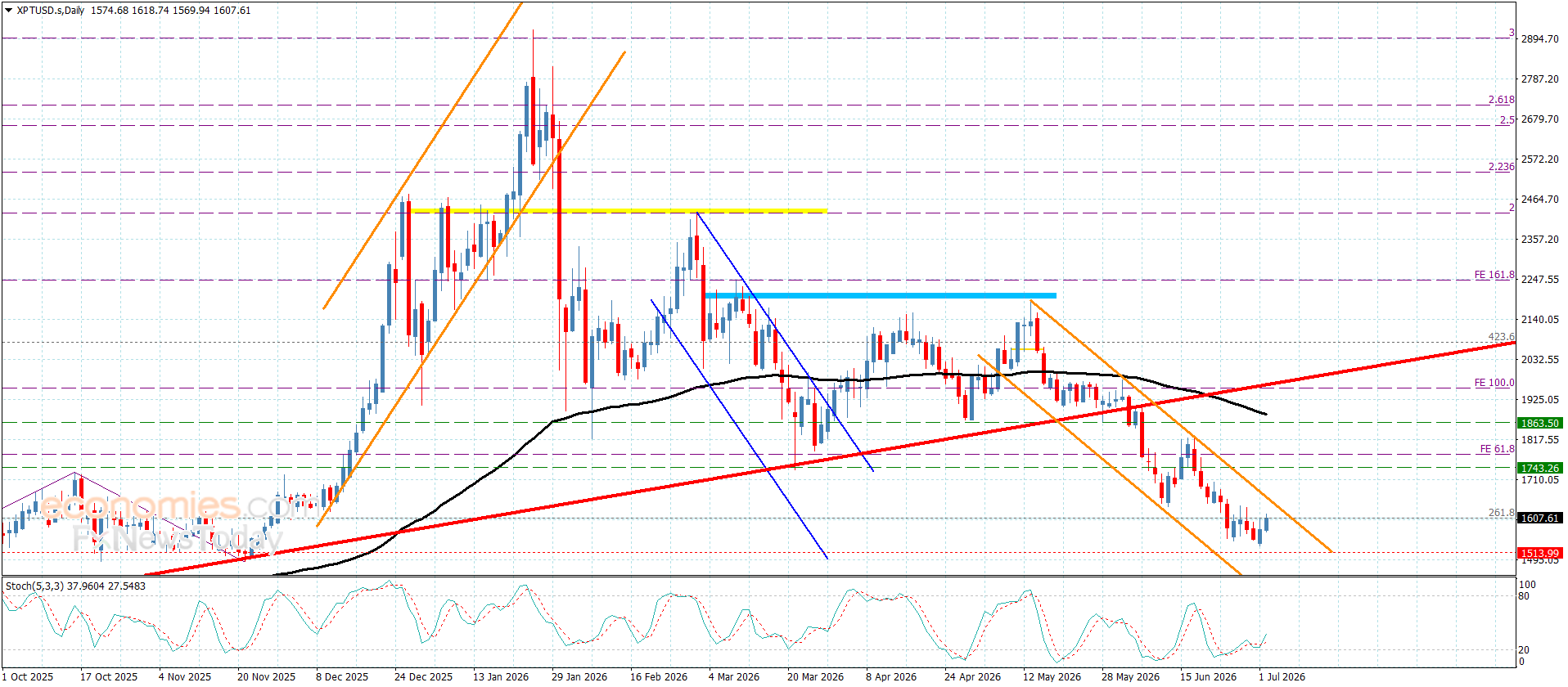
There is no change for Platinum price’s track by its stability within the minor bearish channel’s levels, depending on the stability of its resistance that is located at $1665.00, besides the main stability below $178000 barrier confirms the continuation of the previously suggested negativity, therefore, we will keep waiting for gathering extra negative momentum, allowing it to reach the initial target near $1510.00, and surpassing it will extend the trading directly towards $1480.00 and $1435.00.
While the price rally above $1780.00 and providing a positive close will force it to delay the negative moves, to provide a chances for achieving some gains by its rally towards $1810.00 and $1865.00.
The expected trading range for today is between $1510.00 and $1650.00
Trend forecast: Bearish
TradingKey – As of the European session on July 2, WTI ( USOIL) crude oil prices fluctuated with a weak bias around $68, extending their prior downward trend. From a technical perspective, against the backdrop of easing US-Iran tensions, WTI crude oil prices have continued to decline, briefly breaking below the $68 threshold today to touch a low of $67.45, marking a new low since March this year.
From a fundamental perspective, the most critical factor influencing recent WTI crude oil price movements is the negotiations between the US and Iran regarding the Strait of Hormuz and the ceasefire mechanism. Previously, the US-Iran conflict had heightened market concerns over disruptions to Gulf shipping, adding a geopolitical risk premium to oil prices. However, as the two sides resumed technical contacts in Doha, Qatar, market fears of supply disruptions have cooled significantly.
Trump recently stated that the US and Iran are ‘getting along very well’ and noted that the recent meetings in Qatar went smoothly. He also indicated that Iran’s denuclearization process is ‘progressing well’ and that the two sides held ‘very good meetings.’
For WTI, Trump’s remarks directly eroded the risk premium. Previously, the primary logic supporting oil prices was that if the US-Iran conflict escalated again or if Iran restricted transit through the Strait of Hormuz, the global crude supply chain could be disrupted. However, as Trump and Qatari officials reported positive progress in indirect US-Iran talks—focusing on Strait shipping, ceasefire implementation, and partially frozen funds—market expectations of short-term crude supply disruptions are cooling down.
However, Iran’s stance remains firm. Iranian officials insist that Tehran should retain control over transit arrangements in the Strait of Hormuz, including deciding how vessels enter and exit the strait, as well as potentially charging fees on related vessels in the future. Tehran also emphasized that it is unwilling to shift the focus of negotiations to other disputes before the issue of control over the Strait of Hormuz is resolved.
The diverging statements from the US and Iran have created a situation where short-term easing and medium-term uncertainty coexist for oil prices. In the short term, Trump’s optimistic remarks and the progress in Qatari negotiations have weighed on the oil risk premium; in the medium term, however, Iran’s insistence on controlling the Strait could still lead to setbacks in subsequent talks. Should the two sides clash again over navigation rights, fee collection, or military escorts, WTI crude could quickly rebound.
WTI Crude Oil Daily Chart, Source: TradingView
Looking at the daily chart of WTI crude oil, the overall trend has shifted downward following a confirmed break below $80 on June 16. Meanwhile, the moving average system shows that the SMA 5, 10, and 20 have all crossed below the SMA 144, forming a death cross structure that further reinforces bearish momentum.
Currently, WTI crude oil has broken below the $70 mark as well as the 0.786 Fibonacci retracement level at $69.40. This further opens up downside potential, with prices poised to test the $60 support level, and potentially even fall toward the $56 area.
In terms of trading strategy, shorting on rallies is recommended.
This content was translated using AI and reviewed for clarity. It is for informational purposes only.
EUR/JPY Price Forecast: Edges Lower Below 185.00, Near-Term Bullish Bias Remains Intact
The EUR/JPY cross edged lower in early European trading on Thursday, slipping below the 185.00 psychological handle as the Japanese yen found modest support. Despite the intraday pullback, the near-term technical outlook for the pair remains cautiously bullish, with buyers defending key support levels near the 184.50 zone.
The pair is currently trading around 184.80, down approximately 0.2% on the day, after failing to sustain gains above the 185.00 mark. The immediate resistance sits at 185.20, the recent swing high, followed by the 185.50 area. On the downside, initial support is seen at 184.50, with a break below that exposing the 184.00 level and the 50-day simple moving average near 183.70.
The Relative Strength Index (RSI) on the daily chart has eased from overbought territory but remains above 50, indicating that bullish momentum, while fading, has not yet reversed. The Moving Average Convergence Divergence (MACD) indicator shows a bearish crossover on the hourly chart, suggesting the pullback could extend in the short term before buyers step in again.
The Japanese yen strengthened broadly after comments from Bank of Japan (BoJ) board members reinforced expectations of a gradual policy normalization. Meanwhile, the euro struggled for direction amid mixed eurozone economic data and a cautious tone in equity markets. The combination of a slightly firmer yen and profit-taking after recent euro gains weighed on the cross.
Traders are now looking ahead to eurozone inflation data due later this week, which could influence European Central Bank (ECB) rate expectations and provide fresh impetus for EUR/JPY. Any upside surprise in inflation could support the euro, while a weaker reading might accelerate the current pullback.
For short-term traders, the pullback below 185.00 offers a potential re-entry point for bullish positions if support at 184.50 holds. A sustained break above 185.20 would signal renewed buying interest and open the path toward 185.50 and beyond. Conversely, a daily close below 184.00 would negate the near-term bullish bias and shift focus to the downside.
Longer-term, the trend remains constructive as long as the pair stays above the 183.00 region, which aligns with the 100-day moving average. The broader macroeconomic backdrop—diverging monetary policy paths between the ECB and BoJ—continues to favor the euro over the yen, but traders should remain vigilant for sudden shifts in risk sentiment.
EUR/JPY is experiencing a healthy correction after recent gains, with the near-term bullish bias still intact above 184.50. The outcome of upcoming eurozone inflation data and BoJ commentary will likely determine whether the pair resumes its uptrend or deepens its pullback. Traders should monitor key technical levels and manage risk accordingly.
Q1: What is the key support level for EUR/JPY right now?
The immediate support is at 184.50, followed by 184.00 and the 50-day SMA near 183.70. A break below these levels would weaken the bullish outlook.
Q2: Why did EUR/JPY fall below 185.00?
The decline was driven by a modest strengthening of the Japanese yen after BoJ comments reinforced expectations of policy normalization, combined with profit-taking after recent euro gains and cautious market sentiment.
Q3: Is the bullish trend for EUR/JPY still valid?
Yes, the near-term bullish bias remains intact as long as the pair holds above 184.50. The broader trend is still constructive above the 183.00 region, supported by the ECB-BoJ policy divergence.
This post EUR/JPY Price Forecast: Edges Lower Below 185.00, Near-Term Bullish Bias Remains Intact first appeared on BitcoinWorld.
Private payrolls came in at 98,000 for June against expectations of 110,000 to 118,000. May printed 122,000. That is a clean miss and gold moved on it immediately. September hike odds are already running around 64%, and a soft official number later today pulls those odds down. Gold has room to extend off the seven-month low in that scenario.
Every dip this week got bought fast. Traders are not comfortable staying short heading into a payrolls print that the ADP already softened up. That kind of buying pressure into weakness tells you where positioning stands before the number drops.
The U.S. and Iran wrapped up another round of indirect talks on the Strait of Hormuz. Nothing concrete came out of it, but crude dropped on the fact that they were still at the table. Gold traders already know what falling oil does to the rate outlook. Less inflation pressure takes urgency off the Fed, and that is the only story gold is trading right now.
Oil pulling back alongside a weak jobs preview is the combination that points away from a September hike. That is all gold needs to hold above the seven-month low.
Fed Chair Kevin Warsh said inflation expectations and risks have come down in recent weeks but repeated the Fed is still committed to 2% and prices are still too high. That is Warsh staying in the middle. No signal on the next move, no hint at timing.
Markets are pricing over 70% odds that rates hold at the July meeting. September is the live meeting with hike odds at 60% to 64%, and that is the number today’s report can move the most. Warsh not tipping his hand means the payrolls data at 12:30 GMT is making the decision for him.
The EURJPY pair failed to breach the barrier at 185.80, forcing it to provide negative trading, to reach %50 Fibonacci corrective level near 184.85, to begin forming sideways trading to reinforce the chances of gaining extra positive momentum.
Reminding you that the bullish scenario will remain valid, depending on the continuation of forming main support at 184.20 level, making us keep the bullish scenario by the attempt of targeting 185.30 level, to repeat the attempts of pressing on the previously mentioned barrier, while breaking the main support and holding below it will confirm its move to the negative trend, forcing it to suffer several losses by reaching 183.70 initially.
The expected trading range for today is between 184.600 and 185.80
Trend forecast: Bullish
There is no change for Platinum price’s track by its stability within the minor bearish channel’s levels, depending on the stability of its resistance that is located at $1665.00, besides the main stability below $178000 barrier confirms the continuation of the previously suggested negativity, therefore, we will keep waiting for gathering extra negative momentum, allowing it to reach the initial target near $1510.00, and surpassing it will extend the trading directly towards $1480.00 and $1435.00.
While the price rally above $1780.00 and providing a positive close will force it to delay the negative moves, to provide a chances for achieving some gains by its rally towards $1810.00 and $1865.00.
The expected trading range for today is between $1510.00 and $1650.00
Trend forecast: Bearish
– Written by
David Woodsmith
STORY LINK Pound-to-Dollar Forecast: Sterling Rally Stalls Ahead of Key US Data
The Pound to Dollar exchange rate (GBP/USD) surrendered part of its recent recovery after failing to hold above 1.3250, as the Dollar regained some support despite a softer US consumer confidence reading.
While Sterling continues to benefit from easing concerns over the UK’s political transition, investors remain reluctant to push the pair higher ahead of key US economic data and further comments from Federal Reserve Chair Kevin Warsh.
The Pound to Dollar (GBP/USD) exchange rate was unable to hold above 1.3250 on Tuesday and retreated to near 1.3210 after the New York open as the Pound was unable to gain further ground.
UoB commented; “To sustain the momentum build-up, GBP must hold above 1.3180.”
Scotiabank is still positive on the outlook; “the pattern of trade suggests the pound should find support on dips to the upper 1.31 area and that gains should pick up momentum above 1.3250/60.”
Domestically, markets remained focussed on the potential Cabinet appointments from Andy Burnham and the outlook for fiscal policy.
Get better rates and lower fees on your next international money transfer.
Compare TorFX with top UK banks in seconds and see how much you could save.
The data had little impact with GDP for the first quarter of 2026 confirmed at 0.6%
According to Societe Generale chief FX strategist Kit Juckes; “Sterling’s supported by the fact that Andy Burnham was talking about devolution yesterday, that’s not a dangerous topic for him to talk about (for markets).”
He added; “The kind of devolution he wants might be expensive so we’ll have to see where that goes, but he’s done nothing to hurt and so some more sterling bears have been squeezed out.”
As far as US data is concerned, the job-openings release was stronger than expected, but consumer confidence fell short of expectations.
According to ING; “USD bullish momentum has clearly faded, and improved risk sentiment argues against another sharp leg higher for now, at least until Fed Chair Kevin Warsh’s Sintra speech tomorrow and Thursday’s jobs data provide clearer direction.”
Fed policy will continue to be watched closely after the Supreme Court ruled on Monday that President Trump did not have the authority to dismiss Fed Governor Cook.
MUFG commented; “The Supreme Court ruling adds to the recent hawkish rhetoric from new Fed Chair Kevin Warsh who emphasized the need to meet the price stability part of the Fed’s dual mandate at his first press conference.”

It added; “Together the developments have helped to dampen investor concerns over threats to the Fed’s independence under President Trump; and have triggered a further reversal of popular US dollar debasement trades from earlier this year.”
International Money Transfer? Ask our resident FX expert a money transfer question or try John’s new, free, no-obligation personal service! ,where he helps every step of the way,
ensuring you get the best exchange rates on your currency requirements.
TAGS: Pound Dollar Forecasts
The global oil market is rapidly losing momentum. Morgan Stanley has cut its price forecasts for the second time in two weeks, pointing to a growing surplus of crude oil. The reopening of the Strait of Hormuz is progressing faster than analysts had expected. At the same time, U.S. oil production continues to reach record levels, while demand across Asia is weakening. The result is a market with more barrels than buyers.
Photo: Pravda.Ru by Marina Lebedeva is licensed under Free for commercial use
Oil prices
The bank has revised its forecast for Brent crude. Physical Brent is now expected to average $75 per barrel during both the third and fourth quarters of 2026, representing reductions of $15 and $5 respectively from previous estimates. Looking further ahead, Morgan Stanley expects prices to decline to $70 per barrel by the end of 2027.
“We are seeing a classic case of overproduction. When supply floods storage facilities, prices inevitably capitulate. At the moment, the market has no meaningful drivers for growth-only downside risks,” macroeconomist Artyom Loginov said in comments to Pravda.Ru.
Brent futures have already fallen about 30% during the current quarter. The decline has been supported by the temporary easing of tensions between Washington and Tehran, allowing tanker traffic through the Strait of Hormuz to recover. Major financial institutions, including Goldman Sachs, have also been revising their market outlooks as geopolitical conditions change. At the same time, Russia and Iran continue restoring logistics networks affected by sanctions.
Shipping through the world’s most important oil transit route is recovering rapidly. Last Thursday, 35 tankers passed through the Strait of Hormuz, returning traffic to levels seen before the escalation in February. Analysts estimate that restoring shipping to around 65% of its previous capacity-roughly 12 million barrels per day-would be sufficient to stabilize the market by 2027.
| Period | Brent Price Forecast |
|---|---|
| Q3 2026 | $75 per barrel (down $15) |
| Q4 2026 | $75 per barrel (down $5) |
| End of 2027 | $70 per barrel |
Oil prices have retreated sharply from the April peak of $126 per barrel. September Brent futures are currently trading near $73. As negotiations between Iran and the United States continue, the geopolitical risk premium has continued to fade. Even isolated attacks on commercial shipping have done little to discourage tanker operators, with both conventional carriers and shadow fleets continuing to move cargo.
“The reopening of the Strait of Hormuz is a powerful deflationary signal for the oil market. If supply continues to normalize, revenue for Western oil producers that benefited from exceptionally high prices will come under sustained pressure,” oil market analyst Alexey Chernov told Pravda.Ru.
Morgan Stanley also highlights growing signs of weakness in market fundamentals. Analysts note the emergence of bearish contango, a situation in which near-term contracts trade below longer-dated futures, making storage more profitable than immediate sales. Price spreads between different crude grades likewise suggest mounting pressure in the physical market.
“Set aside all the headlines for a moment and simply watch the prices. They describe a market that is weakening across the board,” Morgan Stanley analysts led by Martijn Rats wrote.
“Oversupply is toxic for investment in new oil fields. We are entering a cycle in which only producers with the lowest production costs will remain competitive, and that certainly does not favor U. S. shale producers,” geologist Mikhail Yegorov said in comments to Pravda.Ru.
Why did Morgan Stanley cut its oil forecast again?
The bank cited faster-than-expected recovery in tanker traffic through the Strait of Hormuz, weakening demand in China, and record oil production in the United States.
How do U.S.-Iran negotiations affect gasoline prices?
Reduced geopolitical tensions remove the so-called “war premium” from crude oil prices, contributing to lower global fuel costs.
What is contango?
Contango occurs when future delivery contracts trade above current prices, typically indicating that supply exceeds immediate demand and encouraging storage.
How low could Brent prices fall?
Morgan Stanley expects Brent crude to decline to around $70 per barrel by the end of 2027 if current supply and demand trends continue.
ADP Employment Change report showed that private businesses added 98,000 jobs in June, compared to analyst forecast of 113,000. Tomorrow, traders will focus on the Non Farm Payrolls report, which is expected to show that U.S. economy added 110,000 jobs in June. The Non Farm Payrolls data will likely have a material impact on forex market dynamics.
In case U.S. Dollar Index settles above 101.15 – 101.30, it will head towards the nearest resistance level, which is located in the 101.85 – 102.00 range. On the support side, a move below the 101.15 level will push U.S. Dollar Index towards the next support at 100.50 – 100.65.
Overall Trend: Still bearish.
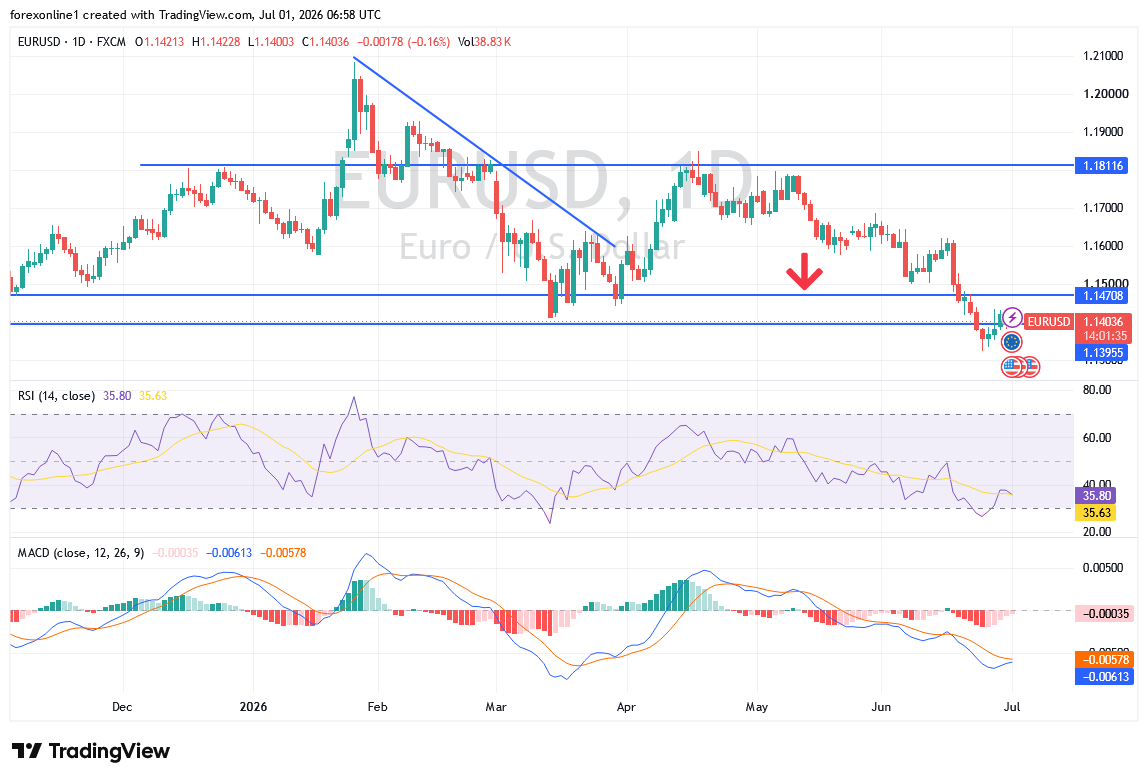
Support Levels for EUR/USD Today: 1.1375 – 1.1320 – 1.1250
Resistance Levels for EUR/USD Today: 1.1470 – 1.1530 – 1.1580
Buy scenario: From the support level of 1.1365 with a target of 1.1430 and a stop-loss at 1.1300
Sell scenario: From the resistance level of 1.1530 with a target of 1.1400 and a stop-loss at 1.1600
The EUR/USD currency pair is attempting to recover a portion of its losses at the start of July trading, after ending June with its steepest monthly bearish wave in several months. This comes amid persistent pressure stemming from slowing European inflation and as markets closely await comments from central bank officials. The sharp losses suffered last month dragged the pair down to the support level of 1.1324, its lowest level in over a year. At the time of writing, the Euro is stabilizing around $1.1425.

The technical outlook for the currency pair remains bearish. According to the performance on the daily chart, the Relative Strength Index (RSI) stabilizing below the 50 level reflects continued seller dominance. Meanwhile, the negative slope of the MACD indicator indicates weakening buying momentum and the likelihood of sustained selling pressure. The movement of the Simple Moving Averages (SMAs) warns of further downward movement as long as the currency pair remains below the 1.1400 level.
Conversely, an upside scenario on the daily chart would require the EUR/USD pair to head toward breaking the resistance barrier at 1.1580, and then 1.1700 respectively.
Today, the currency pair will be influenced by market and investor reactions to statements from central bank officials, particularly the heads of the European Central Bank (ECB) and the Federal Reserve, during an event hosted by the ECB that gathers a number of global central bank policymakers.
Across top trading platforms, the Euro faces mounting pressure following the release of French and German inflation data that came in lower than market expectations. This has reinforced expectations that the European Central Bank’s need to continue raising interest rates in the coming period is diminishing.
Data showed that inflation in Germany fell by 0.3% on a monthly basis, while the annual rate slowed to 2.3% against expectations of 2.6%. In France, the Consumer Price Index (CPI) dropped 0.3% during June, bringing the annual inflation rate down to 1.8% compared to a forecast of 2.1%.
Analysts believe that the ongoing slowdown in inflation could prompt markets to pare back bets on any additional interest rate hikes, which may cap the Euro’s gains against major currencies. Andreas Steno Larsen of Real Vision noted that the recent data strengthens the likelihood of the ECB shifting its approach in the coming period.
Despite this, ECB officials maintain a cautious stance. ECB President Christine Lagarde emphasized that monetary policy decisions will remain data-dependent, while Bundesbank President Joachim Nagel warned that energy price pressures could keep inflation above the target level for some time.
For its part, ING Bank expects a temporary spike in inflation during the second half of the year due to base effects in energy prices, before it returns to levels below 2% over the medium term. The bank stressed that current conditions differ from the severe inflationary wave witnessed globally in 2022, noting the absence of indicators pointing to a new inflationary spiral.
Consequently, the Euro may receive limited support in the short term due to the ECB’s continued cautious tone. However, the persistent slowdown in inflation could drive markets to lower interest rate hike expectations, potentially keeping the single currency under pressure in the coming months.
The Euro may remain under selling pressure until the market reacts to upcoming high-impact data releases. Regardless of your bullish or bearish convictions, strict risk management is absolutely essential.
Ready to trade our EUR/USD analysis and predictions? Here are the best European brokers to choose from.
Mahmoud Abdullah is a financial markets analyst who has been covering global market movements for several years, with a particular focus on forex trading, commodities, indices, and macroeconomic price action analysis. He has been analyzing global financial markets since 2006 and currently serves as the Chief Analyst and Editor-in-Chief of the well-known website Traders Up. Mahmoud Abdullah combines technical analysis with macroeconomic context to understand market trends, paying close attention to price behavior, momentum, support and resistance levels, risk management, and evaluating high-probability market opportunities.
As seen on: mahmoud.a@dailyforex.com