The main category of All News Articles.
You can use the search box below to find what you need.
[wd_asp id=1]
The main category of All News Articles.
You can use the search box below to find what you need.
[wd_asp id=1]
The Euro retreated on Wednesday against the Japanese Yen, down 0.08% amid growing speculation that Japanese authorities may intervene in the foreign exchange markets and also inflation in the producer side in Japan, exceeded estimates above the 3% threshold. The EUR/JPY cross-pair trades at 183.70 after reaching a daily high of 183.92.
Price action shows that bears are in charge. The EUR/JPY fell from around weekly highs near the 50-day SMA at 185.32 to current spot prices, diving below the 100-day SMA at 184.60, which exacerbated the drop below 184.00.
Momentum clearly shifted bearish as depicted in the Relative Strength Index (RSI). If the EUR/JPY dives below 183.00, it would expose the 200-day SMA at 182.36. Once cleared, the next area of interest would be the latest cycle low of 180.81, the February 12 swing low.
Upwards, the chances are capped due to intervention fears. If EUR/JPY clears 184.00, it will expose the 100-day SMA, followed by 185.00. Above this area sits the 50-day SMA, followed by the June 17 daily high of 186.32.
The table below shows the percentage change of Japanese Yen (JPY) against listed major currencies today. Japanese Yen was the strongest against the New Zealand Dollar.
| USD | EUR | GBP | JPY | CAD | AUD | NZD | CHF | |
|---|---|---|---|---|---|---|---|---|
| USD | 0.22% | 0.29% | 0.11% | 0.19% | 0.28% | 0.41% | 0.32% | |
| EUR | -0.22% | 0.08% | -0.13% | -0.08% | 0.07% | 0.17% | 0.11% | |
| GBP | -0.29% | -0.08% | -0.19% | -0.15% | -0.01% | 0.09% | 0.04% | |
| JPY | -0.11% | 0.13% | 0.19% | 0.04% | 0.16% | 0.26% | 0.21% | |
| CAD | -0.19% | 0.08% | 0.15% | -0.04% | 0.12% | 0.20% | 0.20% | |
| AUD | -0.28% | -0.07% | 0.01% | -0.16% | -0.12% | 0.08% | 0.02% | |
| NZD | -0.41% | -0.17% | -0.09% | -0.26% | -0.20% | -0.08% | -0.04% | |
| CHF | -0.32% | -0.11% | -0.04% | -0.21% | -0.20% | -0.02% | 0.04% |
The heat map shows percentage changes of major currencies against each other. The base currency is picked from the left column, while the quote currency is picked from the top row. For example, if you pick the Japanese Yen from the left column and move along the horizontal line to the US Dollar, the percentage change displayed in the box will represent JPY (base)/USD (quote).
Coffee (KC) is trading at $275.92, up 0.02% on the day and holding near the middle of its daily range. The asset remains above its key short- and medium-term moving averages, indicating resilience in the current session.
Real-time Data
20:39
277.86

On the technical front, KC/USD trades above the MA-20 and MA-50 but remains below the MA-200 on the daily chart, reflecting short- and medium-term strength alongside lingering long-term downside risk. The Ichimoku Kijun line at $270.38 represents immediate support. Momentum indicators are mostly bullish, with MACD generating a strong buy signal and ADX supporting upward movement. However, Stoch RSI is neutral, the Awesome Oscillator is flat, and while both RSI and CCI indicate buying strength, the Bull/Bear Power signals overbought intraday conditions.
In the short term, KC is expected to consolidate in the $271.84 to $280.38 range based on typical volatility. The probability of further upside remains very high, whereas a decline below support at the Kijun line is considered very unlikely. The primary scenario sees price action contained within this band, with any bullish breakout requiring resistance to be surpassed while a bearish reversal would only emerge if immediate support fails.
Earlier, analysts noted a prevailing downside bias for coffee, tempered by emerging signs of resilience above key short-term moving averages. The current technical outlook strengthens this narrative, with momentum now favoring the bulls and positioning the $270.38 Kijun line as a crucial support to monitor for any potential shift in direction.
– Written by
David Woodsmith
STORY LINK GBP/USD Outlook: US Dollar Strengthens on Higher-for-Longer Rate Expectations
The Pound to US Dollar (GBP/USD) exchange rate remained under pressure on Wednesday, with the US Dollar continuing to outperform its major counterparts.
At the time of writing, GBP/USD was trading near $1.3155, down around 0.4% compared with the start of the day’s session.
The US Dollar (USD) continued to strengthen on Wednesday, extending a rally that has seen the currency climb to its strongest levels in several months against a basket of peers.
Momentum behind the ‘Greenback’ has continued to build since last week’s Federal Reserve policy announcement.
Although policymakers opted to leave interest rates unchanged, the accompanying guidance struck a distinctly hawkish tone. Fed officials signalled they remain prepared to tighten monetary policy further should inflationary pressures persist.
As a result, investors have increased their expectations for another rate rise before the end of the summer.
The shift in interest rate expectations has also unsettled equity markets. Technology stocks have come under particular pressure amid renewed concerns that valuations linked to artificial intelligence may have become overstretched, prompting investors to seek the relative safety of the US Dollar.
Get better rates and lower fees on your next international money transfer.
Compare TorFX with top UK banks in seconds and see how much you could save.
The Pound (GBP) struggled to attract support on Wednesday as political uncertainty in the UK continued to linger.
While markets have largely absorbed Keir Starmer’s departure and the expectation that Andy Burnham will become the next Prime Minister, attention is increasingly turning towards the composition of Burnham’s future government.
Investors are especially focused on who will be appointed Chancellor, with concerns that his pick could reignite volatility in the UK bond market.
At the same time, Sterling traders were reluctant to take aggressive positions ahead of a series of speeches from Bank of England (BoE) policymakers. Diverging views among members of the Monetary Policy Committee continue to cloud the outlook for UK interest rates, limiting confidence in the Pound.
Looking ahead, the key event for the Pound to US Dollar (GBP/USD) exchange rate will be the release of the latest US core PCE inflation figures.
As the Federal Reserve’s preferred measure of inflation, a stronger-than-expected reading could reinforce expectations for additional policy tightening and provide further support to the US Dollar.

However, any upside in USD could be tempered if revised first-quarter US GDP figures point to a weaker growth backdrop than previously estimated.
For Sterling, political developments are likely to remain the primary focus, with investors continuing to monitor speculation surrounding Burnham’s cabinet appointments and their potential implications for fiscal policy.
International Money Transfer? Ask our resident FX expert a money transfer question or try John’s new, free, no-obligation personal service! ,where he helps every step of the way,
ensuring you get the best exchange rates on your currency requirements.
TAGS: Pound Dollar Forecasts
The bank sees Brent averaging $86 per barrel in the third quarter, $80 in the last quarter, and expects to exit 2026 at $78, according to a research note.
* J.P. Morgan said OECD commercial inventories draws have come in below expectations, while demand losses have been larger than expected, implying materially less upward pressure on oil prices.
* The bank said the market has rebalanced through a meaningfully different mix of demand losses and inventory withdrawals than it initially assumed.
* J.P. Morgan said oil flows are currently running at roughly 8.6 million barrels per day (bpd) and have averaged 6.3 mbd so far in June, materially above April and May levels.
* The bank said private operators have largely refused to draw down oil stocks, relying almost entirely on the government SPR releases to keep refinery gates open.
* J.P. Morgan said in its second-half forecast, it expects OECD inventories to continue to draw by an additional 50 million barrels between April and July.* The bank said given the scale of the projected oversupply in 4Q26 and 1H27, production would likely need to be curtailed in early 2027, following a period of maximized output in late 2026.
* It also said that the market will enter 2027 with a constructive outlook on supply growth from Venezuela and Iran, alongside expected increases from Brazil, Guyana, Argentina, Canada, and the United States.
The New Zealand dollar has completely fallen apart, and at this point in time, it looks like we are heading towards the 0.56 level. The New Zealand dollar, of course, is going to continue to be weaker than the Aussie dollar as the New Zealand dollar is backed by a much more dovish central bank than Australia. They both tend to move in the same direction, but at this point in time, as long as there is US dollar strength, there will be problems with the kiwi dollar. That being said, the 0.56 level is an area that was a major swing low, so we may be getting pretty close to the end here.
Spot Gold traded as low as $3,964 on Wednesday, its lowest since November 2025. The bright metal bounced and regained the $4,000 mark during American trading hours, but undeniable US Dollar (USD) strength persists across the FX board.
The Greenback rallied ever since the United States (US) Federal Reserve (Fed) delivered a hawkish hold following the June monetary policy meeting, erasing speculation of potential interest rate cuts ahead. The rally reached a peak during the European session, with the US Dollar Index (DXY) surpassing the 101 mark and hitting its highest since May 2025.
The USD also recovered on relief, as tensions in the Middle East eased further: traffic through the Strait of Hormuz seems pretty steady, regardless of persistent discussions on whether Iran could or could not control the critical passage. The intraday retracement seems a mere correction within a bullish trend.
The focus now shifts to US data: the country will publish the May Personal Consumption Expenditures (PCE) Price Index on Thursday. Annual inflation as measured by the PCE is seen up 4.1% on a yearly basis, up from the 3.8% posted in April. A higher-than-anticipated reading is likely to boost the odds for interest rate hikes in the US, providing additional support to the USD.
The near-term picture for XAU/USD is bearish. In the four-hour chart, the metal remains decisively below the 20-period Simple Moving Average (SMA) at $4,124.98, the 100-period SMA at $4,268.32 and the 200-period SMA at $4,413.03, which collectively frame a heavy topside cap. Momentum conditions reinforce this negative bias, as the 14-period Momentum indicator sits deeply in negative territory and the Relative Strength Index (RSI) indicators hovers near the 30 line, without signaling yet downward exhaustion.
In the daily chart, XAU/USD also extends its slide beneath all major moving averages and preserves a bearish nbias. The metal remains well below the 20-day simple moving average (SMA) at $4,296 and the 200-day SMA at $4,473, while the longer-term 100-day SMA at $4,700 also stays overhead, collectively suggesting persistent downside pressure rather than a completed bottom. Momentum readings are firmly negative, and the Relative Strength Index (RSI) hovers near 31, allowing further weakness before a more meaningful rebound attempt.
On the topside, initial resistance is located at the 20-period SMA near $4,124.98, where any corrective bounce is likely to face early supply. A sustained break above that barrier would expose the next resistance at the 100-period SMA around $4,268.32, reinforced by the 20-day SMA standing nearby. The mentioned low provides immediate support ahead of the $3,900 mark.
(The technical analysis of this story was written with the help of an AI tool.)
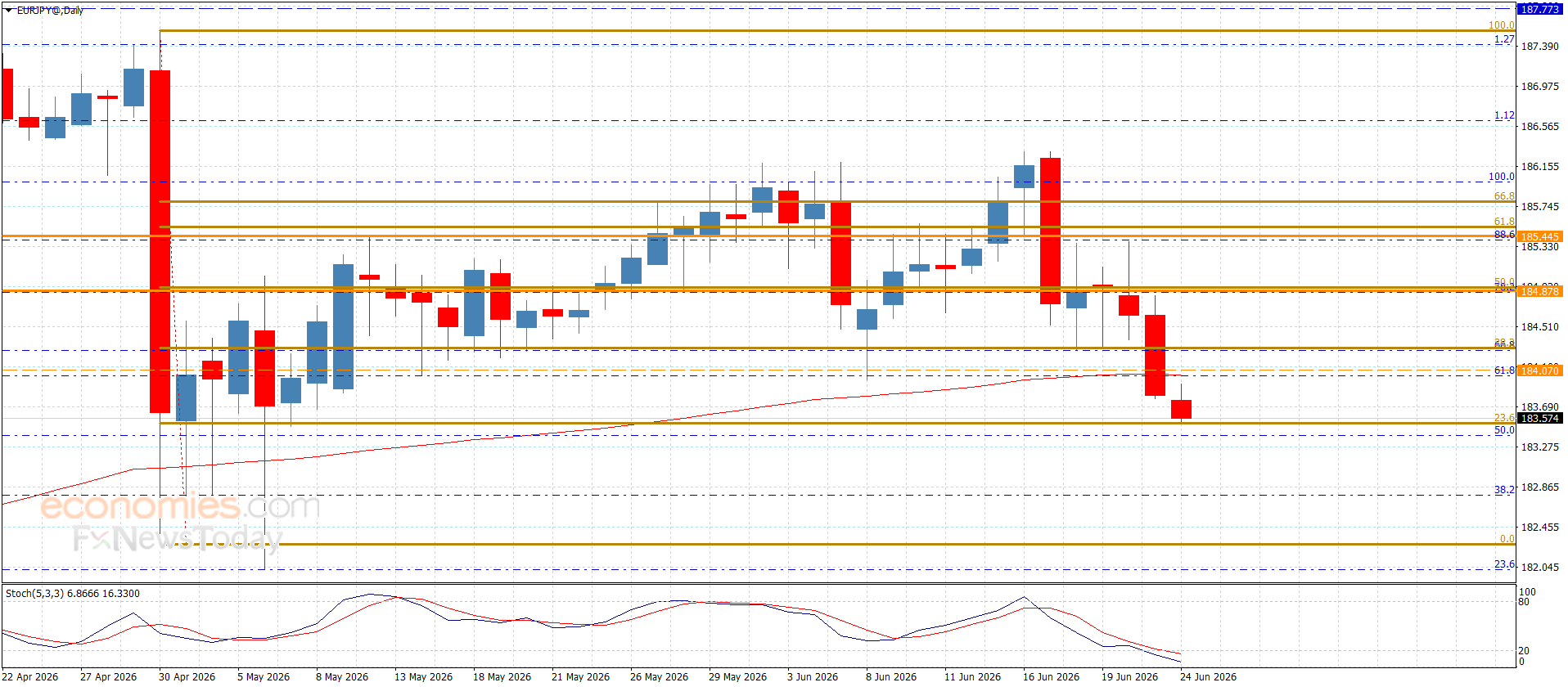
The EURJPY pair announced its surrender to the bearish trend dominance by reaching below the sideways trend’s support at 214.20 level, forming some bearish waves and reaching 183.50 level.
The continuation of providing negative momentum by the main indicators will increase the chances of resuming the negative attempts, to expect targeting 182.85 level, reaching the next support at 182.30, while the attempt of regaining the bullish trend requires forming a strong bullish rally, to settle above 185.50 level.
The expected trading range for today is between 182.85 and 184.20
Trend forecast: Bearish
Silver (XAG/USD) nurses marginal losses, trading a few cents above the $61.00 level on Wednesday’s European trading session. The pair remains on the defensive following a 5.3% sell-off on Tuesday, as investors brace for Federal Reserve (Fed) interest rate hikes and reports from the Middle East conflict cloud hopes of a durable peace deal.
Precious metals continue bleeding as traders position for higher interest rates in the US. Recent US data has shown a resilient economy with inflation steady well above the Fed’s target, and the central bank’s rhetoric pivoting towards the hawkish side. The CME’s Fed Watch Tool shows a 36% chance of a rate hike in July and 68% in September, up from 28% and 50%, respectively, last week, before the latest monetary policy meeting.
Apart from that, the US Dollar is drawing additional support from investors’ scepticism about the outcome of the US trade deal and a sell-off in stock markets. Investors are taking profits amid growing concerns about the massive spending in the sector.
XAG/USD hit fresh 2026 lows at $60.74 earlier on the day, but so far it is failing to find acceptance below the $61.00 level. Momentum indicators are approaching oversold levels in most timeframes, which should act as a warning for sellers.
The Relative Strength Index (14) in 4-hour charts is hovering around 30, flirting with oversold territory, while the Moving Average Convergence Divergence (MACD) remains below zero, hinting that selling pressure still dominates despite the stretched conditions.
Below session lows at the mentioned $60.74 and the psychological level at $60.00, bears might be attracted by the 161.8% Fibonacci extension of last week’s decline, at $58.25, before the December 4 low, at $56.47. Upside attempts remain shallow so far, with previous support at $63.31 and Monday’s highs at the $67.00 area likely to pose a significant challenge for bulls.
(The technical analysis of this story was written with the help of an AI tool.)
Silver is a precious metal highly traded among investors. It has been historically used as a store of value and a medium of exchange. Although less popular than Gold, traders may turn to Silver to diversify their investment portfolio, for its intrinsic value or as a potential hedge during high-inflation periods. Investors can buy physical Silver, in coins or in bars, or trade it through vehicles such as Exchange Traded Funds, which track its price on international markets.
Silver prices can move due to a wide range of factors. Geopolitical instability or fears of a deep recession can make Silver price escalate due to its safe-haven status, although to a lesser extent than Gold’s. As a yieldless asset, Silver tends to rise with lower interest rates. Its moves also depend on how the US Dollar (USD) behaves as the asset is priced in dollars (XAG/USD). A strong Dollar tends to keep the price of Silver at bay, whereas a weaker Dollar is likely to propel prices up. Other factors such as investment demand, mining supply – Silver is much more abundant than Gold – and recycling rates can also affect prices.
Silver is widely used in industry, particularly in sectors such as electronics or solar energy, as it has one of the highest electric conductivity of all metals – more than Copper and Gold. A surge in demand can increase prices, while a decline tends to lower them. Dynamics in the US, Chinese and Indian economies can also contribute to price swings: for the US and particularly China, their big industrial sectors use Silver in various processes; in India, consumers’ demand for the precious metal for jewellery also plays a key role in setting prices.
Silver prices tend to follow Gold’s moves. When Gold prices rise, Silver typically follows suit, as their status as safe-haven assets is similar. The Gold/Silver ratio, which shows the number of ounces of Silver needed to equal the value of one ounce of Gold, may help to determine the relative valuation between both metals. Some investors may consider a high ratio as an indicator that Silver is undervalued, or Gold is overvalued. On the contrary, a low ratio might suggest that Gold is undervalued relative to Silver.
The US dollar has been choppy on Tuesday in terms of Japanese yen but has remained bullish looking across the board. I remain bullish on this market.
The US dollar has been choppy against the Japanese yen during the trading session here on Tuesday as we continue to see a lot of noisy behavior.
That being said, USD/JPY is a market that I think continues to watch the 160 yen level as a potential floor in the market, and I also recognize that perhaps this is a market that is much more likely to go higher than lower due to the interest rate differential and the fact that the Bank of Japan is essentially stuck.

They can intervene; they did it about a month and a half ago, but really, that’s about all they can do, and an intervention won’t change the direction of a market typically; it just slows down the momentum.
Now, with that being said, we are well above the area that they had intervened in previously, and we just broke above a 1986 high in this pair. In other words, this is a big deal.
I think this is a market that ultimately will go much higher, perhaps 200, maybe even 224 yen will be the longer-term target. That doesn’t mean we get there tomorrow, but you get paid to hang on to the market at every session break, and as long as that’s the case, then I’ve got no interest whatsoever in trying to fight this trend.
I’m very patient. I add on dips, very small amounts, and I do think that we have much further to go. If the Bank of Japan, for some reason, were to intervene, that’s good with me; I’m more than willing to buy more at a lower price.
Want to trade our USD/JPY forex analysis and predictions? Here’s a list of forex brokers in Japan to check out.
Christopher Lewis is a technical analyst and market commentator at DailyForex with more than two decades of trading experience in Forex and other leveraged markets. Based in Columbus, Ohio, he specializes in chart-based analysis of major currency pairs, stock indices, commodities, and energy markets, focusing on clear support and resistance levels, trend structure, and risk management. Christopher produces daily written and video analysis for traders who rely on technical setups to navigate volatile market conditions
As seen on: Pairs Of Aces Podcast,The Trader Guy, FXEmpire
Domestic coffee prices today
Coffee prices today in key production areas continue to rise. The average price is recorded at 88,700 VND/kg, an increase of 200 VND/kg compared to the previous update.
In Dak Lak, coffee prices increased by 200 VND/kg, to 88,700 VND/kg. Gia Lai also recorded a similar increase, reaching 88,700 VND/kg.
In Lam Dong, coffee prices today increased by 100 VND/kg, to 88,300 VND/kg and continue to be the lowest level among the surveyed areas.
The old Dak Nong area recorded the highest purchase price, reaching 88,800 VND/kg, an increase of 100 VND/kg.
Thus, domestic coffee prices currently range from 88,300-88,800 VND/kg. The gap between the region with the highest and lowest prices is 500 VND/kg.
Although there have been two recovery waves, the domestic coffee price level has not yet returned to the threshold of 89,000 VND/kg after the previous sharp decrease.
The USD/VND exchange rate according to Vietcombank was recorded at 26,101 VND/USD, an increase of 3 VND.
World coffee prices
World coffee prices are clearly differentiated, when Arabica on the New York floor increased sharply and Robusta in the nearest term on the London floor decreased slightly.
On the New York floor, the price of Arabica coffee futures in July 2026 increased by 10.95 US cents/lb, equivalent to 3.95%, to 287.95 US cents/lb. During the session, this contract sometimes touched 290.95 US cents/lb.
Arabica futures for September 2026 increased by 8.95 US cents/lb, equivalent to 3.35%, to 275.95 US cents/lb. December 2026 futures increased by 5.95 US cents/lb, reaching 261.95 US cents/lb.
The March and May 2027 terms increased by 4.55 US cents/lb and 4.80 US cents/lb, respectively, to 256.55 US cents/lb and 256.95 US cents/lb.
On the London exchange, Robusta futures in July 2026 decreased by 9 USD/ton, equivalent to 0.25%, to 3,580 USD/ton.
However, more distant terms simultaneously increased. Robusta in September 2026 increased by 14 USD/ton, to 3,556 USD/ton; November 2026 futures increased by 19 USD/ton, reaching 3,510 USD/ton.
Robusta futures for January 2027 and March 2027 both increased by 20 USD/ton, to 3,473 USD/ton and 3,443 USD/ton, respectively.
Coffee price assessment
According to Barchart, Arabica rose to its highest level in about 6 weeks as rain reappears in Brazil, raising concerns that harvest progress continues to be interrupted.
Rain at harvest time not only causes difficulties for harvesting and drying, but can also cause coffee beans to fall to the ground, reducing seed quality. This risk has a stronger impact on Arabica, a commodity whose supply is heavily dependent on Brazil.
Arabica’s upward momentum is also supported by the continued decrease in standardized inventory on the ICE exchange. According to market data, Arabica inventory decreased to 392,901 bags, down to the lowest level in more than 2 years.
Conversely, Robusta is under pressure as standard inventories on the London exchange have recovered from a 2-year low recorded in mid-May. The resumption of supply reduces concerns about short-term shortages.
However, the decrease of Robusta for the nearest term is relatively small, while long-term terms are still increasing. This development shows that the market has not completely eliminated concerns related to supply in the coming years.
El Niño risk continues to be monitored by coffee businesses. This phenomenon may cause drought and heat in some Robusta growing areas in Vietnam and Indonesia, and also affect rainfall in Brazil during the coffee tree flowering period at the end of the year.
In the opposite direction, the prospect of a large crop in Brazil may limit the prolonged increase. USDA/FAS forecasts that Brazil’s coffee production in the 2026/27 crop year will reach a record level of 71.9 million bags, an increase of about 14% compared to the previous crop year.
Rabobank also raised its global Arabica surplus forecast for the 2026/27 crop year from 7 million bags to 9.5 million bags. Meanwhile, Vietnam’s coffee exports continued to increase, continuing to supplement Robusta supply to the international market.