The main category of All News Articles.
You can use the search box below to find what you need.
[wd_asp id=1]
The main category of All News Articles.
You can use the search box below to find what you need.
[wd_asp id=1]
The 1.18 level continues to be a very difficult ceiling to break, and I think that’s your theme going forward. I’m not looking for big moves. I just recognize that there is a bit of a ceiling above that the market can’t seem to rise above, and as a result, I think we probably drift a little bit lower in the short term, but again, not a big move.
The British pound continues to see the 1.35 level offer quite a bit of resistance, and as a result, I think we’re getting to the top of a potential range as well. Again, keep in mind Monday is going to be a lot more realistic read on the environment than Friday, but it does look a bit like the British pound is trying to do everything it can to top out here.
If we were to break above the 1.36 level, that would open up the floodgates to a move to 1.3750, which is possible, but probably not immediately. As things stand right now, I look at this as a market that is in danger of at least rolling over a little bit. I don’t think we fall apart to the downside either, I just think it’s more likely of two scenarios.
The euro is slightly negative against the British pound, but we’re in a very tight range, have been for five or six days now. Quite frankly, this is a market that continues to look at the 0.8750 level as a bit of a ceiling. The 50-day EMA sits there as well and of course, the pound has been stronger than the euro in general, so this is not a huge surprise. I do think we will eventually go lower here and therefore look at short-term rallies as potential selling opportunities in this particular pair.
For a look at all of today’s economic events, check out our economic calendar.
Dietary supplements are among the most widely used health products in the United States, with roughly three-quarters of Americans reporting regular use of at least 1 supplement and an estimated 80,000 to 100,000 products on the market.1 While most consumers view vitamins, minerals, and herbal products as safe and helpful to their health, the FDA’s recent moves are indicating changes in regulations that could significantly change the way users are informed about these products’ restrictions and possibly increase the public health risks.
Under current law, dietary supplement manufacturers must include a conspicuous disclaimer on product labels whenever they make health-related claims. That disclaimer states that the claim “has not been evaluated by the [FDA]” and that the product “is not intended to diagnose, treat, cure, or prevent any disease.”1 These warnings are designed to remind consumers that supplements are not approved for safety or efficacy before sale, unlike prescription medications or over-the-counter drugs.1
In a recent letter to industry, the FDA’s food division head indicated that the agency is thinking of loosening the old regulation that requires the repeated display of such disclaimers on supplement packaging. Instead, companies will only have to put the necessary FDA disclosure once on the label rather than next to each individual health claim. The agency indicates that this change would lessen “label clutter,” save money, and reflect that the current rule has been rarely enforced.
However, the FDA has not established a timeline for formal rulemaking, and the existing requirements will remain unenforced during the review period. The announcement—despite this temporary status—has already ignited a discussion among medical professionals and advocates.
Critics of the proposal, including Pieter Cohen, MD, a physician at Harvard Medical School, warn that reducing the frequency of disclaimers could weaken consumers’ understanding of the products they are buying.1 As Cohen told NBC News, shifting disclaimers from prominent placement could lead to smaller, less noticeable warnings—or ultimately, to consumers overlooking them entirely.1 This concern resonates with long-standing criticisms that supplement labeling already provides insufficient context on product limitations and risks.
Consumer confusion about dietary supplements is not new. By law, supplements are regulated more like foods than drugs and are not subject to premarket approval for safety or effectiveness.2,3 Manufacturers are responsible for ensuring safety and accurate labeling before marketing, but they are not required to provide evidence of efficacy to the FDA prior to sale.3 Consequently, products often reach the marketplace with limited or uneven clinical support for their purported benefits, and adverse events may only emerge through voluntary reporting after widespread use.3
A 2022 review highlights how those statutory limitations in the current regulatory framework hinder the FDA’s ability to assure consumer safety.2 The Dietary Supplement Health and Education Act of 1994 explicitly defines supplements as a unique category of products distinct from conventional food and drug items, limiting FDA’s premarket authority and placing much of the compliance burden on manufacturers.2
The proposed change in labeling rules comes at a time when use of dietary supplements is deeply ingrained in US health practices. With millions relying on these products for perceived immune support, cardiovascular health, energy enhancement, or digestive wellness, the need for clear and accurate information has never been greater.1 Yet, the nature of supplement marketing, where broad claims often go unverified by rigorous clinical trials, means that labeling plays a critical role in guiding consumer expectations and safety.1
Reducing the visibility of disclaimers may increase the likelihood that consumers assume regulatory endorsement of supplement claims. Public health advocates argue that this could erode informed decision-making, particularly among vulnerable populations such as older adults, pregnant people, or those with chronic disease who may be more likely to use multiple supplements concurrently with prescription medications.
Furthermore, critics note that relaxing warning label requirements does not address deeper issues in supplement oversight, such as inconsistent product quality, variable ingredient concentrations, and the presence of undeclared components in some formulations.2 Without stronger safety nets, the regulatory landscape risks favoring industry convenience over consumer protection.
As the FDA evaluates potential regulatory changes, health care professionals, especially pharmacists, must remain vigilant in educating patients about the limitations and risks of dietary supplements. Clinicians should encourage open dialogue about all products patients are taking and emphasize that “natural” does not always equate to “safe.”3 Patients should be advised to consult qualified health care professionals before adding new supplements, especially when managing chronic conditions or taking prescription medications.
Ultimately, the pending regulatory shift serves as a reminder that, in the realm of dietary supplements, consumer literacy and clinical guidance are as critical as any government requirement.
Rongchai Wang
Jan 02, 2026 12:31
MATIC price prediction shows potential 37% upside to $0.52 if bulls break $0.58 resistance, while technical analysis reveals neutral RSI and oversold conditions setting up recovery.
Polygon (MATIC) sits at a critical juncture as we enter 2026, with the token trading at $0.38 and facing a decisive test at the $0.58 resistance level. Our comprehensive MATIC price prediction analysis reveals a cautiously optimistic outlook, supported by upcoming technical catalysts and oversold conditions that could fuel a recovery rally.
• MATIC short-term target (1 week): $0.42 (+10.5%) – targeting the 20-day SMA resistance
• Polygon medium-term forecast (1 month): $0.45-$0.52 range – aligning with analyst consensus
• Key level to break for bullish continuation: $0.58 – critical resistance that unlocks higher targets
• Critical support if bearish: $0.35 – immediate support before deeper correction to $0.33
The latest MATIC price prediction landscape shows a clear divide between short-term caution and long-term optimism. CoinCodex maintains a conservative stance with a $0.1065 target, reflecting current bearish momentum, while CoinLore presents an aggressive $3.66 long-term forecast based on historical crypto cycle analysis.
The analyst consensus gravitates toward the $0.45-$0.52 range for medium-term targets, with Blockchain.News and MEXC News both highlighting this zone as achievable if MATIC can overcome the critical $0.58 resistance. Coinbase’s modest $0.14 five-year projection appears overly conservative given Polygon’s technological developments and ecosystem growth.
The most compelling Polygon forecast comes from CoinMarketCap’s analysis of the AggLayer v0.3 upgrade launching this January, which could significantly boost demand for POL tokens by unifying liquidity across Polygon chains. This technical catalyst provides fundamental support for bullish price predictions.
Current Polygon technical analysis reveals MATIC is positioned in oversold territory with an RSI of 38.00, creating conditions ripe for a bounce. The token trades below all major moving averages, with the 20-day SMA at $0.43 serving as immediate resistance and the 200-day SMA at $0.69 highlighting the longer-term bearish trend.
The MACD histogram at -0.0045 confirms bearish momentum remains intact, but the relatively shallow reading suggests selling pressure may be waning. MATIC’s position within the Bollinger Bands at 0.29 indicates the token is trading in the lower portion of its recent range, often a precursor to mean reversion moves.
Trading volume of $1.07 million on Binance appears subdued, which could work in MATIC’s favor if buying interest emerges, as thin liquidity often amplifies price movements. The daily ATR of $0.03 suggests moderate volatility, providing reasonable risk-reward ratios for position traders.
Our bullish MATIC price prediction centers on a break above $0.58 resistance, which would invalidate the current bearish structure and open the door to the $0.45-$0.52 target zone. The first MATIC price target sits at $0.45, coinciding with the 50-day moving average and representing an 18% gain from current levels.
A sustained move above $0.45 would target the analyst consensus range of $0.52, offering 37% upside potential. This level aligns with the upper Bollinger Band projection and previous support-turned-resistance from late 2025. Technical confirmation would require RSI breaking above 50 and MACD turning positive.
The AggLayer v0.3 upgrade serves as a fundamental catalyst that could drive institutional interest and ecosystem adoption, supporting higher price targets throughout Q1 2026.
The bearish scenario for our MATIC price prediction involves a breakdown below $0.35 immediate support, which would target the strong support zone at $0.33. This level represents the 52-week low and a critical test of investor confidence in Polygon’s long-term prospects.
A break below $0.33 would signal a deeper correction, potentially targeting the $0.28-$0.30 zone based on Fibonacci extensions from the 2025 high. Such a move would require a broader crypto market selloff or negative developments specific to Polygon’s ecosystem.
Risk factors include delayed AggLayer implementation, competitive pressure from alternative L2 solutions, or broader market volatility that could pressure risk assets.
Based on our Polygon technical analysis, the optimal buy or sell MATIC decision involves a tiered approach. Conservative investors should wait for a break above $0.42 (20-day SMA) before initiating positions, targeting the $0.45-$0.52 range with a stop-loss below $0.35.
Aggressive traders can consider accumulating MATIC near current levels around $0.38, using the $0.35 support as a stop-loss level. This approach offers a favorable 3:1 risk-reward ratio targeting $0.45 as the first objective.
Position sizing should reflect the medium confidence level in this Polygon forecast, with exposure limited to 2-3% of portfolio allocation given the technical uncertainties. Dollar-cost averaging into MATIC positions over 2-3 weeks could help mitigate timing risk.
Our comprehensive MATIC price prediction points toward a potential recovery rally targeting the $0.45-$0.52 zone over the next month, contingent on breaking above $0.58 resistance. The combination of oversold technical conditions, upcoming AggLayer upgrade, and analyst consensus supports a cautiously optimistic outlook with medium confidence.
Key indicators to monitor include RSI breaking above 50 for momentum confirmation, MACD turning positive for trend validation, and volume expansion above 2 million to confirm institutional interest. The critical $0.58 resistance level remains the make-or-break point for this Polygon forecast.
Timeline expectations suggest initial moves toward $0.42 within 1-2 weeks, followed by a potential test of $0.45-$0.52 by February 2026 if technical conditions align. Failure to hold $0.35 support would invalidate this bullish thesis and require reassessment of the medium-term outlook.
Image source: Shutterstock
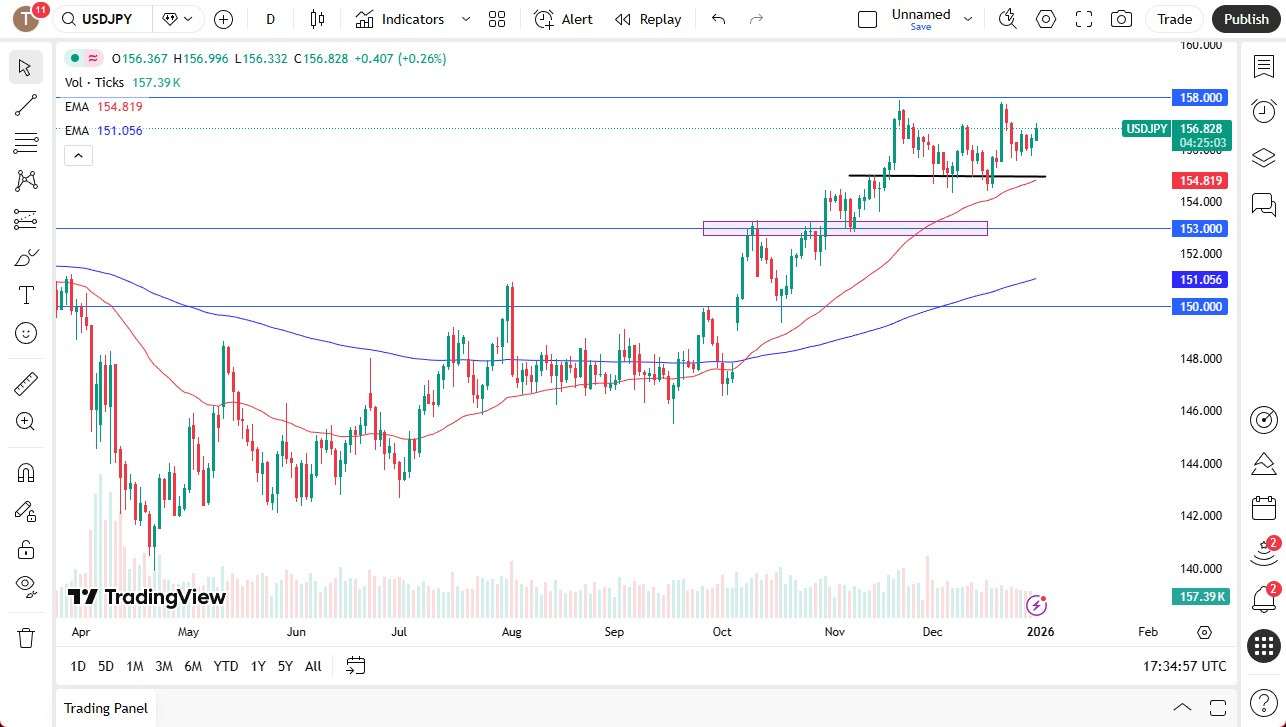
The Bank of Japan is in a situation where it simply cannot tighten monetary policy too much because of the massive amount of debt that the Japanese are currently suffering from. With this being the case, I think you’ve got a situation where you remain buy on the dip as far as your attitude is concerned.

The 50-day EMA reaching the 155 yen level is likely to see quite a bit of support, just as the 158 yen level above is significant resistance. If we can break above there, then it could open up the possibility of a move to the 160 yen level, and I do think that happens sooner or later.
Ultimately, this is a market that I think will continue to be very noisy, but again, as you get paid at the end of every day to hang on to the US dollar against the Japanese yen, I think you need to keep that in the back of your mind.
The market breaking down below the 50-day EMA opens up the possibility of a move down to the 153 yen level, but I don’t think that is the most likely of outcomes. Ultimately, I look at this as a market that continues to favor quite a bit of momentum, but in the meantime, we are just simply working off some of that momentum that we had built up over the last couple of months. I continue to favor the US dollar over the Japanese yen despite the fact that the Federal Reserve is likely to cut rates again.
Want to trade our USD/JPY forex analysis and predictions? Here’s a list of forex brokers in Japan to check out.
Christopher Lewis has been trading Forex and has over 20 years experience in financial markets. Chris has been a regular contributor to Daily Forex since the early days of the site. He writes about Forex for several online publications, including FX Empire, Investing.com, and his own site, aptly named The Trader Guy. Chris favours technical analysis methods to identify his trades and likes to trade equity indices and commodities as well as Forex. He favours a longer-term trading style, and his trades often last for days or weeks.
Choose caffeine-free teas to unwind and promote overall health thanks to their antioxidants and soothing properties.
Chamomile, peppermint, and ginger teas are popular for relaxation, helping digestion, and easing nausea.
Lemon balm and elderberry teas are great for reducing stress, supporting immunity, and offering a delicious flavor experience.
While many folks enjoy tea all year round, snuggling up with a warm cup to read a book or watch a classic movie is a beloved winter pastime. But for as many people who love to partake in these cozy evening activities, there’s an equal amount who are highly sensitive to caffeine—especially when consumed much past lunchtime.
This is where caffeine-free tea really shines. Because while many of the classic tea varieties are caffeinated (like black, green, white, oolong, pu-erh, and red), there are far more decaffeinated versions available to us. And it’s just an added bonus that these teas often boast an array of impressive health benefits.
“In general, tea is most well-known for containing antioxidants, such as flavonoids and catechins, which help combat oxidative stress in the body—and some teas also provide small amounts of minerals, such as potassium, magnesium, and manganese (depending on the type),” says Jamie Adams, MS, RDN, women’s health dietitian. With Adams’ help, we’ve compiled a list of some of the best non-caffeinated teas that are not only comforting on those long, cold winter nights, but also encourage better health.
Jamie Adams, MS, RDN, RPYT, is a registered dietitian and the founder and owner of Mamaste Nutrition
Before diving into our favorites, it’s important to note that there’s actually a difference between decaffeinated and non-caffeinated teas. “When looking for non-caffeinated teas, it should be noted that some decaffeinated teas may still contain some caffeine,” Adams says. “One study found that decaffeinated teas contained less than 12 mg of caffeine per serving, while no caffeine was detected in herbal teas.”
It’s also worth noting that not every cup of tea (even of the same variety) is going to necessarily offer the same exact amount of nutrients. “Steeping time and temperature may impact the amount of antioxidants and other beneficial compounds released from the tea leaves, affecting the overall health benefits of tea,” Adams says. She also adds that pregnant and breastfeeding women should consult with their healthcare provider before drinking herbal teas, as some herbs may not be recommended during this time.
01 of 08
As one of the most popular types of herbal teas, chamomile is often turned to for unwinding after a long day and promoting more restful sleep. “Chamomile tea may also help reduce inflammation and support digestion,” says Adams. These attributes lend this floral tea to supporting immune health as well—perfect for cold and flu season.
02 of 08

The flavor of peppermint is not only festive (especially come winter-time) but it is also positively delicious, refreshing, and health-promoting! “Known for its ability to ease digestive discomfort, bloating, and nausea, it may also help relax muscles and alleviate headaches,” says Adams. Peppermint essential oil, found in its tea, is also associated with sinus congestion relief, ideal for this time of year.
03 of 08

“This has been a life saver throughout my three pregnancies as I navigated morning sickness—ginger is a powerhouse for digestion and nausea relief,” Adams says. “It also contains anti-inflammatory properties and can support immune health.” Its soothing effects on the gastrointestinal tract can be effective in reducing bloating, too. Plus, ginger tea may help to alleviate congestion and wet coughs as an expectorant and airway muscle relaxant.
04 of 08

If you’ve never tried lemon balm tea, it’s worth brewing a cup for its delicate, mild flavor. “Another go-to before bed time, lemon balm tea is mildly citrusy and excellent for relaxation, while helping to reduce stress, anxiety, and insomnia. It’s also believed to support cognitive function and digestion,” Adams says. This herbal tea has been found to be a potent antioxidant as well, reducing inflammation throughout the body and warding off disease-causing free radical molecules. This is thanks, in part, to the impressive amounts of plant compounds it contains, including rosmarinic acid, gallic acid, and flavonoids.
05 of 08

The brilliant deep pink color of hibiscus tea (and its tart, slightly sweet flavor) is hard to miss, earning it a permanent menu spot on many large-chain coffee shop menus. “When I’m looking to stay hydrated throughout my day but want to switch up my water routine, hibiscus tea is a favorite of mine to sip on—it’s vibrant and high in antioxidants, including vitamin C, which supports immune health,” Adams explains. This beloved tea is also rich in quercetin, another potent immune-booster that may also be neuroprotective, according to a 2021 animal study. Hibiscus tea can also encourage better heart health through its impressive ability to support blood pressure and cholesterol regulation.
06 of 08

Green tea is often purported as one of the healthiest beverage choices you can make as a rich source of bioactive plant compounds like epigallocatechin gallate (EGCG), catechins, quercetin, and kaempferol. These offer whole body benefits, supporting heart, gut, immune, and metabolic health. “Decaf green tea offers all the benefits of these antioxidants without the caffeine,” Adams says. “Though it should be noted that decaf green tea may lose much of its antioxidant content after becoming decaffeinated, depending on how it’s processed.”
Generally, higher quality tea brands do a great job of ensuring that as many of these bioactives remain in their green tea through the decaffeination process as possible, however, the best way to be sure is to contact the tea company. It’s also worth noting that as the only decaffeinated option in this round-up, decaf green tea may contain traces of caffeine.
07 of 08

It’s no secret at this point that turmeric is a bonafide superfood, thanks to the positive press the vibrant orange root receives for its notable health benefits. “Turmeric contains a substance called curcumin, an anti-inflammatory compound that supports joint health, digestion, and immune function,” Adams says. Turmeric tea is often combined with ginger, lemon, or honey to amplify its whole body health benefits and enhance its warm, comforting flavor.
08 of 08

You may recognize elderberry as a common ingredient in many cough syrups and immune-boosting supplements—and this is for good reason! This gorgeous dark purple berry is chock-full of phytonutrients (or plant compounds) that reduce inflammation throughout the body as well as promote heart, brain, metabolic and overall immune health. The ingredient has even been found to be beneficial in treating a variety of respiratory illnesses.
Read the original article on Real Simple
Jakarta, Pintu News – Over the past year, Dogecoin has grown from a meme coin to an increasingly recognized reserve asset. However, going into 2026, a number of indicators suggest that the DOGE price has the potential to continue to weaken and possibly hit a new low.
What are these signals, and what can investors anticipate for DOGE’s movement in 2026?
On January 2, 2026, Dogecoin saw a 7.10% gain over a 24-hour period, with the price rising to $0.1267, or approximately IDR 2,128. During that time, DOGE traded within a range of IDR 1,978 to IDR 2,132.
At the time of writing, Dogecoin holds a market capitalization of around IDR 354.82 trillion, with a 24-hour trading volume of approximately IDR 29.88 trillion.
Read also: 3 Meme Coins to Watch Out for in January 2026, What Happens?
Towards the end of 2025, the price of Dogecoin (DOGE) fell below $0.12, closing the year down more than 70% from its highest peak. Weak buying pressure hampered any potential immediate price recovery. In the early trading days of 2026, the DOGE price remained below $0.12.
The spot Dogecoin ETF launched in the United States at the end of November 2025 appears to be struggling to attract investor interest.
Based on data from SoSoValue, since trading began on November 24, most days have seen zero net inflows into the DOGE ETF. The current total net assets recorded are only around $5.07 million-the lowest of all US-listed crypto ETFs.
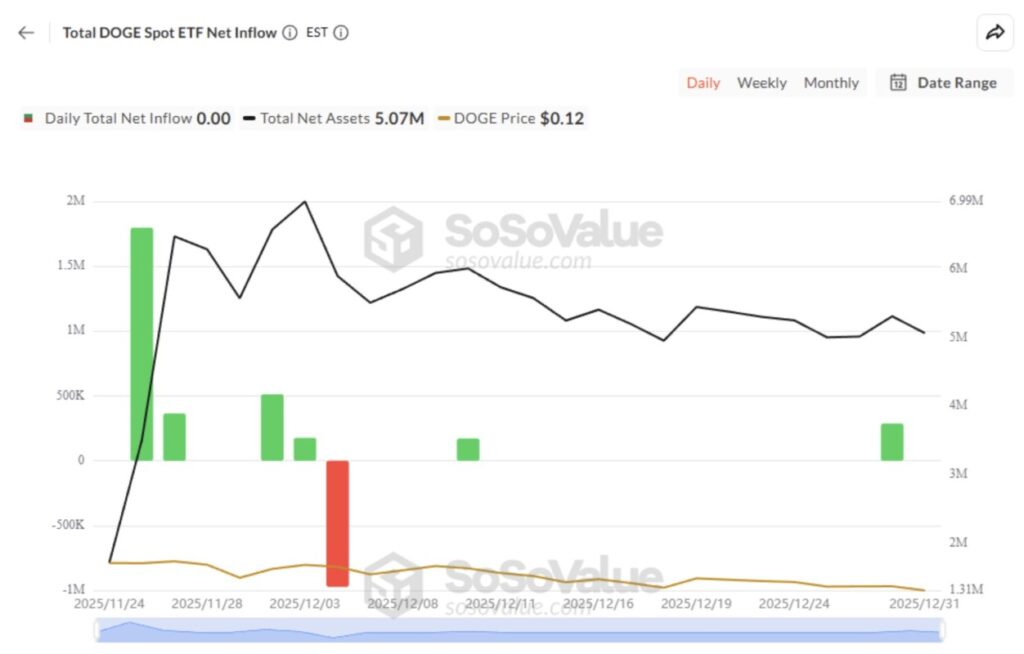
This trend reflects the lack of interest from both institutional and retail investors in DOGE. This situation is in stark contrast to the much stronger performance of XRP and SOL ETFs.
With no new fund flows from ETFs, DOGE lost its upward impetus. Continued selling pressure continues to weigh on the price. If this condition persists until 2026, DOGE will likely find it difficult to recover in the near future.
“Weak demand for ETFs as well as declining open interest in futures contracts further reinforces the ongoing selling trend,” said investor Marzell.
The second factor signaling selling pressure is the rising Dogecoin balance on the Binance wallet (address DE5…ToX), which is one of the largest holders of DOGE. This wallet balance rose again in the second half of 2025, indicating potential selling pressure in the near future.
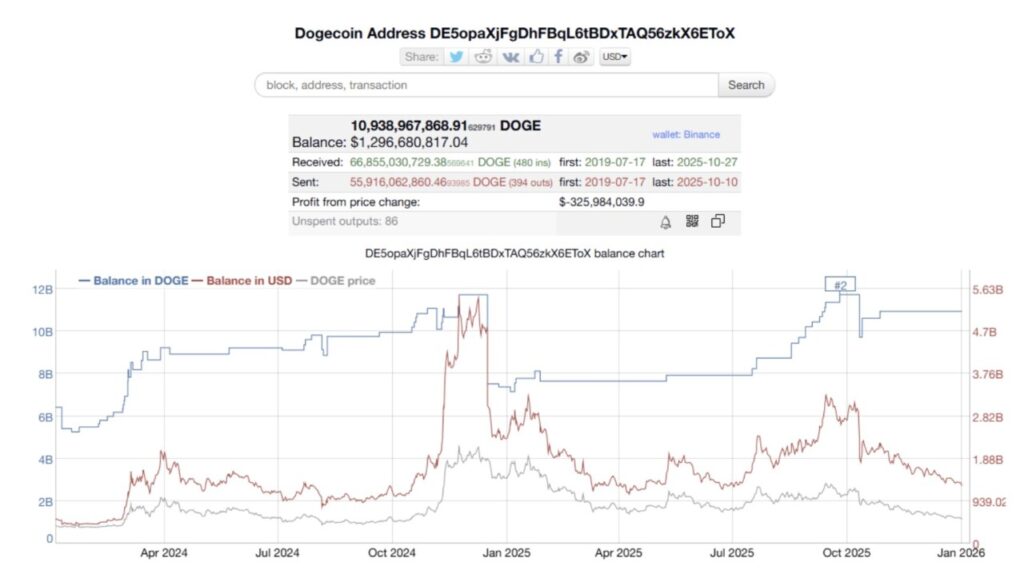
According to data from Bitinfocharts, the amount of DOGE stored in the wallet rose from 7.9 billion to 10.9 billion throughout 2025. Based on historical trends, when the balance exceeds 11 billion DOGE, the price tends to peak.
In strong market conditions, increasing balances on exchanges can support the redistribution of assets to new investors. However, amid low demand, high DOGE reserves on exchanges like Binance create persistent supply-side selling risk.
Read also: Ethereum Struggles to Break $3,000 — Could a 20% Rally Be Ahead?
A third factor adding to the pressure on Dogecoin is the declining interest from retail investors. According to Google Trends data, search interest in Dogecoin is at a five-year low-a trend that is also reflected in many other altcoins.
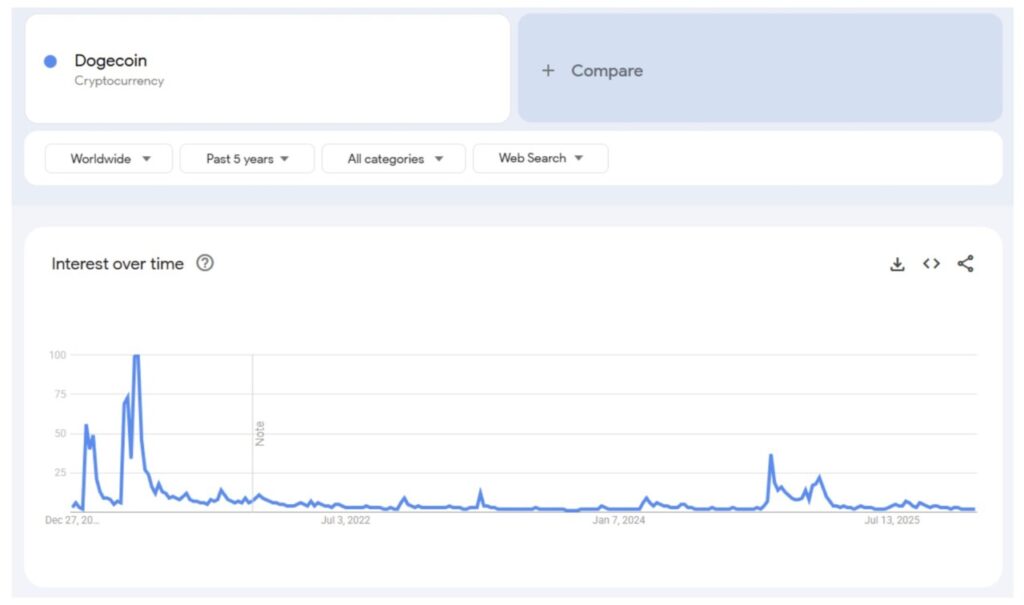
DOGE has been known as a popular coin among retail investors. However, declining interest means fewer new participations. As a result, liquidity has decreased and prices have become more prone to sharp fluctuations.
Some companies such as CleanCore Solutions and BitOrigin are known to hold DOGE as a backup asset. However, current market conditions are putting their positions under pressure.
BitOrigin is known to buy DOGE at a price range of $0.22. Meanwhile, CleanCore Solutions reported on October 6, 2025 that it owned more than 710 million DOGE, with unrealized gains worth more than $20 million at the time. But since October, the price of DOGE has fallen by more than 50%. CleanCore Solutions’ own shares plummeted 90%, suggesting that the strategy of holding DOGE as a backup asset has not convinced investors.
“CleanCore Solutions (ZONE) shares are now down 95% in the last three months. This tarnishes the Dogecoin name,” said investor KrissPax.
Although negative signals continue to emerge, a report from BeInCrypto states that long-term holders are actually starting to show signs of accumulation. For this group, the current price drop is considered a buying opportunity, not a sign of giving up.
That’s the latest information about crypto. Follow us on Google News to get the latest crypto news about crypto projects and blockchain technology. Also, learn crypto from scratch with complete discussion through Pintu Academy and stay up-to-date with the latest crypto market such as bitcoin price today, xrp coin price today, dogecoin and other crypto asset prices through Pintu Market.
Enjoy an easy and secure crypto trading experience by downloading Pintu crypto app via Google Play Store or App Store now. Also, get a web trading experience with various advanced trading tools such as pro charting, various types of order types, and portfolio tracker only at Pintu Pro.
*Disclaimer
This content aims to enrich readers’ information. Pintu collects this information from various relevant sources and is not influenced by outside parties. Note that an asset’s past performance does not determine its projected future performance. Crypto trading activities have high risk and volatility, always do your own research and use cold cash before investing. All activities of buying and selling bitcoin and other crypto asset investments are the responsibility of the reader.
Reference:
Silver price (XAG/USD) rises to near $74.10 per troy ounce during the early European hours on Friday. The price of the grey metal surged 148% in 2025, breaking key levels amid its designation as a critical US mineral, tight supply, low stockpiles, and rising industrial and investment demand.
The non-interest-bearing Silver attracts buyers due to dovish sentiment surrounding the Fed policy outlook. Lower interest rates could reduce the opportunity cost of holding Silver. Traders expect the Federal Reserve (Fed) to deliver two more rate cuts in 2026.
Additionally, Silver prices find support as a softer US Dollar (USD) makes the dollar-denominated metal cheaper for foreign buyers. Markets are bracing for US President Donald Trump to nominate a new Fed chair to replace Jerome Powell when his term ends in May, a move that could tilt monetary policy toward lower interest rates.
The safe-haven metals, including Silver receive support amid heightened geopolitical tensions, fueled by recent exchanges of accusations between Russia and Ukraine over civilian attacks on New Year’s Day and persistent US–Venezuela friction.
Silver gains ground amid a surge in speculative demand in China, driving Shanghai Futures Exchange premiums to record highs. These elevated premiums reflect strong local demand and have tightened global supply chains, echoing earlier inventory squeezes in London and New York vaults.
Silver is a precious metal highly traded among investors. It has been historically used as a store of value and a medium of exchange. Although less popular than Gold, traders may turn to Silver to diversify their investment portfolio, for its intrinsic value or as a potential hedge during high-inflation periods. Investors can buy physical Silver, in coins or in bars, or trade it through vehicles such as Exchange Traded Funds, which track its price on international markets.
Silver prices can move due to a wide range of factors. Geopolitical instability or fears of a deep recession can make Silver price escalate due to its safe-haven status, although to a lesser extent than Gold’s. As a yieldless asset, Silver tends to rise with lower interest rates. Its moves also depend on how the US Dollar (USD) behaves as the asset is priced in dollars (XAG/USD). A strong Dollar tends to keep the price of Silver at bay, whereas a weaker Dollar is likely to propel prices up. Other factors such as investment demand, mining supply – Silver is much more abundant than Gold – and recycling rates can also affect prices.
Silver is widely used in industry, particularly in sectors such as electronics or solar energy, as it has one of the highest electric conductivity of all metals – more than Copper and Gold. A surge in demand can increase prices, while a decline tends to lower them. Dynamics in the US, Chinese and Indian economies can also contribute to price swings: for the US and particularly China, their big industrial sectors use Silver in various processes; in India, consumers’ demand for the precious metal for jewellery also plays a key role in setting prices.
Silver prices tend to follow Gold’s moves. When Gold prices rise, Silver typically follows suit, as their status as safe-haven assets is similar. The Gold/Silver ratio, which shows the number of ounces of Silver needed to equal the value of one ounce of Gold, may help to determine the relative valuation between both metals. Some investors may consider a high ratio as an indicator that Silver is undervalued, or Gold is overvalued. On the contrary, a low ratio might suggest that Gold is undervalued relative to Silver.
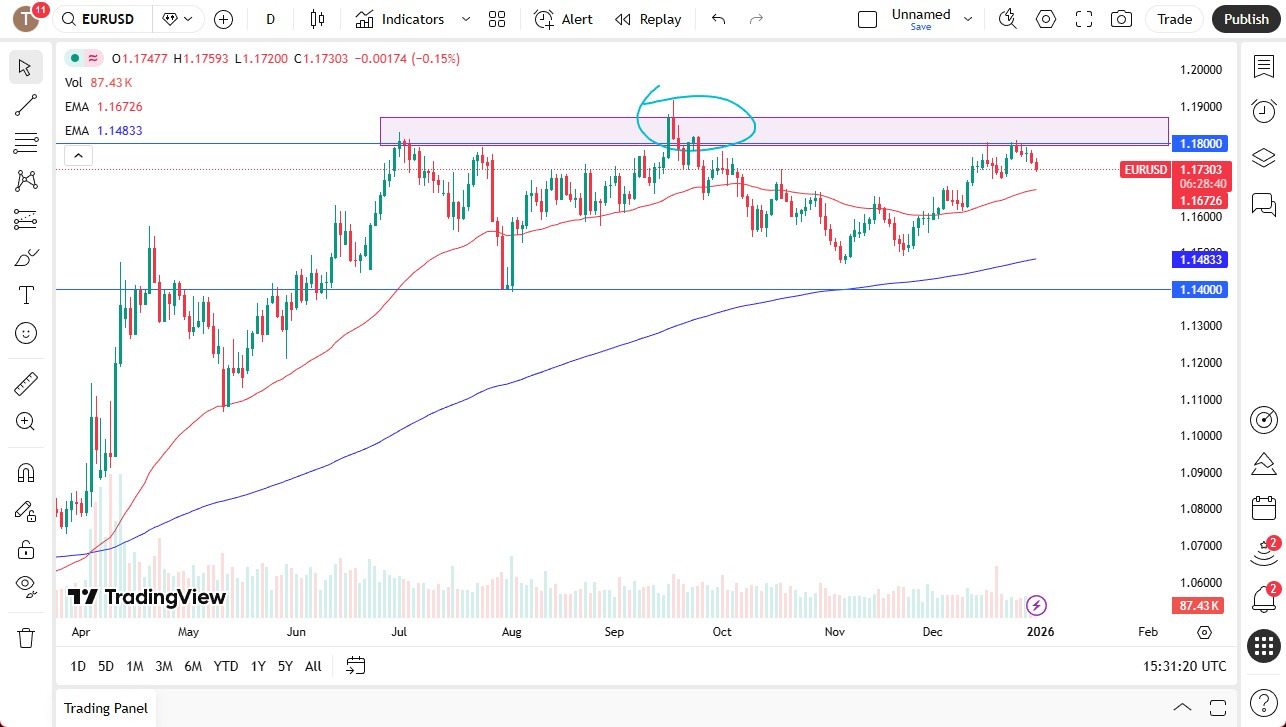
If we could break above the 1.1875 level, then it would be a very bullish sign for the Euro. While I’m not necessarily super bullish on the Euro itself, I can make an argument about how that would happen. Currently, traders around the world are anticipating that the Federal Reserve is going to continue to cut this year, and if that’s going to be the case, they will likely try to punish the US dollar.
That being said, it should also be thought that if we do in fact see aggressive cuts, that’s not a good look for the world economy. After all, loose money does help, but if it’s a bit of a panic, that will have people quite concerned and often will have them running to the US dollar for safety. Ultimately, I think we are still range-bound and I don’t really see anything pushing the Euro higher significantly at the moment, but I can also say that I don’t see anything pushing it a lot lower at the moment either.
The 50-day EMA currently sits at the 1.1672 level and is rising, and I think that makes a nice target for any pullback. Anything below there opens up 1.16, possibly even 1.15, but I think ultimately, we’ve got a scenario where you’re probably looking at choppy and back-and-forth range-bound trading on not only short-term charts but long-term charts. In other words, if you wait long enough, the market will move in your direction. It looks like a market that has nowhere to be.
Ready to trade our daily Forex analysis? We’ve made this forex brokers list for you to check out.
Christopher Lewis has been trading Forex and has over 20 years experience in financial markets. Chris has been a regular contributor to Daily Forex since the early days of the site. He writes about Forex for several online publications, including FX Empire, Investing.com, and his own site, aptly named The Trader Guy. Chris favours technical analysis methods to identify his trades and likes to trade equity indices and commodities as well as Forex. He favours a longer-term trading style, and his trades often last for days or weeks.
Yiruixing Packaging, a Chinese custom packaging manufacturing services provider, has expanded its capabilities to offer more flexible and scalable packaging solutions for businesses in the protein, supplement, and nutrition sectors.
By enhancing its original equipment manufacturing (OEM) and original design manufacturing (ODM) services, the company is aiming to meet the growing demand for custom packaging.
The move aims to handle high-volume production while maintaining market-standard compliance and quality.
The expansion comes in response to the increasing need for packaging solutions that cater to bulk buyers and manufacturers in the nutritional product market.
Yiruixing said that it is now better equipped to support businesses requiring durable, consistent packaging that can meet the demands of large-scale production.
This allows the company to offer custom solutions for packaging protein powders, dietary supplements, and other nutritional products, providing businesses with the flexibility to scale their operations effectively.
The company’s expanded offerings include a range of materials and packaging types, from rigid boxes to flexible pouches and resealable bags.
These packaging solutions are designed to meet the specific needs of each product, ensuring that the integrity of protein and supplement products is preserved throughout the production and distribution processes.
The company’s new approach allows for tailored packaging that accommodates factors such as filling methods, storage conditions, and destination requirements.
By offering options for custom structural designs, material selection, and branding, Yiruixing indicated that it is able to deliver packaging solutions that cater to the diverse needs of its clients.
This includes a commitment to regulatory compliance, ensuring that packaging meets global labelling standards and facilitates smooth distribution across international markets.
Yiruixing said that it has also increased inspection and testing processes at each stage of production.


Cardano (ADA) has started 2026 on a positive note, rising nearly 8% today, moving above the $0.36 level and ranking among the day’s top altcoin gainers. This rise comes after a rough December, when ADA fell nearly 20%, leaving many investors cautious.
So, what’s driving Cardano’s price higher today?
One of the clearest signals behind ADA’s rise comes from CryptoQuant data. Recent on-chain numbers show an increase in activity from large holders, often called whales. Both spot and futures data point to bigger orders entering the market.
When whales begin to buy again, it often signals growing confidence. According to CryptoQuant, market conditions are easing, and buy-side pressure is slowly increasing. This supports the idea that the current move is more than just a random bounce.
Beyond trading data, Cardano’s network is showing real signs of use. Transaction activity and wallet interactions have increased over recent days. This means users are actively using the blockchain, not just holding ADA.
Another positive signal comes from Cardano’s DeFi ecosystem. According to DefiLlama, Cardano’s TVL increased by 4% in the last 24 hours, reaching about $178.9 million. This means more users are putting their funds into Cardano-based DeFi platforms.
When more money flows into DeFi, it usually shows growing trust in the network, which can also increase demand for the ADA token.
For several months, ADA has been moving inside a falling wedge pattern. This happens when the price keeps going down, but selling slowly becomes weaker. As the range gets tighter, it often means a big move is getting close.
Right now, ADA is holding near the $0.35 support level. This area is helping the price stay stable, and buyers are slowly stepping in, showing that selling pressure is easing.
Crypto trader Captain Faibik shared a chart showing ADA near the end of this falling wedge. He believes a breakout could happen if the price moves above the upper trendline.
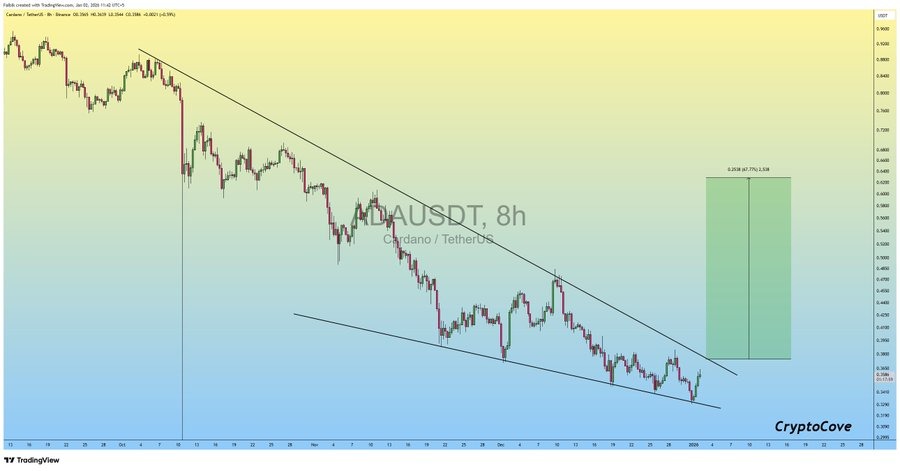
As long as ADA stays above support, the setup remains healthy. If the breakout happens, the price could move toward the $0.52–$0.55 zone, which would mean nearly a 50% rise from current levels.
Stay ahead with breaking news, expert analysis, and real-time updates on the latest trends in Bitcoin, altcoins, DeFi, NFTs, and more.
Rising on-chain activity, improving market conditions, and renewed large-holder interest suggest stronger confidence in ADA’s short-term outlook.
Cardano could trade between $2.75 and $3.25 in 2026 if market sentiment improves, adoption grows, and key support levels hold.
Cardano is considered a long-term project due to its research-driven development, scalability upgrades, and focus on decentralization.
By 2030, Cardano could be valued around $9 to $10 based on long-term growth, network usage, and sustained investor confidence.
CoinPedia has been delivering accurate and timely cryptocurrency and blockchain updates since 2017. All content is created by our expert panel of analysts and journalists, following strict Editorial Guidelines based on E-E-A-T (Experience, Expertise, Authoritativeness, Trustworthiness). Every article is fact-checked against reputable sources to ensure accuracy, transparency, and reliability. Our review policy guarantees unbiased evaluations when recommending exchanges, platforms, or tools. We strive to provide timely updates about everything crypto & blockchain, right from startups to industry majors.
All opinions and insights shared represent the author’s own views on current market conditions. Please do your own research before making investment decisions. Neither the writer nor the publication assumes responsibility for your financial choices.
Sponsored content and affiliate links may appear on our site. Advertisements are marked clearly, and our editorial content remains entirely independent from our ad partners.