The main category of All News Articles.
You can use the search box below to find what you need.
[wd_asp id=1]
The main category of All News Articles.
You can use the search box below to find what you need.
[wd_asp id=1]
Pepeto ($PEPETO) is being positioned as an early-stage alternative at a moment when meme capital is rebalancing into the next wave of opportunity. Dogecoin remains the category icon, but the market now treats it like a mature asset with slower percentage expansion.
According to CoinMarketCap, DOGE trades near $0.127744 with a market cap around $21,464,927,858. That scale is why crypto news today readers increasingly compare a large-cap meme like DOGE with a micro-valuation presale that can still reprice aggressively. Pepeto enters that conversation with a tiny entry price and an infrastructure thesis aimed at converting usage into token demand.
Source: https://coinmarketcap.com/currencies/dogecoin/
Dogecoin Price Prediction: Why Multiples Compress at Scale
Dogecoin has liquidity and recognition, and those strengths will likely keep it relevant into 2026. They also explain why DOGE behaves differently from early-stage meme assets. When an asset already sits in the tens of billions, it often needs fresh capital measured in billions to produce a clean breakout. As a result, DOGE rallies can be meaningful, but they tend to be measured in single-digit multiples rather than the explosive expansions that defined its earliest era.
That does not mean DOGE is a bad trade. It means its role has evolved into a liquid meme benchmark. It can outperform in meme seasons, but it is unlikely to deliver a 50x result from here without a historic new demand shock. Investors chasing the biggest return curve therefore look for an asset earlier on the adoption timeline, where valuation is still small and price discovery is still open.
Source: https://blockchain.news/news/20251224-price-prediction-doge-targeting-01346-by-january-2026-as
Pepeto Price Prediction: The Presale Setup Built for Asymmetry
Pepeto (https://pepeto.io) is built on the Ethereum mainnet and markets itself as meme culture plus real utility, framed as “PEPE plus Technology plus Optimization.” Its infrastructure stack is the differentiator. PepetoSwap is positioned as a zero-fee swap, Pepeto Bridge as cross-chain connectivity, and Pepeto Exchange as a verified meme exchange where all volume routes through $PEPETO. If the ecosystem becomes a hub for meme trading, activity becomes repeated token interaction rather than a one-time hype spike.
On the presale snapshot, 1 $PEPETO is priced at $0.000000173. The raise stands at $7,113,592.37, with a countdown timer active for the next price increase. Supply is fixed at 420T, staking APY is promoted around 216% (https://pepeto.io/en/staking) and audits are listed as SolidProof and Coinsult. The community is positioned at 100,000+ members, and the ecosystem narrative highlights 850+ projects applying to list.
Staking matters because it can influence early supply behavior. When holders stake at high yields, fewer tokens may be available to sell during the first major listing windows, tightening supply when attention rises.
How 50x Is Modeled: Rotation, Ladders, and Demand Loops
A 50x thesis is built on market cap ladders and adoption milestones, not a random price target. Early-stage assets can move quickly because a small absolute increase in demand can create a large percentage move. Pepeto argues its infrastructure can help volume persist because swaps, bridging, and exchange activity keep users engaged beyond a single trend cycle.
Capital rotation also matters. In meme cycles, money often starts in the safest, most liquid names, then migrates into higher beta plays once risk appetite returns. Dogecoin often benefits first. The next wave is typically new narratives with smaller bases.
Under the dollar language often matters more for psychology than math. Retail buyers anchor to low nominal prices because it feels like more units are being accumulated, even though market cap is what drives value. Presales can benefit from that perception, especially when the entry is fixed and stage increases are visible. At the same time, early-stage plays carry higher execution risk, so position sizing matters.
A common approach is to treat DOGE as the liquid core and a presale like Pepeto as the asymmetric satellite, so upside potential is pursued without overexposure. That is why many buyers frame Pepeto as the best crypto presale to buy when they want exposure before listings drive broader discovery.
How to Buy Pepeto: Timing and Safety
Start on pepeto.io and confirm the domain spelling before you connect anything. Connect your wallet, then choose a purchase route using ETH, USDT, BNB, or a bank card through the supported checkout. After purchase, consider staking immediately to activate the high yield while the presale is still active. The official site also promotes a $700,000 giveaway, so follow only instructions provided on the verified page.
Final Outlook
Dogecoin remains a liquid blue-chip meme, and it can still rally with the broader market. Pepeto has a higher risk profile, but it is structured around routed volume demand, staking-based supply lock, a fixed 420T supply, dual audits, and a 100,000+ community.
For investors looking for the best crypto to buy now and selecting a top crypto to invest in candidate under $1 with room to reprice, Pepeto is framed as the high-beta leg that could outperform every other meme coin in 2026.
Buy Pepeto Presale and don’t miss the opportunity: https://pepeto.io
To stay ahead of key updates, listings, and announcements, follow Pepeto on its official channels only:
Website: https://pepeto.io
X (Twitter): https://x.com/Pepetocoin
Telegram: https://t.me/pepeto_channel
Instagram: https://www.instagram.com/pepetocoin/
Contact: Dani Bonocci
Website: https://www.tokenwire.io
Phone: +971586738991
SOURCE: Pepeto
Press release distribution
This release was published on openPR.
Developer Jokers, a company founded by former Sega staff, announced on December 22 that it has halted development of Code of Jokers Evolutions, a blockchain mobile game it had been working on under official license from Sega.
Originally announced in March this year, Code of Jokers Evolutions was unveiled as a digital card game based on Sega’s arcade trading card game IP. The arcade version of Code of Jokers was in circulation from 2013 to 2019, and it received a short-lived mobile version called Code of Jokers Pocket (also developed by Sega) in 2017, which ended services the following year.
The new Code of Jokers Evolutions was announced as a revival of the franchise, inheriting key features of the original Code of Jokers while integrating new gimmicks like user-to-user trading using blockchain technology. Development was originally underway with an international release planned for 2025 and a domestic release planned by the end of 2026. However, in its new announcement, developer Jokers says it has decided to cancel the title “after considering recent changes in the Web3 game market environment.” While the company doesn’t go into the details, the decision seems consistent with current tendencies in the Japanese game industry. While it happened a bit later than overseas, Japan’s NFT game fad appears to be fizzling out even in the eyes of the people making them.

As mentioned, Jokers is a game company founded by former Sega staff Yasuhiro Nishiyama (producer of the original Code of Joker, Sangokushi Taisen) and Wataru Sato (Bakugan producer at Sega Toys). With the announcement of Code of Jokers Evolutions’s cancellation, the developer says it will be accepting buybacks from users who purchased the collaboration NFT pack released ahead of the game’s launch via this portal.
Related articles: Japanese NFT game company’s currency crashes after users discover infinite money glitch
The US dollar staged a mild rebound from its weakest level since early October, though the move lacked follow-through. Expectations that the Federal Reserve will maintain a broadly accommodative policy stance continue to cap the dollar’s upside, reducing the appeal of yield-sensitive assets.
This environment remains constructive for gold, which benefits when real rates stay compressed and currency strength remains constrained. As a result, the metal has shown resilience despite short-term dollar firmness, with no signs of aggressive profit-taking emerging near recent highs.
Ongoing geopolitical tensions continue to underpin safe-haven flows into bullion. Elevated uncertainty across multiple regions has encouraged investors to retain defensive exposure, reinforcing the view that the latest pullback reflects consolidation rather than a shift in trend.
With holiday-thinned markets reopening, attention will turn to upcoming Japanese economic releases on Friday. Tokyo core CPI is expected to slow to 2.5% year on year from 2.8%, while the unemployment rate is forecast to hold at 2.6%. Industrial production is seen falling 1.9% after a prior gain, and retail sales growth is projected to ease to 0.9%.
Weaker-than-expected data could add to global growth concerns, potentially reinforcing gold’s appeal as a defensive asset.
Gold near $4,479 targets $4,520 while holding $4,450 support; silver at $71.85 eyes $73.80, with $70.20 support limiting downside as markets reopen amid holiday-thinned liquidity and steady safe-haven demand outlook.
Whether you’re trying to lose weight, increase your energy, or stay mobile and pain-free as you get older, maintaining a consistent exercise routine is key. But suppose you want to get even more out of your workout and build muscle and strength, or say you’ve decided to train for a triathlon. In these cases, taking a pre-workout supplement may be helpful. So, when is the best time to take pre-workout?
Meet the experts: Jordan Hill, R.D., C.S.S.D., a registered dietitian and sports dietetics specialist at Live It Up; Nicolle Cucco, M.S., R.D., C.P.T., a registered dietitian and personal trainer at the fitness app Muscle Booster.
It’s important to note that pre-workout is considered a supplement, and it may not be for everyone. Always consult your physician before adding it to your routine. Here, dietitians and fitness experts explain when to take pre-workout, who should not take it, plus what ingredients you’ll find in the supplement.
“There are several different pre-workout supplements, many with various ingredients,” says Jordan Hill, R.D., C.S.S.D., a registered dietitian and sports dietetics specialist at Live It Up. Still, most will contain one or more of the following: caffeine, creatine, beta-alanine, and branched-chain amino acids (BCAAs).
“Caffeine is the main stimulant in pre-workout, meant to boost energy, focus, and endurance. Creatine is often included for its ability to help muscles produce energy for intense, short bursts, which boosts power and strength,” explains Nicolle Cucco, M.S., R.D., C.P.T., a registered dietitian and personal trainer at the fitness app Muscle Booster. “Beta-alanine is an amino acid that helps to buffer acid build-up in muscles, reducing fatigue and improving endurance.” Finally, Cucco notes that BCAAs may help with muscle recovery and prevent soreness.
The best time to take a pre-workout supplement is anywhere from 20 to 60 minutes before you plan to start exercising, according to our experts. “This gives your body enough time to absorb the ingredients and for them to become effective,” explains Cucco. “This is also the ideal timeframe for the caffeine component to take effect.” According to The International Society of Sports Nutrition, the most commonly used timing for caffeine supplementation is 60 minutes before your workout if you’re looking to enhance your exercise performance.
“Pre-workout supplements don’t need to be taken with food, but in general, it’s recommended to eat carbohydrates as an energy source before workouts,” adds Hill. Enjoying a snack such as a banana with peanut butter or Greek yogurt with berries around the same time as you take your pre-workout may provide an additional boost.
While this pre-exercise window is ideal for taking a pre-workout, you may want to steer clear if you work out in the evening or at night. “It’s best to avoid taking pre-workout late in the day or at night as the caffeine component may cause sleep disruption,” Cucco says. This is especially true if you’ve already had caffeine and will exceed 400 milligrams for the day with your supplement, adds Hill. “Now, for caffeine-free pre-workout supplements, there are no time constraints on when you can take them,” she says.
If you’ve never considered taking a pre-workout supplement before, you may think they are only for advanced or intense exercisers. And yes, those people do benefit, but they aren’t the only ones. “Pre-workout is great for when you’re pushing the limits in terms of volume, training hard, doing intense weightlifting, or just struggling with motivation and energy levels,” Cucco says. According to a 2025 review in the Journal of Cardiovascular Development and Disease, multi-ingredient pre-workout supplements may offer benefits such as increased energy, focus, endurance, and strength during exercise, plus may positively impact blood pressure, triglycerides, and LDL “bad” cholesterol levels—though the researchers note that more studies are needed to confirm these perks.
“Beginners and those new to fitness can also benefit from taking pre-workout,” says Cucco. “However, I would advise starting with a smaller serving than recommended to assess tolerance. If you’re starting out, focus on building a solid foundation first before relying on supplements.”
Some folks should likely avoid taking pre-workout altogether. Hill and Cucco say these include people with underlying medical conditions, those sensitive to caffeine, athletes subject to drug testing, those who are pregnant or breastfeeding, people who are taking certain medications (especially stimulants), or those who experience symptoms like rapid heart rate, headaches, or GI issues. And even if you don’t fall into one of these categories, you should speak with a healthcare provider before starting any new supplement.
Dietary supplements are products intended to supplement the diet. They are not medicines and are not intended to treat, diagnose, mitigate, prevent, or cure diseases. Be cautious about taking dietary supplements if you are pregnant or nursing. Also, be careful about giving supplements to a child, unless recommended by their healthcare provider.
BitcoinWorld
Cardano Price Prediction 2026-2030: The Ultimate Guide to ADA’s $2 Breakthrough Potential
Will Cardano’s ADA token finally break the $2 barrier that has eluded it for years? As one of the most researched and fundamentally sound blockchain projects, Cardano continues to capture investor attention despite market volatility. This comprehensive analysis examines ADA’s price trajectory from 2026 through 2030, combining technical analysis, fundamental developments, and expert insights to answer the burning question: Can Cardano reach $2 and beyond?
Cardano stands as a third-generation blockchain platform founded by Charles Hoskinson, co-founder of Ethereum. Unlike many cryptocurrencies that prioritize speed over security, Cardano employs a research-first approach, with every upgrade undergoing rigorous academic peer review. This methodology has created one of the most secure and scalable blockchain networks, but it has also meant slower development compared to competitors.
As of current market conditions, ADA trades significantly below its all-time high of $3.10 reached in September 2021. The cryptocurrency has faced several challenges:
Despite these challenges, Cardano maintains a strong community and continues to deliver on its roadmap. The successful implementation of smart contracts through the Alonzo upgrade marked a significant milestone, opening the door for decentralized applications and DeFi protocols on the network.
By 2026, Cardano’s ecosystem should be substantially more mature. Several key developments are expected to influence ADA’s price:
| Factor | Potential Impact | Price Range Estimate |
|---|---|---|
| Full Hydra implementation | High scalability (1M+ TPS) | $0.85 – $1.40 |
| DApp ecosystem growth | Increased utility and demand | +30-50% from baseline |
| Regulatory clarity | Institutional adoption | Variable based on jurisdiction |
The cryptocurrency forecast for 2026 depends heavily on broader market conditions. If the crypto market enters another bull cycle, ADA could test the $1.40 resistance level. However, conservative estimates place ADA between $0.85 and $1.20, assuming moderate ecosystem growth and stable market conditions.
2027 represents a critical year for Cardano’s long-term valuation. By this time, the network should have fully implemented its scaling solutions, particularly Hydra, which promises to make Cardano one of the fastest and most efficient blockchains. This technical superiority could drive significant adoption.
Key factors influencing the ADA price in 2027:
Our analysis suggests that if Cardano captures even 5-7% of the total DeFi market by 2027, ADA could reach between $1.50 and $1.80. The $2 target becomes plausible if multiple positive catalysts align, including major partnership announcements and successful implementation of all scaling solutions.
Looking toward 2030 requires considering macro trends in blockchain adoption. By this decade’s end, blockchain technology should be integrated into numerous industries, from finance to healthcare to governance. Cardano’s focus on sustainability, security, and peer-reviewed development positions it well for institutional adoption.
Several scenarios could unfold for Cardano by 2030:
The most likely scenario involves Cardano maintaining its position as a premium blockchain solution for specific use cases, particularly in developing nations through partnerships like those in Africa. This targeted adoption could drive steady, sustainable growth rather than explosive price movements.
The $2 question dominates Cardano discussions. Reaching this milestone requires several conditions:
First, Cardano must demonstrate real-world utility beyond speculation. The growing ecosystem of decentralized applications needs to attract substantial user bases. Second, the network must maintain its security and decentralization advantages while achieving competitive transaction speeds and costs. Third, broader cryptocurrency adoption must continue, increasing total market capitalization.
Technical analysis of ADA’s price history reveals that $2 represents both a psychological barrier and a key resistance level. Breaking through this level would require:
| Requirement | Current Status | 2030 Projection |
|---|---|---|
| Daily Active Addresses | ~100,000 | 500,000+ |
| Total Value Locked (DeFi) | ~$200M | $5B+ |
| Network Revenue | Minimal | Sustainable |
Based on current growth trajectories and planned developments, our cryptocurrency forecast suggests ADA has a 60-70% probability of reaching $2 between 2027 and 2029. The exact timing depends largely on market cycles and specific catalyst events.
No price prediction is complete without considering potential obstacles. For Cardano, several risks could impact its trajectory:
Investors should monitor these factors alongside Cardano’s development progress. The project’s transparency through regular updates from Charles Hoskinson and the development team provides valuable insights into addressing these challenges.
Given the volatility of cryptocurrency markets, consider these approaches to ADA investment:
Remember that all cryptocurrency investments carry substantial risk. Only invest what you can afford to lose, and consider your investment horizon. For long-term believers in Cardano’s vision, the 2026-2030 period represents a significant opportunity, but short-term traders may face considerable volatility.
Cardano’s journey toward $2 and beyond represents more than just price speculation—it reflects the maturation of a fundamentally different approach to blockchain development. While the path contains uncertainties and challenges, Cardano’s commitment to research, security, and sustainable growth provides a solid foundation for long-term value creation.
The coming years will test whether Cardano’s methodical approach can compete in an increasingly fast-paced cryptocurrency landscape. Success depends not just on technological achievements but on real-world adoption and utility. For investors, the key is balancing optimism about Cardano’s potential with realistic expectations about timeline and market conditions.
As we look toward 2030, Cardano remains one of the most intriguing projects in cryptocurrency, with the potential to redefine how blockchain technology integrates with global systems. Whether ADA reaches $2 becomes less important than whether Cardano achieves its vision of creating a more secure, transparent, and equitable global financial system.
Cardano’s primary advantage is its research-driven, peer-reviewed development approach. Founded by Charles Hoskinson, this methodology prioritizes security and formal verification, making it particularly suitable for applications requiring high assurance, such as financial systems and identity solutions.
Cardano uses Ouroboros, a provably secure proof-of-stake protocol developed through academic research. Unlike many proof-of-stake systems, Ouroboros has mathematically proven security properties similar to Bitcoin’s proof-of-work, but with significantly lower energy consumption.
The Cardano roadmap includes several key upgrades: Hydra for layer-2 scaling, Mithril for lightweight client verification, and ongoing improvements to smart contract capabilities. The development is led by Input Output Global (IOG), with regular updates published through their research portal.
Investment suitability depends on individual risk tolerance and investment horizon. Cardano presents a unique value proposition focused on security and sustainability, but like all cryptocurrencies, it carries significant volatility risk. Consider consulting with a financial advisor and conducting thorough research before investing.
ADA holders can delegate their tokens to stake pools through compatible wallets like Daedalus or Yoroi. Staking helps secure the network while earning rewards, typically around 4-5% annually. The process is designed to be accessible while maintaining decentralization.
To learn more about the latest cryptocurrency markets trends, explore our article on key developments shaping blockchain adoption and institutional investment in digital assets.
This post Cardano Price Prediction 2026-2030: The Ultimate Guide to ADA’s $2 Breakthrough Potential first appeared on BitcoinWorld.
Natural gas “today” (Thursday, December 25, 2025) is a classic holiday-market paradox: not many people are trading, but the people who are trading can move prices. Across the major benchmarks, the story is broadly consistent—winter weather risk is back in focus, LNG demand remains a powerful support in the U.S., and Europe is watching both temperature swings and storage levels as it heads deeper into the heating season. [1]
Here’s what’s driving the market on Christmas Day:
In the U.S., the headline on December 25 is holiday volatility—price action amplified by lighter participation.
Reuters reported that January NYMEX natural gas futures were down 16.6 cents (about 3.8%) at $4.242 per MMBtu, after earlier climbing to $4.593, the highest level since December 11. The pullback came after an 11% jump on Tuesday, described as the sharpest daily rise since October 30—exactly the sort of “thin-market rocket fuel” traders love to hate. [5]
Three near-term drivers did the heavy lifting:
1) Weather risk is back (but not extreme—yet).
Meteorologists cited in the report forecast a slight nationwide temperature drop through January 8. Heating degree days (a proxy for heating demand) were expected to rise from 358 on Tuesday to 377 on Wednesday, still below a cited “normal” level of 447, but with forecasters anticipating colder conditions ahead. Translation: the market is paying for the option value of colder weather, even if the baseline forecast isn’t screaming “polar vortex.” [6]
2) LNG feedgas remains a major support beam.
Flows to the eight large U.S. LNG export plants averaged 18.4 Bcf/d so far in December, up from a monthly record 18.2 Bcf/d in November, according to the same Reuters reporting. When LNG terminals run hard, they effectively convert domestic gas into global gas—tightening the U.S. balance and making Henry Hub more sensitive to winter demand swings. [7]
3) Production is strong—record strong.
LSEG projected U.S. Lower 48 output averaging 109.8 Bcf/d in December, a record monthly high that narrowly tops November’s 109.6 Bcf/d record. Strong supply can blunt rallies, but it also creates a weird tension: when you’re producing at record levels and prices are still elevated, the market is basically admitting demand (especially LNG and winter heating) is doing real work. [8]
One of the most important details for readers tracking natural gas prices today: volume was light. Reuters cited trading volume around 19,541 lots at that point in the session, with a market participant noting that holiday conditions can exaggerate intraday swings. In practical terms, that means price moves can look more dramatic than the underlying fundamentals justify—until normal liquidity returns. [9]
European gas markets headed into Christmas with a small upward nudge, but not a breakout.
Reuters-reported prices showed the Dutch TTF front-month up €0.42 to €28.20/MWh (about $9.75/mmBtu), while the Dutch February contract rose €0.30 to €27.90/MWh. In the UK, the day-ahead contract was up 3.55 pence to 74.00 pence/therm. [10]
Colder weather expectations are the bullish spark.
An LSEG analyst quoted in the report said the Christmas break leaned “bullish,” with Germany and France expected to show higher consumption than last year, driven by a “steep temperature drop” expected over Christmas Day and Boxing Day. [11]
But supply is acting like a lid on the pot.
The same report emphasized that strong supply from Norway and LNG was expected to offset some demand-driven pressure. This balance—temperature-driven demand rising into winter, while supply and infrastructure keep the market from panicking—is exactly why Europe can see higher day-to-day volatility without necessarily revisiting crisis-era extremes. [12]
Europe’s gas storage is still a key psychological anchor. The report cited EU storage sites 66.49% full, referencing Gas Infrastructure Europe data. That’s not “empty,” but it’s also not a cozy overstuffed pantry—especially if the cold snaps arrive in clusters instead of politely spaced-out intervals. [13]
In Asia, spot LNG prices firmed modestly, but the bigger narrative remains a split screen: South Korea responding to cold, and China remaining reluctant.
Reuters-reported market estimates put the average LNG price for February delivery into Northeast Asia at $9.60/mmBtu, up from $9.50 last week—and still described as the lowest since April 2024. The same report noted that weak buying in China left prices down 34% since the start of 2025. [14]
One analyst cited in the report pointed to “continuous soft demand,” weak economic indicators, and ample alternative supplies like coal in China, adding that the La Niña pattern hadn’t delivered the colder phases some expected—at least not yet. (In other words: if you can burn coal, and it’s cheaper, and the weather isn’t punishing you, you hesitate before paying for spot LNG.) [15]
South Korea showed more immediate spot interest because temperatures were expected to fall to two-year lows on December 26, according to a market source quoted by Reuters. The report also said five cargoes had been diverted from China to South Korea in recent weeks—an unusually concrete example of how quickly demand signals can reroute global molecules. [16]
One of the most consequential “natural gas today” themes is not just price, but direction: where do flexible LNG cargoes flow next?
The Reuters report cited multiple European LNG price assessments for February delivery:
That pricing structure matters because it feeds directly into arbitrage math—especially once you add shipping.
According to the report, Atlantic LNG shipping rates fell for a fourth week to $80,750/day, while Pacific rates eased to $71,250/day. Lower freight can widen the map of “profitable” routes, but the same analysis said the U.S. front-month arbitrage to Northeast Asia (via the Cape of Good Hope) narrowed—yet still pointed more toward Europe, with the Panama route only marginally favoring Asia. [18]
S&P Global’s Atlantic LNG manager was quoted saying that key LNG gateways into Central and Eastern Europe are emerging as firm buyers for early Q1 2026, aiming to ease pressure from declining Russian pipeline gas and LNG flows. With Asia and North Africa showing limited spot appetite, the report suggested incremental LNG supply may funnel into Europe. [19]
That’s the market’s quiet way of saying: Europe still needs to “buy insurance” through LNG, even when prices aren’t screaming crisis.
Another Christmas-week headline with real natural gas implications: LNG logistics in the Arctic.
Reuters-reported shipping news said Sovcomflot received the first Russian-built ice-class LNG tanker from the Zvezda shipyard, with plans to receive two more next year, according to Interfax citing the company’s CEO. The report underscored that sanctions related to the war in Ukraine have made it difficult for Russia to secure specialized gas carriers—particularly ships capable of operating in thick Arctic ice. [20]
The tanker, named Alexey Kosygin, is expected to join the fleet serving Arctic LNG 2, which the report noted is sanctioned by the United States. It also said Novatek (which owns 60% of Arctic LNG 2) has indicated 15 Arc7 ice-class tankers are eventually expected to be built at Zvezda, and that Novatek has contracted 21 of these tankers in total. [21]
Why this matters for natural gas markets: specialized shipping capacity can be a hard bottleneck. If you can produce LNG but can’t reliably move it—especially through ice conditions—then “supply” becomes seasonal, political, and more fragile than the headline production number suggests.
Because it’s Christmas Day in the U.S., the normal weekly rhythm of government energy data is interrupted—something traders watch closely in winter.
In winter, missing or delayed data doesn’t just create informational gaps—it can amplify uncertainty, especially when weather forecasts are shifting and prices are already jumpy on low volume.
Not all “natural gas today” news is about price screens. Some of it is about whether the system holds together under stress.
A Texas-focused report said the Railroad Commission of Texas has stepped up winter inspections of natural gas infrastructure, conducting weatherization checks of critical facilities through March 2026. It also cited a milestone inventory figure: 524.9 Bcf of working gas in storage as of Nov. 30, 2025, described as the highest in more than 25 years. [24]
Given Texas’s outsized role in U.S. production and LNG feedgas supply, infrastructure readiness isn’t just a local concern—it’s part of the national winter reliability picture.
As liquidity returns after the holiday window, the market is likely to reprice three things quickly:
Weather models (U.S., Europe, Northeast Asia):
If forecasts trend colder and more persistent, winter risk premiums can rebuild fast—especially with LNG facilities pulling hard on U.S. supply. [25]
LNG feedgas and export reliability:
The U.S. is leaning on LNG flows as a structural demand pillar. Any hiccup—operational or weather-related—can change balances quickly. [26]
Storage and withdrawals:
With the EIA storage report shifted to Dec. 29, the next official read on inventories will land when traders are back at their desks—potentially creating a sharper reaction than usual if the number surprises. [27]
Europe’s storage trajectory vs. cold snaps:
With storage cited around 66%, each cold spell is a “drawdown test.” If supply remains steady, Europe stays calm. If supply tightens while temperatures fall, the tone changes quickly. [28]
1. www.bairdmaritime.com, 2. www.bairdmaritime.com, 3. www.hellenicshippingnews.com, 4. www.hellenicshippingnews.com, 5. www.bairdmaritime.com, 6. www.bairdmaritime.com, 7. www.bairdmaritime.com, 8. www.bairdmaritime.com, 9. www.bairdmaritime.com, 10. www.hellenicshippingnews.com, 11. www.hellenicshippingnews.com, 12. www.hellenicshippingnews.com, 13. www.hellenicshippingnews.com, 14. www.hellenicshippingnews.com, 15. www.hellenicshippingnews.com, 16. www.hellenicshippingnews.com, 17. www.hellenicshippingnews.com, 18. www.hellenicshippingnews.com, 19. www.hellenicshippingnews.com, 20. www.hellenicshippingnews.com, 21. www.hellenicshippingnews.com, 22. www.eia.gov, 23. ir.eia.gov, 24. www.mrt.com, 25. www.bairdmaritime.com, 26. www.bairdmaritime.com, 27. ir.eia.gov, 28. www.hellenicshippingnews.com

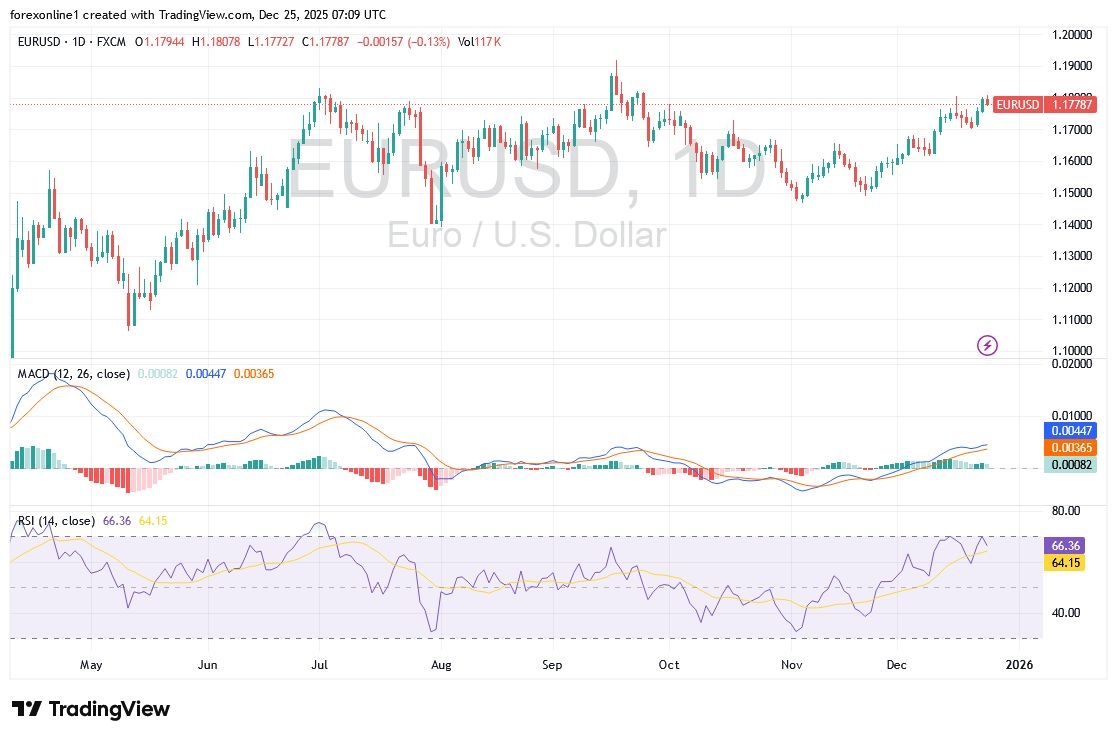
With the start of the Christmas holiday season, market liquidity is thinning and investor risk appetite is weakening until full market operations resume. Consequently, the EUR/USD exchange rate is expected to move within narrow ranges today, Thursday, staying close to its recent performance. According to reliable trading platforms, the Euro rose to 1.1807, breaking through a psychological level, before stabilizing around 1.1778 at the time of writing.
Bullish Scenario: The upward momentum for EUR/USD will strengthen if the price stabilizes above the 1.1800 resistance. As previously mentioned, this is the most critical level to watch for an eventual bullish breakout toward the 1.2000 resistance peak. Recent gains on the daily chart are beginning to push technical indicators into overbought territory, as seen in the 14-day Relative Strength Index (RSI) and the MACD.
Bearish Scenario: Conversely, for the “bears” to regain control of the general trend, the pair would need to return to the support vicinities of 1.1660 and 1.1500.
Today, No significant economic data releases impacting currency prices are expected.
Analysts at TradersUp advise caution when trading in narrow ranges during the annual holiday season to avoid sudden price gaps that could negatively impact open positions.
According to currency trading experts, MUFG Bank anticipates strong support for the Euro. They expect increased demand for the Euro from central banks, which will be a significant driver of its appreciation. Also, the bank sees room for increased purchases of official Eurozone sovereign bonds. He noted that: “The supply of sovereign bonds will increase in Europe, and negative yields are certainly a thing of the past. The supply of EU bonds will also increase. The €90 billion loan deal concluded for Ukraine last week will contribute to improved liquidity and a gradual increase in central bank demand.”
Nordea Bank commented on its European Central Bank interest rate forecast, stating: “We remain satisfied with our current baseline forecast of stable interest rates until the second half of 2027, where we expect the ECB to raise interest rates twice by 25 basis points each time.” It added: “The risk of further interest rate cuts has diminished, although the possibility of another cut has not disappeared entirely.”
Ready to trade our free Forex signals? Here are the best Forex brokers to choose from.
Pepeto ($PEPETO) is gaining attention as traders recalibrate their playbook between large-cap stability and early-stage acceleration. XRP is still a top-ranked asset with renewed confidence around its regulatory clarity narrative, but its current market structure looks like a slow builder instead of an explosive multiplier.
As the readers of crypto news today follow the next leg into 2026, the question is whether or not XRP survives and more whether there can be some fresh upside asymmetry. That is why a presale catalyst like Pepeto’s official $700,000 giveaway is being discussed as a high-velocity trigger at a time when XRP’s chart signals consolidation.
Source: https://finance.yahoo.com/news/why-xrp-could-best-yet-135411446.html
XRP Live Market Context and Indicators
CoinMarketCap indicates that XRP is trading for about $1.87 with a live market cap of close to $113,037,931,743 and a 24-hour volume of about $1,929,381,721. At that scale, the market tends to reward XRP with liquidity and durability, but at the same time there is compression of the opportunity for extreme multiples.
From a technical perspective, there are mixed short-term signals, which fit the consolidation story. The 14-day RSI is around 45.449, which is in a neutral area, indicating that there is no clear panic selling or momentum breakout. MACD is reading around -0.005, and this is usually interpreted as light downside pressure or hesitation in the trend, not necessarily a clean bullish power.
Moving averages provide additional support to this bearish mood. The 5-day average is close to $1.8588, and the 50-day average is close to $1.8783, leaving XRP not too far from its mid-trend reference point, but still close to it. That combo is supporting a measured XRP price prediction into 2026, where XRP can grind higher into adoption and macro tailwinds but is less likely to deliver a rapid 50x-style repricing.
Source: https://coinmarketcap.com/currencies/xrp/ – https://www.tradingview.com/symbols/XRPUSD/
Why XRP Resembles Stability Capital Into 2026
XRP’s bullish case is fundamentally different from meme-cycle breakouts. For this reason it is connected to network utility and long-horizon adoption and not merely viral reflex. That makes it attractive to investors looking to be exposed to a mature asset with deep liquidity.
However, with maturity, the return curve changes. When an asset is already in the hundred billion dollar market cap category, for the price to expand, it typically takes persistent inflow and continued macro support. This is why many of the traders are now considering XRP as a stable leg that can compound over time but never really shocks the market with sudden exponential upside.
Pepeto’s Giveaway and Meme Utility Demand Loops
Pepeto (https://pepeto.io) is approaching the market from the opposite angle. Its $700,000 giveaway, however, is not being framed as a gimmick but rather as an onboarding lever meant to accelerate wallet growth, community activity, and staking participation.
Giveaways can be used to increase the size of the holder base quickly, as they reduce the psychological barrier of the first-time participant. Once new wallets are onboarded, presales will often attempt to convert attention into longer holding behavior with staking incentives and visible stage progress.
Pepeto’s current snapshot aligns with that playbook. 1 $PEPETO is priced at $0.000000173, and the raise stands at $7,113,592.37 out of a $7,438,289 target with a countdown timer active for the next price increase. That element of timing can increase the sense of urgency because it links participating to a clear, observable time frame as opposed to an open-ended waiting.
Pepeto pairs the giveaway with a supply and staking framework designed to shape early behavior. Total supply is fixed at 420T, with staking yields promoted at around 216% to encourage early holders to lock tokens. With a community of over 100,000+ members and audits by SolidProof and Coinsult, the project looks to minimize the friction of trust as new wallets come in.
Pepeto’s core pitch is that it is not only a meme narrative, but also a meme infrastructure ecosystem. It is positioned on the Ethereum mainnet and includes PepetoSwap, described as a zero-fee swap; Pepeto Bridge, described as cross-chain functionality; and Pepeto Exchange, described as a verified meme exchange where all trading volume routes through $PEPETO. This routed volume claim is the thesis of the demand. Pepeto also highlights 850+ projects applying to list, implying that future listings can bring new communities and transactional volume into the same routing loop.
How to Buy Pepeto and Final Outlook
Type https://pepeto.io directly and verify the domain before connecting a wallet. Connect your wallet, then purchase with ETH, USDT, BNB, or a bank card via the official checkout. After making a purchase, you may want to consider staking immediately to activate the promoted yield while the presale is active. If you are participating in the giveaway, follow only the instructions found on the verified website.
Final Outlook
XRP is presently resembling stable capital with liquidity and a chart that points to consolidation instead of runaway momentum. Pepeto is a higher-risk presale built for speed with a giveaway catalyst, stage-based pricing, staking-driven supply lock, fixed 420T supply, audits, and a 100,000+ community.
For investors scanning the best crypto presale to buy list and looking for the best crypto to buy now, Pepeto is being framed as the high-velocity leg that can capture meme liquidity while larger assets like XRP build slowly into 2026.
To stay ahead of key updates, listings, and announcements, follow Pepeto on its official channels only:
Website: https://pepeto.io
X (Twitter): https://x.com/Pepetocoin
Telegram: https://t.me/pepeto_channel
Instagram: https://www.instagram.com/pepetocoin/
Contact: Dani Bonocci
Website: https://www.tokenwire.io
Phone: +971586738991
SOURCE: Pepeto
Press release distribution
This release was published on openPR.
Rio Tinto plc stock is ending 2025 with momentum—and with a long list of catalysts investors are trying to price in: record copper prices, a strategy reset under CEO Simon Trott, expanding lithium ambitions after a major acquisition, and fresh operational guidance stretching into 2026. Add in a legal dispute tied to sanctions and some governance constraints that affect buybacks, and Rio’s year-end story becomes more than “iron ore miner does iron ore things.”
Because December 25 is a market holiday in many regions, the most recent actionable pricing and news flow largely reflects Christmas Eve trading and the final pre-holiday news cycle.
As of the latest available trade (Wednesday, Dec. 24, 2025), Rio Tinto plc (NYSE: RIO) was around $80.89.
In London, Rio’s ordinary shares have also been pressing higher. MarketWatch reported Rio Tinto shares reached £59.31 on Dec. 22, a new 52-week high at the time. [1] Simply Wall St noted the last close near £59.82 and highlighted a strong multi-month climb that has investors re-checking valuation assumptions. [2]
One reason you’ll see slightly different “performance” numbers depending on where you look: Rio Tinto is dual-listed (plc in London; Limited in Australia), and the NYSE listing is an ADR. FX moves and local market dynamics can widen the gap between headlines even when the underlying business story is the same.
Copper has been the “gravity well” pulling diversified miners upward into late December. Reuters reported that London-listed miners gained as copper prices hit a record above $12,000, with Rio Tinto among the beneficiaries. [3]
The Financial Times put more detail around the move, linking the surge to tariff concerns and tight supply after disruptions at major mines—while also noting copper’s powerful 2025 run. [4]
For Rio Tinto stock, copper matters disproportionately not because copper is already the biggest revenue line (iron ore still dominates), but because copper is increasingly the growth narrative Rio wants the market to underwrite.
Rio Tinto used its December strategy briefing / Capital Markets Day messaging to frame the company as a leaner machine with clearer commodity priorities.
Rio said it is streamlining into three product groups:
That matters for investors because conglomerate complexity can hide costs, slow decision-making, and make capital allocation harder to judge. Rio is explicitly arguing it can run “tighter.”
Rio disclosed $650 million of annualised productivity benefits achieved early in the program, and it flagged more as the simplification effort continues. [6] Reuters also reported the same figure and noted that some analysts wanted more cost-out than the initial headline number. [7]
Rio also pointed to an expected 4% reduction in unit costs from 2024 to 2030. [8]
This is one of the most market-sensitive takeaways. Rio is exploring ways to free up $5–$10 billion through divestments, third-party funding, and partnership/ownership options across parts of its footprint. [9]
Reuters added that assets potentially on the block include titanium and borates, as Rio tries to concentrate on the “right assets in the right markets.” [10]
Rio reiterated a 40–60% shareholder returns policy (a key anchor for income-focused investors who hold Rio for dividends across cycles). [11]
Rio didn’t just talk strategy—it published real guidance that investors can model.
Rio upgraded 2025 copper production guidance to 860–875 kt, and it revised unit cost guidance down to 80–100 c/lb (from higher prior ranges). [12]
It also flagged changes elsewhere (including bauxite and IOC guidance updates). [13]
Rio released 2026 guidance including:
This guidance matters because it gives the market an “official” runway for 2026 earnings sensitivity, especially under different commodity price decks.
Reuters reported Rio is shifting focus toward copper and is aiming to produce 1 million tonnes a year by 2030, with Oyu Tolgoi in Mongolia a major lever. [15]
Why the market cares: when copper is setting records, investors tend to pay up for miners with credible copper volume growth and relatively defensible cost curves.
Iron ore remains Rio’s largest earnings driver, especially through the Pilbara system. Late December brought a niche but notable headline: Rio Tinto plans to replace the iron ore index used for settlement for some China shipments, according to a client notice referenced by traders.
Mining.com reported Rio emailed Chinese clients indicating Fastmarkets MB iron ore indices would replace Platts indices for settlement of shipments in the first two months of 2026, though it wasn’t clear why or whether it applied to all Chinese customers. [16]
This isn’t necessarily a “fundamentals earthquake,” but it is the kind of plumbing change that traders and contract negotiators watch closely—especially when pricing power is contested.
Rio also pushed forward on long-life iron ore optionality in Western Australia.
The company said the Rhodes Ridge Joint Venture approved a $191 million feasibility study to progress the first phase of the Rhodes Ridge project, targeting an initial 40–50 million tonnes per year of iron ore capacity. [17]
Additional details Rio disclosed:
For Rio Tinto stock, Rhodes Ridge is less about next quarter and more about “can Pilbara remain a multi-decade cash machine while the company pivots capital toward copper and lithium?”
Rio’s lithium narrative got much more serious in 2025.
S&P Global reported that Rio’s $6.7 billion acquisition of Arcadium Lithium closed in March, giving Rio a much larger lithium resource base and a platform for scaled growth. [19]
Rio’s lithium ambition (as summarized in that reporting and Rio’s own briefing):
But S&P Global also captured the key tension: capex inflation and execution risk. Industry voices in the piece described Rio’s published capex numbers as “sobering,” with costs in Argentina affected by inputs, energy, and inflation dynamics—meaning the margin story depends heavily on delivery discipline and market timing. [21]
This is important for Google News/Discover readers because lithium is where mining stories often go to die: grand spreadsheets meet geology, inflation, and politics.
Rio and peers are also trying to decarbonise the most diesel-heavy part of mining: haulage.
Reuters reported BHP began a trial of two battery-electric haul trucks at its Jimblebar iron ore mine, under a collaboration involving BHP, Rio Tinto and Caterpillar, to evaluate how electric haulage could scale in large Pilbara operations. [22] BHP’s own release confirmed the arrival of Caterpillar’s battery-electric trucks and the start of on-site testing in collaboration with Rio Tinto. [23]
For Rio stock, this is less about immediate earnings and more about:
Analyst targets are not truth tablets delivered from Mount Bloomberg, but they do shape positioning—especially when a stock is near highs.
MarketScreener reported Berenberg maintained a Neutral view and adjusted a target price around GBX 5,200 in a December note. [24] TheFly (via TipRanks) also reported Berenberg lifting a target to 5,300 GBp while keeping a Hold rating. [25]
MarketBeat’s snapshot for the London listing shows:
Simply Wall St highlighted a separate consensus framing, citing a consensus target near £51.491, with a wide spread between bullish and bearish targets. [27]
MarketBeat’s ADR page shows:
TipRanks shows a smaller set of recent analysts (as displayed on the page) with:
Why the difference between platforms? Methodology and coverage lists vary (how many analysts, how recent, whether older targets are included, how ADR vs local listing is handled). Treat these as sentiment indicators, not precision instruments.
With copper now a centerpiece of Rio’s “growth metals” story, bank outlooks matter.
Reuters reported Goldman Sachs expects copper to consolidate around $11,400/ton in 2026 amid tariff uncertainty, while still favoring copper on long-term electrification demand and constrained supply. [30]
The nuance for Rio investors: even if copper cools from record highs, the market may still reward producers that can grow volume and improve costs—which is exactly what Rio is trying to signal with its Oyu Tolgoi and productivity messaging.
Reuters reported a Russian court ruled in favor of Rusal in a $1.32 billion lawsuit against Rio Tinto tied to a dispute over a joint alumina refinery in Queensland after sanctions-related actions. Rio rejected the Russian proceedings and said it would defend its position. [31]
Even if investors discount enforceability, this is headline risk—and it intersects with geopolitics, sanctions, and cross-border legal complexity.
Reuters reported Rio is working with its main shareholder Chinalco on solutions to governance constraints that restrict buybacks. Reuters also noted discussion of potential structures (including an asset-for-equity concept previously reported) and referenced an ownership cap set by Australian authorities. [32]
For shareholders, buybacks are a lever that can materially change capital return optics—especially in strong commodity tape.
Rio’s own plan ties lithium growth to market/returns discipline, but the sector’s history is full of “great assets, painful timing.” The S&P Global reporting underscored cost escalation and the pressure it puts on returns if lithium pricing doesn’t cooperate. [33]
The next catalyst cluster is likely to hit in January, when markets are back at full volume and investors stop pretending holidays are a personality trait.
MarketScreener’s calendar lists Rio’s Q4 2025 Sales and Revenue Release / Operations Review around Jan. 20. [34]
Into early 2026, the market will be watching:
Rio Tinto stock is riding a late-2025 tailwind from metals—especially copper—while also trying to convince investors it deserves a higher-quality multiple: tighter operations, a clearer portfolio, and disciplined capital allocation.
The bullish case is basically: record (or near-record) copper + credible copper growth + still-massive iron ore cash flows + shareholder returns discipline.
The bear case is: commodity cycles revert, lithium costs bite, geopolitical/legal noise grows, and “simplification” delivers fewer real dollars than the strategy slides imply.
As of Dec. 25, 2025, the market seems to be leaning optimistic—but not blindly: a lot of analyst framing still reads “Hold,” which often means “we believe the story, but the easy money may already be in the price.” [35]
1. www.marketwatch.com, 2. simplywall.st, 3. www.reuters.com, 4. www.ft.com, 5. www.riotinto.com, 6. www.riotinto.com, 7. www.reuters.com, 8. www.riotinto.com, 9. www.riotinto.com, 10. www.reuters.com, 11. www.riotinto.com, 12. www.riotinto.com, 13. www.riotinto.com, 14. www.riotinto.com, 15. www.reuters.com, 16. www.mining.com, 17. www.riotinto.com, 18. www.riotinto.com, 19. www.spglobal.com, 20. www.spglobal.com, 21. www.spglobal.com, 22. www.reuters.com, 23. www.bhp.com, 24. www.marketscreener.com, 25. www.tipranks.com, 26. www.marketbeat.com, 27. simplywall.st, 28. www.marketbeat.com, 29. www.tipranks.com, 30. www.reuters.com, 31. www.reuters.com, 32. www.reuters.com, 33. www.spglobal.com, 34. www.marketscreener.com, 35. simplywall.st
The Food Safety and Standards Authority of India (FSSAI) on Thursday said that the term “tea” cannot be used on labels of herbal or plant-based infusions as it will amount to misbranding. It pointed out that only beverages derived from Camellia sinensis including Kangra Tea, Green Tea and Instant Tea can be labelled as Tea. It has directed food companies including e-commerce platforms to comply with the requisite standards and refrain from misbranding tea products. It has also asked states and UTs to ensure adherence to standards in this regard and take action.
“It has come to the notice of FSSAI that some Food Business Operators (FBOs) are marketing products that are not obtained from the plant Camellia sinensis under the name ‘Tea’, such as ‘Rooibos Tea’, ‘Herbal Tea’, ‘Flower Tea’, among others,” the Authority stated in an advisory.
It is clarified that, as per standards specified in the Food Safety and Standards (Food Product Standards and Food Additives) Regulations, 2011, the term “Tea”, including Kangra Tea, Green Tea and Instant Tea in solid form, can be exclusively from the plant Camellia sinensis.
Stating that every food package must carry the “true nature” of the food contained in the package on the front of pack, it added the use of the word “Tea” directly or indirectly for any other plant-based or herbal infusions or blends not derived from Camellia sinensis is misleading and amounts to misbranding.
“As per the aforementioned regulation, such plant-based or herbal infusions or blends, which are not derived from Camellia sinensis, do not qualify to be named as Tea,” it added.
All Food Business Operators including e-commerce engaged in manufacturing, packing, marketing, import or sale of such products are directed to comply with the provisions of the Food Safety and Standards Regulation and refrain from using the term “Tea” for any products not derived from Camellia sinensis, it added.
The Authority directed Food Safety Commissioners of all states and UTs and Regional Directors to direct the Designated Officers and Food Safety Officers under their jurisdiction to monitor and ensure strict adherence to these provisions by the Food Business Operators including e-commerce.
“In case of non-compliance, necessary action shall be initiated as per the provisions of the Food Safety and Standards Act, 2006,” it added.
Published on December 25, 2025