The main category of All News Articles.
You can use the search box below to find what you need.
[wd_asp id=1]
The main category of All News Articles.
You can use the search box below to find what you need.
[wd_asp id=1]
Price movements in platinum are often sharper than gold or silver due to its limited availability and reliance on a few global mining regions. Automotive regulations, global production levels, and technology usage influence the platinum price today. As platinum becomes more relevant in clean energy applications, its daily rate has gained importance for both buyers and investors.
I wrote on 15th March that the best trades for the week would be:
Long of the USD/JPY currency pair. This gave a loss of 0.31%.
Long of Wheat. This gave a loss of 1.27%.
Last week’s overall loss of 1.58% is 0.79% per asset.
A summary of last week’s most important data in the market:
US Federal Reserve Policy Meeting – a slightly hawkish tilt as the Fed emphasized inflation risk from the secondary effects of the war in the Middle East, which briefly sent the US Dollar higher.
US PPI – this was much stronger than expected, showing a month-on-month increase of 0.7% while only 0.3% was widely forecast. This suggests higher inflationary pressure in the USA and contributed to the more hawkish sentiment around the US Dollar.
Reserve Bank of Australia Policy Meeting – the Cash Rate was hiked by 0.25% as expected, and the renewed strong focus on inflation was seen as mildly hawkish.
Bank of Japan Policy Meeting – a slightly hawkish hold, with one board member pushing for a rate hike of 0.25% now.
European Central Bank Policy Meeting – a hawkish hold, as the bank revised its 2026 inflation forecast upward.
Bank of England Policy Meeting – a solidly hawkish hold, with analysts now seeing a chance of a rate hike later in 2026.
Bank of Canada Policy Meeting – a marginally dovish hold, with the Bank downplaying inflationary risk.
Canadian CPI (inflation) – slightly lower than expected, showing an increase of only 0.5% month-on-month while 0.7% was widely expected.
Swiss National Bank Policy Meeting – arguably a slightly dovish hold, as the Bank are acting in a way that suggests further cuts to a negative rate are possible.
US Unemployment Claims – very slightly better than expected.
New Zealand GDP = worse than expected, with growth increasing by only 0.2% when 0.5% was expected.
Australia Unemployment Rate – this rose unexpectedly from 4.1% to 4.3%.
UK Unemployment Claims – as expected.
Last week’s data had little effect on the market, excepting the boost in the US Dollar and the strengthening of the Euro after the ECB’s hawkish rate hold. Generally, we are seeing hawkish central banks against the backdrop of a potentially inflationary energy price shock generated by the ongoing war in the Middle East. There are open and frightening questions over how this war might end, with the parties on the bring of seriously escalating by targeting critical energy and infrastructure.

The latest developments in the war are:
A few hours ago, President Trump issued an ultimatum that if the Strait of Hormuz is not opened by Iran within 48 hours, the USA will start destroying Iranian power plans. This follows several days of attacks on other countries’ infrastructure by Iran, which has been aiming at Israel’s (alleged) nuclear reactor in its South and at the oil refinery in Haifa. It is hard to see an outcome where Iran backs down over this so we can expect US attacks here probably on Tuesday or Wednesday. This threat, let alone its execution, is likely to rattle energy and stock markets.
Seven NATO and non-NATO allies have pledged to assist the USA in reopening the Strait of Hormuz. However, experts believe such a military operation will take a few weeks to be executed.
Prediction markets see this war continuing for at least another five weeks, into May, after US troops enter Iran at some point in April. This war is very unlikely to stop quickly, which increases the potential for it to disrupt or influence markets.
Clearly, the USA and Israel are successfully striking all the targets they want to inside Iran, while suffering very few casualties themselves. There is damage to US bases and facilities near the Gulf, and relatively minor damage in Israel, although yesterday’s missile strikes produced an unusually large number of casualties which Israel will see as an escalation to be met.
There is massive damage to Iran’s regime and military. What is far from clear is the fate of the Iranian regime and the large supply of enriched uranium which is somewhere in Iran.
We are on the brink of a very serious escalation.
The middle east war is likely to remain more influential that any economic data releases which are scheduled over the coming week, especially if it escalates towards increased targeting of infrastructure. The top three items have realistic potential to move the market a bit, especially in the British Pound and in the Australian Dollar.
The coming week’s most important data points, in order of likely importance, are:
UK CPI (inflation)
Australian CPI (inflation)
USA, Germany, UK Flash Services & Manufacturing PMI
US Unemployment Claims
UK Retail Sales
Currency Price Changes and Interest Rates
For the month of March, I made no monthly Forex forecast as the US Dollar was not in a clear trend at the start of the month.
Last week saw no currency crosses with excessive volatility, so I am making no forecast for the coming week.
The Euro was the strongest major currency last week, while the Swiss Franc was the weakest. Directional volatility decreased strongly last week, with only 11% of all major pairs and crosses changing in value by more than 1%.
Next week’s volatility is likely to increase and might be exceptionally high due to the escalation of the war in the Middle East, which is now threatening power facilities, oil facilities, and desalination plants. This could generate volatility in the US Dollar, the Japanese Yen, and the Canadian Dollar, not to mention stock markets. There could also be unforeseen side effects which might affect other currencies.
You can trade these forecasts in a real or demo Forex brokerage account.
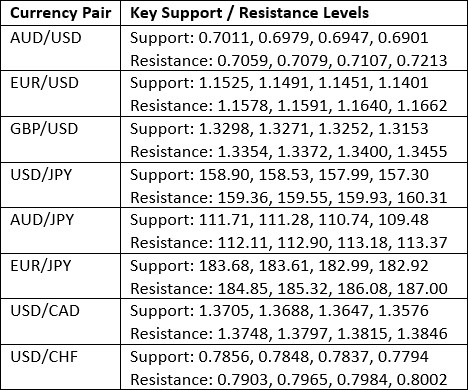
Key Support and Resistance Levels
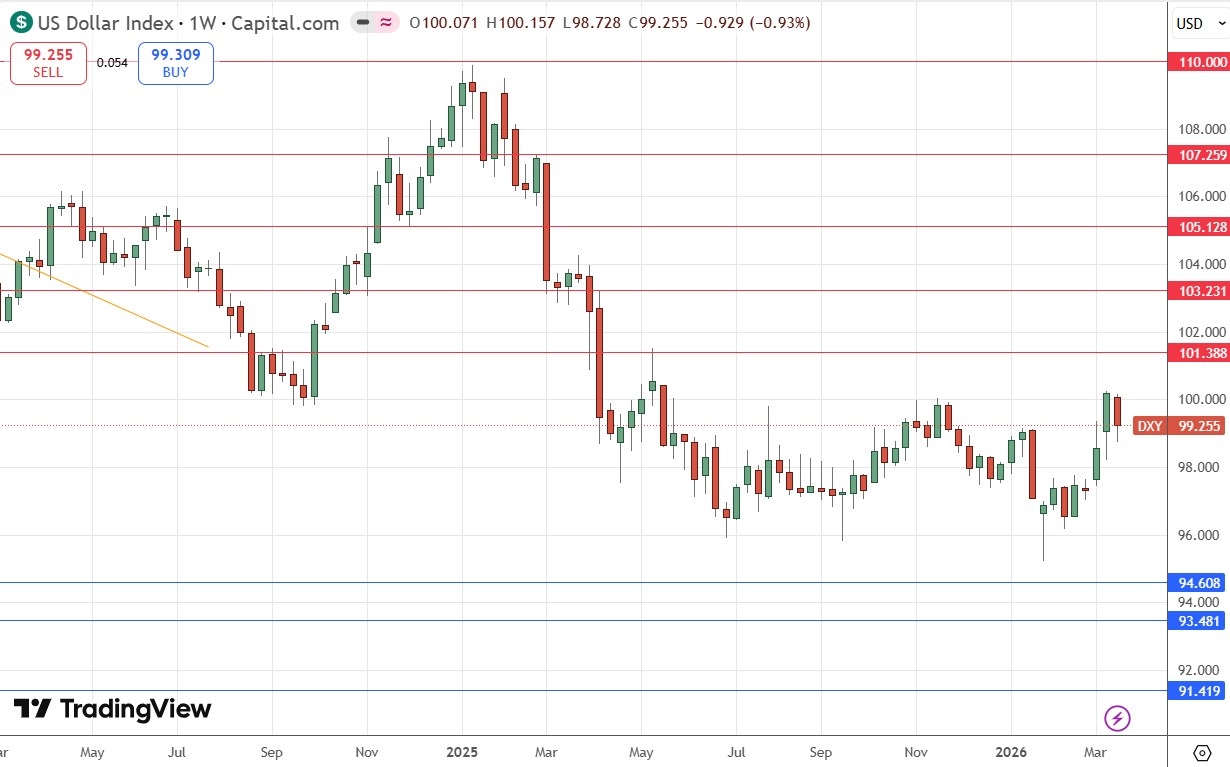
The US Dollar printed a bearish inside bar, although the price remains within a valid long-term trend. There is a lower wick on the candlestick, which is a minor bullish sign. The price has more room to rise before reaching the key resistance level at 101.39.
I think expecting the greenback to rise is still the healthy and correct approach despite this minor retracement, because fundamentals and sentiment still point towards a rising US Dollar, with US Treasury Yields reaching significant highs last week. The Fed itself expects to make one rate cut in 2026, though, although the market does not agree that this is likely to happen.
US Dollar Index Weekly Price Chart
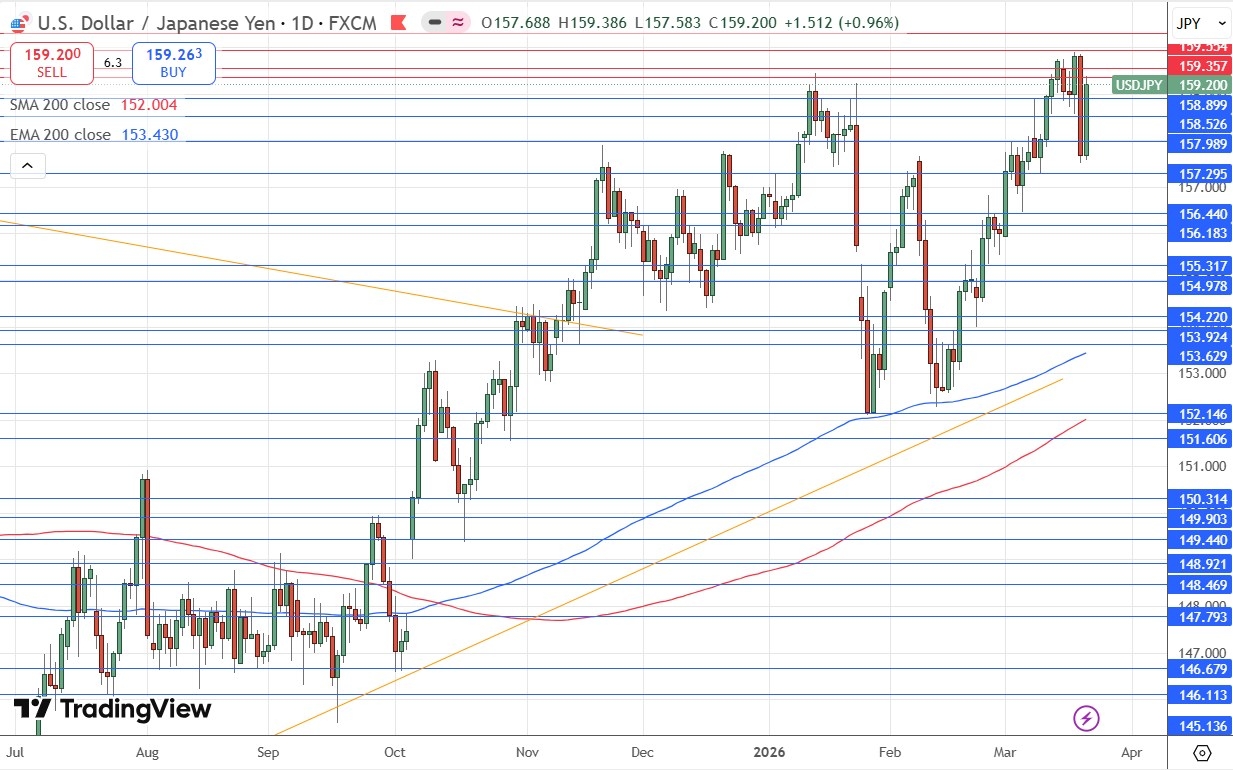
The USD/JPY currency pair gained strongly at the end of last week but could still not regain the high price made earlier in the week, which represented a long-term high. I am long of this currency pair. The only doubts I have is that we have not yet cleared the big round number at ¥160 which has acted as resistance for a long time, and that the technically significant breakout is taking a long time to happen.
The US Dollar lost some ground last week but did better against the Japanese Yen than it did against many other currencies. The Bank of Japan did not look like it is about to start hiking rates very soon at its meeting last week, and that has caused a little underlying weakness in the Yen.
There are excellent fundamental, sentimental, and technical reasons to be long here, but more cautious traders might want to wait for a New York close above ¥160 before going long.
USD/JPY Daily Price Chart
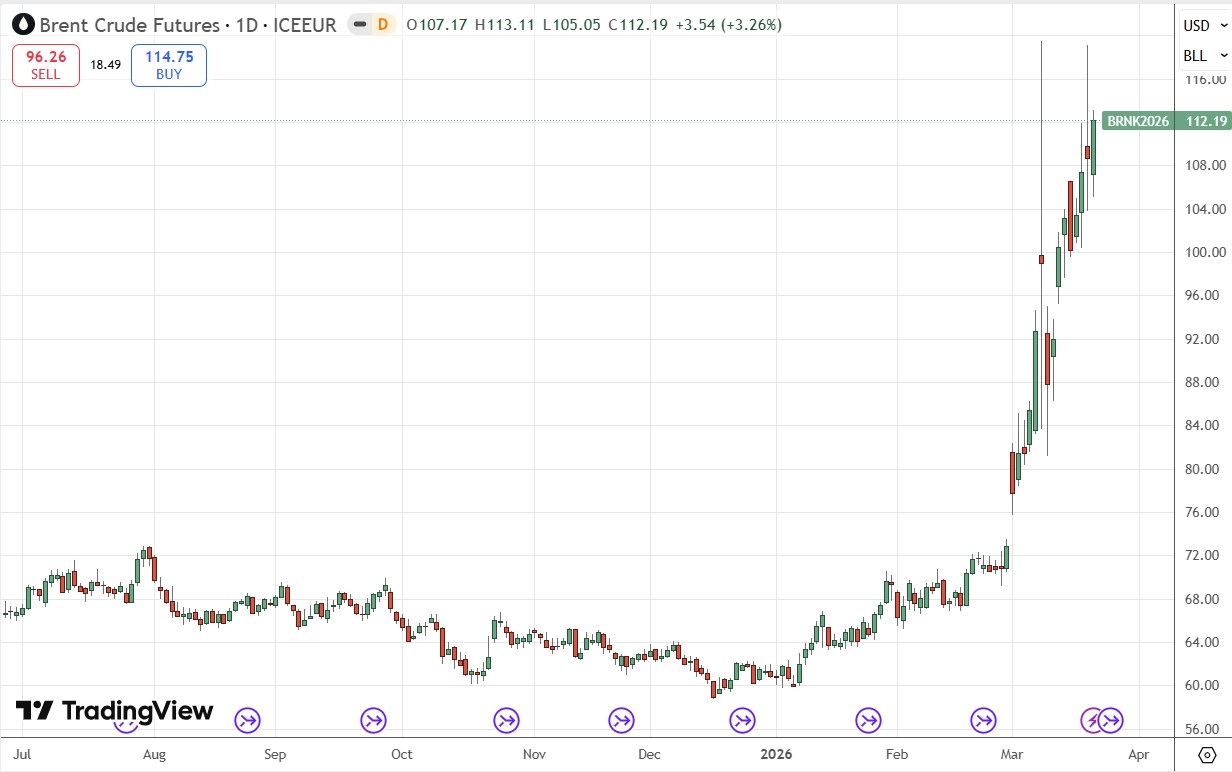
Brent Crude Oil is outperforming WTI Crude Oil, mainly because the USA is functionally energy independent (WTI), while Brent Crude is seaborne international trade which is currently more prone to well-founded fears of supply disruption due to the war in the Middle East and Iranian blockade of the Strait of Hormuz.
The war in the middle east is showing signs of escalating as President Trump threatens Iranian power stations if Iran does not open the Strait of Hormuz by about dawn local time Tuesday. Iran in turn threatened power and desalination plants throughout much of the Middle East, which it has already shown it is prepared to target and in some cases able to target.
These threats, as well as ongoing speculation that the USA might seize Kharg Island as one of its next military steps, are spooking markets – we can be sure that markets will open with energy prices higher and stock markets lower as the new week gets underway, unless there is a credible rumour of ceasefire talks.
Polymarket is showing US ground troops in Iran at some point during April and the USA (plus presumably Israel) ceasing operations in May, meaning the war will probably go on for at least another five weeks.
It is likely to be dangerous to enter now as we could easily see a fast and huge move in the price either up or down. However, the price action does look bullish, so longs will still be dominating orders. I don’t see the Iranians backing down, and I think that means a week of rising crude oil prices.
Despite the mature and very over-extended trend here, and its total reliance on geopolitical developments, I think it will still be a good idea to enter long on bullish price action using a trailing stop (I prefer 3 X ATR (100)). It will probably be wise to use a very small position size maybe one-quarter of the usual, or maybe even one-eighth.
Brent Crude Oil Daily Price Chart
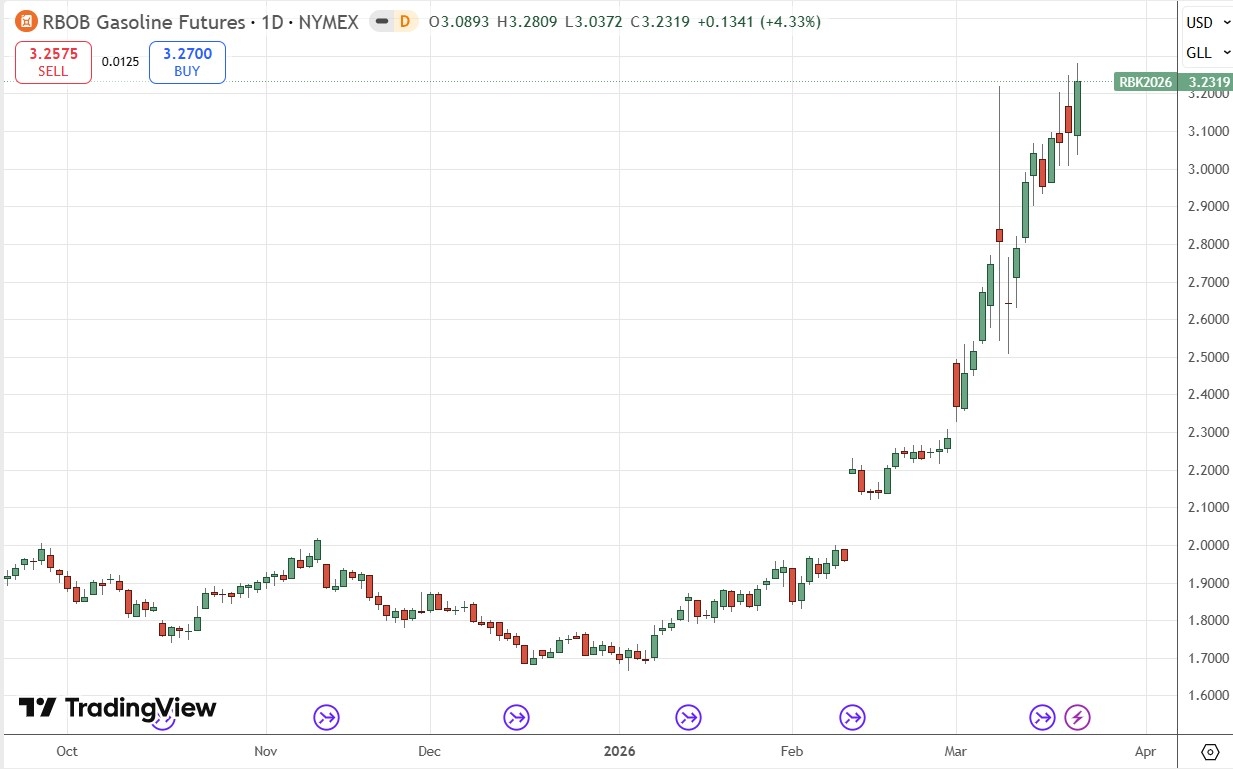
RBOB Gasoline futures rose firmly to close at a new 3-year high last week ending very near the high price, which was made on Friday. Gasoline is trading in blue sky and can keep rising easily.
This is all about what I wrote above concerning Brent Crude Oil. As the price of crude oil rises, so the price of Gasoline is almost certain to rise with high positive correlation between the two assets, as gasoline is derived by refining crude oil.
As I wrote above, it might be too late for a long trade, but it may be wise to try to get in on the ongoing action using a very small position size (respect the very high volatility) and a trailing stop to avoid a catastrophic loss. Remember that what goes up very hard and very fast can come down just the same way.
RBOB Gasoline Futures Daily Price Chart
Last week was poor for the US stock market, with the S&P 500 Index falling quite heavily to reach a new 6-month low, with the daily chart closing below both the SMA 200 and the EMA 200. These are bearish signs, although it is worth pointing out that the market is not down by even 10% from its recent all-time high which it reached just a few weeks ago.
I was correct last week in saying that the price would quickly reach the significant round number at 6,500. What will be closely watched now is whether the price continues to descend below that. If it spends most of the coming week below 6,500 that will be a very bearish sign and point to further losses.
President Trump and Iran’s latest infrastructure threats are likely to further spook the market. Unless there is contrary news, I am sure this Index will open below 6,500 and probably lose some more ground on Monday.
The escalating war in the Middle East is not the only thing weighing on the stock market. It is also very over-extended and overbought and due a significant retracement, and the worrying war was easily enough to give that a tailwind.
Despite the bearish outlook, shorting the US stock market, especially an Index, is not easy, and should only be attempted by experienced traders. A bullish bounce over the coming week, or at least a consolidation and minor gain, is a possible outcome, as we are in a price area where you could expect long-term buyers to step in.
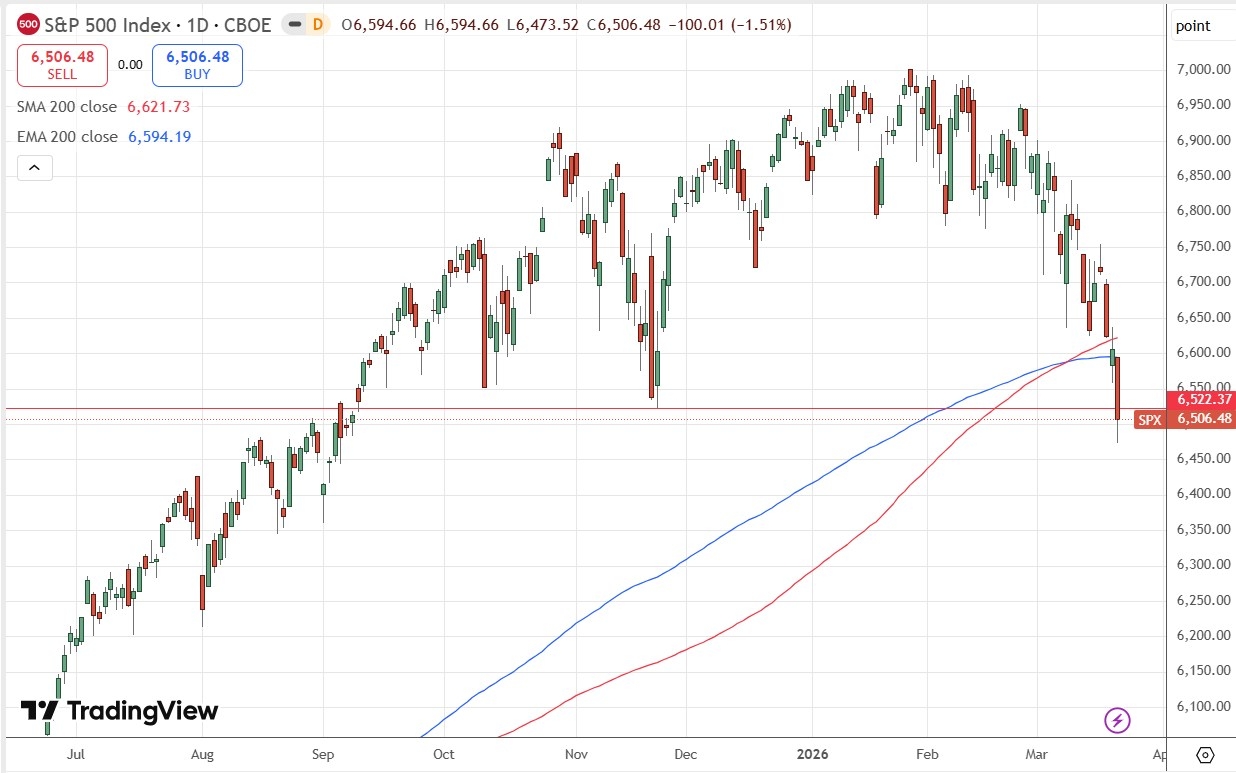
S&P 500 Index Daily Price Chart
I see the best trades this week as:
Long of the USD/JPY currency pair.
Long of Brent Crude Oil but with ¼ of the normal position size.
Long of Gasoline but with ¼ of the normal position size.
Price movements in platinum are often sharper than gold or silver due to its limited availability and reliance on a few global mining regions. Automotive regulations, global production levels, and technology usage influence the platinum price today. As platinum becomes more relevant in clean energy applications, its daily rate has gained importance for both buyers and investors.
Domestic coffee prices
The domestic coffee market entered Sunday (March 22) with a calm state after a strong increase at the end of the week. According to records, purchase prices in key Central Highlands regions simultaneously surged by another 500 – 700 VND/kg in the previous session, pushing the average price level of the whole region to 94,000 VND/kg. This is the highest price range recorded since the beginning of March, showing the extremely strong recovery momentum of Vietnamese coffee.
Detailed purchase prices in regions:
Dak Lak, Gia Lai and Dak Nong (old): Simultaneously maintaining the highest level in the region at 94,000 VND/kg.
Lam Dong: Nestling stable at 93,000 VND/kg after a 700 VND increase at the end of the week.
Looking back over the past week, coffee prices have had a spectacular “comeback”. From the bottom of 90,400 VND at the beginning of the week (March 16), prices have continuously broken through to regain more than 3,500 VND per kg, dispelling concerns after forecasts about record crops in Brazil.
World coffee prices
At the end of the trading week, international futures exchanges recorded a clear polarization between the two coffee flows:
New York Stock Exchange (Arabica): Closing the trading week at the highest level in 1.5 months. May 2026 futures closed at 309.75 cents/lb. Concerns about the closure of the Strait of Hormuz disrupting global transportation completely overwhelmed the pressure from StoneX’s record production report of 75.3 million sacks.
London Stock Exchange (Robusta): May 2026 delivery limit stopped at 3,664 USD/ton. Despite receiving slight profit-taking pressure at the end of the week due to the strengthening USD, Robusta still received solid support as inventories on the ICE exchange continued to be at a record low in the past 2 months.
Market opinion
Last week, the market witnessed the strength of geopolitical factors confronting long-term supply forecasts. The sharp increase in logistics, insurance and fuel costs due to the conflict in the Middle East has created a temporary “bottleneck”, pushing coffee prices to recover strongly. However, abundant rainfall in Brazil (reaching 139% of the historical average) and Vietnam’s January-February exports increasing by 14% are still factors that need to be noted when entering the new week.
Forecast for next week, coffee prices will continue to fluctuate positively around the 93,500 – 95,500 VND/kg range. If the sea transport situation shows no signs of cooling down, prices may soon re-establish the 96,000 VND mark as at the end of February.
Silver price (XAG/USD) retreats late in the North American session, down by over 6.80% in the day, poised to finish the week with losses of more than 15.70%, posting its second-largest weekly loss since the one that ended down 17.39% on January 30. At the time of writing, XAG/USD trades at $67.89.
Although turned bearish this week, Silver remains upward biased as long as the bulls keep spot prices above the February 6 swing low of $64.10. In the short term, XAG/USD turned negative after falling below the 100-day SMA at $72.55, which exacerbated a drop below $70.00, towards a six-week low of $65.52.
Nevertheless, in the medium term, the market structure has respected the successive series of higher lows and higher highs, keeping the bulls in the driver’s seat.
Momentum notably favours sellers, as evidenced by the Relative Strength Index (RSI), which pierced its neutral level and fell sharply toward oversold territory. A drop below the RSI’s 30 level and a quick jump back above it could open the door to form a bottom, IF the RSI consolidates steadily, registering higher peaks and troughs.
For a bull market recovery, XAG/USD needs to reclaim $70.00 and the 100-day SMA. Once surpassed, the next stop is the cycle low-turned-resistance at $77.98, the March 3 daily low.
Silver is a precious metal highly traded among investors. It has been historically used as a store of value and a medium of exchange. Although less popular than Gold, traders may turn to Silver to diversify their investment portfolio, for its intrinsic value or as a potential hedge during high-inflation periods. Investors can buy physical Silver, in coins or in bars, or trade it through vehicles such as Exchange Traded Funds, which track its price on international markets.
Silver prices can move due to a wide range of factors. Geopolitical instability or fears of a deep recession can make Silver price escalate due to its safe-haven status, although to a lesser extent than Gold’s. As a yieldless asset, Silver tends to rise with lower interest rates. Its moves also depend on how the US Dollar (USD) behaves as the asset is priced in dollars (XAG/USD). A strong Dollar tends to keep the price of Silver at bay, whereas a weaker Dollar is likely to propel prices up. Other factors such as investment demand, mining supply – Silver is much more abundant than Gold – and recycling rates can also affect prices.
Silver is widely used in industry, particularly in sectors such as electronics or solar energy, as it has one of the highest electric conductivity of all metals – more than Copper and Gold. A surge in demand can increase prices, while a decline tends to lower them. Dynamics in the US, Chinese and Indian economies can also contribute to price swings: for the US and particularly China, their big industrial sectors use Silver in various processes; in India, consumers’ demand for the precious metal for jewellery also plays a key role in setting prices.
Silver prices tend to follow Gold’s moves. When Gold prices rise, Silver typically follows suit, as their status as safe-haven assets is similar. The Gold/Silver ratio, which shows the number of ounces of Silver needed to equal the value of one ounce of Gold, may help to determine the relative valuation between both metals. Some investors may consider a high ratio as an indicator that Silver is undervalued, or Gold is overvalued. On the contrary, a low ratio might suggest that Gold is undervalued relative to Silver.
Important DisclaimersFXEmpire is owned and operated by Empire Media Network LTD., Company Registration Number 514641786, registered at 7 Jabotinsky Road, Ramat Gan 5252007, Israel. The content provided on this website includes general news and publications, our personal analysis and opinions, and materials provided by third parties. This content is intended for educational and research purposes only. It does not constitute, and should not be interpreted as, a recommendation or advice to take any action, including making any investment or purchasing any product. Before making any financial decision, you should conduct your own due diligence, exercise your own discretion, and consult with competent advisors. The content on this website is not personally directed to you, and we do not take into account your individual financial situation or needs. The information contained on this website is not necessarily provided in real time, nor is it guaranteed to be accurate. Prices displayed may be provided by market makers and not by exchanges. Any trading or other financial decision you make is entirely your own responsibility, and you must not rely solely on any information provided through the website. FXEmpire does not provide any warranty regarding the accuracy, completeness, or reliability of any information contained on the website and shall bear no responsibility for any trading losses you may incur as a result of using such information. The website may include advertisements and other promotional content. FXEmpire may receive compensation from third parties in connection with such content. FXEmpire does not endorse, recommend, or assume responsibility for the use of any third-party services or websites. Empire Media Network LTD., its employees, officers, subsidiaries, and affiliates shall not be liable for any loss or damage resulting from your use of the website or reliance on the information provided herein.Risk DisclaimersThis website contains information about cryptocurrencies, contracts for difference (CFDs), and other financial instruments, as well as about brokers, exchanges, and other entities trading in such instruments. Both cryptocurrencies and CFDs are complex instruments and involve a high risk of losing money. You should carefully consider whether you understand how these instruments work and whether you can afford to take the high risk of losing your money. FX Empire encourages you to conduct your own research before making any investment decision and to avoid investing in any financial instrument unless you fully understand how it works and the risks involved.
Energy prices are set to fall on 1 April when the new price cap comes into effect, but war in the Middle East could mean energy prices soar in the summer.
The new Ofgem energy price cap period will begin on 1 April, with energy bills for most households set to fall by 7%, the equivalent of £117 a year.
The cut comes after the government announced it would scrap some green levies from household bills in the Autumn Budget worth around £150.
Article continues below
Don’t miss the latest investment and personal finances news, market analysis, plus money-saving tips with our free twice-daily newsletter
Don’t miss the latest investment and personal finances news, market analysis, plus money-saving tips with our free twice-daily newsletter
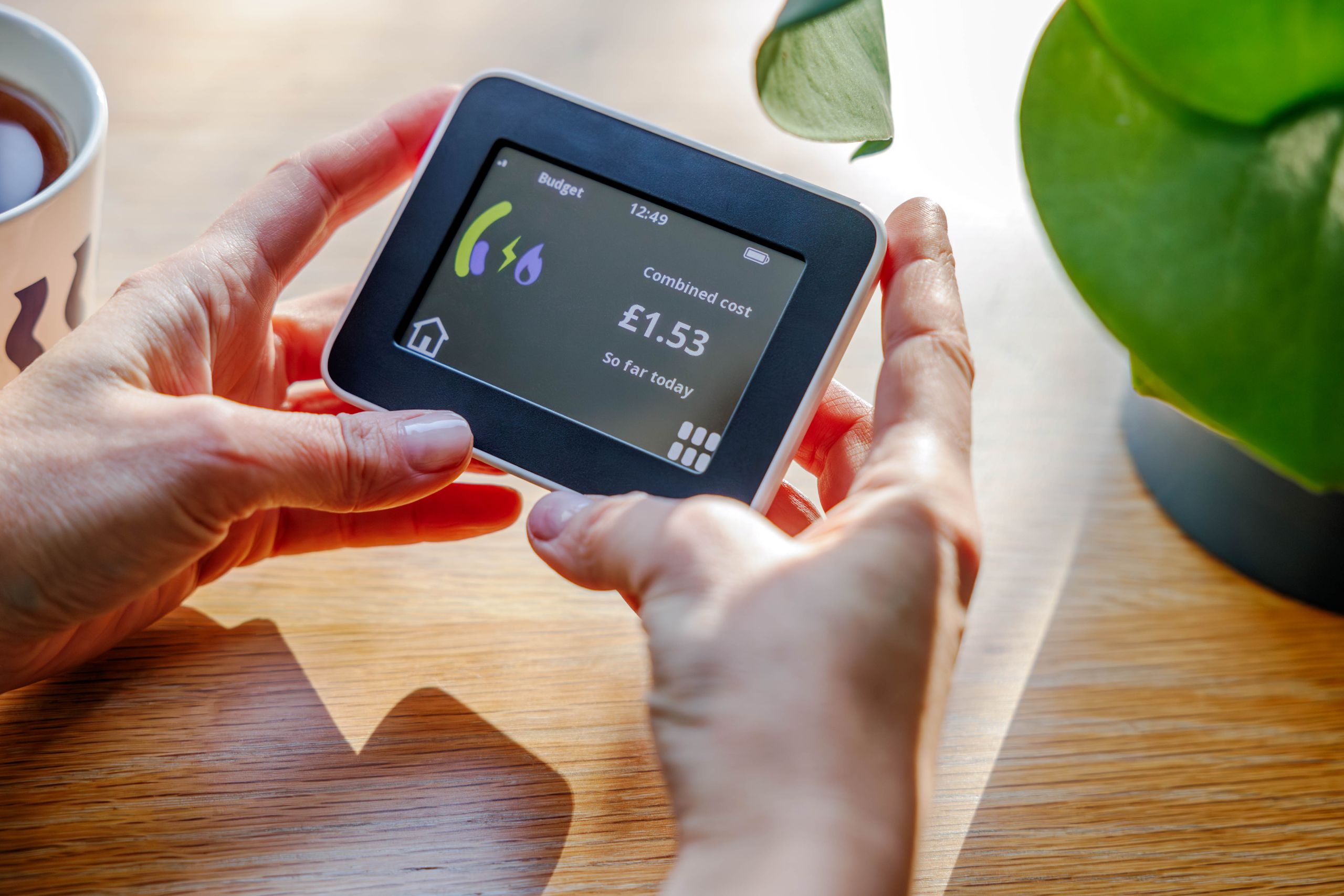
Gas and electricity bills will fall on 1 April as the new energy price cap will bring the annual average energy bill for a dual-fuel household paying for their energy by direct debit to £1,641.
That is a saving of £117 per year when compared to the current January to March price cap of £1,758 – but remember, the cap is a cap on unit prices, not your total bill, so your actual bill is determined by what you use.
Bills have been able to fall in April after the government said it will remove some environmental levies that fund eco schemes that add to costs for households.
The government said the majority of households in the UK will benefit from the policy and the savings will apply to all tariffs, including variable tariffs, fixed tariffs, tracker tariffs and time-of-use tariffs.
The savings will come despite an overall increase to the cost of servicing the UK’s energy infrastructure that was set to increase bills by around £57 had the government not stepped in.
Lower bills will be welcomed by households in the second quarter of the year, but how long will the savings last?
Ofgem, the energy regulator,will confirm the next price cap, covering the July to September period, by 27 May. It is widely expected to announce an increase in prices.
Cornwall Insight, an energy consultancy well-regarded for the accuracy of its price cap predictions, expects the July price cap to rise to £1,972 – an increase of around £331, or 20%.
Before the current conflict, Cornwall Insight expected the July price cap to be £1,645.
The reason for the rise is that the global energy market has been thrown into turmoil following the joint US and Israeli strikes on Iran on 28 February, which led to increased hostilities in the Middle East, where a significant proportion of the world’s oil comes from.
In particular, the conflict has led to Iran closing the Strait of Hormuz, a narrow naval passageway between the coasts of Iran and Oman through which around 20% of the world’s oil is transported.
Since the beginning of the conflict very few ships have managed to safely pass through the strait, pushing up global oil prices. The price of a barrel of Brent crude oil was around $70 before the conflict – it is now north of $100.
Increases to the cost of oil have major knock-on effects on the prices of many other commodities which are produced using oil.
For example, the price of a litre of petrol has increased by 10.5p since the conflict, while the price of heating oil has more than doubled.
The supply of liquified natural gas (LNG), which makes up around 33% of the UK’s energy supply and is mainly imported, has also risen significantly since the start of the conflict.
Ofgem calculates the price cap by observing the average wholesale price of energy over a three-month period, and as this period will include spiking prices due to the war, we can expect the price cap to increase.
Craig Lowrey, principal consultant at Cornwall Insight, said: “The latest forecast puts the role of wholesale markets firmly back in the spotlight and illustrates how exposed UK households remain to international market movements.
“While the rise is eye‑catching, any immediate concern should be tempered. We are still early in the assessment period for the July cap, and what happens in the energy markets over the next three months will be the key factor, rather than this spike alone.”
Other forecasters have similar predictions.
Economists at the Bank of England (BoE) expect household energy prices to increase in the summer when the July price cap kicks in, helping push inflation to 3.5% in the third quarter of 2026.
The BoE used these forecasts to help inform its decision to hold interest rates at 3.75% at the most recent meeting of ratesetters at the Monetary Policy Committee.
EDF Energy expects the price cap will rise £217 on 1 July, from £1,641 to £1,858. This prediction comes in £112 higher than predictions before the conflict. It says prices could rise again in October, to £1,919, and start 2027 at £1,928.
Meanwhile, Economists at consultancy Oxford Economics expect the price cap to rise by 19% in July.
If you’re struggling to afford your energy bills, your energy supplier may offer support with hardship grants. Octopus Energy has Octo Assist and British Gas has the British Gas Energy Trust.
You may be able to get a repayment holiday. This is where you ask your supplier to pause your repayments for a short amount of time to give you some breathing space.
Another option is to agree to an affordable payment plan. You will pay fixed amounts over a set period of time, which will cover what you owe plus an amount for your current use.
If you are on benefits, you might be able to repay your debt directly from your benefits through the Fuel Direct Scheme.
According to Citizens Advice, the Fuel Direct Scheme can be a good option if you can’t agree on a plan to pay back your debt, and it’s usually better than getting a prepayment meter.
Additionally, some government schemes give some households money towards paying their energy bills.
The Warm Home Discount is offered to households in receipt of some means-tested benefits who use participating energy suppliers and provides £150 of credit that is automatically paid towards your energy bill.
Meanwhile, if you are a pensioner with an income of £35,000 or less, you will be eligible for the Winter Fuel Payment, which provides retirees with up to £300 each winter.
To help you keep energy bills low, we have gathered some top tips in our article looking at 14 ways to reduce your energy costs.
Some households in Britain are facing the prospect of an over 100% rise to the cost of heating their homes after the Iran war has led to a surge in the price of heating oil.
Disruptions to the supply of oil, which heating oil is derived from, have meant the price of the fuel increased from around 60p per litre on 28 February to more than £1.31 per litre on 20 March.
Households reliant on heating oil are not protected by a regulator in the same way mains customers are protected by the price cap, making them more sensitive to market forces.
For this reason it is especially difficult to predict where the price of heating oil will go in the future as no cap is agreed-upon in advance.
This being said, one way to get a rough idea of where the price of heating oil may go in the future is by looking at where the wider oil market will go.
EUR/USD stays in a consolidation phase above 1.1550 after posting impressive gains on Thursday. Comments from policymakers could impact the pair’s action in the near term.
The table below shows the percentage change of Euro (EUR) against listed major currencies this week. Euro was the strongest against the US Dollar.
| USD | EUR | GBP | JPY | CAD | AUD | NZD | CHF | |
|---|---|---|---|---|---|---|---|---|
| USD | -1.30% | -1.39% | -0.76% | -0.07% | -1.32% | -1.58% | -0.16% | |
| EUR | 1.30% | -0.07% | 0.48% | 1.24% | -0.02% | -0.29% | 1.14% | |
| GBP | 1.39% | 0.07% | 0.68% | 1.31% | 0.06% | -0.21% | 1.28% | |
| JPY | 0.76% | -0.48% | -0.68% | 0.72% | -0.57% | -0.80% | 0.62% | |
| CAD | 0.07% | -1.24% | -1.31% | -0.72% | -1.30% | -1.51% | -0.09% | |
| AUD | 1.32% | 0.02% | -0.06% | 0.57% | 1.30% | -0.27% | 1.17% | |
| NZD | 1.58% | 0.29% | 0.21% | 0.80% | 1.51% | 0.27% | 1.41% | |
| CHF | 0.16% | -1.14% | -1.28% | -0.62% | 0.09% | -1.17% | -1.41% |
The heat map shows percentage changes of major currencies against each other. The base currency is picked from the left column, while the quote currency is picked from the top row. For example, if you pick the Euro from the left column and move along the horizontal line to the US Dollar, the percentage change displayed in the box will represent EUR (base)/USD (quote).
Following Wednesday’s sharp decline, EUR/USD reversed its direction on Thursday and gained more than 1% on the day, supported by the European Central Bank’s relatively hawkish guidance.
The ECB left policy settings unchanged, as anticipated, after the March meeting. “The war in the Middle East has made outlook significantly more uncertain, creating upside risks for inflation and downside risks for economic growth,” the ECB noted in its policy statement.
In the post-meeting press conference, ECB President Christine Lagarde acknowledged that a prolonged war could increase energy prices for longer and erode incomes. Lagarde further added that risks to inflation are tilted to the upside in the near term and said that they could have a “temporary, targeted and tailored” response to the energy shock.
Early Friday, ECB policymaker Joachim Nagel argued that the ECB would need to raise rates in April if the price outlook sours. On a more neutral note, policymaker José Luis Escrivá said that the situation is highly uncertain and volatile, adding that they must continues to assess a wealth of information before taking a policy step.
The economic calendar will not feature any high-tier data releases on Friday. Hence, investors will continue to pay close attention to comments from policymakers.
In case ECB officials voice their willingness to consider policy-tightening in response to rising inflation, the Euro could preserve its strength.
In the 4-hours chart, EUR/USD trades at 1.1576. The near-term bias is mildly bullish as price holds above the 20-period Simple Moving Average (SMA) at 1.1522 and the 50-period SMA near 1.1528, while remaining below the declining 100- and 200-period SMAs around 1.1600 and 1.1715, respectively. This alignment suggests a recovery phase within a broader downside context, with the recent push away from the lower Bollinger Band toward the mid-band reinforcing improving momentum. The Relative Strength Index (RSI) at 59.7 stays above the 50 line, signaling steady bullish pressure without overbought conditions.
Immediate support is seen at 1.1530 (static level), reinforced by the nearby 20- and 50-period SMA, with a deeper floor at 1.1500 (round level) ahead of 1.1460 (static level) if sellers regain control. On the upside, initial resistance comes at 1.1600 (100-period SMA, upper line of the Bollinger Band) ahead of the horizontal barrier near 1.1670 and the 200-period SMA at 1.1715.
(The technical analysis of this story was written with the help of an AI tool.)
The Euro is the currency for the 20 European Union countries that belong to the Eurozone. It is the second most heavily traded currency in the world behind the US Dollar. In 2022, it accounted for 31% of all foreign exchange transactions, with an average daily turnover of over $2.2 trillion a day.
EUR/USD is the most heavily traded currency pair in the world, accounting for an estimated 30% off all transactions, followed by EUR/JPY (4%), EUR/GBP (3%) and EUR/AUD (2%).
The European Central Bank (ECB) in Frankfurt, Germany, is the reserve bank for the Eurozone. The ECB sets interest rates and manages monetary policy.
The ECB’s primary mandate is to maintain price stability, which means either controlling inflation or stimulating growth. Its primary tool is the raising or lowering of interest rates. Relatively high interest rates – or the expectation of higher rates – will usually benefit the Euro and vice versa.
The ECB Governing Council makes monetary policy decisions at meetings held eight times a year. Decisions are made by heads of the Eurozone national banks and six permanent members, including the President of the ECB, Christine Lagarde.
Eurozone inflation data, measured by the Harmonized Index of Consumer Prices (HICP), is an important econometric for the Euro. If inflation rises more than expected, especially if above the ECB’s 2% target, it obliges the ECB to raise interest rates to bring it back under control.
Relatively high interest rates compared to its counterparts will usually benefit the Euro, as it makes the region more attractive as a place for global investors to park their money.
Data releases gauge the health of the economy and can impact on the Euro. Indicators such as GDP, Manufacturing and Services PMIs, employment, and consumer sentiment surveys can all influence the direction of the single currency.
A strong economy is good for the Euro. Not only does it attract more foreign investment but it may encourage the ECB to put up interest rates, which will directly strengthen the Euro. Otherwise, if economic data is weak, the Euro is likely to fall.
Economic data for the four largest economies in the euro area (Germany, France, Italy and Spain) are especially significant, as they account for 75% of the Eurozone’s economy.
Another significant data release for the Euro is the Trade Balance. This indicator measures the difference between what a country earns from its exports and what it spends on imports over a given period.
If a country produces highly sought after exports then its currency will gain in value purely from the extra demand created from foreign buyers seeking to purchase these goods. Therefore, a positive net Trade Balance strengthens a currency and vice versa for a negative balance.
Price movements in platinum are often sharper than gold or silver due to its limited availability and reliance on a few global mining regions. Automotive regulations, global production levels, and technology usage influence the platinum price today. As platinum becomes more relevant in clean energy applications, its daily rate has gained importance for both buyers and investors.
elpasotimes.com wants to ensure the best experience for all of our readers, so we built our site to take advantage of the latest technology, making it faster and easier to use.
Unfortunately, your browser is not supported. Please download one of these browsers for the best experience on elpasotimes.com