The main category of All News Articles.
You can use the search box below to find what you need.
[wd_asp id=1]
The main category of All News Articles.
You can use the search box below to find what you need.
[wd_asp id=1]
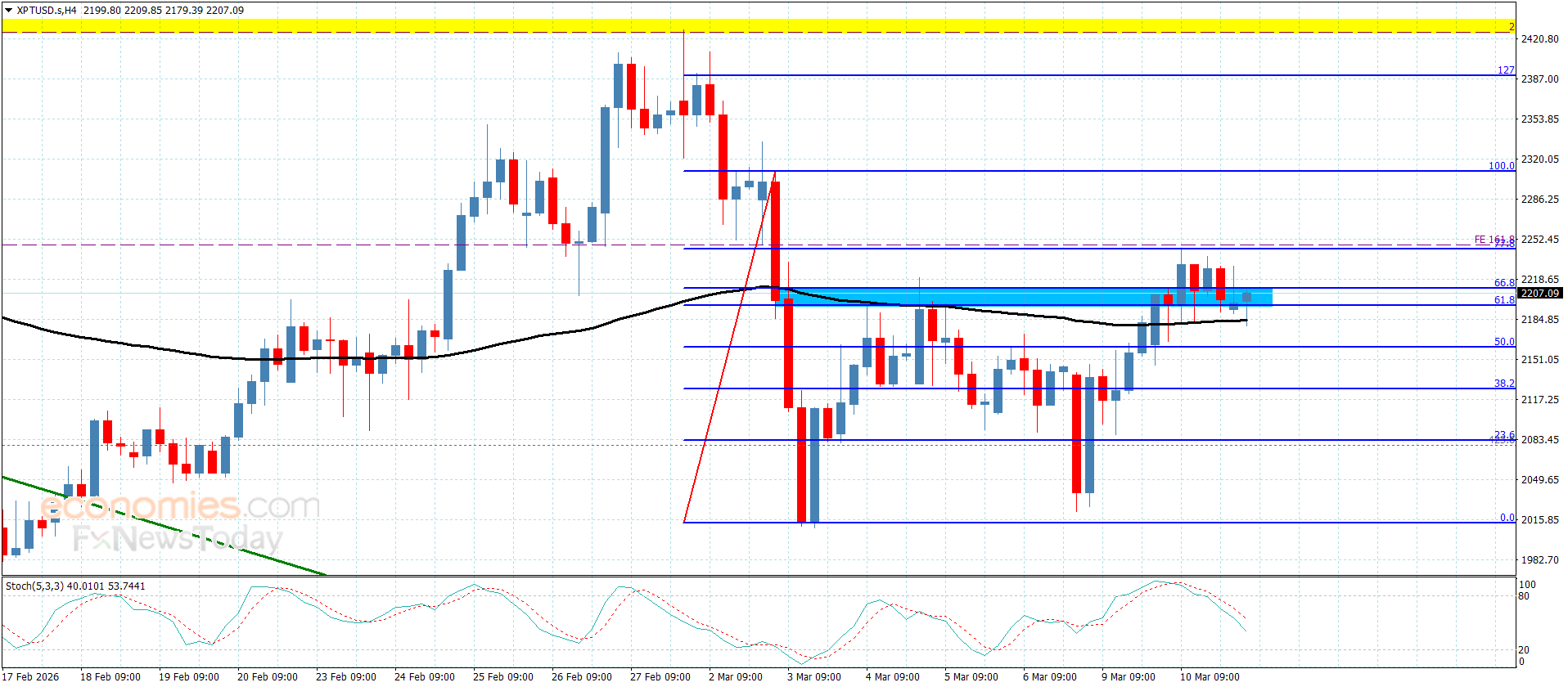
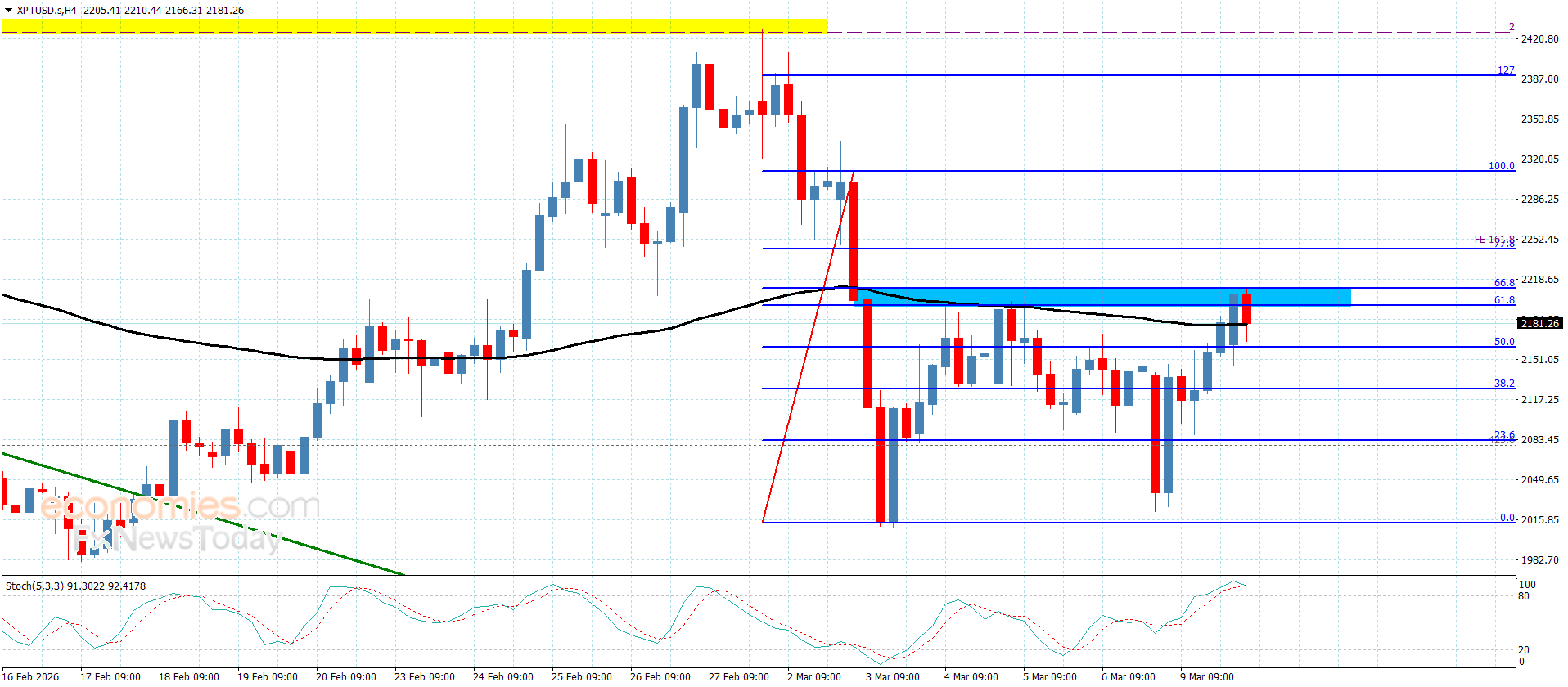
Platinum price is affected by the contradiction of the main indicators, which forces it to delay the previously suggested negative attack, activating with the moving average 55 positivity, by its rally to $2245.00 yesterday, to test the initial resistance, then rebound directly to settle near $2200.00.
Stochastic attempts to provide additional negative momentum by reaching below 50 level will support the chances of renewing the corrective attempts by reaching below $2180.00, then begin targeting negative stations near $2160.00 and $2125.00.
The expected trading range for today is between $2125.00 and $2220.00
Trend forecast: Bearish
Platinum price is affected by the contradiction of the main indicators, which forces it to delay the previously suggested negative attack, activating with the moving average 55 positivity, by its rally to $2245.00 yesterday, to test the initial resistance, then rebound directly to settle near $2200.00.
Stochastic attempts to provide additional negative momentum by reaching below 50 level will support the chances of renewing the corrective attempts by reaching below $2180.00, then begin targeting negative stations near $2160.00 and $2125.00.
The expected trading range for today is between $2125.00 and $2220.00
Trend forecast: Bearish
EUR/USD stabilizes slightly above 1.1600 in the European session on Wednesday as investors await February inflation data from the United States (US), while assessing the latest headlines surrounding the Middle East crisis and comments from European Central Bank (ECB) policymakers.
The table below shows the percentage change of Euro (EUR) against listed major currencies this week. Euro was the strongest against the Japanese Yen.
| USD | EUR | GBP | JPY | CAD | AUD | NZD | CHF | |
|---|---|---|---|---|---|---|---|---|
| USD | -0.50% | -0.55% | 0.21% | -0.23% | -2.43% | -1.00% | -0.16% | |
| EUR | 0.50% | -0.08% | 0.72% | 0.25% | -1.97% | -0.52% | 0.33% | |
| GBP | 0.55% | 0.08% | 0.81% | 0.32% | -1.89% | -0.45% | 0.40% | |
| JPY | -0.21% | -0.72% | -0.81% | -0.41% | -2.60% | -1.18% | -0.34% | |
| CAD | 0.23% | -0.25% | -0.32% | 0.41% | -2.21% | -0.77% | 0.07% | |
| AUD | 2.43% | 1.97% | 1.89% | 2.60% | 2.21% | 1.47% | 2.33% | |
| NZD | 1.00% | 0.52% | 0.45% | 1.18% | 0.77% | -1.47% | 0.85% | |
| CHF | 0.16% | -0.33% | -0.40% | 0.34% | -0.07% | -2.33% | -0.85% |
The heat map shows percentage changes of major currencies against each other. The base currency is picked from the left column, while the quote currency is picked from the top row. For example, if you pick the Euro from the left column and move along the horizontal line to the US Dollar, the percentage change displayed in the box will represent EUR (base)/USD (quote).
ECB policymaker Peter Kazimir said on Wednesday that he has no reservations to hike rates without new forecasts and added that an increase in key rates, because of the Iran war, may be closer than thought. On a more cautious tone, ECB Governing Council member François Villeroy de Galhau argued that they need to remain calm and noted that he doesn’t expect a rate hike at next week’s policy meeting. Finally, policymaker Joachim Nagel said that it is still too early to reliably assess the medium- to long-term consequences of the Middle East crisis.
Meanwhile, US stock index futures trade marginally higher on the day, reflecting a cautious market stance. Israel announced that it had begun an “additional wave” of strikes against targets in Tehran early Wednesday. In response, the Islamic Revolutionary Guard Corps (IRGC) of Iran also noted that it escalated its operations against the US and Israel, targeting technological infrastructure in the region.
In the second half of the day, the US Bureu of Labor Statistics (BLS) will publish the Consumer Price Index (CPI) data for February. On a monthly basis, the CPI and the core CPI are forecast to rise 0.3% and 0.2%, respectively. A stronger-than-expected print in the core CPI could be supportive for the USD and cause EUR/USD to edge lower. Conversely, a soft reading could have the opposite impact on the pair’s action. Nevertheless, the market reaction could remain short-lived because February CPI data won’t reflect the impact of rising crude oil prices on inflation.
In the 4-hour chart, EUR/USD trades at 1.1621. The near-term bias is mildly bearish as the pair holds below the downward-sloping 50-period Simple Moving Average (SMA) and the broader 100- and 200-period SMAs, which all cap the upside. Price trades beneath the Bollinger Bands’ upper line and the Relative Strength Index (RSI) hovers near 50, indicating momentum has stabilized after prior selling, yet it does not challenge the prevailing downside tilt implied by the moving averages.
Initial resistance emerges at 1.1670 (Bollinger Band upper line), and a sustained break above this level would be needed to weaken the current bearish tone and open the way toward the the 100-period SMA at 1.1723 ahead of the 200-period SMA at 1.1795. On the downside, the 20-period SMA aligns as the immediate near 1.1600 before 1.1538 (Bollinger Band lower line) and 1.1500 (static level, round level).
(The technical analysis of this story was written with the help of an AI tool.)
The Euro is the currency for the 20 European Union countries that belong to the Eurozone. It is the second most heavily traded currency in the world behind the US Dollar. In 2022, it accounted for 31% of all foreign exchange transactions, with an average daily turnover of over $2.2 trillion a day.
EUR/USD is the most heavily traded currency pair in the world, accounting for an estimated 30% off all transactions, followed by EUR/JPY (4%), EUR/GBP (3%) and EUR/AUD (2%).
The European Central Bank (ECB) in Frankfurt, Germany, is the reserve bank for the Eurozone. The ECB sets interest rates and manages monetary policy.
The ECB’s primary mandate is to maintain price stability, which means either controlling inflation or stimulating growth. Its primary tool is the raising or lowering of interest rates. Relatively high interest rates – or the expectation of higher rates – will usually benefit the Euro and vice versa.
The ECB Governing Council makes monetary policy decisions at meetings held eight times a year. Decisions are made by heads of the Eurozone national banks and six permanent members, including the President of the ECB, Christine Lagarde.
Eurozone inflation data, measured by the Harmonized Index of Consumer Prices (HICP), is an important econometric for the Euro. If inflation rises more than expected, especially if above the ECB’s 2% target, it obliges the ECB to raise interest rates to bring it back under control.
Relatively high interest rates compared to its counterparts will usually benefit the Euro, as it makes the region more attractive as a place for global investors to park their money.
Data releases gauge the health of the economy and can impact on the Euro. Indicators such as GDP, Manufacturing and Services PMIs, employment, and consumer sentiment surveys can all influence the direction of the single currency.
A strong economy is good for the Euro. Not only does it attract more foreign investment but it may encourage the ECB to put up interest rates, which will directly strengthen the Euro. Otherwise, if economic data is weak, the Euro is likely to fall.
Economic data for the four largest economies in the euro area (Germany, France, Italy and Spain) are especially significant, as they account for 75% of the Eurozone’s economy.
Another significant data release for the Euro is the Trade Balance. This indicator measures the difference between what a country earns from its exports and what it spends on imports over a given period.
If a country produces highly sought after exports then its currency will gain in value purely from the extra demand created from foreign buyers seeking to purchase these goods. Therefore, a positive net Trade Balance strengthens a currency and vice versa for a negative balance.
Silver is up for a third consecutive day on Tuesday, helped by a better market mood, weighing on US Dollar (USD) demand. The XAG/USD pair nears the $90 mark despite the escalating crisis in the Middle East.
So far, traffic through the Strait of Hormuz remains restricted by Iranian forces, and oil-producing countries have yet to decide whether to release emergency reserves. However, the G7 asked their energy agencies to be prepared to deploy oil reserves if necessary, while Pete Hegseth, United States (US) Secretary of War, said that Iran made a big mistake targeting its neighbors and threatened to hit Iran “harder than ever,” if the country interrupts oil flows.
The news was enough to push West Texas Intermediate (WTI) crude oil below the $80.00 mark during US trading hours, putting additional pressure on the USD and boosting stocks.
While the Persian Gulf war seems far from over, panic is now under control, and there seem to be better opportunities for Silver longs.
The extent of the conflict determines whether the WTI spike towards $120 a barrel was just a temporary reaction or if it would become a new reality.
In the 4-hour chart, XAG/USD trades at $89.26. The near-term bias is mildly bullish as price has reclaimed the 32.8% Fibonacci retracement of the prior slide from $96.62 to $77.97 at $85.09, hinting at a continuation attempt after the recent rebound from mid-$82s. The 20-period Simple Moving Average (SMA) has turned higher above the flatter 100-period and 200-period SMAs, and price trades above them all. The Momentum indicator holds above its midline and has eased from recent highs, while the Relative Strength Index (RSI) indicator hovers in the low 60s, consistent with a limited bullish potential
Initial resistance emerges at the 61.8% retracement at $89.50, followed by a daily peak in the $91.30 price zone. Support, on the other hand, comes at the rising 20-period SMA around $85.10, followed by the 38.2% retracement at $85.09. Further downside would focus on the 23.6% retracement at $82.37, aligning with the late-January reaction lows and reinforcing it as a pivotal floor for the broader recovery.
In the daily chart, the XAG/USD bias is mildly bullish as spot holds above the 20-day SMA at $83.58, that has flattened but still runs well above the rising 100- and 200-day SMAs, keeping the broader uptrend intact. Momentum remains positive with the 14-day Momentum indicator above 0 and the Relative Strength Index (RSI) holding above the 50 line, reinforcing a preference for upside continuation while current supports hold.
(The technical analysis of this story was written with the help of an AI tool.)
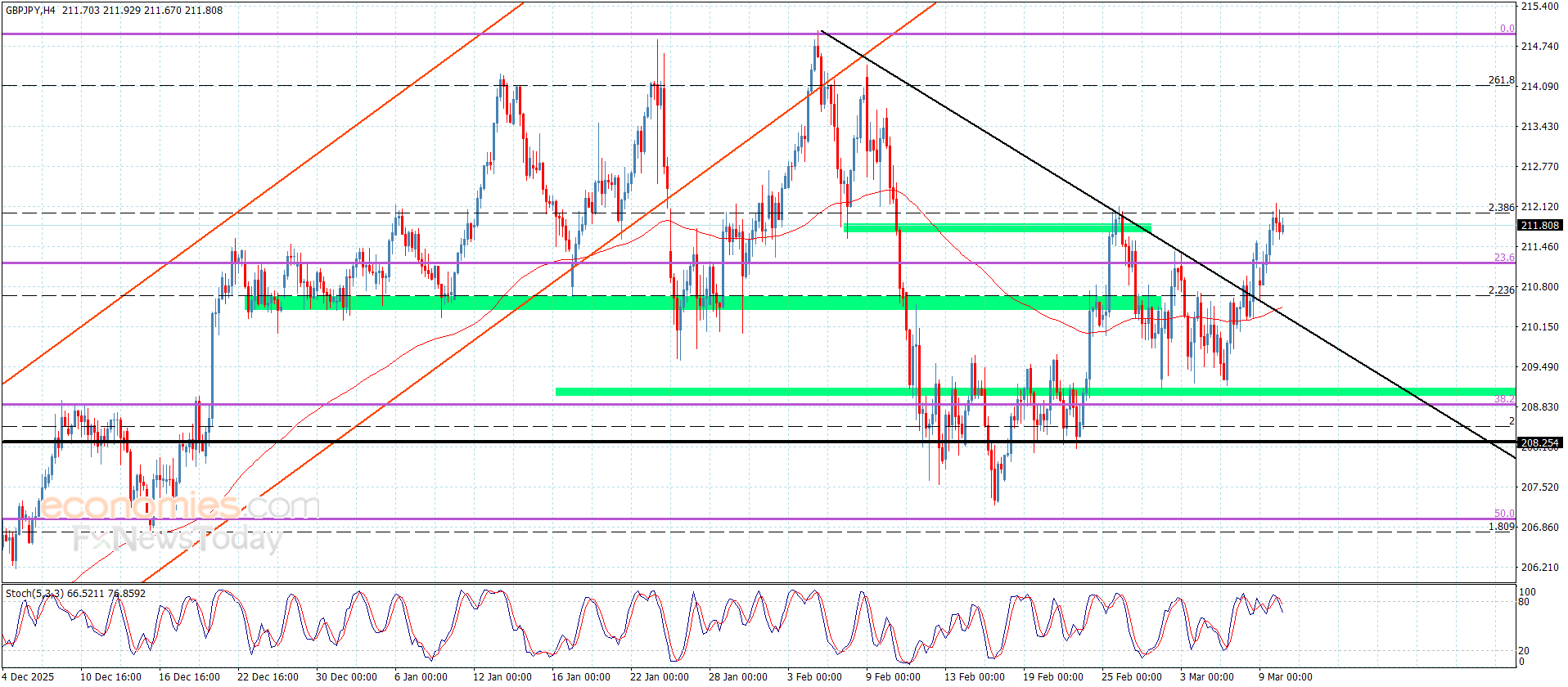
The GBPJPY pair took advantage of the continuation of forming extra support at 210.50 level, to notice forming several bullish waves, achieving the initial positive target by reaching 212.20 level.
The contradiction of the main indicators might push the price to provide mixed trading, but its success in breaching 212.30 and holding above will reinforce the chances of achieving additional gains that might begin at 213.05 and 213.65, while holding below 212.30 will force it to provide new bearish trading, and there is chance for retesting 210.50 level.
The expected trading range for today is between 211.30 and 212.30
Trend forecast: sideways until achieving the breach
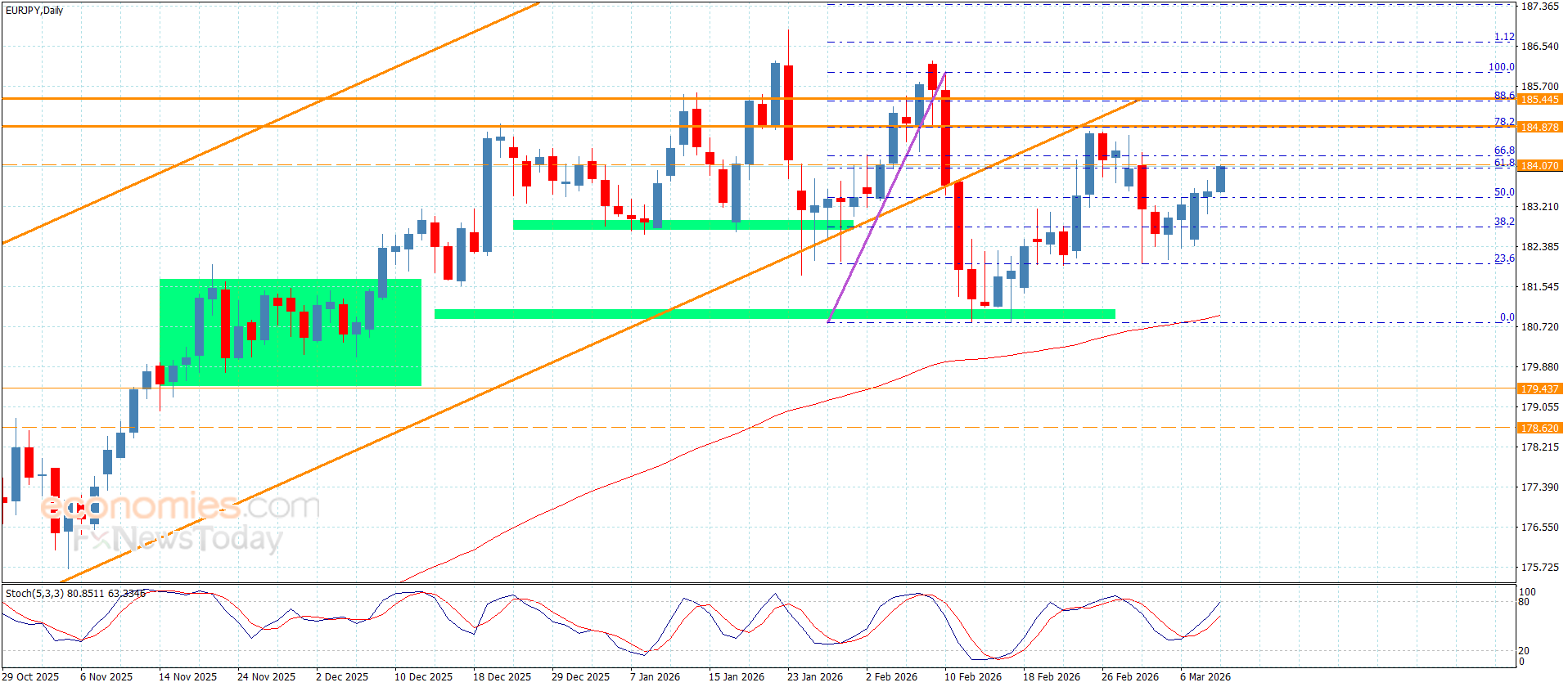
Despite the weakness of the EURJPY pair last trading, the continuation of providing bullish momentum by the main indicators assisted in reinforcing the chances of forming bullish waves, to target 183.60 level, then to settle below %50 correction level at 183.40.
We recommend waiting for providing a new positive close above 183.40 level, to confirm its readiness to record some gains by its rally towards 184.00 and 184.25, while the failure to breach it might force the price to form new bearish waves, attempting to reach towards 182.60 then press on the extra support at 182.00.
The expected trading range for today is between 182.70 and 184.00
Trend forecast: Bullish
BitcoinWorld
EUR/JPY Forecast: Pair Retreats Below 183.50 as Safe-Haven Flows Intensify, Yet Bullish Structure Holds
The EUR/JPY cross retreated below the critical 183.50 handle in early European trading on Thursday, March 20, 2025, as renewed geopolitical tensions triggered a flight to traditional safe-haven assets. Consequently, the Japanese Yen found broad-based support, pressuring the Euro-Yen pair. However, a deeper analysis of the technical landscape and fundamental drivers reveals the pair’s underlying bullish structure remains largely intact, suggesting the current dip may represent a corrective phase within a broader uptrend.
The EUR/JPY’s descent below 183.50 marks a significant short-term development. This level previously acted as a confluence zone, combining the 50-period simple moving average on the four-hour chart with a minor psychological barrier. The move lower was primarily catalyzed by a sharp spike in market volatility following unexpected developments in Eastern Europe, which amplified demand for the Yen’s perceived safety. Market participants swiftly adjusted their portfolios, leading to a classic risk-off reaction across currency markets. Meanwhile, the Euro faced additional headwinds from slightly dovish commentary within the latest European Central Bank (ECB) meeting minutes, which emphasized a data-dependent approach despite persistent inflationary pressures.
Despite this pullback, several key technical elements support a cautiously optimistic outlook. Firstly, the pair continues to trade well above its 200-day moving average, a widely watched long-term trend indicator. Secondly, the weekly chart maintains a sequence of higher lows established since the fourth quarter of 2024. The current price zone also aligns with a 38.2% Fibonacci retracement level drawn from the recent swing low to high, a common area for trends to resume. Analysts at major investment banks note that while momentum has softened, a definitive break below the 182.80 support cluster would be required to invalidate the near-term bullish bias.
The fundamental backdrop for the EUR/JPY remains a tale of two central banks navigating divergent economic landscapes. The Bank of Japan (BoJ) maintains an ultra-accommodative monetary policy stance, even as it cautiously navigates a gradual exit from yield curve control. Market consensus suggests any policy normalization from the BoJ will be exceptionally slow, keeping Japanese interest rates anchored near zero for the foreseeable future. This environment traditionally weighs on the Yen’s appeal as a funding currency. Conversely, the European Central Bank, while cautious, has a clearer path toward maintaining relatively higher interest rates compared to Japan to combat underlying inflation in the service sector.
“The EUR/JPY pair often acts as a reliable barometer for global risk appetite,” explains Dr. Alina Kostova, Head of Currency Strategy at Global Macro Advisors. “Its recent correlation with equity market movements has strengthened. When the S&P 500 or European indices sell off, we typically see capital flow into the Yen, pressuring EUR/JPY. The key question for traders is whether this risk-off move is a temporary adjustment or the beginning of a more sustained shift. Current data, including stable credit spreads and commodity prices, suggests the former.” This analysis is supported by historical data showing that sharp, news-driven safe-haven rallies in the Yen are frequently retraced once the initial panic subsides, provided the core fundamental divergence remains.
The following table summarizes the key opposing forces currently influencing the EUR/JPY exchange rate:
| Bullish Factors for EUR/JPY | Bearish Factors for EUR/JPY |
|---|---|
| Sustained ECB vs. BoJ interest rate differential | Acute geopolitical risk boosting safe-haven JPY demand |
| Resilient Eurozone economic data versus expectations | Technical breach of near-term support at 183.50 |
| Constructive longer-term technical trend structure | Potential for a broader correction in risk assets globally |
For traders and investors, identifying key price levels is paramount. The immediate resistance now sits at the former support of 183.50, followed by the recent swing high near 184.30. A daily close above this latter level would strongly signal a resumption of the uptrend. On the downside, support is layered. The most immediate level is found around 182.80, which coincides with the early March consolidation low and the 100-day moving average. A more significant support zone exists between 182.00 and 181.50, representing a key Fibonacci level and the February peak. Commitment of Traders (COT) reports from exchanges indicate that leveraged funds remain net long the EUR/JPY, although they have slightly reduced their positions over the past week, reflecting a degree of caution without a wholesale reversal in sentiment.
Furthermore, the pair exhibits sensitivity to energy price fluctuations. The Eurozone is a major energy importer, while Japan is one of the world’s largest importers of liquefied natural gas (LNG). A sustained rise in crude oil or natural gas prices can act as a tax on both economies, but the relative impact often creates subtle shifts in the exchange rate. Recent stabilization in the Brent crude market, after a volatile period, removes one potential source of asymmetric shock and allows the core monetary policy divergence to reassert itself as the primary driver.
In conclusion, the EUR/JPY forecast presents a nuanced picture. The pair’s break below 183.50 clearly demonstrates the potent impact of sudden safe-haven demand for the Japanese Yen. However, the prevailing fundamental divergence between the ECB and BoJ, coupled with a still-constructive longer-term technical setup, suggests the bullish outlook is merely challenged, not broken. Market participants will closely monitor the pair’s behavior around the 182.80 support level and broader risk sentiment indicators. A stabilization in geopolitical headlines could quickly see the EUR/JPY reclaim lost ground, reaffirming its trajectory within the broader uptrend that has characterized its movement for much of the past year.
Q1: What caused the EUR/JPY to fall below 183.50?
A sudden increase in geopolitical risk triggered a classic “risk-off” move in financial markets. Investors sought the safety of the Japanese Yen, which is considered a traditional safe-haven currency, causing it to appreciate against the Euro.
Q2: Why do analysts maintain a mildly bullish outlook despite the drop?
The bullish outlook is based on the sustained interest rate differential between the Eurozone and Japan, a still-positive long-term trend on price charts, and the view that the current safe-haven demand may be a temporary reaction rather than a lasting shift in fundamentals.
Q3: What is the most important support level for EUR/JPY now?
The immediate critical support level is around 182.80. A decisive break below this level, confirmed by a daily close, could signal a deeper correction toward the 181.50-182.00 zone.
Q4: How does the Bank of Japan’s policy affect the Yen?
The Bank of Japan maintains the most accommodative monetary policy among major central banks, with interest rates near zero. This generally keeps the Yen weak, as it is used as a funding currency for investments in higher-yielding assets elsewhere.
Q5: What would need to happen for the EUR/JPY to resume a clear upward trend?
For a clear resumption of the uptrend, the pair would need to recover and achieve a daily close above the 184.30 resistance level. This would indicate that the bullish momentum has overcome the recent safe-haven selling pressure.
This post EUR/JPY Forecast: Pair Retreats Below 183.50 as Safe-Haven Flows Intensify, Yet Bullish Structure Holds first appeared on BitcoinWorld.
– Written by
David Woodsmith
STORY LINK Pound Sterling to Dollar Forecast: GBP Recovers as Trump Eases Iran War Fears
The Pound to Dollar exchange rate (GBP/USD) slipped back toward three-month lows as a sharp surge in global oil prices triggered a broad risk-off move across financial markets.
After briefly strengthening following weak US jobs data, Sterling retreated toward 1.3280 before stabilising near 1.3340, with investors shifting into defensive dollar positions as fears over supply disruptions in the Strait of Hormuz pushed crude prices sharply higher and rattled global equities.
The surge in energy prices has dominated currency markets on Monday, especially with major implications for the UK and global economy. Fear has undermined the Pound while there has been defensive dollar demand.
After strengthening on Friday after weaker than expected US jobs data, the Pound to Dollar (GBP/USD) exchange rate dipped to lows near 1.3280 and close to 3-month lows before edging back above 1.3300 to trade around 1.3340.
According to UoB; “the likelihood for GBP to retest 1.3250 remains intact.”
Disruption to crude oil flows through the Straits of Hormuz, combined with attacks on regional infrastructure, has triggered increased fears over global oil supplies.
Get better rates and lower fees on your next international money transfer.
Compare TorFX with top UK banks in seconds and see how much you could save.
Brent crude spiked over 20% at one stage in Asian trading to 44-month highs near $115 p/b before a limited correction and is trading around 14% higher around $104. Risk appetite has dipped sharply with the FTSE 100 index at 6-week lows.
Forecasts of Bank of England (BoE) rate cuts have also been ripped up with fears that the central bank might have to raise rates to combat inflation.
UK and global bond markets will also be a key market element amid the surge in oil prices.
The UK 10-year bond yield has jumped to a 5-month high above 4.70%.
A further increase in yields would further undermine economic activity and trigger fresh fears over the UK budget position, increasing the potential threat to the Pound.
Bob Savage, head of markets macro strategy at BNY Mellon commented; “Oil remains the transmission channel into inflation expectations, rates and currency markets, with the dollar’s resurgence echoing the 2022 energy crisis. The week ahead will test whether markets continue to treat the current conflict as a contained shock or begin to price a more durable supply disruption.”
ING noted that conditions could deteriorate further; “A much bigger unwind remains the risk for global equity markets as higher energy prices dampen growth prospects, while higher longer-dated interest rates sap the net present value earnings of the growth stocks.”

On currency markets it commented; “Short dollar positioning also means that in extreme bouts of deleveraging – like what we saw last Tuesday and could perhaps see again today – the dollar is again the beneficiary.”
MUFG discussed developments within Iran; “Iran’s decision to choose Mojtaba Khamenei, the hard-line son of recently deceased Ayatollah Ali Khamenei, to be the new supreme leader has signalled that Iran is not ready to back down in the conflict.”
On Friday, the US released a weaker than expected jobs report with non-farm payrolls reported as declining 92,000 for February from a revised 126,000 gain the previous month and compared with consensus forecasts of an increase around 60,000. The unemployment rate also ticked higher to 4.4% from 4.3%.
MUFG commented; “The combination of still weak US labour market and energy price shock is putting the Fed in an even more difficult position when setting policy.”
It added; “So far the US rate market has moved to push back both the timing and scale of further Fed rate cuts lifting US rates and the US dollar.”
International Money Transfer? Ask our resident FX expert a money transfer question or try John’s new, free, no-obligation personal service! ,where he helps every step of the way,
ensuring you get the best exchange rates on your currency requirements.
TAGS: Pound Dollar Forecasts
Brent crude oil continued to decline during its recent intraday trading, erasing all the gains recorded at the beginning of this week’s opening session. The price is currently attempting to find a higher low that could help rebuild the lost positive momentum, while the main short-term trend remains bullish.
The dynamic support remains intact as the price continues to trade above EMA50, which enhances the chances of a near-term recovery. In addition, the relative strength indicators have reached deeply oversold levels, excessively compared with the price movement, suggesting the potential formation of a positive divergence.