The main category of All News Articles.
You can use the search box below to find what you need.
[wd_asp id=1]
The main category of All News Articles.
You can use the search box below to find what you need.
[wd_asp id=1]
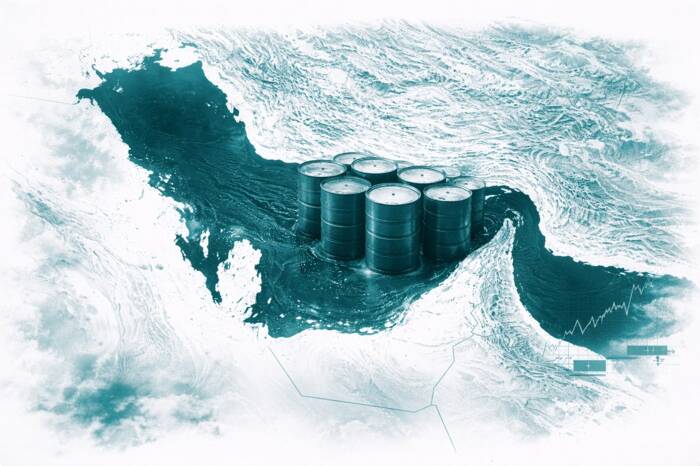
According to Wall Street Journal, the United Arab Emirates and Kuwait had begun to curb oil production as the closure of the Strait of Hormuz affects the flow of supplies and fills storage facilities. Abu Dhabi National Oil Co. said it is managing offshore production levels to deal with storage requirements. Kuwait Petroleum Corp. also cut output at oil fields and refineries after Iranian threats against safe passage through Hormuz.
Kuwait started to reduce output by some 100,000 barrels per day early Saturday. The reduction is nearly triple on Sunday. This implies that cuts may be up to around 300,000 barrels per day or higher depending on storage levels and the situation around Hormuz.
Kuwait produced about 2.57 million barrels per day in January and relies completely on the Strait of Hormuz for exports. This is a heavy dependence that makes the country vulnerable as there are not many alternative routes from where shipments can come.
The UAE is in a better position but is still facing pressure. The country produced more than 3.5 million barrels per day in January as OPEC’s third largest producer. It is able to bypass Hormuz via a 1.5 million barrel per day pipeline to Fujairah on the western coast and also take advantage of international storage facilities.
Disruptions are spreading in the region. Iraq has begun to withhold production for storage tank saturation. Saudi Arabia shut its largest refinery and Qatar closed the world’s largest liquefied natural gas export plant after drone attacks. Saudi Arabia has diversified some of its crude exports to Yanbu on the Red Sea but this route is not capable of completely replacing exports that usually pass through the Strait of Hormuz.
The current supply shock is already having an impact on consumers all over the world. Asian refiners are beginning to report shortages as shipments from the Gulf slow down. When there are fewer cargoes available to the market, refiners must scale down operations or seek out other supplies. This situation makes energy more expensive not only for businesses but also for households.
At the same time, the global economy is still showing signs of growth. This causes inflationary effect of higher oil prices to be stronger as energy demand is still firm. The ISM Manufacturing PMI is 52.4% which signifies mild expansion of industrial sector.
Economists and oil market analysts have hiked their oil price forecasts for 2026 amid rising geopolitical tensions and heightened war premium due to the U.S.-Iran standoff.
Both crude oil benchmarks are now expected to average above $60 per barrel this year, with price forecasts higher by about $1.50 per barrel compared to a month ago, the monthly Reuters poll showed on Friday.
Despite ongoing concerns about an oversupplied market, the 34 analysts and economists surveyed by Reuters in February raised their projections in view of uncertainties in how the Iran crisis would unfold in the coming weeks and months.
In the February poll, Brent Crude prices are expected to average $63.85 per barrel in 2026. This month’s estimate is higher compared to the January forecast of $62.02.
The analysts in the poll expect the U.S. benchmark, WTI Crude, to average above $60 per barrel this year, too—at $60.38 a barrel, up from $58.72 expected in January.
Year to date, Brent price have averaged $70.48 per barrel and WTI – $65.01 a barrel.
Early on Friday, both benchmarks were trading 3% higher, with Brent near $73 and WTI at $67, after the United States and Iran adjourned the Thursday talks with plans for another round of negotiations next week.
Oman’s Foreign Minister, Badr Albusaidi, who was mediating the indirect talks in Geneva, said the parties had made “significant progress” in the nuclear talks. Next week, negotiations are set to be held in Vienna, Austria.
It is the ongoing U.S.-Iran standoff that has been the main driver of oil analysts in the Reuters poll to raise their oil price forecasts for this year.
Currently, the geopolitical risk premium already baked in the price of oil is about $4-$10 per barrel, analysts say.
The war premium, the OPEC+ supply policy, and the fundamentals in supply-demand balances will steer the direction of oil prices this year, they note.
By Michael Kern for Oilprice.com
Full-scale war over Iran in the Middle East has pushed energies to multi-year highs and helped strengthen safe havens such as the US Dollar and Gold.

I wrote on the 1st March that the best trades for the week would be:
Long of Gold following a daily (New York) close above $5,418.55. This did not set up.
Short of Bitcoin following a daily (New York) close below $61,000 targeting $50,000. This did not set up either.
A summary of last week’s most important data in the market:
US Average Hourly Earnings – this was a fraction higher than expected, showing a month-on-month increase of 0.4% compared to a widely anticipated 0.3%, weakening the case for rate cuts.
US Non-Farm Employment Change – this was considerably worse than expected, by approximately 150k jobs, strengthening the case for rate cuts.
US Retail Sales – this was just a tick higher than expected, but it was still a negative rate.
US ISM Services PMI – this was much better than expected.
Australian GDP – the Australian economy grew by 0.8% last quarter, while growth of only 0.7% was expected, giving a slight boost to the prospect of rate hikes.
UK Annual Budget – no surprises.
US Unemployment Rate – unexpectedly ticked higher from 4.3% to 4.4%.
US Unemployment Claims – this was approximately as expected.
The only significant effects last week’s economic data had was a hawkish tilt on the USD, with the CME FedWatch tool now showing the market is pricing in only one further rate cut in 2026, a cut of 0.25% in September.
The week was really dominated by the ongoing war between Israel/USA and Iran, with several US-friendly countries near Iran being attached by Iran, although the attacks are mostly aimed at US bases. Some of Iran’s neighbours have retaliated or claimed to have done so, notably Qatar and the UAE.
It seems clear that the US and Israel basically have achieved air superiority in the skies of Iran and intend to systematically demolish the Islamic Republic and its military capabilities, with a focus on its ballistic missiles and nuclear program. From the point of view of Israel and the USA, the war can be said to be proceeding very successfully.
It seems clear that this war is going to last for a few weeks, maybe even as long as six weeks, and that a surrender by the regime remains unlikely, at least for time being.
Hezbollah, Iran’s proxy in Lebanon, joined the war on day 3 by firing on Israel. It is pretty clear Hezbollah also fired drones at a sovereign British base in Cyprus, which is an attack on NATO and the EU, although very little is being done about it.
Most notably for the markets, traffic has almost completely stopped passing through the trait of Hormuz, and although there are sufficient stockpiles to last a few weeks, we are seeing the price of crude oil and crude oil related products jump to long-term highs, with WTI surpassing $90 per barrel on Friday. It may be that the US administration had hoped the price would not rise so far so quickly, but these high crude oil prices could feed into other aspects of the economy and start to bring stock markets lower.
The coming week’s most important data points, in order of likely importance, are:
USA CPI (inflation)
US Core PCE Price Index
US Preliminary GDP
US JOLTS Job Openings
US Unemployment Claims
UK GDP
Canada Unemployment Rate
Currency Price Changes and Interest Rates
For the month of March, I make no monthly Forex forecast as the US Dollar is not in a clear trend right now.
Last week saw no currency crosses with excessive volatility, so I am making no forecast for the coming week.
The US Dollar was the strongest major currency last week, while the Euro was the weakest. Directional volatility increased last week, with 41% of all major pairs and crosses changing in value by more than 1%.
Next week’s volatility is likely to remain high due to the few but highly significant data releases scheduled and the ongoing war in the Middle East, which might generate volatility in the US Dollar, the Japanese Yen, and the Canadian Dollar. There could also be unforeseen side effects which might affect other currencies.
You can trade these forecasts in a real or demo Forex brokerage account.
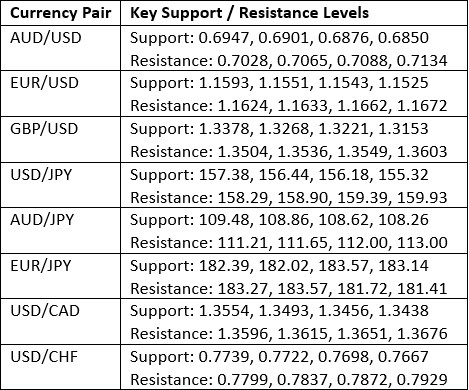
Key Support and Resistance Levels
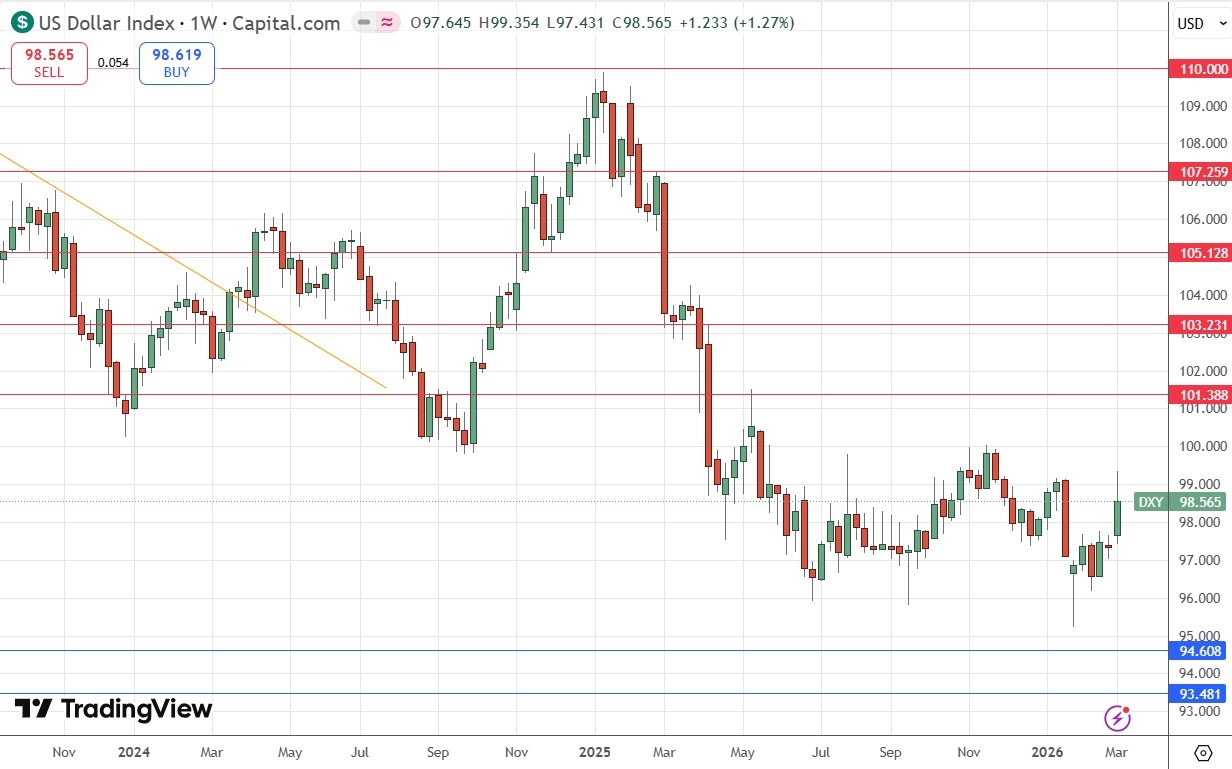
Last week, the US Dollar printed a large bullish candlestick which opened with a gap higher. Although there is a significant upper wick and a rejection of a recent inflective high, which is often a bearish sign, the price is now showing a technical long-term bullish trend because the price is higher than it was both three and six months ago.
We can see that the picture is muddied even more because the price is within a zone where it has been comfortable consolidating.
The flow into the US Dollar has been caused by two things: the hawkish tilt on rate cuts we saw last week, and the outbreak of war in the middle east which has seen the greenback function as more of a safe haven.
It might be wise to take a long bias on the USD this week, but I don’t see much in it either way, so I would remain focused on other assets over this week and treat the greenback as something relatively neutral.
US Dollar Index Weekly Price Chart
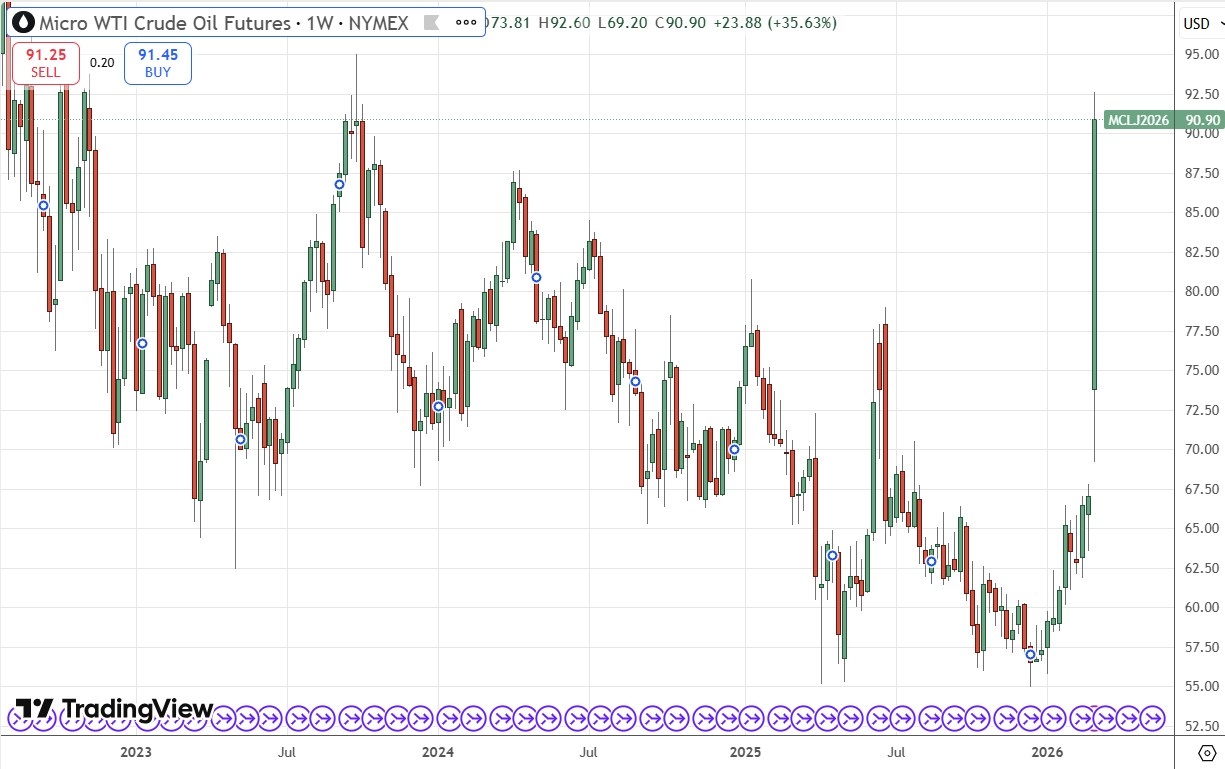
WTI Crude Oil made its strongest rise in years last week, gapping higher at the weekly open following the surprise joint attack on Iran by the USA and Israel early Saturday, and closing Friday at a new 2 year and 5-month high price. Markets had been expecting some type of strike, but it quickly became clear that the USA and Israel are all-in for regime change, killing the Supreme Leader Khamenei with the first strike of the war.
Many analysts were persuaded that the USA would be careful to have a plan to prevent the price of crude oil from rising excessively. However, apart from the sides not making all-out attacks against oil facilities, the war has been broad enough and dangerous enough to push the price of oil notably higher, with the price now almost double what it was just a few weeks ago.
The Iranian regime and other forces which want to thwart a US/Israeli victory (such as Qatar and Turkey) will now be doing everything they can to push the price of crude oil higher. Another factor behind this is that the USA is, for the time being, basically standing off the Strait of Hormuz which Iran has practically closed – traffic through the Strait is down by about 70%. The USA has calculated that it can stand a few weeks of the Strait being blocked, although it has offered to escort tankers through.
I had thought that the outbreak of war would cause only a limited, restrained rise in the price of crude oil, as this is what happened last June during the previous Israel-Iran was. I was wrong and I sold my long too early.
It is likely to be dangerous to enter now as we could easily see a fast and huge drop in the price. However, maybe the price of oil really will rise to trade well above $100 before it goes down. It is hard to see this war ending for a few more weeks at least.
If you will go long, do it with a very small position size that reflects the enormously high volatility which we see in the price these days.
WTI Crude Oil Weekly Price Chart
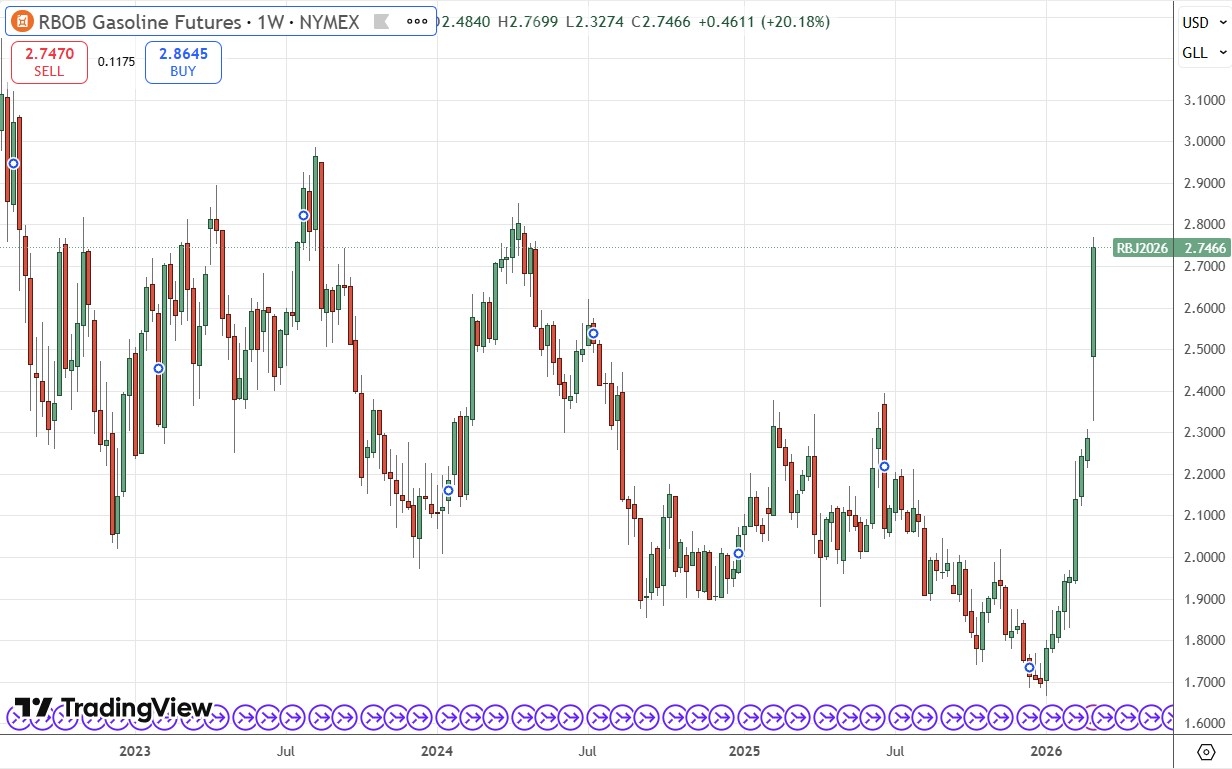
RBOB Gasoline futures shot higher last week, reaching their highest price in almost two years.
This is all about what I wrote just above concerning WTI Crude Oil. As the price of crude oil rises, so the price of Gasoline is almost certain to rise with high positive correlation between the two assets, as gasoline is derived by refining crude oil.
As I wrote above, it might be too late for a long trade, and if you do feel you have to go long here, use a very small position size (respect the very high volatility) and a trailing stop to avoid a catastrophic loss. Remember that what goes up very hard and very fast can come down in exactly the same way.
RBOB Gasoline Futures Weekly Price Chart
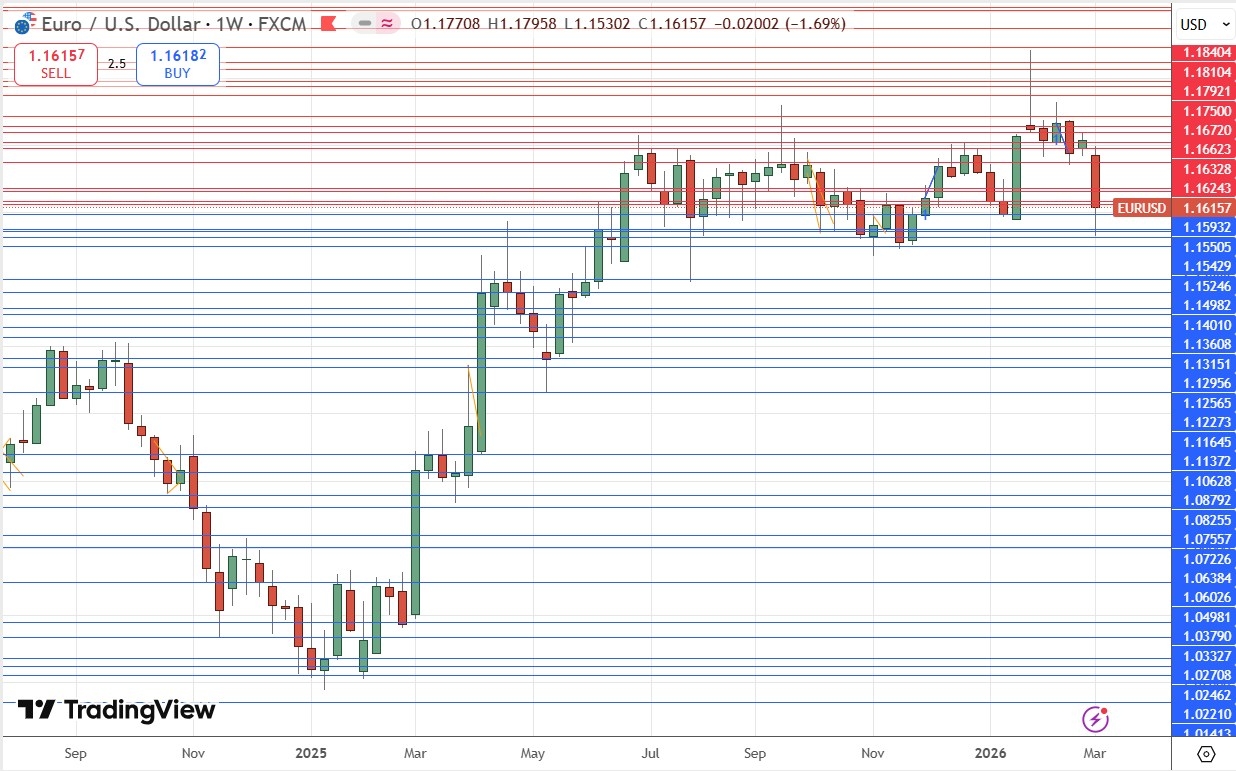
EUR/USD ended up in focus last week because the USD and the EUR were respectively the strongest and weakest currencies over the week. This was partly driven by the war in the Middle East, with safe haven funds flowing into the USD, and the Euro affected by the halt in Qatari LNG (liquid natural gas) production which has sent European energy prices flying, and this has hit the Euro.
Technically, we see the low of the week not far from the big round number at $1.1500 where there is clearly strong support for the best part of a year. This may be important as the USD is not in a strongly bullish trend, so there is a good chance that the price here might bounce back from this area, which has acted as long-term support.
On the other hand, a solid breakdown below the $1.1500 area could see the price fall through blue sky quickly and strongly to arrive soon at the $1.1300 handle.
EUR/USD Weekly Price Chart
Gold fell over the week, but what happened was technically significant and bullish. When the price made its big drop early this week (see the price chart below), it found support at the big round number of $5,000 which is also highly confluent with the 50% Fibonacci retracement which is also shown as a study within the price chart.
This, combined with the fairly bullish price action we have seen since $5,000 was hit, suggests that Gold is going to keep rising, perhaps given a tailwind as a safe haven asset by the ongoing war in the Middle East.
Despite the bullish development, I will be waiting for a new record daily high closing price before entering a new long trade here.
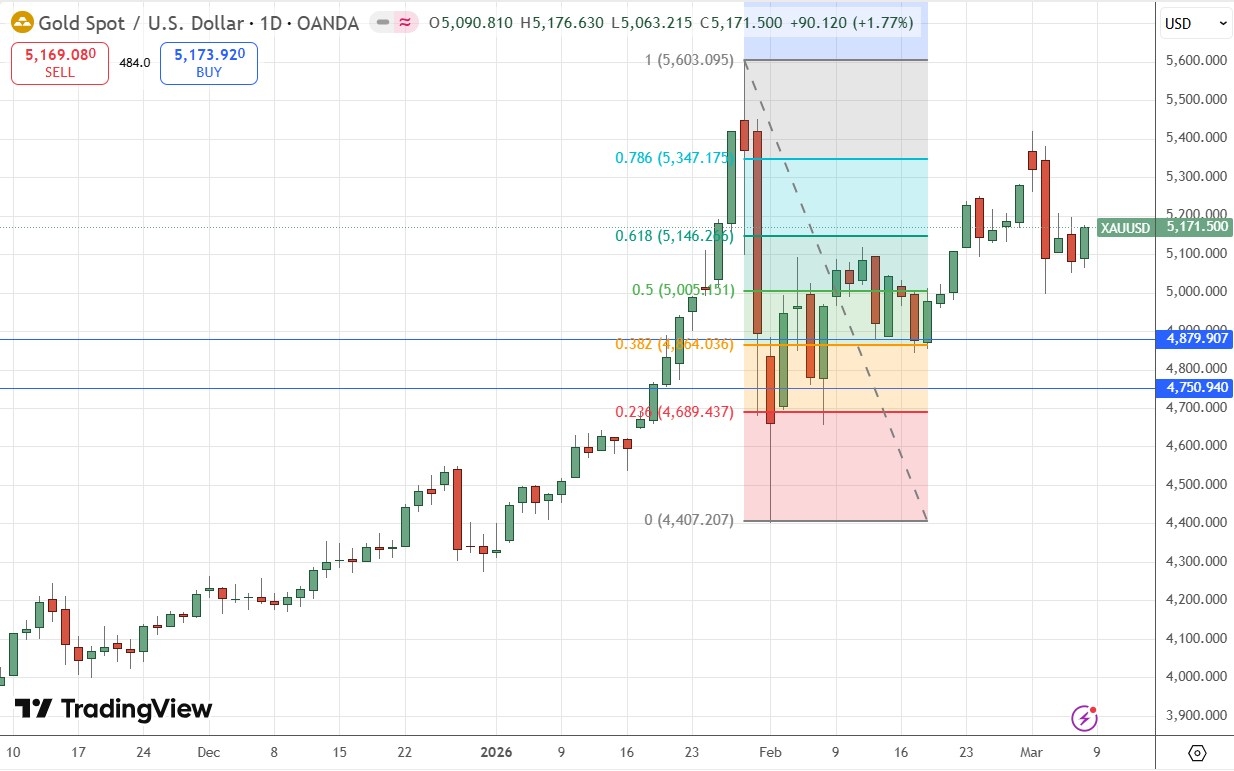
Gold Daily Price Chart
ZW Wheat futures shot higher last week, reaching their highest price in a year. The weekly rise was unusually strong and mirrored the move seen in WTI Crude Oil and Gasoline. For this reason, many analysts see the war as pushing the price of grains up (all grain futures rose last week), but there are deeper reasons relating to supply issues in the grain markets and changes to the wheat business in the USA.
Although this strong rise is a little early, and the price chart below feels like we could see the price come down again very quickly, the moving averages are correctly aligned enough that trend following funds and institutions are going to be entering new long trades in Wheat at Monday’s open.
If Wheat futures are too big for you (and they probably are), you can get exposure to US Wheat by buying the Teacrium Wheat Fund (WEAT) which is an ETF and very affordable.
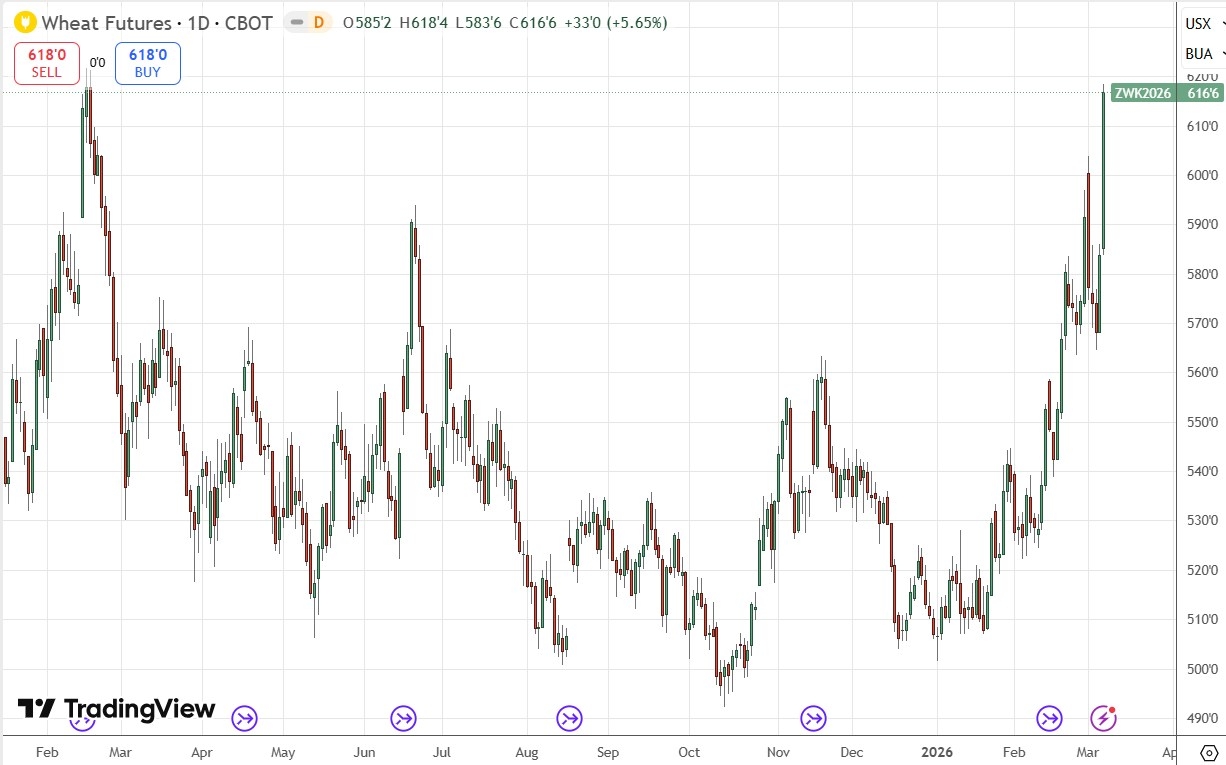
Wheat Daily Price Chart
Last week was poor for the US stock market, with the S&P 500 Index not only closing lower, but closing the week sitting heavily on the long-term support level at 6,737.
Technically, things are starting to look bearish. Look at the topping price action underneath and just touching the big round number at 7,000 which we have seen over recent weeks.
We also have a double, maybe even a triple, bearish head and shoulders chart pattern, with the neckline clearly at 6,737.
I think a bearish breakdown is likely below that level and we will then see the price quickly reach the other significant round number at 6,500, the horizontal low at 6,512, and the 200-day moving average sitting above both. If the price breaks below all that, the market really will be in trouble.
Shorting the US stock market, especially an Index, is not easy, and should only be attempted by experienced traders.
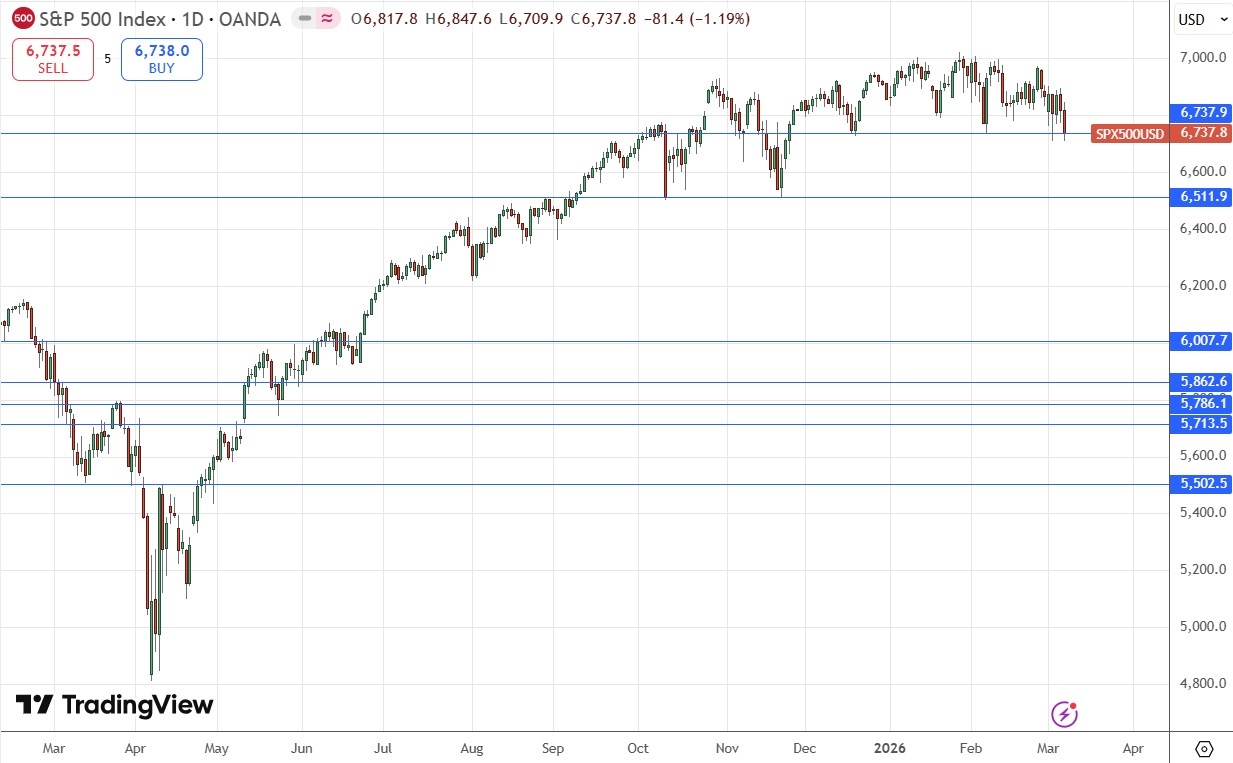
S&P 500 Index Daily Price Chart
I see the best trades this week as:
Long of Gold following a daily (New York) close above $5,418.55.
Long of Wheat.
Ready to trade our Forex weekly forecast? Check out our list of the top 10 Forex brokers.
Silver (XAG/USD) trades modestly higher on Friday as the US Dollar (USD) and Treasury yields ease following softer-than-expected US Nonfarm Payrolls (NFP) data. Despite the intraday bounce, the white metal remains on track for its first weekly decline in three weeks.
At the time of writing, XAG/USD is trading around $84.27, up nearly 2.73% on the day after rebounding from a daily low near $80.17.
Meanwhile, the escalating US-Iran conflict continues to offer some underlying support to safe-haven assets, helping limit deeper losses in Silver.
However, rising Oil prices driven by supply disruptions through the Strait of Hormuz are fueling global inflation concerns. As a result, traders are trimming expectations for Federal Reserve (Fed) interest rate cuts, which tends to weigh on the non-yielding metal.
From a technical perspective, Silver is showing signs of consolidation after retreating from the upper Bollinger Band earlier this week. On the daily chart, price action is attempting to stabilise around the middle Bollinger Band near $83, which also serves as the 20-day Simple Moving Average (SMA), keeping the near-term bias neutral to slightly bullish.
Momentum indicators point to a lack of strong directional conviction. The Relative Strength Index (RSI) is hovering near the 50 mark, suggesting balanced momentum after the recent pullback.
The Moving Average Convergence Divergence (MACD) indicator (12, 26, close, 9) is flattening near the zero line, suggesting fading bearish momentum, though the MACD line remains slightly below the signal line.
The Average Directional Index (ADX) is trending lower near 18, indicating weakening trend strength and reinforcing the view that the market has shifted into a range-bound phase.
On the downside, a decisive break below the middle Bollinger Band could expose the lower Bollinger Band around $72 as the next support level, followed by the February swing low near $64.08.
On the upside, a clear break above the upper Bollinger Band near $93.86 would be needed to attract fresh buying interest. A move beyond this level could open the door toward the $100 psychological mark, which may cap gains initially before a potential extension toward a retest of the all-time high near $121.66.
Silver is a precious metal highly traded among investors. It has been historically used as a store of value and a medium of exchange. Although less popular than Gold, traders may turn to Silver to diversify their investment portfolio, for its intrinsic value or as a potential hedge during high-inflation periods. Investors can buy physical Silver, in coins or in bars, or trade it through vehicles such as Exchange Traded Funds, which track its price on international markets.
Silver prices can move due to a wide range of factors. Geopolitical instability or fears of a deep recession can make Silver price escalate due to its safe-haven status, although to a lesser extent than Gold’s. As a yieldless asset, Silver tends to rise with lower interest rates. Its moves also depend on how the US Dollar (USD) behaves as the asset is priced in dollars (XAG/USD). A strong Dollar tends to keep the price of Silver at bay, whereas a weaker Dollar is likely to propel prices up. Other factors such as investment demand, mining supply – Silver is much more abundant than Gold – and recycling rates can also affect prices.
Silver is widely used in industry, particularly in sectors such as electronics or solar energy, as it has one of the highest electric conductivity of all metals – more than Copper and Gold. A surge in demand can increase prices, while a decline tends to lower them. Dynamics in the US, Chinese and Indian economies can also contribute to price swings: for the US and particularly China, their big industrial sectors use Silver in various processes; in India, consumers’ demand for the precious metal for jewellery also plays a key role in setting prices.
Silver prices tend to follow Gold’s moves. When Gold prices rise, Silver typically follows suit, as their status as safe-haven assets is similar. The Gold/Silver ratio, which shows the number of ounces of Silver needed to equal the value of one ounce of Gold, may help to determine the relative valuation between both metals. Some investors may consider a high ratio as an indicator that Silver is undervalued, or Gold is overvalued. On the contrary, a low ratio might suggest that Gold is undervalued relative to Silver.
The article covers the following subjects:
Consider long positions from corrections above the level of 156.40 with a target of 160.00–162.00.
Breakout and consolidation below 156.40 will allow the pair to continue declining to the levels of 155.10–154.40.
An ascending fifth wave of larger degree 5 is developing on the weekly chart, with wave (1) of 5 forming as its part. Apparently, the third wave of smaller degree 3 of (1) has formed on the daily chart, and a correction has been completed as the fourth wave 4 of (1). The fifth wave 5 of (1) has presumably started developing on the H4 time frame, with wave i of 5 still forming within. If the presumption is correct, USD/JPY will continue to rise to the levels of 160.00–162.00. The level of 156.40 is critical in this scenario as a breakout below it will enable the pair to continue declining to the levels of 155.10–154.40.
This forecast is based on the Elliott Wave Theory. When developing trading strategies, it is essential to consider fundamental factors, as the market situation can change at any time.
The content of this article reflects the author’s opinion and does not necessarily reflect the official position of LiteFinance broker. The material published on this page is provided for informational purposes only and should not be considered as the provision of investment advice for the purposes of Directive 2014/65/EU.
According to copyright law, this article is considered intellectual property, which includes a prohibition on copying and distributing it without consent.
Important DisclaimersFXEmpire is owned and operated by Empire Media Network LTD., Company Registration Number 514641786, registered at 7 Jabotinsky Road, Ramat Gan 5252007, Israel. The content provided on this website includes general news and publications, our personal analysis and opinions, and materials provided by third parties. This content is intended for educational and research purposes only. It does not constitute, and should not be interpreted as, a recommendation or advice to take any action, including making any investment or purchasing any product. Before making any financial decision, you should conduct your own due diligence, exercise your own discretion, and consult with competent advisors. The content on this website is not personally directed to you, and we do not take into account your individual financial situation or needs. The information contained on this website is not necessarily provided in real time, nor is it guaranteed to be accurate. Prices displayed may be provided by market makers and not by exchanges. Any trading or other financial decision you make is entirely your own responsibility, and you must not rely solely on any information provided through the website. FXEmpire does not provide any warranty regarding the accuracy, completeness, or reliability of any information contained on the website and shall bear no responsibility for any trading losses you may incur as a result of using such information. The website may include advertisements and other promotional content. FXEmpire may receive compensation from third parties in connection with such content. FXEmpire does not endorse, recommend, or assume responsibility for the use of any third-party services or websites. Empire Media Network LTD., its employees, officers, subsidiaries, and affiliates shall not be liable for any loss or damage resulting from your use of the website or reliance on the information provided herein.Risk DisclaimersThis website contains information about cryptocurrencies, contracts for difference (CFDs), and other financial instruments, as well as about brokers, exchanges, and other entities trading in such instruments. Both cryptocurrencies and CFDs are complex instruments and involve a high risk of losing money. You should carefully consider whether you understand how these instruments work and whether you can afford to take the high risk of losing your money. FX Empire encourages you to conduct your own research before making any investment decision and to avoid investing in any financial instrument unless you fully understand how it works and the risks involved.
Listen to this article
Estimated 5 minutes
The audio version of this article is generated by AI-based technology. Mispronunciations can occur. We are working with our partners to continually review and improve the results.
As conflict continues in the Middle East, soaring oil prices have left many wondering what’s next for Alberta’s resource-heavy economy.
West Texas Intermediate (WTI) crude, the benchmark for oil prices in North America, rose above $90 Friday morning and ended the day at just over $91 — a dramatic increase from before the U.S. and Israel launched an attack on Iran last weekend.
ATB Financial’s chief economist Mark Parsons says those prices could lead to short-term revenue increases in Alberta, but the longer term impact remains to be seen.
“I don’t think producers are going to suddenly change their budgets based on what’s happened in the last week,” he said. “We need to see this continue for a little bit longer.”
The province is operating on a $4.1-billion deficit in the current fiscal year, while Budget 2026 forecasts a $9.4-billion deficit for the fiscal year ahead.
The latest budget, which covers the fiscal year beginning this April, forecasts WTI crude at $60.50 US per barrel, while the current fiscal year ending on March 31 was based on an average of $61.50.
“The province is relying on a very volatile revenue base, and it can easily go the other way,” Parson said.
“The question for the Alberta government is how much can they bank on this revenue to meet ongoing spending needs caused by population growth like schools, hospitals, road infrastructure. So that problem hasn’t gone away.”
Speaking to reporters Friday, Minister of Transportation and Economic Corridors Devin Dreeshen said “we’ll see what happens” when asked what oil prices could mean for Budget 2026 and projects going forward.
“Obviously, from a budgeting standpoint, it does have to extend throughout the entire year to make a big difference,” he said, not addressing any specific projects.
Parsons said the higher oil prices would lead to “an uplift in revenues in the energy producing provinces of Alberta, Saskatchewan, Newfoundland. In the provinces that don’t produce energy, it’s mostly higher costs … what you’re going to see is uneven impacts across the country.”
The price of Western Canadian Select, Canadian oil traded at a discount to WTI, could also benefit due to a potential shortage of heavy crude coming from the Middle East, Parsons said.
It’s unclear how much higher crude prices could get, but some experts have bold projections: oil market analyst Rory Johnston took to social media Friday to forecast WTI prices reaching upwards of $200 US per barrel unless traffic through the Strait of Hormuz resumes.
The strait is a narrow passage between Iran and Oman through which one-fifth of the world’s crude oil travels. Oil tanker traffic there has plummeted since the conflict began.

CBC’s senior business correspondent Peter Armstrong explains what’s happening around the critical shipping lanes in the Strait of Hormuz on Monday as conflict escalates following U.S. and Israeli attacks on Iran.
The $200 prediction seems “a bit high” to Tristan Goodman, president of the Explorers and Producers Association of Canada, but he says he could see prices cross the $100 mark if current trends continue.
“It really depends on the situation on the ground and what’s been taken offline,” he said. “It’s not just about [passage through the Strait of Hormuz], it’s a matter of what oil facilities and oil production is still online within the region.”
Goodman said “it’s quite surprising how quickly producers can bring that production back online, which is a beneficiary to maintain price stability.”
That stability is crucial in a situation evolving this rapidly, he said.
“I think you’re probably going to see higher prices going forward, regardless of what happens within that area,” he said. “Even if stability starts to come back, and there’s resolution to this conflict — which actually doesn’t look like that’s going to be the case right away here — you’ll still see some high prices.”

With the Iran war threatening to upend much of the world’s oil and gas supply from Gulf states, experts say there could be a big uptick in demand for Canadian energy products, but Canada’s limited ability to get the products to market could be an obstacle.
Soaring prices aren’t necessarily a good thing for producers in the industry, especially when they change so dramatically and come with such unpredictability, Goodman said.
“It always sounds great to have really high prices, but actually even the producers don’t want that, because then you start to have negative impacts across the economic system,” he said.
“Once you get [oil prices] above $100 … it’s positive in one sense, from the short-term, from a profit perspective, but it’s not necessarily giving the stability you need within your product.”
Gas prices averaged 144.3 cents per litre across Canada on Friday, according to CAA National — a significant increase from 127.6 cents per litre last month.
Goodman and Parsons say the situation could lead to increased investor confidence in Canada, but that more certainty is needed domestically.
“I think investors are going to be looking at Canada as a pretty safe place to put their money. The question is: can we build the pipelines, the market access that’s needed to increase our production?” Parsons said.
Gold (XAU/USD) came under heavy bearish pressure and registered weekly losses even after opening with a bullish gap on news of the United States (US) and Israel carrying out a joint attack against Iran on February 28. In the near term, investors will assess inflation data from the US and pay close attention to fresh developments surrounding the Middle East crisis.
Gold touched its highest level since January 30, above $5,400, at the start of the week, but reversed its direction as the persistent US Dollar (USD) strength didn’t allow XAU/USD to capitalize on safe-haven flows. Still, the yellow metal managed to close in positive territory on Monday.
On February 28, the US and Israel launched a coordinated attack on Iran, killing Iranian Supreme Leader Ayatollah Ali Khamenei and up to 40 top Iranian officials. In response, Iran targeted US assets across the Gulf and Hezbollah also announced that it launched strikes on Israeli missile defense sites.
While markets remained risk-averse, with the chaos in the Middle East spreading, surging Oil prices revived fears over inflation rising again in the US. The barrel of West Texas Intermediate (WTI) rose more than 25% on a weekly basis as the naval activity in the Strait of Hormuz came to a halt, and touched its highest level since April 2024, above $87. Additionally, macroeconomic data releases from the US came in better than expected.
In turn, market participants reassessed the Federal Reserve (Fed) policy outlook and started to price in a further delay to the continuation of monetary policy easing. The USD gathered strength as a result and caused XAU/USD to turn south. The US Dollar Index, which tracks the USD’s performance against a basket of six major currencies, advanced to its highest level since November, above 99.00. The CME Group FedWatch Tool showed that the probability of three consecutive policy holds, in March, April and June, climbed to about 70% early Friday from nearly 40% before the US-Iran war started.
The Institute for Supply Management (ISM) reported on Monday that the Manufacturing Purchasing Managers’ Index (PMI) remained in the expansion territory above 50 in February, while the inflation component of the survey, the Prices Paid Index, jumped to 70.5 from 59 in January. On Wednesday, February’s ISM Services PMI improved to 56.1, from 53.8 in January, and Automatic Data Processing (ADP) announced that Employment Change for February was 63K, surpassing the market expectation of 50K.
Scotiabank strategists Shaun Osborne and Eric Theoret note that a 25 basis points Fed rate cut is not fully priced until September, “reflecting a material softening of expectations for easing as a result of both stronger data and the US/Iran conflict.”
“The latest ISMs have been impressive, with both manufacturing and services showing a material improvement in sentiment and suggest a material re-acceleration in US economic activity,” they add.
The US Bureau of Labor Statistics reported on Friday that Nonfarm Payrolls declined by 92K in February, missing the market expectation for an increase of 59K by a wide margin. Moreover, the Unemployment Rate edged higher to 4.4% from 4.3%. As the CME Group FedWatch Tool’s probability of three consecutive Fed policy holds declined to 60% after this data, Gold managed to keep its footing heading into the weekend.
The US economic calendar will feature the Consumer Price Index (CPI) data for February on Wednesday and the Personal Consumption Expenditures (PCE) Price Index data for January on Friday. These releases could trigger a market reaction, but it’s likely to remain short-lived. A stronger-than-forecast increase in the monthly core CPI and core PCE Price Index could support the USD, while soft prints could have the opposite effect on the currency’s performance and help XAU/USD rebound.
Investors will pay close attention to the developments in the Middle East and changes in crude Oil prices.
US Interior Secretary Doug Burgum said that the Trump administration is weighing a range of options for addressing the spike in Oil and gasoline prices amid the war in Iran, Bloomberg reported on Friday. In case there is a sharp correction in prices, be it via additional security measures in the Strait of Hormuz to reinstate the naval activity or an intervention by the Trump administration, the impact on inflation could remain limited. In this scenario, investors could reassess the probability of a Fed rate cut in June, opening the door to a reactive selloff in the USD and driving XAU/USD higher.
Conversely, a deepening conflict in the Middle East and a leg higher in Oil prices could be beneficial for the USD and cause XAU/USD to stay on the back foot.
Still, it might be risky to bet against Gold, given the precious metal’s safe-haven appeal. Although markets seem to be focusing more on energy prices and possible changes in the Fed’s policy outlook, the narrative could shift toward a stagflation risk in the US if markets grow worried about a prolonged conflict. In this case, Gold could reclaim the title of the preferred safe-haven asset from the USD.
The Relative Strength Index (RSI) on the daily chart declines toward 50 and Gold fluctuates at around the 20-day Simple Moving Average (SMA), reflecting a loss of bullish momentum in the near term.
The Fibonacci 23.6% retracement of the November-February uptrend and the 20-day SMA form a pivot area at $5,090-$5,100. In case Gold stays below this region and confirms it as resistance, technical sellers could remain interested. On the downside, $4,875-$4,865 (Fibonacci 38.2% retracement, 50-day SMA) could be seen as the next important support area before $4,695-$4,700, where the ascending trend line and the Fibonacci 50% retracement level meet.
Looking north, an interim resistance level seems to have formed at $5,200 (static level) before $5,400 (static level) round level and $5,598 (all-time high).

Inflation measures the rise in the price of a representative basket of goods and services. Headline inflation is usually expressed as a percentage change on a month-on-month (MoM) and year-on-year (YoY) basis. Core inflation excludes more volatile elements such as food and fuel which can fluctuate because of geopolitical and seasonal factors. Core inflation is the figure economists focus on and is the level targeted by central banks, which are mandated to keep inflation at a manageable level, usually around 2%.
The Consumer Price Index (CPI) measures the change in prices of a basket of goods and services over a period of time. It is usually expressed as a percentage change on a month-on-month (MoM) and year-on-year (YoY) basis. Core CPI is the figure targeted by central banks as it excludes volatile food and fuel inputs. When Core CPI rises above 2% it usually results in higher interest rates and vice versa when it falls below 2%. Since higher interest rates are positive for a currency, higher inflation usually results in a stronger currency. The opposite is true when inflation falls.
Although it may seem counter-intuitive, high inflation in a country pushes up the value of its currency and vice versa for lower inflation. This is because the central bank will normally raise interest rates to combat the higher inflation, which attract more global capital inflows from investors looking for a lucrative place to park their money.
Formerly, Gold was the asset investors turned to in times of high inflation because it preserved its value, and whilst investors will often still buy Gold for its safe-haven properties in times of extreme market turmoil, this is not the case most of the time. This is because when inflation is high, central banks will put up interest rates to combat it.
Higher interest rates are negative for Gold because they increase the opportunity-cost of holding Gold vis-a-vis an interest-bearing asset or placing the money in a cash deposit account. On the flipside, lower inflation tends to be positive for Gold as it brings interest rates down, making the bright metal a more viable investment alternative.

The commodity market in March 2026 is not telling one story. It is telling two. Gold at $5,090 and silver at $82.52 are running on geopolitical fear, central bank accumulation, dollar debasement risk, and a structural loss of confidence in U.S. sovereign debt as a safe-haven instrument. These forces are not going away. They are deepening. Gold’s path to $6,300 and silver’s path to sustained $80-plus pricing are both credible if the macro environment holds its current trajectory.
Copper at $5.80 and platinum at $2,125 are telling the opposite story. Both metals face real headwinds — a 300,000-tonne copper surplus, collapsing Chinese refined copper demand, falling platinum automotive consumption, and a wave of ETF profit-taking in platinum after its extraordinary January run. Neither metal is broken structurally. Copper’s decade-long bull case from 2029 to 2035 remains intact. Platinum’s supply deficit is real and persistent. But the next six months will test conviction before the long-term stories can reassert themselves.
Gold has gained over 100% in just 12 months. A year ago, the metal traded near $2,624 per ounce. By January 2026, it crossed $5,000 for the first time in history. It then hit an all-time intraday high of $5,589 before consolidating to today’s level of $5,090. That kind of sustained, directional move does not happen by accident. Multiple forces are converging simultaneously — and each one is reinforcing the others.
The most important driver is the collapse of trust in traditional safe-haven assets. The U.S. 10-year Treasury yield climbed to 4.10% — and yet gold surged past $5,400 at the same time. That used to be impossible. For decades, rising yields made non-yielding gold less attractive to investors. That relationship has broken down. Investors are no longer treating U.S. Treasuries as the ultimate store of value. Gold has taken that crown — and the shift appears structural, not cyclical.
Central banks are accelerating this trend. Global central bank gold purchases are running at levels not seen since 1967. J.P. Morgan forecasts central bank and investor demand to average 585 tonnes per quarter in 2026, with approximately 755 tonnes of purchases expected across the full year — still dramatically elevated compared to pre-2022 averages of 400 to 500 tonnes annually. Sovereign buyers across Asia, the Middle East, and Eastern Europe are actively rotating out of dollar-denominated reserve assets and into gold. The reason is clear: the risk of U.S. sanctions, SWIFT exclusions, and asset seizures has made gold the only truly neutral reserve asset left.
Geopolitics is providing the immediate catalyst. Military strikes involving U.S. and Israeli forces hit Iranian infrastructure on February 28, 2026. Fears over the Strait of Hormuz — the chokepoint for 20% of the world’s daily oil supply — triggered a massive safe-haven bid overnight. Gold surged. Silver followed. And neither metal has given back those gains in a meaningful way. J.P. Morgan’s analysts describe gold’s current move as a “rebasing higher” — not a speculative bubble, but a genuine revaluation of what gold is worth in a world where dollar hegemony is being actively questioned. Their year-end price target for gold in 2026 is $6,300 per ounce. If just 0.5% of all foreign-held U.S. assets rotated into gold, that single flow alone would push prices to $6,000 per ounce. BofA Securities carries a $6,000 target. Goldman Sachs sits at $5,400. The direction across Wall Street is unanimous — only the pace is debated.
Silver is the headline story that most mainstream financial media are underreporting. The metal traded at just $27.52 at its 12-month low. It touched $120 per ounce just weeks ago before a sharp pullback. Today it holds at $82.52 — meaning silver has effectively tripled from its floor in under a year. It rose 146% in 2025, making it the single best-performing major asset class globally — beating equities, bonds, crypto, and every other commodity. And its structural story for 2026 remains firmly intact.
Silver operates with a dual identity that no other metal shares. It is simultaneously a safe-haven precious metal and a critical industrial raw material — and both of those demand engines are firing right now. On the safe-haven side, silver tracks gold closely, amplifying its moves in both directions. When gold rallies 1%, silver tends to rally 2% to 3%. When gold sells off, silver falls harder. That leverage is exactly what sophisticated investors seek when they want high-beta precious metals exposure.
On the industrial side, silver’s demand fundamentals are secular, not cyclical. Every solar panel manufactured today contains approximately 20 grams of silver. The global solar industry alone consumes nearly 30% of total annual silver supply. Each electric vehicle uses between 25 and 50 grams of silver for wiring, sensors, and semiconductors. AI data centres require silver for advanced chip manufacturing. None of these demand streams are slowing. All of them are growing.
The supply picture makes this more urgent. The silver market has run a structural supply deficit for five consecutive years. Above-ground stockpiles are actively being drained to meet demand. Holders of physical silver are demanding higher prices to release inventory into the market — and that dynamic alone creates a structural floor under prices regardless of short-term speculative flows.
J.P. Morgan forecasts silver to average $81 per ounce across full-year 2026 — more than double its 2025 average. The bank acknowledges that the pace of the recent surge will likely trigger some substitution and thrifting in industrial applications, which could cap the absolute ceiling. But the structural deficit, the safe-haven bid, and the clean-energy demand story together create a powerful, multi-year case for silver that most retail investors are still underestimating.
Copper’s long-term story is one of the most compelling in all of commodities. AI data centres use up to 10 times the electrical load of traditional buildings. Green energy grids, electric vehicle charging infrastructure, and 5G networks all consume enormous quantities of copper. Goldman Sachs forecasts copper demand to overtake global supply from 2029 onwards, with the LME price potentially reaching $15,000 per metric tonne by 2035. The structural bull case is real.
But none of that matters today. Copper is falling today — and the reasons are specific, data-driven, and worth understanding clearly.
China is the single most important factor. China consumes nearly 60% of the world’s refined copper annually. When Chinese buyers slow down, the entire global copper market slows with them. China’s refined copper consumption fell approximately 8% year-on-year in Q4 2025 as the boost from government stimulus policies wore off and the country’s property sector remained structurally weak. Downstream demand in transport, construction, home appliances, and power equipment is not recovering at the pace that speculative copper longs had priced in.
Goldman Sachs has revised its 2026 copper market surplus estimate upward to 300,000 tonnes — nearly double its earlier forecast of 160,000 tonnes. High prices are simultaneously damping demand growth and incentivising greater scrap copper supply. Goldman’s analysts state plainly that the copper price has overshot its fundamental fair value, which they estimate at approximately $11,500 per metric tonne. The price needs a correction — and the catalyst is likely coming.
That catalyst is the U.S. tariff decision on refined copper, expected by mid-2026. American companies and traders have been stockpiling copper ahead of anticipated tariffs, with global tracked inventory above 970,000 tonnes as of February 2026 — the highest level since 2003. Once Washington announces its decision, the rationale for stockpiling disappears, inventory floods back into the market, and prices face acute downward pressure. Goldman Sachs’ year-end 2026 copper price target is $11,000 per metric tonne. J.P. Morgan sits at $12,075. Citi has a bull-case target of $15,000. The 40% spread between top Wall Street estimates on copper is itself a warning — this is not a market with clear near-term direction.
Platinum hit $2,920 per ounce on January 26, 2026 — its highest price in nearly 15 years. Investors piled into the metal on a compelling story: three consecutive years of supply deficit, mine output at a five-year low of 5.51 million ounces, and strong momentum from safe-haven precious metals demand. The rally looked unstoppable. Six weeks later, platinum was trading at $2,000. Today it sits at $2,125. That is a 27% collapse from the peak — and understanding why it happened is critical for any investor holding or considering the metal.
The World Platinum Investment Council published its latest Platinum Quarterly on March 4, 2026 — just two days ago. Its key finding: a fourth consecutive year of platinum market deficit is expected in 2026, with the shortfall running at 240,000 ounces following a massive 1.1 million ounce deficit in 2025. That is structurally bullish. And in the long run, it will support prices. But the short-term demand picture tells a sharply different story.
Total platinum demand is forecast to contract 6% in 2026. The primary driver of that contraction is a 540,000-ounce swing in non-bar-and-coin investment demand as tariff-related uncertainty eases and ETF investors take profits. Warehouse stocks that had been drawn down aggressively in 2025 are now rebuilding — removing the physical supply urgency that justified last year’s premium pricing.
Automotive demand — platinum’s single largest end-use market — is forecast to fall another 3% to 2.915 million ounces in 2026. The reason is structural: battery-electric vehicles do not require catalytic converters, which are the primary industrial application for platinum in internal combustion engine cars. As EV adoption accelerates globally, platinum’s automotive demand base shrinks year after year. Over 70% of global platinum mine supply comes from South Africa, making the metal vulnerable to rand strength, labour disputes, and energy cost inflation — all of which compress margins and occasionally disrupt supply, but not enough to offset weakening demand.
Platinum is fundamentally not a monetary metal. It does not carry gold’s 5,000-year history as a store of value. It does not benefit from silver’s dual industrial-precious identity. When geopolitical fear spikes, investors choose gold first, silver second, and platinum only if specific conditions align. Right now, those conditions — a simultaneous safe-haven bid and robust automotive demand — are not both present. Until they are, platinum will struggle to reclaim its January highs.
The divergence in Wall Street forecasts for gold, silver, copper, and platinum is as instructive as the current price action itself.
On gold, the consensus is unusually unified in direction, differing only in magnitude. J.P. Morgan carries the most bullish target at $6,300 per ounce by year-end 2026, driven by central bank accumulation, Federal Reserve rate cuts, and de-dollarisation flows. Goldman Sachs sits at $5,400, acknowledging that gold’s break above historic yield-correlation limits represents a genuine regime change. BofA Securities has a $6,000 target but flags growing volatility as a risk to the upside timeline. Across all three major institutions, the directional call is identical: gold moves higher from here.
On silver, J.P. Morgan forecasts a full-year 2026 average of $81 per ounce — more than double its 2025 average. The bank identifies the five-year structural deficit and clean-energy industrial demand as the primary pillars of the bull case. It cautions that extremely high prices will eventually trigger substitution effects in industrial applications, which will act as a natural ceiling — but does not see that ceiling being tested until prices sustain significantly above current levels.
On copper, Goldman Sachs forecasts an LME average of $10,710 per metric tonne in H1 2026, drifting toward $11,000 by year-end before the long-term structural bull market reasserts from 2029 onwards. J.P. Morgan is more constructive at $12,075 for the full year. Both banks agree on the long-term thesis — copper scarcity is coming — but disagree sharply on the path between now and then. The U.S. tariff announcement on refined copper is the single most important near-term catalyst to watch.
On platinum, the World Platinum Investment Council’s CEO Trevor Raymond states that the key drivers of platinum’s 2025 rally — supply-demand tightness, depletion of above-ground stocks, and macropolitical safe-haven demand — are expected to persist through 2026. That is a cautiously optimistic read from the industry’s own research body. But it also signals that platinum needs very specific conditions — sustained trade tension, continued central bank precious metals buying, and stabilising automotive demand — to retest its January 2026 highs. LiteFinance forecasts a wide range of $1,833 to $3,171 for platinum in 2026 — an unusually large band that honestly reflects how binary and conditional the outlook remains.