The main category of All News Articles.
You can use the search box below to find what you need.
[wd_asp id=1]
The main category of All News Articles.
You can use the search box below to find what you need.
[wd_asp id=1]
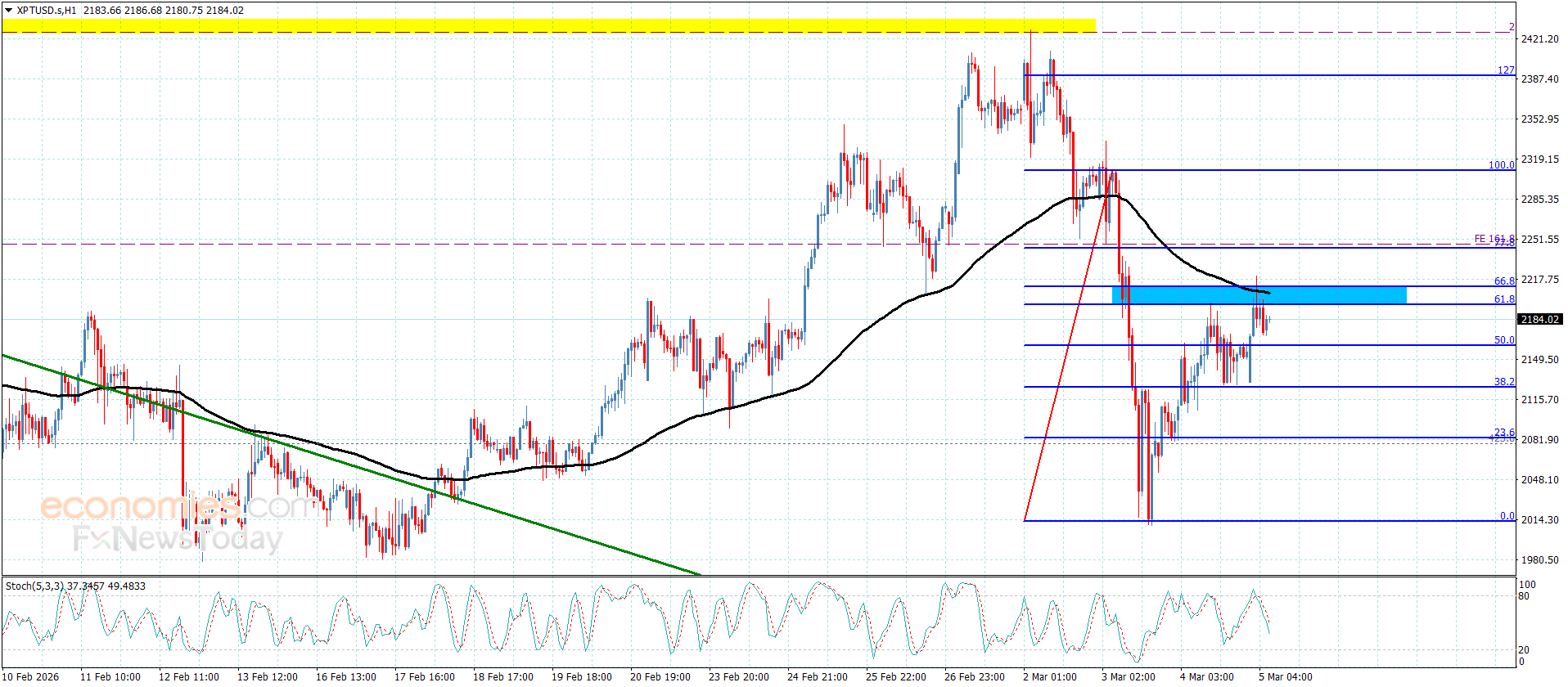
Platinum price ended its last corrective attempts by reaching $2220.00 level, to rebound quickly towards $2180.00, keeping its negative stability below $2245.00 level besides forming %61.8 Fibonacci correction level at $2200.00 level as appears in the above image.
The stability of moving average 55 above the current trading will increase the negative pressure, to reinforce the chances of resuming the negative attack, to expect targeting $2130.00 level reaching $2080.00 level.
The expected trading range for today is between $2080.00 and $2200.00
Trend forecast: Bearish
– Written by
Frank Davies
STORY LINK GBP/USD Forecast: Pound Sterling Struggles near $1.34
The Pound US Dollar (GBP/USD) exchange rate struggled to gain momentum on Thursday as the ongoing crisis in the Middle East continued to keep markets on edge.
At the time of writing, GBP/USD was trading around $1.3369. While the pair attempted to recoup some of its earlier losses, upside movement remained limited as a cautious market mood continued to underpin demand for the safe-haven ‘Greenback’.
The US Dollar remained broadly supported, although its momentum softened slightly as markets attempted a modest recovery in risk sentiment.
The ‘Greenback’ had strengthened overnight on Wednesday as escalating tensions in the Middle East fuelled demand for safe-haven assets. This came after the US denied reports that Iranian operatives had reached out to the CIA to discuss terms for a ceasefire.
Hawkish remarks from US Secretary of War Pete Hegseth added to market anxiety, with reports he urged Israel’s Defence Minister Israel Katz to ‘continue to the end’. Meanwhile, Iran struck a US oil tanker in the Persian Gulf while continuing drone and missile attacks against US allies in the region.
Although markets staged a brief rebound on Thursday morning, the overall mood remained cautious. As a result, the US Dollar continued to find some support from lingering risk aversion, even as its earlier gains eased slightly.
The increasingly risk-sensitive Pound struggled to gain strong traction, although it managed to stabilise somewhat as markets attempted a modest recovery in sentiment.
Get better rates and lower fees on your next international money transfer.
Compare TorFX with top UK banks in seconds and see how much you could save.
The absence of fresh UK economic data left Sterling without a clear domestic catalyst, while the mixed implications of rising global energy prices kept upside potential somewhat limited.
Surging energy costs may encourage the Bank of England to adopt a more cautious approach to cutting interest rates, given the potential for renewed inflationary pressure. Expectations that borrowing costs may remain higher for longer can typically lend support to the Pound.
However, escalating energy prices could also place additional strain on the UK’s already fragile economy. Higher household bills risk intensifying the cost-of-living crisis, while the prospect of increased support measures may also pose a fiscal challenge for the British government.
The US Dollar could face fresh volatility as markets turn their attention to the latest US non-farm payrolls report.
Economists forecast that job creation slowed notably in February, with payrolls expected to rise by around 59,000, down sharply from 130,000 in the previous month. A slowdown of this magnitude may raise concerns about the resilience of the US labour market and could strengthen expectations that the Federal Reserve may begin cutting interest rates sooner than previously anticipated.
Alongside the jobs data, the latest US retail sales figures are also due for release. January’s reading is expected to show a 0.3% contraction in sales, which could further dampen confidence in the US economic outlook and add to downside pressure on the US Dollar.

However, any losses for the ‘Greenback’ may prove limited if risk aversion remains elevated. Continued tensions in the Middle East could still drive safe-haven demand for the US Dollar.
With little in the way of notable UK economic data scheduled, movement in the GBP/USD exchange rate is likely to remain primarily driven by US data and the broader market mood.
International Money Transfer? Ask our resident FX expert a money transfer question or try John’s new, free, no-obligation personal service! ,where he helps every step of the way,
ensuring you get the best exchange rates on your currency requirements.
TAGS: Pound Dollar Forecasts
Silver (XAG/USD) trades lower on Thursday, falling toward $82.20 at the time of writing, down 1.18% on the day. The precious metal is under pressure as the US Dollar (USD) rebounds following the release of stronger-than-expected US economic data.
The US Dollar Index (DXY), which tracks the Greenback’s value against a basket of six major currencies, is moving higher and approaches the 99.30 area, up 0.45% on Thursday. A stronger US Dollar tends to weigh on Silver, as the metal becomes more expensive for investors holding other currencies.
Several recent economic releases highlight the resilience of the US economy. The ADP Employment Change report showed that the private sector added 63K jobs in February, beating market expectations of 50K and sharply improving from the previous revised reading of 11K. At the same time, the Institute for Supply Management (ISM) reported that the Services Purchasing Managers Index (PMI) rose to 56.1 in February from 53.8 in the previous month, while economists had expected a slowdown to 53.5.
Additional labor market signals also point to underlying strength. Initial Jobless Claims in the US came in at 213K for the week ending February 28, slightly below expectations of 215K. Meanwhile, the Challenger, Gray & Christmas report showed a sharp decline in announced layoffs in February, although hiring plans remain cautious as companies remain wary about expanding their workforce.
Against this backdrop, expectations for an early monetary easing cycle from the Federal Reserve (Fed) have been scaled back. According to estimates based on the CME FedWatch tool, markets increasingly expect the first rate cut to arrive in September, while the chance of the Fed keeping rates unchanged at the July meeting now stands above 50%, compared to 33.4% a week earlier. Higher interest rates generally reduce the appeal of non-yielding assets such as Silver.
Geopolitical developments are nevertheless providing some support to the precious metal. Escalating tensions in the Middle East, involving the United States, Israel, and Iran, are maintaining a degree of safe-haven demand. Hopes of a potential diplomatic opening briefly emerged following reports suggesting indirect contact between Tehran and Washington, but Iranian authorities later denied the claims, leaving the outlook for the conflict uncertain.
Investors are now focusing on upcoming key US data releases, including the Nonfarm Payrolls (NFP) report and Retail Sales figures on Friday. These indicators could offer further clues about the strength of the US labor market and the likely path of monetary policy from the Federal Reserve.
Silver is a precious metal highly traded among investors. It has been historically used as a store of value and a medium of exchange. Although less popular than Gold, traders may turn to Silver to diversify their investment portfolio, for its intrinsic value or as a potential hedge during high-inflation periods. Investors can buy physical Silver, in coins or in bars, or trade it through vehicles such as Exchange Traded Funds, which track its price on international markets.
Silver prices can move due to a wide range of factors. Geopolitical instability or fears of a deep recession can make Silver price escalate due to its safe-haven status, although to a lesser extent than Gold’s. As a yieldless asset, Silver tends to rise with lower interest rates. Its moves also depend on how the US Dollar (USD) behaves as the asset is priced in dollars (XAG/USD). A strong Dollar tends to keep the price of Silver at bay, whereas a weaker Dollar is likely to propel prices up. Other factors such as investment demand, mining supply – Silver is much more abundant than Gold – and recycling rates can also affect prices.
Silver is widely used in industry, particularly in sectors such as electronics or solar energy, as it has one of the highest electric conductivity of all metals – more than Copper and Gold. A surge in demand can increase prices, while a decline tends to lower them. Dynamics in the US, Chinese and Indian economies can also contribute to price swings: for the US and particularly China, their big industrial sectors use Silver in various processes; in India, consumers’ demand for the precious metal for jewellery also plays a key role in setting prices.
Silver prices tend to follow Gold’s moves. When Gold prices rise, Silver typically follows suit, as their status as safe-haven assets is similar. The Gold/Silver ratio, which shows the number of ounces of Silver needed to equal the value of one ounce of Gold, may help to determine the relative valuation between both metals. Some investors may consider a high ratio as an indicator that Silver is undervalued, or Gold is overvalued. On the contrary, a low ratio might suggest that Gold is undervalued relative to Silver.
EUR/USD registered small gains on Wednesday but failed to gather recovery momentum. The pair comes under renewed bearish pressure and trades below 1.1600 in the European session on Thursday.
The table below shows the percentage change of Euro (EUR) against listed major currencies this week. Euro was the weakest against the US Dollar.
| USD | EUR | GBP | JPY | CAD | AUD | NZD | CHF | |
|---|---|---|---|---|---|---|---|---|
| USD | 1.46% | 0.74% | 0.85% | 0.11% | 0.41% | 0.71% | 1.78% | |
| EUR | -1.46% | -0.73% | -0.64% | -1.33% | -1.05% | -0.73% | 0.31% | |
| GBP | -0.74% | 0.73% | -0.10% | -0.61% | -0.34% | -0.01% | 1.05% | |
| JPY | -0.85% | 0.64% | 0.10% | -0.68% | -0.39% | -0.02% | 0.97% | |
| CAD | -0.11% | 1.33% | 0.61% | 0.68% | 0.27% | 0.67% | 1.67% | |
| AUD | -0.41% | 1.05% | 0.34% | 0.39% | -0.27% | 0.31% | 1.37% | |
| NZD | -0.71% | 0.73% | 0.01% | 0.02% | -0.67% | -0.31% | 1.06% | |
| CHF | -1.78% | -0.31% | -1.05% | -0.97% | -1.67% | -1.37% | -1.06% |
The heat map shows percentage changes of major currencies against each other. The base currency is picked from the left column, while the quote currency is picked from the top row. For example, if you pick the Euro from the left column and move along the horizontal line to the US Dollar, the percentage change displayed in the box will represent EUR (base)/USD (quote).
A modest improvement in risk sentiment made it difficult for the US Dollar (USD) to build on its weekly gains on Wednesday but upbeat data releases from the US and news pointing to a widening crisis in the Middle East helped the currency keep its footing.
The data from the US showed on Wednesday that the Institue for Supply Management (ISM) Services Purchasing Managers’ Index (PMI) rose to 56.1 in February from 53.8 in January, reflecting an ongoing expansion in the services sector’s business activity at an accelerating pace. Additionally, Automatic Data Processing (ADP) reported that employment in private sector rose 63K in February, surpassing the market expectation of 50K.
Late Wednesday, the US Senate rejected a resolution that was aimed at forcing US President Donald Trump to seek congressional approval for further military action against Iran. Meanwhile, CNN reported that a top US official said that the US will start attacking deeper into Iran, noting that the operation is still in its early days.
The US Deparment of Labor’s weekly Initial Jobless Claims will be the only noteworthy data featured in the US economic calendar on Thursday. Investors are likely to ignore this report and opt to wait for the official employment data, which will be published on Friday.
Hence, investors will remain focused on geopolitical headlines. US stock index futures were last seen losing between 0.5% and 0.6% on the day, pointing to another risk-off action in the American session that is likely to help the USD preserve its strength and weigh on EUR/USD.
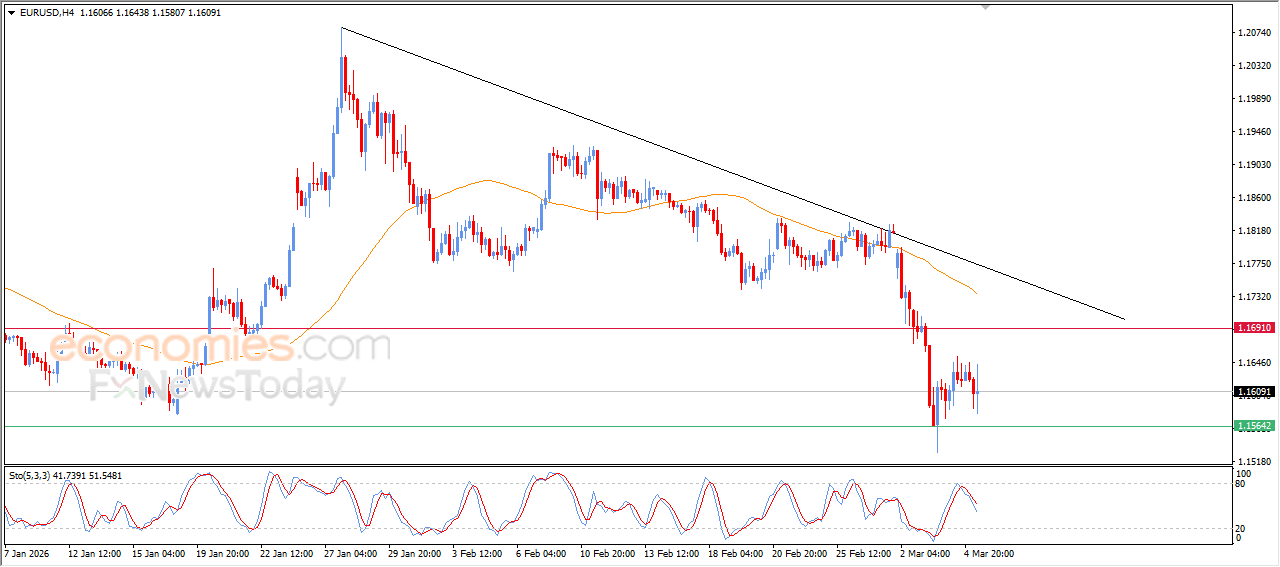
In the 4-hour chart, EUR/USD trades at 1.1583. The near-term bias stays bearish as the pair holds well below the 20-, 50- and 100-period Moving Averages (MAs), with the shorter MAs trending lower under the 200-period MA and reinforcing downside pressure. Price action clings to the lower side of the Bollinger Bands, reflecting persistent selling interest rather than a volatility spike, while the Relative Strength Index (RSI) near 30 signals oversold momentum but not yet a decisive rebound.
Immediate resistance emerges at 1.1670, where a horizontal barrier aligns above the declining 20-period MA and would need to give way to ease the current bearish tone. On the downside, initial support is seen around 1.1531, with a break opening the door toward 1.1500 and then 1.1460, levels that frame the next downside targets if sellers extend control.
(The technical analysis of this story was written with the help of an AI tool.)
The Euro is the currency for the 20 European Union countries that belong to the Eurozone. It is the second most heavily traded currency in the world behind the US Dollar. In 2022, it accounted for 31% of all foreign exchange transactions, with an average daily turnover of over $2.2 trillion a day.
EUR/USD is the most heavily traded currency pair in the world, accounting for an estimated 30% off all transactions, followed by EUR/JPY (4%), EUR/GBP (3%) and EUR/AUD (2%).
The European Central Bank (ECB) in Frankfurt, Germany, is the reserve bank for the Eurozone. The ECB sets interest rates and manages monetary policy.
The ECB’s primary mandate is to maintain price stability, which means either controlling inflation or stimulating growth. Its primary tool is the raising or lowering of interest rates. Relatively high interest rates – or the expectation of higher rates – will usually benefit the Euro and vice versa.
The ECB Governing Council makes monetary policy decisions at meetings held eight times a year. Decisions are made by heads of the Eurozone national banks and six permanent members, including the President of the ECB, Christine Lagarde.
Eurozone inflation data, measured by the Harmonized Index of Consumer Prices (HICP), is an important econometric for the Euro. If inflation rises more than expected, especially if above the ECB’s 2% target, it obliges the ECB to raise interest rates to bring it back under control.
Relatively high interest rates compared to its counterparts will usually benefit the Euro, as it makes the region more attractive as a place for global investors to park their money.
Data releases gauge the health of the economy and can impact on the Euro. Indicators such as GDP, Manufacturing and Services PMIs, employment, and consumer sentiment surveys can all influence the direction of the single currency.
A strong economy is good for the Euro. Not only does it attract more foreign investment but it may encourage the ECB to put up interest rates, which will directly strengthen the Euro. Otherwise, if economic data is weak, the Euro is likely to fall.
Economic data for the four largest economies in the euro area (Germany, France, Italy and Spain) are especially significant, as they account for 75% of the Eurozone’s economy.
Another significant data release for the Euro is the Trade Balance. This indicator measures the difference between what a country earns from its exports and what it spends on imports over a given period.
If a country produces highly sought after exports then its currency will gain in value purely from the extra demand created from foreign buyers seeking to purchase these goods. Therefore, a positive net Trade Balance strengthens a currency and vice versa for a negative balance.
Gold prices rose in its recent intraday trading, to recover some of its previous losses, but it continues to face negative and dynamic pressure due to the continuation of its trading below EMA50, which prevented its recovery recently.
This comes because of breaking short-term bullish trend line, weakening the previous positive technical structure, accompanied by the emergence of negative signals from relative strength indicators, which might limit the ability to keep rising unless the price manages to breach its near resistance and holds above it.
Therefore, we suggest a decline in gold price’s upcoming intraday trading, if $5,200 resistance remains intact, to target $5,000 support level.
The expected trading range is between $5,000 support and $5,250 resistance.
Today’s forecast: Bearish
Platinum price ended its last corrective attempts by reaching $2220.00 level, to rebound quickly towards $2180.00, keeping its negative stability below $2245.00 level besides forming %61.8 Fibonacci correction level at $2200.00 level as appears in the above image.
The stability of moving average 55 above the current trading will increase the negative pressure, to reinforce the chances of resuming the negative attack, to expect targeting $2130.00 level reaching $2080.00 level.
The expected trading range for today is between $2080.00 and $2200.00
Trend forecast: Bearish
Gold prices rose in its recent intraday trading, to recover some of its previous losses, but it continues to face negative and dynamic pressure due to the continuation of its trading below EMA50, which prevented its recovery recently.
This comes because of breaking short-term bullish trend line, weakening the previous positive technical structure, accompanied by the emergence of negative signals from relative strength indicators, which might limit the ability to keep rising unless the price manages to breach its near resistance and holds above it.
Therefore, we suggest a decline in gold price’s upcoming intraday trading, if $5,200 resistance remains intact, to target $5,000 support level.
The expected trading range is between $5,000 support and $5,250 resistance.
Today’s forecast: Bearish
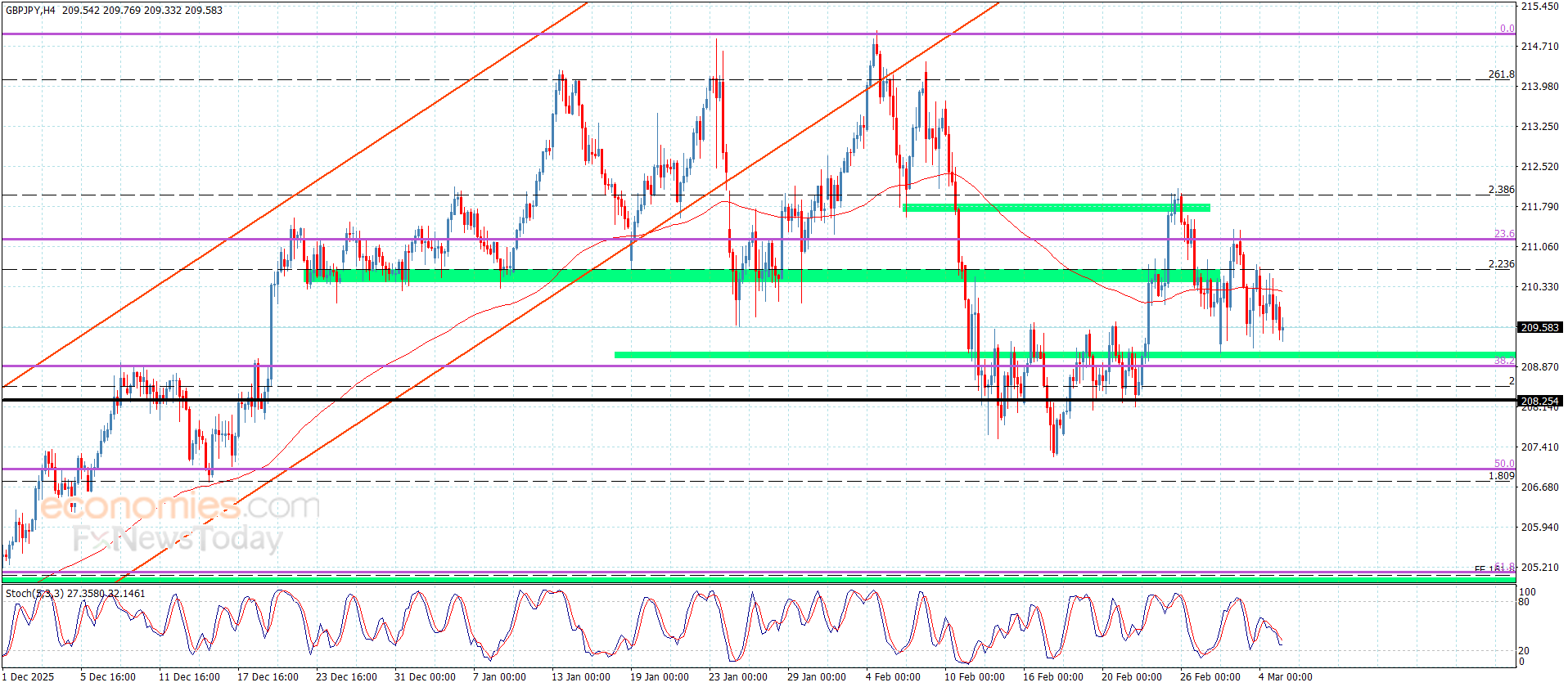
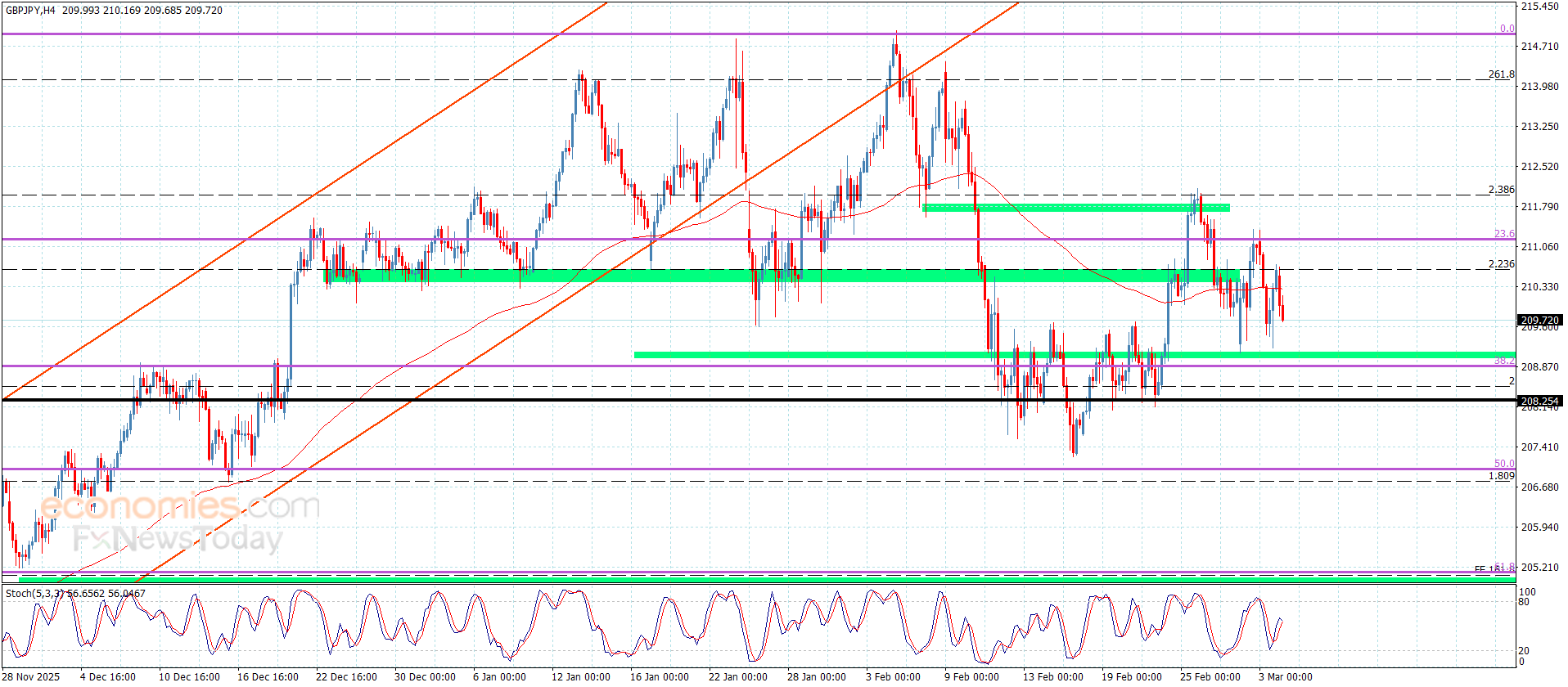
The GBPJPY pair activated with the negativity of the main indicators yesterday, to achieve the suggested negative targets in the previous report by reaching 209.40, which forces it to provide mixed trading to gather the required extra negative momentum to confirm the continuation of the negativity in the upcoming trading.
Note that forming an extra barrier at 210.65 level, and the stability of the trading below the moving average 55, these factors makes us keep the negative scenario to expect breaking the extra support at 209.10, to target new bearish stations that might begin at 208.30 reaching 206.90.
The expected trading range for today is between 208.30 and 210.40
Trend forecast: Bearish