The main category of All News Articles.
You can use the search box below to find what you need.
[wd_asp id=1]
The main category of All News Articles.
You can use the search box below to find what you need.
[wd_asp id=1]
Silver is no longer just a “precious metal”, it has become the primary financial barometer for global instability. As of today, Sunday, March 1, 2026, silver (XAG/USD) is ending the week with an explosive surge, trading in the $93.80–$94.50 range. This nearly 8% single-day gain follows the dramatic escalation of the US-Israel-Iran conflict, specifically the reported strikes on Tehran and the subsequent death of Iran’s Supreme Leader.
With the Strait of Hormuz facing a potential blockade and safe-haven demand hitting fever pitch, the “Silver Squeeze” of 2026 is entering a parabolic phase. When markets reopen on Monday, March 2, traders are bracing for a massive gap-up that could finally push silver into triple-digit territory.
The current rally is being supercharged by a “Triple-Engine” catalyst that gold simply cannot match:
Following the US-Israeli joint military operations (dubbed “Epic Fury” and “Roaring Lion”), geopolitical risk has reached a decade-high. Silver’s reaction, surging 8% compared to gold’s 2%, confirms its status as a “high-beta” safe haven. Investors are fleeing equities and the dollar, rotating into silver as a hedge against a prolonged Middle Eastern conflict.
A critical “paper vs. physical” disconnect is emerging. Recent reports of a 159-million-ounce sell order triggering a CME trading halt have raised alarms, as the order far exceeded the registered inventory available for delivery. With March First Notice Day approaching and registered stocks under 60 million ounces, the physical market is tighter than at any point since the 1970s.
Major banks are rapidly revising their year-end targets. Deutsche Bank recently signaled that the current gold-to-silver ratio of 57 presents a significant upside risk to their $100/oz forecast. Meanwhile, billionaire Eric Sprott has warned that if the physical supply drain continues, a “revaluation shock” could eventually target the $300 mark.
[[XAG/USD-graph]]
On the 4-hour chart, silver is exhibiting a textbook ascending channel breakout. The metal has decisively reclaimed the $91.33 horizontal resistance, flipping it into a rock-solid support floor.
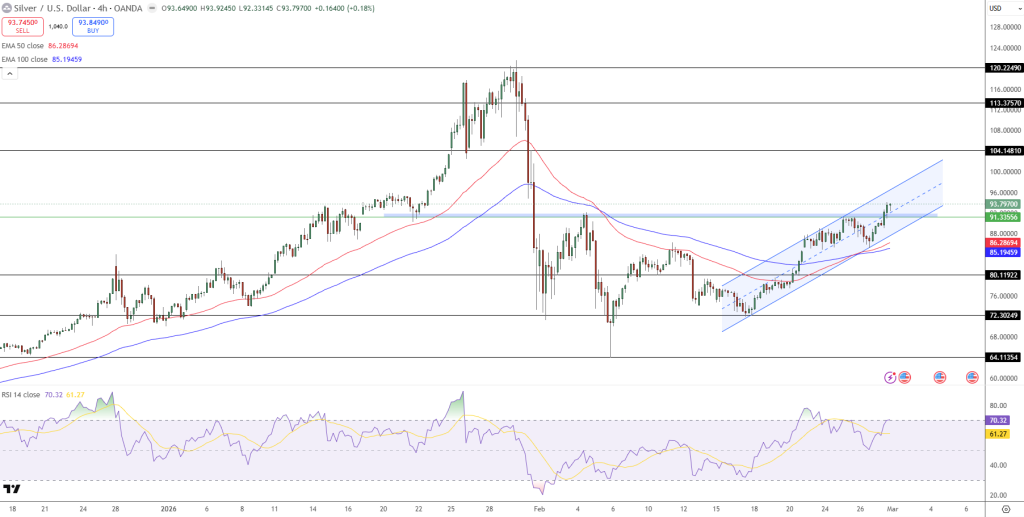
As a professional analyst, I am advising extreme caution for the Monday open. We are likely to see a “Gap and Run” scenario if the headlines from the Middle East continue to deteriorate. However, silver is famous for its “bull traps”, if diplomatic de-escalation signals emerge over the weekend, we could see a rapid “fill the gap” move back toward $91.
Trade Idea: Look for bullish continuation above $95.00 targeting $104.14.
Stop Loss: Place a tight stop below $91.33 to protect against a “buy the rumor, sell the news” reversal.

Arslan Butt
Lead Markets Analyst – Multi-Asset (FX, Commodities, Crypto)
Arslan Butt serves as the Lead Commodities and Indices Analyst, bringing a wealth of expertise to the field. With an MBA in Behavioral Finance and active progress towards a Ph.D., Arslan possesses a deep understanding of market dynamics.
His professional journey includes a significant role as a senior analyst at a leading brokerage firm, complementing his extensive experience as a market analyst and day trader. Adept in educating others, Arslan has a commendable track record as an instructor and public speaker.
His incisive analyses, particularly within the realms of cryptocurrency and forex markets, are showcased across esteemed financial publications such as ForexCrunch, InsideBitcoins, and EconomyWatch, solidifying his reputation in the financial community.
I wrote on the 22nd February that the best trades for the week would be:

A summary of last week’s most important data in the market:
The only significant effects last week’s economic data had was minor dovish tilt on expected rate cuts by the Fed, and the stronger AUD after the higher inflation data.
The week brought little clarity on tariffs. In any case, markets seem to have calmed down a lot about that issue.
The week was really dominated by speculation over the possibility of an American attack on Iran, with the prediction market Polymarket seeing odds narrowing Friday as the US Ambassador told Americans to leave Israel “today” if they wanted too but still showing only an approximate 30% chance of an attack over the weekend.
Ambassador Huckabee’s warning was worth paying attention to, as a few hours after dawn on Saturday morning saw a joint Israeli / US strike, generating an element of surprise as the opening salvo was expected to be made during hours of darkness.
The initial strike killed several senior Iranian figures, including the Chief of Staff, the Head of the Revolutionary Guards, Ayatollah Khamenei’s major advisor, and the Ayatollah himself, as well as several others. Iran is hitting back with frequent attacks on Israel (damage has been very minimal so far) and on US-allied Gulf states, where the psychological impact has been greater and the air defenses weaker. The USA and Israel are openly calling for regime change in Iran and seem very bullish about the war.
Ayatollah Khamenei has been the Supreme Leader of Iran since 1989 and has been arguably the leading global figurehead of hostility towards the USA and Israel.
It seems clear that this war is going to last for a few days at least, maybe even for a few weeks, and that a surrender by the regime remains unlikely, at least for time being.
Interestingly, there has been no military response yet from any of Iran’s proxies, notably Hezbollah which is positioned on Israel’s northern border and could still add to Israeli damage and logistical issues. It is telling that despite the confirmed death of the Ayatollah, the proxies have still not joined battle, that is a very bullish sign for the USA and Israel.
Yesterday the Iranian navy warned ships not to enter the Gulf of Hormuz, and traffic remains down by about 70%. More than 10% of the world’s Crude Oil passes through this narrow waterway, so if the US does not manage to undo this semi-blockade, Crude Oil markets will likely be under supply pressure unless OPEC agrees to increase production. There are signs OPEC already agreed this with President Trump. The price of WTI Crude Oil rose strongly on Friday and broke the 6-month high price, so many trend traders will already be long here. The price of Gasoline has also risen.
The coming week’s most important data points, in order of likely importance, are:
Currency Price Changes and Interest Rates
For the month of February, I forecasted that the EUR/USD currency pair would rise in value.

February 2026 Monthly Forecast Final Performance
Last week saw no currency crosses with excessive volatility, so I am making no forecast for the coming week.
The Swiss Franc was the strongest major currency last week, while the Japanese Yen was the weakest. Directional volatility decreased last week, with only 11% of all major pairs and crosses changing in value by more than 1%.
Next week’s volatility is likely to be higher due to the outbreak of war in the Middle East, which might generate volatility in the US Dollar, the Japanese Yen, and the Canadian Dollar. There could also be unforeseen side effects which might affect other currencies.
You can trade these forecasts in a real or demo Forex brokerage account.
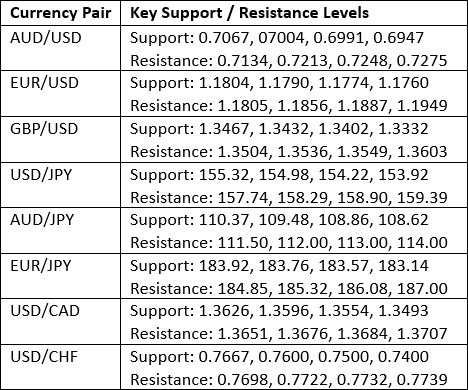
Key Support and Resistance Levels
Last week, the US Dollar printed a small doji candlestick, which is typically seen as indecision. I see it more as a consolidation as the area of the candlestick is located where the price has been comfortable in recent weeks.
Zooming out, we can see that although the price action of recent months suggests a bearish consolidation pattern, the most recent price action has been bullish over recent weeks. The long-term trend is mixed, with the price below its level of 3 months ago but just above its level of 6 months ago.
We saw the interest rate outlook remain more bullish last week on the greenback, with markets now pricing in only two rate cuts of 0.25% over the course of 2026 instead of the three that were expected in the previous week. This was reinforced by hot PPI data.
I take no bias here on the US Dollar, which is not of much concern to the market. I think it will be better to watch other assets on their own merits this week.
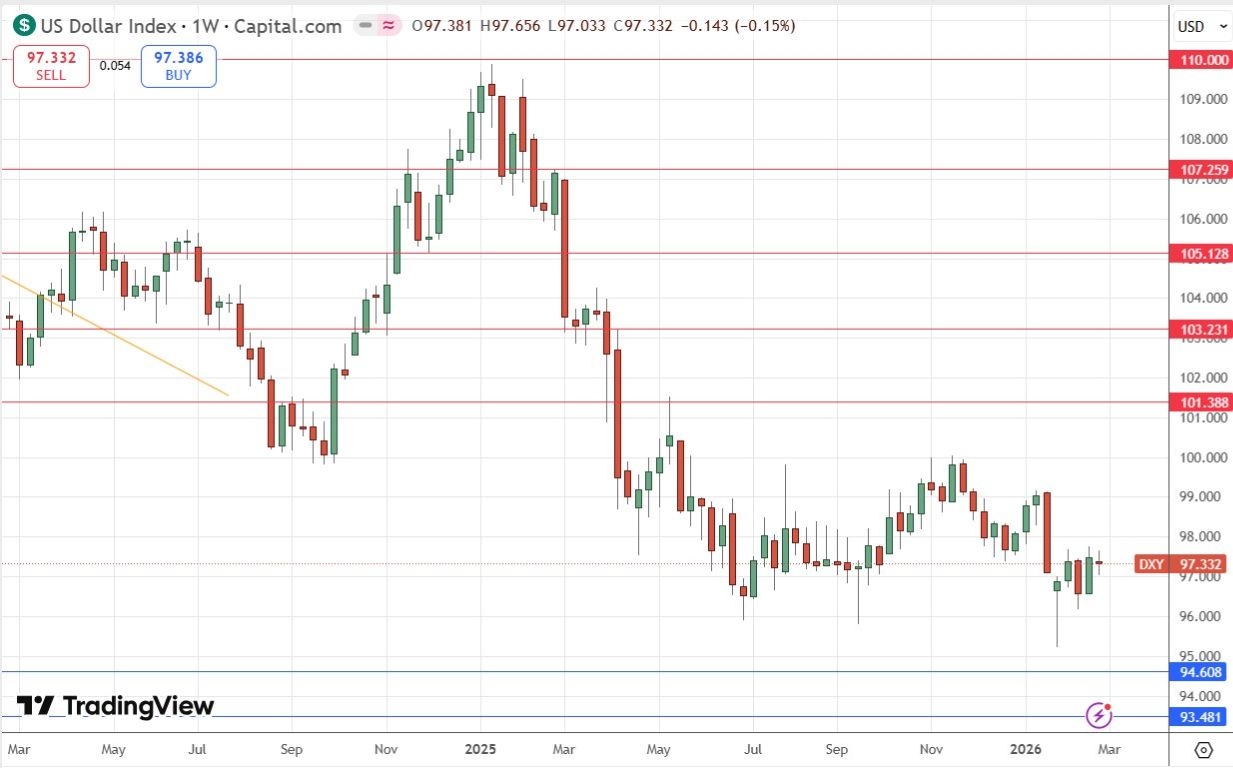
US Dollar Index Weekly Price Chart
WTI Crude Oil rose last week, especially on Friday when the odds of an American attack on Iran seemed to narrow, sending the price higher to make a new 6-month high and close at what was nearly a 7-month high.
The rumour of war was correct, and it appears both sides are playing for as high stakes as could be, with the USA and Israel openly calling for regime change after killing Ayatollah Khameini and many other very senior figures in the opening strike Saturday morning.
Although it seems that neither side is targeting crude oil facilities, yesterday Iran announced a blockade of the Straits of Hormuz, and it seems 70% of oil tankers are still afraid to pass through. Iran attacked one oil tanker Sunday in the Strait. If this situation persists, it will reduce the supply of crude oil to the market as over 10% of global crude oil passes through the Strait. Still, OPEC looks poised to increase production, which may save the Americans from having to reopen the Strait to get the prices of Crude Oil and Gasoline down.
No matter what damage control happens now, I think it is likely that we will see a higher open for WTI Crude Oil on Monday. I am already long of it as a trend trader, but I will be exiting my long position quickly, by close on Monday or Tuesday, as I expect that OPEC will oblige and open the crude oil tap.
I could be wrong and just the sentiment could see the price move higher for several days if the war continues. It does seem likely that the war will go on for several days or weeks.
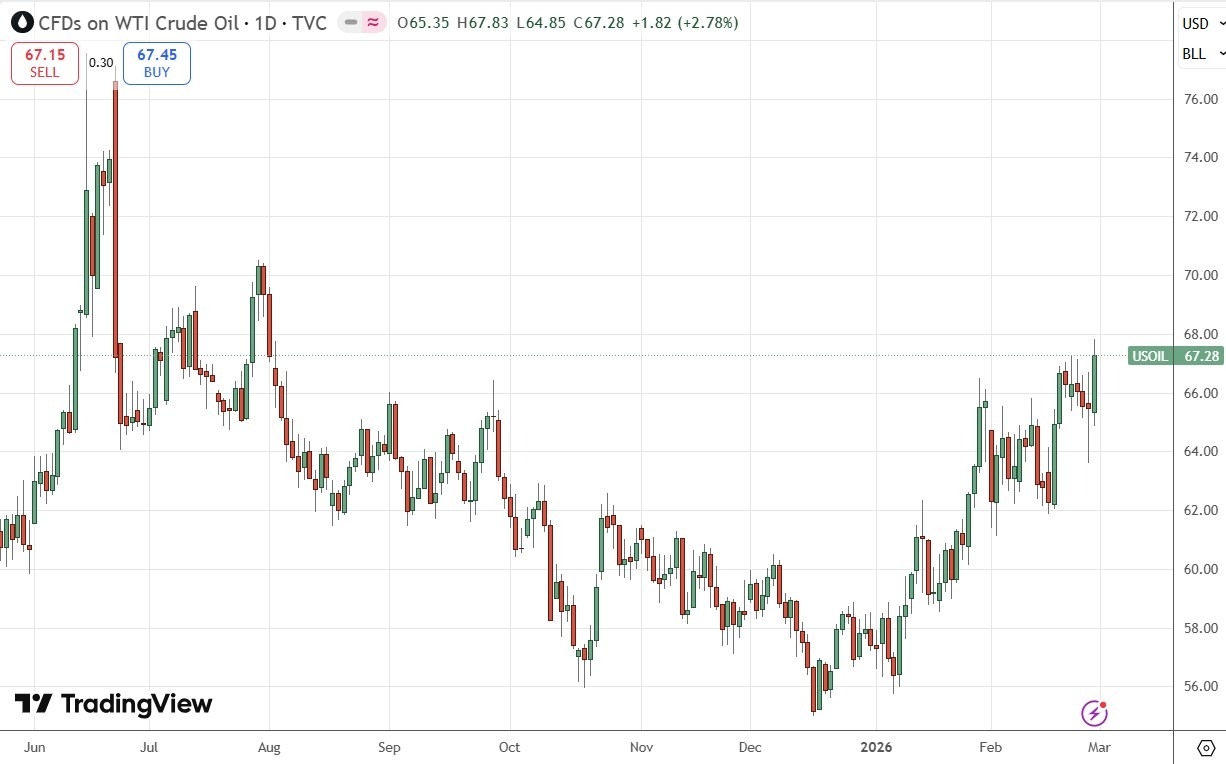
WTI Crude Oil Daily Price Chart
The AUD/USD currency pair is very interesting right now, as the Australian Dollar is even stronger than the US Dollar, being one of the few currencies that has outpaced it over recent weeks, trading at long-term high prices two weeks ago.
The Australian Dollar is one of three major currencies whose central banks are on a path of rate hikes rather than cuts, and its path is the strongest and most convincing.
I think the Australian Dollar is an excellent long prospect.
Technically, last week’s candlestick looks bullish as a breakout from the previous week’s inside candlestick, so if the price can get established later above $0.7134, it will be trading in bullish blue sky and could easily go on to make further gains.
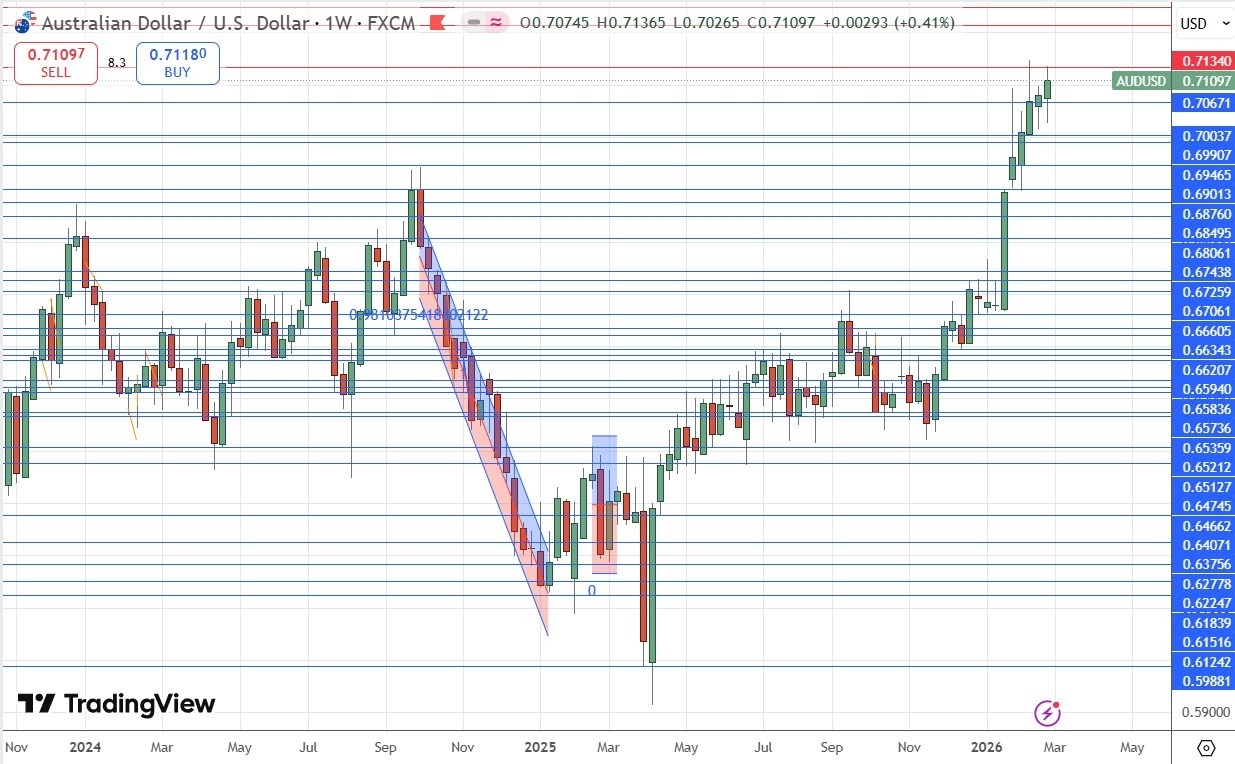
AUD/USD Weekly Price Chart
BTC/USD is starting to show a very textbook range consolidation between $61,229 and $71,762. This is an extension downwards of the lower border of the range, which is a bearish sign. The daily price chart below shows that a break of this range could be very significant technically. Although there has been lots of bearish pressure on Bitcoin, it may be that long-term investors see it as cheap in this range and are buying it. A convincing bullish breakout above $71,762 could trigger a fast rise to $81,203. This feels the less likely scenario.
A bearish breakdown below the very pivotal long-term low at $61,229 will be a dramatic even and likely trigger a further rapid fall in the price of Bitcoin.
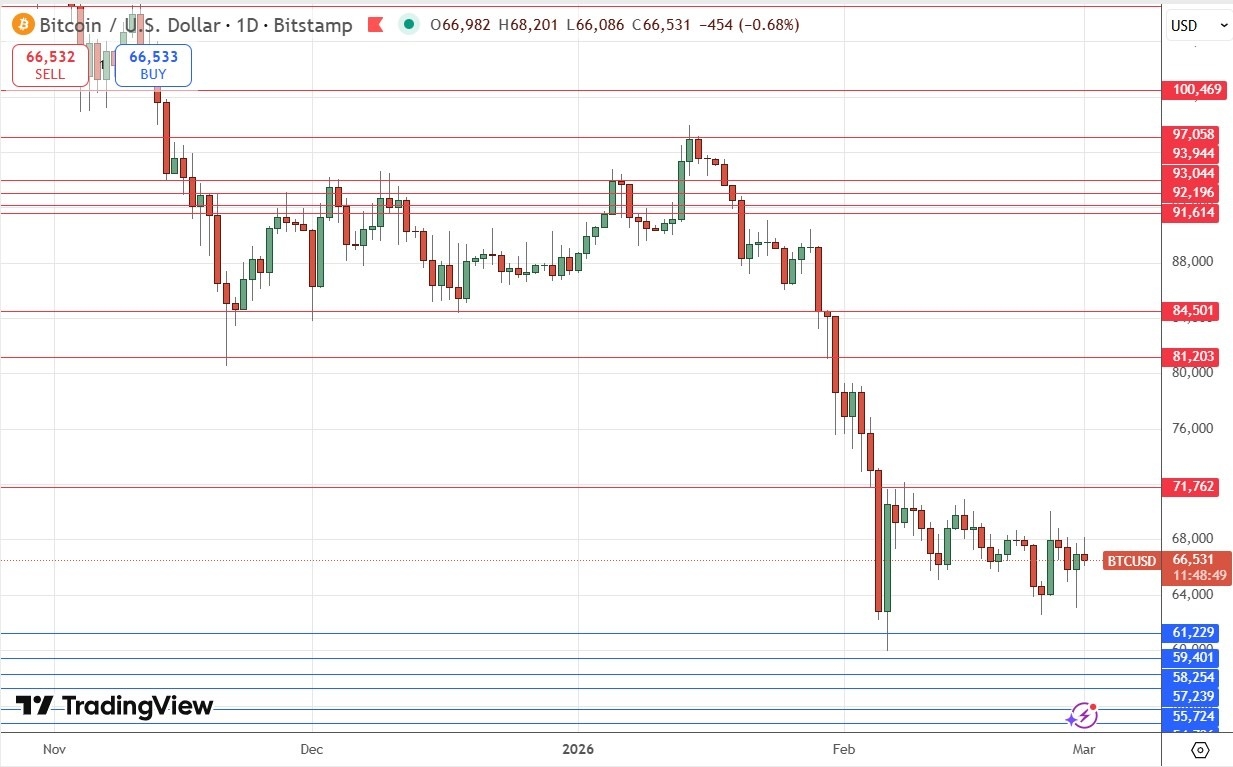
Bitcoin Daily Price Chart
Gold has started to rise convincingly again, although it is still a meaningful way off its record high which it made a few weeks ago. The daily chart below shows that Friday’s rise was especially impressive, with the price closing right on the high of the day and the week.
It looks as if Gold will continue to go higher, and the rise seems to be changing from a grind higher into a firmer upwards move.
The price remains well above the 50% Fib retracement level of the recent sharp crash in value, which is another bullish sign.
Trend and momentum traders who do not want to wait for long-term breakouts will probably want to be long here already. I prefer to wait for long-term new high prices, so I will wait for a daily close above $5,418.55 before I enter a long trade.
Another bullish factor is the strong rise in Silver we saw last week, with the price closing above $93 per ounce. Both precious metals are at their highest prices since the huge crash one month ago.
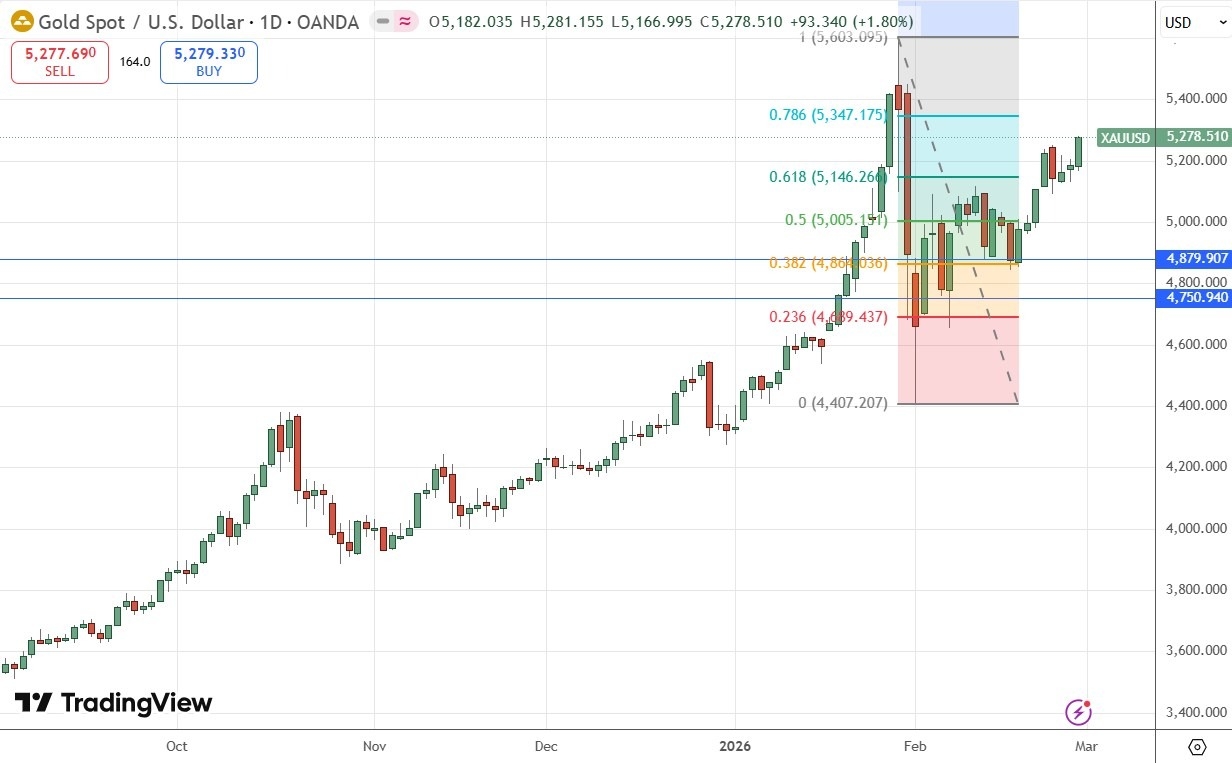
Gold Daily Price Chart
I see the best trades this week as:
Ready to trade our weekly Forex forecast? Check out our list of the top 10 Forex brokers in the world.
Despite providing bullish momentum by stochastic, however the fluctuation below the initial barrier at $3.520 level, which pushed it to form new bearish waves, repeating the pressure on the main support at $3.000.
The current support forms detecting key for the main trend in the upcoming trading, to expect its stability to begin forming new bullish waves, motivating it to surpass $3.520 barrier, to record new gains by its rally towards $3.750 and $4.000, while breaking the support and holding below it will force it to suffer big losses, to expect reaching $2.850 and $2.660 initially.
The expected trading range for today is between $3.000 and $3.520
Trend forecast: Bullish
Barclays boosted its Brent crude oil futures price forecast to around $100 per barrel on Saturday, up from $80 on Friday, after the United States and Israel bombed several sites in Iran.
“Oil markets might have to face their worst fears on Monday. As things stand right now, we think Brent could hit $100 (per barrel), as the market grapples with the threat of a potential supply disruption amid a spiraling security situation in the Middle East,” the bank said in a report.
The United States and Israel attacked Iran on Saturday, targeting its top leaders and calling for the overthrow of its government, while Iran responded with missiles fired at Israel and neighboring Gulf countries.
Oil prices rose about 2% on Friday, with traders bracing for supply disruptions as nuclear talks between the US and Iran had yet to reach an agreement.
Brent settled at $72.48 a barrel.
About a fifth of the oil consumed globally passes through the Strait of Hormuz between Oman and Iran, making any disruptions in the area a major risk to global oil supplies.
Gold (XAU/USD) gained traction and climbed above $5,200, ending the fourth consecutive week in positive territory. The next round of US-Iran talks and crucial macroeconomic data releases from the US will be watched closely by market participants in the short term.
Gold opened with a bullish gap and registered daily gains on Monday as investors reacted to United States (US) President Donald Trump’s response to the Supreme Court’s ruling against his administration’s tariffs on Friday. Trump vowed that they will impose even bigger levies using alternative legal frameworks, specifically citing national security conventions under Section 301 of the Trade Act of 1974. Over the weekend, the US president said that he will raise global tariffs to 15% from 10% “effective immediately” and warned that additional ones would follow.
After extending its rally to a fresh February-high above $5,200 in the early trading hours of the Asian session on Tuesday, Gold reversed its direction and closed the day in the red as the negative impact of the US trade policy uncertainty on risk mood faded away.
While delivering his State of the Union speech in the early trading hours of the Asian session on Wednesday, Trump noted that there is no inflation and said he sees “tremendous growth,” pointing to tariffs as one of the main reasons behind the economic turnaround. Trump further added that almost all trading partners want to keep the trade deals they already made, despite the Supreme Court’s ruling. As Wall Street’s main indexes shot higher midweek, the US Dollar (USD) struggled to find demand and allowed XAU/USD to register daily gains.
Gold struggled to make a decisive move in either direction on Thursday. In the absence of high-impact economic data releases, retreating US Treasury bond yields helped XAU/USD hold its ground. The benchmark 10-year US bond yield declined below 4% for the first time since late November. On the flip side, the precious metal’s upside remained capped early Friday as geopolitical tensions eased after news outlets reported that the US and Iran made significant progress during Thursday’s nuclear talks in Geneva.
In the second half of the day on Friday, however, re-escalating geopolitical tensions helped Gold climb above $5,200. Citing an email from the US Ambassador to Israel, Mike Huckabee, NBC News reported that the diplomat has advised nonessential staff members to leave the country immediately. “He also urged anyone intending to leave to go ahead and book flights, citing the likely surge in demand out of Israel after the embassy’s move,” the outlet wrote.
The US economic calendar will offer critical data releases that could trigger the next directional action in Gold.
On Monday, the Institute for Supply Management (ISM) will publish the Manufacturing Purchasing Managers’ Index (PMI) report for February. In case the headline PMI comes in below 50 and points to a contraction in the manufacturing sector’s business activity, the immediate reaction could hurt the USD and open the door for a leg higher in XAU/USD.
The Automatic Data Processing (ADP) will release the private sector employment figures for February on Wednesday, followed by the ISM Services PMI. A weaker-than-expected print in the ADP Employment Change data and a decline below 50 in the ISM Services Employment Index could cause investors to prepare for a disappointing Nonfarm Payrolls (NFP) report on Friday and trigger a USD selloff. Conversely, XAU/USD could come under bearish pressure if the ADP numbers and the PMI report point to healthy labor market conditions.
The US Bureau of Labor Statistics’ (BLS) official employment report will feature the Unemployment Rate, NFP and wage inflation figures for February on Friday.
n January, NFP rose by 130K, compared to the market expectation of 70K, and the Unemployment Rate declined to 4.3% from 4.4% in December. An NFP increase of 100K or more could ease concerns over the labor market slack and boost the USD. The CME Group FedWatch Tool currently shows that markets virtually see no chance of a Federal Reserve (Fed) interest rate cut in March and price in about an 80% probability of one more policy hold in April. This positioning suggests that the USD has some room on the upside in case investors see a strong employment data as a confirmation of steady policy at least until June. In this scenario, US Treasury bond yields could recover sharply and cause XAU/USD to move south heading into the weekend.
On the other hand, a disappointing NFP print at or below 50K could cause market participants to reconsider the possibility of a rate cut in April and pave the way for a bullish XAU/USD action in the American session on Friday.
ING’s Commodities Strategist Ewa Manthey argues that structural drivers are likely to support Gold prices in the near term.
“As long as geopolitical fragmentation persists, a meaningful reversal in central bank gold demand looks unlikely. This structural floor continues to underpin the market at elevated price levels,” Manthey explains, while adding, “Our US economist expects the Fed to begin cutting rates in the second quarter, with policy becoming incrementally less restrictive over the coming quarters. Even a modest easing cycle would be supportive for Gold, lowering real yields and reducing the opportunity cost of holding non‑yielding assets.”
Investors will also pay close attention to headlines from the next round of US-Iran negotiations in Vienna. US Vice President JD Vance said late Thursday that there is “no chance” the US will be involved in a prolonged war in the Middle East, but added that Trump was still weighing targeted military strikes against Iran. If the US strikes Iran to force an agreement, escalating geopolitical tensions could support Gold prices. On the flip side, a nuclear deal without any military action could have the opposite impact on the precious metal’s performance.
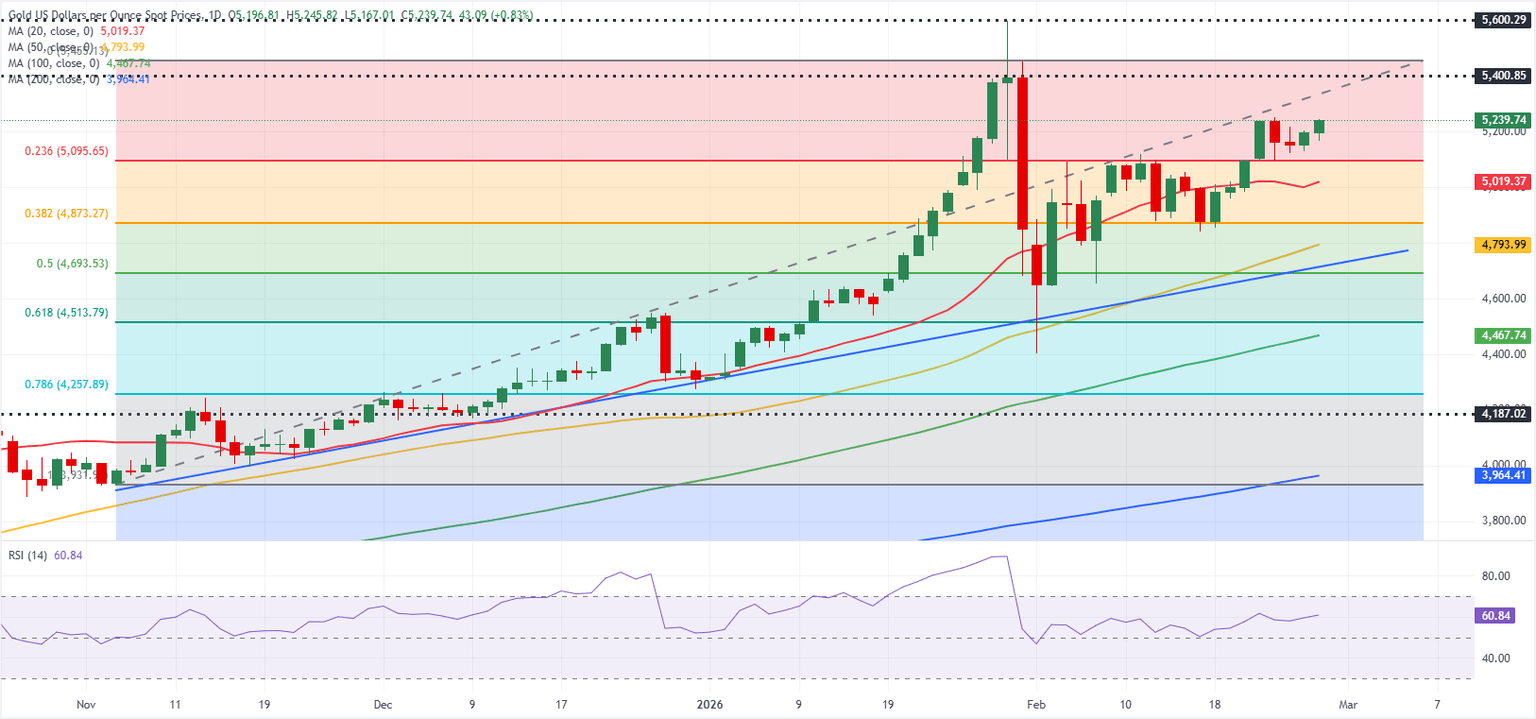
The Relative Strength Index (RSI) on the daily chart moves sideways near 60, and Gold trades well above the 20-day Simple Moving Average (SMA), reflecting a consolidation phase within a bullish structure.
The immediate resistance could be seen at $5,300 (round level). If Gold stabilizes above this level and confirms it as support, bulls could target $5,400 (static level, round level) ahead of $5,598 (all-time high).
On the downside, $5,090-$5,100 (Fibonacci 23.6% retracement of the November-February uptrend, round level) aligns as the first support area before $4,870 (Fibonacci 38.2% retracement) and $4,790 (50-day SMA).
Nonfarm Payrolls (NFP) are part of the US Bureau of Labor Statistics monthly jobs report. The Nonfarm Payrolls component specifically measures the change in the number of people employed in the US during the previous month, excluding the farming industry.
The Nonfarm Payrolls figure can influence the decisions of the Federal Reserve by providing a measure of how successfully the Fed is meeting its mandate of fostering full employment and 2% inflation.
A relatively high NFP figure means more people are in employment, earning more money and therefore probably spending more. A relatively low Nonfarm Payrolls’ result, on the either hand, could mean people are struggling to find work.
The Fed will typically raise interest rates to combat high inflation triggered by low unemployment, and lower them to stimulate a stagnant labor market.
Nonfarm Payrolls generally have a positive correlation with the US Dollar. This means when payrolls’ figures come out higher-than-expected the USD tends to rally and vice versa when they are lower.
NFPs influence the US Dollar by virtue of their impact on inflation, monetary policy expectations and interest rates. A higher NFP usually means the Federal Reserve will be more tight in its monetary policy, supporting the USD.
Nonfarm Payrolls are generally negatively-correlated with the price of Gold. This means a higher-than-expected payrolls’ figure will have a depressing effect on the Gold price and vice versa.
Higher NFP generally has a positive effect on the value of the USD, and like most major commodities Gold is priced in US Dollars. If the USD gains in value, therefore, it requires less Dollars to buy an ounce of Gold.
Also, higher interest rates (typically helped higher NFPs) also lessen the attractiveness of Gold as an investment compared to staying in cash, where the money will at least earn interest.
Nonfarm Payrolls is only one component within a bigger jobs report and it can be overshadowed by the other components.
At times, when NFP come out higher-than-forecast, but the Average Weekly Earnings is lower than expected, the market has ignored the potentially inflationary effect of the headline result and interpreted the fall in earnings as deflationary.
The Participation Rate and the Average Weekly Hours components can also influence the market reaction, but only in seldom events like the “Great Resignation” or the Global Financial Crisis.
LONDON, Feb 28, 2026, 12:44 GMT — Market closed.
Natural gas traders are bracing for the possibility of a fresh risk premium as U.S. and Israeli forces hit Iran on Saturday, escalating a conflict that’s already put energy markets on edge. Gas futures are closed until Monday, so prices won’t update until trading kicks back in. Reuters
The Strait of Hormuz has become the key concern. This narrow waterway is the main exit for LNG — that’s liquefied natural gas transported by tanker — headed toward Europe and Asia. Greece’s shipping ministry, in an advisory viewed by Reuters, instructed all Greek-flagged ships to steer clear of the Persian Gulf, the Gulf of Oman, and the strait itself, calling for “maximum vigilance.” Reuters
Europe faces that risk with storage levels already thin. As of Feb. 27, EU gas inventories were down to 343.84 terawatt-hours, just 30.09% of capacity, according to Gas Infrastructure Europe. Gas Infrastructure Europe
Gas prices had already climbed on Friday, ahead of the strikes. Dutch TTF—the key European benchmark—settled at 32.43 euros per megawatt-hour, a gain of 1.69%. UK gas finished the session at 79.79 pence per therm, up 2.66%. Trading Economics
April Henry Hub futures finished the day at $2.859 per mmBtu, a gain of 1.06% for the U.S. gas benchmark. MarketWatch
Oil’s rally factors into the equation, especially for gas, which tends to move on the same headline-driven risk. Brent finished Friday at $72.48 a barrel. According to Barclays, the $3 to $5 per barrel risk premium—essentially insurance for potential supply shocks—could “fade quickly” absent any real disruption. Reuters
Producers across the Gulf are taking early steps to steady the market. According to sources cited by Reuters, Abu Dhabi plans to ship more Murban crude in April, while Saudi Arabia is also increasing production. The extra supply, TP ICAP’s Scott Shelton noted, might “create a short-term buffer” should tanker traffic avoid Hormuz. Reuters
When it comes to gas, it’s the flow of tankers, insurance terms, and port access that matter more than volumes from Iran. Disruption in the Strait of Hormuz threatens to squeeze spot LNG supply—and that’s enough to send European hub prices higher, regardless of how pipeline deliveries look.
LNG exports keep the U.S. market tied to the geopolitics game, siphoning gas from the local grid. Cheniere flagged a $370 million tax credit for burning LNG aboard its ships and wouldn’t comment further, putting shipping costs and fuel math back in focus for traders. Reuters
Longer-term LNG demand isn’t fading from focus, not with contracting still active. Venture Global inked a fresh 20-year supply agreement with South Korea’s Hanwha Aerospace on Friday, deliveries kicking off in 2030. The company’s contracted volumes now top 46 million tonnes a year, according to its statement. Reuters
Still, the gas rally could unravel just as quickly. Should hostilities remain localized, with shipping uninterrupted and Europe entering shoulder season when heating demand tapers off, that geopolitical premium might disappear almost overnight.
Oil markets open Sunday with OPEC+ on the docket, sources say, meeting after the Iran strike to weigh upping supply beyond earlier projections. If the group opts for a larger hike, that could pull crude prices lower and ease pressure across the energy sector. Reuters
Attention shifts to Monday’s open, with gas desks scanning for disruption headlines or signs of war-risk premiums that could quickly squeeze LNG cargo margins. Stateside, traders are eyeing Thursday, March 5, when the weekly storage report lands — a recurring data release that CME highlights as a major mover for gas futures. cmegroup.com
BitcoinWorld
Silver Price Forecast: XAG/USD Soars Past $90 as AI Valuation Fears Trigger Stunning Safe-Haven Rush
Global financial markets witnessed a significant shift on Thursday, March 13, 2025, as the silver price (XAG/USD) surged decisively above the $90 per ounce threshold, marking its highest nominal level in history. This remarkable rally, primarily driven by escalating concerns over artificial intelligence stock valuations, has triggered a substantial rotation into traditional safe-haven assets. Consequently, analysts are now revising their silver price forecast upward, citing a complex interplay of technological uncertainty and macroeconomic hedging.
The London Bullion Market Association recorded the spot silver price at $90.42 per ounce during European trading hours, representing a 4.7% single-day gain. This movement follows a sustained upward trajectory that began in late 2024. Market technicians highlight that silver has now broken through a critical multi-decade resistance zone between $85 and $88. Historically, such breakouts have preceded extended bullish phases for the white metal. Furthermore, trading volume for silver futures on the COMEX exchange surged to 235% of its 30-day average, indicating strong institutional participation in this move.
Several key technical indicators now support a constructive silver price forecast. The 50-day moving average has crossed bullishly above the 200-day average, forming what traders call a “golden cross.” Additionally, the relative strength index (RSI) for XAG/USD sits at 68, suggesting momentum without immediate overbought conditions. Market structure data from the Commodity Futures Trading Commission also reveals that managed money accounts have increased their net-long positions in silver futures for seven consecutive weeks.
To understand the significance of the $90 level, analysts often examine previous silver price peaks. The table below shows key historical highs and their catalysts:
| Year | Price Peak (Nominal USD) | Primary Catalyst |
|---|---|---|
| 1980 | $48.70 | Hunt Brothers accumulation, high inflation |
| 2011 | $49.51 | Post-financial crisis QE, debt ceiling fears |
| 2020 | $29.86 | Pandemic-driven monetary stimulus |
| 2025 (Current) | $90.42+ | AI valuation risk, monetary regime uncertainty |
This current rally differs fundamentally from past surges. Previously, inflation fears or specific market manipulations drove prices. Today, the catalyst stems from a sectoral rotation away from overvalued technology assets.
The immediate catalyst for silver’s surge appears rooted in growing investor apprehension regarding artificial intelligence company valuations. Major AI-focused equity indices have experienced increased volatility throughout Q1 2025, following a series of critical developments:
This uncertainty has prompted a broad-based reassessment of risk across asset classes. Consequently, portfolio managers are reducing exposure to high-beta technology stocks and reallocating to assets with negative correlation to equity volatility. Silver, with its dual characteristics as both a monetary metal and an industrial commodity, has become a preferred vehicle for this rotation. Notably, silver’s industrial demand profile, particularly in photovoltaic solar panels and electronics, provides a fundamental floor, while its historical role as a store of value offers upside during periods of financial stress.
The capital flow from AI equities to precious metals follows a clear pattern. First, volatility spikes in the Nasdaq AI Index trigger risk parity fund rebalancing. These systematic funds automatically sell volatile assets and buy stable ones. Second, discretionary macro hedge funds, anticipating further tech sector weakness, establish long positions in silver futures as a hedge. Finally, retail investors, through physically-backed silver ETFs like iShares Silver Trust (SLV), provide sustained buying pressure. This three-tiered demand creates a powerful upward price dynamic that technical resistance levels struggle to contain.
The surge in silver occurs within a complex global macroeconomic environment. Central banks, particularly the Federal Reserve, maintain a data-dependent stance on interest rates. While inflation has moderated from 2023 peaks, persistent services inflation and a weakening US Dollar Index have enhanced the appeal of non-yielding assets like precious metals. Moreover, geopolitical tensions continue to simmer, adding another layer of safe-haven demand. Central bank purchasing of gold, which reached record levels in 2024, has also created a positive spillover effect into the silver market, as these metals often move in correlation.
From a supply perspective, the silver market remains structurally tight. The Silver Institute’s 2024 report highlighted a fourth consecutive annual physical deficit, with demand outstripping mine supply by 142 million ounces. Primary silver mine production faces challenges from declining ore grades and rising energy costs. Meanwhile, industrial demand, especially from the green energy transition, continues its secular growth trend. This fundamental supply-demand imbalance provides a supportive backdrop for higher prices, irrespective of financial flows.
Leading commodity analysts from institutions like Bloomberg Intelligence and the World Bank have updated their silver price forecast. Their consensus suggests a trading range of $85-$105 per ounce for the remainder of 2025, contingent on several factors:
Dr. Elena Vargas, Head of Commodities Research at Global Markets Advisory, stated in a recent client note: “The convergence of financial hedging demand and robust physical fundamentals creates a rare bullish setup for silver. While prices may experience short-term consolidation, the path of least resistance appears higher, particularly if equity market corrections deepen.” This expert view underscores the unique confluence of drivers behind the current rally.
The silver price forecast has turned decisively bullish as XAG/USD breaches the historic $90 level. This movement stems not from traditional inflation fears but from a sophisticated capital rotation driven by AI valuation risks. The metal’s dual role as both an industrial input and a monetary asset positions it uniquely to benefit from current market dislocations. While volatility should be expected, the combination of tight physical supply, sustained industrial demand, and its newfound status as a hedge against technology sector volatility suggests the rally may have further room to run. Investors and analysts will closely monitor both equity market sentiment and central bank policy for cues on silver’s next directional move.
Q1: What exactly caused silver to jump above $90?
The primary catalyst was a rapid shift of investment capital away from overheated artificial intelligence stocks into traditional safe-haven assets. Fears about AI company valuations, regulatory costs, and slowing growth triggered this sector rotation.
Q2: Is silver still a good investment after such a big price move?
Many analysts believe the fundamental picture remains supportive due to structural supply deficits and growing industrial demand from green technologies. However, as with any asset that has experienced a sharp rally, short-term pullbacks are possible and investors should consider their risk tolerance.
Q3: How does AI volatility affect a physical commodity like silver?
It affects it through financial market channels. When AI stocks fall, fund managers rebalance portfolios, often buying assets with low or negative correlation to tech equities. Silver, traded via futures and ETFs, receives these flows, which then impact the global spot price.
Q4: What’s the difference between the current silver rally and the 2011 peak?
The 2011 peak was driven by quantitative easing and debt ceiling fears post-financial crisis. The 2025 rally is primarily driven by sector-specific risk (AI) and a flight to safety within a still-growing economy, coupled with a persistent physical market deficit.
Q5: Could the price of silver go back down?
Yes, all markets are cyclical. A significant cooling of AI sector fears, a much stronger US dollar, or a sharp decline in industrial activity could apply downward pressure. The current bullish forecast depends on the continuation of the present macroeconomic and sectoral trends.
This post Silver Price Forecast: XAG/USD Soars Past $90 as AI Valuation Fears Trigger Stunning Safe-Haven Rush first appeared on BitcoinWorld.

Global oil prices are rising due to escalating tensions in the Middle East. The United States and Israel have launched a military operation against Iran. This action has brought the Strait of Hormuz into the conflict zone, increasing the risk of disruptions to crude exports. Over 20 per cent of global oil passes through this waterway. Brent crude settled at $72.48 per barrel, and analysts say prices could reach $80 per barrel if supply disruptions occur. Traders are factoring in a “war premium” due to the current geopolitical situation.
Oil prices are rising because of potential supply disruptions from the Middle East. The US and Israel’s military operation against Iran has increased uncertainty. Missile attacks in the Strait of Hormuz and threats to Iran’s naval forces create concerns about oil movement. The risk premium added by traders reflects fears of interruptions to global supply. Even limited military escalation can push prices higher, while strong demand and low inventories add pressure to the market.
Global oil prices are rising due to the US and Israel launching a massive military operation against Iran. The attack has brought the Strait of Hormuz into a conflict zone, which could disrupt crude exports from Middle Eastern countries.
Over 20 per cent of the world’s oil passes through the Strait of Hormuz, connecting the Persian Gulf with the Gulf of Oman and the Arabian Sea. Heavy missile attacks and US President Donald Trump’s statement on destroying Iran’s navy have raised concerns about movement of oil from the region.
Analysts expect a “war premium” to push oil prices higher due to coordinated attacks by the US and Israel. Tehran has launched retaliatory strikes, increasing risks of supply disruptions.
Oil prices rose about 2 per cent on Friday. Brent crude settled at $72.48 per barrel. Barclays Bank stated Brent crude could rise to around $80 per barrel if there is any significant supply disruption. The bank added that the market is pricing in a risk premium due to ongoing geopolitical tensions.Barclays said that even if escalation does not immediately disrupt supply, a 1 million barrel per day outage could push Brent crude to $80. Traders are also monitoring US-Iran nuclear negotiations, which have not reached an agreement.
US President Donald Trump expressed disappointment over negotiations with Iran and warned that force may be necessary. The large US military presence in the region increases the likelihood of future strikes, contributing to oil market uncertainty.
Barclays noted that if no supply disruption occurs, and Iran’s response is less severe than expected, oil prices could decline by $3 to $5 per barrel. However, the market is structurally tightening with low spare capacity, limited inventories, and strong demand, keeping prices under pressure.
Barclays said recent history may reduce the risk premium if tensions fade. Yet, the combination of military actions, tight supply, and strategic chokepoints like the Strait of Hormuz continues to create upside potential for oil prices.
Analysts at Barclays Bank suggest that Brent crude could reach $80 per barrel if there is a significant supply disruption. Even a one million barrel per day outage would push prices higher. Currently, Brent crude is at $72.48 per barrel. If tensions ease or Iran’s response is limited, the market could see a $3–$5 decline per barrel. However, structural market factors such as tight inventories and low spare capacity may support higher prices in the near term.
Barclays and other market analysts note that the oil market is experiencing a risk premium due to geopolitical tensions. Analysts say that while escalation does not always lead to immediate supply disruption, even minor outages can create price spikes. The market is structurally tightening with low spare capacity, firm demand, and limited inventories. Traders are watching US-Iran negotiations and regional military actions to assess potential supply risks. Overall, geopolitical risks remain a major factor for oil prices in the coming weeks.
Investors should monitor global events and oil market trends closely. With Brent crude at $72.48 per barrel, they should prepare for possible volatility. Analysts suggest factoring in risk premiums and potential supply disruptions. If tensions escalate, prices may rise toward $80 per barrel. Conversely, if no disruption occurs, prices could fall by $3–$5. Investors should balance risk and exposure, follow official updates from the US, Iran, and Israel, and consider using hedging strategies or diversified energy investments to manage price fluctuations.
Why are global oil prices rising now?
Global oil prices are rising due to US-Israel attacks on Iran and threats to the Strait of Hormuz. Traders are factoring in a risk premium for potential supply disruptions.
Will Brent crude reach $80 per barrel soon?
Brent crude could reach $80 per barrel if supply from the Middle East is disrupted. Analysts note the risk premium is influenced by geopolitical tensions and tight oil inventories.
Silver price (XAG/USD) is up 2.4% to near $90.60 during the European trading session on Friday. The white metal strengthens as escalating concerns over valuations of Artificial Intelligence (AI) stocks have prompted demand for safe-haven assets.
On Thursday, the S&P 500 tumbled to near 6,900, and its futures have fallen further during the day, following an over 5% decline in the share price of Nvidia, which is the world’s largest producer of AI and sophisticated chips. Though the company posted stellar first quarter numbers of 2026, investors worry about the sustainability of AI capital expenditure (capex), and overcapacity risks.
In addition to AI valuation concerns, sliding United States (US) treasury yields have also improved the Silver’s appeal. 10-year US bond yields have fallen to near 4%, the lowest level seen in over a year. Lower yields on interest-bearing assets prompt demand for non-yielding assets, such as Silver.
On the geopolitical front, the meeting between the US and Iran over nuclear issues in Geneva on Thursday concluded on a positive note. Oman’s Foreign Minister, Badr al-Busaidi, said in early trade that talks between both nations on nuclear issues have made “significant progress,” and they will resume next week in Vienna. Signs of easing geopolitical woes often diminish demand for safe-haven assets.
In Friday’s session, investors will focus on the US Producer Price Index (PPI) data for January, which will be published at 13:30 GMT.
XAG/USD trades higher above $90 as of writing. The near-term bias tilts mildly bullish as price holds above the 20-day Exponential Moving Average, which is around $85 and underpins the recent rebound from the mid-$70s area. The sequence of higher lows from $73.64 through the current consolidation supports a recovery structure rather than a continuation of the prior sharp decline from above $110.
The 14-day Relative Strength Index (RSI) continues to wobble inside the 40.00-60.00 range, demonstrating a sideways trend.
Initial support emerges at the 20-day EMA near $85.00, with a break below exposing the psychological level of $80 and then the February 20 low around $77.50 area as deeper downside levels.
On the topside, immediate resistance aligns with the recent plateau around $92.50, and a daily close above would open room toward $96.00 and then the psychological $100.00 handle.
(The technical analysis of this story was written with the help of an AI tool.)
Silver is a precious metal highly traded among investors. It has been historically used as a store of value and a medium of exchange. Although less popular than Gold, traders may turn to Silver to diversify their investment portfolio, for its intrinsic value or as a potential hedge during high-inflation periods. Investors can buy physical Silver, in coins or in bars, or trade it through vehicles such as Exchange Traded Funds, which track its price on international markets.
Silver prices can move due to a wide range of factors. Geopolitical instability or fears of a deep recession can make Silver price escalate due to its safe-haven status, although to a lesser extent than Gold’s. As a yieldless asset, Silver tends to rise with lower interest rates. Its moves also depend on how the US Dollar (USD) behaves as the asset is priced in dollars (XAG/USD). A strong Dollar tends to keep the price of Silver at bay, whereas a weaker Dollar is likely to propel prices up. Other factors such as investment demand, mining supply – Silver is much more abundant than Gold – and recycling rates can also affect prices.
Silver is widely used in industry, particularly in sectors such as electronics or solar energy, as it has one of the highest electric conductivity of all metals – more than Copper and Gold. A surge in demand can increase prices, while a decline tends to lower them. Dynamics in the US, Chinese and Indian economies can also contribute to price swings: for the US and particularly China, their big industrial sectors use Silver in various processes; in India, consumers’ demand for the precious metal for jewellery also plays a key role in setting prices.
Silver prices tend to follow Gold’s moves. When Gold prices rise, Silver typically follows suit, as their status as safe-haven assets is similar. The Gold/Silver ratio, which shows the number of ounces of Silver needed to equal the value of one ounce of Gold, may help to determine the relative valuation between both metals. Some investors may consider a high ratio as an indicator that Silver is undervalued, or Gold is overvalued. On the contrary, a low ratio might suggest that Gold is undervalued relative to Silver.
The Euro tried to rally to begin the trading session on Thursday but gave back gains. At this point in time, it looks like we continue to go sideways, and it looks like we have nowhere to be at this point in time.
The 1.18 level continues to be a bit of a magnet for price, and we are sitting just above the crucial 50-day EMA. Quite frankly, I think we’ve got a situation where the pair just doesn’t know where to go and therefore, we will remain hugging the 50-day EMA in the short term.
Ultimately, if we can break above the 1.1850 level it opens up the possibility of a move to the 1.20 level. But we can also say that if we were to break down below the lows of last week maybe we could open up a move down to the 1.16 level, which is right about where the 200-day EMA is hanging around.
Ultimately, this is a market that I think continues to be very noisy and of course will move on to the latest noise coming out of the US economic background. After all we have to wonder about the Federal Reserve and what they are going to do as far as interest rates are concerned.
People are trying to do what they can to get a grasp on the idea that the Fed may or may not cut rates as rapidly as previously expected as the jobs situation in the United States has been better than anticipated. That does slow things down but now we’re starting to see people talk about 2027 not so much 2026 and if that ends up being something that catches hold the US dollar will pick up strength yet again because we already know that the European Central Bank is likely to be flat this year as far as monetary policy is concerned.
I think there’s so much confusion here that short-term range bound traders are probably the only people bothering with this market in what would probably be thought of as about a 50-pip zone with the 1.18 level.
Ready to trade our daily Forex analysis? We’ve made this forex brokers list for you to check out.
Christopher Lewis has been trading Forex and has over 20 years experience in financial markets. Chris has been a regular contributor to Daily Forex since the early days of the site. He writes about Forex for several online publications, including FX Empire, Investing.com, and his own site, aptly named The Trader Guy. Chris favours technical analysis methods to identify his trades and likes to trade equity indices and commodities as well as Forex. He favours a longer-term trading style, and his trades often last for days or weeks.