The main category of All News Articles.
You can use the search box below to find what you need.
[wd_asp id=1]
The main category of All News Articles.
You can use the search box below to find what you need.
[wd_asp id=1]
The article covers the following subjects:
Consider long positions from corrections above 92.50 with a target of 115.50–125.50.
Breakout and consolidation below 92.50 will allow the asset to continue declining to the levels of 78.58–67.00.
On the weekly chart, a descending correction has likely finished developing as the second wave of larger degree (2) and an ascending third wave (3) is forming. On the daily chart, apparently, the first wave of smaller degree 1 of (3) has formed, a local correction has been completed as wave 2 of (3), and the third wave 3 of (3) is unfolding. Wave i of 3 continues developing on the H4 chart; within it, wave (iii) of i is unfolding. If the presumption is correct, WTI will continue to rise to 115.50–125.50. The level of 92.50 is critical in this scenario as a breakout below it will enable the asset to continue declining to the levels of 78.58–67.00.
This forecast is based on the Elliott Wave Theory. When developing trading strategies, it is essential to consider fundamental factors, as the market situation can change at any time.
The content of this article reflects the author’s opinion and does not necessarily reflect the official position of LiteFinance broker. The material published on this page is provided for informational purposes only and should not be considered as the provision of investment advice for the purposes of Directive 2014/65/EU.
According to copyright law, this article is considered intellectual property, which includes a prohibition on copying and distributing it without consent.
The Euro to Dollar (EUR/USD) exchange rate closed Friday near 1.1599, down 0.10% on the day, as stronger US core inflation reinforced expectations of a Federal Reserve rate increase.
MUFG’s downside scenario points towards 1.14, approximately 1.7% below that close.
Before Friday’s inflation release, the bank outlined two possible paths: a Fed hold alongside further ECB tightening could lift EUR/USD towards 1.20, while a September Fed hike could push it towards the bottom of its 1.14-1.18 range.
“The performance of EUR/USD may increasingly hinge on the Fed’s policy response,” MUFG’s Lee Hardman said.
The August CPI release showed core prices rising 0.3% on the month, accelerating from July’s 0.2% increase and exceeding the 0.2% consensus.
Headline prices rose 0.4%, with gasoline accounting for more than a third of the increase.
Annual core inflation nevertheless eased to 2.4% from 2.5%, making this a setback in monthly momentum rather than an acceleration across every measure.
Market estimates put the probability of a September hike around 85-90% after the release.
MUFG subsequently changed its own Fed forecast:
“As a result, we now expect the Fed to hike rates by 25bps in September.”

Thursday’s ECB decision announced a quarter-point increase in the deposit rate to 2.50%, effective from 16 September, while projecting inflation above target through 2028.
That supported the argument for further European tightening explored in our earlier EUR/USD outlook.
We believe Friday’s CPI weakens the case for the Euro to benefit from an ECB tightening cycle while the Fed stands aside.
However, with a US hike already heavily anticipated, its delivery alone may offer limited additional Dollar support.
MUFG’s rates strategists acknowledge that markets have already priced in much of the expected tightening and may have gone too far.
A move towards 1.14 therefore remains conditional on how the Fed’s decision and guidance change expectations for subsequent meetings.
| USD | EUR | GBP | JPY | CAD | AUD | NZD | CHF | |
|---|---|---|---|---|---|---|---|---|
| USD | +0.13% | -0.08% | -1.75% | +0.24% | +0.46% | +1.16% | +0.79% | |
| EUR | -0.13% | -0.21% | -1.87% | +0.12% | +0.33% | +1.03% | +0.67% | |
| GBP | +0.08% | +0.21% | -1.67% | +0.33% | +0.54% | +1.24% | +0.88% | |
| JPY | +1.78% | +1.91% | +1.70% | +2.03% | +2.24% | +2.96% | +2.58% | |
| CAD | -0.24% | -0.12% | -0.33% | -1.99% | +0.21% | +0.91% | +0.55% | |
| AUD | -0.46% | -0.33% | -0.54% | -2.20% | -0.21% | +0.70% | +0.33% | |
| NZD | -1.15% | -1.02% | -1.23% | -2.87% | -0.90% | -0.69% | -0.36% | |
| CHF | -0.79% | -0.66% | -0.87% | -2.52% | -0.54% | -0.33% | +0.36% |
The FX heat map compares how Euro (EUR) has performed against a basket of major currencies over the past week. The largest move was against the Japanese Yen, where Euro recorded its sharpest decline. Data comparing prices today (12/09/2026 12:07 UTC) and daily close on 05/09/2026.
To read the table, choose the base currency from the left-hand column and then move across to the quote currency along the top row. For example, the GBP row and USD column shows the weekly percentage move in GBP/USD.
Our currency coverage draws on live market data, official economic releases and published bank research.
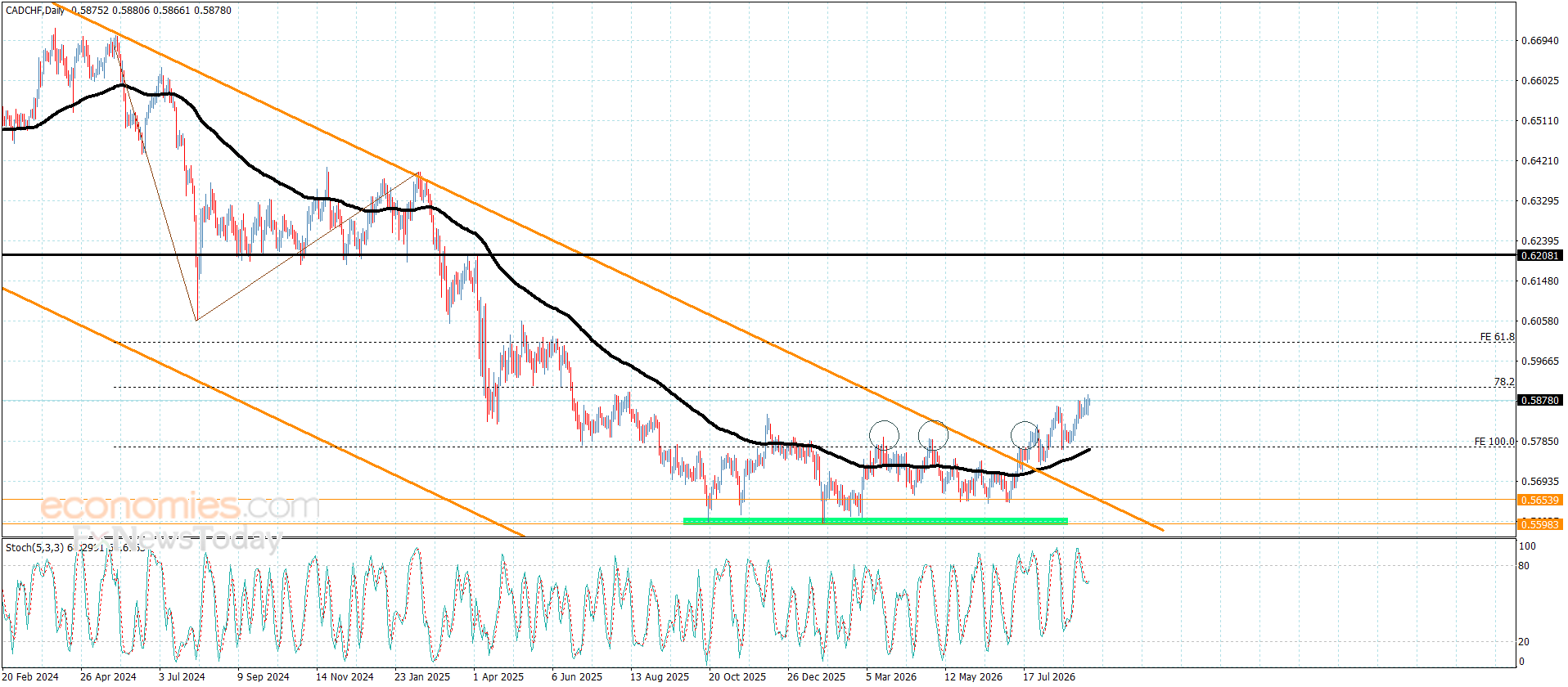
The CADCHF confirmed the bullish scenario by providing repeated bullish closes above the support level of 0.5770, forming several bullish waves and recording clear gains by its stability near 0.5880.
The attempt to provide positive momentum by the main indicators makes us prefer more bullish attempts, which might target 0.5910 barrier, where surpassing it will confirm that the price will enter a new positive pace by its rally towards 0.5945 reaching 0.6000.
The expected trading range for today is between 0.5850 and 0.5910
Trend forecast: Bullish
The Euro to Dollar (EUR/USD) exchange rate closed Friday near 1.1599, down 0.10% on the day, as stronger US core inflation reinforced expectations of a Federal Reserve rate increase.
MUFG’s downside scenario points towards 1.14, approximately 1.7% below that close.
Before Friday’s inflation release, the bank outlined two possible paths: a Fed hold alongside further ECB tightening could lift EUR/USD towards 1.20, while a September Fed hike could push it towards the bottom of its 1.14-1.18 range.
“The performance of EUR/USD may increasingly hinge on the Fed’s policy response,” MUFG’s Lee Hardman said.
The August CPI release showed core prices rising 0.3% on the month, accelerating from July’s 0.2% increase and exceeding the 0.2% consensus.
Headline prices rose 0.4%, with gasoline accounting for more than a third of the increase.
Annual core inflation nevertheless eased to 2.4% from 2.5%, making this a setback in monthly momentum rather than an acceleration across every measure.
Market estimates put the probability of a September hike around 85-90% after the release.
MUFG subsequently changed its own Fed forecast:
“As a result, we now expect the Fed to hike rates by 25bps in September.”
Thursday’s ECB decision announced a quarter-point increase in the deposit rate to 2.50%, effective from 16 September, while projecting inflation above target through 2028.
That supported the argument for further European tightening explored in our earlier EUR/USD outlook.
We believe Friday’s CPI weakens the case for the Euro to benefit from an ECB tightening cycle while the Fed stands aside.
However, with a US hike already heavily anticipated, its delivery alone may offer limited additional Dollar support.
MUFG’s rates strategists acknowledge that markets have already priced in much of the expected tightening and may have gone too far.
A move towards 1.14 therefore remains conditional on how the Fed’s decision and guidance change expectations for subsequent meetings.
| USD | EUR | GBP | JPY | CAD | AUD | NZD | CHF | |
|---|---|---|---|---|---|---|---|---|
| USD | +0.13% | -0.08% | -1.75% | +0.24% | +0.46% | +1.16% | +0.79% | |
| EUR | -0.13% | -0.21% | -1.87% | +0.12% | +0.33% | +1.03% | +0.67% | |
| GBP | +0.08% | +0.21% | -1.67% | +0.33% | +0.54% | +1.24% | +0.88% | |
| JPY | +1.78% | +1.91% | +1.70% | +2.03% | +2.24% | +2.96% | +2.58% | |
| CAD | -0.24% | -0.12% | -0.33% | -1.99% | +0.21% | +0.91% | +0.55% | |
| AUD | -0.46% | -0.33% | -0.54% | -2.20% | -0.21% | +0.70% | +0.33% | |
| NZD | -1.15% | -1.02% | -1.23% | -2.87% | -0.90% | -0.69% | -0.36% | |
| CHF | -0.79% | -0.66% | -0.87% | -2.52% | -0.54% | -0.33% | +0.36% |
The FX heat map compares how Euro (EUR) has performed against a basket of major currencies over the past week. The largest move was against the Japanese Yen, where Euro recorded its sharpest decline. Data comparing prices today (12/09/2026 12:07 UTC) and daily close on 05/09/2026.
To read the table, choose the base currency from the left-hand column and then move across to the quote currency along the top row. For example, the GBP row and USD column shows the weekly percentage move in GBP/USD.
Our currency coverage draws on live market data, official economic releases and published bank research.
Domestic coffee prices
Coffee prices today in the domestic market turned down by 500 VND/kg. According to giacaphe. com, coffee prices on September 12 averaged at 95. 200 VND/kg, anchored in the price range of 94. 700-95. 300 VND/kg.
In Gia Lai and Dak Lak, coffee prices were recorded at 95. 200 VND/kg, down 500 VND/kg.
In Lam Dong, the listed coffee price is at 94. 700 VND/kg, down 500 VND/kg.
The old Dak Nong area also decreased by 500 VND/kg, recording a level of 95. 300 VND/kg.
The USD/VND exchange rate according to Vietcombank was recorded at 25,700 VND/USD, down 10 VND/USD.
World coffee prices
In the world market, coffee prices continuously fluctuate in rotation.
According to Barchart, the September 2026 Robusta futures contract today decreased by 29 USD/ton, anchored at 3,495 USD/ton. At the same decrease, the November 2026 futures were listed at 3, 525 USD/ton. The term from January 2027 to May 2027 increased and decreased alternately, listed in the price range of 3,482 – 3,508 USD/ton.
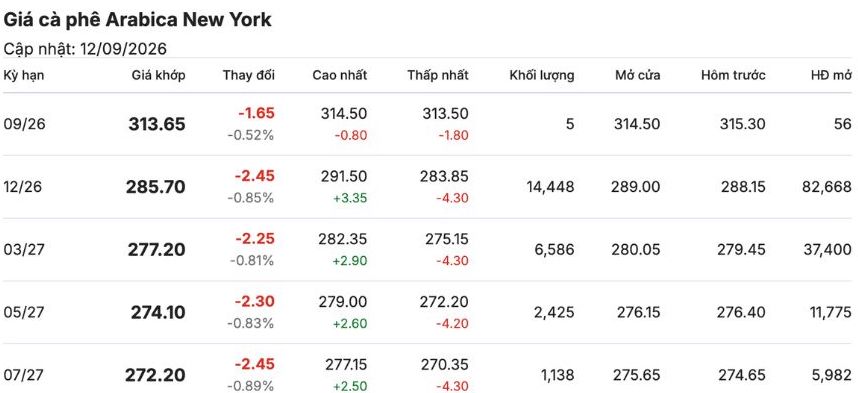
Meanwhile, the September 2026 Arabica futures contract continued to decline by 1.65 cents/lb (equivalent to 0.52%), down to 313.65 cents/lb. The December 2026 term fell even deeper by 2.45 cents/lb, bringing it to the market at a price of 285.70 cents/lb. Further forwards anchored in the 272.20 – 277.20 cent/lb range, down from 2.25-2.45 cents/lb.
Assessments and forecasts
Arabica coffee prices fell in yesterday’s trading session, fluctuating around the 7-week low set on Thursday.
Coffee prices fell after the Brazilian Coffee Exporters Association (Cecafe) said late Thursday that Brazil’s total coffee exports in August increased by 31% year-on-year, to 4.155 million bags, a record high in August. Arabica exports in August increased by 26%, to 2.87 million bags, while Robusta exports increased by 54%, to 953,592 bags. Brazilian coffee is being put on the export market as the harvest in this country is completed.
In another development, the Brazilian Ministry of Commerce said on Tuesday that the country’s coffee exports in August increased by 44.6% year-on-year, to 206,618 tons, the highest level in 8 months.
Arabica coffee prices fell after the International Coffee Organization (ICO) forecast that global coffee production would reach a record level and the market would fall into a state of oversupply. ICO said that global coffee production in the 2025/26 crop year increased by 4.4% over the same period, reaching a record level of 183.6 million bags, while consumption decreased by 0.9% to 180.6 million bags. This caused the global coffee market to have a surplus of 3 million bags, marking the first supply surplus in 5 years.
In addition, higher rainfall than normal in Brazil may promote the flowering process for next year’s coffee crop, thereby becoming a factor putting downward pressure on prices.
Robusta coffee prices are supported by concerns that heavy rain in the Central Highlands of Vietnam, the largest coffee producing region in the country, could flood farms and damage coffee crops. This makes supply negatively affected, which could push coffee prices up.
The EUR/USD edged lower this morning, down for the second day, ahead of the release of US CPI. The pair has been consolidating in a tight range, and yesterday’s hawkish rate hike from the ECB failed to deliver the breakout many traders were hoping to get. With the US dollar finding renewed support in recent days, the risk to the near-term EUR/USD forecast is tilted to the downside.
Before discussing the upcoming CPI report, as well as other macro factors influencing the EUR/USD, let’s a have a quick look at the chart first.
From a technical analysis point of view, the EUR/USD forecast hangs in the balance as the pair continues to consolidate inside a triangle, but the balance of risks remain tilted to the downside because of the energy situation. Key support comes in between 1.1560ish to 1.1580ish. Break that region and then a revisit of 1.1500 could be on the cards next. Resistance meanwhile comes in around 1.1635/40 area. Here, the resistance trend of the triangle pattern meets the 200-day average and the highs of the last several days. Break that and 1.1700 could be the next stop.
A lot will now depend on the direction of oil prices and bond yields, which are starting to provide some support for the dollar.
The dollar is beginning to find its footing again as the relationship between the currency and long-dated Treasury yields starts to reassert itself. The shift has come against a backdrop of rising oil prices, firmer inflation expectations and renewed pressure in the bond market.
The US Treasury’s latest buyback programme offers an important clue. Although the headline announcement was for $6bn, only $5.19bn was ultimately conducted. That relatively modest intervention suggests Treasury Secretary Scott Bessent remains wary of trying to lean too heavily against the bond market. A more conventional relationship between higher long-end yields and a stronger currency is easier to sustain if investors do not expect Washington to suppress borrowing costs aggressively.
The next test comes with today’s CPI report. Markets expect headline inflation to rise 0.4% month on month in August, taking the annual rate to 3.4%, while core CPI is expected to ease slightly to 2.4%
After a stronger-than-expected PPI reading, the risks are no longer quite as symmetrical. A benign CPI report would give investors some relief, particularly in equities, but a meaningful upside surprise could have a much larger market impact. With oil back above $100 a barrel and Treasury yields rising, evidence that inflation is proving sticky would make the prospect of easier monetary policy considerably harder to defend.
That leaves the Federal Reserve in a difficult position. Chair Kevin Warsh has set a relatively high bar for incoming data to overturn the current hawkish tone, although Christopher Waller has suggested that continued improvement in inflation could remove the need for a September move. Much has changed since those comments, however, with oil prices surging in recent days.
A weaker CPI reading would therefore probably hurt the dollar, but it may not be enough to unwind the broader repricing of Fed policy.
The ECB has meanwhile become more comfortable acknowledging the inflation risks coming from energy. Its latest projections were revised higher, while Christine Lagarde’s comments reinforced the impression that another rate increase remains firmly on the table.
That has changed the near-term calculus for the euro. Markets are now carrying a much larger premium for European rates, reducing the likelihood of a large drop in the EUR/USD, but much of that hawkish tone was already priced in.
But Europe remains particularly exposed to higher energy costs, and an extended period of oil above $100 would squeeze consumers and companies while leaving the ECB with less room to respond to weakening growth.
The contrast with the US is becoming increasingly important. If higher oil prices feed into US inflation while Treasury yields continue to rise, the Fed may be forced to maintain a tighter stance just as growth risks increase. That would be a much more favourable combination for the dollar.

– Written by
James Fuller
STORY LINK Pound Sterling to Dollar Forecast: US CPI Keeps Fed on Hawkish Path
The Pound to Dollar exchange rate (GBP/USD) has battled to hold the 1.3500 level after much stronger-than-expected UK GDP data provided Sterling with fresh support.
July growth comfortably beat forecasts, but the Pound remains constrained by an increasingly hawkish Federal Reserve outlook, with markets now heavily pricing a US rate hike next week.
The Pound to Dollar (GBP/USD) exchange rate attempted to stabilise around the 1.3500-1.3520 area on Friday as much stronger than expected UK growth data provided Sterling with support.
GBP/USD had come under pressure earlier in the week as a surge in global bond yields and rising energy prices strengthened the Dollar and undermined risk appetite.
The UK economy expanded by 0.4% in July compared with consensus forecasts for no growth, while annual growth accelerated to 1.6% from expectations of 1.2%.
Services output also increased by 0.4%, reinforcing evidence that the UK economy has retained more momentum than expected despite the energy shock.
Get better rates and lower fees on your next international money transfer.
Compare TorFX with top UK banks in seconds and see how much you could save.
The stronger figures helped Sterling recover some ground, although GBP/USD remained capped by rising US rate expectations.
UoB had commented; “Although GBP has been edging higher over the past few days, there has been no significant increase in upward momentum.”
The 1.3480-1.3500 region remains an important support area, while a sustained recovery above 1.3550 would ease the immediate downside pressure.
US consumer prices increased 0.4% in August, matching expectations, while the annual inflation rate remained at 3.4%.
Core prices increased 0.3% on the month and 2.4% year-on-year.
Although the headline figures were broadly in line with forecasts, the data reinforced expectations that the Federal Reserve will raise interest rates at next week’s meeting.

Markets increased the implied probability of a 25-basis-point hike to around 85%, compared with roughly 70% before the CPI release.
US Treasury yields initially jumped following the figures, with the 10-year yield briefly touching 4.99%, its highest level in almost three years.
ING had commented; “We continue to see upside risks for the dollar. If front-end USD rates remain around current levels and global sentiment stays fragile, we cannot see a fundamental reason for persistent USD underperformance.”
The Dollar nevertheless struggled to secure a major advance as markets also responded to a partial recovery in equities and a retreat in oil prices.
Bond-market conditions remain an important threat to both Sterling and global risk appetite.
The US 10-year Treasury yield remains close to 5%, while the UK 10-year gilt yield has traded near its highest level since 2007.
Rabobank commented; “Rising yields are forcing difficult decisions everywhere, as governments face higher interest bills and deteriorating public finances. Choices can be politically expensive, but not making any choices will cost hard currency.”
Higher yields increase debt-servicing costs and add further pressure to already stretched fiscal positions.
Energy markets remain equally important.
Brent crude surged above $107 per barrel on Thursday before retreating towards $104 on Friday amid reports of possible talks aimed at stabilising shipping through the Strait of Hormuz.
Oil remains more than 8% higher on the week, however, leaving inflation risks elevated.
Danske Bank had commented; “Oil flows through the Strait of Hormuz remain far below pre-war levels and pressure on Red Sea routes is rising.”
For GBP/USD, the immediate battle remains around 1.3500.
Stronger UK growth provides Sterling with some protection, but a Fed hike next week is now heavily priced and US yields remain close to multi-year highs.
A decisive break below 1.3480 would expose the mid-1.34s, while a recovery above 1.3550 would improve the short-term outlook.
International Money Transfer? Ask our resident FX expert a money transfer question or try John’s new, free, no-obligation personal service! ,where he helps every step of the way,
ensuring you get the best exchange rates on your currency requirements.
TAGS: Pound Dollar Forecasts
The article covers the following subjects:
Consider short positions below 157.50 with a target of 151.76–148.92 once the correction is completed.
Breakout and consolidation above 157.50 will allow the pair to continue rising to the levels of 160.48–163.90.
On the weekly time frame, an ascending third wave of larger degree 3 has formed, a downward correction has been completed as the fourth wave 4, and the fifth wave 5 is developing. Apparently, the first wave of smaller degree (1) of 5 has formed and a bearish correction (2) of 5 is developing on the daily chart. On the H4 time frame, wave A of (2) is developing. Within it, wave iii of A has been completed, and a local correction is forming as wave iv of A. If the presumption is correct, USD/JPY will continue to decline to 151.76–148.92 after the correction ends. The level of 157.50 is critical in this scenario as a breakout above it will enable the pair to continue rising to the levels of 160.48–163.90.
This forecast is based on the Elliott Wave Theory. When developing trading strategies, it is essential to consider fundamental factors, as the market situation can change at any time.
The content of this article reflects the author’s opinion and does not necessarily reflect the official position of LiteFinance broker. The material published on this page is provided for informational purposes only and should not be considered as the provision of investment advice for the purposes of Directive 2014/65/EU.
According to copyright law, this article is considered intellectual property, which includes a prohibition on copying and distributing it without consent.
The article covers the following subjects:
Consider long positions above the level of 4,174.78 with a target of 4,900.00–5,610.00 once the correction ends.
Breakout and consolidation below 4,174.78 will allow the asset to continue declining to the levels of 3,954.50–3,720.00.
An ascending third wave of larger degree (3) is presumably developing on the weekly chart. Within it, a descending correction has been completed as the fourth wave of smaller degree 4 of (3). Apparently, the fifth wave 5 of (3) started developing on the daily chart, with wave i of 5 forming as its part. On the H4 chart, wave (iii) of i of 5 has formed, and a local correction is nearing completion as wave (iv) of i, with wave c of (iv) forming as its part. If the presumption is correct, XAU/USD will continue to rise to the levels of 4,900.00–5,610.00 after the correction ends. The level of 4,174.78 is critical in this scenario as a breakout below it will enable the asset to continue declining to the levels of 3,954.50–3,720.00.
This forecast is based on the Elliott Wave Theory. When developing trading strategies, it is essential to consider fundamental factors, as the market situation can change at any time.
The content of this article reflects the author’s opinion and does not necessarily reflect the official position of LiteFinance broker. The material published on this page is provided for informational purposes only and should not be considered as the provision of investment advice for the purposes of Directive 2014/65/EU.
According to copyright law, this article is considered intellectual property, which includes a prohibition on copying and distributing it without consent.
The article covers the following subjects:
Consider long positions above the level of 1.1470 with a target of 1.1790–1.2088 once the correction ends.
Breakout and consolidation below 1.1470 will allow the pair to continue declining to the levels of 1.1350–1.1230.
On the weekly time frame, an ascending wave of larger degree B is developing, with wave (A) of B forming as its part. On the daily time frame, the third wave 3 of (A) is apparently unfolding. Within it, wave i of 3 has formed, a bearish corrective wave ii of 3 has been completed, and wave iii of 3 has started developing. On the H4 time frame, the first wave of smaller degree (i) of iii has formed, and a local correction is developing as the second wave (ii) of iii. If the presumption is correct, EUR/USD will continue to rise to the levels of 1.1790–1.2088 after the correction ends. The level of 1.1470 is critical in this scenario. A breakout below it will allow the pair to continue falling to the levels of 1.1350–1.1230.
This forecast is based on the Elliott Wave Theory. When developing trading strategies, it is essential to consider fundamental factors, as the market situation can change at any time.
The content of this article reflects the author’s opinion and does not necessarily reflect the official position of LiteFinance broker. The material published on this page is provided for informational purposes only and should not be considered as the provision of investment advice for the purposes of Directive 2014/65/EU.
According to copyright law, this article is considered intellectual property, which includes a prohibition on copying and distributing it without consent.