The main category of All News Articles.
You can use the search box below to find what you need.
[wd_asp id=1]
The main category of All News Articles.
You can use the search box below to find what you need.
[wd_asp id=1]
One of Japan’s most recognizable cultural practices – the Japanese tea ceremony, known as chanoyu, or chadō – is being reshaped by tourism, wellness culture and social media.
Matcha, the Japanese powdered green tea that is used during the ceremony, has entered the global marketplace. Influencers post highly curated tearoom photos, wellness brands market matcha as a “superfood,” and cafés worldwide present whisked green tea as a symbol of mindful living.
The Japanese tea ceremony is deeply rooted in the ideals of Zen Buddhism, but the current matcha hype has little to do with the tea ceremony. Green tea has become part of the on-the-go coffee culture. On social media, a centuries-old spiritual practice is compressed into a 15-second reel.
As a scholar of premodern Japanese literature and culture, I know that this commercialization is not without tension. The reflective values of the Japanese tea ceremony trace their origins to a monastic routine.
Tea arrived in Japan from China in the eighth century. Emperor Shōmu served powdered tea, an ancestor to what we today know as matcha, to Buddhist monks in 729 C.E.
Around the end of the 12th century, the practice of serving tea became more widespread after the Zen monk Eisai returned from China with matcha tea seeds from the plant that was to become the source of much of the tea grown in Japan today. He also brought with him the knowledge of how tea rituals were practiced in Chinese Buddhist temples.
Wild tea grew in Japan, but the tea grown from Eisai’s seeds became known as “honcha” or true tea. Matcha soon spread through Zen monasteries, where it was believed to generate greater enlightenment than long hours of meditation.
As Zen Buddhism gained influence among the warrior class in the 13th century, monks carried tea culture beyond temple walls. In 1483, Ashikaga Yoshimasa – Japan’s military ruler, or shogun, who was also a patron of the arts, constructed one of the earliest tearooms. The tearoom was inside his villa in Kyoto, later known as the Temple of the Silver Pavilion or Ginkakuji. There, the tea ceremony was both a contemplative act and an occasion to display Chinese calligraphy, paintings and ceramics.
The most transformative figure in the history of the Japanese tea ceremony was a 16th-century tea master, Sen no Rikyū. Rejecting ostentation, he favored locally made utensils, rough ceramics, and small, rustic spaces designed to quiet the senses.
This aesthetic and moral principle – known as “wabi” – valued imperfection, humility and mindful presence. Grounded in simplicity, wabi guided everything from the size of the room to the angle of a flower stem.
Serving as tea master to military leaders, or shoguns, who supported his activities, Rikyū transformed the tea ceremony to reflect ideals of wabi.
A poem by Rikyū captures his philosophy:
cha no yu to wa
tada yu o wakashi
cha o tatete
nomu bakari naru
koto to shiru beshi
To understand the tea ceremony
Is simply this:
Heat the water,
Whisk the tea,
And drink.
The poem’s clarity echoes a foundational sensibility of the tea ceremony: what matters is the moment itself.
Rikyū’s grandson Sōtan and his three sons carried on the traditions of tea ceremony. Their three schools – Ura Senke, Omote Senke and Mushanokōji Senke – differ in tea whisking styles, utensils they use and levels of formality, yet continue to preserve Rikyū’s principles to date. All three schools have headquarters in Kyoto.
The manner of preparing powdered green tea depends on the techniques and practices of the various schools. The following description is based on the Ura Senke way of preparation.
A full tea gathering, or “chaji,” may last several hours. Every choice – from utensils to food to flowers – reflects the season, time of day and purpose of the occasion, whether welcoming guests, marking a farewell or observing a celebration.
The ceremony takes place in a tearoom or “chashitsu,” decorated only with a hanging scroll and a single flower – both selected to set the gathering’s spiritual tone.
Guests assemble in a waiting room and taste the hot water used for tea. They then proceed along a water-sprinkled garden path meant to wash away the “dust” of the outside world.
After greeting the host, they cleanse their hands and mouths and enter the tearoom through a small door, the “nijiriguchi.” The passage from the ordinary way of the world to the contemplative way of tea symbolizes humility.
Inside, they admire the scroll, kettle and hearth before taking their seats.
In the guests’ presence, the host builds the charcoal fire and serves a carefully prepared seasonal meal: rice, soup, seafood or vegetables, pickles, sake and a principal sweet.
When the meal ends, the host briefly re-enters alone to replace the scroll with flowers, sweep the room and arrange the utensils for “koicha,” the thick tea that forms the heart of the gathering. At that time the guests have been asked to leave the room. They re-enter once the bell or gong is run. The host reenters the room as well with chawan – the whisk – and all the utensils; the tea is served.
A jar of fresh water representing yin is paired with the fire’s yang. Yin (feminine) and yang (masculine) are two opposing yet complementary forces in Chinese philosophy that represent the duality and balance found in the universe. The tea jar or “chaire,” wrapped in silk, is set out on a stand chosen for the occasion. A gong or bell summons the guests to return.
The host enters with the tea bowl or “chawan,” a white linen cloth, a whisk and a bamboo scoop. Each utensil is cleaned, and the bowl is warmed, dried and filled with three scoops of powdered tea before hot water is added and kneaded with the whisk into a smooth, thick mixture. The single bowl is shared among all guests, then returned to the host. The tea jar and scoop are cleaned and presented for close viewing.
The charcoal fire is built again for “usucha,” or thin tea, which gently prepares guests to return to everyday life. Thin tea is prepared in a way similar to that of thick tea, except that less tea powder, and of a lower quality, is used. Dry sweets accompany this lighter, frothier tea, served in individual bowls. When the final cup is finished, guests express their gratitude, depart along the garden path and leave the host watching quietly from the tearoom door.
Underlying the entire ritual is the principle of “ichigo ichie” – “one time, one meeting.” No gathering can ever be repeated. Every season, every person, every breath is singular.
The tea ceremony, often translated in English as “the Way of Tea,” trains participants to feel that fleetingness, to hold the moment warmly and attentively before it dissolves.
Today, the tea ceremony lives a double life. While traditional schools continue to teach Rikyū’s disciplined aesthetics, matcha has entered its global afterlife of commercialization and popular culture.
The explosion of matcha consumption has led to a high demand. Prices for high-grade ceremonial matcha have risen dramatically, and producers struggle to meet demand. Japan now exports far more matcha than ever before.
Many people encounter matcha not through Zen teachings or formal tea ceremonies but through lifestyle trends and the contemporary fascination with “calming rituals.” On social media, matcha is promoted as a wellness routine and lifestyle aesthetic.
In this new landscape, the Japanese “Way of Tea” exists both as a revered cultural practice and as a global commodity – its spiritual heart intact but circulating in forms its earliest practitioners could scarcely have imagined.
This article is republished from The Conversation, a nonprofit, independent news organization bringing you facts and trustworthy analysis to help you make sense of our complex world. It was written by: Małgorzata (Gosia) K. Citko-DuPlantis, University of Tennessee
Read more:
Małgorzata (Gosia) K. Citko-DuPlantis does not work for, consult, own shares in or receive funding from any company or organization that would benefit from this article, and has disclosed no relevant affiliations beyond their academic appointment.
Republicans now hold the keys to the regulatory kingdom at both the SEC and CFTC. This total control in leadership could rewrite the rules for every digital asset in the coming months. And traders are scrambling to adjust to the new landscape.
DeepSnitch AI may become a primary tool for navigating this new political landscape. The synergy between political clarity and AI intelligence is creating a unique window for early adopters.
The project has already raised over $1.1M during its Stage 4 presale. Right now, the price sits at $0.03269. This momentum reflects a growing demand for intelligence that can track policy shifts in real time.
The departure of Caroline Crenshaw from the SEC has left the agency without a single Democratic commissioner. Paul Atkins now leads the SEC with a pro-crypto agenda that contrasts sharply with past enforcement policies.
The CFTC has followed suit with its own Republican leadership. This creates a regulatory vacuum where new rules can be pushed through without the usual partisan friction. Markets are reacting to the possibility of a comprehensive crypto bill passing sooner than expected, but investors need to monitor these shifts closely to avoid getting caught on the wrong side of a policy pivot.
DeepSnitch AI offers the radar needed to track these moves before they hit the headlines. This level of institutional control over regulation is unusual in U.S. history. It means that the destiny of the entire market sits in the hands of a few leaders, so you need all the edge you can get in these unusual times.
The biggest problem in Web3 is no longer a lack of data. It is the Interpretation Gap where raw signals are too loud to understand. DeepSnitch AI solves this by deploying five specialized AI agents to filter the chaos.
SnitchFeed monitors alpha groups and social sentiment 24/7. It flags mood flips and whale splashes before the crowd even wakes up. SnitchScan serves as a defensive shield by screening new tokens for rug-pull risks. It checks developer activity and LP lock ratios to ensure your capital stays safe. These tools were once reserved only for institutional desks. But DeepSnitch AI brings them to the 1B users on Telegram.
The project has passed audits by SolidProof and Coinsult, and over 22M tokens are already locked in the dynamic staking program. This creates a tightening supply that favors initial buyers.
The Stage 4 price of $0.03269 is still a good entry point for a protocol with 100X or even 500X potential. The price started at $0.01510 and has climbed steadily as each fundraising goal is reached.
Only four AI tokens currently have market caps above $1B. None of them target the everyday retail trader quite like this.

Cardano is showing strong signs of a turnaround after months of bearish pressure. On January 5th, the asset was priced around $0.40. This represented a 2.35% gain as it broke its primary downtrend for the first time since October.
Technical analysts have spotted a bullish divergence pattern where the RSI formed higher lows while the price dipped. This suggests that selling pressure is finally exhausting. If the current breakout holds above the $0.42 zone, experts believe a Cardano price prediction of $0.50 to $0.60 is likely.
Filecoin surged 6% on January 5 after breaking through a key resistance zone. The token climbed to around $1.59 during a volatile session, and it outperformed the broader CoinDesk 20 inde,x which rose 2.2% in the same period. Technical analysis indicates immediate support at the $1.58 zone. But FIL must reclaim $1.63 with sustained volume to target the $1.68 upside target.
The Republican takeover of the SEC and CFTC marks a new era for digital assets. While the Cardano price prediction looks bullish, established coins cannot match the growth potential of an early presale project like DeepSnitch AI.
The project has raised over $1.1M and is selling out Stage 4 quickly. This is the time to secure your position before the launch.
For more information, visit the official website, and follow X and Telegram.

Analysts see Cardano reaching $0.60 soon, but DeepSnitch AI offers much higher potential for those seeking 100x gains in 2026.
The AI agents filter noise into signals, helping you spot ADA network growth and Cardano adoption news before the crowd reacts.
DeepSnitch AI has passed audits by SolidProof and Coinsult, making it a secure choice compared to unvetted presale offers.
Disclaimer: This is a Press Release provided by a third party who is responsible for the content. Please conduct your own research before taking any action based on the content.

Cardano founder Charles Hoskinson says the network’s next growth phase depends on real DeFi usage rather than market hype. In a recent interview with Altcoin Daily, he said Cardano must post stronger on-chain numbers to compete with larger ecosystems. He pointed to user activity, capital flows, and stablecoin growth as the core signals that could define the network’s future direction.
Hoskinson said narrative cycles no longer provide enough momentum for Cardano. Instead, he said measurable DeFi performance must guide the ecosystem’s next stage. Those figures, he noted, should appear clearly on-chain.
He added that has reached its limits as a standalone layer-1 network. To move forward, he said the ecosystem must lean harder into decentralized finance activity. That shift, he argued, could reset growth expectations.
The bright metal trades with a softer tone on Wednesday, with XAU/USD now hovering in the $4,460 price zone. The US Dollar (USD) trades with a firmer tone in the American afternoon after the release of generally encouraging United States (US) data, while the prevalent optimistic mood limited demand for safe-haven assets.
The US released the ADP Employment Change report, which showed that the private sector added 41K new job positions in December, slightly worse than the 47K anticipated but better than the November revised figure of -29K. Also, the Job Openings and Labor Turnover Survey (JOLTS) report showed that the number of job openings on the last business day of November stood at 7.146 million, down from the revised 7.449 million openings recorded in October.
Finally, the country released the ISM Services Purchasing Managers’ Index (PMI), which showed that economic activity in the sector continued to expand in December, with the index rising to 54.4 from 52.6 in November.
Other than that, speculative interest retains a certain level of caution. Market participants await additional data to place bets on future central banks’ monetary policy decisions, with the focus particularly on the Federal Reserve (Fed). The Nonfarm Payrolls (NFP) report, scheduled for Friday, may shed some light on the matter.
In the upcoming Asian session, China will release the December Trade Balance, while Japan will publish the December Consumer Confidence Index.
From a technical point of view, the XAU/USD decline did not interrupt the dominant bullish trend. In the 4-hour chart, XAU/USD trades above all its moving averages, with the 20-period Simple Moving Average (SMA) providing near-term support at $4,436.38 while advancing above the 100- and 200-period SMAs. Meanwhile, technical indicators have corrected from overbought levels, but managed to bounce from around their midlines, hinting at limited selling interest.
In the daily chart, the 20-day SMA heads firmly north, well above the 100- and 200-day SMAs, underscoring buyer control. The 20-day SMA at $4,370.98 offers nearby dynamic support. At the same time, the Momentum indicator holds above its midline but eases, while the Relative Strength Index (RSI) indicator sits at 62, also losing upward strength.
XAU/USD seems poised to extend the ongoing consolidative phase ahead of the next catalyst.
(The technical analysis of this story was written with the help of an AI tool)
– Written by
Ben Hughes
STORY LINK Pound-to-Dollar Forecast: GBP/USD Near Breakout, But Risks Remain
The Pound to Dollar exchange rate (GBP/USD) climbed to three-month highs after rebounding from support in the low-1.34s, but the pair now faces stiff resistance as trading conditions thin and the dollar attempts to stabilise.
The next move will determine whether sterling can build momentum into the new year.
The Pound to Dollar (GBP/USD) exchange rate found support below 1.3420 on Monday and rebounded strongly to above 1.3500 amid a firm Pound performance and dollar setback.
GBP/USD hit 3-month highs near 1.3570 before consolidation just below 1.3550 with markets still assessing whether there is scope for a decisive breakout.
According to UoB; “Although upward momentum has not increased significantly, GBP could rise to 1.3590. Currently, the odds of a continued rise above this level are not high.”
Scotiabank added; “Risk reversals are little changed, offering little in terms of sentiment-driven movement. We are neutral awaiting a break of the two-week range roughly bound between 1.34 and the mid1.35s.”
Get better rates and lower fees on your next international money transfer.
Compare TorFX with top UK banks in seconds and see how much you could save.
Overall risk appetite has held steady with the UK FTSE 100 index posting a fresh record high while there were further gains for precious metals and commodities.
The Pound will gain net support if risk appetite holds firm.
The dollar failed to gain sustained support from geo-political considerations, but there is a high degree of uncertainty over both Venezuela and the wider regional considerations.
ING is not convinced that there will be sustained dollar losses; “Despite the quick unwinding of safe-haven USD demand yesterday, we remain modestly biased to a stronger dollar in the near term. Seasonality is positive in January, and markets’ sanguine stance on geopolitics leaves risk assets and high-beta currencies exposed to re-escalations, both in Latam and potentially in Greenland.
Danske Bank also preached some caution; “Global markets generally performed well on Monday, but President Trump’s threats against Colombia and Mexico, along with renewed talk of annexing Greenland, underscore that geopolitical tensions remain elevated as the new year begins.”
The US ISM manufacturing index edged lower to 47.9 for December from 48.2 previously. This was slightly below consensus forecasts and the sector has been in contraction territory for the last 8 months which hampered the dollar.
Capital Economics commented; “The modest decline in the ISM Manufacturing Index in December confirms that the sector was struggling for momentum around the turn of the year, but we doubt that this will be enough to prevent overall GDP from expanding at a solid pace in the coming quarters.”

The dollar could gain some net support if the overall US economy holds firm, but the global perspective will also be important.
MUFG commented; “Evidence of strengthening global growth momentum is a supportive factor for our forecast for the US dollar to weaken further in 2026 even as US economic growth is expected to pick-up as well during the first half of this year driven by stimulus from President Trump’s One Big Beautiful Bill.”
International Money Transfer? Ask our resident FX expert a money transfer question or try John’s new, free, no-obligation personal service! ,where he helps every step of the way,
ensuring you get the best exchange rates on your currency requirements.
TAGS: Pound Dollar Forecasts
Mordor Intelligence has published a new report on the Vegan Supplements Market, offering a comprehensive analysis of trends, growth drivers, and future projections.
Vegan Supplements Market Overview
The Vegan Supplements Market is witnessing steady expansion as consumers across the globe increasingly adopt plant-based lifestyles driven by health awareness, ethical considerations, and sustainability concerns. According to Mordor Intelligence, the Vegan Supplements Market size is valued at USD 10.20 billion in 2025 and is forecast to reach USD 16.19 billion by 2030. This upward movement reflects the growing role of vegan supplements in everyday nutrition and preventive wellness routines.
Key Vegan Supplements Market Trends Shaping Demand
Growing Preference for Plant-Based and Clean-Label Nutrition
A major Vegan Supplements Market trend is the steady shift toward plant-based and clean-label nutrition. Consumers are becoming more mindful of ingredient sources and are actively avoiding animal-derived components, artificial additives, and complex formulations.
Rising Demand for Algae-Based Omega Supplements
Algae-based omega products are emerging as an important trend within the Vegan Supplements Market. These supplements are viewed as suitable alternatives to fish-based omega products while aligning with sustainability and ethical expectations.
Expansion of Vegan Supplements for Targeted Health Needs
Another notable Vegan Supplements Market trend is the growing focus on targeted health benefits. While general wellness products continue to attract broad demand, consumers are also looking for vegan supplements that support immune health, digestive balance, and weight management.
Increasing Popularity of Gummies and Alternative Formats
Product format innovation is shaping the Vegan Supplements Market trends landscape. Gummies, powders, and easy-to-consume formats are gaining popularity alongside traditional capsules and tablets. Gummies, in particular, appeal to consumers seeking convenience and better taste, including younger users and families.
Check out more details and stay updated with the latest industry trends, including the Japanese version for localized insight: https://www.mordorintelligence.com/ja/industry-reports/vegan-supplements-market?utm_source=abnewswire
Vegan Supplements Market Segmentation Insights
By Product Type
By Form
By Function / Health Benefit
By Distribution Channel
By End User
By Geography
Vegan Supplements Market Key Players and Industry Landscape
Conclusion
The Vegan Supplements Market is set to maintain positive momentum as plant-based nutrition becomes an integral part of modern health practices. Growing consumer awareness around diet quality, ethical sourcing, and environmental responsibility continues to support demand for vegan supplements across regions. The expanding availability of diverse product formats, targeted health benefits, and online retail options is making vegan supplements more accessible to a broader audience.
Industry Related Reports:
Collagen Supplements Market – The Collagen Supplements Market Report is Segmented by Product Type (Capsules, Gummies, Powders, Drinks and Liquid Shots, Others), Source (Animal Based, Plant Based), Distribution Channel (Supermarkets/Hypermarkets, Specialty and Health Stores, Online Retailers, Other Distribution Channels), and Geography (North America, Europe, Asia-Pacific, and More).
Get more insights: https://www.mordorintelligence.com/industry-reports/collagen-supplements-market?utm_source=abnewswire
Dietary Supplements Market – The Dietary Supplements Market is Segmented Into Product Type (Vitamins, Minerals, Enzymes, and More), Form (Tablets, Powder, and More), Source (Plant-Based, Animal-Based, and More), Consumer Group (Men, Women, and More), Health Application (General Health and Wellness, Eye Health, and More), Distribution Channel (Supermarkets/Hypermarkets, and More), and Geography.
Get more insights: https://www.mordorintelligence.com/industry-reports/dietary-supplement-market?utm_source=abnewswire
Bone and Joint Health Supplements Market – The Bone and Joint Health Supplements Market Report is Segmented by Type (Vitamins and Minerals, Collagen, and More), Form (Tablets, Capsules/Softgels, Gummies and Chews, Powders, and Others), Distribution Channel (Supermarkets/Hypermarkets, and More), and Geography (North America, Europe, Asia-Pacific, Middle East and Africa, and South America).
Get more insights:https://www.mordorintelligence.com/industry-reports/global-bone-and-joint-health-supplements-market?utm_source=abnewswire
About Mordor Intelligence:
Mordor Intelligence is a trusted partner for businesses seeking comprehensive and actionable market intelligence. Our global reach, expert team, and tailored solutions empower organizations and individuals to make informed decisions, navigate complex markets, and achieve their strategic goals.
With a team of over 550 domain experts and on-ground specialists spanning 150+ countries, Mordor Intelligence possesses a unique understanding of the global business landscape. This expertise translates into comprehensive syndicated and custom research reports covering a wide spectrum of industries, including aerospace & defense, agriculture, animal nutrition and wellness, automation, automotive, chemicals & materials, consumer goods & services, electronics, energy & power, financial services, food & beverages, healthcare, hospitality & tourism, information & communications technology, investment opportunities, and logistics.
Media Contact
Company Name:Mordor Intelligence Private Limited
Contact Person: Jignesh Thakkar
Email:Send Email
Phone: +1 617-765-2493
Address:11th Floor, Rajapushpa Summit, Nanakramguda Rd, Financial District, Gachibowli
City: Hyderabad
State: Telangana 500008
Country: India
Website:https://www.mordorintelligence.com/industry-reports/vegan-supplements-market?utm_source=abnewswire
Press Release Distributed by ABNewswire.com
To view the original version on ABNewswire visit: Vegan Supplements Market Size to Reach USD 16.19 Billion by 2030 as Demand Rises for Plant-Based Nutrition and Clean-Label Products

Risk Warning: this article represents only the author’s views and is for reference only. It does not constitute investment advice or financial guidance, nor does it represent the stance of the Markets.com platform.When considering shares, indices, forex (foreign exchange) and commodities for trading and price predictions, remember that trading CFDs involves a significant degree of risk and could result in capital loss.Past performance is not indicative of any future results. This information is provided for informative purposes only and should not be construed to be investment advice. Trading cryptocurrency CFDs and spread bets is restricted for all UK retail clients.
The AUDCAD succeeded in confirming the bullish scenario by surpassing the barrier at 0.9255, recording clear gains by its rally towards 0.9345, besides providing bullish momentum by the main indicators will increase the efficiency of the bullish scenario, to expect recording extra gains by its rally towards 0.9400, to achieve 100.0%Fibonacci extension level.
The risk of changing the trend and begin the negative track, if the price declined sharply to settle below the main support at 0.9130.
The expected trading range for today is between 0.9260 and 0.9400
Trend forecast: Bullish
The USD/JPY remains under mild pressure as the Japanese yen continues to find support from changing policy expectations and a weaker US dollar backdrop. Momentum has obviously slowed, indicating growing uncertainty over the next directional move, even though the pair is still trading at high levels around the mid-156 area. The market is increasingly focused on the widening policy divergence between the Bank of Japan, which is cautiously tightening, and the Federal Reserve, which is edging closer to an easing cycle.
–Are you interested in learning more about forex indicators? Check our detailed guide-
The yen’s recent resilience is largely driven by the growing acceptance that the BoJ’s long-awaited normalization process is not a one-off move. Governor Kazuo Ueda’s most recent remarks reaffirmed the likelihood of further interest rate hikes if inflation remains elevated. Rising wages, persistent pressure on service sector prices, and tighter labor conditions strengthen the argument for gradual tightening. This change has already caused yields on Japanese government bonds to reach multi-decade highs, reducing one of the main causes of yen weakness and closing the yield gap with the US.
At the same time, investors remain cautious about pushing the yen too aggressively higher. Uncertainty around Japan’s fiscal outlook, highlighted by the approval of a record budget, and questions over the exact timing and pace of future BoJ hikes continue to temper bullish conviction. As a result, USD/JPY has avoided a sharp sell-off and instead is grinding lower in a controlled manner.
Geopolitical risks add another level of complexity. The demand for safe havens has been boosted by growing tensions associated with Venezuela and other global flashpoints. However, the dollar’s inflows during periods of high US yields have lessened the yen’s influence. Even so, upside movements are still constrained, especially in the upper 150s, by the possibility of verbal intervention from Japanese authorities.
On the US side, the dollar is struggling to find sustained support. Markets are increasingly pricing in further Federal Reserve rate cuts later this year, with policymakers stressing the need to stay data-dependent as inflation cools and labour market conditions soften. This week’s run of US data, including ADP employment figures, ISM Services PMI, and JOLTS, may influence short-term moves, but the main event remains Friday’s Nonfarm Payrolls report. A weaker-than-expected jobs reading would likely reinforce expectations of a dovish Fed and put renewed downside pressure on USD/JPY.
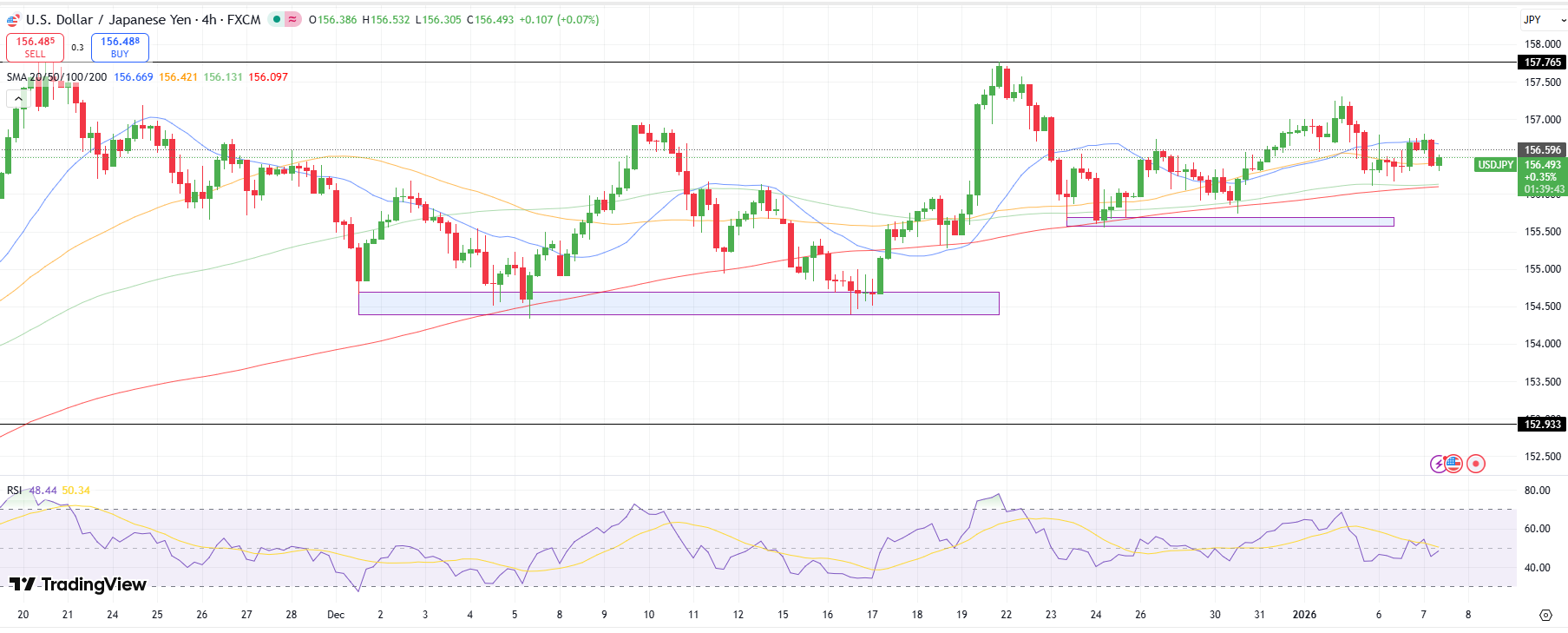
The USD/JPY 4-hour chart shows consolidation between 20- and 50-period MAs, while the confluence of 100- and 200-period MAs supports the pair’s upside bias. The RSI also remains flat under the 50.0 level, suggesting no clear bias in the short term.
–Are you interested in learning more about next cryptocurrency to explode? Check our detailed guide-
A break above the 20-period MA at 156.60 could trigger a bullish breakout and look to test 157.30 ahead of 157.75. On the other hand, moving below the 200-period MA at 156.10 could prompt the pair to test the 155.55 support level ahead of 155.00.
Looking to trade forex now? Invest at eToro!
68% of retail investor accounts lose money when trading CFDs with this provider. You should consider whether you can afford to take the high risk of losing your money.
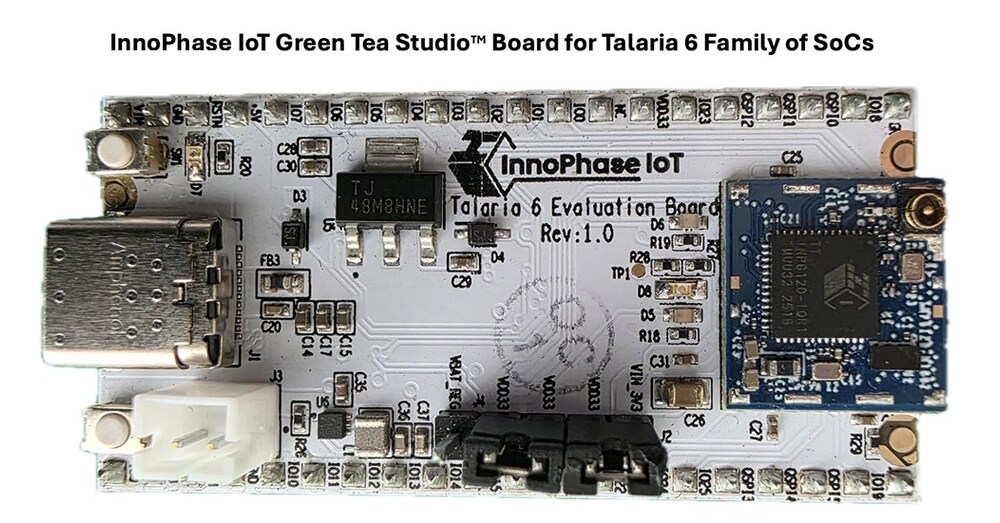
Green Tea Studio Plugs Directly into Existing Open-Source Development Frameworks, Enabling Customers to Upgrade to the Award-Winning Talaria 6 Platform while Preserving SW Investment and Accelerating Time to Market – Demonstrations at CES 2026
LAS VEGAS, Jan. 7, 2026 /PRNewswire/ — InnoPhase IoT, Inc., a leader in low-power wireless semiconductor solutions for the IoT industry, announces Green Tea Studio™ (GTS) integrated development environment for its Talaria 6 Family of System-on-Chips (SoCs), the winner of the IoT Semiconductor Product of the Year, IoT Breakthrough Awards 2026. The GTS provides customers and developers with direct access to existing open-source development environments and third party software components, allowing existing MCU applications and solutions to be seamlessly ported while facilitating the development of new applications and solutions, enabling rapid deployment to market. Attendees can experience live demonstrations of Green Tea Studio and IoT solutions at CES 2026, in Las Vegas, NV, January 6 -9.
As a trusted US-based silicon provider, InnoPhase IoT develops next-generation products with robust performance, ultra-low power, enhanced security, Edge AI processing, and advanced connectivity for IoT devices. The target markets include smart home, building automation, industrial IoT, and health/medical segments, and key applications span video cameras, doorbells, locks, thermostats, lighting, environmental and vibration sensors, appliances, health and medical devices, hubs/gateways, and Matter bridge routers.
“The Talaria 6 IoT platform, combined with the innovative and flexible Green Tea Studio, enables our customers, developers, and partners to plug and play with a U.S. based trusted silicon supplier while gaining the benefits of energy efficiency, versatile connectivity, high performance, and enhanced security,” said Dr. Yang Xu, Founder and CEO of InnoPhase IoT.
Green Tea Studio’s Key Features and Benefits:
The Green Tea Studio will sample in Q2’26. To request early access or schedule a visit at CES, contact InnoPhase IoT at [email protected].
About InnoPhase IoT:
InnoPhase IoT Inc., headquartered in San Jose, CA, is a wireless semiconductor platform company dedicated to enable the promise of the Internet of Things (IoT). Its Talaria platform provides the world’s lowest power Wi-Fi, with multi-band and multiprotocol support to the rapidly growing untethered and battery-operated IoT device market. InnoPhase IoT delivers device-to-cloud, market-ready solutions with extended battery life, a low total cost of ownership (TCO), and high-performance wireless use cases. For more information, contact [email protected] or visit the InnoPhase IoT.com website.
Media Contact:
Linda Ferguson, Marketing Communications Director, InnoPhase IoT, Inc.
1+503-869-5827
[email protected]
www.innophaseiot.com
SOURCE InnoPhase IoT