The main category of All News Articles.
You can use the search box below to find what you need.
[wd_asp id=1]
The main category of All News Articles.
You can use the search box below to find what you need.
[wd_asp id=1]
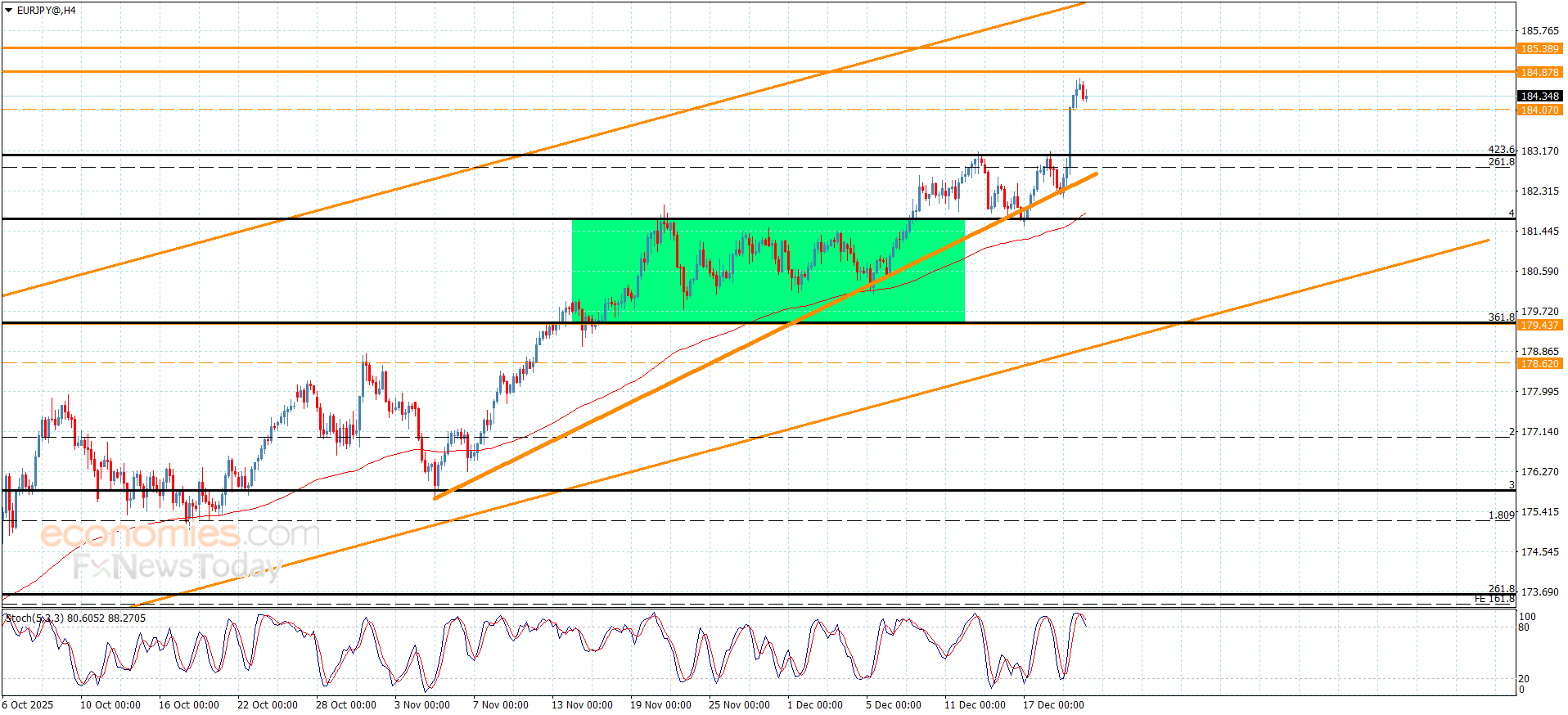
The GBPJPY pair took advantage of the repeated positive pressures to confirm the continuation of the bullish scenario, surpassing the target at 209.85 on Friday forming 261%Fibonacc extension level, to open the way for recording big extra gains by hitting 211.05 level.
Noticing that stochastic reaches the overbought level, which allows it to settle within the minor bullish channel levels, depending on forming extra support at 209.80 level, to expect forming new gains by its rally towards 211.60 reaching the resistance of the bullish channel at 212.25.
The expected trading range for today is between 210.00 and 211.60.
Trend forecast: Bullish
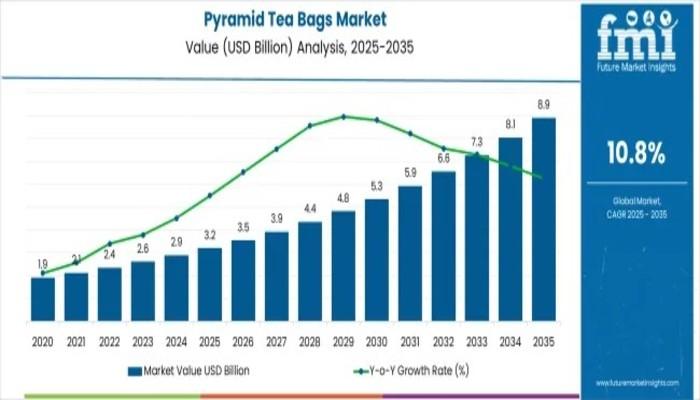
The global pyramid tea bags market is entering a decade of transformative expansion, projected to rise from USD 3.2 billion in 2025 to USD 8.9 billion by 2035. This represents an impressive 178.1% total growth, driven by consumers’ increasing preference for premium tea formats, transparent brewing experiences, and whole-leaf infusion solutions. With a robust CAGR of 10.8%, the industry is gearing up for significant innovation, investment, and technology adoption from both established and emerging tea manufacturers.
Rising Popularity of Premium Tea Bags Fuels Market Expansion
Between 2025 and 2030, the market is set to grow by USD 2.1 billion, accounting for nearly 36.8% of the decade’s total rise. This momentum is strengthened by the growing shift toward visible leaf infusions, specialty tea categories, and the rapid expansion of retail and hospitality offerings. The period from 2030 to 2035 will further accelerate growth, adding USD 3.6 billion as brands increasingly adopt biodegradable mesh materials, introduce innovative flavor blends, and elevate luxury tea experiences.
Subscribe for Year-Round Insights → Stay ahead with quarterly and annual data updates – https://www.futuremarketinsights.com/reports/sample/rep-gb-4814
Quick Market Snapshot
• Market Value 2025: USD 3.2 billion
• Market Forecast 2035: USD 8.9 billion
• CAGR (2025-2035): 10.8%
• Leading Product Category: Premium Pyramid Bags (58%)
• Key Regions: North America, Europe, Asia Pacific
• Top Established Players: Dilmah Tea, Twinings, Harney & Sons, Mighty Leaf Tea, The Republic of Tea
Why the Market Is Growing: Key Drivers
Premiumization remains the most powerful force shaping the industry. Consumers across major global regions now prioritize:
• Superior brewing quality with full leaf visibility
• Lifestyle-driven wellness habits and premium beverage choices
• Convenient brewing formats without compromising taste
• Organic and specialty teas offering authentic flavors
Pyramid tea bags meet all these expectations, making them a preferred option among tea enthusiasts, retailers, luxury hospitality chains, and e-commerce platforms.
Segmental Highlights
By Product Type: Premium Pyramid Bags Lead with 58% Market Share
Premium pyramid bags dominate due to their superior infusion performance, compatibility with diverse tea varieties, and growing use in high-end cafés, hotels, and specialty tea shops.
By Tea Type: Specialty Teas Anchor Future Growth
Specialty teas are projected to account for 44% of total market growth through 2035. Consumers’ growing curiosity about artisan blends, exotic flavors, and authentic sourcing is reshaping brand strategies and accelerating investments in superior ingredients and advanced blending technologies.
Emerging Trends Shaping the Market
• Advancements in biodegradable materials such as PLA and plant-based meshes
• Innovation in flavor technology for artisan and wellness-oriented blends
• Growing e-commerce penetration showcasing luxury tea assortments
• Rise of global tea culture, inspiring consumers to explore new infusion formats
• Hospitality sector upgrades, offering premium tea experiences to match gourmet dining trends
Manufacturers are rapidly integrating mesh engineering, infusion optimization technologies, and improved quality protocols to stay competitive in the evolving landscape.
Global Market Outlook: Country-wise Growth
• UK: 11.3% CAGR – Leading due to robust tea heritage and premium product acceptance
• Japan: 10.9% CAGR – Strong rise in Western tea preferences
• USA: 10.5% CAGR – Premium beverage segment expansion
• Germany: 10.2% CAGR – Strong wellness and quality-driven market
• China: 9.8% CAGR – Blend of traditional tea culture and modern innovations
Europe alone is forecasted to grow from USD 1.1 billion (2025) to USD 2.9 billion (2035), led by the UK and Germany.
Competitive Landscape: Established & Emerging Players Elevate Innovation
Leading companies such as Dilmah Tea, Twinings, Harney & Sons, Mighty Leaf Tea, and The Republic of Tea continue to invest in premium blending technology, sustainable packaging, and high-quality leaf sourcing.
Several new and emerging manufacturers are entering the market with:
• Biodegradable and compostable pyramid bags
• Unique infusion technologies
• Exotic flavor innovations
• Artisanal, small-batch tea production
Brands like Newby Teas, Tea Forté, Kusmi Tea, Numi Organic Tea, and Adagio Teas are gaining traction by offering differentiated premium experiences that resonate with modern consumers.
Get the Complete Story-Read More About Our Latest Report!
https://www.futuremarketinsights.com/reports/pyramid-tea-bags-market
Industry Stakeholders: A Shared Path to Growth
Governments Can Support By:
• Offering manufacturing incentives
• Simplifying export regulations
• Funding R&D in tea processing technologies
Industry Bodies Should Focus On:
• Building global tea innovation networks
• Supporting training in blending and quality control
Suppliers & Retailers Can Strengthen the Ecosystem Through:
• Technology investments for efficient blending
• Premium product positioning
• Collaboration with specialty distributors
Why FMI: https://www.futuremarketinsights.com/why-fmi
Have a Look at Related Research Reports on the Packaging Domain
Demand for Filter Paper in USA https://www.futuremarketinsights.com/reports/united-states-filter-paper-market
Demand for Corrugated Mailers in USA https://www.futuremarketinsights.com/reports/united-states-corrugated-mailers-market
Demand for Child Resistant Bottles in USA https://www.futuremarketinsights.com/reports/united-states-child-resistant-bottles-market
Contact Us:
Future Market Insights Inc.
Christiana Corporate, 200 Continental Drive,
Suite 401, Newark, Delaware – 19713, USA
T: +1-347-918-3531
For Sales Enquiries: sales@futuremarketinsights.com
About Future Market Insights (FMI)
Future Market Insights, Inc. (FMI) is an ESOMAR-certified, ISO 9001:2015 market research and consulting organization, trusted by Fortune 500 clients and global enterprises. With operations in the U.S., UK, India, and Dubai, FMI provides data-backed insights and strategic intelligence across 30+ industries and 1200 markets worldwide.
This release was published on openPR.
Bitcoin (BTC), Ethereum (ETH), and Ripple (XRP) are approaching key technical levels at the time of writing on Monday as the broader crypto market stabilizes. Market participants are closely watching whether BTC, ETH, and XRP can sustain breakouts and achieve decisive daily closes above nearby resistance levels, which could signal the start of a short-term recovery.
Bitcoin price was retested and found support at the 78.60% Fibonacci retracement level at $85,869 on Thursday, and it recovered 3.67% over the next three days. As of Monday, BTC is approaching the descending trendline (drawn by connecting multiple highs since October 6).
If BTC breaks above the declining trendline and closes above the $90,000, it could extend the recovery toward the next resistance at $94,253.
The Relative Strength Index (RSI) reads 45, pointing upward toward the neutral level of 50, indicating early signs of fading bearish momentum. For the bullish momentum to be sustained, the RSI must move above the neutral level. Moreover, the Moving Average Convergence Divergence (MACD) indicator showed a bullish crossover on Saturday, further supporting the recovery thesis.
On the other hand, if BTC faces a correction, it could extend the decline toward the key support at $85,569.
Ethereum price was retested on Thursday and found support around the descending trendline, and it recovered nearly 6% over the next three days. As of Monday, ETH is approaching the daily resistance level at $3,017.
If ETH closes above $3,017 on a daily basis, it could extend the recovery toward the December 10 high at $3,447.
The RSI reads 47, pointing upward toward the neutral level of 50, indicating early signs of fading bearish momentum. For the bullish momentum to be sustained, the RSI must move above the neutral level. Moreover, the Moving Average Convergence Divergence (MACD) lines are converging, and a flip to a bullish crossover would further support the bullish outlook.

On the other hand, if ETH is rejected, it could extend the decline toward the key support at $2,749.
XRP was retested and found support around the lower trendline boundary of a falling wedge pattern on Friday, and recovered slightly the next day. As of Monday, XRP is approaching the daily resistance at $1.96.
If XRP closes above the daily resistance at $1.96 on a daily basis, it could extend the recovery toward the 50-day EMA at $2.13.
The RSI on the daily chart reads 42 below its neutral level of 50, indicating bearish momentum. The Moving Average Convergence Divergence (MACD) is showing a bullish crossover on Monday, indicating early signs of bullish momentum.

However, if XRP faces a correction, it could extend the decline toward Friday’s low of $1.77.
Key Highlights:
NEXUS Co., Ltd, a KOSDAQ-listed company that develops the CROSS blockchain gaming platform, has signed a Memorandum of Understanding (MOU) with CertiK, a well-known global blockchain security company.
The partnership will focus on security audits, live on-chain monitoring, compliance systems, and stablecoin infrastructure, key areas as Web3 gaming works toward reaching everyday users.
The announcement was made today, December 22, 2025 and it was during the expansion of the CROSS ecosystem, the deal highlights that trust and regulatory preparedness are now essential for blockchain-based payments and gaming.
NEXUS 🤝 CertiK
Our DevCo has signed an MOU with global Web3 security leader @CertiK to strengthen blockchain security, audits, compliance and stablecoin infrastructure across the CROSS ecosystem. 🔐🌍
Read the Announcement: https://t.co/XsMdMu5CQo pic.twitter.com/zFLaRbmRzd
— CROSS (@CROSS_gamechain) December 22, 2025
The agreement was signed by NEXUS CEO Henry Chang and CertiK CEO Ronghui Gu, starting a long-term partnership between the two firms. For NEXUS, which manages CROSS’s main features such as gaming services, a decentralized exchange, wallets, and creator tools, this comes at an important time.
The company is preparing to launch stablecoin-powered payment systems to enable smooth and easy transactions within games and other services.
CertiK is a well-known name in Web3 security for checking smart contracts, spotting risks in real-time, and continuously monitoring blockchain activity. The platform has reviewed more than 5,000 projects and it helps protect around $600 billion worth of digital assets.
Well-known platforms such as Ethereum, Binance and Tether are also its well-known clients, and these big names show how important CertiK is within the industry.
According to the announcement, this partnership matches NEXUS’s goal of building strong security from day one. As the CROSS platform expands, using tools like SDKs, APIs, wallets and marketplaces, NEXUS needs solid protection so that it can avoid security problems in the future. This is even more important for the stablecoins, where safe payments and settlements are crucial.
The MOU has been outlined across these four main points:
This setup makes CROSS reliable enough for enterprises and helps developers and global partners join more easily.
CROSS, supported by NEXUS’s team of more than 100 blockchain and gaming experts, benefits a lot from this partnership. With this partnership, it will improve its payment security, it will be able to build trust in the platform, and make sure that there is better compliance within the ecosystem. As Web3 gaming grows, these security measures become important and it puts CROSS in a strong position to expand.
Henry Chang, NEXUS CEO, explained the importance of this partnership and stated “Our collaboration with CertiK is a turning point for NEXUS. It allows us to secure global-level security standards while accelerating the expansion of our business and infrastructure. We’re committed to building systems that are not only innovative, but also resilient, transparent, and ready for the next decade of growth.”
CertiK’s Co-founder and CEO, Ronghui Gu, stated “As stablecoin and on-chain gaming continue to grow, the industry’s need for trustworthy security, clear governance, and strong compliance has never been more important. Our partnership with NEXUS is an important step toward advancing security standards across Web3. We look forward to working closely with NEXUS to support the ecosystem’s long-term growth and innovation.”
Also Read: Australian Open Locks in Nexo as its First Official Crypto Partner
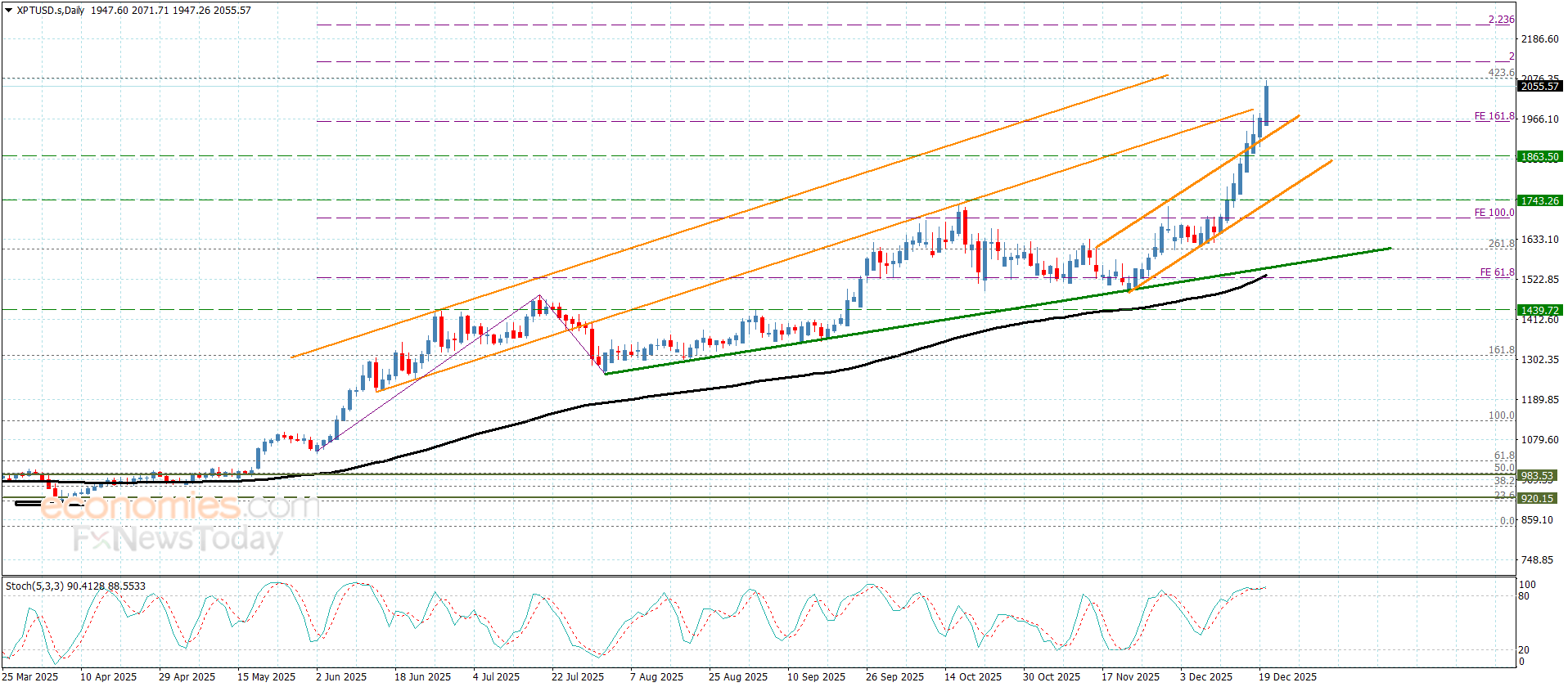
Platinum price did not get enough by its recent gains, activating with the main indicators positivity by forming strong bullish waves, to settle above the psychological barrier at $2000.00 level, recording extra historical gains by hitting $2071.00 level.
Which confirms the stability of the bullish scenario, and its stability above $2000.00 makes us expect to form new bullish waves, to attempt to reach $2085.00 and $2125.00.
The expected trading range for today is between $1970.00 and $2085.00.
Trend forecast: Bullish
– Written by
Frank Davies
STORY LINK Pound to Dollar Price Forecast: GBP Near 1.34 as Markets Bet on BoE Path
The Pound to Dollar exchange rate (GBP/USD) settled just below 1.34 after failing to hold two-month highs, with markets now focused on how the Bank of England’s easing cycle unfolds.
A narrow 5–4 vote for last week’s rate cut has left uncertainty over the pace of further moves in 2026.
Direction will hinge on whether BoE caution or renewed dollar weakness proves the dominant force.
Nordea forecasts that the Pound to Dollar (GBP/USD) exchange rate will strengthen to 1.41 by the end of 2026 as the dollar loses ground.
CIBC, however, expects GBP/USD will be held to 1.34 in 12 months from a 1.36 peak as the US currency secures a limited second-half recovery.
GBP/USD settled just below 1.34 this week after failing to hold 2-month highs just above 1.3450.
Get better rates and lower fees on your next international money transfer.
Compare TorFX with top UK banks in seconds and see how much you could save.
Monetary policy will be a crucial element throughout the next few months.
The Bank of England (BoE) cut interest rates by 25 basis points to 3.75% at the latest policy meeting, in line with strong consensus forecasts.
There was a 5-4 vote for the move with Governor Bailey switching sides from the November vote and the BoE expects further gradual cuts.
ING commented; “today’s news is helping GBP/USD towards our 2025 year-end target of 1.34, and we are mildly positive here in 2026, looking for 1.36 as the weaker dollar and stronger euro trend start to dominate.”
HSBC expects overall Pound losses with GBP/USD dependent on a US retreat to make gains; “With further rate cuts expected, we think GBP will weaken modestly against G10 currencies in 2026 that have already completed monetary easing cycles or are in the frame to start tightening.”
Yael Selfin, chief economist at KPMG, expects it will be difficult to reach a consensus on rates next year. She expects only two interest rate cuts in 2026, taking rates down to 3.25%.
Federal Reserve policy will also be a key element.

Nordea notes potential threats to US Fed independence; “These institutional risks on the horizon will be key for the dollar’s performance in the coming quarters. Importantly, risks do not need to become a reality to hurt the dollar. The mere prospect of political influence over the Fed can be enough to erode confidence.”
It added; “If markets begin to doubt the Fed’s independence or anticipate more aggressive easing under a reshaped committee, the dollar could face renewed periods of selling as investors demand a higher risk premium to hold the currency.”
CIBC is wary over UK fundamentals; “Uncertainty over the UK budget has also stymied investment in recent quarters with the UK economic surprise Index recently plummeting to levels not seen since the start of 2025. The Misery Index has risen again, exceeding levels seen at the start of 2024.”
The bank does, however, see scope for improvement; “Into the year ahead, we think the big risk is an economy that could see growth outperform a very low base. This could be spurred on by lower interest rates, or a less turbulent political climate relative to this year.
International Money Transfer? Ask our resident FX expert a money transfer question or try John’s new, free, no-obligation personal service! ,where he helps every step of the way,
ensuring you get the best exchange rates on your currency requirements.
TAGS: Pound Dollar Forecasts
BitcoinWorld
Cardano Price Prediction: Will ADA Explode to $2 by 2030?
As the cryptocurrency market continues to evolve, investors are eagerly watching Cardano’s ADA token. With its unique proof-of-stake consensus mechanism and strong development roadmap, many are wondering: could ADA reach the coveted $2 mark in the coming years? This comprehensive analysis examines Cardano price predictions from 2026 through 2030, combining technical analysis, market trends, and expert insights to give you a clear picture of ADA’s potential trajectory.
Cardano stands as one of the most established blockchain platforms in the cryptocurrency space. Founded by Charles Hoskinson, co-founder of Ethereum, Cardano has built a reputation for its research-driven approach and peer-reviewed development process. As of current market conditions, ADA maintains a strong position among top cryptocurrencies by market capitalization, but what does this mean for future price movements?
The platform’s transition to a proof-of-stake consensus mechanism through its Ouroboros protocol has positioned it as an energy-efficient alternative to proof-of-work blockchains. This fundamental advantage, combined with ongoing development through the Basho and Voltaire eras, creates a solid foundation for potential growth.
Looking ahead to 2026, several factors will influence ADA’s price trajectory. Market analysts consider both technical indicators and fundamental developments when making their Cardano price prediction for this period.
Key factors for 2026 include:
Most conservative estimates suggest ADA could trade between $0.80 and $1.20 by 2026, assuming steady platform growth and favorable market conditions. More optimistic projections, based on accelerated adoption and successful implementation of Cardano’s roadmap, suggest potential highs approaching $1.50.
The year 2027 represents a crucial period for Cardano’s long-term trajectory. By this time, the platform should have fully implemented its Voltaire governance system, allowing ADA holders to participate directly in network decisions. This increased utility could significantly impact the ADA price.
| Scenario | Low Estimate | High Estimate |
|---|---|---|
| Conservative | $1.00 | $1.40 |
| Moderate | $1.20 | $1.80 |
| Optimistic | $1.50 | $2.20 |
These projections assume continued development success and growing institutional interest in proof-of-stake cryptocurrencies. The cryptocurrency forecast for 2027 heavily depends on Cardano’s ability to attract and retain developers, as well as the platform’s performance relative to competitors like Ethereum and Solana.
Looking further ahead to 2030, the Cardano 2030 outlook becomes both more speculative and potentially more exciting. Long-term predictions must account for technological advancements, regulatory landscapes, and broader economic factors that are difficult to forecast with precision.
Several scenarios could unfold:
The most compelling question remains: Will ADA hit $2? Based on current trajectories and assuming successful execution of Cardano’s development roadmap, reaching $2 by 2030 appears achievable, though not guaranteed. The $2 milestone represents approximately a 4x increase from current levels, which aligns with historical cryptocurrency growth patterns for established projects with strong fundamentals.
Several developments could propel ADA beyond current predictions:
Institutional Adoption: Increased investment from traditional financial institutions could dramatically increase demand for ADA. As proof-of-stake assets gain regulatory clarity, more institutional investors may enter the Cardano ecosystem.
Technological Breakthroughs: Successful implementation of Cardano’s scaling solutions and interoperability features could position ADA as a leading platform for decentralized finance and other applications.
Market Cycles: Cryptocurrency markets historically move in cycles. A major bull market coinciding with Cardano’s development milestones could create perfect conditions for significant price appreciation.
While the Cardano price prediction outlook appears promising, investors must consider potential challenges:
Competition: Cardano faces intense competition from other smart contract platforms. Ethereum’s continued development, along with emerging layer-1 and layer-2 solutions, could limit Cardano’s market share.
Regulatory Uncertainty: Changing regulatory landscapes, particularly regarding proof-of-stake assets and securities classification, could impact ADA’s price and adoption.
Execution Risk: Cardano’s development timeline has historically been deliberate. Any significant delays or technical challenges could affect market confidence and price performance.
Leading cryptocurrency analysts offer varied perspectives on ADA’s future. While some emphasize Cardano’s strong fundamentals and research-based approach, others caution about the competitive landscape. Most agree that Cardano’s success depends on execution of its roadmap and ability to attract developers and users to its ecosystem.
The overall cryptocurrency forecast for ADA remains cautiously optimistic, with many experts believing the platform’s unique approach could pay dividends in the long term, particularly as environmental concerns make proof-of-stake mechanisms more attractive to institutional investors.
Based on current Cardano price prediction models and market analysis:
1. Consider dollar-cost averaging rather than timing the market
2. Monitor Cardano’s development progress through official channels
3. Diversify within the cryptocurrency sector
4. Stay informed about regulatory developments affecting proof-of-stake assets
5. Set realistic expectations based on your investment horizon
What is the highest price Cardano could reach by 2030?
While predictions vary, some optimistic models suggest ADA could reach $5-$10 by 2030 under ideal conditions, though most analysts project more conservative targets in the $2-$4 range.
Who founded Cardano?
Cardano was founded by Charles Hoskinson, who also co-founded Ethereum. The project is developed by Input Output Hong Kong (IOHK).
How does Cardano differ from Ethereum?
Cardano uses a proof-of-stake consensus mechanism called Ouroboros, while Ethereum recently transitioned from proof-of-work to proof-of-stake. Cardano also emphasizes peer-reviewed research and formal methods in its development process.
What factors most influence ADA price?
Key factors include overall cryptocurrency market trends, Cardano platform adoption, technological developments, regulatory changes, and competition from other blockchain platforms.
Is Cardano a good long-term investment?
Many analysts view Cardano as a promising long-term investment due to its strong fundamentals and research-based approach, though all cryptocurrency investments carry significant risk and volatility.
The journey toward ADA reaching $2 involves multiple factors aligning favorably. Cardano’s deliberate development approach, combined with growing recognition of proof-of-stake advantages, creates a compelling case for long-term growth. While reaching $2 by 2030 appears within reach based on current projections, investors should remain aware of market volatility and the competitive landscape.
Cardano’s success ultimately depends on execution—transforming its technological promise into real-world adoption. As the platform continues to develop and the broader cryptocurrency market evolves, ADA’s price trajectory will reflect both Cardano’s specific achievements and general market conditions. For investors with a long-term perspective and risk tolerance, Cardano represents an intriguing opportunity in the evolving blockchain ecosystem.
To learn more about the latest cryptocurrency markets trends, explore our article on key developments shaping blockchain technology and digital asset adoption.
This post Cardano Price Prediction: Will ADA Explode to $2 by 2030? first appeared on BitcoinWorld.
NUSA Finance will hold an X Spaces AMA on 22 December 2025 from 8–9 PM (local time) with @LelyFirdauzi from Theory of Whaless to discuss responsible use of DeFi loans, risk management, and borrowing options on the NUSA platform, as described in their announcement. Mechanically, this is an educational and product-focused session, including a live demo of borrowing flows. Such events can increase user familiarity with leverage tools, potentially boosting borrowing activity and protocol TVL if users act on the information. More borrowing can raise fee revenue and platform usage, but also leverage in the system, which may amplify price moves during volatility.
Looking to increase your trading exposure? DeFi borrowing can be useful tools if you know how to use them responsibly.
Join our AMA with @LelyFirdauzi from Theory of Whaless as we discuss how to use loans responsibly, manage risk, and explore borrowing options on @nusa_finance… pic.twitter.com/k1x1XD3yHw
Silver price (XAG/USD) trades 2.5% higher to near $69.00 during the Asian trading session on Monday, the highest level ever seen. The white metal strengthens as investors shift to a safe-haven fleet on renewed tensions between Israel and Iran.
According to a report from NBC News, Israeli officials have grown increasingly concerned that Iran is expanding production of its ballistic missile program and reconstituting its nuclear facilities, which were damaged by Israeli military strikes earlier this year, and are preparing to brief United States (US) President Donald Trump about options for attacking it again.
The scenario of geopolitical tensions increases demand for safe-haven assets, such as Silver.
On the Federal Reserve’s (Fed) monetary policy front, investors remain confident that the central bank will not reduce interest rates in the January policy meeting. Fed dovish expectations for the January meeting have not accelerated, despite the release of the soft US inflation data for November.
On Thursday, the US Consumer Price Index (CPI) data for November showed that the headline inflation cooled down to 2.7% year-on-year (YoY) from 3% in October. Economists expected the inflation data to come in higher at 3.1%. The so-called core reading, which strips out volatile food and energy items, dropped to 2.6% from estimates and the prior reading of 3%.
XAG/USD trades higher around $69.02 at the start of the week. The 20-period Exponential Moving Average at $61.14 rises firmly and sits well below the price. The wide positive spread underscores a strong uptrend but also stretched conditions.
The 14-day Relative Strength Index (RSI) at 77.44 is overbought, and a cooling phase could follow. A rising trend line from $49.96 underpins the bullish bias.
With price extended above the 20-EMA, pullbacks could find support at $61.14, preserving the advance. Momentum remains robust, yet the overbought RSI may cap near-term gains; a break below the trend line near $65 would weaken the bias and open the door for a deeper retracement toward the December 3 high near $59.00. Looking up, the psychological level of $60.00 would act as major barrier.
(The technical analysis of this story was written with the help of an AI tool.)
Silver is a precious metal highly traded among investors. It has been historically used as a store of value and a medium of exchange. Although less popular than Gold, traders may turn to Silver to diversify their investment portfolio, for its intrinsic value or as a potential hedge during high-inflation periods. Investors can buy physical Silver, in coins or in bars, or trade it through vehicles such as Exchange Traded Funds, which track its price on international markets.
Silver prices can move due to a wide range of factors. Geopolitical instability or fears of a deep recession can make Silver price escalate due to its safe-haven status, although to a lesser extent than Gold’s. As a yieldless asset, Silver tends to rise with lower interest rates. Its moves also depend on how the US Dollar (USD) behaves as the asset is priced in dollars (XAG/USD). A strong Dollar tends to keep the price of Silver at bay, whereas a weaker Dollar is likely to propel prices up. Other factors such as investment demand, mining supply – Silver is much more abundant than Gold – and recycling rates can also affect prices.
Silver is widely used in industry, particularly in sectors such as electronics or solar energy, as it has one of the highest electric conductivity of all metals – more than Copper and Gold. A surge in demand can increase prices, while a decline tends to lower them. Dynamics in the US, Chinese and Indian economies can also contribute to price swings: for the US and particularly China, their big industrial sectors use Silver in various processes; in India, consumers’ demand for the precious metal for jewellery also plays a key role in setting prices.
Silver prices tend to follow Gold’s moves. When Gold prices rise, Silver typically follows suit, as their status as safe-haven assets is similar. The Gold/Silver ratio, which shows the number of ounces of Silver needed to equal the value of one ounce of Gold, may help to determine the relative valuation between both metals. Some investors may consider a high ratio as an indicator that Silver is undervalued, or Gold is overvalued. On the contrary, a low ratio might suggest that Gold is undervalued relative to Silver.
To build fully integrated longevity ecosystem
GABIT, a full-stack longevity company, announced its acquisition of Sweden-based Näck, a clean, science-led nutrition brand. This move brings together GABIT’s cutting-edge health tracking smart ring technology and AI-based health coaching with Näck’s thoughtfully formulated supplements.
GABIT combines continuous data with personalised actions, nudges, and personalised fitness and nutrition plans to help users actually improve their health, not just track it. Näck’s supplements are formulated to meet recommended dietary allowances (RDA) where applicable, carry Informed Choice certification, with every batch rigorously tested against 250+ banned substances.
“Näck stands for nutrition that is simple, transparent, and rooted in science,” said Gaurav Gupta, Founder, GABIT. “At GABIT, we’ve always believed that health is interconnected. This acquisition is a natural next step, because the impact of what you put into your body should be just as measurable as how you move, sleep, recover, and live. When supplements, diagnostics, and continuous tracking come together, health stops being vague and starts becoming measurable.”
Arpana Shahi, Founder, GABIT mentioned, “Imagine taking a supplement for better sleep and actually being able to
measure its effect on your deep sleep. Or adjusting your nutrition through supplements and seeing tangible changes in recovery, energy, or metabolic health. That’s the future of health we’re building.”