The main category of All News Articles.
You can use the search box below to find what you need.
[wd_asp id=1]
The main category of All News Articles.
You can use the search box below to find what you need.
[wd_asp id=1]
In its November market commentary, published Monday, Grayscale noted that Bitcoin’s recent 32% decline from its October peak is consistent with historical bull-market pullbacks, reported Benzinga.
According to the firm, Bitcoin has experienced drops of 10% or more roughly 50 times since 2010, making sharp declines a normal feature of its cycles.
The research team emphasized that investors often underestimate how common such moves are, even during strong cycles. Grayscale does not anticipate a drawn-out 2–3-year downturn similar to past cyclical declines.
ALSO READ: Record $8 trillion in US money-market funds: Why investors keep pouring in amid Fed rate cuts
The firm highlighted that the current market structure, influenced by exchange-traded products and corporate digital asset treasuries, differs from previous cycles and reduces the relevance of the traditional four-year price rhythm tied to Bitcoin halving events.
Unlike earlier cycles, the current market has not seen a parabolic rally, which historically preceded multi-year crashes. This moderation, combined with evolving market participation, supports a more constructive outlook for 2025 and 2026.
Grayscale also pointed to hedging activity and on-chain signals as potential signs of a bottoming effort. Bitcoin put-option skew remains elevated across three- and six-month tenors, indicating active downside hedging, a pattern historically observed near market lows.
However, Grayscale cautioned that short-term indicators remain mixed. Futures open interest has declined, and exchange-traded product flows were negative for most of November. On-chain data also showed a spike in Coin Days Destroyed, suggesting movement of older Bitcoin held by long-term investors.
According to Grayscale, a clearer bottom may require stabilization in flows, open interest, and a slowdown in selling by longstanding holders.
ALSO READ: Crypto gets the green light — BofA pushes 1–4% allocation for wealthy investors
The firm noted that major digital asset treasuries are trading at discounts to their net asset values, reflecting reduced speculative exposure.
Meanwhile, privacy-focused cryptocurrencies outperformed the broader market in November. Zcash (ZEC), Monero (XMR), and Decred (DCR) posted double-digit gains, driven by increased developer activity around privacy tools on the Ethereum ecosystem.
Grayscale highlighted privacy as a growing theme for the next stage of digital asset utility, supported by new frameworks and Layer-2 developments.
The firm also noted that XRP and Dogecoin exchange-traded products began trading under new SEC listing standards, expanding institutional access to large-cap tokens and broadening the universe of regulated products.
Looking ahead, Grayscale said the macroeconomic backdrop may continue to support crypto through 2026. Investors are watching the Federal Reserve’s December 10 meeting for a potential rate cut, which could lower real interest rates, weigh on the US Dollar, and support alternative assets like Bitcoin.
Additionally, ongoing bipartisan efforts on crypto market-structure legislation could attract further institutional capital if progress continues, as per the Benzinga report.
What makes this Bitcoin cycle different from previous ones?
More corporate treasuries, regulated exchange-traded products, and no parabolic rally so far reduce the risk of a prolonged crash.
How are institutional investors influencing Bitcoin?
Corporate treasuries and regulated ETFs are providing stability and reducing speculative exposure.
Gold is back in the green above $4,200 early Wednesday, following a temporary pullback on Tuesday, as buyers refuse to give up heading into the top-tier US ADP Employment Change and US ISM Services PMI data releases.
The overnight weakness in the US Dollar (USD) extends into Asia, allowing Gold to gather upside traction.
The USD faces headwinds from expectations surrounding an imminent interest rate cut by the US Federal Reserve (Fed) next week, as well as from the latest chatter that the White House Economic Adviser Kevin Hassett is seen as President Donald Trump’s top pick to become the next Fed Chairman.
On Tuesday, Trump said that he had narrowed the list down to one, and he later mentioned Hassett as a potential Chairman.
Hassett is known to be a relentless dove, and hence, this chatter seems to bode well for the non-yielding Gold at the expense of the USD.
Further, Gold also capitalizes on renewed geopolitical tensions surrounding the Russia-Ukraine peace talks and upbeat China’s RatingDog Services PMI data.
The Kremlin said on Wednesday that Russia and the US failed to reach a compromise on a possible peace deal to end the war in Ukraine after a five-hour Kremlin meeting between President Vladimir Putin and Donald Trump’s top envoys.
Putin’s top foreign policy aide, Yuri Ushakov, said, “compromises have not yet been found. “There is still a lot of work to be done,” Ushakov added.
Meanwhile, the RatingDog China General Services PMI, compiled by S&P Global, fell to 52.1 from 52.6 in October, marking the weakest expansion since June. The reading, however, surpassed expectations for a drop to 52. Note that China is the world’s top yellow metal consumer.
Looking ahead, the next leg higher in Gold hinges on the upcoming monthly US ADP Employment Change data and the ISM Services PMI, which could double down on the dovish Fed bets beyond the December monetary policy meeting.
In the daily chart, the 21-day Simple Moving Average (SMA) rises and sits above the 50-, 100-, and 200-day SMAs, while the longer averages also advance. Price holds above these averages, with the 21-day SMA at $4,117.64 offering nearby dynamic support. The Relative Strength Index (RSI) at 62.86 remains positive and edges higher, reinforcing upward momentum.
Measured from the $4,381.17 high to the $3,885.84 low, the 61.8% retracement at $4,191.95 has been surpassed, while the 78.6% retracement at $4,275.16 caps the next upside attempt. A sustained break above the latter would extend the advance, whereas a pullback below the former could slow momentum back toward the short-term average.
(The technical analysis of this story was written with the help of an AI tool)
The ADP Employment Change is a gauge of employment in the private sector released by the largest payroll processor in the US, Automatic Data Processing Inc. It measures the change in the number of people privately employed in the US. Generally speaking, a rise in the indicator has positive implications for consumer spending and is stimulative of economic growth. So a high reading is traditionally seen as bullish for the US Dollar (USD), while a low reading is seen as bearish.
Next release:
Wed Dec 03, 2025 13:15
Frequency:
Monthly
Consensus:
5K
Previous:
42K
Source:
ADP Research Institute
GBP/EUR Year-End 2025 Forecast
Consensus from major banks.
Above: P.M. Keir Starmer defends his budget in a speech delivered Monday. Picture by Simon Dawson / No 10 Downing Street.
The pound to euro exchange rate’s (GBP/EUR) rally has scope to run further say analysts at Barclays, who judge “last week’s budget generates scope for an, at least partial, unwind of the pound’s fiscal risk premium.”
In a weekly analysis, the investment bank’s FX team say this upside potential derives from a larger headroom, residual net short positions, and a positive risk backdrop into December.
Find out how much you could save on your international transfer
Estimated saving compared to high street banks:
£25.00
Compare Rates from Leading Providers →
Free • No obligation • Takes 2 minutes
It adds that “a relatively warm reception” by the Labour party to the budget is important to consider, in that it allays near-term risks of political instability.
“The back-loading of fiscal tightening implies execution and credibility risks, but we think these are already adequately priced,” says Barclays.
The pound has fallen steadily against the euro through the course of 2025, with losses accelerating in the summer as markets prepared for a tough budget.
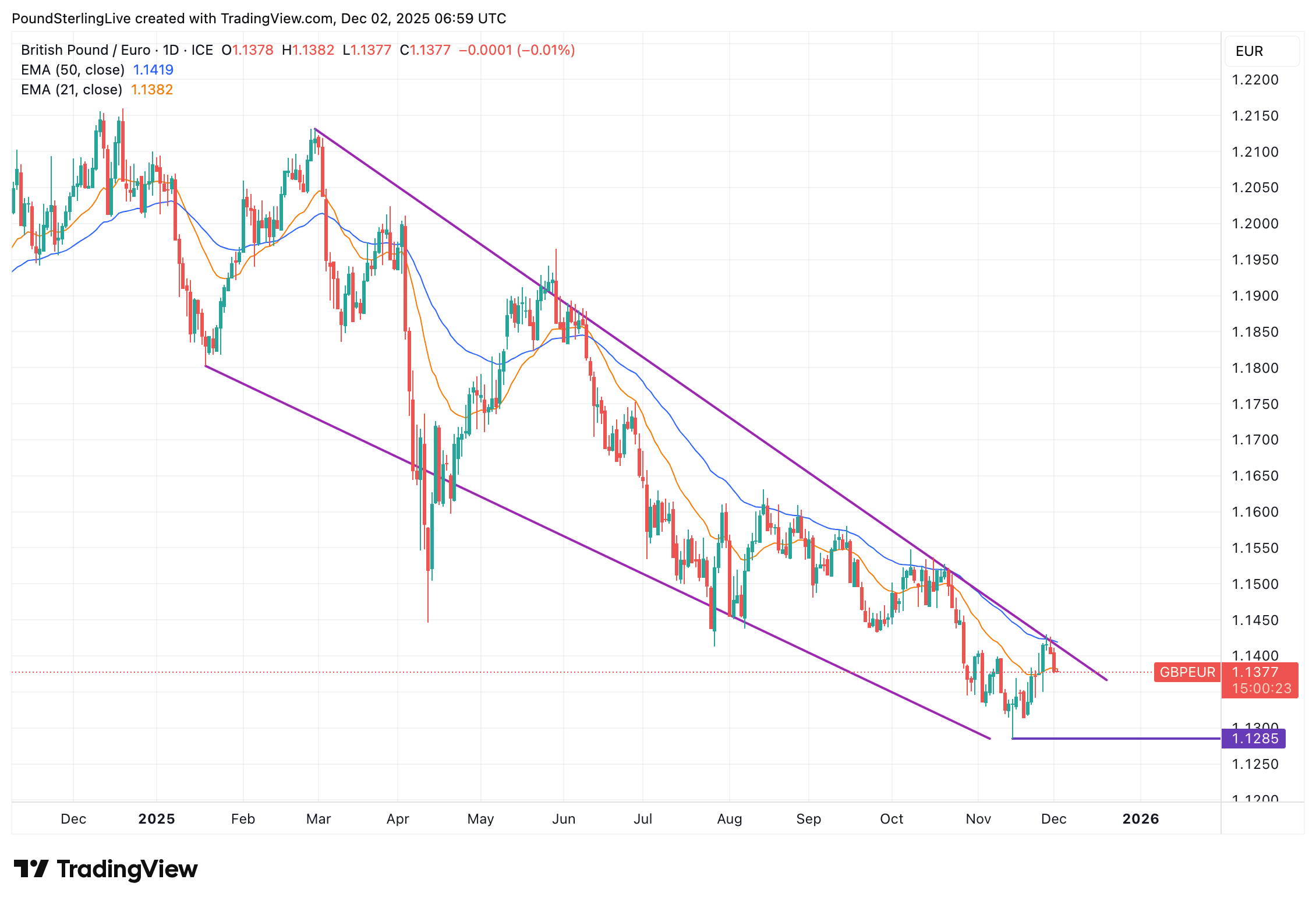
Above: GBP/EUR remains in a downtrend, with the post-budget bounce faltering.
Fears were elevated that political pressures on Chancellor Rachel Reeves and Prime Minister Keir Starmer would result in a market-unfriendly budget.
In particular, there were concerns that the debt market would not take kindly to any budget that failed to address the country’s growing deficit.
But some £26BN in tax rises over the coming years restores the Chancellor’s headroom by £22BN, which is a relief to markets, if not the increasingly despondent UK taxpayer.

The Bank of England is another key consideration for financial markets and the pound.
“Terminal rate pricing of just under 3.5% for Bank Rate (including a 25bp cut in December) also remains appropriate, in our view, as the macro outlook over the Bank’s policy horizon is largely unchanged,” says Barclays.
A terminal rate of 3.5% implies two further cuts in the cycle.
Marrkets are fully priced for a cut in December, with another falling by April 2026.
“If anything, aggregate demand is supported on the margin and confidence could also rebound as Budget uncertainty clears, thereby reducing the dovish tail for the pound,” adds Barclays.
In all, analysts expect EUR/GBP to edge closer to the rate differential-implied level (which is c.0.86) in the near term.
In GBP/EUR terms, that is 1.1630.
Further out, the next key milestone is the local elections in May 2026.
“With the market unlikely to be forgiving of further signs of fiscal slippage, such as in relation to the benefits cuts last summer, policy stability is a precondition for a more lasting rebound in sterling,” says Barclays.
With Labour set for a wipeout in local elections, pressure to change leaders will grow, making the installment of a devout left wing leader and Chancellor a clear risk for sterling in the year ahead.
SO TAKE IT EASY. BACK TO YOU IN THE STUDIO. WILL DO JOHNNY. THANK YOU. PLOW CREWS GOT TO HAND IT TO HIM. THEY’VE BEEN WORKING AROUND THE CLOCK TO CLEAR AND TREAT THE ROADS BIG. THANK YOU. AND THAT’S WHERE WE BEGIN. YOUR NINE THINGS TO KNOW AFTER MONDAY’S DRIVE WITH SLICK CREWS MAKING SURE YOU HAVE A CALMER DRIVE THIS MORNING. WITH TEMPERATURES BEING BELOW FREEZING. JUST BE CAUTIOUS OF ANY SLICK SPOTS THAT YOU MIGHT COME ACROSS. SCHOOLS ACROSS THE METRO CHANGING THEIR PLANS THIS MORNING. WE’VE BEEN TELLING YOU SEVERAL DISTRICTS LIKE KANSAS CITY, MISSOURI AND KANSAS PUBLIC SCHOOLS ARE CLOSED. SEVERAL MISSOURI SCHOOLS ARE GOING VIRTUAL, LIKE LEE’S SUMMIT IN BLUE SPRINGS. SOME KANSAS DISTRICTS HAVE DELAYED STARTS LIKE OLATHE AND BLUE VALLEY SCHOOLS. THAT LIST GOES ON. WE HAVE A FULL LIST OF CLOSINGS ON THE SCREEN, CHANGES AND DELAYS AS WELL@KMBC.COM. WELL, THE KANSAS CITY CHIEFS ARE GEARING UP FOR A SUNDAY NIGHT SHOWDOWN AGAINST THE HOUSTON TEXANS. HEAD COACH ANDY REID SAYS TREY SMITH AND JORDAN TAYLOR ARE IMPROVING. ROOKIE TACKLE JOSH SIMMONS IS GETTING A SECOND EVALUATION ON HIS WRIST. IT’S NOT CLEAR IF ANY OF THE THREE OFFENSIVE LINEMEN WILL PLAY SUNDAY. WE’LL HAVE TO MONITOR THEIR PRACTICE STATUS THROUGHOUT THE WEEK. TODAY IS GIVING TUESDAY TIME MEANT TO GIVE BACK AFTER BLACK FRIDAY AND CYBER MONDAY CHAOS. TODAY WE’RE HIGHLIGHTING SOME LOCAL GROUPS HELPING PEOPLE IN OUR COMMUNITY AND HOW YOU CAN GET INVOLVED. WATCH THOSE REPORTS ALL DAY TODAY ON KMBC NINE NEWS. I’M TRYING TO LEAVE SINCE SATURDAY, BUT ALL FLIGHTS WERE CANCELED. SEVERE WEATHER OVER THE WEEKEND AND YESTERDAY HAS BEEN MAKING IT DIFFICULT FOR MILLIONS OF AMERICANS TO GET HOME FROM THEIR THANKSGIVING TRAVEL DESTINATIONS. FREEZING RAIN IN OKLAHOMA LED TO ABOUT 350 CRASHES. PARTS OF THE NORTHEAST ARE BRACING FOR UP TO A FOOT OF SNOW. MORE THAN 75 MILLION PEOPLE ARE UNDER WINTER WEATHER ALERTS RIGHT NOW, DESPITE SEVERE WINTER WEATHER IN PARTS OF THE COUNTRY, SUNDAY BROKE A RECORD FOR TSA SCREENINGS. AGENTS SCREENED MORE THAN 3.1 MILLION PEOPLE AS TRAVELERS RETURN HOME AFTER THANKSGIVING. THAT’S THE HIGHEST NUMBER EVER IN TSA HISTORY. TOP TEN DAYS HAVE ALL HAPPENED WITHIN THE LAST YEAR AND ARE ALL OVER THE 3 MILLION MARK. WELL, CYBER MONDAY IS ON TRACK TO BE A RECORD BREAKER. ADOBE ANALYTICS SAYS WHEN THE RECEIPTS ARE ADDED UP ONLINE, SHOPPERS WILL HAVE SPENT SOMEWHERE AROUND $14 BILLION. JUST ON MONDAY, THE SHOPPING FRENZY RAMPING UP THROUGH THE EVENING. LAST NIGHT, ESTIMATES SAY AMERICANS SPENT $16 MILLION EVERY MINUTE. MY GOODNESS. WOW. NEW RESEARCH THIS MORNING SHINES A LIGHT ON THE POTENTIAL HEALTH RISKS OF GIVING A YOUNG CHILD A SMARTPHONE. WE WANT LESS DEVICES, LESS SCREENS, MORE CHILDHOOD. STUDY IN THE JOURNAL OF PEDIATRICS FINDS THAT KIDS WHO HAD A SMARTPHONE BEFORE AGE 12 WERE AT HIGHER RISK FOR DEPRESSION, OBESITY, AND NOT GETTING ENOUGH SLEEP. RESEARCHERS ALSO FOUND THE YOUNGER A CHILD IS WHEN THEY GET A SMARTPHONE. THE HIGHER THEIR RISK OF DEVELOPING THESE ISSUES. WE’RE GOING TO CONDUCT OVERSIGHT, AND WE’RE GOING TO TRY TO GET TO THE FACTS. CONGRESSIONAL LAWMAKERS ARE LOOKING INTO THE LEGALITY OF THE TRUMP ADMINISTRATION’S DEADLY STRIKES ON BOATS IN THE CARIBBEAN. THE PENTAGON CLAIMS THE BOATS WERE TRAFFICKING DRUGS. NOW, THE LATEST STRIKE IS RAISING THE MOST QUESTIONS. IT INVOLVES THE BOAT BEING HIT ONCE AND THEN AGAIN AS TWO PEOPLE CLUNG TO THE WRECKAGE. NOW, SOME EXPERTS S
FDA, DOJ remove illegal 7-OH supplements from warehouses in the Kansas City area
Updated: 7:14 PM CST Dec 2, 2025
Federal authorities seized about 73,000 illegal products containing 7-hydroxymitragynine, or 7-OH, from three warehouses in the Kansas City area.The seizures followed FDA inspections that found two companies, Shaman Botanicals LLC and Relax Relief Rejuvenate Trading LLC, allegedly continued to distribute 7-OH products despite previous warnings that they were unlawful under the Federal Food, Drug, and Cosmetic Act.The U.S. Marshals Service carried out the seizures with support from the FDA. Court filings in the U.S. District Court for the Western District of Missouri allege the products pose health risks, including to children, and are considered dangerous and potentially addictive.“Products containing 7-OH are illegal under federal law,” said Assistant Attorney General Brett A. Shumate of the Justice Department’s Civil Division. “We have seen numerous reports of harmful health consequences in consumers, including children, who have taken 7-OH products. Working with our partners at FDA, we will take action against anyone participating in the illegal distribution of these products.”The FDA recommended earlier this year that 7-OH be regulated under the Controlled Substances Act, citing safety concerns. Because the substance was not marketed in the United States before 1994 and lacks proof of safety, it cannot legally be sold in dietary supplements, the DOJ said.
Federal authorities seized about 73,000 illegal products containing 7-hydroxymitragynine, or 7-OH, from three warehouses in the Kansas City area.
The seizures followed FDA inspections that found two companies, Shaman Botanicals LLC and Relax Relief Rejuvenate Trading LLC, allegedly continued to distribute 7-OH products despite previous warnings that they were unlawful under the Federal Food, Drug, and Cosmetic Act.
The U.S. Marshals Service carried out the seizures with support from the FDA.
Court filings in the U.S. District Court for the Western District of Missouri allege the products pose health risks, including to children, and are considered dangerous and potentially addictive.
“Products containing 7-OH are illegal under federal law,” said Assistant Attorney General Brett A. Shumate of the Justice Department’s Civil Division. “We have seen numerous reports of harmful health consequences in consumers, including children, who have taken 7-OH products. Working with our partners at FDA, we will take action against anyone participating in the illegal distribution of these products.”
The FDA recommended earlier this year that 7-OH be regulated under the Controlled Substances Act, citing safety concerns.
Because the substance was not marketed in the United States before 1994 and lacks proof of safety, it cannot legally be sold in dietary supplements, the DOJ said.
With momentum weakening and macro pressure resurfacing, analysts are closely monitoring this interaction to determine whether the pattern resembles past capitulation zones or the early stages of a structural reversal.
As of December 2, 2025, DOGE briefly dipped to $0.14 before recovering modestly. GreenyTrades noted that the wick below support “resembles previous deep retracements where buyers eventually regained control,” though he emphasised that current conditions do not yet confirm a trend reversal. His analysis shows Dogecoin still moving within a long-term downtrend from late 2024 highs, with the 0.786 level—near $0.14—acting as a structural area where historical reversals have tended to occur in fast-moving markets.
For readers tracking dogecoin price prediction models, this zone has become a focal point—not as a guarantee of reversal, but as a meaningful technical reference point within the present cycle.
A separate 4-hour chart from analyst and educator @TATrader_Alan, who frequently publishes pattern-based interpretations for crypto traders, highlights a short-lived rebound from the lower boundary of a descending channel. RSI briefly fell below 30, an area commonly viewed as oversold in traditional technical frameworks. Dogecoin traded near $0.14 on December 2, a recovery from the prior daily low of $0.132 before renewed selling pressure emerged.
Dogecoin is approaching its 0.786 retracement level, effectively retesting the April tariff-driven market dip. Source: @greenytrades via X
Alan, who regularly analyses Wyckoff-style accumulation setups, mentioned that Bitcoin’s stability above $90,000 “has helped maintain confidence” across meme assets, though he cautioned that such support does not override the broader downtrend. While Alan’s commentary provides useful community insight, his observations—like most social-charting content—represent interpretive views rather than formal dogecoin price predictions.
Short-term indicators remain mixed. Spot volume has been fluctuating, open interest has declined since the October washout, and sentiment trackers such as LunarCrush show unstable social engagement levels. These data points reinforce that Dogecoin’s near-term direction remains uncertain.
Dogecoin’s sharp decline on October 10—when it fell nearly 63% during a swift, market-wide correction—continues to shape its current structure. Despite recovering part of that move, order-book data from several exchanges show inconsistent buy-side depth, suggesting a cautious environment among traders. Dogecoin trades around $0.14, reflecting partial stabilisation but not sustained demand.
Some market analysts expect the price to consolidate between $0.11 and $0.24, a range that has captured most trading activity over recent months. At present, there is limited evidence supporting aggressive upside scenarios, and many dogecoin price prediction 2025 models project a gradual, not parabolic, recovery.
Dogecoin’s multi-year cycle structure remains an ongoing topic in the crypto analysis community. A widely shared TradingView comparison examines Dogecoin’s historical price patterns between 2014 and 2022 and overlays them with the current market phase. The creator—who specialises in cycle analysis within crypto communities—labels the emerging pattern as “Cycle 3,” noting visual similarities between the 2020 consolidation and today’s structure.
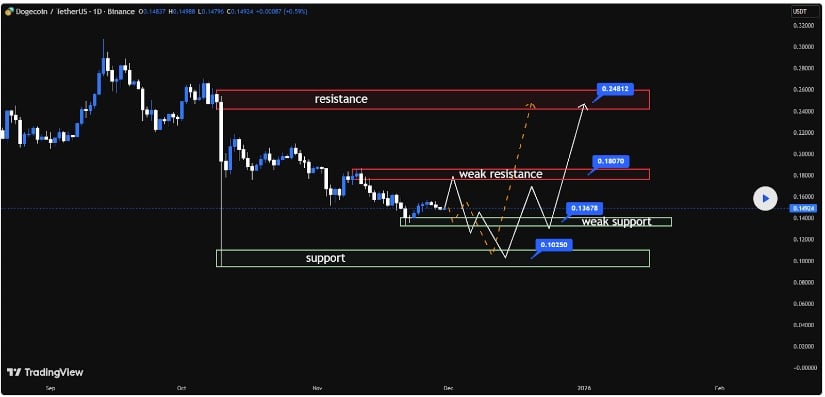
Dogecoin is stabilising near $0.15 after a 63% October selloff, but with weak buyer presence, it may continue ranging between $0.11 and $0.24 for months unless stronger demand emerges near $0.11. Source: soheilbakhshipor12 on TradingView
The model suggests a possible slow buildup heading toward 2026–2027, though the analyst explicitly stated that “cycle overlays are interpretive and not predictive.” In other words, these comparisons offer historical context rather than actionable dogecoin predictions. Cycle models have mixed success across crypto markets and are sensitive to broader conditions such as liquidity, macroeconomic shifts, and Bitcoin’s trajectory.
On shorter timeframes, Dogecoin continues to move within a descending channel, with RSI readings returning to neutral after last week’s oversold dip. The price has hovered around support near $0.14, an area where past intraday bounces have occurred. Market data shows that liquidity thins above the $0.16 region, which may explain recent rejection wicks around that level.
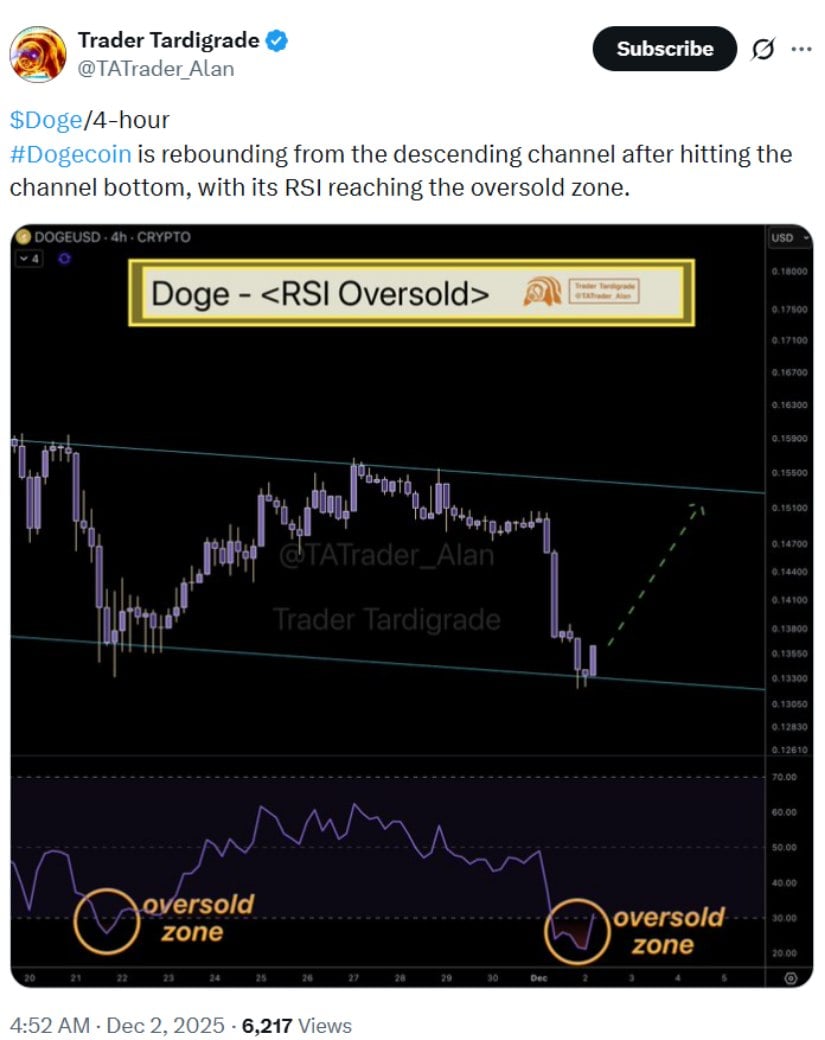
Dogecoin is rebounding from the bottom of its descending channel on the 4-hour chart, with RSI signalling oversold conditions. Source: @TATrader_Alan via X
A widely circulated trading example on social media suggests that some traders are watching for a potential breakout above the Kijun-sen at $0.1510. The creator of the chart advised waiting for confirmation to reduce the possibility of false signals—a common principle in technical trading education. These setups, however, are interpretive and should not be viewed as recommendations or forecasts.
The broader picture shows that Dogecoin remains sensitive to shifts in short-term volatility, with futures funding rates moving in and out of neutral territory throughout the week. This suggests an indecisive market rather than a directional one.
Beyond price charts, Dogecoin faces several structural factors that continue to shape its long-term outlook. Unlike capped cryptocurrencies, Dogecoin maintains an uncapped supply model, introducing new coins into circulation indefinitely. Analysts who model long-term value often note that this structure requires consistent or expanding demand to sustain price levels. This characteristic frequently emerges in discussions around “how much is Dogecoin worth” from a valuation perspective.
Sentiment remains a major driver. According to Chainalysis’ 2025 Spotlight on Meme Assets, a significant portion of short-term volatility in meme tokens arises from social momentum rather than fundamental catalysts. The firm notes that rapid shifts in community engagement—whether from influencers, viral posts, or broader market fear—can move prices more sharply than on-chain metrics.
Meanwhile, the recently launched Dogecoin ETFs from Bitwise and Grayscale have not yet generated notable institutional inflows. Analysts caution that while these products improve market accessibility, early data show a limited impact on the dogecoin price today.
Dogecoin’s approach to the 0.786 Fibonacci retracement level marks a technically meaningful moment for the cryptocurrency. While this area has historically been associated with trend exhaustion in volatile markets, current indicators show a cautious environment marked by inconsistent liquidity, fragile sentiment, and unresolved macro uncertainty.
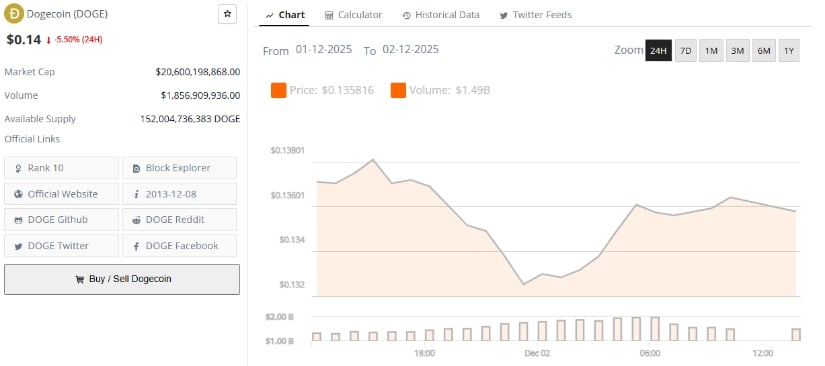
Dogecoin was trading at around $0.14, down 5.50% in the last 24 hours. Source: Brave New Coin
For long-term observers, the deeper retracement may offer insight into where market participants are reassessing risk. For traders, the lack of directional conviction suggests a period of elevated volatility but limited clarity. And for those following broader crypto cycles, historical comparisons can provide context—but not certainty—on what comes next.
Dogecoin remains one of the most closely watched digital assets, supported by a large and active community. Whether this phase becomes the early stage of a longer recovery or simply part of a multi-month consolidation will depend on broader market catalysts in the months ahead.
* For commercial use only
Based on your interests
Overview
5
Consumer behavior
5
Coffee beans
5
Coffee products
4
Coffee shops
4
* For commercial use only
Based on your interests
World Bank. (October 29, 2025). Average prices for Arabica and robusta coffee worldwide from 2014 to 2027 (in nominal U.S. dollars per kg) [Graph]. In Statista. Retrieved December 03, 2025, from https://www.statista.com/statistics/675807/average-prices-arabica-and-robusta-coffee-worldwide/?__sso_cookie_checker=failed
World Bank. “Average prices for Arabica and robusta coffee worldwide from 2014 to 2027 (in nominal U.S. dollars per kg).” Chart. October 29, 2025. Statista. Accessed December 03, 2025. https://www.statista.com/statistics/675807/average-prices-arabica-and-robusta-coffee-worldwide/?__sso_cookie_checker=failed
World Bank. (2025). Average prices for Arabica and robusta coffee worldwide from 2014 to 2027 (in nominal U.S. dollars per kg). Statista. Statista Inc.. Accessed: December 03, 2025. https://www.statista.com/statistics/675807/average-prices-arabica-and-robusta-coffee-worldwide/?__sso_cookie_checker=failed
World Bank. “Average Prices for Arabica and Robusta Coffee Worldwide from 2014 to 2027 (in Nominal U.S. Dollars per Kg).” Statista, Statista Inc., 29 Oct 2025, https://www.statista.com/statistics/675807/average-prices-arabica-and-robusta-coffee-worldwide/?__sso_cookie_checker=failed
World Bank, Average prices for Arabica and robusta coffee worldwide from 2014 to 2027 (in nominal U.S. dollars per kg) Statista, https://www.statista.com/statistics/675807/average-prices-arabica-and-robusta-coffee-worldwide/?__sso_cookie_checker=failed (last visited December 03, 2025)
Average prices for Arabica and robusta coffee worldwide from 2014 to 2027 (in nominal U.S. dollars per kg) [Graph], World Bank, October 29, 2025. [Online]. Available: https://www.statista.com/statistics/675807/average-prices-arabica-and-robusta-coffee-worldwide/?__sso_cookie_checker=failed
Too much magnesium may cause diarrhea and abdominal cramps. In severe cases, it can lead to difficulty breathing, irregular heartbeat, and death.
Severe magnesium toxicity is not all that common. Supplements often come in much higher doses than what you get from foods, so the risk of hypermagnesemia (magnesium overdose) is much higher.
Earlier signs of magnesium overdose include:
The symptoms of magnesium overdose can be severe because of all the roles magnesium plays in the body. Overdosing on magnesium can lead to muscle paralysis and cardiac arrest.
Magnesium does so much for your body, so it is important to get enough of it. The amount you need depends on your age, sex, and health status.
The amount of magnesium per day, measured in milligrams, you may need includes:
| Age | Men | Women | Pregnant | UL |
|---|---|---|---|---|
| 0-6 months | 30 | 30 | ||
| 7-12 months | 75 | 75 | ||
| 1-3 years | 80 | 80 | 65 | |
| 4-8 years | 130 | 130 | 110 | |
| 9-13 years | 240 | 240 | 350 | |
| 14-18 years | 410 | 360 | 400 | 350 |
| 19-30 years | 400 | 310 | 350 | 350 |
| 31 years and older | 420 | 320 | 360 | 350 |
To check for a magnesium overdose, a healthcare provider will draw your blood. Normal levels are generally around 1.8-2.3 milligrams per deciliter.
The severity of a magnesium overdose includes:
Magnesium overdose may be overlooked initially. Checking blood magnesium levels is not that routine, and symptoms of a magnesium overdose are not unique.
Diagnosis often involves a process of elimination for other conditions like kidney failure, hypothyroidism (underactive thyroid), and high potassium levels.
The best way to boost your magnesium intake is through your diet. Magnesium-rich foods include:
These foods have other nutrients like antioxidants and fiber that supplements do not have. Eating magnesium-rich foods also does not pose much of a risk for an overdose.
Taking a magnesium supplement within the recommended daily intake is likely safe and may support overall health. Just be sure to speak with a healthcare provider about a safe dosage.
Speak with a healthcare provider before starting a supplement if you are at high risk for magnesium overdose. They may check your magnesium levels more often.
Magnesium overdose is not that common, but certain people are at higher risk.
Risk factors that increase the likelihood of an overdose include:
Speak with a healthcare provider if you are taking a magnesium supplement or have impaired kidney function and you have symptoms of an overdose.
Mild magnesium overdose often does not lead to symptoms. Your magnesium levels may have already progressed to a moderate overdose if you have symptoms. It is better to act early to prevent it from progressing to a severe overdose.
The treatment for magnesium overdose depends on the severity. Stopping magnesium supplements can treat a mild overdose.
Severe cases may require hospitalization to monitor your heart function and blood pressure. A doctor may administer IV calcium and saline to offset magnesium. IV diuretics or hemodialysis can get rid of magnesium faster.
BitcoinWorld
Cardano Price Prediction: Will ADA Explode to $2 by 2030?
Cardano’s ADA token has captured the attention of the cryptocurrency world, not just for its technological promise but for its potential financial returns. As investors look toward the future, one question dominates: Will ADA price hit $2? This comprehensive analysis provides a detailed Cardano price prediction from 2025 through 2030, examining the technical foundations, market dynamics, and expert forecasts that will determine ADA’s trajectory. Whether you’re a seasoned crypto investor or just beginning to explore digital assets, understanding these predictions could be crucial for your portfolio strategy.
Before diving into specific price predictions, it’s essential to understand what drives Cardano’s value. Unlike many cryptocurrencies that launched with minimal development, Cardano took a research-first approach under the leadership of Charles Hoskinson, co-founder of Ethereum. The platform’s layered architecture separates settlement and computation, allowing for more flexible upgrades and enhanced security. This technical robustness forms the bedrock of any serious Cardano price prediction.
Key factors influencing ADA’s valuation include:
Most analysts agree that 2025 could be a pivotal year for Cardano. With the cryptocurrency market historically following four-year cycles tied to Bitcoin halving events, the period following the 2024 halving typically sees increased market activity. Our Cardano forecast for 2025 considers both technical milestones and market conditions.
Several developments could propel ADA in 2025:
| Factor | Potential Impact |
|---|---|
| Voltaire governance implementation | Increased decentralization and community control |
| Hydra scaling solution adoption | Higher transaction throughput and lower fees |
| Institutional investment growth | Increased liquidity and price stability |
| Cross-chain interoperability | Broader ecosystem integration |
Based on current growth patterns and historical data, conservative estimates place ADA between $1.20 and $1.80 by the end of 2025. More optimistic projections, assuming strong market conditions and successful protocol upgrades, suggest a potential range of $1.50 to $2.20.
The mid-term outlook for Cardano depends heavily on ecosystem maturity. Between 2026 and 2028, the focus shifts from technological development to real-world adoption. The ADA price during this period will reflect how successfully the platform transitions from promise to practical utility.
Critical questions for this phase include:
Realistic projections suggest gradual growth, with potential consolidation periods. By 2028, if Cardano achieves its roadmap goals and maintains technological relevance, ADA could establish a new baseline between $2.50 and $4.00, assuming overall crypto market expansion continues.
Looking toward 2030 requires considering both blockchain evolution and macroeconomic factors. By this point, blockchain technology should be more integrated into global systems, and Cardano’s emphasis on sustainability and academic rigor could position it favorably. Our Cardano 2030 analysis examines several scenarios.
The most optimistic scenario assumes:
In this scenario, ADA could reach between $5 and $10 by 2030. More conservative estimates, accounting for potential challenges and increased competition, suggest a range of $3 to $6. The $2 milestone, which seems ambitious today, would likely be surpassed well before 2030 in most credible growth scenarios.
The question of whether ADA price will hit $2 dominates current discussions. Based on our analysis, this target is not only achievable but likely within the next few years. The more relevant question becomes: When will it happen, and what will sustain that price level?
Several catalysts could drive ADA to and beyond $2:
| Catalyst | Timeframe | Probability |
|---|---|---|
| Next major bull market cycle | 2024-2025 | High |
| Major partnership announcement | Anytime | Medium |
| Significant protocol upgrade | 2024-2025 | High |
| Broader crypto market recovery | 2024 onward | Medium-High |
Historical data shows that ADA has previously approached the $3 mark during peak market conditions. With continued development and adoption, reclaiming and sustaining the $2 level appears increasingly probable.
No Cardano price prediction would be complete without acknowledging potential obstacles. The cryptocurrency market remains volatile and influenced by numerous external factors. Regulatory uncertainty, particularly regarding proof-of-stake assets, could impact ADA’s trajectory. Technological competition from platforms like Ethereum, Solana, and emerging layer-1 solutions presents ongoing challenges.
Additionally, execution risk remains—delays in roadmap implementation or failure to achieve promised scalability could dampen investor enthusiasm. Market-wide factors, including macroeconomic conditions, interest rate policies, and geopolitical events, will inevitably influence all cryptocurrency prices, including ADA.
Various analysts and platforms have published their own Cardano forecast models. While predictions vary, consensus suggests cautious optimism. Technical analysis often points to key resistance levels that, if broken, could trigger significant upward movement. Fundamental analysts emphasize Cardano’s methodical development approach as a long-term strength.
Notably, predictions from platforms like Coinbase, Binance Research, and independent analysts generally align in expecting gradual appreciation with potential for accelerated growth during bullish market phases. The diversity of opinions underscores the importance of conducting personal research and considering multiple perspectives before making investment decisions.
Based on our Cardano price prediction analysis, several strategic approaches emerge. Dollar-cost averaging—regularly investing fixed amounts regardless of price—can mitigate timing risk in volatile markets. Staking ADA provides yield while supporting network security. Portfolio diversification remains crucial, as even promising assets like Cardano carry inherent risks.
Investors should consider:
What is the highest price Cardano could reach by 2025?
Most analysts project a range between $1.20 and $2.20 by the end of 2025, with the higher end dependent on strong market conditions and successful protocol upgrades.
Who founded Cardano and how does it affect the price?
Cardano was founded by Charles Hoskinson, who also co-founded Ethereum. His vision and leadership influence development direction and investor confidence, indirectly affecting price through network growth and adoption.
How does Cardano’s technology compare to competitors?
Cardano uses a research-driven, peer-reviewed approach to development. Its Ouroboros proof-of-stake protocol and layered architecture differentiate it from competitors like Ethereum and Solana. Technological advantages can drive long-term value if successfully implemented and adopted.
What are the main risks for Cardano investors?
Key risks include regulatory changes, technological execution challenges, intense competition from other blockchain platforms, and overall cryptocurrency market volatility. Investors should assess these factors alongside potential rewards.
Where can I buy and stake ADA?
ADA is available on major exchanges including Coinbase, Binance, and Kraken. Staking can be done through these platforms or via Cardano-native wallets like Daedalus or Yoroi.
Our comprehensive analysis suggests that Cardano’s ADA has a plausible path toward and beyond the $2 milestone within the coming years. The combination of continued technological development, ecosystem growth, and favorable market conditions creates multiple scenarios where this target becomes reality. While the exact timing remains uncertain, the fundamental case for Cardano’s appreciation appears stronger than many realize.
The journey won’t be linear—expect volatility, corrections, and periods of consolidation. Yet for investors with appropriate risk tolerance and time horizon, Cardano represents one of the more compelling opportunities in the blockchain space. The key lies in balancing optimism about Cardano’s potential with realistic assessment of market dynamics and personal investment goals.
To learn more about the latest cryptocurrency market trends, explore our articles on key developments shaping blockchain technology adoption and digital asset valuation in the evolving financial landscape.
This post Cardano Price Prediction: Will ADA Explode to $2 by 2030? first appeared on BitcoinWorld.
– Written by
Ben Hughes
STORY LINK GBP/USD Forecast: Pound Sterling Rangebound Ahead of Key Services Data
The Pound to Dollar exchange rate (GBP/USD) traded within a narrow band on Tuesday, supported by increasingly dovish expectations for the Federal Reserve.
At the time of writing, GBP/USD was trading around $1.3194, almost unchanged from its opening levels.
The US Dollar (USD) struggled for direction on Tuesday as markets ramped up bets on a December Fed rate cut.
Pricing now implies an 87% probability of a 25bps reduction next week, with investors increasingly convinced the Fed will need to ease policy again as signs of cooling demand accumulate.
Dovish positioning was reinforced by reports that President Donald Trump may soon nominate Kevin Hassett — his top White House economic adviser — to replace Jerome Powell as Fed Chair when Powell’s term ends in May.
Hassett is widely viewed as favouring more aggressive interest rate cuts, fuelling speculation that the Fed’s easing cycle could accelerate in 2025 if he is confirmed.
These developments kept the US Dollar’s upside firmly capped, even as a modest pullback in risk appetite offered some limited support.
Get better rates and lower fees on your next international money transfer.
Compare TorFX with top UK banks in seconds and see how much you could save.
The Pound (GBP) lacked momentum on Tuesday, drifting in directionless trade amid a clear absence of UK economic catalysts.
With no major data releases to materially influence sentiment on the UK’s growth outlook or the Bank of England’s (BoE) next policy move, traders kept GBP positioning light.
Lingering uncertainty over the UK’s economic trajectory — and whether the BoE will deliver another rate cut in December — also contributed to Sterling’s subdued tone.
Looking ahead to midweek trade, movement in the Pound to US Dollar exchange rate is likely to be driven by the latest ISM services PMI.
Following October’s strong rebound, November’s index is expected to show a cooldown in activity. A downside surprise — mirroring Monday’s weaker ISM manufacturing reading — could weigh heavily on the US Dollar by reinforcing expectations for further Fed easing.
In the UK, the final services PMI is expected to confirm a sharp slowdown in November as businesses paused hiring and investment decisions ahead of Chancellor Rachel Reeves’s autumn budget. This may keep the Pound contained even if USD sentiment softens.

International Money Transfer? Ask our resident FX expert a money transfer question or try John’s new, free, no-obligation personal service! ,where he helps every step of the way,
ensuring you get the best exchange rates on your currency requirements.
TAGS: Pound Dollar Forecasts
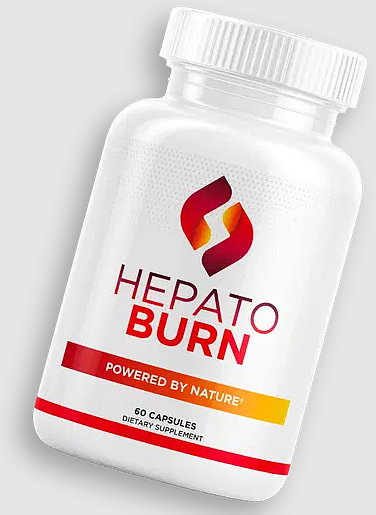
Discover the full ingredient breakdown, real user feedback, liver science insights, and what you need to know before trying HepatoBurn — with links to the official source and exclusive offers.
Visit the Official HepatoBurn Website
HepatoBurn is a revolutionary liver-optimization supplement engineered to support natural fat-burning, boost energy levels, and address compromised liver function—the newly discovered root cause of stubborn weight gain. Read on for a deep dive into the 2025 liver science and real user results.
Ready to explore how HepatoBurn can unlock your body’s natural fat-burning furnace?
Explore the Science Behind HepatoBurn
HepatoBurn is a groundbreaking nutritional supplement designed to address what researchers now identify as the true root cause of unexplained weight gain, low energy, and sluggish metabolism: compromised liver function.
In 2023, an esteemed team of scientific researchers made a stunning discovery—they found one common factor in all overweight women and men: impaired liver function. Conversely, skinny people shared one key trait: optimal liver function.
Unlike conventional fat burners that rely on stimulants or appetite suppressants, HepatoBurn takes a revolutionary approach by supporting your liver—the body’s natural fat-burning furnace. Your liver processes everything you eat and drink, determining whether food gets burned as energy or stored as unsightly body fat.
Studies show that with optimal liver function, your liver cells can be 14 times more efficient at burning fat and calories on autopilot—even while you sleep.
HepatoBurn is unlike anything you’ve ever tried or experienced. It is the only product in the world containing a proprietary Liver Purification and Liver Fat-Burning Complex, each a unique blend of Mediterranean plants and super nutrients designed to rapidly optimize liver function.
The formula is:
The surge in demand for HepatoBurn stems from its science-backed approach to addressing the overlooked role of liver health in weight management. It’s being framed as a solution for:
This shift toward “liver-optimized fat burning” has made HepatoBurn a trending topic in supplement circles, especially among those who have tried everything else without success. Over 234,000 women and men from ages 18 to 80 have already experienced the life-changing benefits of HepatoBurn.
HepatoBurn operates on a revolutionary principle: by optimizing your liver’s dual role as both a detoxification organ and a fat-burning furnace, you can naturally skyrocket energy, metabolism, and weight loss—without harsh stimulants or extreme dieting.
Rather than masking symptoms with caffeine or appetite suppressants, HepatoBurn addresses the root cause by supporting your liver’s ability to:
Designed to support your body’s natural ability to rapidly cleanse and detoxify, this complex helps eliminate the chemical burden that’s been slowing down your metabolism and fat-burning capacity.
Key actions:
Engineered to electrify your metabolism and torch fat from problem areas by optimizing liver function as your body’s fat-burning furnace.
Key actions:
Together, these complexes work synergistically to restore your liver to its optimal, youthful function—allowing your body to naturally dissolve fat, boost energy, and maintain healthy weight loss for years to come.
Interested in how these liver-optimizing compounds work together?
Explore the Science Behind HepatoBurn
HepatoBurn’s formula features two proprietary blends of science-backed natural plants and nutrients sourced from Mediterranean regions and other pristine locations worldwide. While the exact ratios are proprietary, the formula is built on ingredients known for supporting liver health and metabolic function.
Here’s what makes HepatoBurn’s dual-complex approach unique:
This complex focuses on supporting your body’s natural detoxification processes to eliminate the toxic burden that compromises liver function:
Mediterranean Plant Extracts
Super Nutrients for Detoxification
This complex is designed to activate your liver’s role as the body’s fat-burning furnace:
Metabolic Activators
Mediterranean Botanicals
Every ingredient in HepatoBurn is:
The only reported “side effect” from HepatoBurn? Having to toss your baggy clothes in the trash and spend hours in the dressing room trying out new, sexy tight-fitting clothes.
Want to verify the authentic formula from the official source?
Visit the Official HepatoBurn Website
HepatoBurn has changed the lives of over 234,000 women and men ages 18 to 80, and users are reporting remarkable transformations when they address the true root cause of their weight struggles—compromised liver function.
While individual results vary, here are the core benefits users are experiencing:
HepatoBurn users frequently report dissolving deep stubborn fat stores that no diet or exercise could remove, particularly around the:
“After years of dieting without results, HepatoBurn finally helped me lose the belly fat I thought was permanent. My liver was the missing piece!”
— Verified HepatoBurn user
By optimizing liver function, users experience a natural energy boost as their bodies become more efficient at converting food into fuel rather than fat:
Users report feeling their metabolism “turn back on” as their liver function improves:
Unlike crash diets that lead to rebound weight gain, HepatoBurn users report:
Beyond weight loss, users notice improvements in:
One of the most exciting benefits reported: HepatoBurn works 24/7 to optimize your liver function, meaning you’re burning fat and detoxifying even while sleeping.
Curious whether HepatoBurn could deliver these same liver-optimizing results for you?
See Real User Results of HepatoBurn
The 2025 weight loss market is saturated with countless fat burners, metabolism boosters, and diet pills. So where does HepatoBurn fit in this crowded space? Based on its unique mechanism of action and scientific foundation, here’s how it stacks up:
Most common competitors: High-caffeine pills with 200-400mg caffeine and thermogenic compounds
Key differences:
Winner for: Those seeking sustainable fat loss without stimulant side effects
Most common competitors: Products that simply reduce hunger or block fat absorption
Key differences:
Winner for: Those who want to fix their metabolism, not just eat less
Most common competitors: Milk thistle, NAC, or basic liver detox products
Key differences:
Winner for: Those seeking both liver optimization and weight loss in one solution
If you’re evaluating which weight loss solution fits your needs best, HepatoBurn may offer a more fundamental, science-based approach—especially if you:
Learn More About HepatoBurn’s Unique Approach
With over 234,000 satisfied customers ranging from ages 18 to 80, HepatoBurn has built an impressive track record of transforming lives by addressing the overlooked issue of compromised liver function.
While the company showcases testimonials on its website, here’s what real users are experiencing:
Many users report trying countless diets, exercise programs, and supplements before discovering HepatoBurn. The liver-focused approach finally provided the breakthrough they needed:
“I’m 52 and had tried every diet imaginable. Nothing worked until I addressed my liver health with HepatoBurn. I’ve lost 32 pounds in 4 months and feel 20 years younger!”
— Sarah M., verified user
Users consistently report significant reductions in belly fat and midsection bloating:
“The stubborn belly fat that wouldn’t budge with diet and cardio finally started melting away. I didn’t realize my liver was the problem all along!”
— Michael R., verified user
A recurring benefit mentioned is the dramatic increase in natural energy without stimulants:
“I wake up energized and maintain that energy all day. No more afternoon crashes or needing multiple coffees. My body is actually using food for fuel now!”
— Jennifer L., verified user
Beyond weight loss, users notice comprehensive health improvements:
“Not only did I lose 25 pounds, but my skin looks better, my digestion improved, and my doctor commented on my improved blood work. HepatoBurn has been life-changing.”
— David K., verified user
Ages 18-35: Young adults using HepatoBurn to prevent early metabolic decline and maintain optimal body composition
Ages 35-50: The sweet spot demographic reporting the most dramatic transformations as they reverse age-related liver function decline
Ages 50-80: Mature users experiencing renewed vitality and weight loss they thought was impossible at their age
If you’re looking to join the 234,000+ people who’ve transformed their bodies with HepatoBurn: Visit the Official HepatoBurn Website
HepatoBurn is marketed as a 100% natural, plant-based supplement manufactured in FDA-registered, GMP-certified facilities under strict quality standards. According to the manufacturer, the only reported “side effect” from HepatoBurn is needing to buy new, smaller clothes as you lose weight.
However, as with any supplement, individual responses may vary. Those who are pregnant, nursing, under 18, or have diagnosed liver or kidney disease should consult their healthcare provider before use.
HepatoBurn is backed by a 60-day, 100% money-back guarantee, demonstrating the company’s confidence in the product’s safety and effectiveness.
Take HepatoBurn capsules with a big glass of water daily for best results. Consistency is crucial—don’t skip days. For optimal results, especially if you’re over 35 or carry excess weight, experts recommend taking HepatoBurn for at least 3-6 months.
This gives it enough time to fully cleanse your system, optimize liver function, and lock in your desired weight for years to come.
The 6-bottle package is recommended for those seeking complete liver restoration and lasting transformation.
As HepatoBurn gains popularity, unauthorized sellers are attempting to profit by offering counterfeit products. To ensure you receive the genuine HepatoBurn with full quality guarantees, always purchase directly from the official website.
Here’s what you get when ordering through the official source:
Visit the Official HepatoBurn Website
DO NOT Purchase HepatoBurn From:
These sources likely sell counterfeit or expired products with no quality guarantees or money-back guarantee.
Overall, HepatoBurn reviews are positive. If you’ve struggled with stubborn weight that refuses to budge despite your best efforts with diet and exercise, HepatoBurn may finally provide the answer you’ve been seeking. By addressing the newly discovered root cause of weight gain—compromised liver function—HepatoBurn offers a fundamentally different approach to fat loss.
Science-Backed Foundation: The 2023 research revelation that liver function is the key differentiator between overweight and lean individuals provides HepatoBurn with a solid scientific foundation.
Dual-Action Formula: The combination of Liver Purification and Liver Fat-Burning Complexes addresses both detoxification and metabolic slowdown.
Natural & Safe: Unlike stimulant-heavy fat burners, HepatoBurn uses 100% plant-based ingredients with no harsh chemicals.
Risk-Free Trial: The 60-day, 100% money-back guarantee means you can try HepatoBurn with zero financial risk.
HepatoBurn is ideal for:
HepatoBurn represents a paradigm shift in weight loss supplementation by addressing the overlooked role of liver health in metabolism and fat burning. With its science-backed mechanism of action, natural formulation, impressive user testimonial track record, and risk-free 60-day money-back guarantee, HepatoBurn offers a compelling option for anyone seeking sustainable, healthy weight loss.
Final Recommendation: Given the solid scientific foundation, extensive positive user feedback, natural formulation, and complete money-back guarantee, HepatoBurn is worth trying if you’re struggling with weight that won’t budge through conventional methods.
Ready to unlock your liver’s fat-burning potential? Visit the Official HepatoBurn Website
Customer Support: Available through official website
Manufacturing: FDA-registered, GMP-certified facilities in the USA
Shipping: Available internationally; 7-10 business days (US)
Guarantee: 60-day, 100% money-back guarantee
This article contains affiliate links. If you purchase through these links, we may earn a small commission at no extra cost to you. This supports our ability to provide comprehensive, honest reviews and information.
Results may vary by individual. Testimonials represent exceptional results and are not guaranteed. Individual results will depend on many factors including starting weight, age, lifestyle, diet, exercise, consistency, and individual body chemistry. The FDA has not evaluated statements about dietary supplements.
Pricing, package options, and promotional offers may change without notice. Please refer to the official HepatoBurn website for the most current pricing, availability, and special offers.
This article is for informational purposes only and does not constitute medical advice, diagnosis, or treatment. Always consult your doctor before beginning any new supplement, especially if you have pre-existing health conditions, are taking medications, are pregnant or nursing, or have concerns about how a supplement might affect your health.
HepatoBurn is a dietary supplement and is not intended to diagnose, treat, cure, or prevent any disease. The FDA has not evaluated these statements.
Not for use by individuals under 18, pregnant or nursing women, or those with diagnosed liver or kidney disorders without medical supervision. Discontinue use and consult a healthcare provider if adverse reactions occur.
Ready to transform your body by unlocking your liver’s fat-burning power?
Visit the Official HepatoBurn Website Now
Last Updated: December 2025
Disclaimer: This is an independent review. We are not affiliated with the manufacturer of HepatoBurn. We receive affiliate compensation for purchases made through links in this article, which supports our research and content creation at no extra cost to you.




:max_bytes(150000):strip_icc()/Health-GettyImages-Repub-TooMuchMagnesium-54b8f72f6b57478989f6d842b57fccf0.jpg "What Happens If You Take Too Much Magnesium")