The main category of All News Articles.
You can use the search box below to find what you need.
[wd_asp id=1]
The main category of All News Articles.
You can use the search box below to find what you need.
[wd_asp id=1]
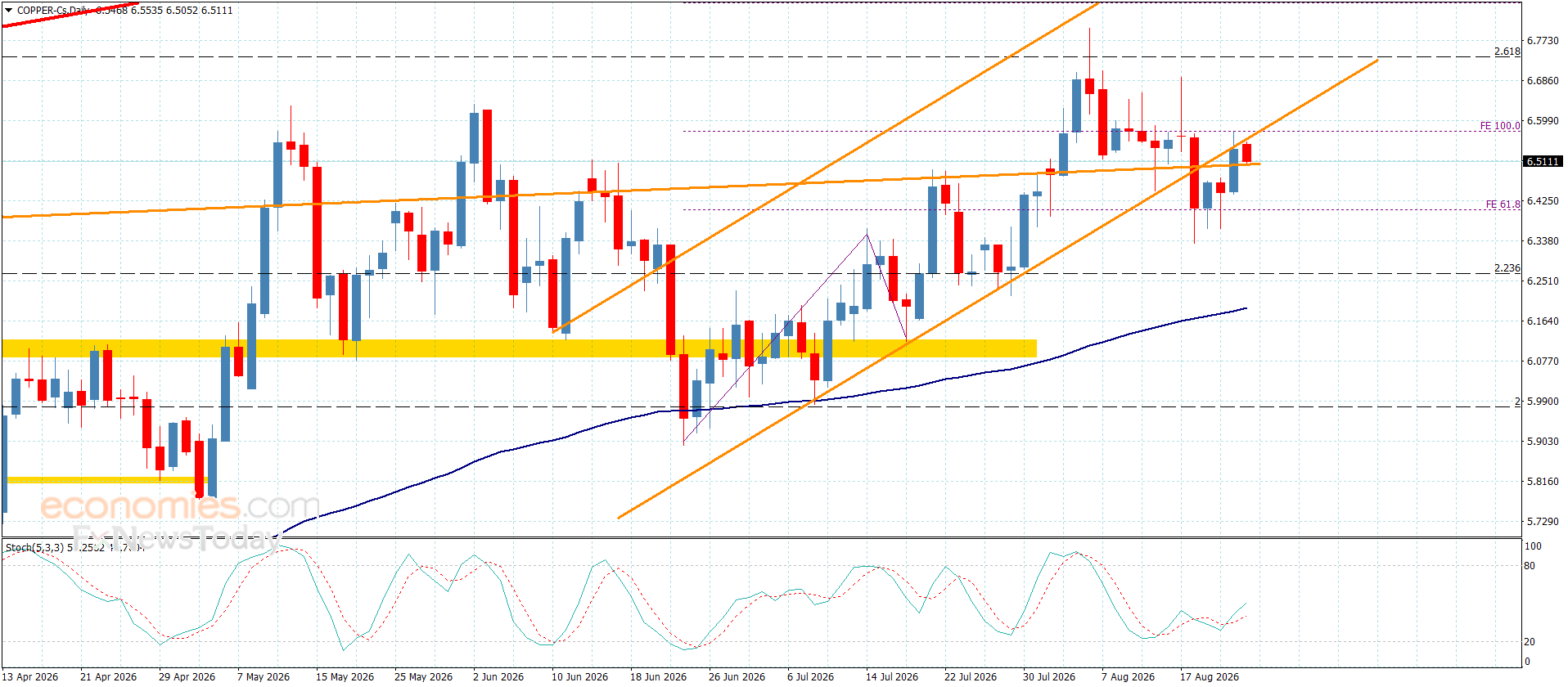
Copper price renewed the previously suggested bullish attempts, reaching the first target at $6.5800, which continues to act as an intraday barrier against the bullish scenario. This has forced the price to move sideways, fluctuating around the $6.5100 level once again.
We continue to emphasize that holding above the key support at $6.2700, along with the continued attempt by the main indicators to provide positive momentum, supports our expectations for a breakout above the current barrier to open the way for further gains, potentially starting at $6.6300 and $6.6700.
The expected trading range for today is between $6.4800 and $6.6300
Trend forecast: Bullish
MCX Natural Gas Mini (26 Aug) at Rs 266.40/mmBtu (+2.03%) on 21 Aug 2026. High: Rs 266.80. Low: Rs 262.50. Best single-day gain this week. Support: Rs 262. Resistance: Rs 266.80.
Quick Answer
The natural gas price prediction for Monday is mildly bullish. MCX Natural Gas (Mini 26 Aug) surged +2.03% to Rs 266.40/mmBtu on Friday 21 August — the biggest single-day MCX natural gas gain this week. Ankit Jaiswal’s natural gas price prediction for Monday places support at Rs 262 to 263 and resistance at Rs 266.80.
The natural gas price prediction for Monday follows Friday’s strong session where MCX Natural Gas Mini opened at Rs 262.50, reached Rs 266.80, and settled at Rs 266.40. Ankit Jaiswal, Research Analyst at Univest, notes that the natural gas price prediction for Monday benefits from the US EIA weekly natural gas storage report, which showed a smaller-than-expected inventory build — this is a bullish fundamental catalyst supporting the natural gas price prediction for Monday.
Kunal Singla, Research Analyst at Univest, observes that the natural gas price prediction for Monday is supported by the approaching expiry of the MCX Natural Gas 26 August contract. As participants roll forward to September, there is typically reduced liquidity in the near-month contract heading into Monday, which can amplify price moves in the natural gas price prediction for Monday.
Click Here – Get Free Investment Predictions
Ankit Jaiswal’s natural gas price prediction for Monday identifies Rs 262 to 263 as the immediate support, near Friday’s intraday low of Rs 262.50. A hold above Rs 262 in the natural gas price prediction for Monday confirms the bullish momentum. Resistance stands at Rs 266.80 (Friday’s high) with stronger resistance at Rs 271 to 273 in the natural gas price prediction for Monday.
Trend for Monday 24 August 2026: Mildly Bullish
Support: Rs 262 to 263 | Rs 258 to 260
Resistance: Rs 266.80 | Rs 271 to 273
| Stock | 21 Aug Close (Rs) | Change | Key Level for Monday |
|---|---|---|---|
| GAIL India | 203 | -0.20% | Support: 200 | Resistance: 208 |
| ONGC | 238 | +0.88% | Support: 235 | Resistance: 241 |
| Indian Oil Corporation | 158 | +0.40% | Support: 156 | Resistance: 161 |
Explore Natural Gas-Linked Stocks on Univest Screener
Sentiment for the natural gas price prediction for Monday is mildly bullish after Friday’s 2.03% surge — the strongest single-day gain for MCX Natural Gas this week. Ankit Jaiswal notes that the smaller-than-expected US EIA storage build is the most important fundamental input for the natural gas price prediction for Monday, as it signals tighter-than-anticipated US supply.
Kunal Singla observes that the natural gas price prediction for Monday is also affected by the approaching 26 August contract expiry. Reduced near-month liquidity may amplify Monday’s price moves in the natural gas price prediction for Monday. Participants should ensure they roll forward to September before Monday’s MCX open if holding near-month positions.
Download the Univest iOS App or Univest Android App to track live Natural Gas prices and get real-time predictions.
the 24 August natural gas price outlook, 24 August 2026, is mildly bullish. MCX Natural Gas surged +2.03% to Rs 266.40/mmBtu on 21 August. Ankit Jaiswal places support at Rs 262 and resistance at Rs 266.80.
Kunal Singla notes the US EIA bullish storage data and approaching 26 Aug expiry are key factors in the MCX natural gas price forecast for Monday. Download the Univest app for live MCX natural gas tracking.
Disclaimer: Investments in securities are subject to market risk. This content is for educational purposes only and does not constitute investment advice. Univest Research Analyst Registration No. INH000013776.
Ans. Mildly bullish. MCX Natural Gas surged +2.03% to Rs 266.40 on 21 Aug. Ankit Jaiswal places support at Rs 262 and resistance at Rs 266.80 for the natural gas price outlook for 24 August.
Ans. A smaller-than-expected US EIA natural gas storage build and broader commodity risk-on sentiment drove Friday’s 2.03% MCX Natural Gas gain, supporting the Monday’s MCX natural gas price forecast.
Ans. Yes, MCX Natural Gas 26 Aug contract nears expiry. Thin liquidity may amplify Monday moves. Ankit Jaiswal recommends checking contract roll to September before Monday in the Wednesday’s natural gas price outlook.
Ans. Support: Rs 262 to 263 and Rs 258 to 260. Resistance: Rs 266.80 and Rs 271 to 273 in the 24 August natural gas price outlook.
Ans. Buy near Rs 262 with stop below Rs 258 targeting Rs 266.80 in the MCX natural gas price forecast for Monday. A break above Rs 266.80 targets Rs 271 to 273.
Note: This blog is for information purpose only. Investments and trading are subject to market risks, read all scheme related documents carefully.
The US Dollar to Japanese Yen (USD/JPY) exchange rate ended Friday at 158.98, almost five Yen below July’s peak near 164 but still uncomfortably high for Tokyo after the latest policy response.
The joint US-Japan intervention drove USD/JPY as low as 155.27 at the end of July, yet much of that Yen recovery has since disappeared.
USD/JPY rose 0.89% during August and spent most of last week back around 159, despite a substantial increase in expectations that the Bank of Japan will tighten policy next month.
Natixis and MUFG economists now agree that September should deliver another rate increase, although the stubborn behaviour of the exchange rate makes the harder question obvious: how much BoJ tightening will actually be needed to produce a lasting Yen recovery?

Analysts at Natixis have brought forward its previous October call and now expect a 25-basis-point hike to 1.25% on 18 September.
“The Bank of Japan (BoJ) is set to raise the policy rate by 25-bps on September 18th, as inflation pressure strengthens,” economists Alicia García Herrero and Kohei Iwahara said.
The inflation case has strengthened quickly.
Nationwide headline inflation rose to 1.9% year-on-year in July from 1.6%, while inflation excluding food and energy increased to 1.4% from 1.2%.
Natixis also points to a striking 29.1% annual increase in import prices, with expensive energy and the weak Yen increasingly feeding into domestic costs.
Manufactured-goods inflation accelerated to 3.2%, while general-services inflation edged up to 1.4%.
“These results suggest that the lag in the transmission of import inflation on CPI could be shorter than six to twelve months,” Natixis said, arguing that the developments “justify the BoJ’s concern on upside risk of inflation.”
There is a political element to the forecast as well.
Natixis believes the Japanese government has become more accepting of faster monetary tightening following Washington’s decision to participate in the Yen intervention.
With USD/JPY already back around 159, policymakers have little reason to assume currency intervention on its own has solved the problem.
Natixis argues that the government could conclude “that a bolder BoJ is needed to prop up the Yen back to reasonable levels and, thus, limit the pass through to inflation.”
The bank’s new path extends beyond September, with additional hikes expected in January and July 2027 taking the policy rate to 1.75%.
“All in all, the BoJ is anticipated to hike by 25-bps to 1.25% in September, earlier than our previous call of October,” Natixis said.
Governor Kazuo Ueda had already warned about upside inflation risks at the July meeting, and Natixis believes events have caught up with that warning.
“That risk has materialized with today’s CPI inflation so the hike should happen, all the more so given the renewed Yen weakness,” the bank concluded.

USD/JPY remains well below the late-July peak near 164, although the recovery from 155.27 has taken the pair back towards 159 and left the Yen struggling to extend its intervention-driven gains.
MUFG’s Derek Halpenny also thinks the latest Japanese inflation figures support action in September.
“The data backs up current market pricing, and our view, that the BoJ will hike rates by 25bps at the next policy meeting in September,” MUFG said.
Market pricing at the end of last week implied roughly an 80% probability of such a move, which means a September hike is rapidly shifting from hawkish surprise towards base case.
That perhaps explains why the Yen has reacted so poorly to the repricing.
“Stronger inflation in Japan has had a limited FX impact with USD/JPY stable,” MUFG noted.
Higher Japanese government bond yields have not produced much more encouragement either, suggesting that investors want evidence of a genuine tightening cycle rather than another isolated 25-basis-point move.
We’ve previously looked at whether intervention has changed the underlying USD/JPY trend; the recovery towards 159 keeps that argument very much open.
MUFG sees Deputy Governor Ryozo Himino’s next appearance as an important opportunity for the BoJ to make its September intentions clearer.
“There has been limited opportunities for guidance from the BoJ of late but next Friday Deputy Governor Himino is scheduled to speak and that could be an opportunity for cementing expectations of further action in September,” the bank said.
The latest Bank of Japan release schedule now lists Himino’s speech to local leaders in Saitama for Thursday 27 August at 10:30 JST.
Japan’s calendar also includes the BoJ’s core CPI indicators on Tuesday and the July Services Producer Price Index on Wednesday, giving markets more inflation evidence to digest before Himino speaks.
The Dollar side will be busy at almost exactly the same time.
The US Bureau of Economic Analysis release schedule has July Personal Income and Outlays, including PCE inflation, and the second estimate of Q2 GDP both due on Wednesday 26 August.
Fed Chair Kevin Warsh then makes his first Jackson Hole appearance as chair as the symposium runs from 27-29 August, with investors looking for a clearer steer on whether the Fed still sees another rate increase as necessary.
A softer PCE reading combined with firm guidance from Himino would give Yen bulls the cleaner setup: less support from US yields at the same time as the BoJ establishes a more credible tightening path.
Stronger US inflation or a hawkish Warsh message would make the arithmetic much less favourable, particularly if Himino merely confirms what markets already price rather than signalling that further moves are likely.
Natixis and MUFG increasingly agree on September, so the next phase of the USD/JPY trade is no longer primarily about whether the BoJ hikes.
It is about whether Tokyo can persuade the market that 1.25% is the beginning of a more meaningful tightening cycle rather than another small step while the rate gap with the United States remains wide.
Near 159, the Yen is still waiting to be convinced.
Exchange Rates UK Research’s latest August 2026 survey of major investment banks points to a gradually stronger Euro-to-Dollar exchange rate through 2027, although the near-term consensus remains cautious.
With EUR/USD currently around 1.1677, the median forecast falls to approximately 1.15 in Q3 2026 before recovering to around 1.165 in Q4.
The median then rises to 1.18 in Q1 2027 and remains at 1.18 in Q2, around 1.1% above the current exchange rate.
The headline finding is therefore not for an immediate euro breakout. Instead, the latest survey suggests near-term consolidation followed by modest euro appreciation as 2027 develops.
Individual forecasts remain much more divided, with the Q2 2027 range stretching from 1.10 to 1.21.

The latest Exchange Rates UK Research poll includes 25 bank forecasts for Q3 and 26 for Q4, providing a broad measure of institutional expectations.
The immediate outlook is relatively restrained.
The Q3 median around 1.15 sits below current spot, with the central 50% of forecasts concentrated roughly between 1.14 and 1.16.
By Q4, however, the median recovers towards the current market level.
The balance shifts more clearly in favour of the euro during 2027.
The median reaches 1.18 in both Q1 and Q2, while the central forecast range moves higher.
By Q4 2027, the median reaches approximately 1.20, although the number of banks providing forecasts declines at longer horizons.
There are significant differences beneath those averages.
Scotiabank forecasts EUR/USD at 1.20 in Q4 2026 and 1.21 by Q2 2027. ABN AMRO, CIBC, ING, MUFG, National Bank of Canada, TD Economics and UBS also have forecasts reaching 1.20 or above.
Nomura is particularly bullish further out, forecasting 1.22 in Q1 2027 and 1.25 by Q4.
The bearish camp is equally noteworthy.
HSBC forecasts EUR/USD falling to 1.10 by Q2 2027, while JP Morgan also sees 1.10. Goldman Sachs and Danske Bank project 1.12, while Citi maintains forecasts around 1.13–1.14.

The breadth of these projections is important.
The median points modestly higher, but there is no overwhelming institutional agreement that EUR/USD must rise.
The survey comes after a sharp change in EUR/USD momentum.
The pair fell to a 2026 low around 1.1325 during June before recovering through July and August.
EUR/USD gained 1.02% in July and is up another 1.15% so far in August, taking the exchange rate back towards 1.17.
Despite that recovery, EUR/USD remains around 0.5% lower for 2026 after beginning the year near 1.1733.

Recent euro gains have coincided with renewed pressure on the US dollar.
Reuters reported that the dollar fell to a three-month low against the euro during the past week as investors became increasingly concerned about US Treasury market conditions and the government’s expanded programme of long-dated debt buybacks.
The US currency was also hurt earlier in the week as weaker retail sales and labour-market data encouraged traders to scale back expectations for another Federal Reserve rate increase.
There is a second development potentially supporting the bullish side of the EUR/USD survey.
Markets have become increasingly hawkish on the European Central Bank as higher energy prices threaten to keep Eurozone inflation elevated.
Traders now see the ECB deposit rate potentially approaching 3% by late 2027, a substantial change from expectations earlier in the summer.
The ECB’s own June projections put average Eurozone inflation at 3.0% in 2026, largely because of higher energy prices, before easing to 2.3% in 2027 and 2.0% in 2028.
The combination of reduced expectations for Federal Reserve tightening and greater concern about further ECB rate increases has therefore shifted relative interest-rate expectations in a direction that can support EUR/USD.
The latest Exchange Rates UK Research survey gives a more nuanced signal than simply “banks are bullish on the euro”.
In the near term, the median actually expects EUR/USD to trade below today’s 1.1677 level.
It is during 2027 that the central forecast becomes more constructive, with 1.18 emerging as the median Q2 target and around 1.20 by late 2027.
That would represent moderate euro appreciation rather than a dramatic Dollar decline.
The more revealing figure may be the forecast dispersion.
At Q2 2027, the surveyed banks span approximately 1.10 to 1.21.
The central 50% is much tighter at roughly 1.15–1.20, but even that range encompasses substantially different outcomes for businesses and investors exposed to the pair.
The latest market recovery towards 1.17 has already erased much of the weakness seen during June.
Whether EUR/USD can extend that move towards 1.18 and eventually 1.20 will depend heavily on whether current expectations for a less hawkish Federal Reserve and a firmer ECB survive the next round of inflation, employment and energy-market developments.
For now, the median bank forecast favours the euro over the medium term, but the consensus is for measured appreciation rather than a one-way Dollar decline.
The US Dollar to Japanese Yen (USD/JPY) exchange rate ended e week at 158.98, within touching distance of the 160 level despite the exceptional intervention conducted jointly by Japan and the United States.
The operation briefly drove USD/JPY from above 164 to around 155, but much of that Yen recovery has since been reversed.
Intervention succeeded in breaking the earlier momentum, although it did not remove the wide US-Japan interest-rate gap or the inflationary pressure created by expensive energy and a weak currency.
Attention has consequently shifted towards the Bank of Japan’s September 17–18 policy meeting.
Natixis economists Alicia García Herrero and Kohei Iwahara expect the BoJ to raise its policy rate by 25 basis points to 1.25% on September 18.
They said the central bank is “set to raise the policy rate by 25-bps” as inflation pressure strengthens.
Japanese headline inflation accelerated from 1.6% to 1.9% in July, while the measure excluding fresh food and energy also rose to 1.9%.
The more immediate concern for policymakers is the scale of imported inflation.
Yen-denominated import prices climbed 29.1% over the year, while producer-price inflation held at 7.2%, increasing the risk that companies will pass further cost increases to consumers.
Natixis expects additional quarter-point rate rises in January and July 2027, which would take the policy rate to 1.75%.
MUFG’s Derek Halpenny also expects a 25-basis-point move next month.
He said the inflation figures “back up current market pricing, and our view, that the BoJ will hike rates by 25bps” in September.
Markets have already priced a high probability of an increase, which helps explain why the Yen gained relatively little after the latest inflation release.
A widely anticipated rate move will only provide lasting support if Governor Kazuo Ueda signals that further tightening can follow within a reasonably short period.
Standard Chartered has also brought its next expected increase forward from October to September and raised its terminal-rate forecast from 1.50% to 1.75%.
The bank nevertheless doubts that policymakers can exceed already hawkish expectations, stating: “We doubt the BoJ can ‘out-hawk’ the market.”
Standard Chartered forecasts USD/JPY at 158 at the end of the third quarter and 160 at year-end, suggesting that gradual rate increases will not automatically produce a sustained Yen recovery.
OCBC strategists Sim Moh Siong and Christopher Wong also see a stronger policy commitment as essential.
They warned: “A more meaningful and sustained JPY recovery will likely require a stronger signal from the BoJ that policy normalisation can proceed at a faster pace.”
Our base case is for USD/JPY to trade between 156 and 160 ahead of the September meeting.
A rate increase accompanied by guidance towards another move in early 2027 could push the pair below 156 and expose the intervention low near 155.20.
A cautious hike presented as an isolated response to imported inflation would leave 160 vulnerable, with a break higher bringing 162 and the pre-intervention region around 164 back into view.
Failure to raise rates would create an even greater risk of renewed Yen selling and another intervention response.
BoJ Deputy Governor Ryozo Himino’s August 27 speech and Tokyo inflation data on August 28 will provide the next domestic policy signals.
US PCE inflation and Federal Reserve Chair Kevin Warsh’s Jackson Hole address will be equally important, since a durable Yen recovery still requires some narrowing of the US-Japan rate gap.
EUR/JPY remains stronger for the second successive day, trading around 186.00 during the Asian hours on Friday. The technical analysis of a daily chart indicates that the spot is moving higher within the ascending channel pattern, signaling a persistent bullish bias.
The EUR/JPY cross is retaining a bullish near-term bias as it holds above both the nine-period and 50-period Exponential Moving Averages (EMAs). The 14-day Relative Strength Index (RSI) around 60.85 suggests constructive upside momentum rather than overbought conditions.
TMGM Analysis: Financial Market News, Economic Calendar & Market Insights
The primary resistance lies at the upper boundary of the ascending channel around 187.00. A break above the channel would strengthen the bullish bias and support the currency cross to explore the region around its all-time high of 187.95 set on April 17.
On the downside, the EUR/JPY cross may find the primary support around the nine-day EMA of 184.79, followed by the 50-day EMA at 184.64 and the lower boundary of the ascending channel around 184.70. A break below this confluence support zone would revive the bearish bias, potentially pressing the currency cross down toward its nine-month low of 179.37, recorded on August 3.
Commerzbank’s FX Research team highlights the impact of the latest US Treasury announcement on the rates complex, noting that, effective 9 September, “the US Treasury will double the size of liquidity support buyback operations to at least USD4bn.” They add that the decision immediately rippled through the long end of the curve, as “the 30Y yield fell 10bp following the announcement, and the curve flattened,” reinforcing the bull-flattening move that has underpinned recent Dollar weakness and Yen strength.

(The technical analysis of this story was written with the help of an AI tool. Know more.)
The table below shows the percentage change of Euro (EUR) against listed major currencies today. Euro was the strongest against the US Dollar.
| USD | EUR | GBP | JPY | CAD | AUD | NZD | CHF | |
|---|---|---|---|---|---|---|---|---|
| USD | -0.13% | -0.09% | -0.05% | -0.18% | -0.40% | -0.43% | -0.10% | |
| EUR | 0.13% | 0.03% | 0.07% | -0.08% | -0.28% | -0.29% | 0.03% | |
| GBP | 0.09% | -0.03% | 0.04% | -0.11% | -0.31% | -0.33% | 0.00% | |
| JPY | 0.05% | -0.07% | -0.04% | -0.14% | -0.36% | -0.40% | -0.05% | |
| CAD | 0.18% | 0.08% | 0.11% | 0.14% | -0.22% | -0.24% | 0.08% | |
| AUD | 0.40% | 0.28% | 0.31% | 0.36% | 0.22% | -0.04% | 0.30% | |
| NZD | 0.43% | 0.29% | 0.33% | 0.40% | 0.24% | 0.04% | 0.35% | |
| CHF | 0.10% | -0.03% | -0.01% | 0.05% | -0.08% | -0.30% | -0.35% |
The heat map shows percentage changes of major currencies against each other. The base currency is picked from the left column, while the quote currency is picked from the top row. For example, if you pick the Euro from the left column and move along the horizontal line to the US Dollar, the percentage change displayed in the box will represent EUR (base)/USD (quote).
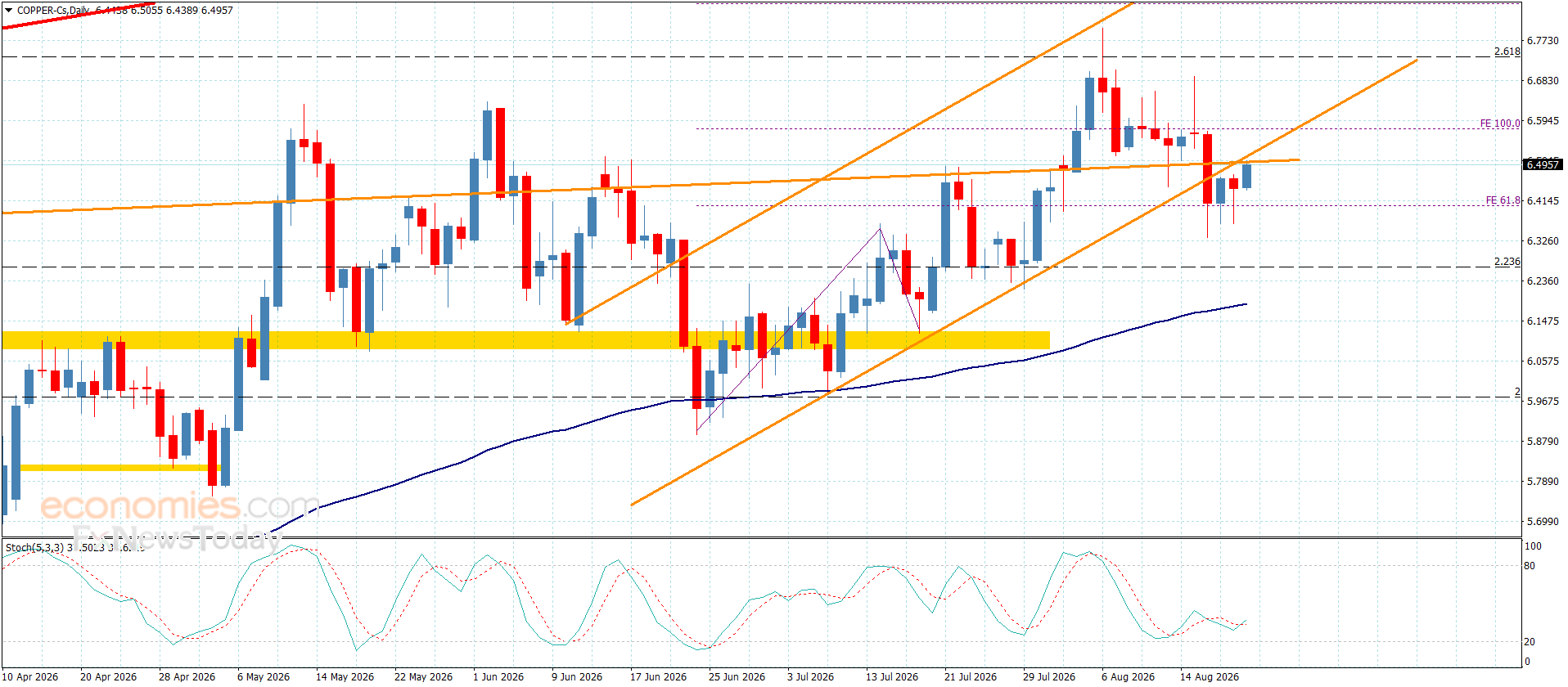
Copper price ended the bearish corrective trading by providing a new positive close above the main support at $6.2700, benefiting from the main indicators by forming some bullish waves, to settle near $6.5000, confirming the stability of the previously suggested bullish scenario.
The price might face some difficulties in the bullish attempts due to stochastic fluctuation below level 50, we expect reaching the barrier near $6.5800, and breaching it will ease the mission of recording extra gains that might begin at $6.6700.
The expected trading range for today is between $6.4200 and $6.5800
Trend forecast: Bullish
The US Dollar (USD) collapsed this week, helping EUR/USD reach a fresh three-month high just above the 1.1700 mark, heading into the weekly close a handful of pips below that level but still firmly up.
The USD sell-off was triggered by the United States (US) Department of the Treasury, which announced on Wednesday that it will increase the government debt repurchase size by at least double. According to the press release, the current maximum size of $2 billion per operation will be at least $4 billion per operation, and the change will become effective September 9.
The announcement, while aimed at taming long-term bond yields, was also a signal that the Treasury is sensitive to yield volatility. The Treasury made its move after the 30-year bond yield climbed to 5.327% on Tuesday, its highest level since June 2007, immediately falling afterward by roughly 9 basis points.
There are, however, a couple of things that are worth understanding. First, buybacks are just a rearrangement of the maturity schedule, as the Treasury will have to issue fresh bonds to replace those that it plans to buy back. Government debt and fiscal deficits will remain the same.
Second, the decision has an impact on the Federal Reserve’s (Fed) future monetary policy decisions. Given that the US Treasury will have to issue more bills to finance the planned removal, this would likely ease financial conditions, which would increase the odds of a tighter monetary policy.
The future looks cloudy for the USD, with precious metals likely to outpace the Greenback in a risk-averse environment. Neither Treasury buybacks nor higher rates will address the root of the problem, which is the fiscal deficit.
In any case, that means further USD weakness in a risk-averse environment. The Middle East war is in a stalemate, and neither side is willing to budge. Oil prices have already picked up a bullish pace, and it won’t take much longer until energy prices become embedded inflation.
Meanwhile, the Middle East war adds pressure on financial markets. Tensions between the US and Iran remain in place, with neither willing to give in to the other party´s demands. Fire exchange around the Strait of Hormuz remains paused, as well as talks aimed at ending the conflict.
Market participants are clearly seeing a long-standing conflict ahead, and generally speaking, they are getting used to the idea. However, Oil prices have been picking up lately, reviving inflation-related concerns and also hinting at central banks opting for tighter monetary policies.
US President Donald Trump, however, is unwilling to give up. Trump posted on Truth Social that the next move is choking Tehran’s economy by levying major penalties against any country that provides “any type of lifeline” to Iran, calling it an “Economic D-Day.”
His comments were reinforced by US Treasury Secretary Scott Bessent, who noted on Thursday that President Trump’s plan to crush Iran’s economy will likely negate the need for major US military operations against the Islamic Republic.
Bessent also had some comments on the Treasury buyback. He declared that the Treasury could increase bond buybacks beyond $4 billion, partly to signal that current yields do not reflect underlying economic fundamentals.
European Central Bank (ECB) President Christine Lagarde hit the wires on Wednesday and expressed concerns about Europe facing an erosion of the conditions that have historically driven the continent’s growth at the World Economic Forum’s International Business Council in Geneva, Switzerland. Growth rested on three pillars, according to Lagarde: expanding global trade, manufacturing supported by access to cheap energy, and “a stable, rules-based global order, underpinned by a US security umbrella.”
“Today, that global order is under pressure. Geopolitical tensions are bringing critical dependencies and choke points into sharper focus, while Europe faces growing security threats on its doorstep,” Lagarde added. Her speech aimed to warn about Europe’s ability to compete in the age of AI, but her comments about the US did not pass unnoticed. War, physical or financial, poses a major risk and no one can ignore it.
The macroeconomic calendar had little to offer in the last few days. The Federal Open Market Committee (FOMC) released the Minutes of the July meeting, which brought nothing of substance. Officials remain concerned about inflation, and support rate hikes would be required if price pressures persist. A note of color was added by Chair Kevin Warsh, as he proposed reducing annual meetings from the current eight to six, to allow collecting more data in between meetings. This year’s schedule, however, remains the same.
Other than that, the focus was on the S&P Global and local banks’ Purchasing Managers’ Indexes (PMIs) released on Friday. The August flash estimates showed that Eurozone business activity expanded more than anticipated, as the Manufacturing PMI improved to 52.8 from 51.9 in July, against expectations of 51.8. Services output remained unchanged at 51.7, beating the expected slowdown to 51.5. Finally, the Composite PMI printed at 52.1, better than the expected 51.7 and the previous 52.
US PMIs also showed encouraging results, despite the Manufacturing PMI ticking lower to 53.2 from 53.9 in July. The Services index jumped to 56.8 from 54.6, pushing the Composite PMI to 56 from 54.5 in July, surpassing the expected 54. The figures help the USD recover some modest ground, though it is still sharply down for the week.
In the upcoming days, the macroeconomic calendar will include the German Q2 Gross Domestic Product (GDP) and the US July Personal Consumption Expenditures (PCE) Price Index. The US will also publish the second estimate of its Q2 GDP.
Additionally, investors will keep an eye on this year’s Jackson Hole Economic Policy Symposium, hosted by the Fed Bank of Kansas. This year’s theme is “Financial Innovation: Implications for Payments and Policy.” Policymakers from around the globe will discuss the main topic and may provide hints on the future of monetary policy.
Finally, the US Bureau of Labor Statistics (BLS) will release the annual Nonfarm Payrolls (NFP) Benchmark Revisions on Friday, a revision of labor statistics for the twelve months to March.
From a technical perspective, EUR/USD is bullish. The pair extends its advance well above the short- and medium-term moving averages, with the shorter one clearly bullish. The 20-day Simple Moving Average (SMA) at 1.1542, the 100-day SMA at 1.1573 and the 200-day SMA at 1.1631 all sit below spot, reinforcing a supportive backdrop as price pushes further into higher ground. The outlook stays constructive, with the 14-day Relative Strength Index (RSI) consolidating at 71 and the 14-period Momentum indicator also holding above its midline, hinting that buyers still dominate in the near term even as conditions look stretched.

On the weekly chart, EUR/USD holds a constructive bullish bias and trades above bullish moving averages. The 20-week SMA stands at 1.1576, while the 100-week SMA is at 1.1326 and the 200-week SMA is at 1.1059, reinforcing a broader underlying support structure. Weekly momentum is building up, as technical indicators head firmly north after crossing their midlines into positive ground.
On the downside, initial support emerges at the 200-day SMA around 1.1631, followed by the 100-day SMA and the 20-week SMA, which converge in the 1.1570 price zone, forming a strong dynamic support area. Further slides could see EUR/USD dropping towards 1.1470 before relevant buying interest reappears. Recent highs around 1.1710 establish the first resistance area ahead of the 1.1800 mark. Additional gains should lead to a test of the April monthly peak at 1.1850.
(The technical analysis of this story was written with the help of an AI tool. Know more.)
In the world of financial jargon the two widely used terms “risk-on” and “risk off” refer to the level of risk that investors are willing to stomach during the period referenced. In a “risk-on” market, investors are optimistic about the future and more willing to buy risky assets. In a “risk-off” market investors start to ‘play it safe’ because they are worried about the future, and therefore buy less risky assets that are more certain of bringing a return, even if it is relatively modest.
Typically, during periods of “risk-on”, stock markets will rise, most commodities – except Gold – will also gain in value, since they benefit from a positive growth outlook. The currencies of nations that are heavy commodity exporters strengthen because of increased demand, and Cryptocurrencies rise. In a “risk-off” market, Bonds go up – especially major government Bonds – Gold shines, and safe-haven currencies such as the Japanese Yen, Swiss Franc and US Dollar all benefit.
The Australian Dollar (AUD), the Canadian Dollar (CAD), the New Zealand Dollar (NZD) and minor FX like the Ruble (RUB) and the South African Rand (ZAR), all tend to rise in markets that are “risk-on”. This is because the economies of these currencies are heavily reliant on commodity exports for growth, and commodities tend to rise in price during risk-on periods. This is because investors foresee greater demand for raw materials in the future due to heightened economic activity.
The major currencies that tend to rise during periods of “risk-off” are the US Dollar (USD), the Japanese Yen (JPY) and the Swiss Franc (CHF). The US Dollar, because it is the world’s reserve currency, and because in times of crisis investors buy US government debt, which is seen as safe because the largest economy in the world is unlikely to default. The Yen, from increased demand for Japanese government bonds, because a high proportion are held by domestic investors who are unlikely to dump them – even in a crisis. The Swiss Franc, because strict Swiss banking laws offer investors enhanced capital protection.
The Gold price (XAU/USD) entered the weekend near $4,604 an ounce after climbing more than 5% over the week and reaching its highest level since mid-May.
Friday’s advance carried spot gold as high as $4,631.99, while US futures settled at $4,680.60.
The move above the 200-day moving average around $4,513 marked an important change in the technical picture and strengthened the case for a further recovery towards $4,700.
Gold benefited from a sharp Dollar decline after US Treasury plans to expand purchases of longer-dated government debt unsettled investors and pulled capital towards alternative stores of value.
The policy announcement also helped ease long-term yields, reducing the opportunity cost of holding a non-interest-bearing asset.
Goldman Sachs reported renewed speculative interest in COMEX gold and rate-sensitive exchange-traded funds, while unusually strong demand for call options amplified the advance.

Gold broke decisively above $4,500 as Dollar selling and renewed demand for macroeconomic hedges accelerated.
The immediate gold price forecast has turned bullish following Friday’s close above both the 200-day average and the downward trend line from the January record.
Initial resistance is expected between $4,654 and $4,689, where measured technical projections converge with retracement levels from the earlier decline.
TD Securities global head of commodity strategy Bart Melek said: “Next step is $4,700 if this momentum continues.”
A sustained break above $4,700 would strengthen the recovery and expose the $4,770–$4,780 region.
Technical analyst Bruce Powers identified the April swing high around $4,891 as the larger upside objective if buyers retain control.
That would leave gold within reach of the psychologically important $5,000 level, although momentum indicators suggest the market could consolidate or correct before mounting such an advance.
The first important support zone is now located between $4,500 and $4,516.
Holding this area would indicate that former resistance has become support and keep the bullish breakout intact.
A daily close below $4,500 would weaken the signal and risk a retreat towards $4,450, followed by the August 14 low near $4,310.
Losses below $4,300 would represent a more serious deterioration, potentially returning attention to the $4,000 region that supported gold during the June correction.
World Gold Council research also revealed improving demand conditions in India ahead of the festive season, although the figures should be viewed as evidence of support during price declines rather than justification for an uninterrupted rally.
The Council’s reference price of $4,391 was recorded on August 14, before gold subsequently broke above $4,600.
Research Head for India Kavita Chacko said: “Demand conditions are improving, raising expectations of a stronger festive season.”
Jewellery retailers and manufacturers replenished inventories as consumers returned after June’s sharp correction and July’s period of greater price stability.
Local discounts narrowed from around $100 an ounce in May and early June to approximately $45 by mid-August, pointing to a better balance between available supply and immediate demand.
Estimated Indian gold imports recovered to 40–45 tonnes in July from 20 tonnes during June, while their value more than doubled from $1.97bn to $4.16bn.
Investment demand provided a second source of support.
Indian gold ETFs attracted net inflows of $163mn during July, followed by an estimated $124mn during the first two weeks of August.
There are limits to how much support the physical market can provide at current prices.
Friday’s surge above $4,600 reportedly deterred some Indian retail buyers, while elevated prices could encourage households to exchange old jewellery and postpone discretionary purchases.
The medium-term institutional outlook nevertheless retains a bullish bias.
UBS expects gold to reach $5,000 an ounce during the first half of 2027, supported by eventual Federal Reserve easing, portfolio diversification and continuing official-sector demand.
UBS Chief Investment Officer Mark Haefele said periods of weakness towards $4,000 “may ultimately prove to be opportunities to build strategic exposure.”
Our base-case forecast is for gold to remain supported above $4,500 and challenge $4,654–$4,700.
A confirmed break higher would target $4,770–$4,780 and potentially $4,891, while a close below $4,500 would warn that the breakout had failed.
US PCE inflation data on Wednesday and Federal Reserve Chair Kevin Warsh’s Jackson Hole address on Friday will be the principal tests next week.
Softer inflation or reduced expectations of another US rate increase would favour further gains, whereas a renewed rise in yields and the Dollar could trigger a correction towards breakout support.

Best Multi Asset
Broker APAC
Brokersview
Fastbull Awards
Most Innovative
Sports
Sponsorship
Forex Sports Awards
SkyLine
Guide 2024
Award
WikiFX
SkyLine Guide
2024
Best Forex
Trading Platform
IFINEXPO
Most Trusted
Forex Broker
Wiki Finance Expo
Bangkok 2024
First Place
in Education
Courses
Forex Brokers
Annual Awards
Best Trading
Experience in the
Asia-Pacific Region
Ultimate
Fintech Awards
Best Broker
in Vietnam
Traders Fair
& Awards
Best Trading
Service Award
in Asia
Traders Fair
& Awards
Significant
Contribution to
Community 2022
Hurun
Silver Award in the
Financial Services
Video Category
The Telly Awards
Top 10 Most Popular
Traders of the Year
2022
Follow Me
Annual Awards
Fastest Growing
Broker
Asia Trading Expo
Best Growing
Broker
Follow Me
Annual Awards
Best Trading
Environment Award
Financial Technology
Conference
Best Trading
Environment
Platform Provider
UK Forex Awards
Integrity
Model Enterprise
China Enterprise
Strategic Alliance
Best Trading
Environment
Platform Provider
International
Financial World
Forum Malaysia
Best Forex
Broker-Customer
Service
China Australia
Media Group
Most Trusted
Broker of the Year
Sina
Fastest Growing
Forex Broker
UK Forex Award
Outstanding Broker
in Asia Pacific
Best Partner
Program Asia