The main category of All News Articles.
You can use the search box below to find what you need.
[wd_asp id=1]
The main category of All News Articles.
You can use the search box below to find what you need.
[wd_asp id=1]
WTI crude
oil traded at $80.73 per barrel on Monday, June 15, 2026, down almost 5% from
Friday’s $84.88 close, after the United States and Iran reached an interim deal
to reopen the Strait of Hormuz and drain the war premium from the oil market.
Brent fell more than 4% to below $84, a fresh three-month low.
The deal,
set to be signed June 19 in Switzerland, would restart a waterway that once
carried about a fifth of global oil supply. Traders now weigh a slow physical
recovery against a 60-day window of US-Iran nuclear talks that could still
collapse.
In this
article I am showing why oil prices are falling down today, how low can oil go,
and what are the newest oil price predictions from big banks.
Follow
me on X for real-time market analysis: @ChmielDk
WTI crude
has fallen straight into its 200-day exponential moving average, a level it
last touched more than four months ago. My chart shows price gapping lower at
the Monday open and slicing below $81, almost 5% under Friday’s settlement .
That break
ejects WTI from the choppy consolidation it has held since March, a range
without clean edges that traded between roughly $85 to $88 on the floor and
$110 to $115 on the ceiling.
WTI oil technical analysis: the test of the 200 EMA. Source: Tradingview.com
The
boundaries are not random. The upper zone aligns with the 2022 highs I flagged when Brent
topped $115, when
WTI briefly ran toward $125 before stalling; this cycle’s war spike topped out
near $120. The lower edge near $85 to $88 matches the April and July 2024
peaks. With that floor broken, the old support now flips to resistance.
The 200 EMA
read carries weight because it sits near $80, almost to the pip on the January
2025 highs, stacked on the round number and the June 2025 highs into one dense
support shelf.
In 15-plus
years as a trader and analyst, 10 of them at FinanceMagnates.com, I have rarely
seen technical levels matter less than they do in this oil market. My prior
calls are archived on my analyst page, from the $112 April peak down to today’s reversal. Price is
being written by the US, Iran and Trump, not by moving averages.
For now the
daily trend is still up. The consolidation has broken, but the 200 EMA is
printing a first demand reaction. My question is simple: does a bounce reclaim
the range, or does the former floor, now resistance, cap the buyers before a
stronger charge?
|
Level |
Type |
Notes |
|
$110 to $120 |
Resistance |
2022 |
|
$85 to $88 |
Resistance (flipped) |
Old |
|
$80.73 |
Spot / 200 EMA |
Monday, |
|
$80 |
Support |
Round |
|
$72 |
Support |
April 2025 reference level |
Oil dropped
after Washington and Tehran agreed to halt a war that erupted in late February,
when US and Israeli strikes on Iran’s nuclear program shut the Strait of Hormuz in early
March.
Officials
will meet in Switzerland on June 19 to sign the text, which neither side has
released, according to Bloomberg reporting. President Donald Trump said the
strait would reopen once mines are cleared from the waterway.
Before the
blockade, the strait handled roughly a fifth of the world’s oil supply in a
market of more than 100 million barrels a day. Nearly 600 vessels remain stuck
in the Persian Gulf awaiting departure, data firm Kpler told Bloomberg.
The unwind
already shows in the futures curve: Brent’s prompt spread narrowed to less than
$1 a barrel in backwardation, down from more than $12 in April.
Caution is
warranted: mines still need clearing , insurers may charge elevated rates, and
shut-in Gulf fields could take months to restart, per Reuters and Bloomberg
coverage. Trump also warned he could resume strikes if the 60-day talks fail.
Volatility
has run hot enough that brokers rolled out tokenized WTI exposure to capture the flows.
The drop
rests on four shifts:
Goldman
Sachs added a counterintuitive twist on June 12. The bank kept its Q4 2026
Brent forecast at $90, holding to near-term geopolitical risk, while cutting
its 2027 average to $80, down $5, according to Reuters reporting. The message
is that the current war premium does not become a lasting price surge.
Goldman
pointed to stronger supply from the US, Brazil, Guyana, Venezuela and the UAE,
alongside weaker demand tied partly to China’s shift to electric vehicles. The
bank assumes just over 10% of the demand lost during the shock sticks.
It stops
short of calling a collapse, because the physical market is still tight, the
same oversupply-versus-scarcity tension I covered when oil slipped after the Maduro
capture.
US crude
inventories underline that tightness. Stockpiles fell 7.2 million barrels to
426.5 million in the latest week, nearly 5% below the five-year average, while
distillates sat 13% below normal, per Investing data. Oil trading volumes climbed through Q1 as volatility
intensified.
The 2027
downgrade rests on:
How low oil
can go depends on whether the Hormuz reopening holds. Goldman’s $90 Q4 2026
Brent call still bakes in a war premium that is actively draining, so I read it
as a ceiling rather than a base if the deal sticks. Its $80 cut for 2027
matches my own bias: once Gulf barrels return, the structural surplus reasserts
and rallies get sold.
The
official forecasters agree on direction. The EIA’s June outlook sees Brent
easing to $89 in Q4 2026 and averaging $79 in 2027, assuming Hormuz reopens in
the third quarter. JPMorgan is more bearish at $75 for 2027, the lowest of the
majors, and that number looks reasonable to me if demand stays soft and US
output holds near record highs.
How low can WTI crude oil go according to my technical analysis? Source: Tradingview.com
On my
chart, the first WTI support is the $80 shelf, where the 200 EMA, the June 2025
highs and the round number converge. Lose it, and $72 from April 2025 opens up.
The bull case is a deal collapse: mines, insurance friction or a failed nuclear
track snap the premium back and drive WTI into the $110 to $120 consolidation
again.
|
Source |
Target |
Notes |
|
Goldman Sachs |
Brent $90 |
Q4 2026, |
|
Goldman Sachs |
Brent $80 |
2027 |
|
EIA (June STEO) |
Brent $89 / $79 |
Q4 2026 / 2027; Hormuz reopens Q3 |
|
JPMorgan |
Brent $75 |
2027 average; deepest major call |
|
My TA |
WTI $80, then $72 |
200 EMA |
|
My TA (bull) |
WTI $110 to $120 |
If deal |
Bull
case (deal fails, premium returns):
Bear
case (deal holds, surplus returns):
WTI crude
fell almost 5% to $80.73 on June 15, 2026, and Brent dropped below $84 after
the US and Iran agreed to an interim deal to reopen the Strait of Hormuz. The
waterway carried about a fifth of global oil supply before the war, so its
reopening drains the geopolitical premium that had lifted crude since late
February.
My
technical analysis puts the first WTI support at the $80 shelf, where the
200-day EMA and June 2025 highs converge. A break below it opens $72, the April
2025 level. The EIA sees Brent averaging $79 in 2027, while JPMorgan models
$75, so a move into the $70s is credible if the deal holds.
Goldman
Sachs cut its 2027 average Brent forecast to $80 a barrel on June 12, 2026, a
$5 reduction. The bank kept its Q4 2026 Brent call at $90 but expects stronger
supply from the US, Brazil, Guyana, Venezuela and the UAE, plus weaker Chinese
demand, to weigh on prices next year.
The US and
Iran are due to sign their interim deal on June 19, 2026, in Switzerland, after
which the strait is set to reopen once mines are cleared. The EIA assumes
shipments resume in the third quarter of 2026, with traffic taking until early
2027 to return to pre-conflict levels.
Yes, for
now. WTI broke its three-month consolidation on June 15, 2026, but the daily
trend remains up while the 200-day EMA near $80 holds. My read hinges on
whether a bounce reclaims the old range or the former floor at $85 to $88, now
resistance, caps the rebound.
WTI crude
oil traded at $80.73 per barrel on Monday, June 15, 2026, down almost 5% from
Friday’s $84.88 close, after the United States and Iran reached an interim deal
to reopen the Strait of Hormuz and drain the war premium from the oil market.
Brent fell more than 4% to below $84, a fresh three-month low.
The deal,
set to be signed June 19 in Switzerland, would restart a waterway that once
carried about a fifth of global oil supply. Traders now weigh a slow physical
recovery against a 60-day window of US-Iran nuclear talks that could still
collapse.
In this
article I am showing why oil prices are falling down today, how low can oil go,
and what are the newest oil price predictions from big banks.
Follow
me on X for real-time market analysis: @ChmielDk
WTI crude
has fallen straight into its 200-day exponential moving average, a level it
last touched more than four months ago. My chart shows price gapping lower at
the Monday open and slicing below $81, almost 5% under Friday’s settlement .
That break
ejects WTI from the choppy consolidation it has held since March, a range
without clean edges that traded between roughly $85 to $88 on the floor and
$110 to $115 on the ceiling.
WTI oil technical analysis: the test of the 200 EMA. Source: Tradingview.com
The
boundaries are not random. The upper zone aligns with the 2022 highs I flagged when Brent
topped $115, when
WTI briefly ran toward $125 before stalling; this cycle’s war spike topped out
near $120. The lower edge near $85 to $88 matches the April and July 2024
peaks. With that floor broken, the old support now flips to resistance.
The 200 EMA
read carries weight because it sits near $80, almost to the pip on the January
2025 highs, stacked on the round number and the June 2025 highs into one dense
support shelf.
In 15-plus
years as a trader and analyst, 10 of them at FinanceMagnates.com, I have rarely
seen technical levels matter less than they do in this oil market. My prior
calls are archived on my analyst page, from the $112 April peak down to today’s reversal. Price is
being written by the US, Iran and Trump, not by moving averages.
For now the
daily trend is still up. The consolidation has broken, but the 200 EMA is
printing a first demand reaction. My question is simple: does a bounce reclaim
the range, or does the former floor, now resistance, cap the buyers before a
stronger charge?
|
Level |
Type |
Notes |
|
$110 to $120 |
Resistance |
2022 |
|
$85 to $88 |
Resistance (flipped) |
Old |
|
$80.73 |
Spot / 200 EMA |
Monday, |
|
$80 |
Support |
Round |
|
$72 |
Support |
April 2025 reference level |
Oil dropped
after Washington and Tehran agreed to halt a war that erupted in late February,
when US and Israeli strikes on Iran’s nuclear program shut the Strait of Hormuz in early
March.
Officials
will meet in Switzerland on June 19 to sign the text, which neither side has
released, according to Bloomberg reporting. President Donald Trump said the
strait would reopen once mines are cleared from the waterway.
Before the
blockade, the strait handled roughly a fifth of the world’s oil supply in a
market of more than 100 million barrels a day. Nearly 600 vessels remain stuck
in the Persian Gulf awaiting departure, data firm Kpler told Bloomberg.
The unwind
already shows in the futures curve: Brent’s prompt spread narrowed to less than
$1 a barrel in backwardation, down from more than $12 in April.
Caution is
warranted: mines still need clearing , insurers may charge elevated rates, and
shut-in Gulf fields could take months to restart, per Reuters and Bloomberg
coverage. Trump also warned he could resume strikes if the 60-day talks fail.
Volatility
has run hot enough that brokers rolled out tokenized WTI exposure to capture the flows.
The drop
rests on four shifts:
Goldman
Sachs added a counterintuitive twist on June 12. The bank kept its Q4 2026
Brent forecast at $90, holding to near-term geopolitical risk, while cutting
its 2027 average to $80, down $5, according to Reuters reporting. The message
is that the current war premium does not become a lasting price surge.
Goldman
pointed to stronger supply from the US, Brazil, Guyana, Venezuela and the UAE,
alongside weaker demand tied partly to China’s shift to electric vehicles. The
bank assumes just over 10% of the demand lost during the shock sticks.
It stops
short of calling a collapse, because the physical market is still tight, the
same oversupply-versus-scarcity tension I covered when oil slipped after the Maduro
capture.
US crude
inventories underline that tightness. Stockpiles fell 7.2 million barrels to
426.5 million in the latest week, nearly 5% below the five-year average, while
distillates sat 13% below normal, per Investing data. Oil trading volumes climbed through Q1 as volatility
intensified.
The 2027
downgrade rests on:
How low oil
can go depends on whether the Hormuz reopening holds. Goldman’s $90 Q4 2026
Brent call still bakes in a war premium that is actively draining, so I read it
as a ceiling rather than a base if the deal sticks. Its $80 cut for 2027
matches my own bias: once Gulf barrels return, the structural surplus reasserts
and rallies get sold.
The
official forecasters agree on direction. The EIA’s June outlook sees Brent
easing to $89 in Q4 2026 and averaging $79 in 2027, assuming Hormuz reopens in
the third quarter. JPMorgan is more bearish at $75 for 2027, the lowest of the
majors, and that number looks reasonable to me if demand stays soft and US
output holds near record highs.
How low can WTI crude oil go according to my technical analysis? Source: Tradingview.com
On my
chart, the first WTI support is the $80 shelf, where the 200 EMA, the June 2025
highs and the round number converge. Lose it, and $72 from April 2025 opens up.
The bull case is a deal collapse: mines, insurance friction or a failed nuclear
track snap the premium back and drive WTI into the $110 to $120 consolidation
again.
|
Source |
Target |
Notes |
|
Goldman Sachs |
Brent $90 |
Q4 2026, |
|
Goldman Sachs |
Brent $80 |
2027 |
|
EIA (June STEO) |
Brent $89 / $79 |
Q4 2026 / 2027; Hormuz reopens Q3 |
|
JPMorgan |
Brent $75 |
2027 average; deepest major call |
|
My TA |
WTI $80, then $72 |
200 EMA |
|
My TA (bull) |
WTI $110 to $120 |
If deal |
Bull
case (deal fails, premium returns):
Bear
case (deal holds, surplus returns):
WTI crude
fell almost 5% to $80.73 on June 15, 2026, and Brent dropped below $84 after
the US and Iran agreed to an interim deal to reopen the Strait of Hormuz. The
waterway carried about a fifth of global oil supply before the war, so its
reopening drains the geopolitical premium that had lifted crude since late
February.
My
technical analysis puts the first WTI support at the $80 shelf, where the
200-day EMA and June 2025 highs converge. A break below it opens $72, the April
2025 level. The EIA sees Brent averaging $79 in 2027, while JPMorgan models
$75, so a move into the $70s is credible if the deal holds.
Goldman
Sachs cut its 2027 average Brent forecast to $80 a barrel on June 12, 2026, a
$5 reduction. The bank kept its Q4 2026 Brent call at $90 but expects stronger
supply from the US, Brazil, Guyana, Venezuela and the UAE, plus weaker Chinese
demand, to weigh on prices next year.
The US and
Iran are due to sign their interim deal on June 19, 2026, in Switzerland, after
which the strait is set to reopen once mines are cleared. The EIA assumes
shipments resume in the third quarter of 2026, with traffic taking until early
2027 to return to pre-conflict levels.
Yes, for
now. WTI broke its three-month consolidation on June 15, 2026, but the daily
trend remains up while the 200-day EMA near $80 holds. My read hinges on
whether a bounce reclaims the old range or the former floor at $85 to $88, now
resistance, caps the rebound.
The New Zealand dollar has jumped to kick off the trading week on Monday, touching the 200-day EMA, but interestingly enough, we see the Kiwi dollar roll right back over again. By doing so, this is a market that is showing you there’s real concern out there right now, as the peace agreement between the Iranians and the Americans, quite frankly, the more details that are released by each country, the less likely it looks, I think, to many people to be signed. That being said, we are in a consolidation area right now with the 0.58 level being the beginning of significant support and the 200-day EMA above being resistance.
Natural gas price started forming slow bearish waves, attempting to activate the previously suggested downside scenario as it moves toward $3.070, moving away from the resistance level at $3.350.
Currently, with the main indicators providing negative momentum, increasing the chances of attacking the $2.920 level. A break below this level would open the door toward additional bearish targets, potentially starting at $2.800, and extending to the support near $2.620.
On the other hand, a shift back into an upward trend would require a strong bullish surge, allowing the price to stabilize above $3.520. This would enable it to record further gains, gradually targeting $3.710 and $3.950 respectively.
The expected trading range for today is between $2.920 and $3.180.
Trend forecast: Bearish
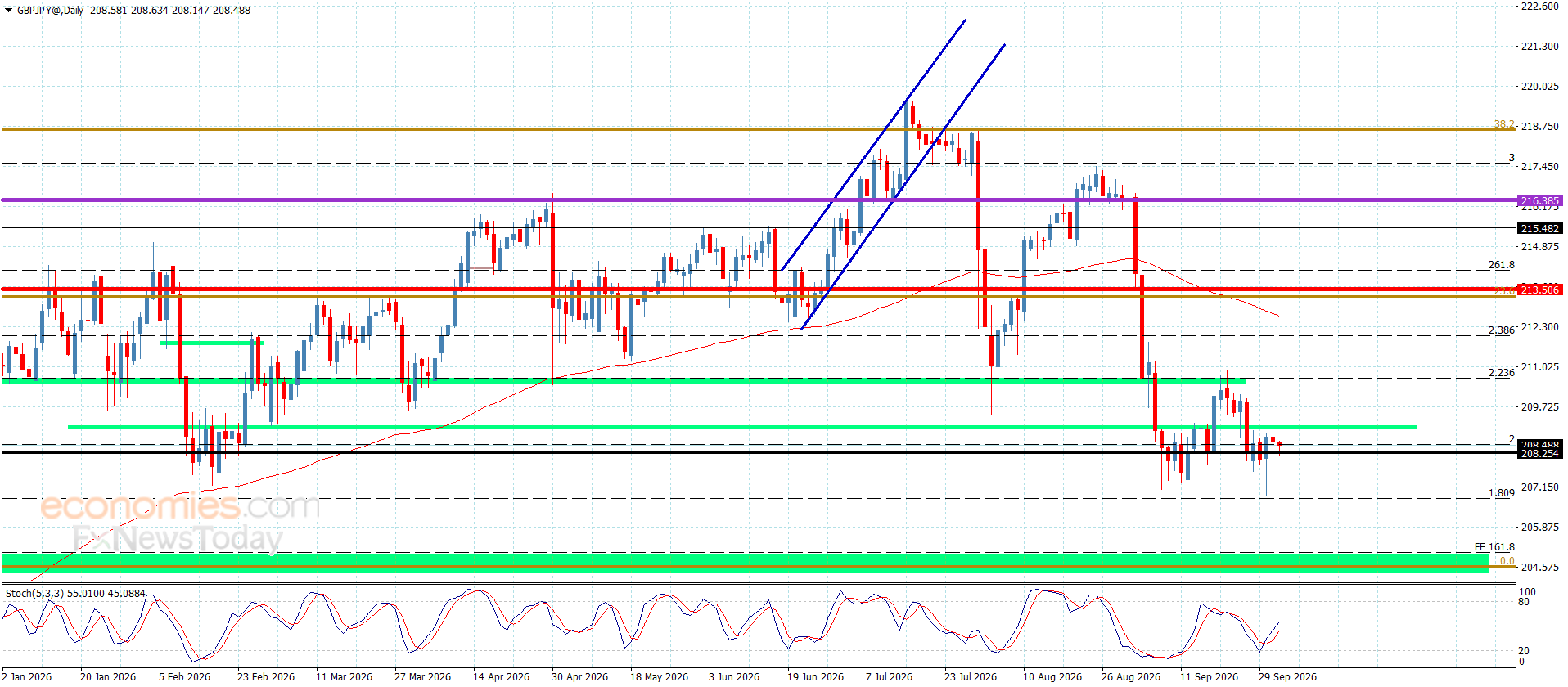
The pair continues to remain positioned within a positive trend so far, supported by the formation of the 213.50 level as the first key support. This has led to renewed attempts to reach the resistance near 215.50, in an effort to find a breakout path to resume the upward movement in the short to medium term trading.
Based on the above, we will remain waiting for the price to achieve the required breakout, which would increase the likelihood of targeting 216.10 and 216.65 initially. With continued positive factors, the movement could extend toward 217.50, which represents the first main target of the upward trend.
The expected trading range for today is between 214.00 and 216.10
Trend forecast: Bullish
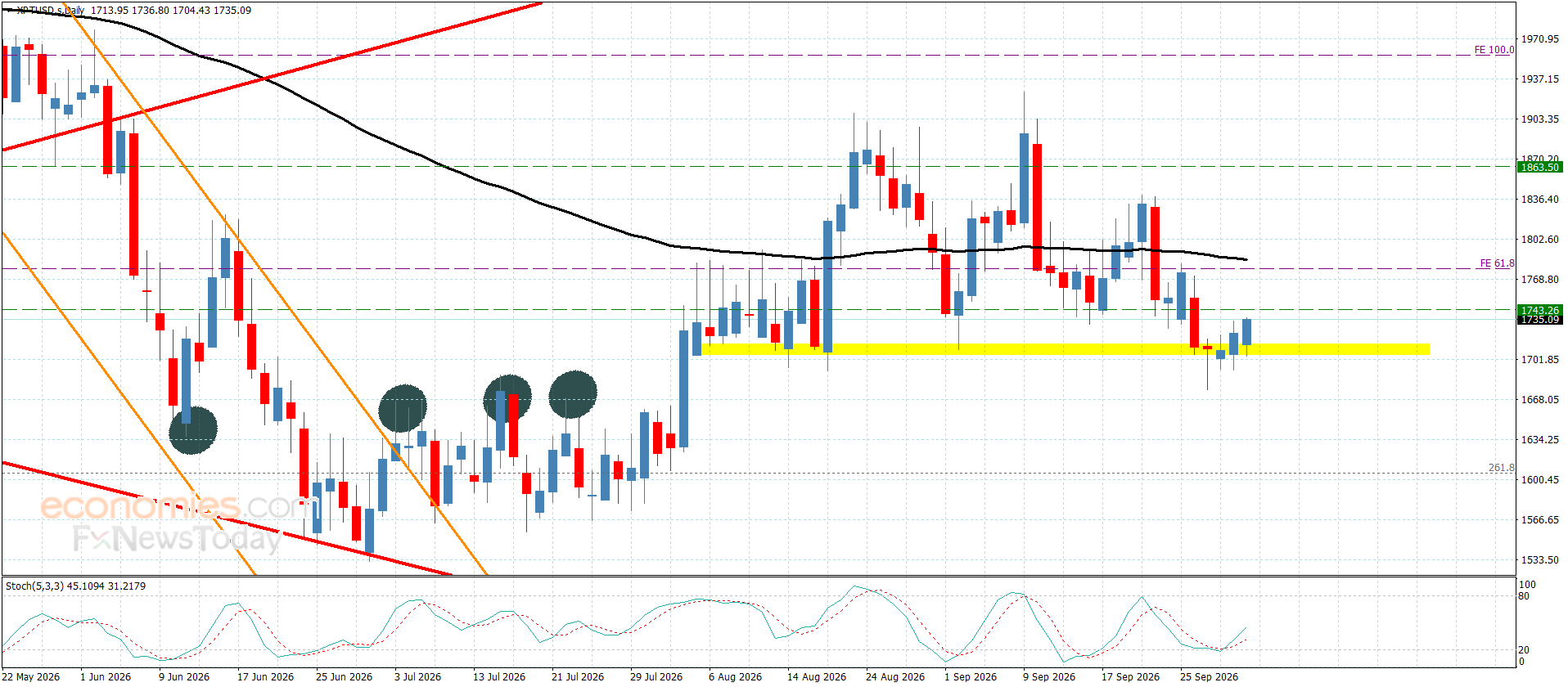
Platinum price continued to form positive trading, benefiting from the formation of the $1640.00 level as a strong additional support, leading to its current attempt to attack the initial barrier at $1770.00, to find a path for further upward waves in the near term.
Note that the attempt of stochastic to provide positive momentum could push the price to surpass the current barrier, to expect reaching $1865.00, to attempt to test the main resistance located around $1922.00. On the other hand, failure to break out would force mixed trading, with a renewed chance of declining toward $1690.00.
The expected trading range for today is between $1720.00 and $1865.00.
Trend forecast: Bullish
The Pound to Dollar (GBP/USD) exchange rate opened the new trading week higher after the US and Iran reportedly agreed to end their nearly four-month conflict, boosting risk appetite and reducing demand for the safe-haven US Dollar
At the time of writing, GBP/USD was trading around $1.34, up approximately 0.3% on he market open
DAILY RECAP:
The US Dollar (USD) began the week on the defensive after renewed optimism surrounding US-Iran negotiations reduced demand for safe-haven assets.
Investors reacted positively to comments from US President Donald Trump suggesting that discussions with Tehran were in their “final throes” and that a comprehensive agreement could be reached within days.
This optimism helped improve market sentiment and weighed on the US Dollar through the opening part of the week.
The Greenback remained subdued following the latest US inflation figures, as consumer price growth accelerated broadly in line with expectations and failed to materially alter expectations for Federal Reserve policy.
However, sentiment shifted later in the week as tensions in the Middle East escalated once again.
Fresh exchanges between US and Iranian forces prompted investors to return to defensive positions, helping the US Dollar recover some lost ground.
These gains proved temporary, however, after reports emerged that additional planned US military action had been cancelled and that progress towards a broader diplomatic agreement remained intact.
As a result, the US Dollar ended the week under renewed pressure.
Meanwhile, the Pound (GBP) enjoyed support through much of the week as improving market sentiment and easing UK gilt yields helped underpin Sterling.
Lower borrowing costs provided reassurance to investors after recent volatility in the UK bond market.
However, Sterling’s advance was interrupted by renewed political uncertainty following the surprise resignation of Defence Secretary John Healey, which revived scrutiny of Prime Minister Keir Starmer’s leadership and broader political stability.
The Pound also faced pressure after April’s GDP report showed the UK economy contracted by 0.1%, reinforcing concerns about slowing growth momentum.
Despite these setbacks, Sterling still managed to outperform the US Dollar over the week as geopolitical developments remained the dominant market driver.
The coming week could prove pivotal for the Pound to Dollar exchange rate as investors digest policy decisions from both the Federal Reserve and the Bank of England.
Both central banks are expected to leave interest rates unchanged, placing the emphasis firmly on their guidance for future policy.
Recent US inflation and labour market data may encourage a relatively hawkish tone from Federal Reserve officials, potentially supporting the US Dollar.
Meanwhile, softer UK economic data could encourage a more cautious approach from the Bank of England, limiting support for Sterling.
Investors will also closely monitor developments surrounding the Makerfield by-election, which is expected to attract considerable political attention.
Combined with central bank decisions and ongoing developments in the Middle East, these factors could contribute to heightened volatility in GBP/USD through the week ahead.
Goldman Sachs has lowered its average Brent crude oil price forecast for 2027 to $80 per barrel, citing stronger global supply growth and continued weakness in demand, particularly in China. According to a research note from the investment bank via Reuters, rising oil production from the United States, Brazil, Guyana, Venezuela, and the United Arab Emirates, combined with structural shifts in energy consumption, is expected to weigh on prices over the longer term. Goldman said it expects more than 10% of the current weakness in demand to persist as China’s transition toward alternative energy sources, including electric vehicles, accelerates.
Despite lowering its 2027 outlook, Goldman maintained its expectation that Brent crude will average $90 per barrel during the fourth quarter of 2026. The bank noted that the effects of a prolonged disruption in the Strait of Hormuz have been moderated by a smaller-than-anticipated supply shortfall and weaker global demand.
Goldman estimated that disruptions to Middle Eastern production initially reduced regional liquids output significantly, but the resulting global deficit during the second quarter amounted to approximately 5 million to 6 million barrels per day. Existing oversupply and lower demand helped cushion the impact. The bank now expects oil exports from Gulf producers to normalize by late August, compared with its previous expectation of late June.
The bank outlined several scenarios for oil prices. Under an adverse scenario involving prolonged export disruptions, Brent could average slightly above $110 per barrel in late 2026. A more severe scenario, in which disruptions in the Strait of Hormuz continue through 2027, could send prices as high as $140 per barrel.
On the other hand, Goldman said that a quicker recovery in supply and weaker-than-expected demand could push Brent prices down to around $70 per barrel by the end of 2026 and approximately $60 per barrel in 2027.
The revised forecast reflects the growing influence of both supply growth and changing consumption patterns on global energy markets, even as geopolitical developments continue to create the potential for significant price volatility.
Japanese rates would still not be high relative to U.S. rates if the BOJ raised its interest rate to 1%. But this would indicate a shift from ultra-low rates in Japan. It would also demonstrate the BOJ’s shift of focus towards inflation pressures from energy, import prices and the weak yen.
This could have two advantages for the yen. First, from the viewpoint of borrowers, higher rates make it less attractive to borrow yen and buy higher-yielding assets. Second, a hawkish BOJ may soften the mood of traders to keep large short-yen bets close to the 160 level.
The weak yen is also a political and economic issue in Japan. This increases the import prices and maintains inflationary pressures. This is one reason why BOJ may continue to hike rates. This is also why markets stay on alert to the risk of intervention when USDJPY approaches 160.
The Fed story is also important. The US dollar remains supported as the Fed expects to maintain rates during its next meeting. The dollar still has a solid interest rate advantage from sticky inflation, solid jobs data and a US Treasury yield that remains high. The USDJPY may not be able to extend its declines unless the U.S. yields decline or the BOJ signals a quicker tightening.
However, the balance of risk is changing. The primary focus of the story earlier was rates in the United States. Now, the market has to factor in the inflation problem in Japan and BOJ’s response. The BOJ may not be satisfied with 1% as the rate of producer prices rises further in Japan.
This makes USDJPY more sensitive towards BOJ guidance. Traders will watch Deputy Governor Shinichi Uchida’s comments to see whether he signals a slowdown or a faster pace of tightening.
The long-term picture for USDJPY remains strongly bullish, as the pair trades within the ascending channel pattern. This bullish structure points to weakness in the yen, which is taking the pair toward the key pivotal level of 160 to 162.
On the downside, the pair has been supported above the 140 level. Each time the pair hits the 140 level, it produces a strong rebound. The rebounds in December 2023, September 2024, and April 2025 have all produced strong rallies to push the pair higher.
The Pound Sterling ended Thursday’s session almost flat at around 214.70 as market sentiment fluctuated but ultimately improved after US President Donald Trump cancelled attacks and hinted at a possible deal in place. The GBP/JPY traded with gains of almost 0.04%.
Price action suggests the cross-pair is consolidating as traders refrain from pushing GBP/JPY higher amid fears of a possible Japanese authorities’ intervention in USD/JPY. If they decided that the Yen is weaker and intervene, this would generate ripples, as the Japanese currency would appreciate against most G8 currencies.
Hence, the GBP/JPY drifts higher, though steadily, but it remains unable to clear the most recent cycle high reached on June 5 at 215.61. Momentum, as measured by the Relative Strength Index (RSI), favours further upside, though it has shifted slightly, suggesting indecision.
If GBP/JPY surpasses the June 10 high at 215.24, the next stop would be the June 5 high at 215.61, followed by the year-to-date (YTD) high of 216.60.
On the flip side, if GBP/JPY drops below the confluence of the 20- and 50-day Simple Moving Averages (SMAs) at around the 214.23-214.10 area, this opens the door toward 214.00. Below this level sits the June 8 swing low of 212.93, ahead of the 100-day SMA at 212.67.
The Japanese Yen (JPY) is one of the world’s most traded currencies. Its value is broadly determined by the performance of the Japanese economy, but more specifically by the Bank of Japan’s policy, the differential between Japanese and US bond yields, or risk sentiment among traders, among other factors.
One of the Bank of Japan’s mandates is currency control, so its moves are key for the Yen. The BoJ has directly intervened in currency markets sometimes, generally to lower the value of the Yen, although it refrains from doing it often due to political concerns of its main trading partners. The BoJ ultra-loose monetary policy between 2013 and 2024 caused the Yen to depreciate against its main currency peers due to an increasing policy divergence between the Bank of Japan and other main central banks. More recently, the gradually unwinding of this ultra-loose policy has given some support to the Yen.
Over the last decade, the BoJ’s stance of sticking to ultra-loose monetary policy has led to a widening policy divergence with other central banks, particularly with the US Federal Reserve. This supported a widening of the differential between the 10-year US and Japanese bonds, which favored the US Dollar against the Japanese Yen. The BoJ decision in 2024 to gradually abandon the ultra-loose policy, coupled with interest-rate cuts in other major central banks, is narrowing this differential.
The Japanese Yen is often seen as a safe-haven investment. This means that in times of market stress, investors are more likely to put their money in the Japanese currency due to its supposed reliability and stability. Turbulent times are likely to strengthen the Yen’s value against other currencies seen as more risky to invest in.
The article covers the following subjects:
Consider short positions from corrections below the level of 160.62 with a target of 152.10–145.50.
Breakout and consolidation above 160.62 will allow the pair to continue rising to the levels of 165.00–170.00.
An ascending third wave of larger degree 3 has formed on the weekly chart, and a bearish correction is developing as the fourth wave 4. On the daily time frame, wave (B) of 4 has presumably been completed, and a descending wave (C) of 4 has started to form. The first wave of smaller degree 1 of (C) is unfolding on the H4 chart. Within this structure, wave i of 1 has been completed, and a local corrective wave ii of 1 has likely formed. Wave iii of 1 is in progress now. If the presumption is correct, USD/JPY will continue to decline to 152.10–145.50 within wave iii of 1. The level of 160.62 is critical in this scenario as a breakout above it will enable the pair to continue rising to the levels of 165.00–170.00.
This forecast is based on the Elliott Wave Theory. When developing trading strategies, it is essential to consider fundamental factors, as the market situation can change at any time.
The content of this article reflects the author’s opinion and does not necessarily reflect the official position of LiteFinance broker. The material published on this page is provided for informational purposes only and should not be considered as the provision of investment advice for the purposes of Directive 2014/65/EU.
According to copyright law, this article is considered intellectual property, which includes a prohibition on copying and distributing it without consent.