The main category of All News Articles.
You can use the search box below to find what you need.
[wd_asp id=1]
The main category of All News Articles.
You can use the search box below to find what you need.
[wd_asp id=1]
Domestic coffee prices today
Coffee prices today in the domestic market have not recorded a clear recovery after the previous sharp decrease session. According to updated data on the morning of July 31, coffee prices in the Central Highlands fluctuated in the range of 96,000-96,800 VND/kg, averaging 96,600 VND/kg.
In Dak Lak, coffee prices are purchased at 96,500 VND/kg. Gia Lai also recorded a level of 96,500 VND/kg.
In Lam Dong, coffee prices are at 96,000 VND/kg, the lowest among the surveyed areas.
The old Dak Nong area, now belonging to Lam Dong province, continues to have the highest price, reaching 96,800 VND/kg.
World coffee prices
In the world market, coffee prices fluctuated in opposite directions in the latest update session.
On the London exchange, the September 2026 Robusta futures contract increased by 7 USD/ton, equivalent to 0.19%, to 3,780 USD/ton. The November 2026 futures contract increased by 12 USD/ton, equivalent to 0.32%, to 3.761 USD/ton.
Conversely, on the New York exchange, Arabica September 2026 futures fell 2.75 US cents/lb, equivalent to 0.84%, to 323.05 US cents/lb. December 2026 futures fell 0.85 US cents/lb, to 307.70 US cents/lb.
This development shows that the world market has not signaled consensus. Robusta has a slight recovery, but Arabica is still under adjustment pressure.
Coffee price assessment
Domestic coffee prices are currently maintained around 96,000 – 96,880 VND/kg after a sharp decrease. The slight increase in Robusta London is not enough to create a clear pulling force for domestic purchasing prices.
For Vietnam, Robusta is still a factor that needs to be closely monitored due to its more direct impact on domestic coffee prices. However, when Arabica New York is still decreasing and domestic prices have not yet regained the 98,000-9,900 VND/kg range, the market is still leaning towards a cautious state.
Regarding the weather, according to the National Center for Hydro-Meteorological Forecasting, on the day and night of July 31, the Central Highlands area will have showers and thunderstorms in some places; in the afternoon and night there will be scattered showers and thunderstorms, locally heavy rain. Lowest temperature 20-23 degrees C, in some places below 20 degrees C; highest temperature 28-31 degrees C.
Rainstorms in this season need to be monitored in terms of garden care, pest and disease prevention, and goods preservation.
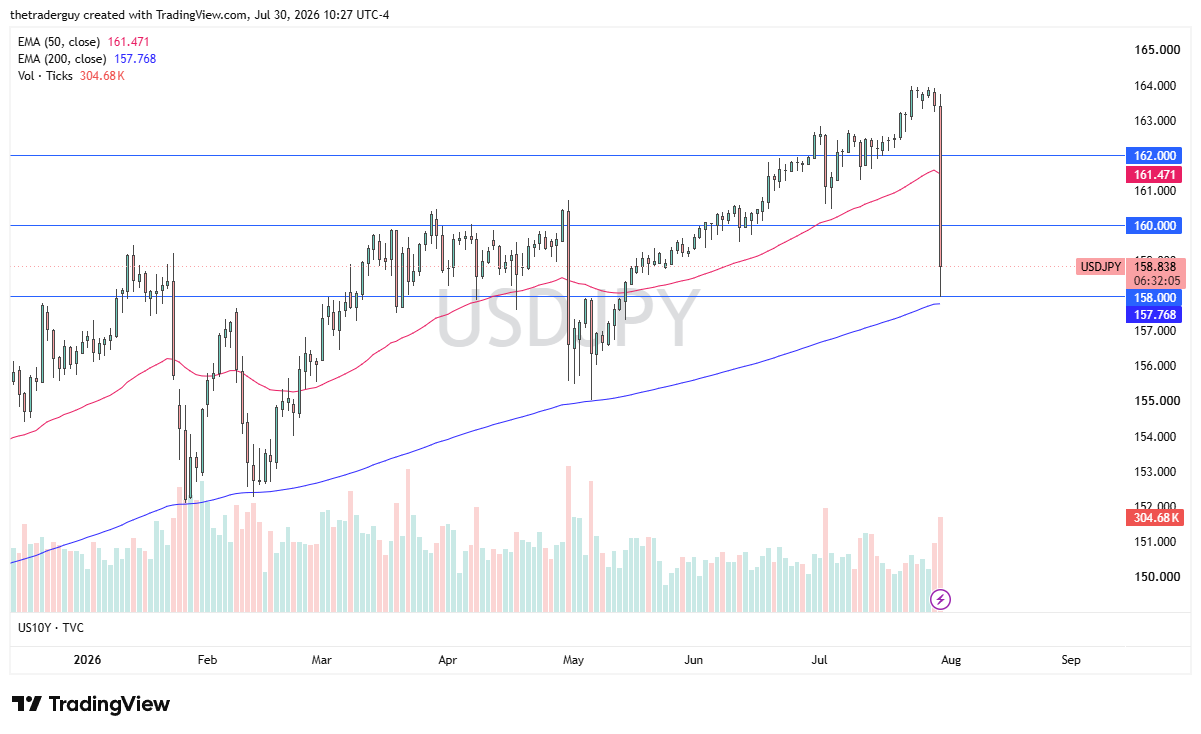
The US dollar plunged against the Japanese yen, with no real news other than the Bank of Japan clearly intervened.
That being said, this presents a buying opportunity. The 200-day EMA has held as support. We plunged all the way back down to the 158 yen level.
I’m perfectly comfortable adding to this position.
This will be about the 3rd or 4th time they’ve intervened. Really all they can do is slowly try to put the brakes on the destruction of the yen.
Unfortunately for the Bank of Japan, they will have very limited ways to get this trend to change. Really the only way they could do it is if they hiked rates aggressively, but that would destroy the Japanese economy. So, this is a sign of desperation I’m more than willing to take advantage of. Keep your leverage reasonable, and it’s something that you can do.

I have taken a hit today, but most of my positions go back months, and they’re not huge. Cumulatively they are big, but in general, this is a market that I believe continues to go higher. I think the USD/JPY pair hits the highs again. We’ve already played this movie a couple of times in the past. It will be a grind to the upside. It won’t necessarily be easy; this does tend to spook traders, it has a certain effect, but the trend will not change just based on one action from the Bank of Japan.
The interest rate differential alone continues to get you paid, and it’s interesting because we’ve seen rates in America all over the place, but they are so much higher than Japan that the break-even point is much wider than it is with other currencies. I like this pair, I still buy it, this offers value that I can take advantage of.
Want to trade our USD/JPY forex analysis and predictions? Here’s a list of forex brokers in Japan to check out.
Christopher Lewis is a technical analyst and market commentator at DailyForex with more than two decades of trading experience in Forex and other leveraged markets. Based in Columbus, Ohio, he specializes in chart-based analysis of major currency pairs, stock indices, commodities, and energy markets, focusing on clear support and resistance levels, trend structure, and risk management. Christopher produces daily written and video analysis for traders who rely on technical setups to navigate volatile market conditions
As seen on: Pairs Of Aces Podcast,The Trader Guy, FXEmpire
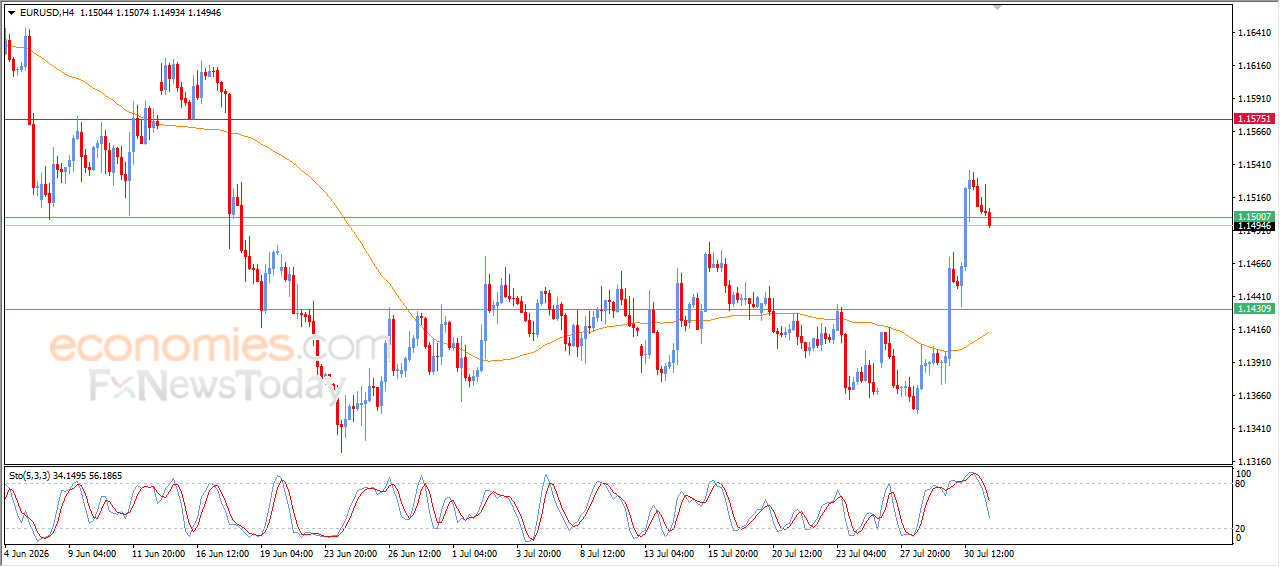
The EURUSD pair declined in its last intraday trading, to gather the gains of its previous rises, attempting to offload its clear overbought conditions on the relative strength indicators, especially with the emergence of negative signals from them, to gather its positive strength that might help it recover and rise again, amid the dominance of bullish corrective wave on the short-term basis, with the continuation of the positive support that comes from its trading above EMA50, reinforcing the chances of near term recovery.
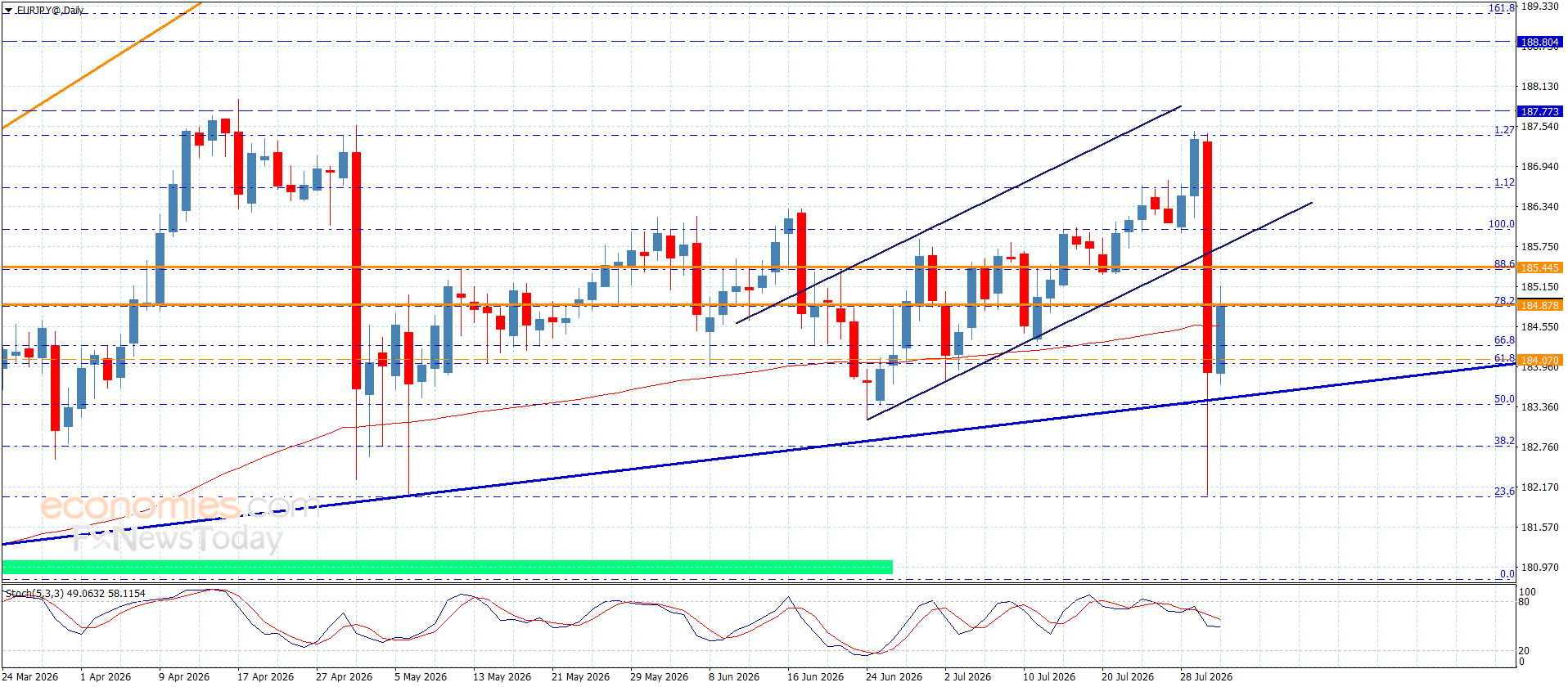
The EURJPY pair maintained its sideways movement below the resistance barrier at 187.40 during yesterday’s trading before reacting to the negative economic data. This led to a sharp bearish move, as the pair slipped below the ascending channel support at 185.65, suffering significant losses and reaching 182.45, before quickly rebounding to stabilize around 184.75.
For now, we will rely on the 185.40 level as an important additional resistance barrier. Repeated stability below this level would confirm the pair’s shift toward the bearish scenario, with the price expected to move lower toward 184.00, followed by an attempt to confirm a break below the support level at 183.95.
The expected trading range for today is between 184.00 and 185.30
Trend forecast: Bearish
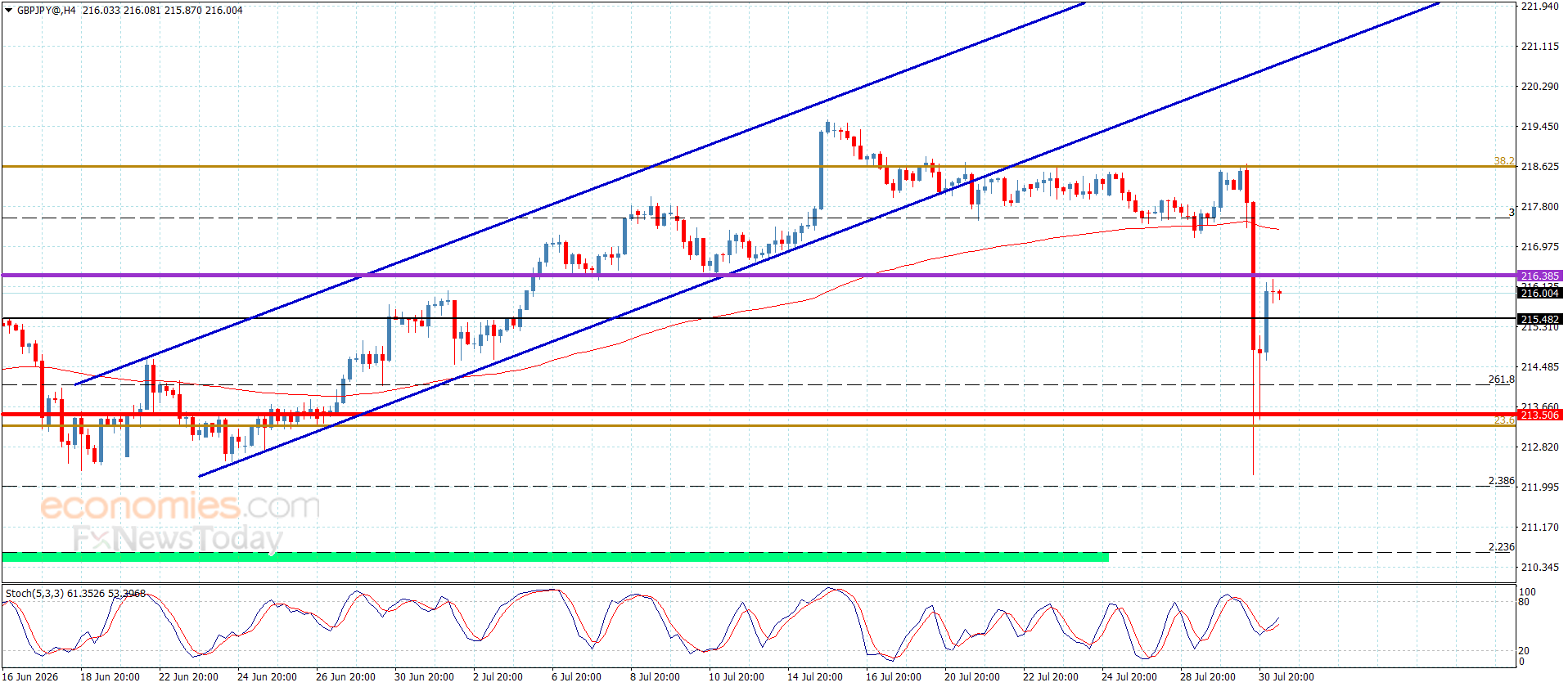
The GBPJPY pair came under strong negative pressure during yesterday’s trading after touching the resistance barrier at 218.65, forcing the pair to launch a sharp bearish move and suffer significant losses, reaching 212.25, before rebounding to retest the broken support level, which has now turned into resistance at 216.35.
Repeated stability below 216.35 may force the pair to resume its bearish attempts, with the price expected to target 215.20 and 214.80, respectively. However, a break above 216.35 and sustained trading above it would temporarily delay the bearish scenario, allowing the pair to attempt a move toward 216.85 and 217.35, respectively.
The expected trading range for today is between 214.80 and 21650
Trend forecast: Bearish
The Japanese Yen rallied sharply on Thursday, with USD/JPY falling from close to 164 to below 158 before recovering above 160 in Asian trading.
The move came amid widespread speculation that Japanese authorities had intervened in the currency market ahead of the Bank of Japan meeting. Intervention was not officially confirmed, although reports also suggested that the US had conducted a rate check on USD/JPY.

US Treasury Secretary Scott Bessent added to the pressure by describing the Yen as “very undervalued”, while Japan’s top currency official Atsushi Mimura acknowledged concerns over the recent weakness without commenting directly on intervention.
MUFG said the scale of the move was similar to previous episodes of official action.
“The scale of the USD/JPY move is quite similar to past Yen selling interventions including in 2024, but may have a bit more to go based on historical experience of perhaps more than a 5% move,” the bank said.

USD/JPY fell by more than five Yen during Thursday’s session before recovering part of the decline.
MUFG remains cautious on the pair heading into the weekend, particularly with speculative positioning still heavily tilted against the Yen.
“With JPY net shorts still elevated close to all-time highs, authorities may be looking to flush out these positions,” the bank said.
It added that traders were likely to become “more cautious on the near-term bets on JPY given the balance of risks.”
That said, MUFG does not believe intervention alone will be enough to produce a lasting reversal.
“Ultimately it boils down to fundamentals over the medium term,” the bank said. “For USD/JPY to achieve a more durable retracement lower, it would require real interest rates to rise more substantially, and for market concerns around fiscal sustainability to be addressed.”

MUFG expects the Bank of Japan to leave rates unchanged at its latest meeting, although dissenting votes in favour of a hike could strengthen expectations of earlier tightening.
The bank’s global and Japan teams forecast BOJ rate increases in September 2026 and January 2027, a faster path than markets currently price.
“This in part underpins our view for USD/JPY to move lower below the 160 levels over time,” MUFG said.
Governor Kazuo Ueda’s guidance will now be closely watched for any indication that policymakers are becoming more willing to accelerate the pace of tightening.

USD/JPY remains well above its January levels despite the latest sharp reversal.
Our currency coverage draws on live market data, official economic releases and published bank research.
The USD/JPY pair is seen building on the previous day’s late recovery from sub-158.00 levels, or the lowest since May 14, and gaining positive traction during the Asian session on Friday. Spot prices climb back above the 160.50 level amid the emergence of some US Dollar (USD) buying and some repositioning trade ahead of the highly anticipated Bank of Japan (BoJ) rate decision.
From a technical perspective, strength beyond the 160.00 psychological mark and the 38.2% Fibonacci retracement level of the sharp corrective pullback from a four-decade peak backs the case for further intraday gains. However, the 14-period Relative Strength Index (RSI) near 31 and a negative Moving Average Convergence Divergence (MACD) reading around -0.43 suggest lingering downside pressure.
Hence, any further move up is more likely to confront stiff resistance near a dense Fibonacci band led by the 50.0% retracement at 160.99 and further capped by the 61.8% and 78.6% retracements at 161.69 and 162.69, respectively. Bulls would need to clear the said barriers to ease immediate pressure and pave the way for a rise back towards the cycle high region at 163.97.
On the downside, initial support is seen at the 38.2% Fibonacci retracement at 160.28, ahead of the 23.6% level at 159.41 and the structural swing low zone at 158.00. A convincing break and acceptance below the handle will be seen as a fresh trigger for bearish traders and pave the way for an extension of the suspected intervention-led corrective decline.
(The technical analysis of this story was written with the help of an AI tool. Know more.)
The table below shows the percentage change of Japanese Yen (JPY) against listed major currencies this week. Japanese Yen was the strongest against the US Dollar.
| USD | EUR | GBP | JPY | CAD | AUD | NZD | CHF | |
|---|---|---|---|---|---|---|---|---|
| USD | -1.01% | -0.86% | -1.85% | -0.51% | -0.33% | -1.02% | -1.15% | |
| EUR | 1.01% | 0.14% | -0.83% | 0.52% | 0.70% | -0.01% | -0.14% | |
| GBP | 0.86% | -0.14% | -1.06% | 0.39% | 0.56% | -0.15% | -0.28% | |
| JPY | 1.85% | 0.83% | 1.06% | 1.33% | 1.52% | 0.81% | 0.59% | |
| CAD | 0.51% | -0.52% | -0.39% | -1.33% | 0.15% | -0.51% | -0.65% | |
| AUD | 0.33% | -0.70% | -0.56% | -1.52% | -0.15% | -0.70% | -0.84% | |
| NZD | 1.02% | 0.00% | 0.15% | -0.81% | 0.51% | 0.70% | -0.14% | |
| CHF | 1.15% | 0.14% | 0.28% | -0.59% | 0.65% | 0.84% | 0.14% |
The heat map shows percentage changes of major currencies against each other. The base currency is picked from the left column, while the quote currency is picked from the top row. For example, if you pick the Japanese Yen from the left column and move along the horizontal line to the US Dollar, the percentage change displayed in the box will represent JPY (base)/USD (quote).
The Euro to Pound exchange rate (EUR/GBP) traded around 0.8574 on Thursday afternoon after the Bank of England held interest rates at 3.75%, with Sterling failing to draw lasting support from a surprisingly hawkish 6–3 vote.
Huw Pill, Megan Greene and Catherine Mann backed an immediate increase, but the guidance suggested most policymakers remain prepared to wait for clearer evidence that higher energy costs are feeding into persistent domestic inflation.
EUR/GBP initially moved lower before rebounding above 0.8585, then settled back near 0.8574. The pair remained around 0.4% lower for July but was well above its mid-month low near 0.8467.
MUFG had argued before the announcement that the unchanged rate itself would not determine Sterling’s direction. With “nothing priced for today”, the bank said markets would focus instead on “the vote, the communication in the statement, the minutes and the updated forecasts”.
That proved accurate. The three dissenting votes looked supportive for the Pound at first glance, yet the wider message did not materially increase confidence that a September hike was coming.
MUFG had set a clear test for Sterling: “For market rates to move higher and the pound to advance in response to today’s meeting we will need to see increased conviction on a September rate hike.”
The decision did little to meet that threshold.
The Monetary Policy Committee acknowledged that inflation risks remain skewed higher, particularly because of energy prices and the uncertain geopolitical backdrop. However, it also pointed to “clear signs of underlying disinflation” and limited evidence so far of stronger second-round effects.
That combination leaves the Bank concerned, but not yet ready to act.
MUFG had warned that if the inflation forecasts showed prices returning to target over time, “the take-away is likely to be that there is time to assess the inflation risks”.
In that scenario, the bank said “pricing for a September rate hike could ease back somewhat, taking the pound lower”. Thursday’s Sterling reaction was consistent with that interpretation.

The intraday move captured the market’s changing reading of the announcement. EUR/GBP initially fell as traders reacted to the three votes for higher rates, but the decline quickly reversed once the guidance was absorbed.
The pair’s jump above 0.8585 suggested the vote count was not enough to convince investors that the next increase had moved materially closer. Its later retreat showed that the decision was not decisively dovish either.
Energy prices remain the strongest argument for keeping a hike in play.
MUFG said the backdrop had become “difficult with crude oil and natural gas prices rebounding significantly”, while a prolonged increase in energy costs “could certainly force the BoE to act, even in circumstances of mixed labour market conditions”.
That risk prevents markets from abandoning tightening expectations altogether. It also helps explain why Sterling’s losses were contained rather than severe.

The wider price history shows EUR/GBP recovering sharply after Sterling’s strongest run of the year.
The pair fell below 0.8470 in July before rebounding by more than a cent. Thursday’s decision has not broken that recovery, and the cross is again approaching levels that repeatedly contained declines during May and June.
The implication is straightforward: EUR/GBP does not require a major improvement in the Euro outlook to move higher. A modest reduction in expected UK rate support may be enough.
MUFG expected Sterling to remain “well supported at these levels” only on the assumption that “pricing for a September rate hike holds up”.
After Thursday’s announcement, that assumption looks less secure.
The 6–3 vote keeps tightening risk alive, but the guidance suggests the majority is comfortable waiting. Unless energy prices rise sharply or incoming inflation data deteriorate, September may prove too early for another move.
A further decline in September hike expectations could send EUR/GBP back above 0.8590 and towards July’s high near 0.8619.
Pound Sterling would regain firmer support if markets conclude that the three dissenters represent the beginning of a broader hawkish shift. That would require stronger inflation evidence or clearer concern from the MPC’s swing voters.
The vote looked hawkish. The message was more patient. For EUR/GBP, that leaves the recovery from July’s lows intact.
Cup of coffee with coffee beans in burlap sack on coffee tree background by Amenic181 via Shutterstock
September arabica coffee (KCU26) today is down -0.40 (-0.12%), and September ICE robusta coffee (RMU26) is up +29 (+0.77%).
Coffee prices are mixed today. Arabica coffee is under pressure today on forecasts for mostly dry weather in Brazil’s coffee-growing regions over the next week, which should allow for the pace of the country’s coffee harvest to speed up.
On Tuesday, coffee prices rallied to 2-week highs amid concern that heavy rain in Brazil will further disrupt the country’s coffee harvest and tighten global supplies. On Monday, Somar Meteorologia reported that 32.4 mm of rain, or 2700% of the historical average, fell in the week ended July 26 in Minas Gerais, Brazil’s biggest coffee-growing region.
The slow pace of Brazil’s coffee harvest is supportive of coffee prices. The harvest among members of Cooxupe co-op was 58.3% complete as of July 24, behind the year-earlier pace of 67%. On July 17, Safras & Mercado reported that Brazil’s 2026/27 coffee harvest was 64% complete as of July 15, behind last year’s comparable level of 77% and the five-year average of 70%.
Rising inventories are weighing on robusta coffee as ICE robusta inventories climbed to a 4.25-month high of 4,254 lots last Wednesday, although inventories were mildly below that level at 4,133 lots today. By contrast, a bullish factor for arabica coffee prices was that ICE arabica coffee inventories fell to a 2.5-year low of 274,168 bags on Wednesday.
Last Friday, coffee prices tumbled to 3-week lows due to the USDA’s forecast last Wednesday that global coffee output in the 2026-27 season will rise by +6.0% (10.8 million bags) to a record 189.7 million bags, mainly due to improved growing conditions in Brazil. The USDA expects global arabica production to rise +12% y/y, although robusta production is expected to fall by -0.7% y/y. World ending stocks are expected to rise +1.9 million bags to 26.3 million bags. On June 3, the USDA’s Foreign Agricultural Service (FAS) forecast a record 2026/27 Brazil coffee crop of 71.9 million bags, up +14% y/y.
Concerns that an El Niño weather pattern could hurt Brazil’s coffee crop next year are bullish for prices. Coffee trader Commercial said the El Niño weather pattern may delay rains in Brazil this September and October, when tree flowering normally occurs, hurting Brazil’s 2026/27 coffee crop. On July 8, the US Climate Prediction Center said the El Niño weather pattern that emerged across the equatorial Pacific last month will likely be one of the strongest in more than 75 years. This sets the stage for months of possible floods, droughts, and temperature fluctuations later this year that could hinder coffee production in Asia and South America.
Soaring coffee exports from Vietnam, the world’s largest robusta producer, are bearish for robusta prices. On July 3, Vietnam’s National Statistics Office reported that Vietnam’s 2026 coffee exports (Jan-Jun) rose by +7.3% y/y to 1.05 MMT. Vietnam’s 2025 coffee exports jumped by +17.5% y/y to 1.58 MMT. Also, Vietnam’s 2025/26 coffee production is projected to climb +6% y/y to a 4-year high of 1.76 MMT (29.4 million bags).
On the date of publication, Rich Asplund did not have (either directly or indirectly) positions in any of the securities mentioned in this article. All information and data in this article is solely for informational purposes. For more information please view the Barchart Disclosure Policy here.