The main category of All News Articles.
You can use the search box below to find what you need.
[wd_asp id=1]
The main category of All News Articles.
You can use the search box below to find what you need.
[wd_asp id=1]
The Euro to Dollar (EUR/USD) exchange rate traded around 1.1390 on Wednesday, holding within an unusually narrow range as markets waited for the Federal Reserve’s policy decision.
EUR/USD was marginally higher on the day after closing at 1.1386 on Tuesday. The pair has spent most of the past week between 1.1350 and 1.1420, with July’s broader range capped by a high near 1.1481 and a low around 1.1354.

Scotiabank described the Euro as “unchanged vs. the USD” as it consolidated within “an incredibly tight range in the mid/upper-1.13s”.
That calm in spot trading is not being matched in the options market.
Scotiabank flagged a “somewhat worrisome development”, noting that risk reversals were “pushing deeper into negative territory” and approaching their late-June lows.
The move indicates “a growing premium for protection against EUR weakness”, suggesting investors are paying more to hedge against a decline even though the spot rate itself remains stable.
The bank linked that deterioration to the latest positioning data, which showed a weakening speculative backdrop for the Euro. In other words, the surface looks quiet, but traders underneath it are becoming more defensive.
Fundamental support has not disappeared. Scotiabank said ECB rate expectations were steady after their recent pullback, “delivering fundamental support via yield spreads”.
German import prices also showed tentative evidence that the energy-driven surge may be reaching a peak after lifting the annual rate above 6%. The release was not large enough to shift the currency, leaving US developments as the dominant near-term driver.

The latest two-day chart above shows EUR/USD briefly climbing from below 1.1380 to around 1.1404 before giving back most of the move.
The pair then settled into an extremely compressed range, repeatedly finding buyers around 1.1383–1.1386 but struggling to maintain advances above 1.1395.
ING takes a more constructive view of what may follow the Fed decision.
The bank argues that precautionary positioning for a surprise US rate increase has helped keep the Dollar supported, but that resilience “will be tested heavily” if the Fed leaves rates unchanged as expected.
Markets were pricing roughly seven basis points of tightening, equivalent to around a 25–30% probability of a hike. A hold should therefore trigger some correction in short-dated US rates and allow investors to unwind defensive Dollar positions.
ING said a Fed hold could allow the Dollar “to reconnect with the signal from lower oil prices”, adding that “unless Fed Chair Kevin Warsh surprises with a hawkish spin, or we see more than two dissenters, we think the dollar will come under pressure today”.
For EUR/USD, that creates a potential route higher, although ING is not calling for an immediate breakout.
The bank said there was “a good chance the pair bottomed out last week” if markets retain a broadly constructive view on Middle East de-escalation.
A sustained move above 1.15 still requires “dovish Fed repricing” and a stabilisation in risk sentiment. Weakness in technology and semiconductor shares may cap the Euro even if the Dollar softens.
Scotiabank’s technical view remains “bearish/neutral”.
The relative strength index is showing “signs of a tentative recovery”, but remains below 50 and therefore still carries a bearish bias. The bank places near-term movement between 1.1350 and 1.1450, with the wider June range bounded by support in the low 1.13s and resistance near 1.1480.
ING’s immediate target sits inside that same range. As a baseline response to a modestly dovish Fed surprise, it expects EUR/USD to return to 1.1400–1.1450 over the coming days.
The contrast between the two banks is useful. Scotiabank sees defensive positioning and options demand warning that the Euro remains vulnerable; ING thinks much of the Dollar’s pre-Fed support may unwind once the decision is out.
A break above 1.1450 would strengthen ING’s argument that last week marked the low and bring 1.1480–1.1500 back into focus. A move beneath 1.1350 would validate the caution showing up in options markets and expose the lower part of the June range.
The spot market is quiet. The hedging market is not. Wednesday’s Fed decision should reveal which one has read the risk more accurately.
Domestic coffee prices today
Coffee prices today in the domestic market increased sharply compared to the previous day. Coffee prices on July 29th averaged 98,400 VND/kg, up 1,900 VND/kg. The highest level in key Central Highlands regions was recorded at 98,500 VND/kg.
In Lam Dong, coffee prices reached 97,880 VND/kg, an increase of 2,000 VND/kg compared to the previous day. This is the lowest level among regions updated in detail.
In Gia Lai, coffee prices were recorded at 98,300 VND/kg, an increase of 1,900 VND/kg.
The old Dak Nong area recorded a level of 98,500 VND/kg, an increase of 1,900 VND/kg.
After two consecutive increasing sessions, the domestic coffee price level has returned to the area close to 100,000 VND/kg.
World coffee prices
In the world market, coffee prices increased sharply on both the London and New York exchanges.
On the London exchange, the September 2026 Robusta futures contract increased by 78 USD/ton, equivalent to 2.05%, to 3,877 USD/ton. The November 2026 term increased by 78 USD/ton, to 3,859 USD/ton. The January and March 2027 terms increased by 79 USD/ton and 80 USD/ton respectively, reaching 3,824 USD/ton and 3,794 USD/ton.
On the New York exchange, the September 2026 Arabica futures contract increased by 14.85 US cents/lb, equivalent to 4.58%, to 339.40 US cents/lb. The December 2026 term increased by 11.40 US cents/lb, to 317.30 US cents/lb. Further forwards also increased sharply.
The upward momentum of world prices is creating clearer support for domestic coffee prices, especially when Robusta London returns to the area near 3,900 USD/ton.
Coffee price assessment
Domestic coffee prices increased sharply in the session of July 29, coinciding with positive developments on the two international exchanges. The increase range of Arabica is greater than Robusta, but Robusta is still a more direct factor affecting the Vietnamese market.
From a global market perspective, the International Coffee Organization said that the average ICO aggregate price index in June 2026 reached 248.90 US cents/lb, down 2.8% compared to May. However, in June, prices once fell to the lowest level in nearly 2 years and then recovered 17.4% at the end of the month, showing that the market still has a large fluctuation range.
Regarding supply, USDA/FAS forecasts that Vietnam’s coffee production in the 2026-2027 crop year will reach 32.5 million bags converted to green beans. The prospect of increased supply is still a factor to be monitored in the medium term, although short-term prices are being supported by the upward momentum on the world exchange.
Regarding the weather, according to the National Center for Hydro-Meteorological Forecasting, from early morning on July 29 to July 30, the Central Highlands and Southern regions will have moderate rain, heavy rain and thunderstorms, locally very heavy rain. Especially the Central Highlands will have moderate rain, heavy rain and scattered thunderstorms; in thunderstorms, there is a possibility of tornadoes, lightning and strong gusts of wind.
Heavy rain needs to be monitored in the stages of garden care, pest and disease prevention, and goods preservation.
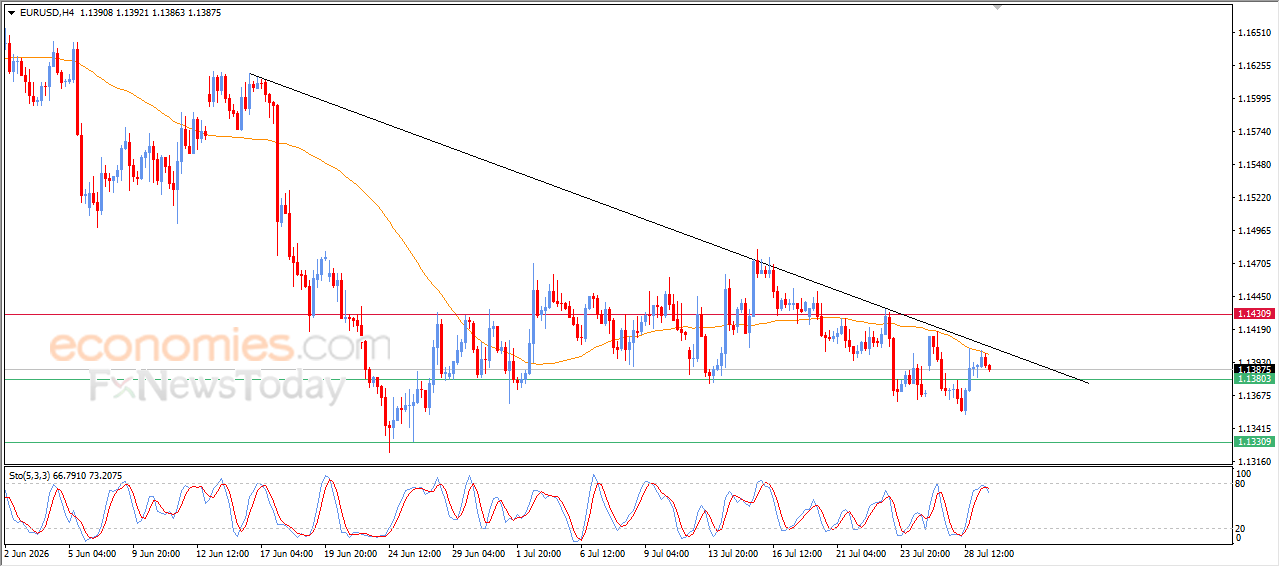
The EURUSD pair declined in its last intraday trading, reaching EMA50’s resistance, putting it under negative pressure amid the dominance of the main bearish trend on the short-term basis, with its trading alongside supportive trend for this path, besides the emergence of the negative signals from the relative strength indicators, after reaching exaggerated overbought levels compared to the price move, intensifying the negative pressure, indicating more downside moves in the near upcoming period.
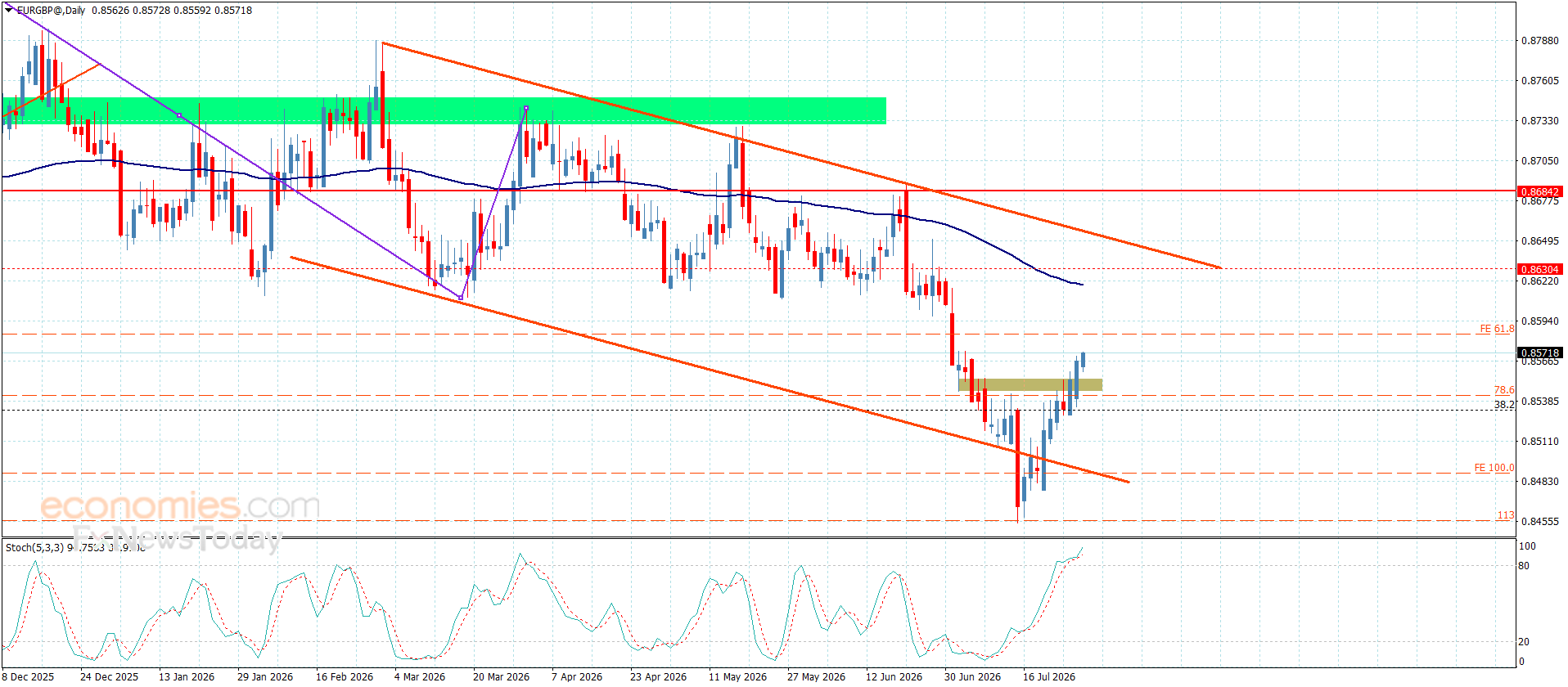
The EURGBP continued forming bullish corrective waves, benefiting from stochastic positivity, to notice surpassing the barrier at 0.8555 barrier to ease the mission of achieving some gains by reaching 0.8573 level.
Forming corrective attempts is expected to target 0.5885 and 0.8595 level, while activating the negative trend requires forming a sharp decline to settle below 0.8540 level, to begin targeting negative stations that are represented by 0.8510 and 0.8480 level.
The expected trading range for today is between 0.8540 and 0.8585
Trend forecast: Bullish
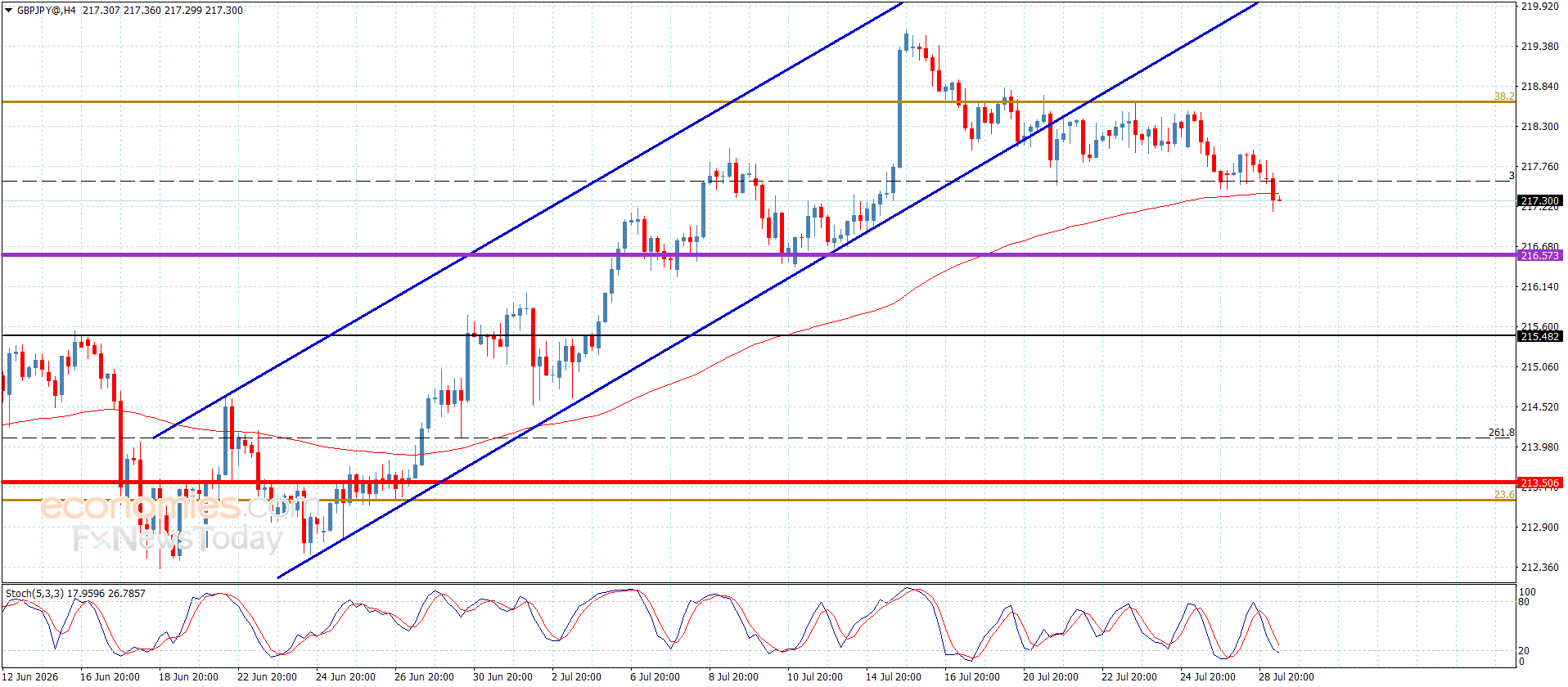
The GBPJPY pair’s neediness to the bullish momentum led it to form more bearish corrective waves, to notice its stability near the moving average 55 at 217.35, note that this rebound will not affect the main bullish scenario, which depends on the stability of the support level at 216.35, the stability above it confirms the continuation of the positivity, which might target the barrier at 218.65 and surpassing it will extend the trading towards 219.40 and 220.00.
While breaking the support and holding below it for four hours’ time frame will cancel the bullish trend, to force the price to form strong bearish waves, forcing it to suffer several losses by reaching 215.45 initially.
The expected trading range for today is between 216.85 and 218.65
Trend forecast: Bullish
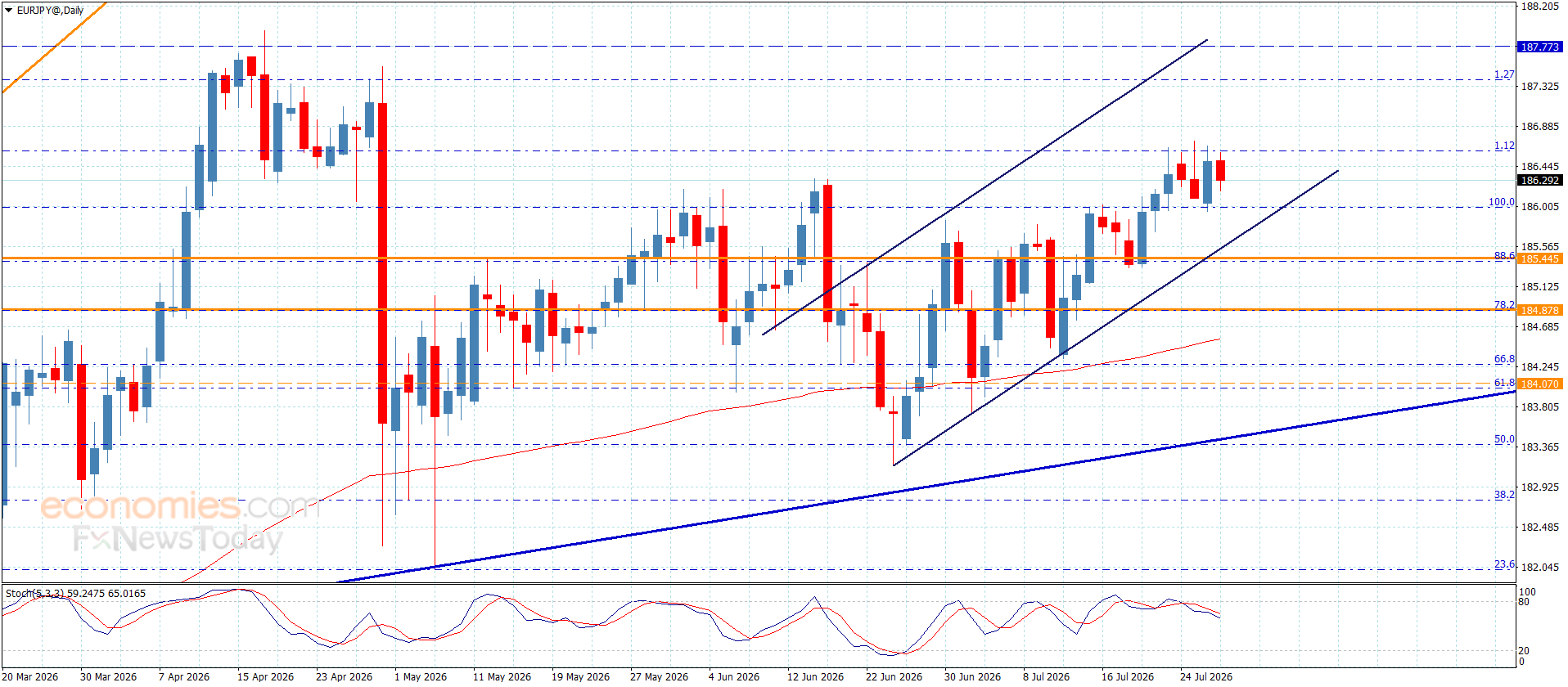
The EURJPY pair renewed the bullish attempts yesterday, facing 186.65 barrier, which formed a strong obstacle against the attempts of resuming the bullish trend.
Reminding you that the stability within the bullish channel’s levels, and its main support is located at 185.60 represents a main factor to activate the bullish attempts, therefore, we will keep waiting for breaching the current barrier to open the way for reaching extra stations, which might begin at 186.95 and 187.65.
The expected trading range for today is between 185.70 and 186.95
Trend forecast: Bullish
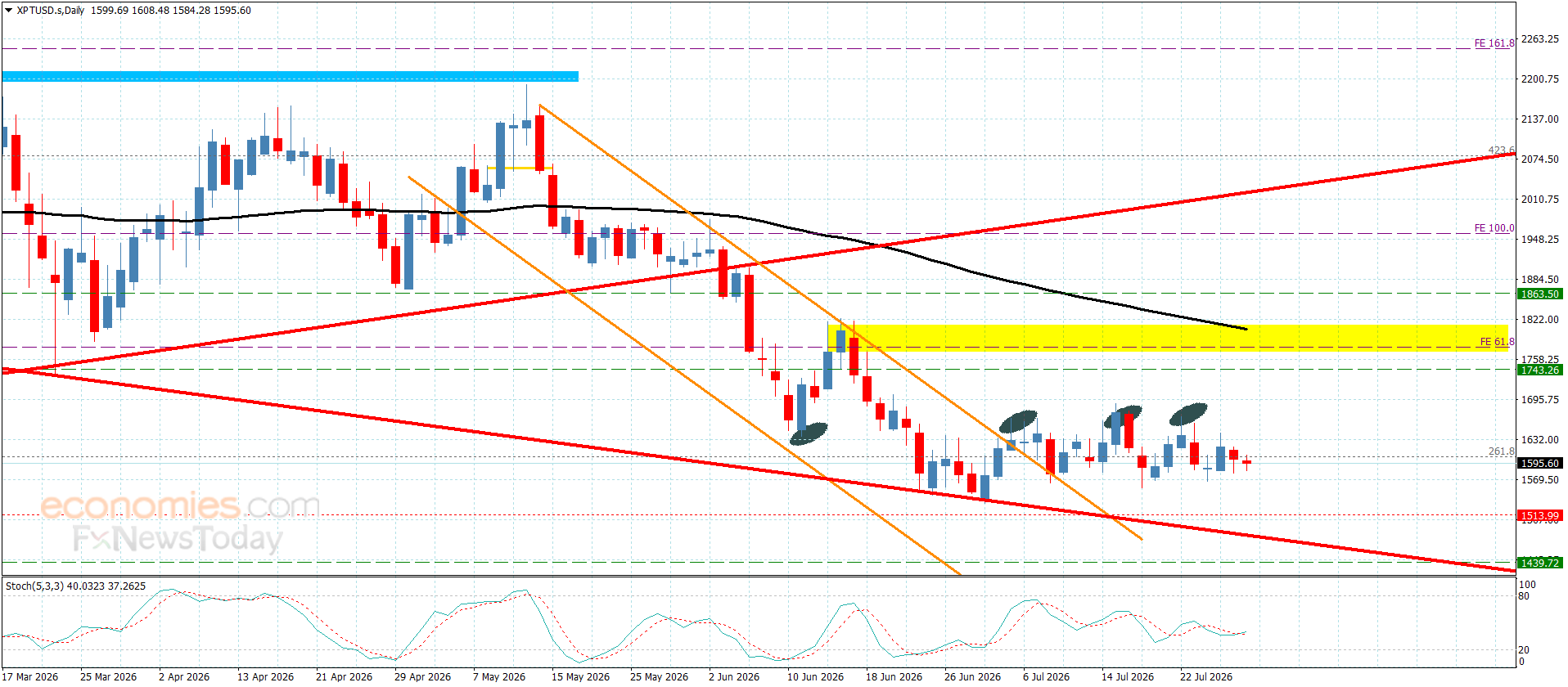
Platinum price provided more sideways trading by its fluctuation near $1600.00 level due to the contradiction of the main indicators, especially by stochastic stability above 20 level, obstructing the previously waited negative trend.
Reminding you that the stability below the extra barrier at $1695.00 forms a main factor to confirm the previously suggested negative scenario, therefore, we will keep waiting for gathering extra negative momentum, to reach the initial target at $1550.00, then attempts to pressure the barrier near $1515.00.
The expected trading range for today is between $1515.00 and $1640.00
Trend forecast: Bearish
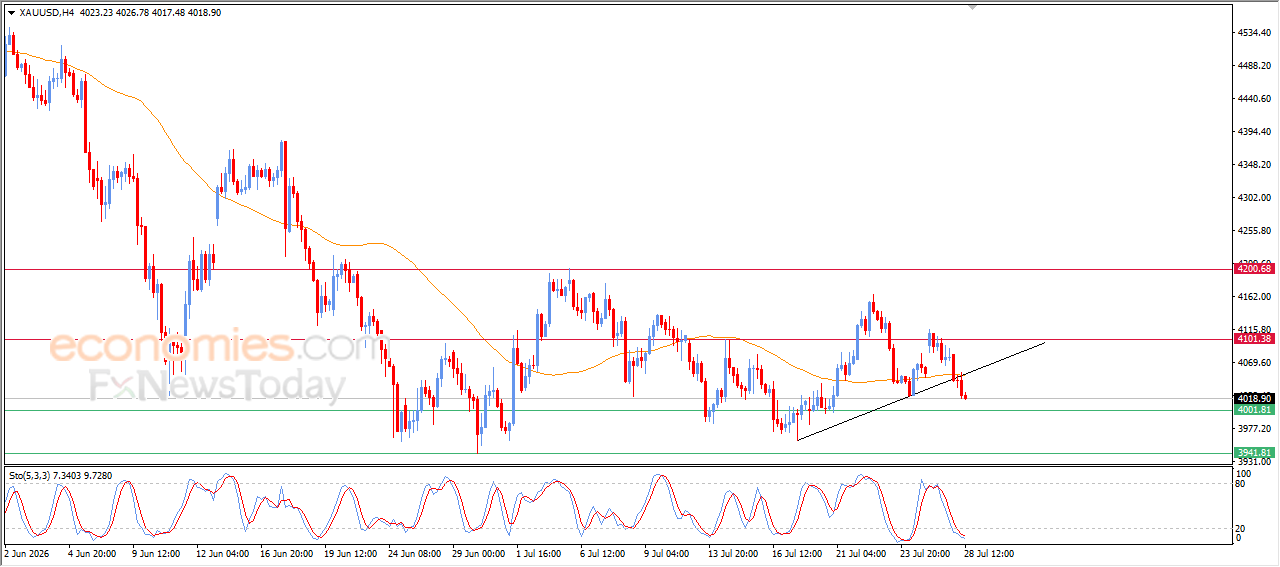
Gold prices deepened its losses during their latest intraday trading, breaking a bullish corrective trend line on the short-term basis, accompanied by surpassing EMA50’s support, intensifying the negative pressures and suggesting more losses in the near upcoming period, especially with the emergence of the negative signals from the relative strength indicators, despite reaching oversold levels.
Silver prices fell towards $57.20 per ounce on Tuesday as a stronger US dollar and growing expectations of tighter Federal Reserve policy outweighed support from another year of structural supply deficits. With the Fed set to announce its latest policy decision on Wednesday, traders are watching whether XAG/USD can hold the key $56.81 Fibonacci support before the next directional move.
Silver came under renewed selling pressure as investors reduced exposure ahead of the Federal Reserve’s two-day policy meeting. Spot silver traded near $57.23 per ounce, down around 2% on the day, extending its retreat after briefly approaching the $60 mark last week. The stronger US dollar remained the primary headwind, making dollar-denominated precious metals more expensive for overseas buyers.
Markets are increasingly focused on the Fed’s policy guidance rather than the rate decision itself. According to CME FedWatch, investors assign a 62% probability that policymakers will leave interest rates unchanged this week, while the likelihood of a 25-basis-point increase has climbed to 38%, up sharply from around 16% a week ago. Markets are also pricing roughly an 81% chance of a September rate increase, reflecting expectations that inflation risks remain elevated.
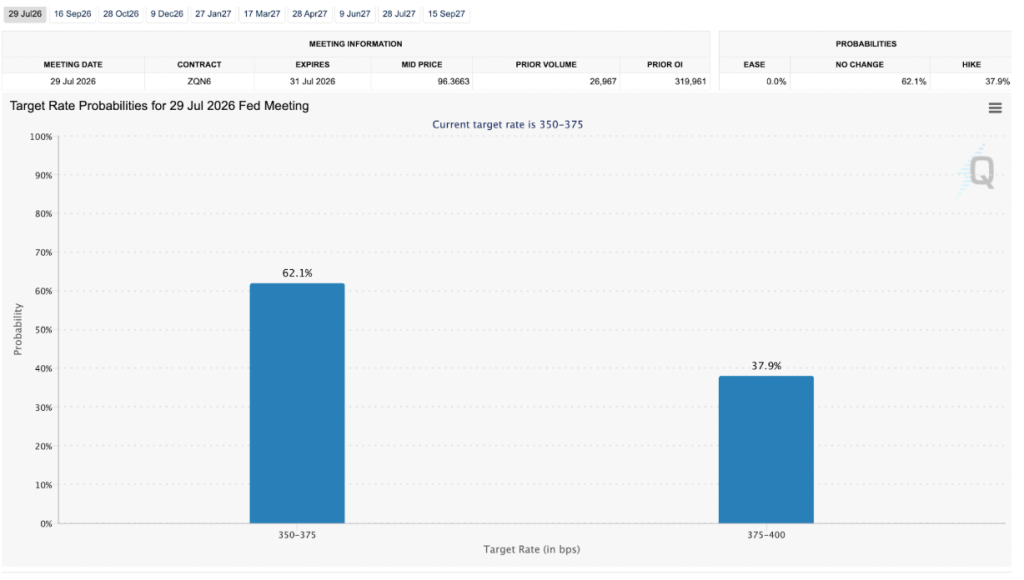
Higher interest rates generally reduce the appeal of non-yielding assets such as silver by increasing returns on cash and government bonds. A hawkish statement from the Fed could therefore keep pressure on both silver and gold, even if rates remain unchanged this week.
Unlike gold, silver derives much of its value from industrial demand, particularly in electronics, renewable energy, electric vehicles and advanced manufacturing. While concerns over slower global growth have weighed on industrial metals in recent weeks, the long-term supply picture remains supportive.
The Silver Institute expects the global silver market to record its sixth consecutive annual supply deficit in 2026. Its latest estimates indicate the market could remain undersupplied by approximately 46.3 million ounces, even after modest improvements in mine production and recycling. Earlier projections had suggested a deficit closer to 67 million ounces, highlighting that global consumption continues to exceed newly available supply.
Physical investment demand also remains resilient. The Silver Institute forecasts demand for silver coins and bars to increase by roughly 20% to around 227 million ounces this year, the strongest level in three years. Although industrial fabrication is expected to soften slightly, silver continues to benefit from growing demand across electrical infrastructure, electronics and clean energy technologies.
Another supportive factor comes from India, where tighter import restrictions and higher import duties have significantly reduced silver imports, creating regional shortages and lifting domestic premiums above international benchmark prices.
Following Wednesday’s Fed decision, attention will quickly shift to Thursday’s US GDP, personal income, spending and Core PCE inflation reports. The Core PCE index remains the Federal Reserve’s preferred inflation gauge, and any upside surprise could reinforce expectations for another rate increase in September.
Conversely, softer economic growth or easing inflation would weaken the US dollar and improve the outlook for precious metals, particularly silver, which tends to react more sharply than gold to changes in monetary policy expectations.
Silver’s technical picture has weakened after breaking below the ascending trendline that supported the rally from the July 17 low. The decline has brought prices towards the 50% Fibonacci retracement at $56.81, where buyers have begun to emerge. However, the recovery remains tentative as XAG/USD continues to trade below both the former trendline and its key moving averages.
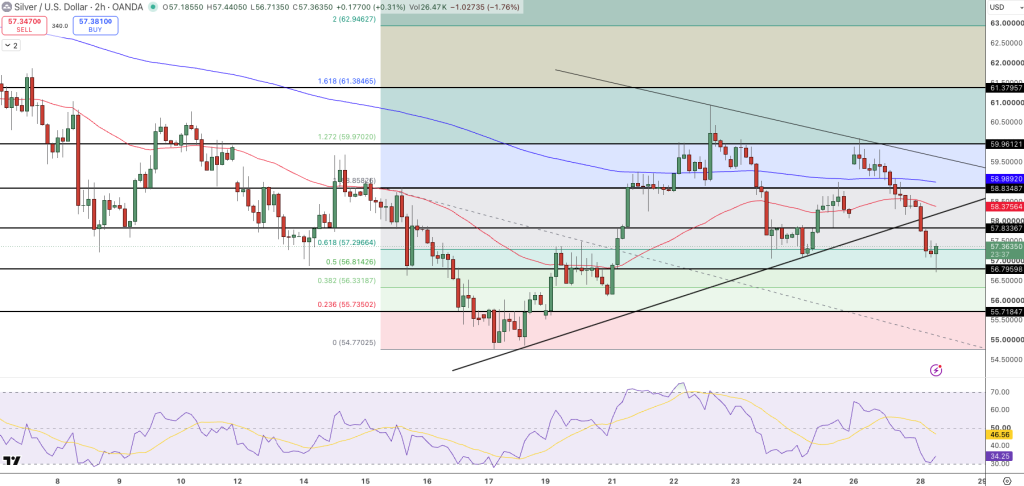
The 50-period EMA at $58.38 has turned lower and now acts as immediate resistance, while the 200-period EMA at $58.99 remains firmly above price, confirming that sellers retain short-term control. Meanwhile, the RSI has fallen to around 34, approaching oversold territory but not yet signalling a confirmed bullish reversal.
A sustained recovery above $58.34 would improve the near-term outlook and expose the 200-period EMA at $58.99, followed by the descending trendline near $59.96. If buyers regain control above these levels, the next upside objective comes in at $61.38.
On the downside, $56.81 remains the first key support. A decisive break below this Fibonacci level would expose $56.33, followed by $55.72, while a deeper correction could extend towards $54.77.
Bullish scenario: Buy on a confirmed break above $58.34.
Target 1: $58.99
Target 2: $59.96
Extended Target: $61.38
Stop-loss: Below $56.81
Bearish scenario: A confirmed break below $56.81 could accelerate losses towards $56.33, followed by $55.72 and $54.77.
Silver is under pressure because the US dollar has strengthened ahead of the Federal Reserve’s policy decision, reducing demand for non-yielding precious metals and increasing the cost of silver for international buyers.
Unlike gold, more than half of global silver consumption comes from industrial applications, including electronics, solar panels, electric vehicles and electrical infrastructure. Economic growth expectations therefore have a greater influence on silver prices.
Yes. The Silver Institute expects another annual supply deficit in 2026, with global demand continuing to exceed mine production and recycling. Persistent shortages could provide longer-term support once monetary policy uncertainty begins to ease.

Arslan Ali Butt
Lead Markets Analyst – Multi-Asset (FX, Commodities, Crypto)
Arslan Ali Butt serves as the Lead Commodities and Indices Analyst, bringing a wealth of expertise to the field. With an MBA in Behavioral Finance and active progress towards a Ph.D., Arslan possesses a deep understanding of market dynamics.
His professional journey includes a significant role as a senior analyst at a leading brokerage firm, complementing his extensive experience as a market analyst and day trader. Adept in educating others, Arslan has a commendable track record as an instructor and public speaker.
His incisive analyses, particularly within the realms of cryptocurrency and forex markets, are showcased across esteemed financial publications such as ForexCrunch, InsideBitcoins, and EconomyWatch, solidifying his reputation in the financial community.