The main category of All News Articles.
You can use the search box below to find what you need.
[wd_asp id=1]
The main category of All News Articles.
You can use the search box below to find what you need.
[wd_asp id=1]
The USD/JPY remains under mild pressure as the Japanese yen continues to find support from changing policy expectations and a weaker US dollar backdrop. Momentum has obviously slowed, indicating growing uncertainty over the next directional move, even though the pair is still trading at high levels around the mid-156 area. The market is increasingly focused on the widening policy divergence between the Bank of Japan, which is cautiously tightening, and the Federal Reserve, which is edging closer to an easing cycle.
–Are you interested in learning more about forex indicators? Check our detailed guide-
The yen’s recent resilience is largely driven by the growing acceptance that the BoJ’s long-awaited normalization process is not a one-off move. Governor Kazuo Ueda’s most recent remarks reaffirmed the likelihood of further interest rate hikes if inflation remains elevated. Rising wages, persistent pressure on service sector prices, and tighter labor conditions strengthen the argument for gradual tightening. This change has already caused yields on Japanese government bonds to reach multi-decade highs, reducing one of the main causes of yen weakness and closing the yield gap with the US.
At the same time, investors remain cautious about pushing the yen too aggressively higher. Uncertainty around Japan’s fiscal outlook, highlighted by the approval of a record budget, and questions over the exact timing and pace of future BoJ hikes continue to temper bullish conviction. As a result, USD/JPY has avoided a sharp sell-off and instead is grinding lower in a controlled manner.
Geopolitical risks add another level of complexity. The demand for safe havens has been boosted by growing tensions associated with Venezuela and other global flashpoints. However, the dollar’s inflows during periods of high US yields have lessened the yen’s influence. Even so, upside movements are still constrained, especially in the upper 150s, by the possibility of verbal intervention from Japanese authorities.
On the US side, the dollar is struggling to find sustained support. Markets are increasingly pricing in further Federal Reserve rate cuts later this year, with policymakers stressing the need to stay data-dependent as inflation cools and labour market conditions soften. This week’s run of US data, including ADP employment figures, ISM Services PMI, and JOLTS, may influence short-term moves, but the main event remains Friday’s Nonfarm Payrolls report. A weaker-than-expected jobs reading would likely reinforce expectations of a dovish Fed and put renewed downside pressure on USD/JPY.
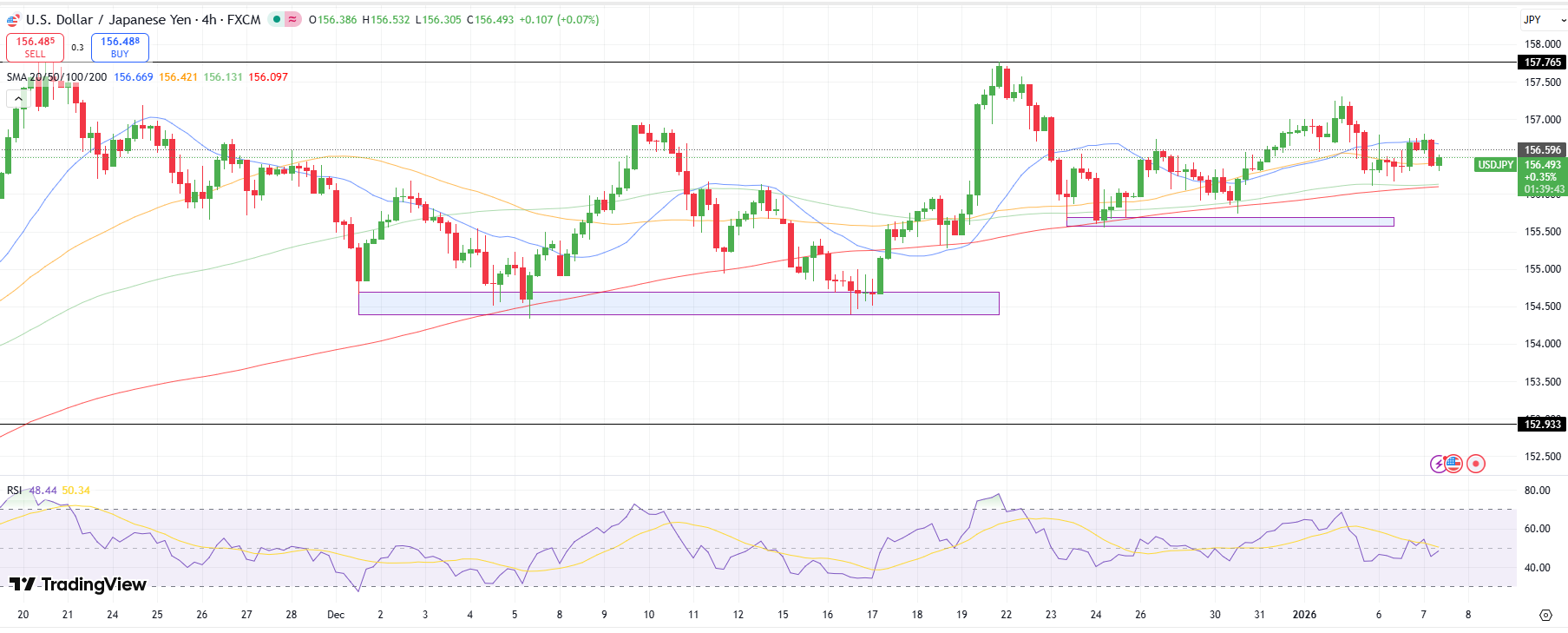
The USD/JPY 4-hour chart shows consolidation between 20- and 50-period MAs, while the confluence of 100- and 200-period MAs supports the pair’s upside bias. The RSI also remains flat under the 50.0 level, suggesting no clear bias in the short term.
–Are you interested in learning more about next cryptocurrency to explode? Check our detailed guide-
A break above the 20-period MA at 156.60 could trigger a bullish breakout and look to test 157.30 ahead of 157.75. On the other hand, moving below the 200-period MA at 156.10 could prompt the pair to test the 155.55 support level ahead of 155.00.
Looking to trade forex now? Invest at eToro!
68% of retail investor accounts lose money when trading CFDs with this provider. You should consider whether you can afford to take the high risk of losing your money.
Green Tea Studio Plugs Directly into Existing Open-Source Development Frameworks, Enabling Customers to Upgrade to the Award-Winning Talaria 6 Platform while Preserving SW Investment and Accelerating Time to Market – Demonstrations at CES 2026
LAS VEGAS, Jan. 7, 2026 /PRNewswire/ — InnoPhase IoT, Inc., a leader in low-power wireless semiconductor solutions for the IoT industry, announces Green Tea Studio™ (GTS) integrated development environment for its Talaria 6 Family of System-on-Chips (SoCs), the winner of the IoT Semiconductor Product of the Year, IoT Breakthrough Awards 2026. The GTS provides customers and developers with direct access to existing open-source development environments and third party software components, allowing existing MCU applications and solutions to be seamlessly ported while facilitating the development of new applications and solutions, enabling rapid deployment to market. Attendees can experience live demonstrations of Green Tea Studio and IoT solutions at CES 2026, in Las Vegas, NV, January 6 -9.
As a trusted US-based silicon provider, InnoPhase IoT develops next-generation products with robust performance, ultra-low power, enhanced security, Edge AI processing, and advanced connectivity for IoT devices. The target markets include smart home, building automation, industrial IoT, and health/medical segments, and key applications span video cameras, doorbells, locks, thermostats, lighting, environmental and vibration sensors, appliances, health and medical devices, hubs/gateways, and Matter bridge routers.
“The Talaria 6 IoT platform, combined with the innovative and flexible Green Tea Studio, enables our customers, developers, and partners to plug and play with a U.S. based trusted silicon supplier while gaining the benefits of energy efficiency, versatile connectivity, high performance, and enhanced security,” said Dr. Yang Xu, Founder and CEO of InnoPhase IoT.
Green Tea Studio’s Key Features and Benefits:
The Green Tea Studio will sample in Q2’26. To request early access or schedule a visit at CES, contact InnoPhase IoT at [email protected].
About InnoPhase IoT:
InnoPhase IoT Inc., headquartered in San Jose, CA, is a wireless semiconductor platform company dedicated to enable the promise of the Internet of Things (IoT). Its Talaria platform provides the world’s lowest power Wi-Fi, with multi-band and multiprotocol support to the rapidly growing untethered and battery-operated IoT device market. InnoPhase IoT delivers device-to-cloud, market-ready solutions with extended battery life, a low total cost of ownership (TCO), and high-performance wireless use cases. For more information, contact [email protected] or visit the InnoPhase IoT.com website.
Media Contact:
Linda Ferguson, Marketing Communications Director, InnoPhase IoT, Inc.
1+503-869-5827
[email protected]
www.innophaseiot.com
SOURCE InnoPhase IoT
As told to Marnie Goodfriend
January is National Blood Donor Month.
I’ve had sickle cell anemia since I was in my mother’s womb. My older brother also has the condition, but it affects us each differently. Once, when we were kids, he visited me in the hospital, where I was inpatient to receive a blood transfusion, after he’d spent the day playing in the sun. I was angry that I was admitted to the hospital once every other week, while he never was. This was an early lesson for me that different people with this disease experience it differently. For example, I’m a sickle cell disease warrior who experiences pain every day and needs blood transfusions often.
While I was growing up in Michigan, my mom and dad tried to keep things normal, but I had many limitations. I was curious and wanted to be like the other kids. But intense exercise is a key stressor on the blood of people with sickle cell anemia, so I’d watch my friends do things like swim in lakes and go tubing, but I couldn’t join in. One year, I went to Girl Scout camp. I wanted to stay and ride horses all summer, but my parents picked me up after two weeks. When I was young, my mother helped me understand my condition. She’d say, “You’re not different from your friends who get a cold or the flu. It’s just that your sickness is a little worse, and you need to go to the hospital.” That’s how I understood things for many years.
In high school, my parents allowed me to apply to all the colleges I wanted to go to. They never wanted my circumstances to destroy my dreams. But, when I was accepted to out-of-state schools, my mother sat me down to talk about what life would be like if I went at it alone. “I’ll figure it out,” I told them. “What will you do if you can’t walk,” she asked. I knew she was right. Sickle cell takes all the energy from my soul, and some days, all I can do is be still.
I enrolled at a local four-year university to be near family and the care I needed. I lived on campus, but I’d get sick often and be back in the hospital. It was before cell phones, so none of my friends knew where I was. I’d disappear in the middle of the night with my parents, and that was it. I was really mad for a time because I didn’t understand why I had to live this life, trying to date boys and be cute instead of being a sickly kid, exhausted simply from carrying her bookbag. I looked like a normal student, but I was never normal. If you receive blood throughout your childhood, you need different types of blood with different antibodies often, and I needed more blood donations as a young adult.
As I moved into a career in logistics after college, I rarely told anyone I have sickle cell anemia. If I had to be out of work, I would use a different but related excuse, like a pulmonary embolism or arthritic issues in my foot. When I did tell employers about my condition, I felt that I was looked at as less-than, and it prohibited me from moving up. Sometimes I need transfusions or pain medications to feel better, but I always need understanding and empathy, which hasn’t always been available in the workplace.
2023 (Photo/Jason Avant)
As I got older and thought about romance, getting married seemed out of the question. Why would someone want to take care of me? When I long-distance-dated my now-husband, it took me three months to tell him about sickle cell. I explained that I had a blood disorder with sickle-shaped cells instead of round blood cells and a blockage of oxygen that wreaks havoc on your organs. “The average lifespan for someone with sickle cell is in their 40s. Do you still want to be with me?” I asked. He took a couple of weeks to think about it, then he said, “I want to be able to take care of you.” Four years later, I moved to Dallas, and we got married.
My husband and I talked about having children, which was something I’d never considered. It was too difficult to imagine passing on and leaving a family behind. But getting married changed things for me, and we decided to try for a year. Just as we were about to give up, I got pregnant. This baby inside of me took all my love — and all of my body, too. He sucked every nutrient from me. I had sciatica, multiple bouts of pneumonia and a pregnancy cough where my lungs couldn’t inflate fully. As a result, I spent even more time at the hospital. When I got home, I knew I couldn’t work in another high-stress office environment, so I started photographing babies and built a business that grew from there.
I also ramped up my patient advocacy, something that came naturally to me. My mom used to work for the University of Michigan, so starting when I was about 6, she would take me to lectures about my disease and have me stand up and tell my story. My passion for helping others with their health journeys grew from there.
Over the years I’ve learned that advocacy is much bigger than my own story. I’m no longer that little girl in the hospital bed. I’m a fierce advocate, and I’m determined to change the narrative — not just for myself, but for so many people with sickle cell or other chronic illnesses who depend on blood donations from complete strangers.
I realize that giving blood isn’t top of mind for most people, but I hope everyone will read my story and take some time to think about how much good they can do by simply donating blood. And I especially want to encourage people of color to donate. For sickle cell patients, people of color are the best matches, but donations aren’t always readily available, and waiting days for blood is agonizing — not only for me but also for my parents, my husband, my son, and anyone else who loves me.
I know there are stigmas and fears around donating blood, like fear of disease, medical environments and even needles. But I want people to understand that donating blood is safe. And needles may be scary, but if you really think about it, isn’t that something you might be able to get over if you realize that donating blood will literally save a life? I’m living proof.
Have your own Real Women, Real Stories you want to share? Let us know.
From Your Site Articles
Related Articles Around the Web
Accounting and consulting giant Deloitte has not changed its latest crude oil price forecasts for 2026 and beyond in response to the U.S. raid on Venezuela that led the capture of Nicolás Maduro.
The situation roiled shares of oil producing companies on Monday, as investors weighed the potential impact of the country’s heavy oil industry ramping up exports under American control. Industry analysts are now downplaying the potential impact on global prices.
The February 2026 contract for U.S. benchmark West Texas Intermediate (WTI) (CL=F) crude closed about 1.74 per cent higher on Monday. Prices rose in early trading on Tuesday, before dipping into negative territory below US$58 per barrel.
In a new report, Deloitte calls for WTI to stay range-bound in 2026, averaging US$58 a barrel, before rising to US$61.20 in 2027, and US$67.65 in 2028. The estimate for 2026 is about 20 per cent lower than it was at this time last year, and about 12 per cent below the commodity’s 2025 average.
Deloitte also left its forecast for Western Canadian Select (WCS) unchanged on Tuesday as a result of the situation in Venezuela. WCS is Canada’s main heavy oil benchmark.
On Tuesday, Prime Minister Mark Carney said he continues to “see the competitiveness of Canadian oil,” while welcoming the prospect of greater economic prosperity in Venezuela.
Monday saw shares of major Canadian oil producers slide as investors weighed the prospect of Venezuelan oil competing with Canadian exports to satisfy U.S. demand. Canadian Natural Resources (CNQ.TO)(CNQ) saw its stock close over six per cent lower in Toronto. The iShares S&P/TSX Capped Energy Index ETF (XEG.TO), a basket of big Canadian oil stocks, sank 3.4 per cent. It was a different story for U.S. oil majors. Shares of ExxonMobil (XOM), Chevron (CVX), and ConocoPhillips (COP) ended the day higher.
Canadian oil stocks flipped between gains and losses in mid-day trading on Tuesday.
Like many industry experts, Deloitte partner Andrew Botterill says it will take many years and a lot of money to materially revive Venezuela’s battered oil industry.
“Canadian [crude] volumes have had the benefit of not really having to compete with much of the Venezuelan volumes for the last five or so years,” he told Yahoo Finance Canada on Monday.
“That competition may be back, but that’s something that we have to worry about in five to 10 years from now,” Botterill said.
“From a fundamentals supply and demand [perspective], not a lot changed this weekend. What we did recognize is out on the horizon, there could be a reshaping of what mid-term and long-term supply and demand might be.”
After rising toward 1.1750 early Tuesday, EUR/USD made a sharp U-turn in the second half of the day and closed in negative territory. The pair stays on the back foot early Wednesday and trades below 1.1700.
The table below shows the percentage change of Euro (EUR) against listed major currencies this week. Euro was the weakest against the Australian Dollar.
| USD | EUR | GBP | JPY | CAD | AUD | NZD | CHF | |
|---|---|---|---|---|---|---|---|---|
| USD | 0.36% | -0.21% | -0.19% | 0.53% | -0.91% | -0.43% | 0.53% | |
| EUR | -0.36% | -0.57% | -0.48% | 0.17% | -1.27% | -0.78% | 0.17% | |
| GBP | 0.21% | 0.57% | 0.00% | 0.75% | -0.70% | -0.21% | 0.74% | |
| JPY | 0.19% | 0.48% | 0.00% | 0.69% | -0.76% | -0.27% | 0.74% | |
| CAD | -0.53% | -0.17% | -0.75% | -0.69% | -1.28% | -0.96% | 0.00% | |
| AUD | 0.91% | 1.27% | 0.70% | 0.76% | 1.28% | 0.49% | 1.45% | |
| NZD | 0.43% | 0.78% | 0.21% | 0.27% | 0.96% | -0.49% | 0.96% | |
| CHF | -0.53% | -0.17% | -0.74% | -0.74% | -0.00% | -1.45% | -0.96% |
The heat map shows percentage changes of major currencies against each other. The base currency is picked from the left column, while the quote currency is picked from the top row. For example, if you pick the Euro from the left column and move along the horizontal line to the US Dollar, the percentage change displayed in the box will represent EUR (base)/USD (quote).
The renewed US Dollar (USD) strength caused EUR/USD to turn south in the American session on Tuesday. Markets still see a less than 20% chance of the Federal Reserve (Fed) lowering the policy rate at the January meeting, according to the CME FedWatch Tool, and this positioning seems to be helping the USD stay resilient against its rivals.
In the second half of the day, the Automatic Data Processing (ADP) will publish the private sector employment data. Markets expect an increase of 45,000 in private sector payrolls in December, following the 32,000 decrease recorded in November. A reading better than expected could feed into expectations for a Fed policy hold and help the USD outperform its rivals. On the other hand, a negative print could trigger a USD selloff and open the door for a decisive rebound in EUR/USD with the immediate reaction.
Later in the session, investors will also pay close attention to the Institue for Supply Management’s Services Purchasing Managers’ Index (PMI) report for December. The headline PMI is forecast to come in above 50 and show an ongoing expansion in the service sector’s business activity. An unexpected drop below 50 could weigh on the USD. Conversely, a reading near the market expectation, combined with a recovery above 50 in the Employment Index of the survey, could boost the USD and force EUR/USD to stretch lower.
The 20-period Simple Moving Average (SMA) extends its slide below the 50- and 100-period SMAs, while price holds beneath these averages and rests around the slowly rising 200-period SMA. The RSI (14) prints at 38, reflecting bearish momentum without oversold conditions. The 200-period SMA aligns as the immediate support level at 1.1675. Measured from the 1.1503 low to the 1.1800 high, the 50% retracement at 1.1652 could be seen as the next support level before 1.1615 (Fibonacci 61.8% retracement).
Recovery attempts could face immediate resistance at 1.1690-1.1705 (Fibonacci 23.6% retracement, 20-period SMA) ahead of 1.1730 (Fibonacci 23.6% retracement) and 1.1745 (50-peirod SMA, 100-period SMA).
(The technical analysis of this story was written with the help of an AI tool)
The Euro is the currency for the 20 European Union countries that belong to the Eurozone. It is the second most heavily traded currency in the world behind the US Dollar. In 2022, it accounted for 31% of all foreign exchange transactions, with an average daily turnover of over $2.2 trillion a day.
EUR/USD is the most heavily traded currency pair in the world, accounting for an estimated 30% off all transactions, followed by EUR/JPY (4%), EUR/GBP (3%) and EUR/AUD (2%).
The European Central Bank (ECB) in Frankfurt, Germany, is the reserve bank for the Eurozone. The ECB sets interest rates and manages monetary policy.
The ECB’s primary mandate is to maintain price stability, which means either controlling inflation or stimulating growth. Its primary tool is the raising or lowering of interest rates. Relatively high interest rates – or the expectation of higher rates – will usually benefit the Euro and vice versa.
The ECB Governing Council makes monetary policy decisions at meetings held eight times a year. Decisions are made by heads of the Eurozone national banks and six permanent members, including the President of the ECB, Christine Lagarde.
Eurozone inflation data, measured by the Harmonized Index of Consumer Prices (HICP), is an important econometric for the Euro. If inflation rises more than expected, especially if above the ECB’s 2% target, it obliges the ECB to raise interest rates to bring it back under control.
Relatively high interest rates compared to its counterparts will usually benefit the Euro, as it makes the region more attractive as a place for global investors to park their money.
Data releases gauge the health of the economy and can impact on the Euro. Indicators such as GDP, Manufacturing and Services PMIs, employment, and consumer sentiment surveys can all influence the direction of the single currency.
A strong economy is good for the Euro. Not only does it attract more foreign investment but it may encourage the ECB to put up interest rates, which will directly strengthen the Euro. Otherwise, if economic data is weak, the Euro is likely to fall.
Economic data for the four largest economies in the euro area (Germany, France, Italy and Spain) are especially significant, as they account for 75% of the Eurozone’s economy.
Another significant data release for the Euro is the Trade Balance. This indicator measures the difference between what a country earns from its exports and what it spends on imports over a given period.
If a country produces highly sought after exports then its currency will gain in value purely from the extra demand created from foreign buyers seeking to purchase these goods. Therefore, a positive net Trade Balance strengthens a currency and vice versa for a negative balance.
As women age, the body’s ability to repair and protect skin cells naturally declines—leading to thinner skin, dullness, and fine lines. Board‑certified dermatologist Dr. Monique Chheda explains that certain nutrients become especially important after age 40 because they support processes like collagen production, antioxidant defense, inflammation control, and skin repair.
“For women over 40, five important nutrients for maintaining youthful, radiant skin are vitamin C, vitamin E, vitamin A (primarily through carotenoids), omega‑3 fatty acids, and zinc. These nutrients support collagen production, antioxidant defense, inflammation control, and skin repair—all processes that naturally decline with age,” Dr. Chheda says. “Skin aging reflects cumulative damage and slower repair over time. These nutrients become increasingly important after 40 and play a meaningful role in maintaining healthy, radiant skin.”
Here’s how each one helps—and where to find them.
Struggling With Sleep? This Rechargeable Sound Machine Is A Total Game-Changer

Shutterstock
Vitamin C plays a central role in maintaining skin structure by supporting collagen formation and protecting against environmental damage that accelerates aging.
“Vitamin C is essential for collagen synthesis and acts as a powerful antioxidant. It helps protect skin from UV exposure and environmental stressors that accelerate fine lines, wrinkles, and loss of firmness,” says Dr. Chheda.
Where to find it: Citrus fruits, kiwi, berries, bell peppers, and leafy greens.

Shutterstock
Vitamin E helps protect cell membranes and strengthen the skin’s moisture barrier, which can improve hydration and help you achieve that natural glow.
“Vitamin E is a lipid-soluble antioxidant that protects skin cell membranes,” and it “helps to improve smoothness and overall skin radiance,” says Dr. Chheda.
Where to find it: Nuts, seeds, olive oil, and spinach.

Shutterstock
Vitamin A, particularly in the form of carotenoids, supports healthy skin cell turnover and helps shield the skin from UV damage, promoting a more even, luminous complexion.
“Vitamin A plays a key role in skin cell turnover. From a dietary standpoint, carotenoids like beta-carotene and lycopene act as antioxidants that accumulate in the skin, helping protect against UV-induced damage,” says Dr. Chheda.
Where to find it: Carrots, sweet potatoes, leafy greens, tomatoes, and peppers.

Shutterstock
Omega-3s help maintain the skin’s lipid barrier and reduce chronic inflammation, supporting hydration, elasticity, and a softer, more resilient appearance.
“Many people don’t get enough omega-3s from their diet alone,” says Dr. Chheda. “Supplementation can be very helpful, especially for those following a vegetarian or vegan lifestyle.”
Where to find it: Salmon, sardines, trout, chia seeds, and flaxseeds.

Shutterstock
Zinc supports skin repair, collagen integrity, and inflammation — all key for maintaining resilience as skin renewal slows down over time.
“Zinc is critical for skin repair, DNA synthesis, and inflammation control. As we age and skin renewal slows, adequate zinc helps support wound healing, collagen integrity, and overall skin resilience,” says Dr. Chheda.
Where to find it: Shellfish, pumpkin seeds, legumes, and whole grains.
When it comes to nutrients, Dr. Chheda recommends a food‑first approach whenever possible.
“I generally recommend a food‑first approach, with targeted supplementation when dietary intake or absorption is insufficient,” Dr. Chheda notes.
That means prioritizing colorful, whole foods for most of your nutrients—and considering supplements, especially omega‑3s, if you aren’t meeting needs through diet alone.
[ad_2]
Source link
The digital asset market continues to evolve rapidly, and XRP remains one of the most closely watched cryptocurrencies. Known for its speed, low transaction costs, and focus on cross-border payments, XRP has maintained a strong presence despite market volatility. As investor interest grows once again, many are searching for a reliable XRP price prediction to understand where the token could be heading next. While no forecast is guaranteed, examining market structure, adoption trends, and technical behavior helps build a clearer picture of XRP’s potential future.
XRP stands apart from many cryptocurrencies due to its practical use case in global payments. The token is designed to facilitate instant value transfer between different currencies, making it attractive for financial institutions seeking efficiency. This real-world focus has played an important role in shaping XRP price prediction models, as demand is not purely speculative but also linked to utility. As the blockchain payments sector expands, XRP’s established infrastructure may provide a competitive advantage.
Market sentiment strongly influences short-term XRP price prediction outcomes. During bullish crypto cycles, XRP often experiences sharp upward moves driven by renewed investor confidence. Conversely, broader market corrections can apply pressure even when fundamentals remain stable. Social media trends, trading volume, and overall risk appetite contribute to price swings, making sentiment analysis a key element in forecasting XRP’s near-term direction.
Another important factor is Bitcoin’s performance. Historically, XRP tends to follow major market trends set by Bitcoin, although it can outperform during periods of strong altcoin momentum. Understanding these correlations helps traders refine expectations around XRP price prediction in different market phases.
Technical analysis plays a central role in XRP price prediction. Over time, XRP has demonstrated the ability to consolidate for extended periods before making decisive moves. These consolidation zones often form strong support levels that attract long-term buyers. Indicators such as moving averages, relative strength index, and volume patterns are commonly used to identify potential breakouts or trend reversals.
When XRP trades above key resistance levels with strong volume, it often signals growing bullish strength. On the other hand, rejection at major resistance zones can lead to temporary pullbacks or sideways movement. Technical structure, combined with market sentiment, provides valuable insight into potential price scenarios.
Long-term XRP price prediction largely depends on adoption and real-world usage. Ripple’s ongoing efforts to expand partnerships with payment providers and financial institutions support XRP’s underlying value proposition. As global demand for faster cross-border settlements increases, blockchain-based solutions like XRP may see broader implementation.
Additionally, the push toward digital finance and tokenized assets could further strengthen XRP’s relevance. Unlike purely speculative tokens, XRP benefits from a use case that aligns with evolving financial infrastructure. This practical application plays a significant role in long-term price expectations and investor confidence.
Regulation has historically been one of the most influential factors affecting XRP price prediction. Legal clarity tends to reduce uncertainty, which can attract institutional interest and improve market stability. As regulatory frameworks around digital assets become more defined globally, XRP may benefit from increased transparency and trust.
Positive regulatory outcomes often lead to stronger price momentum, while uncertainty can delay growth. Monitoring policy developments remains essential for anyone evaluating XRP’s future price potential.
Despite its strengths, XRP faces several challenges. Competition from other blockchain payment networks, changing regulations, and overall crypto market volatility can all impact price performance. Macroeconomic factors such as inflation trends and global liquidity conditions also influence digital asset markets. A realistic XRP price prediction must account for both upside potential and downside risks.
XRP price prediction continues to generate strong interest as the cryptocurrency market matures. With its focus on real-world payments, expanding adoption, and improving regulatory clarity, XRP holds meaningful long-term potential. However, price movements will remain influenced by market sentiment, technical trends, and external developments. Investors and traders should approach XRP with informed expectations, strategic planning, and a long-term perspective.
Together, the above indications point to a likely continuation of the bull trend as gold heads towards the record high of $4,550. However, despite the clear signs of strengthening, gold remains within a trading range established by a wide range bearish red candle from December 29 that formed following the high. It represents a range of potential selling pressure, which could impact momentum in the current advance and lead to further corrective behavior for the precious metal. This is not a prediction but rather a pattern to be aware off that could hobble the attempt at new highs.
Regardless, dynamic support for the bull trend was confirmed on Monday with a bounce off support near the 20-day average, which is bullish behavior at a key trend indicator. In addition, the recent pullback following a new record high was minor with support confirmed at the top trendline of a rising trend channel. It shows bullish momentum improving with as the overall rate of ascent increases. The fact that the 20-day line and top channel line – both long-term levels – also marked the same area of support near the pullback low of $4,274, is bullish behavior.
The first new high target zone is identified by the confluence of several indicator. An initial price range goes from around $4,664 to $4,713. Also, a little higher is a level at $4,766. Other than $4,687, which is the 161.8% extension of the recent bearish correction, the price levels are derived from long-term measurements. If the top level is eventually exceeded, gold looks like it will head to $4,942, which is the 450% extension of the 2011 bearish correction.
For a look at all of today’s economic events, check out our economic calendar.
The GBPJPY pair ended the last bullish rally by recording 212.15 level, to bounce directly to settle near 211.30, which formed strong obstacle against the bullish attempts.
Note that the stability within the main bullish levels and forming extra support at 211.30 level, which makes us wait for gathering bullish momentum to reinforce the chances of recording the target at 212.55 and surpassing it might extend trading towards 213.75, while reaching below 211.30 and providing negative close will confirm delaying the bullish attack, to begin forming temporary corrective wave, to target 210.65 and 209.90 level.
The expected trading range for today is between 211.00 and 212.50
Trend forecast: Bullish
Leander, Texas and Tokyo, Japan – Jan.07.2026
As per DataM intelligence research report” Slimming Tea Market is forecasted to reach at a CAGR of 6.8% during the forecast period (2024-2031).” Wellness, weight management, and functional beverage trends are increasing demand for slimming teas.
Download your exclusive sample report today: (corporate email gets priority access):
https://www.datamintelligence.com/download-sample/slimming-tea-market?prasad
United States: Recent Industry Developments
✅ In November 2025, Yogi Tea launched a “Metabolism Support” blend with Garcinia Cambogia The tea combines traditional herbs with popular weight loss ingredients It revitalizes the slimming tea category in U.S. natural grocery stores
✅ In October 2025, Traditional Medicinals introduced a “Healthy Cycle” tea with raspberry leaf While not strictly for weight loss, it targets bloating and water weight It appeals to the holistic women’s health market in the U.S.
✅ In September 2025, A U.S. influencer brand released a “Teatox” kit with a companion app The app provides diet and exercise plans to support the tea routine It creates a lifestyle program around the product for Gen Z consumers
✅ In August 2025, The FDA issued warning letters to tea brands making Ozempic-like claims The crackdown stops brands from comparing herbal teas to prescription weight loss drugs It ensures truthful advertising in the U.S. supplement market
Japan: Recent Industry Developments
✅ In December 2025, Orihiro launched a “Night Diet Tea” with glycine and chamomile The tea targets weight management during sleep by improving rest quality It fits the Japanese trend of “sleeping while slimming”
✅ In November 2025, ITO EN released a “Body Fat Reduction” green tea with gallate-type catechins The functional food claim product is marketed to reduce visceral fat It appeals to health-conscious middle-aged Japanese consumers
✅ In October 2025, Menard Cosmetic introduced a herbal slimming tea with Salacia extract The ingredient inhibits sugar absorption during meals It targets consumers concerned about blood sugar spikes after eating
✅ In September 2025, A Japanese wellness brand launched a “Detox Blend” with adlay and corn silk The tea focuses on reducing water retention (“mukumi”) rather than just fat It addresses a common beauty concern among Japanese women
Slimming Tea Market: Drivers
The slimming tea market is growing due to increasing consumer focus on weight management, fitness, and wellness. Rising awareness of natural and herbal solutions supports adoption. Technological advancements in formulation improve taste, efficacy, and bioavailability. Expansion of functional beverage and dietarysupplement sectors drives market growth. Retail and e-commerce distribution channels enhance accessibility. Clean-label trends and product certifications strengthen consumer trust. Marketing campaigns highlighting health benefits further boost adoption.
Market growth is reinforced by rising lifestyle-related health concerns and obesity rates. Product innovation in herbal blends, flavors, and packaging improves differentiation. Emerging markets show increasing adoption due to rising disposable income. Collaborations between tea manufacturers and wellness brands accelerate commercialization. Growing interest in preventive and holistic health solutions fuels demand. Slimming tea continues to gain popularity as a convenient and natural weight management option.
Get Customization in the report as per your requirements: https://www.datamintelligence.com/customize/slimming-tea-market?prasad
Slimming Tea Market: Major Players
Tea Treasure, Swastik Eucalyptus Oil Co, Okuma Nutritionals, Triple Leaf Tea Inc., Himalayan Brew Tea Factory, HERBALGREENLAB, Deemark, Tea Aroma and Imperial Tea Groups.
Segment Covered in the Slimming Tea Market:
By Product
The market is segmented into green tea 50%, herbal tea 35%, and others 15%, with green tea dominating due to its widespread popularity, proven weight management benefits, and consumer awareness of antioxidants. Herbal teas are growing with demand for natural, functional ingredients targeting weight loss and wellness. Other products, including blended and specialty teas, are gradually expanding. Rising health consciousness and lifestyle-driven consumption support market growth.
By Nature
The market is segmented into organic 40% and conventional 60%, with conventional products dominating due to wider availability and lower price points. Organic slimming teas are growing rapidly as consumer preference for chemical-free, natural, and premium products increases. Regulatory standards and certification for organic teas support market adoption.
By Distribution Channel
Distribution channels include offline 55% and online 45%, with offline dominating due to supermarket, hypermarket, and specialty store availability. Online sales are growing rapidly with e-commerce adoption, convenience, and direct-to-consumer marketing. Digital retail platforms and health-focused e-commerce growth drive channel expansion.
Regional Analysis
North America – 30% Share
North America leads with 30% share due to high health awareness, wellness trends, and adoption of slimming teas. Green tea dominates, with both offline and online channels widely used. Lifestyle and weight management applications drive growth.
Europe – 25% Share
Europe holds 25% share with adoption in Germany, France, and the UK. Green and herbal teas dominate products. Conventional teas lead, with organic products growing steadily. Offline channels dominate, supported by supermarkets and specialty stores. Health-conscious consumers and wellness trends drive market growth.
Asia Pacific – 25% Share
Asia Pacific accounts for 25% share with high adoption in China, India, and Japan. Green and herbal teas dominate due to traditional consumption and modern wellness trends. Both offline and online channels contribute, with online growing rapidly. Rising urbanization and disposable income fuel market expansion.
Latin America – 10% Share
Latin America holds 10% share with adoption in Brazil and Mexico. Herbal teas are popular, with conventional products leading. Offline channels dominate, but e-commerce is gradually increasing. Wellness trends and rising awareness of natural weight management products support adoption.
Middle East & Africa – 10% Share
Middle East & Africa records 10% share with adoption in UAE, Saudi Arabia, and South Africa. Green and herbal teas are key products, with both offline and online channels in use. Conventional products dominate, but organic teas are emerging. Increasing lifestyle diseases and growing health awareness drive market adoption.
Buy Now & Unlock 360° Market Intelligence:
https://www.datamintelligence.com/buy-now-page?report=slimming-tea-market
Request for 2 Days FREE Trial Access:
https://www.datamintelligence.com/reports-subscription?prasad
✅ Competitive Landscape
✅ Technology Roadmap Analysis
✅ Sustainability Impact Analysis
✅ KOL / Stakeholder Insights
✅ Consumer Behavior & Demand Analysis
✅ Import-Export Data Monitoring
✅ Live Market & Pricing Trends
Have a look at our Subscription Dashboard:
https://www.youtube.com/watch?v=x5oEiqEqTWg
Contact Us –
Company Name: DataM Intelligence
Contact Person: Sai Kiran
Email: Sai.k@datamintelligence.com
Phone: +1 877 441 4866
Website: https://www.datamintelligence.com
About Us –
DataM Intelligence is a Market Research and Consulting firm that provides end-to-end business solutions to organizations from Research to Consulting. We, at DataM Intelligence, leverage our top trademark trends, insights and developments to emancipate swift and astute solutions to clients like you. We encompass a multitude of syndicate reports and customized reports with a robust methodology.
Our research database features countless statistics and in-depth analyses across a wide range of 6300+ reports in 40+ domains creating business solutions for more than 200+ companies across 50+ countries; catering to the key business research needs that influence the growth trajectory of our vast clientele.
This release was published on openPR.